
Barbara Chepaitis's Blog: http://aliterarylunch.blogspot.com/2015/07/frying-mad.html, page 10
June 25, 2012
TASTING STARS AND STRAWBERRIES
 June is the month when strawberries go ripe, and that is a wondrous thing indeed, and well worth celebrating because of how strawberries please our palates, and fill our souls with a sense of summer. In Mohawk, the word for strawberry is Eryahsa, which also means heart, and at the traditional Mohawk community of
Kanatsiohareke
, in Fonda NY, the people of the flint hold an annual festival celebrating and thanking this leader of berries. In my yard, I celebrate them as well, in two different forms. I have a big patch of tame strawberries, a Honeoye variety, plump and juicy and sweet. But before ever I planted a thing, our yard was already full of resident wild strawberries, which I first noticed as tiny pieces of red light, flashing in the shadowed green world of what passes for a lawn out our way. They look so different from tame strawberries the first time I saw them I wasn’t exactly sure what they were, or if they were edible, though the leaves were definitely strawberry leaves. Being bold and adventurous, I picked some and ate them, and when I did not die, I ate some more. As they dissolved in my mouth, the taste of strawberries seeped into my skin, carrying undertones of something more. Something beyond strawberryness. Something far away, and singing. Mmm. Yes. They taste like stars. These, I thought, are worth nurturing, so I started making sure our patches had room to grow, room to spread and multiply and be - you know, fruitful. I didn’t want to change them, or make them bigger or more tame, even though they aren’t very practical. It takes a lot of plants to get a bowlful, topping them is persnickety work, and they don’t store well. They’ll never be suitable for mass market, but then again, I’m not sure I ever will be either, so we get along. Wild hearts, for a wild heart, perhaps. Another problem is the way they attract fairies, with whom they love to frolic at night. That gets noisy, which bothers some home owners. Their high-pitched laughter often fills my dreams. But I love their delicate insistence on being themselves, and I think their uniquely stellar flavor profile makes them invaluable for recipes both culinary and literary. For example, they’re the main ingredient in a love scene between Jaguar and Alex, in The Green Memory of Fear: This is how her skin tasted to him. Like wild strawberries that disappear on the tongue and taste of stars. This is where they met each other, sweet and sure, direct as stars. He tasted and fed her the longing that lived in his mouth, and she drank it and gave him back what poured down her throat. You taste like stars, he whispered into her. Yum. Or, as the French say, Miam. Now, I have been asked how I know what stars taste like. Well, really. I’m a writer. That’s one of my Superpowers. But you don’t have to be a writer to get this same wisdom. Just find a wild strawberry, and put it on your tongue. Or, if that’s not possible, take a moment to lick the lips of someone you love. Savor and sigh. Then you’ll know. Here’s some simple ways to feature strawberries, tame and wild, on the stories of your table. Here's a review of The Green Memory of Fear, and here's where you can find me on Facebook. TAME STRAWBERRY MOLE (pronounced Mo-lay)Dry fry a mix of about a quarter cup total of fennel seeds, cumin, cinnamon, ground almonds, and ancho chili powder. Add this to two cups of really fine melted dark chocolate and stir.
June is the month when strawberries go ripe, and that is a wondrous thing indeed, and well worth celebrating because of how strawberries please our palates, and fill our souls with a sense of summer. In Mohawk, the word for strawberry is Eryahsa, which also means heart, and at the traditional Mohawk community of
Kanatsiohareke
, in Fonda NY, the people of the flint hold an annual festival celebrating and thanking this leader of berries. In my yard, I celebrate them as well, in two different forms. I have a big patch of tame strawberries, a Honeoye variety, plump and juicy and sweet. But before ever I planted a thing, our yard was already full of resident wild strawberries, which I first noticed as tiny pieces of red light, flashing in the shadowed green world of what passes for a lawn out our way. They look so different from tame strawberries the first time I saw them I wasn’t exactly sure what they were, or if they were edible, though the leaves were definitely strawberry leaves. Being bold and adventurous, I picked some and ate them, and when I did not die, I ate some more. As they dissolved in my mouth, the taste of strawberries seeped into my skin, carrying undertones of something more. Something beyond strawberryness. Something far away, and singing. Mmm. Yes. They taste like stars. These, I thought, are worth nurturing, so I started making sure our patches had room to grow, room to spread and multiply and be - you know, fruitful. I didn’t want to change them, or make them bigger or more tame, even though they aren’t very practical. It takes a lot of plants to get a bowlful, topping them is persnickety work, and they don’t store well. They’ll never be suitable for mass market, but then again, I’m not sure I ever will be either, so we get along. Wild hearts, for a wild heart, perhaps. Another problem is the way they attract fairies, with whom they love to frolic at night. That gets noisy, which bothers some home owners. Their high-pitched laughter often fills my dreams. But I love their delicate insistence on being themselves, and I think their uniquely stellar flavor profile makes them invaluable for recipes both culinary and literary. For example, they’re the main ingredient in a love scene between Jaguar and Alex, in The Green Memory of Fear: This is how her skin tasted to him. Like wild strawberries that disappear on the tongue and taste of stars. This is where they met each other, sweet and sure, direct as stars. He tasted and fed her the longing that lived in his mouth, and she drank it and gave him back what poured down her throat. You taste like stars, he whispered into her. Yum. Or, as the French say, Miam. Now, I have been asked how I know what stars taste like. Well, really. I’m a writer. That’s one of my Superpowers. But you don’t have to be a writer to get this same wisdom. Just find a wild strawberry, and put it on your tongue. Or, if that’s not possible, take a moment to lick the lips of someone you love. Savor and sigh. Then you’ll know. Here’s some simple ways to feature strawberries, tame and wild, on the stories of your table. Here's a review of The Green Memory of Fear, and here's where you can find me on Facebook. TAME STRAWBERRY MOLE (pronounced Mo-lay)Dry fry a mix of about a quarter cup total of fennel seeds, cumin, cinnamon, ground almonds, and ancho chili powder. Add this to two cups of really fine melted dark chocolate and stir.
 Eryahsa, tame and wildGet a really big bowl of tame strawberries from your local farmstand or your yard or your neighbor’s yard. Dip them in the chocolate sauce and watch them go wild.WILD STRAWBERRY FAIRY CAKEMake an angel food cake, in a tube pan. Or, when it’s too hot to cook, go to the store and buy one already made. Slice about half an inch off the top, and scoop out a tunnel in the center.Whip a cup of heavy cream with about a quarter cup of confectioner’s sugar. Or, if you prefer, add cocoa, because you know the rule: PLAY WITH YOUR FOOD!Sprinkle your precious wild strawberries into the tunnel and spread a blanket of freshly whipped cream over them. They like that, and will wiggle and giggle some, but probably not too loudly. Cut slices and add more berries and/or cream to the top. Dig in, but when Fairies clamor at your window, be sure to share.


June 16, 2012
FATHER FOOD
aliterarylunch.blogspot.com/2012/06/father-food.html
FATHER FOOD
 My father loved all things wild
Father’s Day isn’t really as simple as all the commercials make it seem. Fathers, and our relationship with them, is complex, because it’s a father’s job to teach you how to interact with the world - no easy task. And so, on Father’s Day this year, I’ll give you just one question to think about: . What food did your father feed you, and what he was teaching you with it? Really. Think about it. As I said last week, food is a language, expressing life philosophies, the story of the heart, the nature of the soul. In my family, since my mother (Italian) and my father (Lithuanian) came from very different cultures, the food they spoke with used different languages, each one delivering its own particular sermon. My mother’s food appeared on the table effortlessly and in abundance, carrying the subtext that love was something given freely, no strings attached, and there would always be more than enough to go around. But I had to work for the food my father gave me. I had to demonstrate skill and courage to get it. He taught me how to gently lift the spine from a trout, and how to crack a lobster. He brought home snapping turtles, pheasant, deer, and more, all of which had to be prepped before it was cooked. And it was my father who taught me how to eat a clam. He did that at polka hops, held at the Polish Sportsman’s club on summer Sunday afternoons, where groups of beer-jolly men and their families would Roll Out the Barrel, as a shrill whistle periodically announced one more keg of beer kicked under. Women with beefy arms from the Polish and Italian churches cooked infinite piles of pierogies, sausage with pepper and onion, hot dogs, and barbecued chicken. It all tasted wonderful, but the best treat was the raw bar, where my father and his cronies would shuck about an ocean of clams. I was the only one of my siblings interested in this strange ritual, and I’m guessing that was more about wanting my father’s attention than love of raw clams. After all, I was only about 7, and I don’t even know if kids are supposed to eat raw clams. Then again, not much of what we ate growing up would meet FDA approval. We consumed vast quantities of raw meatballs, and sometimes went right from playing with our pet turtle, Myrtle, to eating turtle soup caught from the river. Without washing our hands. As the youngest child, I wanted to prove myself, and the raw bar seemed like a good testing ground. I can still remember my father placing the recalcitrant beast in my hand, teaching me how to hold the knife tucked close in my palm, then press it against the hard, closed lips of the shell – just enough to open it, and not enough to cut myself. That little push was riddled with tension, taking place under the watchful eyes of my father and all his mostly unshaven friends. My success was greeted with murmurs of approval, but another test remained. A slathering of horseradish and ketchup was applied, and when I slurped it down without gasp or flinch, open admiration was my reward. Thus my father taught me the discipline it takes to get at the sweetest meat of what’s wild. Yes, he might have been saying, the world does lay a lot of clams at your feet, but you only get to taste them through skill, patience, and personal risk. That lesson has been incredibly valuable in my writing profession, and in my personal life.
 Daddy's big trout and little girls. And in an essential way, he was also teaching me about himself, because while my mother’s interior life was as accessible as the food on her table, my father was a closed kind of man. He tended to brood. He was often silent and, I think, shy. He didn’t reveal himself easily, but getting to know him had its own rewards. And though he was an educated man, he understood the nature of wildness. It’s abundant. It’s full of good stuff, and infinitely variable. And it’s not always kind, pleasant, or clean. My father died more than 30 years ago, after a stroke that left him without the ability to make words. I think of him often. Of what he did and didn’t teach me. I think of the gifts he gave me just because of who he was, and the ways he came up short. Sometimes I’m still angry at him for what he couldn’t give. Many times I realize how immeasurably fortunate I am for what he could. And very often, when I think of him, I see myself standing by his side, coming about up to his waist as he put his large hand over mine, showing me how to open a clam. His expression solemn, his large hand gentle, he taught me not only the nature of risk, but that I was capable of meeting it. Okay, Daddy. Okay. Your wildest daughter is thinking of you today. Missing you. Still willing to scold you for what you got wrong. Still very grateful for what you got right. As for the rest of you, dear readers, go and consider what your father fed you, about what it meant. And honor that, in whatever way seems right to you.
 Now daughter writes the wildest woman of all
I often wonder what my father would think of my character, Jaguar Addams , whom he never got to meet. I mean, my father could curse like a sailor, and so can she, so maybe they’d have a bond? If you have any answer to that, or if you’d like to tell me what your father fed you, leave a note on Jaguar’s Facebook page.
HOW TO EAT A WILD CLAMA bunch of smaller type clams - how many depends on who you’re sharing with, but figure maybe 7 -12 per person.A slightly lesser bunch of fearless men with scruffy faces and women with raucous laughs.1/2 bowl of ketchup2/3 bowl of horseradishBeer, ginger ale, and wine spritzers First, check your clams for signs of life. Good clams keep their mouths shut. If you findan open one, give it a disciplinary little tap on the cheek. If it doesn’t shut up then, throw it out. Also discard those that float or have broken shells. Take at least one of the good clams and dance around the room with it, preferably a Polka because you know the rule: DANCE WITH YOUR FOOD. Next, put the clams through several washings of water and let them soak in a cold brine of 1/3 cup salt for each gallon of water. Sprinkle cornmeal over the water, 1/4 cup to every quart of water. Let them soak for 3 –12 hours while you mix together the ketchup and horseradish in a larger bowl, and gather your bunch of people around you. With your people, proceed to soak up equal proportions of beer, wine spritzers and ginger ale. When you and the clams are adequately cleansed, pick one up and grasp it firmly inthe palm of your hand. Take the shucking knife in your other hand, press it close against the opening, and push in while drawing across. When the clam is opened, slather it with the ketchup mixture, and slurp it down.HOW TO EAT A TAME CLAM 1 dozen steamers, your choice of breed*A glass of really nice wine1 clove chopped garlic1/4 cup chopped parsleyHalf a lemonMore really nice wine,or lemon spritzers. Soak and cleanse the clams as per the wild ones. Don’t drink the wine yet. Find something else to do with your time. Put the wine in a 8 quart pot, and add enough water to bring it up the side to about an inch. Add the garlic and parsley. Put a steamer in the pot and put the clams on the steamer. Cover the pot closely. Steam the clams over moderate heat until they open – 5 to 10 minutes, but not more or they’ll toughen up. Open the pot and take out the clams. Squeeze the lemon juice into the broth. Stir it a little, add salt or pepper as needed and get it into a pretty bowl with the clams. Pour yourself some more of that nice wine, or lemon spritzers, and enjoy. *If you’re actually sharing this treat with other people, figure 7-12 clams per person, and adjust the proportions accordingly. Also, strain and save the broth for clam chowder.

June 10, 2012
FEAR NO WEEVIL
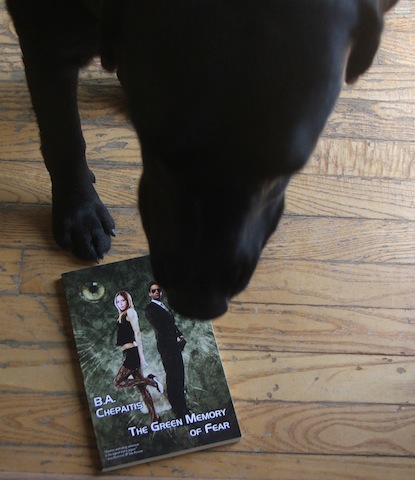 Luna taste tests a fine book
This week’s title is brought to you by poet Tess Lecuyer, and it grew out of a Facebook conversation I started, asking for opinions on a title for the next Jaguar Addams novel - A Strangled Cry of Fear, or Haunting Fear? Things got out of control pretty quickly. My Lithuanian ‘cousin’ Tomas Chepaitis threw a Walt Whitman quote at me - A Strangled Cry I heard while moving through the fear. Nora offered 5 Shades of Fear, a paranormal parody, and Trevor came back with Fear and Loathing in Space Vegas, which Tess read as Fear and Loathing of Space Vegans, and so on. Fear got flung wildly about, including Fear No Weevil, title for a Jaguar Addam’s baking book - with recipes like HeadCheese Pie: Find an enemy and take off his head. Marinate thoroughly with tequila for three days, etc. etc. That kind of thing is inevitable when writer’s get in a room, virtual or real. I remember when Tess and I were taking a poetry workshop in grad school, the class had an impromptu competition on who could write the best poems on certain male and female parts. We all won. The victory is in the play itself, which is as important as the main rule of cooking - PLAY WITH YOUR FOOD! What we’re really doing is the equivalent of a food fight, using words. We’re flinging funky sounds at each other and laughing at the mess we’re making, gleefully immersed in the particular tastes and textures that hit us in the face. Just as food is more than caloric count and nutritional value, words are more than definitions. They’re rich with with flavor profiles, and the sensuality of sound. For instance, my friend Sarah says she prefers Haunting Fear, based only on the sound. To her, the consonants in Strangled Cry give it an odd, clumsy cadence, while the softer sounds of Haunting Fear are more mysterious. And I may choose Strangled Cry because of the odd cadence, which creates a sound beyond the meaning.
 Ziggy would read the food bag, if he knew how Keep in mind that this whole formula is totally reversible. while you lick the words you write, you should also listen to what you cook. Words taste, but food talks. It's a language, and can be used to communicate a particular message. If my husband’s birthday meal is pizza, fried calamari, cheesecake and beer, I’m encouraging him to relax. Reminding him he doesn’t always have to be Mr. Responsible. If I want to tell him how much richness he’s brought to my life, prime rib and scallops wrapped in bacon would be the better choice. As for Fear No Weevil - Fling it around a little. Feel free to suggest recipes, real or surreal. I'll surely fling something back.
 Meantime, you can listen to Tess’s Villanelle For Lily , and try out her Fear No Weevil Scones. I’d be hard pressed to say which one tastes better.You can visit Jaguar on Facebook , where she’ll offer her own recipes for magic at your request. She doesn’t actually cook, but she’s great with a spell. Fear No Weevil Scones (also known as the Scones of Lost Space Vegans)4 cups flour½ cup sugar½ teasp salt1 1/2 Tablsp baking powder1/8 LB. butter (half a stick)Cut up cold butter & work it in with your hands until there are no lumps bigger than lentils. Those lumps are okay, and even encouraged.Make a well in the dry, add2 cups half & half 1 teaspoon vanilla1 cup “stuff” – currents, berries, chocolate chips, anything not too wet.
 Kind of toss together. Very dry dough – you may need to mush it together with your hands but DO NOT KNEAD. Add tiny trickles of milk if you absolutely have to.Still resisting the urge to knead the dough – perish the thought, okay? Pat it gently into a 1” high disk. Cut said disk into as many wedges as you think are necessary. Position wedges on baking sheet, brush with milk and sprinkle with turbanado sugar (sugar in the raw) because it is pretty. Bake 350F until gently brown on edges.
May 15, 2012
Creative Mothering
This blog is late, deliberately. I was going to post something for Mother’s Day, and then realized my mother’s ghost would not be pleased.
She didn’t believe in Mother’s Day. She said, with some bitterness, that it was a Hallmark Card conspiracy, one day to relieve the guilt of those who didn’t do anything for their mother’s the rest of the year.
Have I mentioned she was a bit of an outlier? She was. She wouldn’t let us buy her presents or cards, though she would accept gifts of work (Clean your room! Pick up your socks!). We were also allowed to gather flowers from the woods for her, or make cards for her. And thus, she taught us an early lesson in anti-consumerism, in the value of the creative over the value of the economy.
It’s a lesson that stuck with me, in far too many ways. For instance, I never understood why getting a job was more important than writing. My mother worried about that, as well she should, because it was all her fault, as I told her many times.
But on the positive side, I really enjoy it when my husband uses old white packing paper to wrap my presents, drawing strange glyphs on the outside to hint at what’s within. (See picture below) That way, I get both the fun of a present, and the giggles of the guessing game.
I also believe that finding your creative side - whether it’s in a garden, a kitchen, at a keyboard or an easel - is the best way to feed your spirit. The best way to avoid feeling a hole that insists on being filled with useless stuff, mindless consumerism of all kinds. In the play Rent, the characters say that peace isn’t the opposite of war. The opposite of war is creativity. The same is true, I think, of greed.
Now, all this is not to say that I don’t enjoy getting bought presents, even on Mother’s Day. As a December birthday girl, I take any presents I can get. And I’ll admit that when my son sent me the BEST truffles in the world (called ‘No Chewing allowed), I was pretty damn pleased.
But he also sent me the story he just wrote, which made me weep in the best possible way because his writing (Oh, God help me! I raised a writer!) is such a reflection of his careful and clear-seeing soul. And this story happened to be about food, and death, and love:
The best foods aren’t necessarily the ones that take the longest to prepare. She knows this in her brain. But in her heart and her stomach, she knows that “T-I-M-E” time is a very special ingredient. “There’s a flavor to time,” Mike used to say to her. “It’s a different flavor in nearly every dish it’s a part of, but it’s there, you can taste it. And if it’s not there, you know. You know like you would know if someone came through that door tomorrow and told you he was Michael James Wallace. Even if he looked like me and sounded like me and smelled like me - you would know it wasn’t me. It’s a personal flavor, time. It changes the DNA of a dish.”
If your son, who was raised in a variety of very difficult circumstances, can write something like that, you know he was born with something fine and shiny in his spirit. And you can eat your truffles in peace and joy.
So here’s to my son, the kid who became an adult capable of bringing me good tears and laughter. The kid who made it possible for me to get presents in May. And here’s to my mother, who taught me to pass on to my child the primacy of the creative. Right now, I feel truly blessed by both.
Here’s a recipe that may be the epitome of creative triumph. It was made with ground venison given to me as a gift by a hunter friend, and honestly, I had no idea what I was doing at the time, but it came out really good. So give it a try, but keep in mind that the measurements are inexact because I was making my own card and coloring outside the lines. Amend as you like because you know the rules. PLAY WITH YOUR FOOD!
If you’d like to find out more about my writing, you can check out my website, wildreads.com, or you can find me on Facebook.
VENISON TERRINE
About a pound of ground venison
Half a pint of good dark rum
Thinly sliced onion
1 mango
6 slices of bacon
About a quarter cup of pancetta, sauteed golden brown
Salt and pepper
A teaspoon of thyme
1 egg
Soak the venison in the dark rum overnight. (You can use all of it, or save some to make yourself a Dark and Stormy - dark rum and ginger beer, the official drink of my writer’s MFA cohort.)
In the morning,drain the excess liquid. Brown your pancetta over medium heat until golden brown and add it to the venison. Also add salt and pepper, the thyme and the egg. (If you want, you can add heat with tabasco, or cayenne pepper).
Mush it all together and press it into a firm, firm block, like a small brick. Slice the brick into three layers and separate them.
Using a mandolin or some really good knife skills, make some really thin onion slices - using about a quarter of the onion. Peel your mango and also make really thin slices of that - About 6 to 10.
Place a layer of onion slices and then a layer of mango slices over the first venison brick layer. Pack the second venison layer on top, making sure it holds together. Add another layer of mango and onion to the top of that layer. Put the third venison layer on top and pack it down. (You see? You’re building something here.)
Put a final layer of onion and mango on top of your brick. Working carefully, wrap the strips of bacon around the entire brick.
Put it in an oven (I used my small convection toaster oven) and cook it at 350 degrees for about an hour.
Let it come to room temperature and serve, with love and gratitude for all good gifts.
May 1, 2012
Waiting, Waiting, Waiting. . .
http://aliterarylunch.blogspot.com/2012/04/waiting-waiting-waiting.html
April 10, 2012
How to Be a Serial Writer
http://www.the-top-shelf.com/?p=3781
March 27, 2012
An Interview
Here's the full interview.
Speaking of Writing
March 17, 2012
Wearing of the Green
I’m thinking about the color green today, for lots of reasons. Things are growing in the yard, and I’m doing a virtual tour for The Green Memory of Fear, and, well, you all know what the holiday is today.
Many people have asked me why I used the color green for the Jaguar novel, The Green Memory of Fear. As I was writing, I had no conscious reason, but in thinking about it I realized how complex the color is: It’s used to represent jealousy, and can be a sickly thing. But it also reminds us of the constant renewal of life, the re-greening of the earth and our souls after the cold somnolence of winter. All of that is present in this novel, as it is in Jaguar’s eyes, and in the color she often wears, and she’s a woman who walks between death and life on a regular basis. The color must have given me a visceral feel of all that, and fallen out of my hands accordingly. Writers often work that way. Carpe Sententia! (Sieze the Thought)
But that’s just a part of the green in the day. As you all know, it’s St. Patrick’s Day, a holiday that always made this Lithuanian-Italian American a tad confused. The Irish Catholic school I went to celebrated it strongly, while the rest of us immigrants were just a little nervous about it. My mother remembers being tormented by Irish immigrants who’d been in town a generation longer, and she always told us to be careful on St. Patrick’s day, and made sure we slathered on the green for the date, and so on.
Because of that, it never was my favorite holiday. But when I grew up and started storytelling group called The Snickering Witches, St. Patrick’s was the most popular time for gigs.
Of course, that made sense, given the storytelling traditions of the Irish, who have given me one of my favorite sayings - “Never let the truth stand in the way of a good story!” Fortunately, the two other witches - Lale Davidson and Cindy Parrish - had Scotts and Irish in them, so they had lots to say, but I had to find my footing. I researched the holiday, seeking connection.
Ego Instituo is! Meaning, I found it, in my Roman ancestors.
If you all remember your Shakespeare, and how old Caesar was murdered on the Ides of March, this date has its roots in the ancient roman practice of ritually ‘killing’ the old king at the end of winter. Following that killing, the romans ritually raised up the new king right before the vernal equinox - on or about St. Patrick’s day, which they called Patrician’s day, a celebration of the mythic father and king.
It involved lots of wine and, um, other activities because it was a fertility rite, and there also was a parade, where they’d march through the streets carrying giant phallic things of various kinds. My ancestors weren’t big on subtlety.
There you have it. A Roman St. Patrick’s day, which continues, in not unsimilar fashion, to this day. My forebothers, connecting me across cultures and time to the wearing of the green.
In honor of that, I cooked some traditional food. I made a Mushroom risotto, and served it with seared shrimp and scallops. Also asparagus because it’s green and, well, kind of the right shape.
No matter what your heritage, go sniff the spring in the air, then come inside and cook something good.
I’m on a virtual tour for The Green Memory of Fear and you'll find my schedule at this link - http://www.pumpupyourbook.com/2012/02...
MUSHROOM RISOTTO
Risotto can seem tricky because you have to watch it as it cooks, but it’s worth the time, and really not as difficult as it’s made out to be. You can make it simpler than this - use just herbs or saffron and eliminate the mushroom part. Or you can add other components - spinach, other veggies, and so on. Because you know the rule - PLAY WITH YOUR FOOD!
1/2 onion, chopped fine
2 cups Arborio rice
6-7 cups stock (you can use chicken, veggie, mushroom, etc. For this, I happened to have duck stock, which was YUMMY)
About 2 cups dry white wine
About a cup of grated Reggiano Parmigiano cheese
Olive oil or Truffle Oil (NOTE: Truffle Oil will add depth to the flavor)
Salt and pepper
2 sprigs fresh rosemary
8 ounches cremini or baby bella mushrooms, sliced thin
1/4 cup dried porcini mushrooms
1 clove garlic, diced fine.
Okay. This is a process, so now we begin.
Get your stuff all set up - chop your onions, dice your garlic slice your mushrooms, grate your cheese, and get it arranged where it’s handy.
Put your stock on the stove to heat it. Crush the dried mushrooms in your hand and toss it right in. Also toss in the garlic. Let it come to a boil, then turn it off. The dried mushrooms will rehydrate and add their flavor to the stock.
Heat a large saucepan on medium high and coat generously with olive or truffle oil. Throw in the onions and season with salt and pepper. Let them get soft and sweet, shaking the pot or stirring as you prefer, for about 5 minutes.
Add the rice and keep stirring. The rice will go kind of transparent. Some may stick, which is okay, but don’t burn it for pity’s sake.
Add as much wine as it takes to just cover the rice and keep cooking, stirring, and so on while the rice drinks your wine.
When it’s happy (you’ll see it smiling and it may start singing Danny Boy, but that’s okay), add enough stock to cover it, and throw in your rosemary sprigs. Stir, season, taste. Turn the heat down to medium!
Put a frying pan on another burner and get it hot. Add just a little oil, then throw in the mushrooms. They may yell about it, but pay them no mind. Seasons them, shake them up, let them render out their liquid and get nicely browned but not all dried out.
PAY ATTENTION TO YOUR RICE at the same time, and when it’s absorbed this round of stock, add a few more cups to cover, and again let it absorb.
When your mushrooms are nicely done and subdued, toss them in with the rice.
When the rice has absorbed its last round of stock, add another - the final round, continuing to stir. You may mutter whatever spells you have at hand over it as you work.
When that’s absorbed, taste it. The rice should be soft and firm - cooked, but not mushy. If it’s too hard, add more stock.
When it’s cooked to your liking, take it off the heat, add the parm and finish it with truffle oil if you have it. Then, get a wooden spoon and BEAT this in with great vigor - like the Roman army going after some Huns. This is called mantecare, and it makes all risotto cooperate itself into a light and creamy final texture.
Serve it, as I did, with seared shrimp and scallops and asparagus, or with a perfectly cooked filet mignon, or some good salmon, as you choose. Probably, though, corned been won’t work with this one.

February 8, 2012
PAIRINGS, PEEVISH AND PERFECT
I’m going to confess that there’s certain sitcom paradigms I can’t watch, no matter how funny they are. For instance, The Three Stooges are a riot, but they make me go ‘ouch.‘ Too many mirror neurons, I guess - those pesky neural impulses that make you feel what you see in others. I also can’t watch the sitcoms where an overweight, arrogant, insensitive and selfish man is married to an intelligent, good-looking woman who puts up with him.
I know, I know. The Honeymooners was brilliant, and Family Man is funny, but they both make me want to shout at the TV, “Walk away! Just walk away!” I don’t think that’s a mirror neuron problem. I think I just know too many real life women who live that way, and I project my frustration onto the fictional versions.
Of course, if I subscribed to conspiracy theories, I’d say those shows were written by people who want to encourage such behavior in women. In just the same way, that old frog prince story, which I’ve mentioned before, does. No matter how slimy that frog is, if you kiss him, you’ll get a prince, it says.
No, you won’t. I’ll say it again. In the original she did NOT kiss the frog. He was disgusting, and she slammed him into a wall. Then he turned into a prince. Then she kissed him. Okay? Okay? You get it?
Well, I feel better now. So onto the main point, which is, there’s nothing wrong with odd pairings, but they should be to your taste. I happen to like peanut butter and bananas. My husband leaves the room when I eat it. He enjoys chicken gizzards and hearts. I’d rather chew off my left arm.
And there are some pairings which, at first, seem suspiciously wrong, and turn out to be exactly right. Jaguar and Alex, one of my favorite fictional couples, have their fights now and then, but they’re right for each other. And I like The Simpsons because even though Homer is who he is, he goes well with that blue-haired lady, and loves her. Both couples know there’s a difference between loving tolerance of individuality, a loving expression of understanding for it, and putting up with crap.
And how do you know the difference? Here’s a story for you. A kind of love story.
When I started dating my husband I was also dating another man, living the single life. I happened to go see Titanic with both men, at different times of course. With the first man, as we watched he took my hand and got teary eyed as he spoke about how beautiful it was that the old couple was going down together. I agreed. It was beautiful.
But when I went with the man who would become my husband, as he watched he got agitated and said, “They could have tried to rig up something that floats,” and he went on to explain the various ways he would have made sure to get us both off the boat alive.
This isn’t my first marriage, so I understood that long term relationships all face their own Titanic at one point or another. And I understood that even though my pairing with Steve seemed odd, since he races cars, likes dogs, and doesn’t dance, he was a man of great integrity who would always place my well-being very high on his list.
After more than a decade with him, I can honestly say that I even think lovingly of the things about him that drive me crazy, because they’re all part and parcel of that integrity and capacity for love. No higher praise hath woman or wife.
I suppose it’s possible Alice felt that way about Ralph, too. Maybe they were bananas and peanut butter together. Or gizzards and rice. If so, I leave them to it. And I leave it to you to find your own particular recipe for lasting love.
While you do, you might want to try my version of Mole`, appropriate because it’s a loving relationship of unexpected flavors, and one you have to pay attention to while you concoct it. Throughout this recipe you should sniff, taste, adjust. Add your own touch to it. Make it your own. Use it in tamales. Because you know the rule - PLAY WITH YOUR FOOD!
You can keep up with Jaguar and Alex’s love story at wildside press And you can visit me at my website, wildreads.com
Ole` Mole`
NOTE: If you don’t have these chiles available, I’d just go with dried anchos, which are mild. If you like hotter, then go for hotter chiles.
1dried mulato chili
1 dried ancho chili
1 dried pasilla chili
1/2 cup ground almonds
1 tablespoon cinnamon
1 tablespoon cumin
1 tablespoon fennel seeds
1 tablespoon chili powder
2 cloves chopped garlic
1 onion, chopped
1/2 cup cocoa powder
dark chocolate to add to your taste
1 fresh sweet green pepper, chopped
2 cups chopped tomatillos
1 cup pureed tomato, fresh or canned
salt and pepper
olive oil
2 pounds boneless chicken breasts and/or thighs cut into chunks. (NOTE: If you prefer, you can use chicken pieces with the bones in, or a whole chicken cut up, but that will change the cooking time)
First, gut your dried chiles, taking out the seeds, ripping off the stem and so on. Put them into a small pot with about a cup of water, bring them to a boil, then turn the water off and let them soak until they get soft. If they complain, just ignore them. They’re fine where they are.
Then, take everything from almonds through chili powder and put it in a bowl together. Put an iron skillet on high heat and get it hot. Toss the stuff in the bowl into the hot skillet and move it around for about a minute - no more - then turn the heat off and keep moving it around a little. This is called a dry fry, and while you do it, you should breathe in deeply because it will smell incredibly good.
Pour the spices back into a bowl. Now is a good time to check your soaking chiles, and if they’re soft, puree them with the water they’re in, and the tomatillos.
Season your chicken with salt and pepper, and take some of the spices from the bowl and sprinkle it on the chicken as well. Put about a tablespoon of olive oil in the skillet you used for the dry fry, get it back onto high heat and when the oil is hot, add the chicken a little at a time, letting it get nicely golden outside.
Turn the heat down once the meat is seared to your liking, and let it cook on medium for about 15 minutes if you’re using the boneless meat. (It’ll go longer for the bone in.) Add the peppers and onions and garlic and and let it go about ten minutes more on medium to low.
Then, take everything out of the skillet, leaving the juices behind. Put the spices back in, pour in the pureed chili and tomatillo mixture, with the tomato puree. Keep the heat on a medium-low and let it simmer for a while. Breathe in deeply. Say, “Wowie that smells good!”
This is the time when I taste, and ask myself if I want more of anything. Often I toss in a cinnamon stick, add more cumin, and I season with salt and pepper. So taste. Sniff. Adjust.
When you’re happy with it, add your cocoa. Taste again. Adjust as you like. Add a chunk or two of dark dark chocolate ( the 70% cocoa kind) if you want. Taste and adjust some more. If you like, toss in some tabasco. It won’t hurt.
Then put the chicken back in the skillet and let it simmer for about 15-20 minutes on low until all the flavors are happily married, learning to do what’s best for each other.
Because that’s what love is all about! Barbara Chepaitis


