Paul O'Connor's Blog, page 11
December 23, 2020
"Anarchist punks, in particular, were instrumental in organizing the first groups to oppose the far..."
- Music Subculture versus Class Revolutionaries: Czech Antifascism in the Postsocialist Era, Ondřej Daniel (2020).


December 11, 2020
Re-entry Culture Shock: Pedestrian Crossings Revisited.Recently...
Re-entry Culture Shock: Pedestrian Crossings Revisited.
Recently I returned to the UK to take up a new post. It is my first time living back in England in twenty years. In essence things are enormously familiar. I returned to my home country, my home county and the area in which I grew up. I know my way around, I have strong memories of many of the places I pass by and visit. I am also a fluent not only in the language, but also the vernacular and local idioms. Yet I continue to experience various elements of culture shock. What is more rightly referred to as re-entry shock when one returns to their home setting after years abroad.
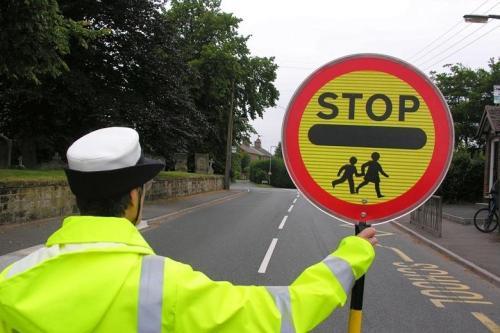
Yesterday morning I had a distinct moment of this shock when my car was stopped by a Lollipop Lady. Essentially a British Crossing Guard. Children crossed from one side of the road to another while she stood in the middle of the road with her Lollipop sign up commanding the traffic to stop.
I was bemused by the sight which seemed entirely foreign. It was a quaint situation and one I had not witnessed in at least twenty years. It seemed at odds with the road rules I had become familiar with and normalised to in Hong Kong. Yet, one of my earliest posts on this blog tackled the issue of a Zebra crossing in Hong Kong’s Lai Tak Tsuen estate. Like the Lollipop crossing a Zebra crossing relies on drivers to defer to the needs of pedestrians, and not the traffic system of lights. I noted how it was uncommon for Hong Kong drivers to respect the rules of the Zebra crossing, seldom stopping if people were waiting to cross.
The civic duty of the pedestrian crossing has been proposed by Ghassan Hage as a social gift. This had all become quite foreign to me and I have spent the last day dwelling on it. This was underlined this morning once more when I failed to stop at a Zebra crossing. I only realised afterwards that three teenage girls were waiting for the traffic to stop and I simply saw an empty crossing and proceeded. I had once been so smug about my attention to these crossings in Hong Kong, yet I appear to have changed. Would I now still stop at the Lai Tak Tsuen crossing?
What was perhaps the most odd thing about my encounter with the Lollipop Lady was the contradiction it created in my mind. Firstly I was struck by the unusual scenario, then I was surprised to recall my own vivid memories of being a child walking to school and chatting daily to the Lollipop Man who provided safe passage to my primary school. In short, something I had grown up with now seemed out of place. The gendered term also struck me as peculiar, ‘Lollipop Lady’ seemed at once perfectly correct and yet antiquated.
This rather banal episode is just one of a series of re-entry shocks I have had. Naively I thought I was prepared for them. I had seen it happen to many friends over the years. I reminded myself in advance that this was no longer the country I left shortly after the turn of the century. I am now able to report that this reassurance was rather poor preparation. There is a good deal of research that makes reference to ‘re-entry shock’ and ‘reverse culture shock’. These works refer to students returning home after a year abroad, expatriates returning ‘home’ after years abroad, and ‘Third Culture Kids’ settling in the country of their parent’s birth. In one article the term was even used to refer to IT workers re-entering the job market after the completion of a project.
The re-entry shock is well documented from novels to Facebook groups that offer support. But at its heart the issue is about hybridity and the tension between the exotic and the banal. People are more apt to prepare for a journey to somewhere new and align themselves for novelty. Yet, they don’t expect an adventure on a return to familiarity. Return deceives in its promise of the familiar and the consistent.
What my brief foray into the literature on ‘re-entry shock’ highlights is the validity of Bauman’s Liquid Modernity in which re-entry is just as much an issue for the career expatriate as it is for the temporary contract worker. It is relevant to all of us navigating a changing society with new rules about recycling, health and safety, bureaucratic policies, gender, and social distancing. In some measures my shock at seeing the Lollipop lady is congruent with a changing Britain. I learned there were many transformations for Lollipop men and women in recent years. One report about their new role as lookouts for domestic abuse, and another report about their dwindling numbers. Modern Britain and its austerity policies have meant local councils have cut funding to Lollipop workers.
So much like the student returning from a year abroad, and the workers adapting to being furloughed, we are all in a constant state of re-entry.
November 29, 2020
Utah Monolith Pilgrimage Season Ends Abruptly…In another...
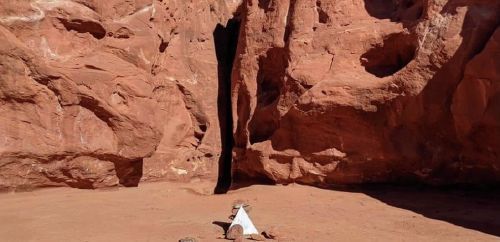
Utah Monolith Pilgrimage Season Ends Abruptly…
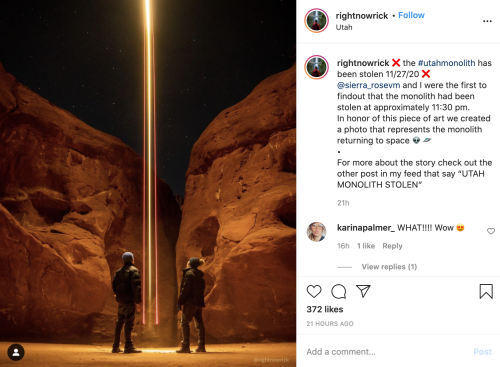
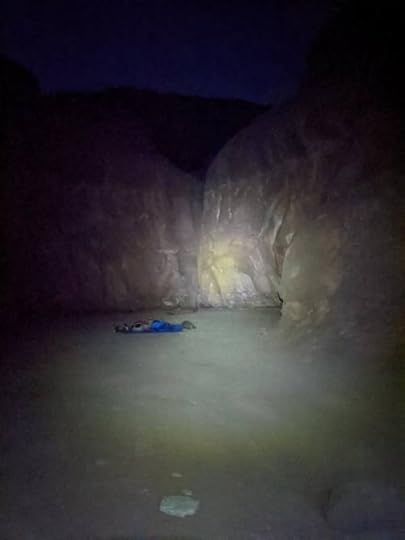
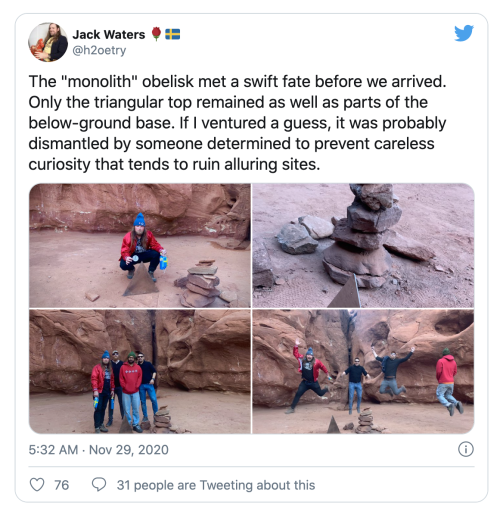
In another twist on the Utah Monolith pilgrimage, it appears that it has been removed. The account of Riccardo Marino posted on Instagram who had made the journey to the site reveals that it was taken late in Saturday night. Reducing any further ideas of a mystical origin Riccardo’s video shows the message ‘By Bitch’ scrawled in the sand at the site.
Social media continues to follow this story eagerly speculating on who took the monolith, and where it might appear next.
From a pilgrimage studies perspective the removal of the monolith adds to the emerging folklore surrounding it. A pilgrimage site is typified in part by the necessity to journey to it. This journey should not be too east, it should include effort in order to make the pilgrimage both worthwhile and efficacious. Similarly many pilgrimage must be performed within a set timeframe. Unbeknownst to may of those seeking to see the Utah Monolith, that timeframe was short and perhaps artificially constrained.
For those looking for a mystical or extraterrestrial sign in this story, it appears that there is only a comically absurd one. Sadly there is little mystery and perhaps this was why everyone was so interested in the monolith. Rather than being a 2001 monolith pilgrimage it is now much more a Four Seasons Total Landscaping Monolith pilgrimage.
November 28, 2020
Pilgrimage to the Utah Monolith What a time to be alive. The...

Pilgrimage to the Utah Monolith
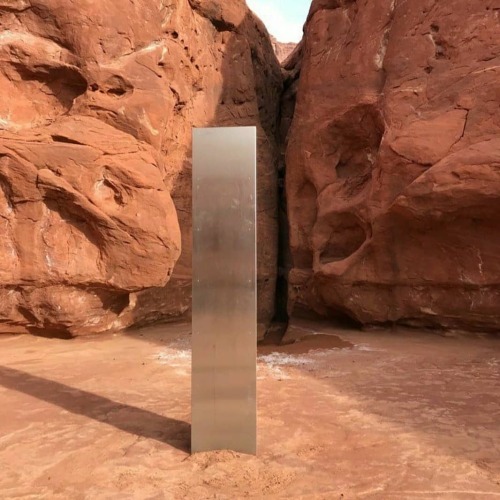
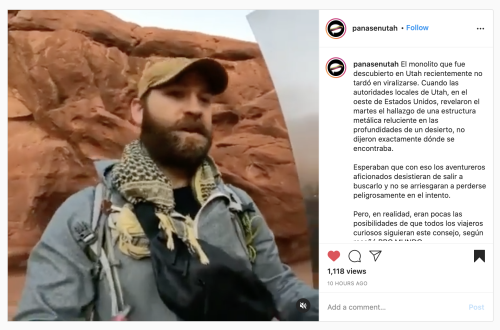
What a time to be alive. The discovery of a metal monolith in the Utah desert on November 18th quickly went viral as a new mystery. The now increasingly fabled story of wildlife workers from the Utah Department of Public Safety spying the monolith from a helicopter resulted in the sharing of some remarkable images. Keen to not attract visitors who might find the hike to the remote spot precarious, the location was kept secret.
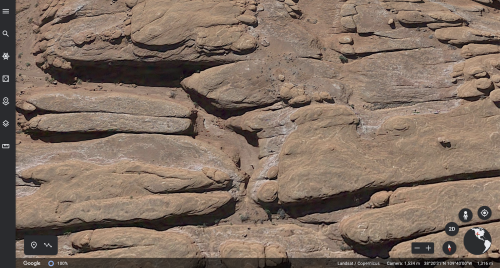
But in the digital age little can be kept secret. Time Slaine, a reddit sleuth, quickly tracked down the location by following the clues of the helicopter flight path and the rock formations pinpointing it on Google Earth. As soon as this information was available it took less than 48 hours for people to arrive at the location and to explore for themselves just what this object might be.
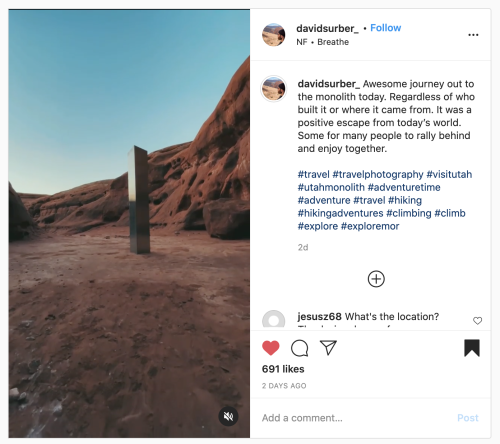
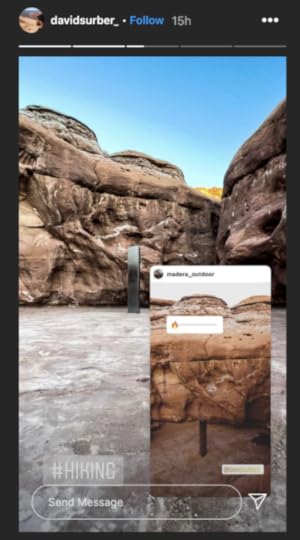
David Surber has been the most successful in physically finding the monolith using the Google Earth data and posting videos and images on his Instagram. We learn that the monolith is hollow and is not magnetic. It is constructed of three pieces and is riveted together. This information seems to confirm that the object is a human construction and is not some alien mystical sign.
Part of the mystique surrounding the monolith is connected to Stanley Kubrick’s 2001: A Space Odyssey. The desert scenery of the Utah monolith appears to be chosen to look alike the iconic scene from the opening of the film where primates discover the monolith and evolve by using tools. It goes without saying that the monolith has become a potent pop-culture symbol. It is has been revisited in film, artwork, and extensively in memes. In one sense we have been performing a pilgrimage to Kubrick’s (and Arthur C Clarke’s) monolith for decades. It comes as no surprise therefore that the Utah monolith would become a site of secular, pop-culture, and digital pilgrimage.

This title of pilgrim is precisely how David Surber and others are being described. The Guardian reports that the Utah DPS decided to keep the location secret because of potential pilgrims.
“They did not share its coordinates, hoping to put people off trying to make their own pilgrimages in case they got lost in the remote area.”
Modern pilgrimages are fascinating because we are flooded with accessible information. Almost no part of the world in a mystery. With dedication and an internet connection you can perform a virtual hajj, or work out the locations of your favourite films. Modern pilgrimage is uniquely mediated but also reveals where our myths and passions lie.
For more on pilgrimage from my blog click here.
November 21, 2020
My book ‘Skateboarding and Religion’ is now released in...

My book ‘Skateboarding and Religion’ is now released in paperback format. You can get hold of it via the Palgrave site (they occasionally have great deals so you can pick it up at a reduced price), on Amazon, and Book Depository.
I am really pleased that the images are all still in colour. Its a good quality print and I am super proud of it.
November 20, 2020
"Someone experiencing personal uncertainty might find herself wondering, “Who am I,..."
-
Existential uncertainty and religion, Holly R.Engstrom KristinLaurin (2020)
I share this quote not because I think it is edifying and speaks to a truth. No, not at all. I share because it made me laugh. Despite skateboarding being in the olympics, despite both adult men and women having careers that span decades, despite progressive politics in skateboarding dealing with issues of race, sexuality, suicide, gender identity, substance abuse, and disability… we still get stuff like this.
Skateboarding as a handy trope to describe a phase.

November 14, 2020
Tom Knox - Hidden in Plain SightThe new Atlantic Drift part from...
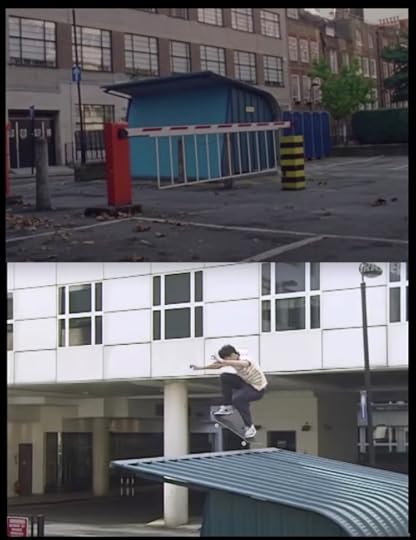
Tom Knox - Hidden in Plain Sight
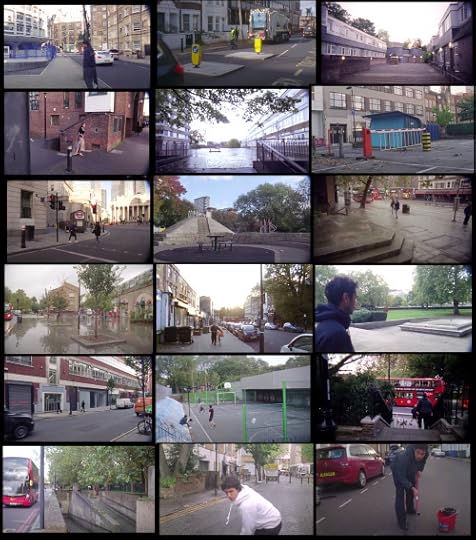
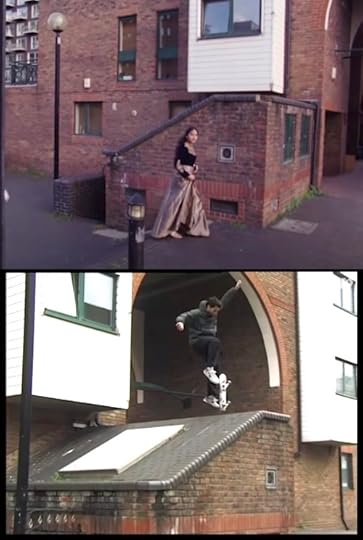
The new Atlantic Drift part from Tom Knox is being widely celebrated. There is a lot in the video that invites scrutiny and a closer look. My initial response was that it was cerebral, like last year’s Verso, but also wisely understated. Tom Knox is lauded for his quick technical lines at spots that many would pass by without a second thought. The video plays on this theme deliberately showing multiple locations in their banal everyday setting. We see these spots as they are viewed by pedestrians, passersby. On a couple of occasions we see Tom gazing at them, perhaps thinking about what he plans to do there.
After each of these shots of the spots in their unskated state we then flick to a typically skate angle. The camera is close to the ground, or tilted up to a rooftop or wall. Then we see how Tom has incorporated the spot into a line.
This plays on the notion of ‘skater’s eye’, a term first used in published work in an early issue of Thrasher. It appears in a short work of fiction where a dead skater’s eyes are donated to a non-skateboarding girl. She begins to see the world in new ways, becoming distracted by painted curbs and swimming pools. The idea of the ‘skater’s eye’ plays on the notion, that skateboarders see the world differently. Alike shamans, they are able to journey to an alternative realm and imagine possibilities unintended in the original design and construction of urban space. As Sean Wilsey states, ‘skateboarding is bringing emotion to emotionless terrain.’ This is precisely what Tom Knox does, he brings emotion, magic, and love to unloved places. The catalogue of shots I have compiled from the video are mundane London locations. Far from the Californian mystique of a skate utopia. It is like Tom Knox is doing missionary work, faithfully showing that London is skateable. He ardently skates his home surroundings, teaching us, like a prophet finding a spring of water in the desert.

The video also operates as a book end to Tom’s other parts filmed by Jacob Harris. He is seen mopping a mirror just as he was shown mopping the street in the Isle video Vase. Again, subtly, in his Vase part the location of his ender is shown void of skateboarding at the very start, before we even see him with the mop. The new video also makes a nod to the first Atlantic Drift episode where Tom is introduced posing in front of some multicoloured circular neon lights. The same lights are shown again but this time crediting Jacob Harris. So, the part becomes a homage to all the previous collaborations, citing them, paying respects, just as respect is paid to Ben Raemers, and Tom’s siblings. This is all neatly brought together in the video ‘Out There: Tom Knox’ from earlier this year. Truly, it is a companion piece.
So, it is a remarkable and reassuring video. A triumph and validation. If skateboarding is overcoming adversity, expressing yourself, and testing your creativity, this video shows just that. So much potential hidden in plain sight.
November 10, 2020
Lawn Surfing: Why Autumn’s Obsession with Rolling on Turf?It is...
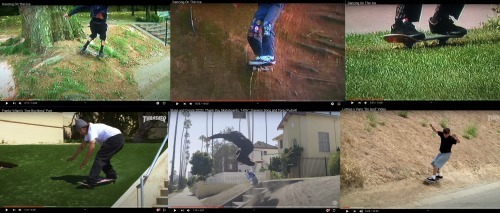
Lawn Surfing: Why Autumn’s Obsession with Rolling on Turf?
It is perhaps not too unusual to see the occasional clip of a skateboarder rolling on grass or dirt. Typically after landing a trick they might roll out onto concrete and then some grass. Yet, over the last few weeks the number of clips in which grassland has actually become the focus of the trick seems to have swelled. Indeed, Autumn’s video offerings see a remarkable inclusion in the number of clips where lawn is the chosen terrain. Why?
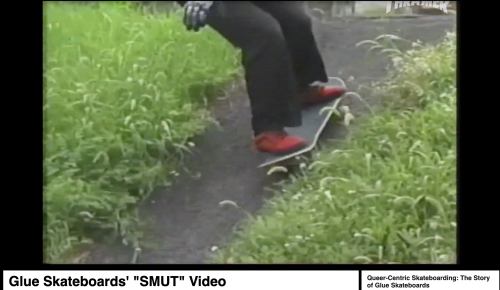
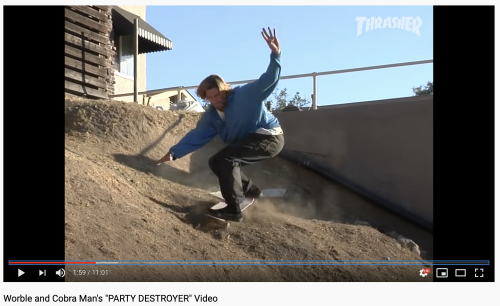
Firstly let’s look at the evidence. I have screen capped a collection of videos. In each case the grass either provides the landing or the roll in for a trick. The most obvious culprit is the October FA offering ‘Dancing on Thin Ice’ where we see three solid clips in which lawn is used counterintuitively. Aidan Mackey’s manual to lawn manual is a prime example of my topic. So too is Kevin Rodrigues’s tree root nose grind. Then in Franky Villani’s ‘One Big Mess’ part we see a feeble grind to a lawn landing. Also check Daewon’s dirt lawn roll up, kickflip, lawn landing. I also spotted other lawn rolls in the Glue skateboards video, and an unnecessary dirt carve in the Lottie’s video.
First off, the lawn trick is far from new. The Worble and their rewilding ethic have made the use of organic material feature in their videos a staple. Rocks, trees, and dirt have all appeared as novelty obstacles in their videos and others. Even special skits about rain, and all terrain skateboarding are nothing new. Yet, this nestling of clips, at this particular time, from the videos released by these brands has set me pondering.
Possibly Autumn’s rise in lawn clips can be attributed to Covid-19 and the necessity to be more creative with terrain. Lack of travel may have encouraged people to see spots and home grown possibilities anew. There was certainly no lawn clips in the Berrics recent Shanghai based video ‘Diplomatic Immunity’. The Covid factor, should not be dismissed as one facet of Autumn lawn clip. Another contributing factor, slowly gathering momentum over the years is the perfection of skateparks. The love hate relationship with the often perfect, too often simply pre-crafted, and dare I say sterile, terrain of skateparks might be making skateboarders even more ‘all-terrain.’ Brian Glenney and I wrote a paper on the hybrid nature of skateparks. We argued that whatever skateboarders skate in the wild of the city, becomes incorporated into the skatepark. Take the Pole Jam as an example. Skateparks aren’t static, they develop with skateboarding preferences. Might we therefore see at some point in the future skateparks with skatestoppers, boulders, and in light of recent findings, a lawn?
Yet, more sensibly the Autumn lawn clip is probably just an abberation. It will likely be less common and obvious in the following months. So enjoy this harvest of clips and be watchful of future additions.
"A society’s political structure is only the way in which its various component segments have..."
- Durkheim E. ‘The Rules of Sociological Method’