Rajesh Kamath's Blog, page 6
December 24, 2019
A note on fasting
Many people start their fast by having dinner the night before as their last meal and having their next meal as breakfast on the day following Narsimha Jayanthi (approx 36 hours). The options are dry fasts (no food and water), regular fasts (no food), juice fasts (only fruit or vegetable juices), fruit fasts (only food), raw veggie fasts (only fruit and raw veggies, no cooked food), one meal fasts (one meal through the day mostly in the evening), no grain and pulses fast, etc. The types have bee...


December 6, 2019
The Royal Meets A Naga Master
This incident happened during the Kumbh Mela of 2019 before the one related in the blog post, A Royal Revelation. To introduce our star cast, I will copy over the relevant background from that story here.
Mohanji had a royal visitor at the Kumbh Mela 2019 – two brothers from the Samoothiri family. The Samoothiris (anglicised name: Zamorins) were the erstwhile ruling family of Kozhikode (anglicised name: Calicut) – legendary and powerful rulers that kept the foreign invaders (Portuguese, Dutch...
December 2, 2019
A Tale of Two Boatmen
I wanted to share a delightful but lesser known story from the Rāmāyana – a famous epic from the Hindu scriptural treasures. Surprisingly, I had never heard of it before. I once said the last sentence to Mohanji and he replied, “There are many things you have not heard in life.” So true! 
June 8, 2019
Sacrifice. Why? Why?
This is a follow up to the article Sacrifice Why? published in the May issue of the online magazine, The Awakening Times. For those who haven’t read the article, I have copied the opening from the first article to outline the rationale behind penning this series of articles.
I chance upon a folded newspaper supplement in Mohanji’s house in Dharamshala. The image of an imposing soldier in blue dressed in full military gear catches my eye. I pick it up and hear Mohanji behind me, “Yes. Read the article. See the kind of personal stoic courage that can move mountains. Think of what a disciple can do with that inner power.” These words hook me and I devour the article quickly. It’s about one of the most famous Sikh generals, Banda Singh Bahadur and, particularly, his sordid and torturous end and how he faced it with stoicism and serenity (more on this later). I am left speechless. I read it a few more times and was in complete awe which, at the same time, was tinged with guilt.
I am amazed by stories of people – revolutionaries, spies, soldiers and, most importantly, saints and Masters – who have endured unspeakable pain and torture and yet stuck steadfastly to their higher purpose without yielding an inch from those lofty heights. I feel guilty of neither being endowed with that enduring faculty nor a purpose so self-consuming that even excruciating pain or torture cannot weaken the indomitable resolve to achieve and hold on to it. Masters take this concept to a completely different level. Unlike the rest who suffer from enemies, a Master is reviled and attacked by the very people that he helps. They go through the agony to show the world, through their sacrifice, an example of loving against all odds.
The story of Jesus immediately comes to mind. His life is described succinctly in Douglas Adams’ Hitchhiker’s Guide to the Universe, “Nearly two thousand years ago, one man had been nailed to a tree for saying how great it would be to be nice to people for a change.” Though he only wished for and worked to give the best to the society, his reward was humiliation, torture and the intense physical suffering of crucifixion. In response, his prayer for his tormentors was, “Forgive them for they know not what they are doing!”
And he knew the power at his disposal for he said, “Do you think that I cannot appeal to my Father, and he will at once send me more than twelve legions of angels?” Twelve legions of angels could kick every Roman and Philistine ass a million times over and still not break a sweat. Then why go through it all? In his words, “Father, if You are willing, take this cup from me. But how then should the scriptures be fulfilled, that it must be so? Not my will, but Yours be done.” He went through the ordeal to fulfil the purpose of his incarnation as ordained by the will of His Father.
Like Jesus, I’d like to share some of these stories of extreme courage and strength of character against all odds that have fascinated me over the years
In part deux of this series, we will look at the story of Guru Arjan Dev, the fifth of the ten human Gurus of Sikhism.
[image error]
Guru Arjan Dev was born in the mid 1500s as the son of the fourth Guru, Guru Ram Das, and Mata Bhani, the daughter of the third Guru, Guru Amar Das. As a child, one day he found his way to the bed of his grandfather, Guru Amar Das, who was then resting. His mother ran to fetch the child before he could disturb the Guru but he had already awakened Guru Amar Das. Guru Amar Das asked the mother to allow the child to come to him. He revealed the divine nature of his grandson’s incarnation by exclaiming, “Yeh mera dohita bani ka bohita howega.” (This grandson shall be a ship to take mankind across the ocean of the world)
Even though he was the youngest, Guru Ram Das chose Guru Arjan Dev as his successor. Guru Arjan Dev became the Guru at the age of eighteen and led Sikhism for a quarter of a century. He continued the infrastructure projects of his father, Guru Ram Das expanding the town built by him, financed by donations and constructed through voluntary effort. The city that emerged from this town is now known as Amritsar, and is the holiest place in Sikhism. He is credited with completing many other infrastructure projects, such as water reservoirs called Santokhsar (lake of peace) and Gangsar (lake of Ganga) as well as founding the towns of Tarn Taran, Kartarpur and Hargobindpur.
[image error]
The Guru constructed the Harmandar Sahib (literally abode of God) also popularly known as the Golden Temple, the preeminent pilgrimage site of Sikhism. In true spirit of religious equality, Guru Arjan Dev invited Pir Mian Mir, a Muslim saint from Lahore to lay the cornerstone of the foundation of the Harmandar. The head mason moved the brick to place it in order. Whereupon the Guru prophesied that since the brick was moved by the mason, the foundation of the temple would be laid again in the coming times. The temple was repeatedly rebuilt by the Sikhs after it became a target of persecution and was destroyed several times by the Muslim invaders from Afghanistan and the Mughal Empire.
The temple was open from all four sides to denote that God existed in all four directions and that all had equal access to the temple.
Guru Arjan decreed, “My faith (Sikhism) is for the people of all castes and all creeds from whichever direction they come and to whichever direction they bow.”
Several Sikhs remonstrated to the Guru that Harmandar should be the tallest building in the neighborhood. Guru Arjan Dev suggested that the temple should be at a level lower than the city surroundings to emphasize humility and the need to efface one’s ego before entering the premises to meet the Guru.
The Guru explained, “It should be the lowest because what is humble, shall be exalted. The more a tree is covered with fruit, the more its branches descend to the earth.”
[image error]
He composed a voluminous amount of Sikh scripture. He compiled the first official edition of the Sikh scripture called the Adi Granth, which later expanded into the Shri Guru Granth Sahib – the principal scripture of Sikhism which is itself regarded by Sikhs as the final, sovereign, and eternal living guru, as the embodiment of the ten human Sikh Gurus.. He was a prolific poet who contributed more than two thousand hymns to the Shri Guru Granth Sahib (which is a third of the Shri Guru Granth Sahib) including the thirty five page long Sukhmani Sahib Bani (Psalm of Peace) which is a theological statement of the major tenets of Sikhism expressed in a devotional poetic form.
He installed the Adi Granth in the Harmandar Sahib, The Mughal emperor, Akbar, was informed of the development with the allegation that it contained teachings hostile to Islam. He ordered a copy be brought to him. Guru Arjan sent him a copy on a plate, with the following message that was later added to the Shri Guru Granth Sahib,
“In this thali (dish) you will find three things – truth, peace and contemplation. In this too the nectar of nama (repetition of the Lord’s name) which is the support of all humanity.”
He was also an able administrator who strengthened and institutionalized systems founded by his father (Guru Ram Das) – the Masands who were representatives (spiritual and administrative) of the Guru in far flung places along with the principle of Dasvand, donating a tenth of one’s income for the Guru’s langar (common kitchen) and for charity. Attracted by his spiritual magnetism, thousands from all religions and walks of life flocked to him and the Sikh population grew manifold and spread to all parts of Punjab.
The Mughal emperor Akbar had high regard for the Sikh Gurus and had even partaken of the langar (common kitchen) seated as a commoner on the floor with the rest of the community. However his son, Jahangir, was not so equitable. There were several possible causes that made him view the Sikh community and its Guru as an enemy. With Sikhism becoming a popular and majority religion in Punjab, the Mughal rulers in Delhi were perturbed by the Sikhs becoming formidable as a social group and the active involvement of the Sikh Gurus in political conflicts. The orthodox Muslim clergy who, some say, helped Jahangir in his ascension to the throne were angered by Muslim converts. Jahangir had an ongoing dynasty dispute with his son Khusrau who was liberal like his grandfather and was willed by Akbar to succeed him. While passing through Punjab, Khusrau went to meet Arjan Dev and took his blessings. This outraged the emperor who believed that the Sikhs were assisting in his son’s rebellion.
[image error]
Jahangir ordered the Sikh Guru to be arrested. Guru Arjan Dev was imprisoned in the Lahore fort. Jahangir is said to have demanded a fine of two hundred thousand rupees and also demanded that Guru Arjan Dev erase the hymns in the Adi Granth that he found offensive. The Guru refused both the demands and, consequently, Jahangir ordered that the Guru be tortured and executed. Pir Mian Mir approached the Guru and offered to intercede on his behalf. The Guru refused his help holding that everything was happening by God’s will and he accepted the Lord’s hukam (command or divine order) without any complaints.
The gentle Guru endured unrelenting torture for five days. On the first day, he was not given anything to eat or drink and was kept awake all night. The second day he was seated in a copper cauldron full of water that was boiled by fire. The third day, he was seated in boiling water while red hot sand was poured on his body from above. When Pir Mian Mir went to see him, he was aghast at the state of the Guru. He cried out, “O Master! I cannot bear to see these horrors inflicted on you. If you permit me, I would demolish this tyrant rule.”
[image error]
The Guru smiled and asked Mian Mir to look towards the skies. It is said that Mian Mir saw angels begging the Guru’s permission to destroy the wicked and the proud.
The venerable Guru said, “All is happening in accordance with the will of the Lord. Men who stand for Truth have to suffer often. Their sufferings give strength to the cause of Truth. Go, brother. Pray for me. Pray for the success of my cause. Pray for victory to truth.”
Mian Mir asked, “Why are you enduring suffering at the hands of these vile sinners when I possess ecclesiastic powers?”
The Guru replied, “I bear all this torture to set an example to the teachers of the true Name, that they may not lose patience or rail against God in affliction. The true test of faith is in the hour of misery. Without examples to guide them, ordinary people’s minds would tremble in the midst of suffering.” Upon hearing this, Mian Mir departed, commending the Guru’s fortitude and singing his praises.
[image error]
On the fourth day, the Guru was seated on a plate of iron that was heated from below until it became red hot. Then, scalding hot sand was poured over his body. On the fifth day, the Guru was meant to be suffocated by sewing him up in fresh cowhide. The Guru requested for a bath in the river Ravi which flowed along the walls of the city of Lahore. The request was granted. While leaving for his bath, the Guru saw his disciples outside the fort. He forbade them from taking any action by saying, “Such is the Will of my God. I submit to the Divine Will. Move not. Stand calm against all woes.” It is said that upon entering the river, he stood in the waters, took a dip and merged with it. Thousands watched him enter the river never to be seen again.
Throughout the torture, the Guru did not display any emotions. No reactions – not even a cry or a sigh. He continued with simran (chanting the holy name) of Waheguru (wonderful Lord). His mind was fixed on the Lord and he stayed absorbed within. Even though he could barely walk to the river, he sang the song which has been immortalized in the Shri Guru Granth Sahib.
tera kiya mitha lage. har naam padharath nanak mange
Your actions seem so sweet to me. Nanak begs for the treasure of the Lord’s name
har ka naam hridaya nit dhyayi. sangi sathi sagal tarAni.
Meditate continually on the Lord’s name within your heart. Thus you shall save all your companions and associates.
gur mere sang sadaa hai naale. simar simar tis sadaa samhaale.
My Guru is always with me, near at hand. Meditating, meditating in remembrance on Him, I cherish Him forever.
Yesterday (7th June 2019) was the martyrdom day of Guru Arjan Dev (as per the Sikh calendar). I leave you with the great Guru’s final song – a veritable ode of surrender to God and Guru’s will. May we all work to make the words of this song the reality of our lives.
Attribution: This article uses content from Guru Arjan Dev references in Wikipedia and Sikhwiki
April 28, 2019
A Tale of Two Masters
Guru Hargobind, revered as the sixth Nanak, was the sixth of ten Gurus of the Sikh religion founded by Guru Nanak. Even though a saint, Guru Hargobind had taken to martial ways to create a will of resistance among his people to enable them to stand up to the tyranny and oppression of the Mughal empire that held sway on the Indian subcontinent.
[image error]
After the martyrdom of his father Guru Arjan Dev, Guru Hargobind was enthroned as the next Guru. At the time of his coronation, the traditional symbols of holiness – saili (a woollen cord belt signifying spiritual power), topi (cap), etc. – were brought. Guru Hargobind put them aside with great respect and declared, “My saili shall be a sword belt and I shall wear my turban with a royal aigrette.” He asked for two swords to be donned on him. The wearing of two swords was a departure from tradition since the preceding Gurus only wore the salli. One sword symbolized the concept of miri (derived from the Persian word amir which means lord signifying temporal authority) and the second symbolized the concept of Piri (derived from the Persian word pir which means saint signifying spiritual authority).
From Dr Satish K Kapoor’s article – Equipoise: Keynote of Miri-Piri
Equipoise is the keynote of miri-piri. It is living in the blazing consciousness of one’s higher self and, at the same time, working with zeal and purpose on the material plane. From equipoise comes balance and harmony in life. Miri-piri symbolizes the amalgam of power and devotion, of royalty and humility. When the inner awakening born of piri reflects in one’s actions, miri becomes the outer aspect of Truth. The illumined soul makes history by lacing worldly activity with spiritual values.
The revered Guru met the Maratha saint, Swami Samarth Ramdas, during his rambles in Northern India. Swami Samarth Ramdas was himself a powerful spiritual Master who would later go on to instruct Chatrapati Shivaji, the founder of the Maratha empire, who also fought against the Mughal empire.
[image error]
Fully armed, riding a horse with a full retinue of soldiers with him, the Guru was returning from a hunting excursion when he encountered Swami Samarth Ramdas. The discourse that followed further elaborates on this concept of miri and piri.
[image error]
Swami Samarth Ramdas, “I heard that you have occupied the gaddi (seat) of Guru Nanak.”
He continued, “Guru Nanak was a renunciate – a saint who had renounced the world. You are wearing arms, keeping an army and riding horses. You allow yourself to be addressed as Sacha Padshah (the true emperor). What sort of a saint are you?” asked the Maratha saint.
[image error]
Guru Hargobind replied eloquently in verse,
“Batan faqiri, Zahir amiri“
A renunciate inside, a royal outside.
“Shastar garib ki rakhya, Jarwan ki bhakhiya“
Arms to protect the poor and destroy the tyrant
“Baba Nanak sansar nahi tyagya, Maya tyagi thi“
Guru Nanak did not renounce the world, He renounced Maya
These words of Guru Hargobind found a ready response in the heart of Swami Samarth Ramdas. He spontaneously replied, “Yeh hamare man ko bhaata hai” (This appeals to my mind).
[image error]
I love this response and the story because it expresses, in a nutshell, Mohanji’s philosophy of practical spirituality. Being spiritual is not an escape mechanism to detach from the world. Far from it. You involve yourself even more deeply with the world adding as much value as possible while, at the same time, working equally hard to lead your life based on the highest principles.
One aspect of that is also experiencing life fully without censure. Many people express surprise or disapproval at Mohanji expressing his individuality – whether dressing flamboyantly in non-spiritual apparel, riding bikes, participating in adventure sports or doing things that don’t fit their “mental mould” of a spiritual Master. They fail to connect to him because they are unable to get past the external. Or actually their internal mental frames of how a Master is supposed to look and behave. It is entirely their loss. Because it does not bother him the least bit. Quite to the contrary, I feel that it serves the purpose of keeping out those with a rigid outlook who won’t benefit from a Master whose basic teaching is to break through all mental frames.
[image error]
Those who have “eyes” will see. For the rest, it is aptly said in the Bible,
God has given them a spirit of stupor,
Eyes that they should not see
And ears that they should not hear,
To this very day.
They are left to bide their time searching futilely in the unreal world of illusions until dealt a second chance. Unfortunately, the rarest of the rare.
April 25, 2019
Lessons from an Avadhoota – A Master’s actions are beyond human understanding
Paramahansa Narsing Gopaldas Maharaj was a powerful Avadhoota who lived in Nashik, Maharashtra – a state in the Western region of India that is a prominent seat of the Nath and Dattatreya traditions.
[image error]
No one knows about his origins or whence he came from. He was found lying naked in the mud in a huge lotus swamp behind one of the rest houses near the banks of the Godavari river in Nashik. He would be there day or night. At that time, people were oblivious to his spiritual stature. Yet, they would take him out of the mud every now and then but Gopaldas Maharaj would just go right back in to lie in the mud. This continued for three years. He was not known to eat anything and also never disturbed anyone. He would lie in the mud without any body consciousness. Sometimes, he would be sitting with snakes coiled around him. At such times, people would get frightened and stay away from him. People gradually started realizing that this was not an ordinary man but a divine personage.
One day, Nandgaonkar, Dattopant Chaphekar and a few other people decided to house him in the Kala Ram temple in Nashik. As decided, they took him out of the muddy swamp, bathed him with the water from the Godavari river and brought him to the entrance of the sanctum sanctorum of the Kala Ram temple. He stood at that very place for a year and a half. People who came to the temple offered him food and drink but it was of no use since he neither ate nor drank anything. He did not even bother to look at the offerings. If someone fed him in the mouth, he would mostly spit it out and rarely eat a little bit. After a year and half, he took a seat in the sanctum sanctorum behind the big door by the East entrance and setup his dhuni (sacred fire) there.
[image error]
His favorite god was Lord Narsimha – the fourth avatar of Lord Vishnu and he would be constantly chanting Lord Narsimha’s name. Due to this, people started calling him Narsing (a variation of the name Narsimha) Maharaj and he came to be known in Nashik by that name. It is said that he had installed Lord Narsimha in the pillar next to where he sat and would never allow anyone to touch that pillar. After a while, he started smoking the chillum (pipe) with marijuana. It wasn’t a habit as he was not addicted to it. Since then, he started speaking a little though the words were not for everyone but intended for specific devotees only. For some special individuals, he would discourse on Vedanta, religion, etc after midnight. That was when people found out about the depth of his knowledge and wisdom.
Gopaldas Maharaj is referenced in the biographies of contemporary saints such as Sai Baba, Gajanan Maharaj, Ramanand Beedkar Maharaj, Madhavnath Maharaj amongst others.
In the Sai Satcharitra (Ch. 33), there is a reference to a devotee of Sai Baba named Haribhau Karnik from Dahanu, Maharashtra who went to meet Baba in Shirdi on the eve of Guru Poornima in the year 1917. He worshipped Baba with due formality, offered him clothes and money and then took Baba’s permission to leave for home. As he got down the steps, he felt that he should have offered one more rupee to Baba. As he turned to climb the steps again, Shyama, Baba’s companion, indicated through signs that since Baba had granted him permission to leave, it is best for him to go and not come back. En route to his home in Dahanu, he stopped to visit the Kala Ram temple in Nashik. Gopaldas Maharaj, who was sitting there with his followers, immediately got up, accosted Haribhau Naik, caught his wrist and asked, “Give me my one rupee!” Haribhau Karnik was surprised. He paid the money most willingly understanding that Sai Baba was fulfilling his desire to pay him one more rupee through this saint (Gopaldas Maharaj). This shows how the saints work in unison.
[image error]
Hansraj of Sakori was suffering from asthma and was distressed about it. He also had no children which bothered him as well. In 1916, he went to meet Gopaldas Maharaj in the Kala Ram temple. Without being told, Maharaj told him that I know that you are suffering. You need to go to Shirdi to get this resolved. Sai Baba of Shirdi will slap you twice and your work will be done. As directed, Hansraj dutifully went to Shirdi. No sooner did he get up after prostrating to Sai Baba, Sai Baba slapped him twice and asked him to leave his presence immediately. From that day, Hansraj was relieved of the asthma issue and in due course he became a proud father.
Once Madhavnath Maharaj (another contemporary saint) went to visit Gopaldas Maharaj in the Kala Ram temple. People around were curious to see how the saints would converse since Gopaldas Maharaj stayed mostly in silence. Madhavnath Maharaj went to Gopaldas Maharaj, looked at him and started slapping his upper arms like a wrestler. Gopaldas Maharaj responded by slapping his thighs like a wrestler. To this, Madhavnath Maharaj put his hands to his mouth and made loud sounds. Gopaldas Maharaj responded likewise. They then set off in opposite directions. 
March 1, 2019
Behold the power of human intention
There was once a poor farmer who lived in the kingdom of a powerful and rich king. The farmer was a great devotee of Lord Shiva. One day, he gave shelter to an artisan who was on the way to the capital city of the kingdom. The artisan told him that the king was also a great devotee of Lord Shiva. He was building the most magnificent temple for Lord Shiva and was leaving no stone unturned to make it the grandest temple ever built by man. On hearing about the temple, there arose a desire in the mind of the poor farmer to build a great temple for Lord Shiva. But he neither had the money nor the means to do it. Yet, the desire stayed and grew stronger every day. Finally, knowing it was not physically possible for him to build a temple, he decided to mentally conceive the temple and install the Lord there.
[image error]
He visualized the landscape, the structures, the water bodies, the greenery, the architecture, the walls, the doors, the pathways, the main temple, the associated temples, the intricate temple roofs, the temple masts and flags, the sanctum sanctorums, the idols, the ornaments, the clothes, the lamps, the utensils, etc. It was the most beautiful temple that he could imagine using the best marble and stone, the finest metals mostly gold and silver, the rarest of gems and the most detailed of designs. It was a passion that completely consumed him. From the time he woke up to the time he went to bed, he spent every free moment thinking about the temple making it more and more intricate.
[image error]
A while later, an announcement was made in the farmer’s village on behalf of the king inviting everyone for the inauguration of the king’s temple for Lord Shiva. It was mentioned that the king had invited Lord Shiva himself to inaugurate the temple. The poor farmer had never thought about inaugurating his temple. After hearing the king’s announcement, he had a strong desire to get his temple inaugurated by Lord Shiva too. He surmised that Lord Shiva would be coming to the kingdom anyway on the day of the king’s inauguration. So, he prayed fervently to Lord Shiva to bless him with His presence by stopping at his house on the way to the kingdom and inaugurate his temple as well.
[image error]
Lord Shiva heard the poor farmer’s prayers and notified the king that He would be delayed for the inauguration ceremony. He said that he had to inaugurate another grand temple on the same day which belonged to a very powerful devotee. The devotion of this person was so powerful that He had to do his inauguration first. Lord Shiva told the king that it was the grandest temple ever conceived. He described the entire temple complex in vivid detail and the king was amazed. The king was dejected because his own temple paled before the magnificence of this edifice as described by Lord Shiva. He asked the Lord of the location of the devotee’s temple and was very surprised to find out that it was located within his own kingdom. He requested Lord Shiva if he could also participate in the inauguration of this devotee’s temple. Lord Shiva gave him the general directions and asked him to be there only on the day of the inauguration.
[image error]
On the day of the inauguration, the king set off on his horse, by himself, to reach the temple following the directions given by Lord Shiva. He arrived in front of the small dilapidated hut of the poor farmer. He looked around and there was nothing but plains and small fields everywhere the eye could see. Leave alone the grand monument, there wasn’t even a small temple in sight. The king was perplexed. Surely, Lord Shiva could make no mistake. Yet, the king could clearly see that there was no temple in sight. At that moment, Lord Shiva appeared there as well. He asked the king to knock at the door of the hut and state the purpose of their arrival. It was opened by the poor farmer who was surprised to see his king at the doorstep. The king announced that he had come for the inauguration of the grand temple at this location as described by Lord Shiva.
When the poor farmer saw Lord Shiva, he was beyond himself and moved to tears. He fell at Lord Shiva’s feet. Lord Shiva blessed the farmer and held him tightly in a loving embrace. Lord Shiva told the king, “Behold the power of human intention.” The three of them were transported to the beautiful mental temple conceived by the farmer for Lord Shiva. Lord Shiva showed the king around the entire temple complex and blessed every area of the temple. When they were done, the three returned back to the spot outside the doorstep of the farmer’s dilapidated hut. The king’s pride was shattered. The king fell at the feet of the farmer in awe of the farmer’s single pointed focus and devotion and the magnificence of this creation that had brought Lord Shiva Himself to his doorstep.
[image error]
Mohanji says that creation has three aspects – iccha shakti (power of intention or will), gyaan shakti (power of knowledge), kriya shakti (power of action) – the desire, the conception and the actual creation. It all begins with the power of intention. With the powerful transformational energy of Mohanji behind us that can move mountains, we are constrained by our own limitations and constraints that do not allow His energy to manifest our creations. Mohanji says that I can give as much capacity as one wants – from one horsepower, ten horsepower to a million horsepower. You decide your capacity, I will provide. And our capacity is determined by only two factors – the power of our intention and the singular degree to which we can hold on to that intention in the midst of crashing worlds – respectively shraddha (faith) and saboori (patience) in Sai Baba’s words.
[image error]
From a popular Bollywood dialogue, “Kitni shiddat se tumhe paane ki koshish ki hai ki har zarre ne mujhe tumse milane ki saazish ki hai. Kehte hai agar dil se chaho to saari kayanath tumhe usse milane ki koshish me lag jaati hai” (I have tried to attain you with such intensity that every moment has conspired to arrange this meeting. It is said that when you love something with all your heart, the entire universe works to make the meeting happen.)
Behold the power of human intention! Be aware!
Credits: This story was dictated by dearest Devi Amma to Devadas Ambayi Chithran who related this story to me. All credits to the respective narrators, all mistakes are mine.
Note: From Ganapathy Srinivas (Chennai, India). This story is about the Shaivite saint Poosalaar Nayanaar. The temple is located in Tiruninravur on the outskirts of Chennai and, of course, exists till date. The deity of the temple, Lord Shiva, is known as Hrdayaleeswarar (the Lord who resided in the heart) and stands testimony to the power of manasa puja (mental prayer with a pure heart).
[image error]
February 16, 2019
A Delightful Story
I wanted to share a delightful but lesser known story in the Mahābhārata – a famous epic from the Hindu scriptural treasures. The crux of the Mahābhārata is the righteous war fought between two sets of cousins’ of the Kuru dynasty – the five Pandavās and the hundred Kauravās. It was a war of epic proportions like a world war. Most of the kingdoms participated in the war by siding with the Pandavās or the Kauravās. The Kauravās had much larger numbers on their side while the Pandavās had the Lord (Krishnā) Himself but in a non-combative capacity. At the start of the righteous war, Arjuna, the most gifted Pandavā warrior, experienced moral guilt at having to fight his own brethren, uncles, friends, teachers, etc and sought Lord Krishnā’s counsel. Lord Krishnā’s divine discourse in response, known as the celebrated Bhagavad Gitā (meaning Song of the Lord), in essence, outlines that the core of our existence is to discharge our righteous duty through selfless action without expectations.
[image error]Bhagavad Gitā – The The Song of the Lord
Before the Mahābhārata war began, Lord Krishnā wanted to assess the relative strengths of the two opposing armies. Lord Krishnā approached the most prominent stalwarts from the two armies and asked them how long they would take to finish the Mahābhārata war single handedly. Bheeshma, the patriarchal regent of the Kuru dynasty and grandsire of the Pandavās and Kauravās, said twenty days. Dronācharya, the exalted teacher of the Pandavās and Kauravās, said twenty-six days. Karna, the estranged Pandavā brother who fought on the side of the Kauravās, said twenty-four days. Arjuna, the most prominent warrior among the Pandavā brothers, said twenty-eight days. So it was a big surprise when Barbarika, a relatively unknown warrior from the Pandavā clan, said that he could end the war in a minute!
Barbarika, a lesser known character of the Mahābhārata, was the son of Ghatotkacha and the grandson of Bheema (one of the Pandavā brothers who was known for his superhuman strength and appetite). Barbarika was a brave warrior right from his childhood and was a great devotee of Lord Shiva. He was taught the art of warfare by his mother, Maurvi. Lord Shiva was pleased with his talents and penance and gave him three powerful arrows, graced by the the eight principal deities, that had the power to conquer the whole world. The first arrow would mark all the targets to be destroyed, the second would mark all the targets to be saved and the third arrow would destroy all the targets marked for destruction and any other targets intended by the archer except those that were marked safe. At the end, the arrows would return to the quiver so they could be used again. He was also given a special bow to wield the arrows by Lord Agni (the Lord of fire). As gurudakshinā (an offering made to the Guru in lieu of the knowledge received), his mother, who was his Guru, made him promise that – 1. He would not fight for personal vengeance 2. He would always fight for the weaker side in a battle.
[image error]Barbarika – the warrior with the three powerful arrows to conquer the world
When Barbarika realized that the confrontation between the Pandavās and the Kauravās was imminent, he rode to the battlefield of Kurukshetra on his blue horse equipped with his bow and three arrows to witness the Mahābhārata war and participate in it. Lord Krishnā met Barbarika en route to test his phenomenal claim. When Barbarika approached Lord Krishnā, Lord Krishnā mocked him for showing up for battle with just a bow and three arrows. Barbarika explains to Lord Krishnā, the significance of the three arrows. Lord Krishnā challenges Barbarika to prove his claim by using his arrows to make a hole through all the leaves of the banyan tree (considering them as enemies) under which Lord Krishnā was standing. Barbarika starts meditating to release his arrow by closing his eyes. Lord Krishnā quietly plucks a leaf from the banyan tree and hides it under His foot.
When Barbarika releases his first arrow, it marks all the leaves of the banyan tree and then starts hovering around Lord Krishnā’s foot. Barbarika realizes that one or more leaves must be under Lord Krishnā’s feet and requests Him to raise his foot lest the arrow pierce it to mark the leaf. When Lord Krishnā does so, the arrow marks the leaf and returns to Barbarika’s quiver. When Barbarika releases the third arrow, it makes a hole through all the leaves of the banyan tree including the one under Lord Krishnā’s foot. Lord Krishnā concludes that the arrows are infallible because they can search out even hidden targets, that Barbarika is unaware of, and destroy them. None could escape these arrows making them even more powerful than the most powerful of weapons. Thus, Barbarika’s phenomenal claim of ending the Mahābhārata war in a minute was justified indeed.
Lord Krishnā then was curious to know who Barbarika planned to support in the war. Barbarika revealed the vows that he had taken to offer gurudakshinā to his mother (his Guru) that required him to always fight for the weaker side in a battle. The Pandavās had only seven akshauhinis (a battle unit prevalent at that time) while the Kauravās had eleven akshauhinis. Hence, Lord Krishnā surmised that Barbarika would have to fight for the Pandavās. Given the power of his arrows, Lord Krishnā realized that Barbarika would significantly weaken the opposing side, then switch and join the now weakened opposing side (to fulfil his vow) and continue in this manner until both armies were completely destroyed and he remained the sole survivor. Since neither side would emerge victorious, it would defeat the purpose for which the righteous war was being fought – to defeat the evil forces convincingly and restore and uphold dharma (righteousness).
[image error]Barbarika sacrificing his head to Lord Krishna
Lord Krishnā then explains to Barbarika that the head of the bravest warrior of the clan needs to be sacrificed before the war to purify the battlefield and to ensure victory for his grandfathers, the Pandavās. Considering Barbarika to be the bravest warrior, Lord Krishnā asks Barbarika to offer his head (essentially his life) in sacrifice thus avoiding his participation in the war. Barbarika readily accedes to Lord Krishnā’s request. Before decapitating himself, Barbarika requests Lord Krishnā to fulfil his desire to witness the epic Mahābhārata war. Lord Krishnā is pleased with Barbarika’s selfless sacrifice and promises him that He Himself will give life to Barbarika’s severed head and arrange to have it placed on the hill overlooking the battlefield so Barbarika could witness the Mahābhārata war. Barbarika was one of only four people to view Lord Krishnā’s vishwaroopa form (the supreme form of Vishnu with the whole universe contained in His Supreme Being) that was revealed to Arjuna after the Bhagavad Gitā discourse. The other three were Arjuna, Lord Hanumān (who was seated on the flag in Arjuna’s chariot) and Sanjaya who witnessed the proceedings of the Mahābhārata war using his divine vision to narrate to the blind king, Dhritrāshtra, the father of the Kauravās.
[image error]Lord Krishnā’s vishwaroopa form
Only twelve warriors including all five Pandavās brothers survived the Mahābhārata war. After the war, the Pandavās argued amongst themselves to find out the greatest amongst them who should be credited with the victory. Krishnā suggested that Barbarika who was a silent witness to the whole war would be best suited to give them a neutral judgement. The Pandavās walked up the hill where Barbarika’s head was kept. When the Pandavās queried Barbarika, he burst out laughing loudly and uncontrollably. He continued laughing for a long time and then laughed some more. The Pandavās were quite agitated by his rude behaviour. When Barbarika finally came around, he looked at them scornfully and said, “You fools! Forget about having anything to do with the victory in the war. How could you even think that you did anything at all? All I could see was Krishnā… Krishnā… Krishnā… and Kāli… Kāli… Kāli… The divine Sudarshana chakra (the celestial weapon of Lord Krishnā) was spinning all around the battlefield, killing all those who were opposed to dharma. The supreme goddess Kāli (the original form of Draupadi – the wife of the Pandavās) had her tongue spread out on the battle field and consumed all the sinners as her sacrifice.” As soon as this was said, a shower of flowers rained on Barbarika from the sky and the divine melodies were heard. The Pandavās realized that it was Lord Narayana and Goddess Kali who actually cleaned up the world to restore and uphold dharma, and the Pandavās were mere instruments.
Does this story ring a bell? Mohanji always says that people working together for the Tradition are participating in a grand collaboration. There is no higher and lower. Be it a Master or disciple. Or the role or the capacity in which they operate. Everyone is insignificant as compared to the Tradition that sent them. The cog in the wheel and the engine motor are equally important for the car to function smoothly wherein each part is expected to play its role to perfection. How we do what we are given is more important than what we do? Relative importance or hierarchy are all plays of the ego. In fact, Masters like Mohanji practice insignificance to demonstrate that being completely insignificant is being extremely powerful because only then does the full strength of the Tradition operate through them.
As we allow the Tradition to operate more and more through us, we start delivering beyond our perceived limitations and start getting closer and closer to our true potential as a human being. At that point, the ego does raise its ugly head and demands its pound of flesh in the form of doership or ownership. It makes us believe that we are special and the results are due to our own inherent abilities and capabilities. The attention, applause and accolades deceive us into believing this false projection. Much like the Pandavās forgetting that it was Lord Krishnā doing everything through them.
If you buy into the ego’s story, you lose the way and get lost in the illusory jungle of spiritual ignorance. A big trap for every spiritual seeker who is becoming a worthier soldier of the Tradition. As a wise man, Mohana Hanumatānandā, from Macedonia once said, “We have to be alert and aware all the time. I always sleep with one eye open.”
As Mohanji says, “Beware! Ownership = Karma“. This is the true essence of the Bhagavad Gitā.
[image error]Masters like Mohanji practice insignificance
February 1, 2019
A Royal Revelation
Mohanji has a royal visitor at the Kumbh Mela – two brothers from the Samoothiri family. The Samoothiris (anglicised name: Zamorins) were the erstwhile ruling family of Kozhikode (anglicised name: Calicut) – legendary and powerful rulers that kept the foreign invaders (Portuguese, Dutch and British) at bay with their powerful army and navy. Krishna Raja Samoothiri (henceforth known as KRS so I don’t have to type so much) has come to the Kumbh Mela along with his brother Hari Raja Samoothiri (likewise HRS) to do sadhana in a quiet ashram at the periphery of the Kumbh Mela area. KRS has the highest and deepest reverence for Mohanji and his stature and, at every chance, makes time to meet and spend time with Mohanji. Likewise, Mohanji always makes time to meet him no matter how busy his schedule. When it is time for KRS to leave, he mentions to Mohanji that he is staying at the Gyanganga Mutt on the other side of town and it is a very beautiful and tranquil place well suited for sadhana.
[image error]Mohanji with KRS
Mohanji asks me to tag along with KRS and HRS to check out the ashram if I don’t have any tasks in the afternoon. I agree to go along. We step out of our Kumbh Mela pilgrimage abode. It is around 1:30pm. KRS suggests that we first have lunch before we leave for the ashram. I suggest that we can go closer to the ashram and get lunch there. The royal refuses to budge before he is fed. You can’t argue with a hungry royal. The royal wins. We hop into the closest restaurant and have lunch while swapping our personal Mohanji stories. Well sated, we look for an auto-rikshaw to take us to the ashram. We don’t know that today is National Rip-off day. The auto-rikshaw driver decides to charge an arm and a leg to take us there. The royals agree that the rip-off price is fine given that we are in the Kumbh. So I grudgingly go along and enter the auto-rikshaw. The auto-rikshaw chugs along the makeshift temporary roads and bridges of the Kumbh Mela area – a virtual city constructed in just 6 months over a 42km area that will be taken down when the Kumbh Mela ends on the 1st week of March. All muscles, tendons, joints, bones and fluids are shaken, stirred, configured and reconfigured as we bump our way through to the other side of the Kumbh.
[image error]A royal revelation – An exceedingly long titleWhat’s in a name? Supposedly everything including the kitchen sink. An exceedingly long title
Along the way, I find the above name plate on a car that belonged to a religious person. As the tag line for a popular brand of whiskey goes, “It’s your life. Make it large.” This person took it literally. His title is 3 and a half lines long. It goes like this – Ananth (eternal) Shri VIbhushit (decorated and honored) Shrimat (well respected) Paramhansa (supreme swan) Parivrajakacharya (wandering teacher) Shrotriya (adept in vedas) Brahmanisht (established in Brahma) Rajguru (guru of kings) Virakta (unattached – he must mean unattached to reality, of course), Shiromani (great scholar) Acharya (great teacher) Mahamandaleshwar (great spiritual guardian) Shri Shri 1008 times Shri followed by his name. I filed this in memory so I have relevant material to make my title should I have that opportunity in the future.
January 20, 2019
With Mohanji at the Sai Palakkad temple
Attended the third day of the fifth Pranapratishta (idol installation) celebration function for the Sai Baba temple in Palakkad scheduled from (18th-20th Jan 2019). Today was the main day – the day of installation of the Sai Baba idol in the temple by His Holiness Shri Shri Vittalananda Saraswati (aka Vittal Babaji). Mohanji performed the mangala (morning) aarati along with the trustees, organizers and dignitaries. He then spent time with the followers and Sai devotees. A group of people who were forming a Vedic university came to seek His blessings and feedback. Mohanji outlined His vision for the World Consciousness Alliance (for raising the frequency of Mother Earth) and the United for Tradition group (for spreading awareness about Sanata Dharma – the Eternal Religion).
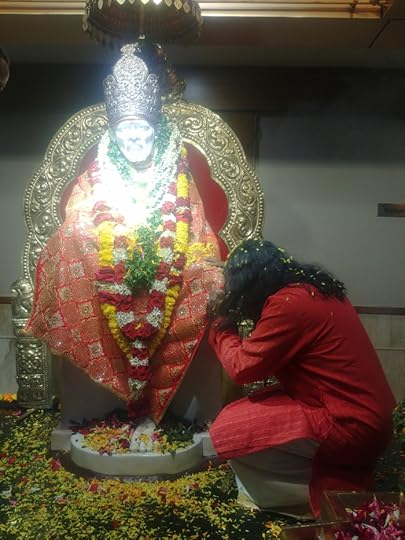
[image error]Mohanji with Sai Baba
This was followed by a delightful satsang in Malayalam by Mohanji and an address by the pontiff of Vallabhapuram, His Holiness Shri Shri Ramprasannanda. Swamiji spoke about his experiences with Mohanji especially His humility, inherent goodness and selflessness. Today, the homa (fire ceremony) was conducted at the temple propitiating all deities for the benefit of the community. Mohanji and the trustees performed the poornahuti (the final offering to conclude the 3 day ceremony). This was followed by the afternoon aarati. There were a steady stream of visitors – some of whom came from out of town to meet Him. The day ended with an amazing Madhyanha (afternoon) Sai Baba aarati followed by lunch prasad (consecrated offering) that was served in the temple.
[image error]Sai Baba at the temple in Palakkad
When it was time to leave, the Swamis came to bid Mohanji goodbye. Swami Poorna Nityananda, the head of the Math for Dubacherla ashram, related a nice anecdote that Vittal Babaji told him about his first meeting with Mohanji. Vittal Babaji said that when he first met Mohanji, he was so overcome with love for Mohanji that he just sat with Mohanji for 30min when Mohanji walked into his room. Only then did Babaji get up to receive and hug Mohanji. On his weekly visits to the Dubacherla ashram, Babaji would frequently talk to Swamiji about Mohanji with great love. Swamiji said that he had the good fortune to meet Mohanji only 3 years after Babaji’s samadhi (at Bhima Pushkar function at Dubacherla last year).
[image error]Mohanji with the Swamis from Kuruvapuram
An amazing end to a wonderful 3 days dedicated to Sai Baba. Grateful to Mohanji for the grace to attend this wonderful function.