
W. Terry Whalin's Blog, page 6
December 15, 2024
Opportunity Is Everywhere

By Terry Whalin @terrywhalinWhen you look at our world, you can go two different directions. You can buy into the negativity and rejection or you can see abundance and opportunity. I’m intentionally going toward the opportunities. In fact, we are surrounded with incredible opportunities. Thousands of podcasts, print publications, people to write their books, important stories to tell, and the list goes on.
As I look at my own writing life, there are several keys in this process and here’s a few of them:
--We each have limited time and resources. Each of us have the same 24 hours and seven days of the week to accomplish what we will do. It is important to be conscious of this limited time and use it carefully.
--We have to make wise choices with our time. Each of us waste time (including me) doing things like watching mindless television or scrolling through social media. Awareness and choosing wisely is important.
--When opportunity comes we have to seize them. For example, I have new books from authors and publishers which continue to pour into my office. I write book reviews about some of them and some I do not. It’s just one of a multitude of choices and opportunity for each of us.
--We have to be organized and choose wisely. For example, each of us as writers have to maintain and keep our connections. This past week I saw my youngest son and his wife. They looked at a tech issue on my phone and were amazed at the number of addresses in my gmail account. I was not surprised because gathering this information is something I am working constantly to increase and expand--and I encourage you to gather as well. --Whatever you want to get done, you have to build with careful planning. For example, I have a book that I want to write. I have a scratched outline but to get it moving. I have to organize my thoughts into a book proposal (something every author needs to do when they begin whatever type of book you are writing). Then I have to plan my strategy to write this book. I want to have a nearly finished manuscript before I pitch it. I know where I will publish it but also want to take a reasonable deadline for this book. Each of these details is important to build into your creative process. I’ve done this work over and over. I’m aware of my future steps to get it done and into the world.
I agree with Markus Dohle, former CEO at Penguin Random House who said on a webinar I attended, “We live in one of the greatest times in human history since Gutenberg invented the printing press.” Let this statement drive your activity and your seizing of various opportunities. We live in a remarkable time in history.
--For example Morgan James Publishing has recently started a new TV and film division and getting those rights to shop for the authors. Just consider the new opportunties in recent years--streaming and expanded people in film--which were not available as broadly only a few short years ago.
In this process of exploring your opportunities, I encourage each of you to cover the basics:
--do what you promise to do.--return your calls and emails.--develop new relationships.--keep learning new things and trying them.--be consistent and keep moving forward no matter what happens.
Each of us must seize the day and use our time and opportunities wisely. I’m definitely a glass half full type of person rather than half empty--yet I try and balance my optimism with a realistic perspective. What am I missing? Let me know in the comments below.
Tweetable:
According to this prolific writer and editor, opportunity is everywhere. In this article, get some of the key insights and details for every writer. (ClickToTweet)
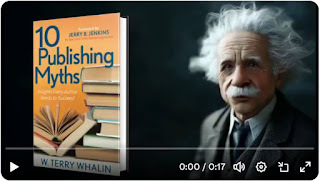 Use this link to watch the video
A great deal of the publishing process is outside of our control as authors, yet there are specific actions every writer can take. Get my decades of insights in 10 Publishing Myths for only $10, free shipping and over $200 ofbonuses.


December 8, 2024
Repeated Exposure Is Important

Within the publishing world, on the surface, there appears to be a disconnect. While authors resist social media yet others spend a lot of time on it, the sales statistics have proven large social media numbers does not necessarily sell books. Yet when you submit your manuscript to a publisher or literary agent, they want to know about your social media numbers and your online presence. Why do they care about this information and why is it important? It’s what I'm going to explain in this article and give you some strategies for your online presence.
Why Is Your Online Presence Important?
Through the years, I’ve read numerous stories from people who work with authors on promotion and selling books that many times an author with a large social media following will have a limited response to trying to sell to this audience. The small number of sales make you wonder why authors should spend any time on social media. Is it a waste? Not necessarily.
If you read the literature on marketing books, you learn that someone has to learn about your book multiple times and repeatedly hear the benefits of your book before they purchase the book. Some experts will say the reader needs to hear about it seven or eight times before buying. Other experts will say that number of exposures is over 20 times. No matter which statistic you believe, you and your book need the exposure multiple times before you sell the book.
When I say exposure, I’m talking about telling readers about the benefits and the stories which are in your book. It’s much more detailed than simply putting up a “buy my book message” which no one pays much attention. Instead, list the benefits for someone who reads your book and emphasize those messages on social media, through your newsletter and other places.
Not everyone reads all of your social media posts or follows your posts in detail. For example, I published an article in Publisher’s Weekly about book proposal creation. I’ve posted multiple times about this article but recently a long-time writer friend engaged me with the post saying something like “Congratulations to get in this prestigious publication” as though she was reading my post about it for the first time (it wasn’t). I post on social media 12-15 times every day or a great deal of information and content.
For example, my Billy Graham biography was released over 10 years ago--yet every day I post something on social media about Billy Graham. I will often include a link to a live radio interviews or some other insightful information for the reader. As I guest blog and write articles, I include a link to my biography as another exposure for the book to that reader.
I've mentioned that recently I’ve been doing multiple podcast interviews and recordings. During these interviews, I occasionally tell a story about my Billy Graham biography and that creation process. These stories continue to resonate and are of interest to others.
The multiple exposures is not a waste of time or effort but informs readers the relevance of your book and that you as an author have on-going passion for your book.
How Do Publishers Use This information?
Publishers and literary agents look at your social media numbers to see the engagement and at least get a big picture view of your online presence and potential readership. Publishers have access to other information as well such as Nielsen’s BookScan to check the actual sales of your recent books. The agent or editor will also google your name and see what they learn in the first few pages of their search. This basic information helps them learn about you and your book.
How Can an Author Build a Presence Without the Time Suck?
If the sales from this repeated exposure is limited, you want to have the exposure but use your time wisely. For example, I use Hootsuite but other people use Buffer or another social media scheduling program. I schedule my posts ahead of time.
I’ve also started being consistent on sending my newsletters each week. Like my social media, I’m scheduling them and getting them done ahead of time when I have a spare moment. Or these articles on my blog which I write each week. There are several keys for every author:
1. Be consistent in whatever you do. You don’t have to be on every social media channel but pick one or two and post on them consistently. If you post several times a week, do that consistently. If you post 12-15 times a day like me, then do that consistently.
2. Often you will get little response from such activity. I don’t hear a lot sometimes and then some well-known author or media person and I will be talking and they will tell me how they read each of my email newsletters. I keep those stories in mind as I persevere even without a lot of feedback.
I hope this article about the importance of repeated exposure is clear. If not, or you have other additions, let me know in the comments below.
Tweetable:
If high social media numbers do not sell books, then why is the repeated exposure important? This prolific author and editor gives you the details and insights here. (ClickToTweet)
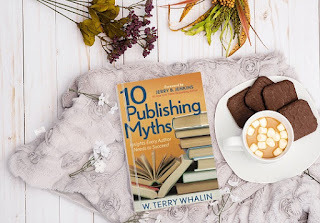 When I’ve worked with different publishers on a variety of books, I’ve learned the hard way that much of the publishing process is outside of anything an author can control. As an editor, I’ve spoken with different authors about their books, I’ve found many unrealistic expectations. There are actions every author can take with their books. I wrote 10 PUBLISHING MYTHS to give authors practical help. You can get decades of insights in 10 PUBLISHING MYTHS for only $10, free shipping and over $200 of bonuses.
December 1, 2024
Connect Before You Ask

By Terry Whalin @terrywhalin
Part of my commitment in these articles is to write about my journey as a writer and editor. Today I want to tell you about a recent experience with another writer. I’ve changed the details and not used the person’s name because I don’t want to embarrass or call out anyone in the community. I believe my experience can become a “teaching moment.”In these articles I’ve often encouraged you to ask for help or what you need. You and I belong to a generous community and if you ask in the right way (a big caveat), then you can get what you ask. But there is an earlier action I encourage you to take before you ask, build a relationship.
For years I’ve traveled the country and spoken at writer’s conferences. At this conference, I gave a keynote message and one of my points was encouraging authors to ask me for help and assistance. If someone reaches out to me with a question, it gives me an opportunity to help them but also they can learn more about the world of publishing which is constantly in motion.
During a conference, I meet with a number of people, give them my contact information and my advice. One of these writers who I had met once at an event, reached out to me. He is publishing a new book and asked me to endorse his book. As he suggested, I would only have to read 50% of it then write my endorsement. In the same email he recalled our conversation where I mentioned knowing a bestselling author. In the same email, he asked if I could introduce him to this person.
I respect the courage it took for this writer to reach out to me and ask for what he needed. Here’s the issue from my perspective: his ask had little to no conscious about my own packed schedule and at the moment I have no availability to read 50% his book and write an endorsement. Also I could not introduce him to the bestselling author because I don’t have this author’s email. I responded graciously and declined both asks. Many people would have simply not responded or ghosted this writer but this writer received my response.
Before you ask, there are several aspects that I want to point out:
1. Before you ask, build a connection / relationship. There are multiple ways to get my attention (or anyone else you meet at a conference such as an editor or literary agent) and build a relationship (other than our single meeting at a conference). Here’s some ideas: Review one of their books and send a short email letting them know you have done these reviews. Repost something the person has posted on social media or a blog. Comment on their blog posts or any number of proactive actions where you are visible to this person you are building a relationship. After you build this connection and relationship, then you can ask.
2. Make it easy for them to say yes and ask in the right way. Don’t assume they will read your book. People who endorse books often do not read anything inside the book. This insider information is something I’ve learned from years of working with authors and on endorsements. I encourage you to send a cover with your request and tell them who is publishing the book (a detail this author neglected to tell me). The transparency with this detail is important to include even if you are going to self-publish. Also offer the endorser that if they need your help, you will send a draft or sample endorsement. Dol you see how this offer has cut down the time and energy that other person will have to put out for your endorsement yet you will be more likely to get it?
3. Make only one request in one brief email. You may have a second or third need but don’t load your email with another ask.
I want to help others but this young writer didn’t understand (or likely even consider my intense schedule and the many other things in my life that consume my day. I applaud the courage it took for him to send his request but the shape of the message was an overask and without any work on his part to build a relationship gave me little reason to agree to it. If you don’t take these factors into consideration, then you are basically “begging” to get a “no thank you,” negative response or no response.
The basic principle I’m encouraging with this article is to take visible steps with another person and build your relationship before you ask for their help.
The writing community is willing to help you if you have become active in it and built the good will and relationships to ask for their help. There are many simple ways you can build these relationships such as active participation in a group where this person also belongs. For the writer that started this post with his overask, it had been at least eight months since we met and during that period, I had not seen his name any place. See why this person asked for something way beyond what I could do or expected from this person? Foundational in this process is the relationship. Build it, connect and reconnect, then ask.
What am I missing in this process from your view? Let me know in the comments below.
Some of My Writing In Other Places
 Why I Give Away Books–And You Should Too When you first look at it, it seems counter-productive to give away books that you are selling. If you publish books it is something you should do and I explain the details in this article.
 It may not seem like it to a new writer but on Writers on the MoveI explain that beginning writers do get published--especially when you get rejection after rejection as an author. Often new authors will tell me they are writing the next Harry Potter--yet have no idea of the initial struggles that it took for J.K. Rowling to get published. I give the details in this article.
  Once a month I write about book proposals on Almost An Author. In this article I explain Why to Never Submit Your First Draft.
I’ve been using PodMatch.com to book podcast interviews and several of them launched last week and here are those links so you can watch them.

For the second time, Tom Dutta invited me to The Quiet Warrior Show. Our last recording several years ago was only audio but this one included the visual recording and was promoted in many different venues.
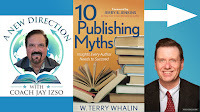 Also Coach Jay interviewed me on A New Direction Podcast. We spoke about Publishing Myths. I encourage you to watch this broadcast.
 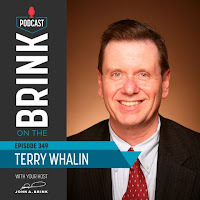 Also John Brink interviewed me on his On the Brink podcast. John has a remarkable personal story that we discuss during the interview. To promote this interview, the On the Brink team sent several short videos and I’m including one here.
 I show you this information to encourage you to use PodMatch and get booked on a podcast to tell more people about you, your website or your latest book.
In the Spring of 2025, I’m speaking at a couple of conferences. Follow this link to learn more details and hope to see you at one of these events.
Tweetable:
While it takes courage to ask someone for their help, this prolific author and editor encourages you to build a relationship and connection before you ask. Get the detailed insights in this article. (ClickToTweet)
 Much of the publishing process is outside of the writer
’s control. 10 Publishing Myths helps writers have a realistic perspective and take action. Get 10 Publishing Myths for only $10 +FREE shipping + over $200 of free bonuses.
Much of the publishing process is outside of the writer
’s control. 10 Publishing Myths helps writers have a realistic perspective and take action. Get 10 Publishing Myths for only $10 +FREE shipping + over $200 of free bonuses.
November 24, 2024
Thankfulness Is A Year-long Habit

By Terry Whalin @terrywhalin
This week, our nation will pause and celebrate Thanksgiving. Do you have activities which you do each year on this holiday? Some people travel home. Other people run a local 5K or 10K race early that morning which is often called a Turkey Trot. Other people gather with their family and watch the Macy’s Thanksgiving Day Parade.
In this article, I want to give the writing community some ideas and practices to celebrate gratitude. I believe thankfulness is more than an annual event but an attitude and action which should be a frequent part of your writing life.
The Apostle Paul listed a grave list of sins during the last days in his first letter to Timothy. He wrote, “There will be terrible times in the last days. People will be lovers of themselves, lovers of money, boastful, proud, abusive, disobedient to their parents, ungrateful, unholy.” (2 Timothy 3:1-2, NIV). Among these words, a single word stands out for this article: ungrateful. How can you increase your gratitude?
Several years ago, I began using a blank notebook as a gratitude journal. Every day I spend a few minutes writing some words of gratitude and thanks in this notebook. It is a regular part of my day and early morning activitites.
Also I have a box of thank you notes. Several times a week, an author or a publisher will send me a physical book that they want me to read and review. When each book arrives, I take a few minutes, pull a thank you note and write a short note of appreciation, then mail it. Early in my writing career, I gained this practice and habit. Like my gratitude journal it is not something I do just around Thanksgiving but something I practice all year long.
With thousands of new books entering the marketplace every day, every author needs encouragement about their book. Here's a simple and practical way you can support them: when you see they have posted about their book on social media, comment, cheer, and even repost it so other people learn about it. You can also purchase their book, read it and write a few sentences of review. This second option is much more time consuming but as I’ve written here in other articles, reviews are often hard to get yet something simple each of us can do and another way to express our thankfulness for their writing.
Books from publishers and authors come into my physical mailbox. Sometimes when I get a book, I will pull the cover into my MockUp Shots tool and create a few images which I send off to the author and encourage them to use the images on their website or social media or their blog. To do this action doesn’t take a lot of my time yet it touches and helps the author and shows that I’m concerned about them and the success of their book. It’s another simple action that anyone who has MockUp Shots could take.
Each week at Morgan James Publishing we are releasing new books into the world. It’s what happens when you publish about 180 to 200 books a year. Whenever I see a new book from an author that I’ve brought to the company, I reach out to them on email with a note and often I send a book marketing resource attached to my email as encouragement to them.
This past week one of my authors had a book anniversary and made it into an event celebration. She invited me to participate for a few minutes and I came to her celebration and spoke for a few minutes. It’s another simple way to express gratitude with your presence and participation.
Thankfulness and expressing gratitude is not just something we do once a year on the national holiday. It’s an attitude which we carry with us every day. Look for ways to fill some of your days with appreciation, thankfulness and gratitude. I hope I’ve stirred some ideas for you in this article. What other ways can you suggest? Let me know in the comments below.
Tweetable:
Thankfulness and gratitude is more than an annual holiday but a year-long habit. In this article, this prolific author and editor encourages simple actions. Get the details here. (ClickToTweet)
 Through my years in publishing, I’ve written for over 50 publications and more than 60 books with traditional publishers. Several of my books have sold 60,000 to 100,000 copies. I’ve also written different types of books such as biography, children’s books, how to/ self-help, co-authored and devotional books. From speaking with different authors about their books, I find many unrealistic expectations. Many aspects of the publishing process are outside of anything an author can control. I wrote 10 PUBLISHING MYTHS to give authors practical help. You can get decades of insights in 10 PUBLISHING MYTHS for only $10, free shipping and over $200 of bonuses.
November 17, 2024
More Lessons on New Doors

By Terry Whalin @terrywhalinLast week I wrote about how I’m knocking on some new doors through podcasting and using PodMatch. In this article, I want to continue that topic with some new insights and actions for you.
As I was looking around inside PodMatch, I saw a book for someone like me who wants to be a guest on podcasts. I reached out to the author and asked for a review copy of the book. He responded and sent the book. I wrote a review and posted the review (my responsibility). It’s a step you can take when you see a new book. Instead of buying it, reach out to the author and ask for a review copy. If they send it, then write and post a review. It’s something you can do with new books but also with books that have been in the market for a while.
When I received a review copy of PODMATCH GUEST MASTERY, I began to read it. My experience reminded me of a basic publishing principle I have learned when I started writing query letters or book proposals or news releases or back covers or any other type of writing in the publishing world:
1. If you are starting something new, you need to learn the system before you leap into it.
2. Gain the inside track on how the system works by learning from successful people who use the system.
3. Pick up on their habits and suggestions for your own work.
As I read this book, I liked the simplistic structure of the book. With 16 successful PodMatch experts, each one was asked a series of questions. They answered the questions with a word limit of 1500 words. This word limit made the answers short and to the point and uniform.
Also each contributor was given a promotion page in the back of the book for their podcast or website. Finally each one offered a special website gift to connect them to the readers.
Could you use the format of this book for something you are writing? It's a nonfiction pattern which could be duplicated with other tools and other systems. It’s something to consider and possibly incorporate into your writing life.
Another aspect I learned reading this book about guest podcasting, if you don’t learn the rules and the system, you will waste a lot of time, energy and possible rejection from other podcasters. Yet if you learn the rules, you will be able to succeed and use the system for your needs and the promotion of your book. For every system, there is a learning curve and a path for success--if you are aware and use it.
Here’s my review with some more bits of insight and advice:
“This is a quick reading book and 16 successful PodMatch guest members give their advice and insights about effective use of PodMatch. I’ve been in publishing for years but I’m new to PodMatch and this book contains valuable yet not unexpected information. Like any system, you will get out of PodMatch whatever you put into it. Repeatedly these authors stress the importance of careful and targeted pitching to the podcast hosts where you are matched through PodMatch. Then (and equally important), watch the podcast and get to know the host and format BEFORE you are interviewed on their program. Finally know your focus and where you are sending listeners for your particular topic and make a point of making it easy for the listener to connect with you.” “Without this type of focus, you will struggle to be a successful guest. I highly recommend PODMATCH GUEST MASTERY for everyone who is a guest on podcasts and especially on PodMatch.”
I’ve been using PodMatch for about four weeks and I’ve booked at least 15 podcasts. These podcasts are scheduled over the months ahead--something you can control as you schedule them. Here’s a couple of the podcasts which are now live:
 Joe Dimino (@jdimino) on the Neon Jazz podcast interviewed me about publishing myths watch it on your favorite channel at: https://bit.ly/40Fb1g5
 Kyle Yates (@TheVibesBrdcst) interviewed me on The Vibes Broadcast Podcast. Watch our conversation. Also notice the different live links in Kyle’s show notes which is another benefit from the podcast.
When each of these podcasts launch, if I don’t have an image to promote, I create one using MockUp Shots. Also I promote the podcast on my social media channels. Finally I don’t promote it once but put the post into a file for regular rotation on social media and an ongoing promotion. Each of these steps is a way to distinguish yourself from other guests and build relationships with the podcast hosts.
When you start a new marketing campaign, what lessons do you learn? Am I missing something? I look forward to your comments to this article.
Tweetable:
Are you beginning to use a new tool or system? This prolific author and editor details some insights and lessons to use for success. (ClickToTweet)
 Through my years in publishing, I’ve written for over 50 publications and more than 60 books with traditional publishers. Several of my books have sold 60,000 to 100,000 copies. I’ve also written different types of books such as biography, children’s books, how to/ self-help, co-authored and devotional books. From speaking with different authors about their books, I find many unrealistic expectations. Many aspects of the publishing process are outside of anything an author can control. I wrote 10 PUBLISHING MYTHS to give authors practical help. You can get decades of insights in 10 PUBLISHING MYTHS for only $10, free shipping and over $200 of bonuses.
November 10, 2024
How to Knock on New Doors

By Terry Whalin @terrywhalin
As writers, it is important to get our books in front of new people on a consistent basis. It’s why in these articles, I encourage you to make new connections on LinkedIN and other actions. In this article, I want to give another resource so you can tell others about your book and stories: podcasting.
During a recent meeting with David Hancock, the founder of Morgan James Publishing, we were talking about how to get more traffic to my special offer. He suggested I use PodMatch. It’s a monthly subscription but he also told me that if you schedule too many podcasts, you can also put it on hold for a few months. It’s important with these different opportunities to see the potential and also the different options with it--some which might not be obvious when you sign up with it.
After I joined PodMatch, I carefully filled out my profile (which is often one of the first steps whatever you are starting). I made a point to focus on my 10 Publishing Myths book and my special offer. Every aspect of my profile points to this book. Follow this link to see my profile.
PodMatch has internal training about how to use their system. These videos are short, interesting and to the point. I watched each one of them as I began working with the program.

This program uses the keywords and other data in your completed profile to match you to podcasts in their system. On the dashboard you can get these matches several times a day and they come in trios or three matches at a time. With the matches, you read the profile of the host which tells you the type of guest they are looking for, then I crafted a message or pitch to each match with an emphasis on the type of guest they want or targeted to that host.
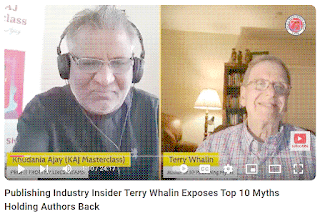 Within the first week of pitching, I booked six new podcasts and more of them are on the way. Also podcasts hosts can pitch you through their internal system. A journalist in India, Khudania Ajay pitched me to come on his podcast live. I've done a number of podcasts before PodMatch but they were all recorded, then produced and launched. I had never done a live podcast but accepted Ajay’s offer which was filmed in the morning in India but I’m in California so it was midnight here. Before the recording, Ajay moved me to an earlier time so it was locally 10:30 pm. My point is to take the offer and do it--no matter what time of day it happens. I made a point to tell stories and if I’m honest it was not my best podcasting appearance but it happened. I gave Ajay a five star review and he gave me one for the appearance. All of these details add up to more exposure and more podcast bookings. My key point is to take advantage of the opportunities whenever they happen for you. It's not easy to pull off but take a risk and try it.
I booked six new podcasts in the first week and I have more podcasts which I will be booking through this service. Maybe you are like me and reluctant to join another service where I make another modest monthly payment. Here’s another way to look at it, if I get on these podcasts and sell more books, then it is worth the regular investment.
Within PodMatch on the dashboard there is a ranking of the top performing members. I noticed one of my Morgan James authors was placing among the top ten in the system. I reached out to him. He had no idea of his ranking and told me he has done about 15 podcasts. I learned it does not take a lot of activity to get on this list--just consistency and willingness.
If you look at my PodMatch profile, you will see that I am intentionally pointing to one place which is my special offer of 10 Publishing Myths . I have made a simple way to do that with the website www.publishingoffer.com which someone can remember orally and it goes directly to the place.
Through their syste, PodMatch will match my profile with different podcasts. What I've been doing consistently is looking at the pitches and what type of guest the host is looking for their program. After reading that material, I use it when I shape my pitch. If I don’t see a connection then I pass on pitching that podcast and go on to the next one. I’m consistently pitching and I continue to book new opportunities.
When I make a connection and see they are based in the US, I offer to send a signed print copy of my book to the podcast host if they send their mailing address. It’s a way to stand out from other possible guests to send this signed book. What steps can you take to stand out and be distinct in your pitch? When I do the podcast or speak with a podcast host (such as a pre-interview), I make a point to tell stories and be entertaining. Why because these hosts are looking for people who understand their podcast and know how to tell good stories. It makes you memorable to that podcast host. From my experience, success breeds success. As I have a number of successful podcasts, these hosts will talk with each other and they will book me so I can speak to their listeners.
What are you going to do to apply this opportunity for your own writing life? I hope you will take the action, join PodMatch and spread your message to new readers. Let me know your plans in the comments below. Tweetable:
If you want to reach new readers with your book marketing, you have to knock on new doors. This prolific author and editor gives some action ideas and resources in this article. (ClickToTweet)
 When I’ve worked with different publishers on a variety of books, I’ve learned the hard way that much of the publishing process is outside of anything an author can control. As an editor, I’ve spoken with different authors about their books, I’ve found many unrealistic expectations. There are actions every author can take with their books. I wrote 10 PUBLISHING MYTHS to give authors practical help. You can get decades of insights in 10 PUBLISHING MYTHS for only $10, free shipping and over $200 of bonuses.
November 3, 2024
Do The Hard Work of Publishing

By Terry Whalin @terrywhalin
Our work as writers doesn’t involve physical labor but it can be equally as challenging. If you are in a hard situation with your writing, I want to offer some some ideas and encouragement in this article.Let’s be honest. Not every part of the publishing journey is fun or interesting. Some of the details of publishing involve a great deal of detailed work and repetiton--which in many ways is boring and hard to accomplish. Yet these steps are a necessary part of the process whether the repetition is boring or not.
For example, consider the marketing of a book proposal. It’s hard to write a complete proposal in the first place (check out my book on proposals for guidance in this area). Then you need to search for the right places to send it. You often need to access a database, then cut and paste the information, and craft the query letter and proposal (creative) but then the boring part of sending out a professional submission. You or your literary agent (also it is hard to find an agent and then you have to monitor their work) sends out your proposal over and over.
The submission process involves boring repetition and hard work but it is a necessary part of the process. It involves lots of cutting and pasting from one file to another in order to gather the information then use it in a personal way to reach the editor and capture their interest. You don’t send a mass mailing to many editors or agents (which is obvious and ghosted or little response. Instead you send a individual submission--which is clearly marked as simultaneous (important to tell them). I’m only searching for one yes or acceptance but I have to receive many nos in this searching process.
Or with my work at Morgan James Publishing, I will exchange multiple emails and phone calls with an author to understand and capture his vision for the book and put together the different pieces my colleagues need to make a decision. When my colleagues look at it, they turn it down or pass on it. In a sense, my efforts fail and don't produce a book.
Or in another situation, I work hard with an author on his book and vision, secure a contract from my colleagues then he decides to self-publish his novel. A few weeks later, this same author returns to me with a nonfiction book which is more of his passion with a solid proposal and gameplan. Once again I work hard to get him a book contract from my colleagues and this author decides to pass on signing his contract and moving forward.
Or I work with another author who spends years searching for a publisher for her excellent middle grade novel. She finds a publisher and struggles to communicate with this publisher since they don’t talk on the phone and only via email (happens in the publishing world). Now this publisher decides to close their doors and return their rights to this author. She wonders what next and I give her some ideas but it will take work and effort on her part for those ideas to happen.
Repeatedly within the publishing world, I find I can’t control the reactions or responses of others (even if I would like to do so). I can only be responsible for my own actions and I need to keep pushing forward.
I write this article as a reality check for each of us along with some action steps for your own writing life:
1. Do something every day that scares you and stretches the boundaries of your writing life. Maybe it is an email or phone call or something you want to write or whatever. I’m often scared but I do it anyway.
2. Continue to knock on doors of opportunity to see if they will open for you. To succeed, you need to be in the right place at the right time with the right stuff. It doesn’t happen if you are not pitching and knocking on these doors.
3. Continue to write your stories and get them into the world in various ways--in print and online and in magazines and in books.
4. Continue learning and growing and looking for the right avenue for you. It will be different from my way but it will be work to find right one for you.
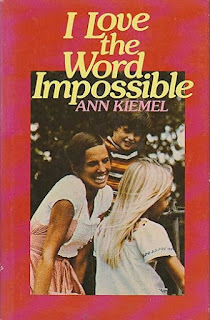 Years ago I interviewed Ann Kiemel Anderson who published a little bestselling book,
I Love The Word Impossible
. Ann’s book was funky and started every sentence with a lowercase letter throughout the book but her story and encouragement was moving. If she heard the word impossible then it led her to the Lord of the Universe and stretched her faith to see if that impossible event would happen. It’s the journey each of us are on as writers. Don’t lose heart but keep marching forward is the only answer in the face of the hard work. As Ann writes in the book’s preface:
Years ago I interviewed Ann Kiemel Anderson who published a little bestselling book,
I Love The Word Impossible
. Ann’s book was funky and started every sentence with a lowercase letter throughout the book but her story and encouragement was moving. If she heard the word impossible then it led her to the Lord of the Universe and stretched her faith to see if that impossible event would happen. It’s the journey each of us are on as writers. Don’t lose heart but keep marching forward is the only answer in the face of the hard work. As Ann writes in the book’s preface:“I love the word impossible because my God believes in adventure and extraordinary mountains, and He dares to be alive in a world crawling with terrible situations. He promises to be bigger than any impossibility because He is love…and love always finds a way through, in time.”
No matter what you write or publish, I encourage you to do the hard work of publishing. What am I missing? Let me know in the comments below.
Tweetable:
It’s not easy to do the hard work of publishing. There is little we can control. This prolific writer and editor gives the details and action steps for every writer. (ClickToTweet)
 Throughout my years in publishing, I’ve reviewed thousands of submissions. As a part of the process, I speak with them about their dreams and plans. Often these authors have unrealistic expectations about what will happen with their published book. Many aspects of the details of publishing are outside of anything an author can control. You can get decades of insights in 10 PUBLISHING MYTHS for only $10, free shipping and over $200 of bonuses.
October 27, 2024
Join the Generous Community

By Terry Whalin @terrywhalin
When they survey the personality of writers, the majority of them are introverts. Most people who have met me in person at a conference or an event would not categorize me as an introvert. I’ve taken personality tests and I do land in this category. At a party or event, I’d rather be sitting in the corner speaking with a person than leading the group or speaking to many people. Writing is something we do alone in our offices. Some writers intentionally need a busy environment to write so they will write in a coffee shop. I have written in those busy environments but it is not my preference.While writing is a solitary activity, you don’t have to be alone or by yourself in this process. Years ago I learned to join the generous community of writers. Through my local writer group, I got connected to a community of writers. I joined a critique group (learn more how to do that here). At that time of my life, the bulk of the people I interacted with on a daily basis were Christians. I decided to expand my connections and I joined the American Society of Journalists and Authors. Some years I’ve been more active in this group than others. For over 20 years I served as the chairman of their membership committee. Unlike many groups, you have to apply and meet the member requirement of the ASJA to join it. Also I served a term on their board of directors and often attended their annual conference in New York City.
During one of those trips to New York, I rushed to the airport and when I reached my destination and unpacked, I discovered I had left my clothing in my closet at home. In NYC, I had a series of meetings scheduled with literary agents and editors and planned to wear my suit and be appropriately dressed. I called my wife, Christine, in a panic and she suggested, “You are in the biggest city in the world. Go buy yourself a suit.”
The next morning before my scheduled meetings, I went to Harold’s Square and purchased a suit off the rack. That shop adjusted my pants during the day and I returned later for them but I was appropiately dressed for my meetings.
The ASJA had two group meetings. One was the large well-known public meeting. A second meeting with a smaller group was only for members and held the day before the public meeting. That year, one of our members had written a book with Roselyn Carter and they had invited the Carters to attend our member meeting. As a regular member, I wasn’t invited to sit with the former President but with a colleague, we figured out where the Secret Service would sit and sat at that table.
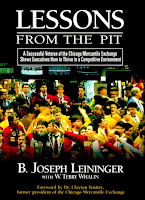 That year I had written a new book with Joe Leninger, who traded for ten years in the Eurodollar Pit of the Chicago Merchantile. Broadman and Holman published our book,
Lessons From the Pit
and I had a copy in my briefcase. Also I knew Broadman Press published President Carter’s first book,
Why Not the Best?
I asked the Secret Service, “When could I give President Carter a copy of my book?”
That year I had written a new book with Joe Leninger, who traded for ten years in the Eurodollar Pit of the Chicago Merchantile. Broadman and Holman published our book,
Lessons From the Pit
and I had a copy in my briefcase. Also I knew Broadman Press published President Carter’s first book,
Why Not the Best?
I asked the Secret Service, “When could I give President Carter a copy of my book?”He said, “I’d do it now because we are going to eat, greet and leave.” With the permission of the Secret Service, I signed my book to President Carter, then walked over to his table. The former President stood, shook my hand and graciously accepted the copy of my book. I have no idea if he opened and read anything in it but I know this book was the only one he carried out of the room that day.
I had this incredible opportunity because I joined the generous ASJA community. Among the members, a common saying is “We train our competition.” It’s true there is no competitive spirit among the members because there is plenty of writing work for all of us.
If you are feeling disconnected and alone as a writer, I encourage you to join the generous community and here’s some specific ideas:
1. Make a short list of the types of groups that tie to your type of writing.
2. Join those groups online or in person and make plans to attend their gathering.
3. When you are at the event, make sure you bring your business cards and swap with everyone you meet, then follow-up and expand your connections.
Through the years, I’ve met some incredible authors and writers through our generous community. I encourage you to not feel isolated in your writing but to take action steps to join the community and expand your connections and opportunity. I have no doubt my work and what I write and teach is built on what others have taught to me.
What actions are you going to take in this area to increase your connections to the community? Let me know in the comments below.
Tweetable:
We write in isolation. In this article, this prolific writer and editor encourages you to join the generous community with specific action steps. Get the details here. (ClickToTweet)
 Much of the publishing process is outside of the writer’s control. 10 Publishing Myths helps writers have a realistic perspective and take action. Get 10 Publishing Myths for only $10 +FREE shipping + over $200 of free bonuses.
October 20, 2024
Writing in Spare Moments of Life

By Terry Whalin @terrywhalin
Sometimes I write in the cracks of life. I’ve been in publishing for a long time and have many things that I have to get written. There are follow-up calls and letters to potential Morgan James authors. I have meetings to schedule and paperwork to turn into my colleagues so authors can get considered and possibly get a publsihing contract. These details are only a few of the numerous ones I am handling day in and day out. Also each week I write an original article on The Writing Life.
Outside of writing that I need to get done, I also enjoy doing some other writing such as book reviews. I’ve written over 1,000 reviews on Amazon and enjoy supporting other writers with a review. It’s hard to fit this writing into my routine with the pressure of other writing. Where do I get it done? I write my reviews in the spare moments of life. It amounts to reading late at night (outside of my work) and marking some passages that I want to highlight then finding a few moments to write my review and post it. Like everything, even writing a short review takes time. Each of us have a finite supply of time. My question is are you writing in the spare moments of your life?
Maybe you have put mental walls or parameters on your writing time. For example, some have decided to write a chapter or a story or a book proposal or manuscrpt, they need a chunk of time to get that written. From my experience, this mental wall or restriction is a false one. I can write a short piece in the cracks of my life.
As I’ve explained in other articles, the books from publishers and authors pour into my mailbox throughout the week. I attempt to read as many of them as I can handle during my limited reading time. Then when I have a spare moment, I will write a review and often go back to it several times to make sure I like how it is written. Then I will post that review on Amazon and Goodreads. Sometimes I post it on some other sites as well. The Goodreads review always posts immediately but Amazon and others can take a few days before they post on the site.
When I see that one of my new reviews has posted, I will tell others through my social media connections along with a unique image of the book. In this simple way I can support and help other writers to tell others about their books. Several years ago I wrote another article about this process called Writing In the Cracks of Life. It’s another way with some different examples of how I handle this process of writing in spurts instead of a lengthy session. I hope it will give you some ideas for your own writing life.
Also I use the reminders feature on my phone so I don’t miss something. I freely admit to being human and every now and then something gets missed. Whenever this happens I give myself some grace which is something each of us need.
The process of consistently writing isn’t easy for anyone--even someone like me who has been doing it for a long time. The key is to keep sitting in your chair and moving your fingers on your keyboard--over and over. If you get a paragraph written, then eventually you will get a page written. When you get a page written eventually you can write a chapter and then a manuscript. Your persistence and consistency is a critical part of the process.
Have you put some mental restrictions on the length of time you need to do some writing? Or maybe it is another issue that prevents you from writing in the spare moments of your life. Let me know in the comments below.
Some of My Writing in Other Places
In these articles, I encourage you to write in other places. As a writer, you can consistently write in other places. I do not add this feature every month yet every month I am consistently publishing my writing on other sites. Here’s a few recent articles:
 Many authors on the publishing journey, wonder, “Where is the easy part of publishing?” In this article, I give authors the honest answer and resources.
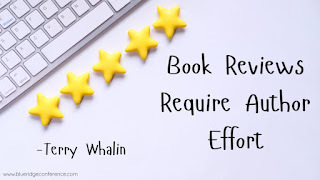 It is not simple for any author to get book reviews. In this article, I give details and resources to help authors understand book reviews require author effort.
  What is the hardest element to find on your book proposal? In this article, I give the details and a resource to make sure you put what the editor or agent is expecting in your submission before you hit the send button.
 Tweetable:
As writers, we can’t always choose when we will write. According to this prolific writer and editor, it is a matter of mindset and writing in the spare moments of life. Get his insights here. (ClickToTweet)
Much of the publishing process is outside of the writer’s control. 10 Publishing Myths helps writers have a realistic perspective and take action. Get 10 Publishing Myths for only $10 +FREE shipping + over $200 of free bonuses.
October 13, 2024
Pour Creativity Into Your Marketing

By Terry Whalin @terrywhalinHopefully every writer pours a solid dose of creative energy into their writing and their mansucript. Ironically it is in the writing where the bulk of writers put their energy. I understand and believe it is important to build a solid foundation in the writing and storytelling. You select a way to publish your book and get it into the world.
After your book is available to others, then you move into a different area where you market or sell your book. To help in this process, I recorded a free teleseminar where I gave a dozen different ways to sell books (follow the link to check it out). In this article, I want to call a different aspect of the writing business to your attention: creative marketing.
In the process of marketing your book, it often takes some financial investment such as to hire a publicist or to produce marketing materials or any number of other aspects. What if you don’t have the money or your financial resources are limited? Keep reading this article because I have some ideas and examples which any of you can do if you take action with these creative marketing ideas.
Several years ago I learned about Publishizer which is a free fund-raising tool. If you follow the link, you will see Morgan James Publishing has their own branded version of it. In some ways, Publishizer is like some other fundraising sites like GoFundMe or Kickstarter. Publishizer is focused on books where you can use these other places for many different kinds of fundraising projects. Check this page to get more details about how it works.
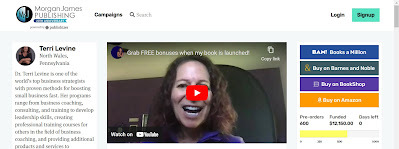
Before your book is published, you can use Publishizer to create different packages. Then you can use an email list or social media to promote those packages and gather pre-sales on your book or funds which you can use for creating the packages but also for marketing or anything else you need with your book. Several years ago I worked with Terri Levine who is a Morgan James author. Terri used this tool to create her campaign and as you can see from the website, she raised $12,500 using this system.
I met Kirsten Pistorius through her children’s book submission to Morgan James Publishing. She wrote and illustrated a beautiful picture book called My Little Prayer Book: Inspirational Verses for Children. Her campaign is just starting and in pre-sales. I encourage you to look at it and if you can help her with some pre-sales.
 If you want to use Publishizer, I encourage you to carefully study the website to learn about the packages and pitches other authors have made for their books, then use these ideas for the creative marketing you will pour into your book.
Publishizer is not for one type of book. Terri Levine’s book was a nonfiction business book. Kirsten Pistorius has a children’s book and she lives in Zimbabwe. You can also use Publishizer for fiction. Debra McIntyre has published a historical novel with Morgan James called A Wishful Eye. Follow this link to check out Deb’s campaign which is also in process (which means you can participate in her campaign and get one of her packages).

Using Publishizer is a creative way to turn your marketing into book sales and money. You can use this process in the early days of your marketing.
Also you can use Publishizer after your book is already in the market to create a special sales campaign. Just like the regular program, you have to fill out a form and apply to Publishizer to use the tool for your campaign. Follow this link to the form if you want to create a special sales campaign.
The key message I want to make with this article is there is not one path or one strategy to use with your book marketing. You can use several different strategies with your plans. It’s important to learn about these opportunities, then take action and use them effectively for your book. I hope I’ve helped open your eyes to some possibilities other authors are using--and you can use as well.
If you have used Publishizer or have other creative ways you are marketing your book, let me know in the comments below.
Tweetable:
Do you want to pour creativity into your marketing? Prolific author and editor highlights the Publishizer website with some examples. Get the details here. (ClickToTweet)
 Much of the publishing process is outside of the writer’s control. 10 Publishing Myths helps writers have a realistic perspective and take action. Get 10 Publishing Myths for only $10 +FREE shipping + over $200 of free bonuses.


