Petrina Binney's Blog, page 9
January 19, 2022
Book Review – Everything Is Beautiful by Eleanor Ray
Book Review – Everything Is Beautiful by Eleanor Ray
First published, 2021

The story follows Amy, a thwarted artist, office worker, and heartbroken hoarder. Keeping her own counsel while the neighbours gossip about the state of her house (which they can only see, fleetingly, as she enters and exits through the front door) and her terracotta-pot-crammed garden, Amy is pretty well alone.
Having been deserted by her boyfriend and best friend who presumably ran off together eleven years ago, Amy has found consolation in the acquisition of things: primarily bottles, newspapers, cigarette lighters, ashtrays and cookbooks. Their usefulness is best explained by the fact that Amy neither cooks nor smokes. Amy is, however, able to get around her house, by virtue of the narrow path she has created between her items.
But when a cat and the new neighbour kids unearth a precious unreceived present from the jumble of the garden, the mystery of what really happened to the missing Tim and Chantel comes dashing to the fore. With her life otherwise at something of a standstill, will Amy find out the truth of their betrayal? And will she finally be able to let go?
A lovely little novel, and Christmas present from my near-as-dammit mother-in-law, I really enjoyed the character of Amy. Her little irritations, like other people’s preoccupation with winking and emojis raised a smile of recognition with me. And her part-time rivalry with chattery neighbour Rachel was very well-observed.
“Both women were distracted by the growl of a large engine. Their little street of suburban terraced two-up two-down rarely saw much traffic, and they both turned to watch as a large moving van pulled in.
“‘Old Mrs Hill’s place. It must be,’ said Rachel. The women enjoyed a temporary truce as they watched the van attempt to park.
“Amy missed Mrs Hill. She’d been the perfect neighbour, quiet and undemanding. Even when Amy had shared the house with Tim and Chantel, they’d never made it beyond a gentle nod of greeting and an occasional muttered ‘hello’ if either was feeling particularly gregarious. In fact, she didn’t even notice that Mrs Hill was gone until her grown-up children turned up one day to fill up their cars with her possessions. Sad as she’d been, there followed a glorious time with no neighbours at all on that side, a luxury rarely afforded in the area. Then the ‘For Sale’ sign was replaced with a triumphant boast from the estate agent. Sold.
“And now, here they were. Her new neighbours.
“Well, not exactly. Two men in bright blue overalls emerged from the truck and opened it up. ‘I’m going to see if they’d like a cuppa,’ said Rachel, trotting over to the van. She turned back to Amy as she went. ‘Sort out the mice or I will be forced to report you. I mean it this time.’
p12, Chapter One, Everything Is Beautiful by Eleanor Ray
Some years back, I visited my honorary granddad, Ivor, when he went into a retirement home and I brought him a couple of beers and a bottle opener. He hadn’t asked for any of it and I hadn’t given it that much thought. It just seemed like a decent enough gift to bring along. A handful of friends told me, at the time and since, with knowing smiles, that I was awful. In that very Dick Emery way.
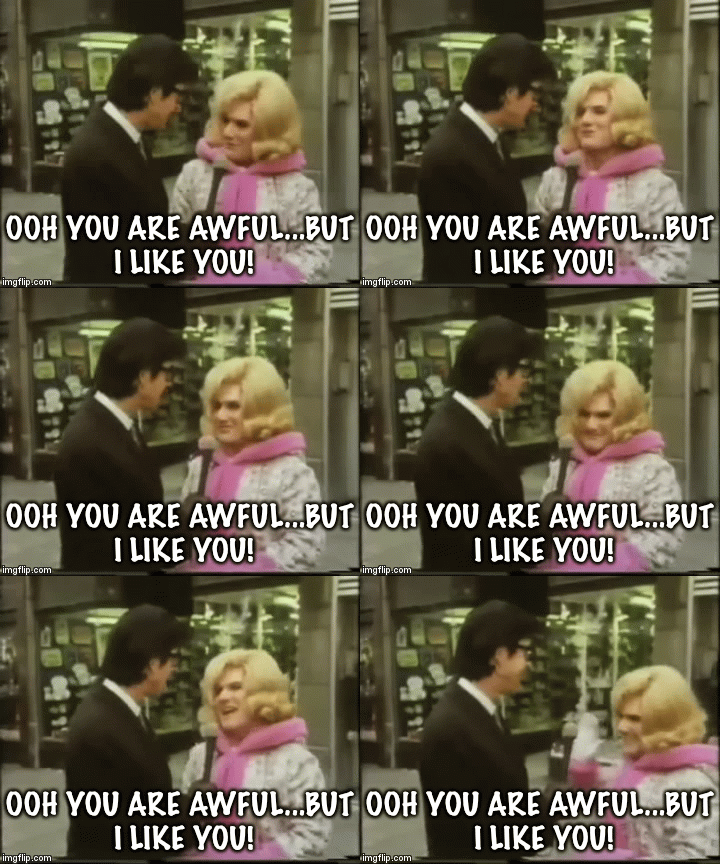
In my defence, it was only a couple of bottles and nobody told me there were rules about what you could bring. Of course, it makes sense if you think about it: alcohol’s interaction with certain medications, the absence of locks in the old folks’ home making the presence of booze unwelcome for those residents with strong beliefs or dependency issues. As I say, it makes sense if you think about it. I just didn’t think about it. But when I read about Amy visiting Arnold in the retirement home and, on his instruction, emptying a bottle of red wine she’d sneaked in, into an empty bottle of Ribena, I laughed. You know, I’m sure half those fruit-cage water bottles are just cider with decorations.
Although there was a short section of discussion questions for books clubs – which I generally dislike (I’ve been in book clubs, we can talk without being led), it was swiftly followed by a lovely section of snippets from the contributors to the book (editors, cover designer, marketing people) talking about items they’ve hung onto that would be deemed ‘clutter’ by anyone else.
A sweet surprise of a book.


January 15, 2022
Book Review – The Count of Monte Cristo by Alexandre Dumas
Book Review – The Count of Monte Cristo by Alexandre Dumas
First published, 1844
“He who has felt the deepest grief is best able to experience supreme happiness.”
Chapter 117, The Fifth of October, The Count of Monte Cristo by Alexandre Dumas
As you may remember, I made a decision a little while ago to fill in the gaps in my knowledge of classical literature by actually reading some. I know. Such a rebel. This was, as ever, in the hopes that I would recognise obscure quotes and oblique references in the course of the sorts of run-of-the-mill, intellectual conversations I plan to have as I approach my middle years. I am not entirely without understanding. Thanks to a childhood in the nineteen-eighties, I am an aficionado of film, television and pop culture. All of which have, in their way, exposed my brain to all manner of literary giants with sneaky jokes and asides. So as much as I might recognise a quote and even know where it’s from, that doesn’t necessarily mean I’ve read the book. Hence this quest.
All of this is really just to introduce myself. Apologies for that.
I remembered a film I’d watched years ago and felt certain it was based on something literarily magnificent but I couldn’t remember the title, the author or anyone who’d appeared in the adaptation I barely recalled. So far, so good. I had a vague recollection of the plot, so I headed on over to Google.
“Book Frenchman convicted of a crime he didn’t commit, escapes from prison and claims vengeance.”
And good old Google came back with: “The Count of Monte Cristo by Alexandre Dumas.”
Pretty certain I already knew that, at least deep down where I need not produce proof, I went straight to Amazon.
I found the ebook advertised with a price of practically nothing and a page count of 486. I know how fast I read. Although, no doubt, a sophisticated story, translated from the original French (I would struggle to read a menu in the original French – it’s something I plan to work on next year), with possibly loftier language than might be found in the more modern novel, I reckoned I could finish it in four or five days. A promising start to 2022 and a thundering classic to tick off my list – I was well pleased.
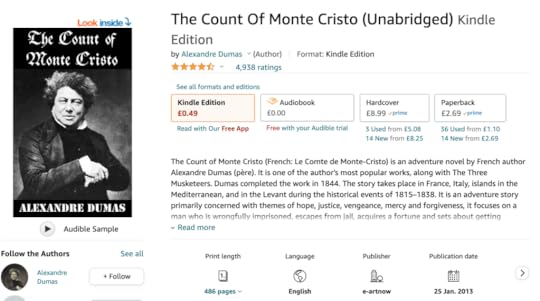
As an ebook, of course, the number of times you tap to turn that page doesn’t necessarily correlate with the number of pages in the physical book. This is due to print size, screen size and technological whatnot I can’t begin to understand. But I was surprised, after twelve or so taps of the screen, to find myself still at 0%.
Back to Google: How many pages in The Count of Monte Cristo (Unabridged)?
Oh, Amazon. How my heart shook. Even at 0%, I was loving the story – vast and operatic and sitting-in-the-firelight as it is – but 486 pages it is not. Not even close, actually.
Of course, there are probably a good number of English translations out there, but I suspect they’re all in ballpark of each other for length and according to Google, that’s 1297 pages long. My 4-5 day read had suddenly swelled into two weeks, without interruption, which is asking a lot in a house full of dogs.
It’s lucky I’m not the only person in the house because I’ve barely looked up from my phone in the past fortnight. My eyes have become bloodshot and watery, caused solely (I suspect) by the hours spent staring at the screen. I have thought of little else.
So, the story follows Edmond Dantes, a successful young sailor and the beloved of the beautiful and adored Mercedes. When popular Edmond returns home from the sea with the promise of promotion and engagement, he cannot know that three villains are plotting against him, planning to rob him of his destiny and throw him in a dungeon, alone, forsaken and forgotten.
And so, when, many years later, two of the baddies are wildly successful, living the high life in the upper echelons of society, and their co-conspirator, encouraging manipulator, is still a small rather pitiful figure, the villains are falling over themselves to meet the deathly pale but fabulously wealthy and mysterious Count of Monte Cristo.
But after fourteen years imprisonment, and another ten seeking answers, treasure and himself, has Edmond left it too late to claim his revenge? And, if he gets it, will it really balance the scales?
For the most part, I felt like I was sitting in a wingback chair, by the fireside, being told the story by an avuncular (as we can see from the cover) high-cheekboned Frenchman with a bottle of brandy catching the light from the flames. The command over story and character exhibited by the author was powerful and assured.
There were some irritating moments. Spectacles, such as Paris at night, and various other majestic sights, were alluded to with expressions like – ‘those who have seen [whatever it might be] will already know how glorious a sight it is’ – but those of us who haven’t are left waiting for a description that doesn’t come. There were a fair number of instances of feelings and impressions which were “impossible to describe” – which felt a little bit like a cop out.
People who don’t care for the opera often complain that there’ll be a bad guy on some nefarious rampage and it’ll turn out that it’s the town mayor, wearing a hat. The audience knows exactly who he is but his wife doesn’t, and that makes the suspension of disbelief more than a little tricky. Although I got a sense of that from time to time, the sub-plots and characterisations were so rich as to distract me from it almost immediately.
Although I found the character of Valentine just a little but too sweet for my tastes, I’m pretty sure Eugenie Danglars is my kind of girl. Avoiding marriage to run off with a lady musician sounds about right to me.
Unfortunately, this translation uses the word ‘his’ in place of ‘has’ a fair number of times, a couple of instances of ‘be’ that should have been ‘he’ – but I think I’ve found the origin of the phrase “folded his arms over his chest”, a phrase that seems favoured by USA Today Bestselling, and other American, authors (8% in, Chapter 11, The Corsican Ogre, The Count of Monte Cristo by Alexandre Dumas).
An incredible story, beautifully told, but make sure you have a couple of weeks free from drama to read it.
December 31, 2021
Book Review – The Great Gatsby by F. Scott Fitzgerald
Book Review – The Great Gatsby by F. Scott Fitzgerald
First published, 1925
“‘Whenever you feel like criticizing any one,’ he [my father] told me, ‘just remember that all the people in this world haven’t had the advantages that you’ve had.’”
1% in, Chapter One, The Great Gatsby by F. Scott Fitzgerald
Thus, Nick Carraway begins the novel with his father’s words echoing in his ears.
As Nick moves to a rundown little place out east, with an overgrown garden, in the shade of a mighty mansion, he can’t help but become intrigued by the elusive man who lives there, a man who throws regular cocktail-soaked parties for strangers, lives the high life, but about whom relatively little is known. There’s rather a lot of speculation among the party-goers, of course. He’s thought to be a bootlegger, a murderer, a playboy, but Nick wouldn’t know him if he had to pick him out of a line-up.
As Nick spends times with cousin Daisy, her imposing, abject-failure of a husband, and their all-but-forgotten toddler, as well as lady athlete Jordan, Nick becomes embroiled in everyone else’s affairs, of which there are many, and forgets his father’s words almost entirely by judging the elusive Gatsby twelve ways from Sunday.
In fact, he judges everyone because they’re all very hedonistic and, whether happy or not, I fancy Nick looks down on them all because he’s stalled in his own rather stagnant life. Vicarious thrills aren’t always what they’re cracked up to be. His only strong feelings about other people are disappointment and frustration, he struck me as a rather bitter, peripheral figure, even in his own life.
A great portrait of the time, gloriously rendered, and another classic to tick off my list.
“So we beat on, boats against the current, borne back ceaselessly into the past.”
100% in, last line, Chapter Nine, The Great Gatsby by F. Scott Fitzgerald
December 29, 2021
Book Review – Around The Dark Dial by JD Sanderson
Book Review – Around The Dark Dial by JD Sanderson
First published, 2020
A collection of eleven short sci-fi stories, inspired by and perhaps in tribute to, radio dramas of the 1950s.
Although the stories are short enough that you can just dip in and out whenever time permits, I read this collection from cover to cover in one go. Compulsive reading, I loved it.
The writing is glorious. JD Sanderson has that rare ability to make you care about a character within the first few sentences. As such, although it’s not a genre I’m particularly drawn to (science is complicated enough for me; throw in some fiction and I’ll rarely know which bits are rooted in reality and which are pure fantasy), I was compelled to read on.
Stories of inaccessible areas of the earth, gone wild, untamed and become home to unknowable life forms flow dynamically into tales of alien abduction, anti-vax governments, sentient robots and eloquent animals, I adored these stories.
The theme running throughout is as old as time itself: misunderstanding of the different or unusual leads, inevitably, to violence and destruction. Beautifully detailed, addictive stuff.
Unfortunately, despite a lovely foreword from the editor of this collection, the proofreading wasn’t great. There were a good number of missing apostrophes, occasional missing words and a couple of misnamed characters. This left me feeling frustrated from tome to time. However, this is a great collection and I’m very pleased to have found a new favourite author.
December 26, 2021
Book Review – Darkly Dreaming Dexter (Dexter #1) by Jeff Lindsay
Book Review – Darkly Dreaming Dexter (Dexter #1) by Jeff Lindsay
First published, 2004
Sharp, witty and full of purpose, Dexter Morgan is a Miami-based blood spatter analyst, with a foster sister in the police force, a sweet, damaged but undaunted girlfriend, and all the charm of a classic movie icon dipped in Dior.
He’s also (spoiler) a murderer. But he only kills bad people, so it’s hard not to root for him. His conscience, as well as the code of ethics gifted him by late foster father, Harry, dictates who needs to die. Whereupon, Dexter allows his ‘dark passenger’, the murderous, hack-happy side of himself, to take over.
I love the TV series and this was my first foray into the books. How I loved it. Dexter is an endlessly fascinating character, meticulous, a student of human behaviour, he isn’t cold but he isn’t quite human either. And he’s funny. My, he’s funny.
“There is something strange and disarming about looking at a homicide scene in the bright daylight of the Miami sun. It makes the most grotesque killings look antiseptic, staged. Like you’re in a new and daring section of Disney World. Dahmer Land. Come ride the refrigerator. Please hurl your lunch in the designated containers only.”
10% in, Chapter Three, Darkly Dreaming Dexter (Dexter #1) by Jeff Lindsay
With a new serial killer in town, Dexter can’t help but marvel at the bloodlessness of the bodies the Miami police find, and it’s hard for him to believe that the murderer isn’t trying to communicate with him directly. Not to challenge or threaten him, it’s more like the killer is inviting him out to play. But with his dreamscape taking him to new and confusing places, is the killer with the precision cuts and the bloodless bodies Dexter himself?
A dark, deadly delight. I must read the rest.
December 25, 2021
Book Review – Shifting Skin (DI Jon Spicer #2) by Chris Simms
Book Review – Shifting Skin (DI Jon Spicer #2) by Chris Simms
First published, 2006
The second story of DI Jon Spicer, Shifting Skin finds our hero, rugby-fanatic, detective inspector and soon-to-be dad, Jon Spicer on the hunt for a killer in Manchester who flays his victims and leaves their bodies in the area of Belle Vue.
Meanwhile, Fiona Wilson, a friend and co-worker of Jon’s girlfriend, Alice, finds herself in a shabby motel room in Belle Vue, having left her violent husband. But when Fiona hears choking sounds and a heavy thud from the next room, could it be that she’s stumbled upon the murderer and his latest victim? And will Spicer find the time to follow her leads when he’s trying to chase his own?
A clever, psychological crime drama, this. I really enjoyed the relationships between the characters, particularly Spicer and new partner, university-educated, fast-track promoted DS Rick Saville.
The story proffers an intriguing, if uncomfortable, insight into inclusive hiring and how admittance of minority groups into the police force might just jar with older attitudes. The story, however, was well-written, with shades of Silence of the Lambs, and the observations regarding the more ghoulish aspects of human curiosity struck a chord with this reader.
“’Has someone been killed?’ A council worker in a shiny grey suit called through the fence. The eager note in his voice riled Jon. ‘It looks like a corpse.’
“Jon paused and stared at the man, took in his pallid skin and fish-like eyes. ‘So do you.’ He carried on, leaving gasps of shock behind him.
“Without turning his head, Rick murmured, ‘Please, don’t mince your words.’
“He smiled to indicate sarcasm but Jon’s face remained stormy. ‘One thing I hate is members of the public getting a thrill from this sort of thing.’
“As they reached the rendezvous point in the outer ring of tape Jon noticed a young man nearby lining up the crime scene in the viewfinder of his camera phone. ‘If I hear that click, I’ll impound your phone as evidence.’
“The man lowered his phone, an uncertain expression on his face. A uniform stepped over and, as he noted down their names, Jon nodded towards the man with the phone. ‘Take his name and address.’ Then, louder, “The perpetrator of a crime often returns to where he committed it.’
“The man looked as if he wished he’d stayed home.”
12% in, Chapter Three, Shifting Skin by Chris Simms
Book Review – Stage 3 by Ken Stark
Book Review – Stage 3 by Ken Stark
First published, 2016
A rip-roaring, flesh-tearing, zombie apocalypse novel, Stage 3 finds misanthropic hero, Mason, on a flight bound for San Francisco. Having boozily slept his way through much of the journey, Mason wakes to find himself the only person on the plane still blessed with the gift of sight. Including the pilot and copilot.
As the rest of the passengers and crew wail, moan and rant their way through the descent, Mason must read the dials out loud for the pilot to be able to monitor a safe landing. But that’s only the start. For the blindness quickly gives way to madness and, from that point, the true horror of the story unfolds.
With plucky, ten-year-old sidekick Mackenzie, Mason must find a way through a city filled with monsters of one kind or another to get to Mackenzie’s only living relative. But with no power, no weapons except those they can fashion from items along the way, and zero training for this situation, will the intrepid pair make it past the horde unscathed? And does Mackenzie’s recent blindness mean what Mason thinks it means? That she’ll turn out like all the others and lose her mind as well as her humanity?
An awesome story, the tension never let up. The characters were well-drawn, if rather more affectionate than seemed particularly usual in a zombie apocalypse, and the descriptions were epic.
I did get a little irked by Mason regularly shoving people “rudely”; okay, there’s no other way to shove someone but there are other words. And the extraneous apostrophes for “Stage 3’s” (sic) got a little irritating. Also, it’s been impressed upon me by my partner (who’s the daughter of a commercial pilot) that the pilot is not just a passenger with a certificate and aeroplanes cannot land themselves.
That said, these all feel like pretty small quibbles in the face of a story that blew me away.
Must read.
December 23, 2021
Book Review – Between The Stops by Sandi Toksvig
Book Review – Between The Stops by Sandi Toksvig
First published, 2019
Between The Stops is a sort of bus ride down memory lane. Part memoir, part travelogue, this book is packed with facts about the various luminaries and history of one bus route in London, the personal memories that are sparked by certain sights and people along the way, and very funny anecdotes of one of the nation’s favourite broadcasters and entertainers.
As a feminist, it’s quite true that history, as well as being written by the victors, is almost exclusively written about the men. There’s a great line from Mrs. Lintott in Alan Bennett’s The History Boys: “History is a commentary on the various and continuing incapabilities of men. What is history? History is women following behind with the bucket.”
I think all women should share in Ms Toksvig’s (who should surely be Dame Sandi by now) frustration at the obscurity to which women have been regularly relegated in the story of mankind.
I have read a great deal of Sandi Toksvig before, and have seen her in one thing or another for most of my life, so some of the stories were well-known to me but still joyous. I was shocked by how appalling her coming out was. I wasn’t really paying attention at the time (I think I was twelve), but it was a tale that threw me quite badly during the story.
To begin with, reading about one of my favourites, sitting on the top deck of a bus, largely ignored while the other passengers played with or answered their phones, I was saddened because I felt a tremendous sense of loneliness on her behalf. However, I was lucky, because Sandi was right there waiting to pull me through.
Heartrending in places, a delight in others. As ever, Sandi Toksvig feels like a friend. I particularly liked this part:
“I’ve been on television for so long that I think lots of people feel they know me, which is lovely, and they chat to me, which is also nice, but I never cease to be amazed what some folk think is appropriate to tell me. One of the strangest encounters was at a motorway service station on the way to Bournemouth. I was taking my elder daughter, Jesse, to the university there for an open day and we stopped at the services to get coffee. As soon as we entered the place Jesse did what young people seem to be trained to do: she rushed off to a retail opportunity presuming I was following with money. As it happened, I didn’t have any on me so I headed to a cash machine. I can’t read well without my glasses and I had left them in the car so I was leaning in to the machine and concentrating when a little old lady barrelled up to me. She was wearing something I hadn’t seen in years – a Pac-A-Mac, which makes the most marvellous early-warning rustling sound. She was very old indeed. I don’t know where she was going. Perhaps she was being made to go on a coach trip to see the sea one last time. She said, ‘Hello Sandi.’
“‘Oh hello,’ I said, still trying to focus my eyes on the ATM.
“‘You’re very funny,’ she went on.
“‘That’s very kind,’ I replied, continuing to attempt my transaction.
“‘But that’s not why I like you.’
“I finished what I was doing and turned to look at her. ‘No?’
“‘No,’ she declared. ‘I like you because you, like me, are not a specific shape.’
“And with that she left.”
p137, Camberwell Church Street/Camberwell Green, Between The Stops by Sandi Toksvig
Book Review – This Much Is True by Miriam Margolyes
Book Review – This Much Is True by Miriam Margolyes
First published, 2021
“Life’s like cheesecake: you want to have as much as you can.”
p 155, Heather, This Much Is True by Miriam Margolyes
I can’t remember a time in my life when I didn’t know who Miriam Margolyes was. First as an actress (I think I remember her as Lady Whiteadder in Blackadder first), later as a raconteuse and chatshow favourite, with some of the naughtiest stories and language and the sharpest wit to be found on late-evening telly.
Never afraid to voice an opinion, Miriam Margolyes is uncompromising, a national treasure (quite right, too) and wrote this, her long-awaited memoir at the age of eighty, in lockdown.
Filled with anecdotes, heartache and humour, this book and its author should be protected and, if possible, kept on display behind a velvet rope.
When we lived in Devon, I used to go to a six-monthly regional quiz night in aid of the Rotary Club who, among other causes, have raised a vast amount of money to wipe out polio (something which looks to be achieved in the not too distant). Although a laudable cause, I’ve been known to argue a point, even on charity quiz nights, and especially when the Guinness is flowing.
When Barry (gawd bless Barry, he’s an icon of the Rotary Quiz) asked: “Who played Professor Sprout in the Harry Potter film, The Chamber of Secrets?” I yelled out before anyone else had chance to draw breath, “Miriam Margolyes!” Barry frowned at his answer sheet and shrugged, “I’ll give you that, although the correct answer is Miriam Mar-goll-YES.”
Regardless of the awarded point, I was on my second pint, as well as a mission.
“It’s spelt Mar-gol-yes, but it’s pronounced Mar-gol-ees.” I wish I’d known at the time that it means ‘pearl’ but next time I see Barry, I’ll let him know. In any case, I like to think that MM would approve.
What comes across in this memoir is a fiercely intelligent, humorous, opinionated woman, who has battled to a good age, had friendships and love to balance out some of the harder times, and has never lost herself. A woman of exceptional memory and with a great love for people, and a surprising (to me) background modelling for and entertaining gentlemen.
Like the lady herself, a rare treat.
Book Review – Murder At Teal’s Pond by David Bushman and Mark T. Givens
Book Review – Murder at Teal’s Pond by David Bushman and Mark T. Givens
First published, 2022
In 1908, the body of a twenty-year-old woman was found floating in Teal’s Pond, Sand Lake, New York State. With the neighbourhood of various mountain folk and charcoal-makers thrown into disarray, the police inundated with potential suspects and dubious testimony, and speculation running riot in the daily press, the multi-doctor autopsy lacks the conclusive wallop required to definitively point to a likely perp.
Thus, the story of Hazel Drew is relegated to the annals of history and campfire legend until the emergence of the TV series, Twin Peaks: created by a man who heard the story as a child and considered it a source of inspiration for his show.
This novelised true crime investigation into the murder of Hazel Drew is hampered by two things.
Firstly, the writers have researched the area, the key players and possible suspects for five years, and as such, there’s far too much detail for the reader to keep track of. There are too many characters, with too little characterisation to make them memorable. The imagined thought processes of the key players are laborious and speak to many hours of writing, rewriting, tweaking and overthinking; as such, they lack plausibility.
The book starts with the Dramatis Personae, which helps as a quick reference but is intimidating once you realise there are so many characters to be introduced. Then, after the bulk of the story is dealt with, there’s a very brief Here’s What We Think Happened section, and we’re straight into the Author’s Note and Acknowledgements. Thus, the book feels overstuffed and then, quite suddenly, flat as a pancake.
Secondly, and I don’t like myself for saying it, but there’s no getting past the idea that this book is written by two fanboys who want to impress the creator of their favourite show. The authors’ love of Twin Peaks is clear and runs right the way through the story. I suspect it goes some way to explaining the incongruous imagined thoughts of the main characters. These are fans, with an interest in forensic investigation, but I’m not sure they’re really writers.
For a while, I held out hope:
“Who was Hazel Drew? Because almost all of the people who controlled the narrative contemporaneously – chiefly investigators and reporters – were men, the story was filtered through the male gaze, and Hazel – like Laura Palmer and her antecedent, the eponymous protagonist of the 1944 Otto Preminger film noir Laura – became a projection on a screen, absorbing whatever qualities or shortcomings these unreliable narrators assigned to her: woman as defined by male obsession.”
6% in, Introduction, Murder At Teal’s Pond by David Bushman and Mark T. Givens
And okay, it’s a run-on sentence, but it gave me hope that these authors wouldn’t give a pantomime facsimile of a lead female character. Unfortunately, as Hazel is imagined, walking fearlessly through the woods at night, near the pond where she’d be found a few days later…
“She wipes at her brow with her sleeve. Her hair has dampened and matted in the heat. How many men had complimented her on her radiant blonde hair and glittering blue eyes.
“The young woman chuckles to herself. ‘If they could see me now.’”
6% in, Chapter One, Murder At Teal’s Pond by David Bushman and Mark T. Givens
Dang it. I don’t care if it’s 1908 and Hazel is somewhere she knows. Women have never walked in so cavalier a fashion. No woman goes anywhere alone at night, her shoes caked in mud, with no torch, keys between her fingers or weapon of any kind, without thinking that an attack is imminent. And I’m sorry, fellas, but even if she does feel impossibly safe and undaunted, she doesn’t devote all her thoughts to what various faceless men think of her.
I’m sure inadvertently, but the authors have retained the female victim as the film noir femme, and removed any real depth from her thoughts, actions and murder.
Exhaustive and exhausting.