Petrina Binney's Blog, page 13
September 15, 2021
Book Review – Dubliners by James Joyce
Book Review – Dubliners by James Joyce
First published, 1914

A good while ago now, I heard that James Joyce is one of the more difficult authors to read. With his naturalistic, free-flowing, full-stop-avoiding style, he’s one of the great writers who a lot of people have pretended to read. I’ve yet to get on to Ulysses, but Dubliners is not a challenge of held breath and strugglesome rhythm, so there’s none of that to fear here.
The classic short story collection, Dubliners, contains fifteen stories from James Joyce, each depicting life in the early part of the twentieth century, in the Irish capital. It was a time of great change in Ireland and Joyce does not shy away from subjects including nationalism, religion and personal frustration.
I know others have had trouble with the fact that some of the stories just stop – with no particular conclusion. I rather enjoyed that, though. Certainly, I’m sure some of the stories will stay with me for a very long time to come. The last line of An Encounter, a story of two schoolboy chums, trapped in conversation with a stranger, is a personal favourite:
“‘Murphy!’
“My voice had an accent of forced bravery in it and I was ashamed of my paltry stratagem. I had to call the name again before Mahoney saw me and hallooed in answer. How my heart beat as he came running across the field to me! He ran as if to bring me aid. And I was penitent; for in my heart I had always despised him a little.”
p22, An Encounter, Dubliners by James Joyce
Eveline, the story of a woman, locked in the domestic service of her family, desperate to leave with her lover and start a new life of endless possibility and, ultimately, finding herself unable to leave, broke my heart. A delight.
In Counterparts, we find a man stuck in a job that bores him, doomed to stay in an office where he’s thought lazy or a fool, with only the promise of a pint to keep him going. In A Mother, we discover a woman, intent on making sure her daughter is properly paid for her work, making things ten times worse for her offspring, ensuring she’s not only underpaid but never to be hired again.
These are stories of people, stymied by their lives, forlorn and reckless, tormented by their choices, but with some of the most beautiful language printed.
That said, there are a handful of instances where Joyce alludes to childhood games with unfortunate names, Jewishness in a stereotypical way (very common of the time) and Blackness. However, in his addressing of Blackness, the character seeks to unmask the racist attitudes around him. Whether he does so successfully is really up to the reader. I’ve said before that, although it can be painful to reconcile the language of the past with the morals and education of our time, I do think it’s important not to censor our past selves but rather, learn from them, to see how far we’ve come.
Sometimes, it’s very tempting to dip into the classics and I think Dubliners is an excellent place to start. There are some stunning turns of phrase in this collection, and I suspect it’s become a set text for language students for very good reason.


September 14, 2021
Book Review – The Daemoniac (Gaslamp Gothic Book One) by Kat Ross
Book Review – The Daemoniac (Gaslamp Gothic Book One) by Kat Ross
First published, 2016
In The Daemoniac, we meet Harrison ‘Harry’ Fearing Pell, younger sister of acclaimed New York sleuth Myrtle, as a new client appears looking for the great detective. Sick of living in her sister’s shadow, Harry decides to make the most of Myrtle’s Pinkerton-related absence and allows the client to believe they have found the very person they were looking for.
But when the case involves an unholy grimoire, spirit boards and a bizarre series of murders, and bodies as well as suspects are unearthed with frightening regularity, will Harry be able to solve the case before Myrtle comes home? And will her efforts be enough to get her an interview with her beloved Society for Psychical Research?
I loved this book. The writing is strong and gothic, the characters are beautifully created. I especially loved Harry and John’s relationship. Theirs is a close friendship that I felt might just have tipped into romance, were it not for Harry’s insistence on being right about everything. It can be hard to find the balance when friends don’t always get along, but this is very well-written. The story is set in 1888, and there are lots of references to world events of the time, which I very much enjoyed.
I also loved Mrs. Rivers. As housekeeper and almost-parent to Harry, what might have been an all-but overlooked character was a game old bird and (not revealing too much here I hope) the scene with the spirit board was stunning; I was actually scared. I have a penchant for horror films, so that takes some doing.
“‘Oh dear, you’re soaked to the bone!’ Mrs. Rivers exclaimed as I made my way upstairs, leaving large, squelchy footprints on the rose-patterned carpet. ‘I’ll brew a pot of tea.’
“She headed toward the kitchen, still sprightly and dark-haired despite her advanced years. Not much seemed to surprise our housekeeper anymore. She’d practically raised Myrtle (which couldn’t have been very pleasant) and seemed resigned to the fact that her charges had little interest in men, fashion or parties – the Holy Trinity of upper class femininity.”
13% in, Chapter Three, The Daemoniac (Gaslamp Gothic Book One) by Kat Ross
September 13, 2021
Book Review – Rise Above: Leadership Lessons from the RAF by John Jupp
Book Review – Rise Above: Leadership Lessons from the RAF by John Jupp
First published, 2021
I should state right from the off that my dad was in the RAF so it’s a world, and an attitude, that holds a certain importance to me. I did wonder, when I first saw this book, if it was indeed possible to transfer the camaraderie and teamwork, the trust, listening and dynamism of the RAF into any other business venture. But, do you know, it seems so.
As the youngest of the services, the RAF has seen enormous change over its 100 year history. One only needs to think about the advances in aircraft design, radar, air-to-air refuelling, and the complications of the political climate, to get a glimpse of how the ability to think on one’s feet and work together with a team is not just advantageous, it’s vital.
One of the most stirring lessons in this – grammatically stunning – book dealt with how important it is for a leader to listen to their people lower down the chain. I’ve sat on a couple of committees and this is a lesson that could make all the difference in any organisation. Of course, there are people who don’t know when they’ve made their point and will go on and on without achieving very much – I’ve been that person; I know how it goes. But I’ve also been the person making a reasoned statement, only to have my boss shut me down with, “I’ve had just about enough of you.” He achieved his aim. I stopped talking (albeit briefly).
There were some very good examples through the text, and some historical facts that kept it all moving at a good pace. By leading by example, bringing in the best people for the job, listening to their experience and advice, planning for problems, reacting to situations as they change, and pulling the whole thing together with a clear intent, it is possible to be a good leader, regardless of our job titles.
“… Park had one of his young pilots brought in front of him because that pilot had landed without putting his wheels down. The result, of course, was a seriously damaged precious aircraft that the RAF was badly in need of. Park ‘bollocked’ him. When done, Park took the young pilot to the bar a bought him a pint. The pilot, too, was a precious asset, who needed reassurance and to be in a place where he was capable of flying the next day. Look after your people and they will look after the organisation.”
p56-57, Chapter Three: Leaders Leaders Everywhere: Understanding the Multiple Leadership Contexts from Rise Above by John Jupp
If you’re in business, this is one for you.
September 12, 2021
Book Review – The Things You Find In Rockpools by Gregg Dunnett
Book Review – The Things You Find In Rockpools by Gregg Dunnett
First published, 2018
“It’s Tuesday evening now, and my head hurts a little. That’s because I’ve been thinking a lot.”
14% in, Chapter 11, The Things You Find In Rockpools by Gregg Dunnett
In The Things You Find In Rockpools, we meet eleven-year-old Billy Wheatley. As a young lad growing up on a holiday island off the eastern coast of the United States, with single father Sam, Billy has assorted interests, including hermit crabs, wildlife photography and amateur detective work, and everything he does, he completes to a near-professional standard – which isn’t bad for a preadolescent.
However, when teenage tourist, Olivia Curran, goes missing, the rest of the island is prepared to believe she just went swimming late at night and drowned. Always looking for a new interest, Billy decides to solve the mystery of what happened to Olivia, but little does he know, the answer lies a little closer to home than he might have imagined.
The writing is stunning. Billy is a great character, really well-written and thoroughly enjoyable to read. He has a bit of a butterfly brain, always interested in something different to the point of distraction, and he has the semi-formed ideas of a young lad which I really liked. He was terrifically well realised. Actually, all the characters are remarkable. It can be difficult to keep track of who everybody is, and what their relationships are, with a new book and an author you don’t know, but I was able to follow the story really easily, which is pretty amazing given the cast of characters and how complex the mystery is.
I just loved Billy and will look forward to reading the rest of this series.
“I slide back behind my tree and think for a moment. I’ve made good progress: I know where (redacted for the sake of spoilers) lives, and therefore, I probably know Olivia’s location, whether she’s alive or dead. This is good. But I know I need more. If I go to the police now, they still won’t believe me. I’m just a kid, they won’t realize I’m really a scientist. Even if I could get them to listen to me, they might believe me just a little bit and send one officer to ask him some questions, and then they’d probably get kidnapped and be kept in the cellar or killed too.”
17% in, Chapter 14, The Things You Find In Rockpools by Gregg Dunnett
An exceptional story. Must read.
September 7, 2021
Book Review – Love and Care by Shaun Deeney
Book Review – Love and Care by Shaun Deeney
First published, 2021
In this memoir, Shaun Deeney, former journalist and handyman, returns to England from France, to take his mother out of a care facility and bring her back to the family home in the wake of her husband’s death.
As Shaun moves on from his divorce and with his children grown, he embarks on the hazardous journey of caring for his mother, who has dementia. Assisted by many able carers and with friends and family regularly on the phone, Shaun relishes his time with his mother but watches in astonishment as his world becomes smaller and smaller. But there’s no one quite like one’s mother, and they’ll never have this time again.
It’s very well-written. I was worried about reading this one as I was a carer to my mother for eleven years. I was concerned that, in reading about someone else’s experience, a whole slew of painful memories and things I’d sooner not think about would come flooding back. I was wrong. Although, of course, the main thrust of the book is a man caring for his mother – it’s also a story of finding oneself in middle-age, of a man connecting with his family, both past and present, it’s a story of not giving up.
In Love and Care, we get to know the story of a very nice, very kind man, not without flaws but a generally good guy, who takes on a remarkably difficult challenge. To try to help as you watch someone you love getting sicker, getting infections, receiving treatment and being talked about as if they’re not there, is very hard going. As Mr. Deeney says:
“As a carer, or trainee carer, it’s difficult, impossible really, to express the odd combination of constant visitations and complete isolation your life comprises, with every day just like every other, with your own existence reduced to that of a functionary, a bit player, an amateur among professionals, a man among women, and a novice in a hermetic world where carers, as the name implies, simply care, their lives dedicated to the service of others.
“Still, I’m glad I tried. Nothing comes from nothing, and in trying, I may just have made a friend.
“Perhaps that’s enough.”
p123-124, Chapter Eight, Love and Care by Shaun Deeney
A very thoughtful book. Well worth a read.
September 5, 2021
Book Review – As Good As Dead (A Good Girl’s Guide to Murder, Book 3) by Holly Jackson
Book Review – As Good As Dead (A Good Girl’s Guide to Murder, Book 3) by Holly Jackson
First published, 2021
Okay, I’m going to level with you from the get-go: I didn’t realise this was the third in a trilogy when I started reading. Usually, I would start at the beginning of any series but, in some ways, it can be instructive to see if a book can stand alone without the previous episodes.
So, the story follows teenage detective and podcaster, Pip. Growing up in the village of Little Kilton, she has seen more than her fair share of murder and despair and, in order to cope, she has started self-medicating. As far as anybody knows, there’s a serial killer rotting in prison, having gone on something of a spree a few years ago. However, was the right man convicted? And when it all goes horribly wrong, will the wrong man pay for his other crimes?
The writing is dark and stunning. The descriptions are beautifully detailed and the characters burst out from the page. I did struggle a bit to work out who was who in relation to everyone else, but that’s because I started with book 3; I have no doubt about that.
“Death stared back at her. Real death, not the clean idealised version of it; the purpling pockmarked skin of a corpse, and the eerie forever-whitened imprint of a too-tight belt they must have worn when they died. It was almost funny, in a way, Pip thought as she scrolled down the page on her laptop. Funny in the way that if you thought about it too long, you’d go mad. We all end up like this eventually, like these post-mortem images on a badly formatted web page about body decomposition and time of death.”
Page 37, Chapter Five, As Good As Dead (A Good Girl’s Guide to Murder, Book 3) by Holly Jackson.
It’s always a bit thorny to review a book where the police are incompetent and the criminal justice system horrifically flawed. Depending on personal experience and what we read in the news, it’s either deeply depressing or worryingly cynical. Luckily, the writing saves it from being either. There are important points made throughout the book about the importance of ethics, and how a podcaster with a crime show, or any amateur journalist, can derail or correct a whole investigation.
Although I didn’t always like the main character – I felt she had a big old dose of martyr syndrome – she was very well-written and believable, and I adored her boyfriend. They had some very sweet moments and a delightful shorthand in their interactions. Now, I just need to go back to the start.
August 28, 2021
Book Review – Twice as Hard: Navigating Black Stereotypes and Creating Space for Success by Opeyemi Sofoluke and Raphael Sofoluke
Book Review – Twice As Hard: Navigating Black Stereotypes and Creating Space for Success by Opeyemi Sofoluke and Raphael Sofoluke
First published, 2021
In this beautifully written and thoughtful book, the authors explain, through personal experience in the world of business and finance, and through interviews with prominent people from various fields, how to be an entrepreuner and deal with other people’s expectations and prejudices when you’re Black. They also explain, in succinct and easy-to-implement style, how to be a true ally to the Black community in work and in life, whatever your background.
It’s remarkably positive and left me feeling motivated:
“A common phrase used by many Nigerians is, ‘Those at the top do not have two heads.’ In other words, there is nothing stopping you from succeeding. Those who have achieved success do not possess a physical superpower – if they can do it, you can do it, too.”
Page 52, Chapter One – Who Do People Say You Are? Building Your Brand by Opeyemi Sofoluke, Twice as Hard by Opeyemi Sofoluke and Raphael Sofoluke
I really loved this book. Having grown up in a multicultural community through my childhood, and having missed that through my teens (when we moved to East Devon), I consider myself an ally to the Black community but it’s definitely instructive to be sat down and told: this is how you can help.
This book has a lot to say about finding your opportunities and the struggles that you will face, but that you can rise above:
“A former student, who went to Eton in the 1980s, stated that ‘kids arrived there with this extraordinary sense that they knew they were going to run the country’. According to reports, the school puts a premium on individualism and encourages students to pursue any dream they might have. The encouragement given to those at private school as opposed to those in state schools creates a chasm of opportunity. This unfair disadvantage only serves to reinforce our point made earlier that ‘talent is equally distributed; opportunity is not.’”
Page 73, Chapter Two – The Power of Your Network, Creating an Elite Circle by Raphael Sofoluke, Twice as Hard by Opeyemi Sofoluke and Raphael Sofoluke
I have a cousin, a good few years my senior, who’s been in business for decades, and I would recommend this book to him. This isn’t simply a book for Black people who want to succeed; this is a book for everyone who wants to make things better for people. There are plenty of examples within this book, where the authors tell the reader of times when they, and those they’ve interviewed, have had to explain and define their culture, keep people from reaching out and touching their hair, when they’ve felt the weight of having to represent all Black people everywhere, and facing an uphill battle in so doing because the person they’re dealing with has their own preconceived notions of who they’re talking to.
And this fascinating comment on the subject of not seeing colour or not seeing race:
“Acknowledging the challenge and struggle that the Black community experiences requires you to see colour – it requires you to be attentive to the differences in experiences people face because of their colour. To not see colour is to be dismissive of the challenges Black people face because of their appearance.”
Page 291, Chapter Eight – “Ally” – It’s A Doing Word, What It Really Means to Support the Black Community by Opeyemi Sofoluke, Twice as Hard by Opeyemi Sofoluke and Raphael Sofoluke
It’s not the easier subject. Lord knows, it’s one most of us are trapped by because we are so sure that we don’t know any racists, or if we did, we’d kill that friendship dead. But is that really true? And as much as each of us thinks we’re good people, are we really doing all we can to help and promote our friends?
August 22, 2021
Book Review – Broken World (Broken World Book 1) by Kate L. Mary
Book Review – Broken World (Broken World, Book 1) by Kate L. Mary
First published, 2014
The story follows Vivian, Axl, Angus, and several waifs and strays they find and save on their way through a plague that might mean the end of times. While stripper Vivian finds herself increasingly drawn to the stormy-eyed, golden-hearted, gun-toting redneck, Axl, his brother Angus is a sometime drooling bigot with a foul mouth and a spitting habit.
But Vivian has more important things on her mind. While the world turns to mush and the vast majority of the population has fallen to some sort of dread disease, she needs to find the daughter she gave up for adoption and save her before it’s too late.
But will Vivian find little Emily? And will the safe, secure, Nirvana-like oasis in the desert prove to be more than an illusion?
The eye for detail this writer has is extraordinary:
“A woman in her fifties stands behind the register. She wears the same uniform as the other waitresses: orange dress with short sleeves and an apron that probably used to be white. The entire thing is now splattered with food and grease, old and worn just like she is. Her hair is short and jet black, the kind of color that only comes from a bottle, and the creases on her face are so deep they’re probably just as full of grease as the walls of the diner.”
3% in, Chapter One, Broken World by Kate L. Mary
The characters practically vibrate off the page. Although I struggled a bit with Vivian – she recognises her selfishness and dislikes it as a trait but does nothing to change it – arguably, she is going through an apocalyptically awful time so, I suppose I’ll forgive her for that. And baddie Mitchell is an amazing character. Total rotter. Couldn’t bear him – he’s so well-written.
If you like your apocalypses Zombie-style, I’d happily recommend this book.
August 19, 2021
Author Interview with Kerri Davidson
Well, now, lovelies. I have a cracker for you today. I had a little chat with incredible author, and tremendous friend, Kerri Davidson today. You may recall, I reviewed the first of Kerri’s Journey of Souls series, Soul’s Choice here: https://petrinabinney.com/2019/11/30/book-review-souls-choice-by-kerri-davidson/
Enjoy.
Tell us a little bit about your Journey of Souls series. What is it about? Who are your main characters? What drew you to this story?
Yikes. Long story, of course.
So, this was my first full length novel. One I’d been trying to write for years. In fact, I’d started it dozens of times by writing a chapter or two and walking away, or trying to make one of those silly little outlines they taught us about in school.
Yeah… every time I came back to it I realized it was garbage. This was long before I understood that a first draft is supposed to suck.
‘Twas many years later after I’d joined the writing community on Twitter when someone told me about the 85K Writing Challenge. It no longer exists but it was similar to NaNoWriMo in the way that it provided the much-needed motivation and a bit of guidance to WRITE THAT BOOK.
So I signed up for this challenge on New Year’s Eve and began writing the next day. That was the secret. I just wrote. No outline; no regrets. Can I use a semicolon there? Probably not. I never get those right. This is why I have an editor.
Anyhoooo, I cranked out the required 85K (with an extra and unneeded 20K) way ahead of the three-month schedule in 41 days. Editing was… a whole other story.
This story was supposed to be the story of Amy – a troubled teenage girl. I wanted to write about her struggles with weight and body image, being bullied and an outcast, basically trying to find her place in a cold, hard world.
And I did. But this time when I sat down to write the story, imagine my surprise when Amy’s mother, Amelia showed up dead on page one.
In the end, my original story of Amy was told but the other half centered on Amelia in the In Between – my version of the afterlife and how I imagine it to be.
Because it’s all about imagination.
Which brings me to the second book of the series: The Soul Must Go On.
When I first published Soul’s Choice, I knew what happened after it “ended.” It was quite a cliff-hanger of an ending, yet I wouldn’t commit to writing a sequel until I saw how the first one was received and determined if there was a demand for second one. Turns out, there was.
I wrote the second book a year later, once again using the 85K Writing Challenge for motivation. This book flowed out so easily and I absolutely gave my imagination full reign. This story is honestly my favorite out of all my books and my editor agrees. The surprising part was it needed so very few edits. I took one pass after the first draft, sent it to betas then my editor, and it was the easiest damn thing I ever did.
Wrapping this up because whoops, I’ve been dithering.
Soul Connections is the third (and second last) book in the series. Really, I could have ended with just the one sequel, but these characters and their worlds are so addicting that I decided to keep writing them. Soul Connections will release sometime this fall.
If you could give your younger self any advice, what would it be?
Nada. I don’t think I was ready to write the novels back then. I think it’s better I waited until I retired and was able to give writing my full attention and commitment.
Well, I guess I would tell my “starting out” self to join the Twitter #WritingCommunity and make connections with other authors, editors, writing challenges, and all that good stuff. I kinda lucked into that.
Fun fact about how I started using Twitter:
Back in 2017/2018 when I was still only creating my drunken chicken humor novels, it was brought to my attention that I should start creating a social media presence as an author. Groan. So I finished opening a Twitter account that I had apparently been in the middle of doing in 2010 or so, and was immediately confused. I texted my little sister and asked her how this thing worked. She told me to “follow a bunch of people and like their crap.” Lol. It turned out to be a bit more involved than that. I do remember finally connecting with other creatives and learning how to navigate the thing when I stumbled across the #amwriting hashtag.
Are you a big reader?
You bet. Not a big reviewer anymore. It feels too much like work and I found it was sucking the pleasure out of everything I read. I’ll do a short little blurb for books that blow me away but otherwise I’m on review-hiatus. I’m currently alternating between rereading my old favorites and all the authors I’ve come to know on social media. Basically, my TBR list is longer than my projected life span.
What’s the most unusual subject you’ve researched for your writing?
All things chicken. Although I use next to none of it. Then the usual unusual things like how to kill someone with such and such thing, how to properly dispose of a body, swearwords in all the languages, etc.
Do you base any of your characters on real people?
Yeppers. Almost all of them and all the time. If I know you, you’re in one of my books but YOU WILL NEVER FIND YOURSELF. MARHARHAR.
What do you think is the most difficult part of the writing process?
Accepting changes. Even if I already knew something wasn’t working. I’ll do it, on occasion, but there will be angst.
Who are your favourite authors? Do you feel they’ve had an influence on your writing?
Robin Cook, Chris Tullbane, V.C. Andrews, Kelly Armstrong, etc
I wouldn’t say “favorite” but Stephen King and Dean Koontz took up a lot of my reading time in my twenties. They were just so available. I think I learned a lot of things I DIDN’T want to do this way. Eg. Drag out a “monster is creeping up on me” scene for three chapters. YAAAAAAAWN.
What is your next project? Is it something you can talk about?
I am trying desperately to not start a new project because I have so many “almost” publications haunting me. You know, those manuscripts that have been through all the stages but just need that final polish…
However, I do feel the writing itch. That glorious, freeing first draft spewing… I probably should write the final book of the Journey of Souls series before I get too sidetracked on shiny new things. Oh, then there’s the coauthored sequels to Eyes on the Road.
Currently, I’m working on my cozy mystery And the Librarian. It’s a dumpster fire so I thought I’d take a break from it and yak away at you, Tree.
(And it’s much appreciated, Kerri)
Tell us five of your favourite films.
Um, I’m not big on films or TV but I do heart me The Secret Life of Pets, old Doris Day/Cary Grant movies, The Grinch, and almost shamefully, the Twilight movies. That counts as more than five, yes?
Five top albums.
I used to be big into music but I haven’t been able to listen to any for almost two years now. Just life stuff, I suppose. Working through that… Album titles? Well, the world has gone e-crappy so I don’t really look at album titles anymore. Go-to bands were Imagine Dragons, Disturbed, and Mariana’s Trench.
Are you an early bird or a night owl?
Neither now. I used to be night owl. Then an early bird after I met my husband. Now I can’t wait to get to sleep and want to sleep in because it makes the day shorter. Again, life stuff and that will probably HOPEFULLY be temporary. I’m much more functional in the morning, though.
What can you tell us about Henny?
Most importantly, never, ever call him Henry. He hates that.
So, once upon a time, in 2008/2009, I sat down to write a sticky note message for my husband’s lunch. This was something I normally did. A simple “You’re having a good day” or “I love you.” On this particular day, I decided I wanted to draw a little joke to make him laugh at work. The original three sticky notes ended up being page 1 of volume 1. But that wouldn’t happen for nearly a decade…
Long story short, the first knock-knock joke was a hit. I continued to write them and by the second set of notes, I had titled them The Chronicles of Henny in my head.
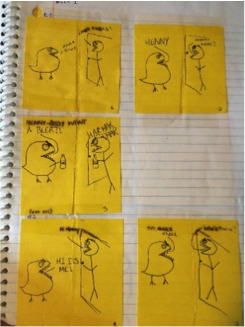 Post-its of The Chronicles of Henny
Henny is abrasive, rude, a drunk, and he swears like a sailor. Some of the jokes that appear in the books make me cringe (after I roll on the floor laughing). So why did I create Henny to be this way and why do I continue to love him after all these years?
I didn’t create him. He wrote himself. Henny is the one who decided to move himself into Cst. (Constable) Poopers’ house and wreak havoc. And deep down inside, as the story progresses, you’ll find yourself rooting for Henny. It’s messed.
So, long story a bit shorter, for some reason my husband continued to bring the notes home every day. I compiled them into a notebook by simply taping them in there. Not the best preservation process.
Years went by and the pen and sticky notes turned to drawing paper and pencils. Still, I had no intention to publish them. In fact, I didn’t have the slightest clue how I would do such a thing.
Eventually, I stopped writing them. I took the notebooks I’d collected and photocopied them, gifting them to my dad and sister. That’s close to immortalizing them as I came.
So I thought.
In 2017, my dad Bruce brought his girlfriend Pat to our home. It was the first time I’d met her and she told me about her daughter who was a graphic novelist in her spare time. Jamie Isfeld is actually an amazing artist. Her mother gifted me one of her graphic novels (the real deal, not chicken-scratches) and asked about the comics I had drawn as she’d heard about them from my dad.
I laughed and dug them out to show her. She said she’d like to take a copy of them home to her daughter and so I sent her off with photocopies.
That year, my dad and Pat returned to visit on my birthday. They brought a gift with them and he insisted on video taping me opening it. I couldn’t believe it when I found someone had already made The Chronicles of Henny. I was confused and outraged until I turned the book and saw my name on the spine. Pat’s daughter had taken the photocopies of my pen and pencil scribblings and created a proof copy of The Chronicles of Henny Volume 1.
This changed my life.
I had the opportunity to meet Jamie Isfeld and she directed me on how to go about publishing this graphic novel. She then asked how experienced I was with computers and graphics and all, so I would be able to continue on my own. I just shook my head in reply.
Nevertheless, after a quick tutorial from her (two hours), I learned on my own and formatted and published The Chronicles of Henny Volume 2.
At this point, I’d run out of pre-drawn material and got back into writing them. For Volumes 3 and 4, I switched from black and white to color.
From the first scratchy, barely legible Volume 1, I sold my first 200 copies and had to order more. In addition to the graphic novels, I created a line of swag including T-shirts, hoodies, beer cozies, ball caps, and toques.
The Chronicles of Henny wasn’t just a comic. It wasn’t just a graphic novel. It was an experience. And it still is. Always remember though, as it says on the cover: “WARNING: This comic may appear to have been drawn by an eight-year-old. It is NOT recommended for one. This book contains language and humor that may offend humans and chickens.”
Moral of the story (yes, there is one): Read Henny. Laugh at Henny. Do NOT be like Henny.
Where do you find inspiration?
Dreams. Literally. When I was a teen I took my favorite dreams and kept them with me – I even used a dream journal and all that – but I dissected them and tried to find a way to make them closer to reality. It kind of gave me hope that things like my favorite surreal dreams could actually be real. Beneath the Snow is a prime example from a dream I had in my twenties while working in retail although the final draft is a lot different from my original concept.
Do you have a pet peeve in writing, any words or phrases that make you roll your eyes?
Yesssss. This form of writing… how can I explain?… Okay! Example time:
“Getting out of bed, so and so fed the cat and got ready for work while eating an apple with one hand.”
Basically, no. I read this as WHILE so and so is getting out of bed, they’ve accomplished all these tasks. That is a hell of a long time to be getting out of bed for.
Then there’s the heaving bosoms and hot juices spurting forth phrases. Lol.
Ooh, and we can’t forget my current biggest peeve… when writer’s decide they’ve been using the word that too often and instead of just deleting it where appropriate they substitute the word which. In fact I really, really, miss THAT little superfluous word. I find it soothing to read. And to be honest, I enjoy passive voice.
Point: Overall, a lot of the “new” writing I’ve seen, in my opinion, is taking all these new “rules” and stretching them out of proportion. No passive voice. No tropes. Show, don’t tell. That’s one right there. If I wanted to be shown a story I’d watch TV. I watch Netflix to fall asleep to. The end. If I read a book, I want to be told a story.
It’s your ideal dinner party. Who are your guests? (They can be literary, fictional, real, living or dead, so go crazy)
Me, myself, and I in my bed all alone in the dark with potato and cheese based vegetarian dinner, vodka, and potato chips by the bucketful for dessert. Dress code = onsies. Sigh. I am so hungry now. I may have to cut this interview short. : )
Which literary character is most like you?
Why oh why does my husband say Cruella Deville? I mean she’s hot and all so I’ll take it but yeesh, I LOVE the animals.
Where can we find you on social media?
Twitter @bagoflettuce and I have an alter ego @KerriDavidson20 to host the #WriterlyWIPChat writing game. I have no idea what my Facebook and Instagram thingers are and I can barely find myself on those platforms. Needless to say, they are not kept up to date. In fact, I’m pretty sure I just got my Facebook profile to list my occupation as “Author at Author.” I sigh.
What is the greatest ambition you have for your writing?
Not sure ATM. Just want to hold my books in my hands, really. If I can snag a person or two and get them to read and enjoy it, BONUS!
Do you have any unfinished manuscripts lurking in the back of a drawer?
I have first drafts and idea seed docs on my laptop and iphone notes. They all will be finished should I live to complete them. My drawers are filled with socks and secret treasures.
What advice would you give to potential authors?
If you really want it, do it. You CAN do it. It’s incredibly easy and incredibly hard. You WILL want to quit. A lot.
But really, the best advice would be to make connections with other writers, editors, cover artists, etc. It takes a while to find people that you click with, whether it be on social media or in person, but it’s so worth it. These are the people that will save you from otherwise screaming into the void.
You can find all Kerri’s amazing books right here, https://amzn.to/3D3IsLh, and I’d suggest you do.
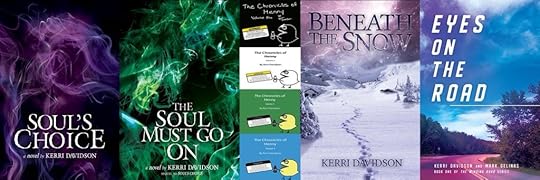 The books of Kerri Davidson
August 18, 2021
Book Review – Be Right Back!: How To Overcome Your Dog’s Separation Anxiety and Regain Your Freedom by Julie Naismith
Book Review – Be Right Back!: How To Overcome Your Dog’s Separation Anxiety and Regain Your Freedom by Julie Naismith
First published, 2019
I live in a multi-dog household. I’ve had dogs since I was really little – six months old when we picked up Rupert from Battersea Dogs and Cats Home – and I’ve had my dog Doobie for almost ten years. Although I have spent my life with dogs, I don’t pretend to be an expert. Luckily, my partner is training to be a canine behaviourist, so I have a bit of a leg-up when it comes to doggy problems. But I suspect one of the most troubling behaviours for most owners is separation anxiety.
It is heartbreaking when you hear a whining, barking, scratching sound from behind the front door, or come home to find the house trashed, the dog trembling; and there’s so much advice out there. Much of it, dreadful. Some of it, harmful. And everyone has an opinion. I’ll say it: often, it’s wrong.
As explained adroitly by Ms Naismith in this how-to guide to dealing with your dog’s separation anxiety, there is no need to use painful, damaging or uncomfortable collars and other equipment to frighten your dog into behaving better. Although shock collars and such do supply quick results, they will do physical and psychological harm an already petrified dog. If you have dogs, especially a dog with separation anxiety, you know you need to put in the work to see meaningful results and a happier dog.
I especially loved the explanation of the difference between attention-seeking and terror-barking. I’ve been told by drinking buddies to let my dog bark it out and I’m absolutely going to quote this in conversations in bars from now on:
“When your dog uses barking to get what he wants, letting him bark it out does work. The dog thinks, Hmm, this isn’t getting me anywhere. I guess I’ll give up.
“The barking that comes from their fear of being alone doesn’t die out. In fact, this kind of barking can spiral. Your dog isn’t barking with an end in mind. It might start out as, “Hey, where did you go? Come back!” but as long as the fear remains, the barking will continue. Anxious dogs don’t think clearly. The longer you leave the dog who has separation anxiety, the more fearful he will become and the longer he will bark.”
Page 43, Chapter One, What Is Separation Anxiety?, Be Right Back! by Julie Naismith
This book teaches the reader, step by step, how to gradually expose your dog to short periods of alone time, at the dog’s pace, so that they learn to manage their emotions and not associate your leaving with the end of the world.
It is so refreshing to find a guide that’s written not for the expert, but for the standard dog-owner (me). There’s a lot of emphasis placed on the dog’s emotional well fare and a lot of honesty regarding how long it’ll take for the training to stick, and I think that’s very important.