Petrina Binney's Blog, page 7
April 25, 2022
Book Review – The Dynamite Kid by Brian Blessed
Book Review – The Dynamite Kid by Brian Blessed
First published, 1992

A powerful, heartfelt and stirring memoir from iconic actor and national treasure, Brian Blessed, The Dynamite Kid starts with his birth in a mining village of South Yorkshire, through the tumultuous War years, and into the author’s early twenties.
From a coal mining family in the north, Brian Blessed grow up at a time when people didn’t have much but the children had adventures that would start first thing in the morning and stretch right the way through to dinner time. His stories of great crested newts and bicycles, childhood tragedies and the BBC Light Programme reminded me sharply of my parents, who grew up around the same time.
I thoroughly enjoyed this memoir, particularly the sections where young Brian discovered his love of acting, and those times when his stubbornness and sense of justice threatened to get him into trouble. I don’t think I’ve ever read such a well-described breakdown as I found in Chapter Eleven, and for that section alone, it’s well worth a read.
I only found this book because his daughter, Rosalind Blessed, and I follow each other on Twitter and she mentioned it once in an interview. Naturally, it went straight to the top of my TBR list, and I’m pleased it did. A delight of a memoir, filled with love, atmosphere and enthusiasm, much, I imagine, like the man himself.


April 10, 2022
Book Review – The Mad Women’s Ball by Victoria Mas
Book Review – The Mad Women’s Ball by Victoria Mas
First published, 2019
Set in Paris in 1885, The Mad Women’s Ball tells the story of four women at the Salpêtrière Asylum, a hospital for lunatics, hysterics and epileptics, in the run up to their annual Lenten Ball.
At the Ball, the cream of the Capital are invited, in their top hats and furs, to eat, dance, and socialise with the madwomen. And, as the inmates spend their year looking forward to the Ball, so the patricians spend the year dining out on stories of the patients and their behaviour.
A powerful feminist story, The Mad Women’s Ball speaks to the experience of women who are considered difficult (for all manner of reasons), while they are passed from the care of embarrassed or disgusted fathers, into the hands of note-taking and ogling medical men. The women are put on display for the edification of giggling male students and the only person who really cares for them is the emotionally shut-down matron, Geneviève.
And so, the main characters:
Young Louise, who developed a womanly figure early and was sent to the asylum after her uncle took a fancy to her.
Thérèse, a former prostitute who has been so violently assaulted by men that she finds peace in the asylum, where the majority of her time is spent knitting, with women.
Eugénie, who confided in the wrong person about her ability to see spirits and who, without proof of her abilities (because there is no way of proving these things) might never leave the Salpêtrière.
And Geneviève, the emotionally closed-off nurse, whose life is her work and whose late sister Eugénie can see over her shoulder. But when the only person who might just listen to the lunatics is herself a woman and therefore under threat of incarceration in the institution, will anyone pay attention and release those who’ve been wrongly detained?
A brilliant novel, filled to the brim with pathos and memorable characters. The writing is robust and assured, and the narrative comes with what I can only describe as an arched eyebrow of a voice, which I loved.
“Beyond the walls of the Salpêtrière, in fashionable salons and cafés, people speculate about what Professor Charcot’s ‘clinic for hysterics’ might entail. They imagine naked women running through the corridors, banging their heads against tiled walls, spreading their legs to welcome some imaginary lover, howling at the top of their lungs from dawn until dusk. They picture lunatic bodies convulsing under starched white sheets, faces grimacing beneath a tangle of hair, the wizened countenances of old women, obese women, ugly women, women who are best kept confined, even if no one can say precisely why, since the women have committed no sin, no crime. For those troubled by the slightest eccentricity, whether bourgeois or proletarian, the very thought of those ‘hysterics’ kindles their desire and feeds their fear. Madwomen fascinate and horrify. Were those people to visit the asylum for the late-morning rounds, they would surely be disappointed.”
9% in, Chapter One, The Mad Women’s Ball by Victoria Mas
A must read. I loved it.
Book Review – The City of Tears (The Burning Chambers #2) by Kate Mosse
Book Review – City of Tears (The Burning Chambers #2) by Kate Mosse
First published, 2021
An epic story about faith and loss, The City of Tears follows Minou and Piet during the approach of a French Royal wedding, intended to unite the Catholic and Huguenot faiths who have, hitherto, been determined to tear each other apart. But as the uncomfortable civility begins to fracture, and the violence and devastation of mob mentality rends Paris asunder in the St Bartholomew’s Day Massacre, Minou and Piet discover, to their horror, that their firecracker of a daughter, seven-year-old Marta, has gone on an adventure through the bloodied streets of the Capital.
In all the mayhem, the press of bodies and the danger posed to the two of them, their baby son, and the elderly aunt who’s travelled with them from the French countryside for the historic wedding, the parents have no choice. After two days of searching, they have to leave Paris and spend the ensuing years wondering about their daughter from their new home in Amsterdam.
But Piet’s arch nemesis, Cardinal Valentin, is also in Paris, seeking artefacts and a way out of the employ of the Duke of Guise.
The ending made me wonder how people always seem to glimpse the last person they would ever want to see – at Royal weddings. Remind me never to go to one.
A tightly written epic, covering hundreds of years and hundreds of miles, I was surprised I was able to keep up with all the characters. At the beginning of the book, there’s a list of the Dramatis Personae – something which usually sets off alarm bells in my head because I’ll surely never remember who these people are – but the characters were so crisply written and the story so engaging, I had no trouble at all. And I loved the violent attention to detail. For example:
“A moment of stillness was broken by the rasp of a sword drawn from its sheath and a flash of steel as the blade slid in. The pastor’s eyes widened in surprise. He looked down, saw the hilt protruding from his belly and felt warm blood soaking his black robes. Then, the suck of the blade being pulled free in a slither of flesh and guts. Only then did the pain hit him and he staggered back.”
p221, Chapter 42, City of Tears (The Burning Chambers #2) by Kate Mosse
Awesome.
Book Review – Post Mortem (Kay Scarpetta #1) by Patricia Cornwell
Book Review – Post Mortem (Kay Scarpetta #1) by Patricia Cornwell
First published, 1990
Kay Scarpetta is the Chief Medical Officer in Richmond, Virginia. A lone woman in a sea of testosterone, Kay has to work that much harder than everyone else to be taken seriously, and she’s got more than enough on her plate anyway.
A serial sex murderer, who stalks lone women to their homes and makes the most of lax security, warm nights and the gathering dark, tortures his victims to death, and every woman who lives on her own begins to feel the terror of the details in the news and the “no comment”s coming from the Chief Medical Officer’s department.
But when Kay’s database is breached and pertinent details of the crime scenes seem, inexplicably, to match the inaccurate press reports, could there be a leak in Kay Scarpetta’s office? And why change the details to match the reporters’ bylines? What is the strange, sweetly-sweating smell detected at one of the crime scenes? What’s with all the glitter? And could a power-hungry, thrusting boyfriend really be a misogynistic torturer?
The pacing of this novel was incredible. The story was powerful and the action never let up. The relationship between Dr Scarpetta and her precocious ten-year-old niece, Lucy, was particularly potent. The writing is sophisticated and the provenance of the author’s knowledge only adds further punch to an already intricately woven tale. To team all of this with a believable, emotionally naive, butterfly-brained ten-year-old left this reader in a whirl.
“The moon was a milk-glass globe through gaps in the trees as I drove through the quiet neighborhood where I lived.
“Lush branches were moving black shapes along the roadside and the mica-flecked pavement glittered in the sweep of my headlights. The air was clear and pleasantly warm, perfect for convertibles or windows rolled down. I was driving with my doors locked, my windows shut, and the fan on low.
“The very sort of evening I would have found enchanting in the past was now unsettling.
“The images from the day were before me, as the moon was before me. They haunted me and wouldn’t let me go. I saw each of those unassuming houses in unrelated parts of the city. How had he chosen them? And why? It wasn’t chance. I strongly believed that. There had to be some element consistent with each case, and I was continually drawn back to the sparkly residue we’d been finding on the bodies. With absolutely no evidence to go on, I was profoundly sure this glitter was the missing link connecting him to each of his victims.
“That was as far as my intuition would take me. When I attempted to envision more, my mind went blank. Was the glitter a clue that could lead us to where he lived? Was it related to some profession or recreation that gave him his initial contact with the women he would murder? Or stranger yet, did the residue originate with the women themselves?”
P200-201, Chapter Nine, Post Mortem (Kay Scarpetta #1) by Patricia Cornwell
Beautiful language, vivid detail, stunning-observed characters and a satisfying conclusion.
Incidentally, this:
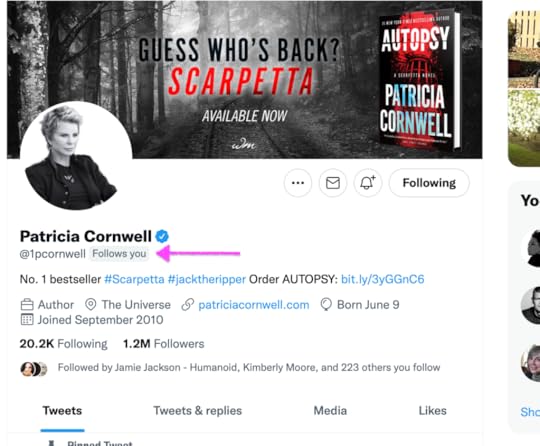
Imagine, if you will, how my mouth fell open when I saw that.
Bigger.
April 1, 2022
Book Review – Wuthering Heights by Emily Bronte
Book Review – Wuthering Heights by Emily Bronte
First published, 1847
A windswept, rugged and gothic tale of passion and revenge, Wuthering Heights follows the rebellious, desperate love between proud Catherine Earnshaw and fatherless foundling, Heathcliff.
Taken in by Catherine’s father as a lonely, wandering boy, Heathcliff is thought of as inherently less than by Catherine’s brother, the arrogant bully, Hindley, who regularly beats and abuses the lost lad, with particular ferocity after the family patriarch dies.
With only one friend in the world, his soul-twin Catherine, Heathcliff is devastated upon hearing only half a conversation, in which Catherine supposes herself too good for the likes of him. Thus, our dark hero goes off to make something of himself, to spite them all.
But death is never far away on the Yorkshire moors and, even through a new generation, Heathcliff is just as devoted, wild and furious as ever, despite his apparent success.
The story of Heathcliff, Catherine and their families is told by Nelly, lifelong housekeeper and confidant, to new tenant, Mr Lockwood, and the pair stay up nights to delineate and understand the history of this star-crossed, but ultimately doomed, pair.
You may remember from my review of Dracula a wee while ago that I wasn’t too taken by the use of phonetic writing for the purposes of conveying accent. It’s a personal thing. I find the phonetic harder to read than standard English. Well, there’s loads of it here. Particularly from hard-hearted, rustic, bible-basher and estate keeper, Joseph:
“…’Aw wonder how yah can faishion to stand thear i’ idleness un war, when all on ’ems goan out! Bud yah’re a nowt, and it’s no use talking – yah’ll niver mend o’yer ill ways, but goa raight to t’divil, like yer mother afore ye!'”
4% in, Chapter Two, Wuthering Heights by Emily Bronte
Good grief.
Both Joseph and Hareton speak in a similar style so there was a lot of mangled speech to work through. I suppose I credit myself with enough imagination to superimpose the accent without having it spoon-fed to me; maybe that’s why it grated.
That said, one thing that struck me quite profoundly and not until close to the end was Nelly; also working class and every bit as Northern as Hareton and Joseph, she’s telling the majority of the story, but has no written accent at all. Which begs the question: is it the fact that she’s being translated by Mr Lockwood that renders her accentless, or does she fancy herself above a manner of speech complete with dialectic tics?
In any case, there are a good number of beautifully observed characters, not a one of them happy, and a stunning meditation on the tragedy of love encumbered by prejudice.
Also, this novel is a useful reference for those of us who’d want to refute the idea that entitlement is a flaw of the Millennial generation, with whom it clearly began. Read Linton Heathcliffe and tell me entitlement is new.
March 29, 2022
Book Review – The Widow by Fiona Barton
Book Review – The Widow by Fiona Barton
First published, 2016
“When I open the door, she hands me a bottle of milk from the doorstep and says, ‘You don’t want to leave that out, it’ll go off. Shall I come in? Have you got the kettle on?’
“I can’t breathe, let alone speak. She smiles again, head on one side. ‘I’m Kate,’ she says. ‘Kate Waters, a reporter from The Daily Post.’
“‘I’m—‘ I start, suddenly realizing she hasn’t asked.
“‘I know who you are, Mrs Taylor,’ she says. Unspoken are the words: you are the story. ‘Let’s not stand out here,’ she says. And as she talks, somehow, she’s come in.”
1% in, Chapter One, The Widow by Fiona Barton
And so, it all begins. Jean, a former hairdresser, has been married to Glen, former banker, later a driver, since she was very young. So young, in fact, that her personality has been subsumed by his and all his actions become theirs.
When Glen becomes distant and starts living his life on the internet, Jean carries on with the household chores, with little to no understanding of the chatrooms with which her husband quietly engages. She certainly doesn’t know about the images on his computer, until the police take it away, and Glen has an explanation for everything: identity theft, malware, credit card cloning, something he stumbled onto, an addiction, it’s her fault.
Because Jean has always longed for a baby; she’s dreamt and scrapbooked her fantasy family for years. She’s always wanted children. And so has Glen. Just not in the same way.
But when a child goes missing on one of Glen’s driving routes, the evidence is only patchy, but Jean insists on standing by her man. But the press are parked in front of the house, clamouring for interviews, and she knows he wouldn’t take a child. He wouldn’t hurt a child. Would he?
Cleverly written with fascinating characters and a shocking storyline. I was in too much of a rush at first and didn’t read the dates at the beginning of each chapter as carefully as I should have. Entirely my fault, and that’s why I struggled to keep the storyline in place for a little while. Luckily, that only happened for the first few chapters, so I was able to go back and get the timeline straight in my head quite quickly. I read the rest of the book voraciously, and over the course of a day. Loved the writing. Even when the subject matter was difficult, it was handled with superior skill. A triumph.
March 28, 2022
Book Review – Baby Talk, Book One: The Womb Has Ears by Mike Wells
Book Review – Baby Talk Book One: The Womb Has Ears by Mike Wells
First published, 2011
The story follows Neal Becker, young husband and father who has been tricked into both roles by uncompromising Annie. With his new responsibilities, Neal has had to drop out of college and take an ordinary sub-minimum wage job that he hates in order to keep the new family’s heads above water. Resentful of his change in circumstances, disgusted by their rathole apartment, and regretful of the few seconds of pleasure that led to them, Neal freaks out in epic style when baby Natasha suddenly starts talking to him at the tender age of five months.
But worse is yet to come. With each interaction, Neal becomes more and more convinced that the baby is trying to kill him.
I found myself feeling every ounce of Neal’s frustration, particularly when his new wife dabbled in babble-speak when talking to the baby:
“’Can ooo help Mommy find a parking space?’
“Natasha smiled back and wiggled her arms.
“‘Sure you taaaan,’ Annie said, patting the baby’s fuzzy blonde head.”
72% in, Chapter Seven, Baby Talk Book One: The Womb Has Ears by Mike Wells
The fact that the mother uses half-formed words was rather galling, particularly as, behind her mother’s back, the child seemed to have a far larger vocabulary than her parent. It was, however, an important aspect of the mother’s character, which came across very clearly. The story was very well-written, with intriguing characters and a clever plot.
March 22, 2022
Book Review – Tales From The Greenhills by Terry Melia
Book Review – Tales From The Greenhills by Terry Melia
First published, 2018
The story follows Tommy, a scally, but not a bad chap, as he approaches adult life during violent gang battles in Liverpool during the frighteningly hot summer of 1976.
As Tommy tries to get into girlfriend Linda’s underwear, gang leaders circle each other as their hatred rises with the temperature. And although not really part of it, trouble follows Tommy wherever he goes. Even when he takes a little holiday to the Welsh countryside, it’s not long before angry words and blows are exchanged. But Tommy has a big decision coming his way. Will he go home, or will he start a new life elsewhere?
A very evocative portrait of both time and place. I was thoroughly transported and very taken with the main character.
The swearing, though copious, fits fully with the subject matter, and the story is well drawn, and very well paced. I could see this turning into a weekend drama series on TV. A handful of missing apostrophes but not a lot to complain about. A very enjoyable read.
March 15, 2022
Book Review – The Fallen Stones by Diana Marcum
Book Review – The Fallen Stones by Diana Marcum
First published, 2022
and a half
A travelogue about a butterfly farm in Belize, Central America, and its relationship to a butterfly attraction in the UK and parts beyond.
I found the stillness and beauty in the narrative very evocative. There’s just something about butterflies that encourages a sense of calm and wonder.
I did think, right in the beginning, that the author and her husband had better be divorced by the end of the book:
“I despise men who try to control women with their little fits and jealousies.
“‘What’s wrong with you? Don’t try to tell me what I can and cannot do!’ I screamed, no longer envying the tempestuous types.
“‘Maybe you should go find a Diego, a Mikhail, a Pierre who likes to daaaaaaance!’ he bellowed, doing some odd imitation of a cha-cha-cha. ‘Maybe you’d be happier without me Maybe we shouldn’t be together.’
“I didn’t think I was the histrionic type, but apparently I am. I started crying.
“‘Leave me alone. Don’t follow me,’ I hissed and ran down the beach to our sad little shack that he’d booked because he only looks at the photos and doesn’t read 227 comments.”
5% in, Chapter One, The Very Bad Vacation, The Fallen Stones by Diana Marcum
A beautifully captured scene of passive aggressive argument-making. Anyway, the need for calm and giving becomes apparent and the author travels to the butterfly sanctuary in Central America and learns all she can about the flying lovelies.
Unfortunately, and I don’t know why those who are unsure don’t check Debretts (https://debretts.com/), there are a couple of occasions when the author refers to Dame Miriam Rothschild as “Dame Rothschild”. I’m sure there are people out there who think that’s, if not correct, then, not a big deal.
It’s a huge deal and it irritated me no end.
The general rule is: it’s Lady Surname, Dame First Name. If you called Maggie Smith, “Dame Maggie” that would be accurate, though she’d probably think you were impertinent. If you called her “Dame Smith”, she’d think you were a philistine. I’m basing these opinions on interviews from across the years, I don’t know her – more’s the pity because at least I know how to address her.
You’d be quite right in thinking this should have been a minor irritant at best, but it haunted me throughout the reading. I was just getting over it, when the author wrote “Dame Rothschild” a second time and I blinked quite rapidly for a good two minutes.
Book Review – The Girl Who Kicked The Hornets’ Nest (Millennium III) by Stieg Larsson
Book Review – The Girl Who Kicked The Hornet’s Nest (Millennium III) by Stieg Larsson
First published, 2007
In this third instalment of the Millennium series, the last written wholly by the original author, Stieg Larsson (who died suddenly at the age of fifty in 2004), we find erstwhile, antisocial and much-abused heroine, Lisbeth Salander, beginning the road to recovery from the shocking encounters of book two, The Girl Who Played With Fire. Not going to spoil it for anyone currently reading it but book two is dynamite.
In The Girl Who Kicked The Hornets’ Nest, Salander is in hospital, looking for a means of communicating with the outside world, while absolute rotters Dr Peter Teleborian and the Section do their best to discredit Lisbeth and lock her up for good. Meanwhile, Mikael Blomkvist is writing his book about Salander’s devastating history, to be released at the beginning of a trial that’s bound to rock the nation. And Erika Berger, having started her new high-powered job at Svenska Morgen Posten, has drawn the obsessive attention of a misogynistic stalker.
Gosh, it all happens, doesn’t it?
As ever, Stieg Larsson has woven a fabulous cast into an astonishing, jaw-droppingly original story. Sadly, I did struggle through some of this 746 page brick. Strangely, it wasn’t the length that challenged me. There were quite a few scenes – especially those including descriptions of the structure of Swedish government and the secret service that just lagged for me. There was lots of complex, intricate information which slowed the story to a dead halt and intruded upon the narrative. It was enough to make me wonder if another writer had filled in the blanks in an incomplete manuscript and sought to stamp their own authority on it with a total change in style. But no, I was wrong.
I’m not without understanding: fact is, it is important to understand the structure of the various organisations that come into play within the story – to see how deeply the corruption runs, but it felt like an unceremonious info dump, spread across several chapters. That said, I wouldn’t have missed those last hundred pages for the world.
Five stars for the story and the characters. Three stars for the plodding informative bits. Meet in the middle, we’ll call it a four.