Omid Malekan's Blog, page 3
June 11, 2019
The Stablecoin Manifesto (and a defense of Facebook)

Yes, even I’m surprised that I’m defending that company. And no, I haven’t changed my mind about their disintermediation or the rotation from platforms into coins. Nor do I have confidence that Facebook’s foray into stablecoins will be a success. This is a defense of their idea of developing a blockchain-based payment network.
That defense, as it applies to Facebook or anyone else that applies DLT to dollars, starts with a number: $2 trillion. Those are the revenues of the payments industry today, expected to grow substantially in the next few years. And why not? As the world grows increasingly global, digital and platform based, more and more money needs to zoom around for goods and services, or borrowing and investing. Someone needs to own the pipes through which that money flows, and those owners need to be compensated.
Or do they?
Let’s answer that question by asking another: what exactly is a payment? Is it a product? service? In my not-at-all humble opinion, it’s neither. A payment is a transfer of data. Money is just information, and always has been. If I pay you with a physical dollar bill, all that happens is the universe now considers me a dollar poorer and you a dollar richer. The point of money is to keep score, and the preferred mechanism is always whatever happens to work best.
The first mechanism was physical and intrinsic: the coins in your possession were your score. Then banking showed up and introduced scorekeeping via ledger. Ledgers used to be written on paper, and updated by sending around more paper, like a check. Then things were sped up with telegraphs and telephones. When databases showed up they got adopted, as was the internet. Today, the scorekeeping happens via an interconnected networks of ledgers inside banks, clearinghouses and FinTechs.
But the payment is still just data, traveling as debits and credits across different databases. Venmo doesn’t have a bag of cash with your name on it sitting in a vault, it has an entry in a ledger, and Venmo’s bank doesn’t have a bag of cash either, nor does that bank’s central bank. It’s all ledgers updated continuously and electronically. But therein lies the problem, because electronic is not digital.
Consider this: today, I can send almost anyone on the planet a text or an image instantly and at no marginal cost. Texts and images are just data, and data roams the world fast and free. Even voice calls are free, because a voice chat is also just an exchange of data. But if I want to send that same person a payment, then I have a problem.
Payments are a special kind of data, because they require guaranteed delivery, perfect reliability and total security. For a text message to not arrive or a voice call to have static is not a big deal, but a failed or error-riddled payment is. Thus the need for electronic payments to travel across special pipes like cards networks or correspondent banking. The core protocols of the Internet — great as they are for moving texts and images — are not good at moving value. So we’ve needed separate applications (like Venmo) on top of them to handle payments.
But now, there’s a blockchain for that.
What the base layer of the internet can’t do, protocols like Bitcoin, Ethereum and whatever else is yet to come do well. Yes, they were built for crypto, and no, the world isn’t about to abandon fiat money. Blockchain is just a tool for digital value transfers, and it can be used for anything, from Dogecoins to dollars to digital cats. It is natively digital, which makes it distinct from our electronic payment systems, most of which were architected before the internet showed up. These legacy systems have adopted certain digital features, but their DNA dates back to a bygone era. They are what Blue-Ray disk was to VHS. They are not Netflix.
The availability of this new tool has now inspired a crop of new entrants into the payments universe, including Circle, the companies behind the Utility Settlement Coin and Facebook. Unlike the legacy players who treat payments as a service to charge for, these guys are treating it like the data it always was, and understand that data wants to be free. In a world where everyone has access to unlimited data, it doesn’t make sense to have users pay extra for just one kind of data. That’s how Skype eliminated the long-distance calling industry. It’s also what stablecoins will do to the payments industry.
Disruptive new tech is seldom developed by the legacy giants of the old guard, for obvious reasons. Skype wasn’t invented by AT&T and stablecions aren’t being pioneered by those collecting big chunks of that $2 trillion. They are being built by new entrants to that world who see the ability to offer affectively free solutions as a good foundation for other business models. That’s Circle, Fnality and Facebook for you. Today’s legacy payment rails have been put on notice. I can already use USDC on Ethereum to pay an Ebay merchant a grand for just pennies in fees. How much longer will PayPal get to charge $30 for the same thing?
The only unknown is who will win this new arms race. It could be the existing stablecoin providers, Facebook or someone else. There are also thorny questions of how AML, KYC and sanctions laws will be applied. But people will find solutions, as tech always leads regulations, not the other way around.
The acceleration of payments towards free — a trend began by other tech solutions — will be great for society. Revenues on payments are a tax on data, which means we are headed for a $2T tax cut. Imagine the resulting value creation, not to mention the social benefits of payments that no longer discriminate against the poor, migrants or the unbanked.
As I have said before, the dollar will be the first killer application for blockchain.
PS: If there’s one critique I have of Facebook’s efforts, it’s this whole “global coin” business. Nobody other than academics at an NGO wants a basket currency. It looks and sounds like something from Mr. Robot. People are fine with euros and dollars so long as the trust the source.
And while we are at it, could the entire industry please drop this whole “coin” business? Bitcoin is a coin. A tokenized dollar is not. When people log into their Venmo account, it doesn’t say “Venmo Coins,” it just says dollars, which is accurate, because after all, it’s just a way of keeping score.


May 10, 2019
Dr. Stablecoin or: How I Learned to Stop Worrying and Love Tether

I’ve been a vocal advocate of stablecoins for a while, and have written about my belief that they’ll be the first killer application for blockchain. I my talks, I often refer to Tether as “the worst implementation of a great idea,” on account of the persistent lack of transparency, bank hoping and poor communication.
That shadiness, combined with its popularity, has made USDT an industry liability for years. Although I never subscribed to the crazy conspiracy theories, I have always worried that a stablecoin-related scandal would tank prices and make me look bad. When you are passionate about a new idea, the biggest danger is a poor implementation early in the life cycle ruining it in the eyes of others. So imagine my excitement last year when a handful of better designed, more transparent and willingly regulated alternatives showed up. Surely, I thought, all the people who used Tether would now switch to something safer.
Except that they didn’t, and Tether continued to dominate in market cap, even after news of withdrawal issues at parent exchange Bitfinex temporarily collapsed the peg last fall. This should have been the first sign that the world of stablecoins was not as I thought it was, but I wrote it off to a temporary lack of availability of the other coins at major exchanges.
Then came the recent filing from the attorney general of New York, and the worst case scenario was realized. There was now solid proof from an important authority that there were more tokens outstanding than dollars backing them by a wide margin. Surely the UDST peg would now collapse by at least the amount of the missing funds — if not more, and the industry would swiftly move to a better stablecoin. Upon hearing the news, I put several cross-stablecoin markets on my quote screen and waited for the fireworks to start, relieved that the albatross would soon be lifted.
But that didn’t happen, either. Confirmation of Tether not being fully backed had more of an impact on the price of Bitcoin than USDT itself. The peg never fell by more than a few percent, despite Bitfinex effectively admitting that a substantial portion of the collateral was no longer cash, but IOUs of funds that had been confiscated or stolen. Today, Tether’s peg sits back near $1, and the market cap has barely budged. At this point, I have to concede that the market has been trying to teach me something new, and that the world of stablecoins is not as I thought it was.
Having mulled it over for a week, here is what I’ve learned.
Tether Was Fully Collateralized At One Point
Most of the fears surrounding Tether and the crazy conspiracy theories revolved around the idea that its managers minted tokens whenever they felt like it, and that the stablecoin was never fully backed. The NYSAG filing disproves that. Their investigation shows that USDT was fully backed until Bitfinex was more or less robbed and forced to borrow some of Tether’s cash to continue meeting client redemptions. Sometimes, bad news makes a market go up because the reality is not as bad as what was feared.
In a way, we’ve finally gotten the outside audit of Tether we’ve always wanted, albeit from an investigation into whether the funds were wrongly used and the public misled. Presumably, if Tether had been lying about its reserves from the get go, they would have been prosecuted for that fraud as well. We can reasonably conclude that at some point last year, USDT was fully backed by dollars sitting in a bank account, a fact that many never would have expected just a month ago.
The Intent Was Good

Something else that becomes apparent from the court filings is the fact that the people orchestrating all of this at iFinex had good intent, even as they were deceiving their customers. Tether no longer being fully backed is not the result of a Machiavellian scheme to manipulate Bitcoin prices, but rather executives being forced into a corner by a combination of unfair banking practices, shady service-providers and their own history. Deceiving your customers is wrong and should be prosecuted, but how that deception began — the intent — still matters.
In this case, cash that technically belonged to USDT holders was swapped for a loan backed by a combination IOUs on the frozen Bitfinex funds, equity in that exchange, and rights to some of its future cash flows. The last two “assets” might seem worthless in any other context, but the success of exchange coins like BNB proves otherwise. So the collateral backing the loan from Tether to Bitfinex has some value. More importantly, this was all done in a desperate bid to not destabilize the crypto market.
History Matters
Finance in the abstract tends to be a top-down, “view from 30,000 feet” affair. What I mean is that when we talk theory, we often talk about static conditions and definitions. For example: what makes a good stablecoin?100% collateralization in safe, liquid cash held by a trusted and large balance sheet who facilitates client redemption in a timely fashion.
Finance in practice is far messier. Execution is often dynamic and involves navigating common known unknowns along with the occasional black swan. In other words, it’s less algorithmic and more human, so hard to define concepts like relationships, perception and history matter more than an abstract academic might think.
I myself stopped using Tether long ago, so I took for granted that many others didn’t, and that for them, the stablecoin has a long history of working. This seems to be a theme that comes up when reputable reporters go looking for answers to the same questions that I’ve had. Here’s Frank Chaparro from The Block, quoting a source:
“People have tried to redeem even single digital millions (tiny really) and Gemini has failed to allow those redemptions,” one person said. “Whereas even with these events, Tether [redemptions] are working fine.”
The same understanding of history can be expanded to the rest of the Bitfinex universe. As others have pointed out, the exchange has a long history of recovering from attacks and setbacks, including another time when it issued a token to recover lost funds. Investors and their clients have always been made whole, as have the users of Tether.
In Conclusion
Crypto people are big fans of the “Lindy Effect,” or the theory that the longer something has been around, the longer it will continue to be around. By blockchain industry standards, Tether is ancient, predating the start of most of our careers. That wouldn’t have happened if it didn’t do what it was supposed to do, far more often than not. In that sense, my attitude towards it is now a lot less critical than it used to be. Despite now being a year old, it’s biggest rivals barely manage 1/10th the market cap. This tells me that operating a proper stablecoin is hard.
During my talks on the potential for stablecoins I usually include a slide with pictures of money orders, cashiers checks and prepaid debit cards to prove that the idea of using proxies for cash being held by a trusted party to make a payment is neither new nor controversial. What is new is the fact that thanks to public blockchain rails, those products can now ride the first truly decentralized and global payment network. The threat of disruption there cannot be understated, and in the short and immediate term is far greater than the disruptive threat of Bitcoin.
But the road to get there is messier than I initially thought. There will be a battle for dominance between Tether, its existing rivals, whatever we get from the likes of Facebook & Telegram, bank tokens like a JPM Coin, and possibly even a central bank digital currency. It’s too soon to predict who will win, but I now believe that two important considerations will be which ones work well, and have a long history of doing so.

May 2, 2019
You Can’t Change Without Changing
 source: Adledger
The recent Adledger conference on the intersection of new technology and digital advertising included a panel of experts discussing how blockchain might improve the online programmatic market. The panel included a handful of professionals representing brands, publishers and agencies, and they all seemed to appreciate the stakes. To their credit, despite having come up the ranks in the legacy era, they can all be considered pioneers on account of joining an organization like Adledger and being open to reinvention of their industry.
The conversation was lively, but there was a sort of tension in it, because most were trying to argue that blockchain would indeed change their industry, without actually changing it. Let me explain.
In case you aren’t familiar, programmatic advertising is where online content sites auction off “eyeballs” to brands looking to advertise. In between sit a morass of intermediaries who supposedly provide an important service while taking a cut, as demonstrated in the picture above. Everyone gets paid on volume, and neither the party paying for the service nor the one providing it has much visibility into what happens in the middle. As often happens in markets with low transparency and poor incentive structures, fraud and abuse run rampant, and the middlemen end up eating a lot of the value.
The problems with this market remind me of the securitized mortgage market before the crash, and some of the experts I’ve talked to within the industry don’t disagree. Research shows that up to a third of all money spent goes to fraudulent bots and domain spoofers, and even the “honest” work being performed by the intermediaries takes such a chunk of the profits that it is collectively known as “the tech tax.” If there was ever a market in need of transparency, provenance, consensus and “a single source of truth,” it’s this one. Thus the birth of Adledger itself, and a handful of blockchain startups trying to apply the tech, or even just specific aspects of it, to the industry.
Which brings us back to that panel. While everyone on stage agreed that the current market has its problems, and that blockchain could be a force for good, nobody wanted to admit the obvious fact that success means eliminating some of the folks in the middle. One panelist even said that he doesn’t care for the pejorative use of the word tax, “so long as everyone is doing something valuable.”
I appreciate where he is coming from, but his thinking misses the broader point that you don’t need to be doing something “not valuable” under the legacy model to be a candidate for disintermediation in the new one. In fact, I would argue that most companies that have been disintermediated throughout the ages were doing something highly valuable. That’s why they were targeted. (“Your profit margin is my opportunity,” and all that)
I experience this tension in blockchain conversations regularly. On the one side you have the people who value the transformative nature of the tech, and on the other you have those who don’t want anyone to lose their job or go out of business. Sometimes both ideas are held by the same person. The cognitive dissonance is understandable, but unsustainable.
Lest we forget, the whole point of this technology is to decentalized and disintermediate. Great for users, but bad for intermediates. Just as you can’t have “Peer to Peer Electronic Cash” without eliminating those that traditionally sit between sender and receiver, you can’t have blockchain-enabled programmatic without cutting out some of the boxes pictured above. Otherwise, one shouldn’t bother. The trade-offs of moving to a distributed ledger of some kind are too significant to try to dump your current industry stack into it.
So the next time someone proposes a blockchain solution to a legacy problem, it’s worth asking who they are going to put out of business. And for those sitting smack dab in the middle (here’s looking at you shared economy platform) I recommend considering the old poker adage about taking a hard look around the table and seeing if you can spot the patsy.

April 15, 2019
An Open Letter to CoinDesk: Please Stop Publishing Price Predictions
Technical analysis of price charts is not news, and hardly qualifies as analysis. That basic point, understood by most reputable forms of financial media, seems lost on CoinDesk. The popular blockchain and crypto news site loves publishing articles like this, chocked full of sentences such as:
A break above last week’s high of $5,347 would invalidate the weekly chart doji candle, although an immediate rally to $6,000 looks unlikely with the daily RSI still flashing overbought conditions.I hereby respectfully call on them to stop publishing this pseudo-science and all market predictions other than the rare few that can be considered newsworthy because they were made by someone prominent, or managed to move the market.
The first problem with publishing such articles is that they are not credible. As a general rule of thumb, people who know how to trade short term moves successfully (those rare unicorns, made even rarer by a hard winter) don’t tell you their secrets for nothing (or whatever CoinDesk pays its writers). They raise big funds and charge investors hefty fees. Given how hard of a time the prominent crypto hedge funds are having generating alpha, what are the odds some web pundit will get it right?
The second problem is that they are bound to be wrong more often than not. Short term trading itself is a negative sum game (it starts out as zero sum, requiring a loser for every winner, but turns negative since exchanges and the Tax Man always get their cut). If the actual trading is often wrong, how good can the writing about the trading be? Unless of course…
Given how hard it is to predict actual moves, pundits tend to hedge every call by also predicting the opposite. That’s why you get a lot of this “it looks like it’s going to go up, unless of course it goes down” analysis. The article linked to above tells you if Bitcoin falls below $4900 it’s going to $4500, but also says if it goes to $5300 it’s going to $6000. And those are just the opening bullets! Imagine if weather forecasts had the same conviction…”if it rains you’ll need an umbrella, but if it doesn’t you should have brought your sunglasses.”
I don’t mean to pick on anyone, but this wishy washiness is a staple of the creepy market prediction industry (just tune into CNBC around lunchtime or after the close to see what I mean) and infects almost every CoinDesk article predicting price. Being a successful trader is about being right, while being a successful pundit is about being able to pretend like you were right after the fact. That’s why you never see a CoinDesk article that says “Bitcoin is definitely going up” and instead get essays on the doji on Dogecoin being bullish while the RSI on Ripple is bearish. It’s also why no CoinDesk pundit ever says “Here is a link to my synthetic portfolio where I execute every trade so you can measure my ability in real-time.”
But the main reason why CoinDesk should stop with these articles is that they confirm the worst stereotype of the crypto industry being nothing but a bunch of amatuer punters. That point was made today by the sites very own resident expert Michael Casey:
There’s something fundamentally wrong with reducing the measure of bitcoin’s worldwide importance to a price metric that’s denominated in a fiat currency that its advocates hope to replace. It pushes the debate into an inane all-or-nothing binary set of predictions: bitcoin is either going to zero or “to the moon.”
The price of cryptocoins is important for a host of reasons, including security, adoption and attention. I spend a lot of my time as a consultant countering the “blockchain, but not Bitcoin” narrative that is so prevalent in legacy industries, as it entirely misses the point of the important connection between the two. But writing news articles about what the market has done is very different than publishing forecasts on what it will do. One is the stuff of respectful reporting, while the other is best left for aggressively marketed trading newsletters that don’t pretend to be journalism.
So I hereby call on CoinDesk to stop publishing these ridiculous articles. Doing so diminishes their otherwise respectable brand and quality journalism and, as them being an important symbol for the overall industry to outsiders, makes us all look bad. At a certain point, we all have to grow up.

April 10, 2019
MMT & and the Fracturing of the Free Lunch Crowd
Before my blockchain career, I had a brief stint as a famous economic pundit thanks to a viral cartoon criticizing the Federal Reserve’s Quantitative Easing program. There was plenty that I got wrong in that cartoon (as I’ve discussed before in the New York Times) but my general skepticism of playing money games to fix structural problems or fighting the business cycle has withstood the test of time.
That the second round of QE failed to deliver what was promised by the likes of Ben Bernanke was proven by the fact that we ended up needing many more rounds, and yet significant GDP growth, inflation or wage gains never materialized. What gains have showed up are obviously fickle, as proven by how quickly the Fed changed its mind on “undoing-QE” recently.
What QE did succeed in doing was exploding the wealth gap and inspiring populist uprisings. Central Bankers would like us to believe that when they channel free money to banks and billionaires they are really helping poor people (going so far as writing papers and making videos arguing as much) but unfortunately for them, reality doesn’t agree. When Fed policy causes a jump in the stock market (as discussed here, here, here and here) and Amazon’s stock surges as a result, Jeff Bezos benefits more than his minimum wage earning warehouse employees.
To argue otherwise is prove that central bank economists are even dumber than we thought. Or, to invite others to co-opt the idea. If printing money is good and inconsequential, then why not print money to built roads, give people healthcare or even introduce basic universal income?
That in a nutshell is at the core of MMT, or Modern Monetary Theory, an old idea that’s enjoying a resurgence thanks to support by young political luminaries like Congresswoman Ocasio-Cortez. MMT argues that government can print money to fund itself today, then deal with any resulting inflation by raising taxes or issuing debt tomorrow. A free lunch, followed by a free dessert.
It’s a cooky idea with a lot of complicated pieces, but what is most remarkable about MMT is the fact that it is opposed by a who’s who of the “print money to give to Wall Street crowd.” Take Janet Yellen, former Fed Chairwoman and a great fan of QE. She recently told an audience at a conference that she’s not a fan of MMT because “that’s how you get hyperinflation.” During the same talk, she said that although she doesn’t see a recession on the horizon, the Fed might have to cut rates anyway.
Former New York Fed President Bill Dudley has likened the theory to what’s happening in Venezuela, a daring comparison from the man who helped execute the Fed’s alphabet soup of interventions after the financial crisis, including one that circulated printed dollars to the wives of Wall Street CEOs and the government of Muammar Gaddafi.
I’m going to go out on a limb and speculate that the real reason why MMT is suddenly so popular is because of the hypocrisy of its biggest critics. If you are for printing money to bail out irresponsible companies and dictators, you probably shouldn’t argue against printing money to expand the social safety net. And yet Jerome Powell, the Fed Chair whose easy-money-reversal just made Jeff Bezos significantly richer, has called the theory “just wrong.” Even more hypocritical was Peter Praet, chief economist of the ECB, when he tweeted:
body[data-twttr-rendered="true"] {background-color: transparent;}.twitter-tweet {margin: auto !important;}Praet: The general idea that government debt can be financed by central banks is a dangerous proposition. In the past, this has resulted in hyperinflation and economic turmoil. That's why central banks are independent @ramontremosa @pedroantoniak @Paolo_Guida @patrikakis #AskECB https://t.co/9LonoN2JqF
— @ecb
The European Central Bank has expanded its balance sheet by over two trillion euros during Praet’s tenure, and used the printed funds to finance the debt of troubled countries like Italy. It’s also bought the bonds of private companies, including a failed supermarket chain and a fraudulent South African retailer. With chief economists like that, is it any wonder that Europe is tearing itself apart?
MMT might be the second worst idea in economics, but at least its advocates are intellectually honest. The economists who got us going down this path of printing-money-to-cure-all-ills are not. A collision between these two camps was always inevitable. As others have astutely observed, QE is socialism for the 1%. Here comes everybody else.
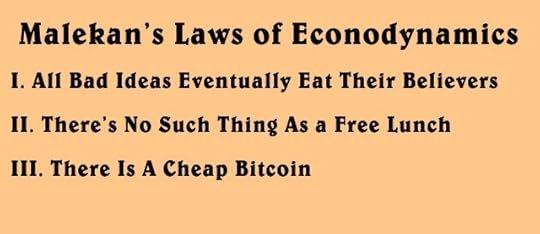
As a general rule of thumb, all bad ideas eventually devolve to their ugliest form and devour their biggest believers. Communism turned on Trotsky, Facebook sold out its users, and MMT is slowly devouring QE. Those who have embraced free money for some can only resist for so long against politicians arguing for free money for all.
Which brings us to my second and third laws of econodynamics. Although there’s no such thing as a free lunch, there is such a thing as a cheap Bitcoin. The appeal of decentralized money only grows now that the print-money-crowd is in turmoil. Aside from a fixed and algorithmic inflation schedule, the other benefit of crypto in such a world is as a vote. A vote for the growth of the platform, and a vote against a legacy system soon to be consumed by the greater of two evils.

April 5, 2019
Maker Shows the Way

The 2008 financial crisis had no single cause, and instead resulted from an amalgamation of factors that built up over time into one terrifying crescendo. They ranged from financial engineering to government policy, along with the twin tendencies of greed and fear. Many of those issues have been addressed since, but the opacity of the banking system remains, partly because there is no way get rid of it.
It’s hard for big companies to be transparent about their health because even insiders sometimes don’t know. The most terrifying moments of the crisis revolved around this hard truth. Banks have always had strict reporting requirements, and are even more closely watched today. But consolidation and the ancient systems most financial institutions still use make it hard to gauge their exact health — with one exception.
Welcome to the the world’s first fully transparent bank. MakerDao is a blockchain project where users put up an asset as collateral and borrow money against it. It’s a decentralized bank that utilizes modern technology to replicate the oldest financial transaction in history — borrowing cash against an existing asset, an activity anyone who’s taken out a mortgage or bought stocks on margin is familiar with.
The project currently only accepts the native currency of the Ethereum blockchain as collateral, and lends a digital currency pegged to the dollar called Dai. Since it resides on a public blockchain, everyone can watch in real time as users all over the world put up collateral, borrow money, repay their loan with interest or, should the value of their collateral fall too much, get liquidated. Bankers and underwriters are replaced with smart contracts executing known rules. While every other bank in the world tells you what their lending practices are, Maker will show you.
Despite the negative associations of blockchain technology in regulatory circles, it offers a form of radical transparency that doesn’t exist elsewhere. The public knows more about the status of Maker than your typical CEO may about his own company. Despite having no official regulator, Maker is arguably the most regulated financial entity on earth, as anyone can scrutinize every loan. So while traditional banks require an army of employees, auditors and regulators to estimate a figure like their collateral ratio, Maker yields the exact number as of the next block. (398% as of block #7507738.) You can’t make this stuff up. Literally.
For now, MakerDao is relatively tiny, warehousing $356m in collateral and lending $89m against it. The projects rapid growth has led to more borrowing and stablecoin generation than there is currently demand for, leading to Dai occasionally breaking below the $1 soft peg. The community has tried to resolve this situation by raising the system’s interest rate — in the same fashion that a central bank might raise rates to defend its currency. Unlike a simpler fiat-backed stablecion, Dai is prone to drifting from its peg due to liquidity flows. But also unlike a fiat-backed stablecoin, Dai is truly decentralized and totally uncensorable.
In lieu of executives, Maker’s governance is handled through a digital token called MKR, a pseudo-equity stake in the success of the project. Ownership of that token gives anyone the right to vote on decisions like changing the interest rate. To incentivize responsible banking, MKR owners get to collect the interest payments the system generates. But to make sure that they don’t suffer from the same greed-fueled lowering of lending standards that contributed to the financial crisis, MKR owners are also buyers of last resort should the collateral backing the loans prove insufficient. Just imagine: a bank where executive compensation, and not taxpayer funds, is used for a bailout.
Although legacy banks talk about inclusion and reaching the unbanked, they are limited by the laws of physics. The manual work of determining credit worthiness and issuing a loan has a minimal cost that makes the activity unprofitable for smaller loans. Maker’s automated processes on the other hand are value agnostic. Smart contracts don’t care if you want to borrow one dollar or one million dollars. They also don’t care, and don’t even know, about your age, gender or race. To the blockchain, we are all just numbers.
For all the controversy surrounding blockchain and its ill-begotten reputation as appealing primarily to criminals, it is in many ways a regulator’s dream come true. It replaces regulations written in thousand page bills and enforced by underpaid bureaucrats with elegant code. Although there is an open question of whether Maker’s governance token violated securities laws when it was issued, there is no doubt that its banking features are more compliant than any legacy bank can be — so much so that even regulators are starting to take notice. Just recently, the Chairman of the CFTC speculated that had this technology been around during the 2008 crisis, the government could have had a more effective response.
Maker is just one of a brand new class of “decentralized finance” projects that are starting to sprout on public blockchains. They include lending, money markets and even market making. Most are predicated on a simple question: other than being a trusted middleman, is there anything special about the services provided by a bank? If the answer is no, then the service can — and probably will — be disintermediated, with the key requirements of trust and liquidity being provided by a public ledger.
The basic human needs of trading value for time or security for profit has not changed for thousands of years, but how institutions go about providing them has. Blockchain enabled decentralized finance is the cutting edge of that evolution. It is unlikely that the transition will be as smooth as the faithful would like to believe, but the potential is large enough that even the biggest skeptics should pay attention.

March 29, 2019
The App Is Not the Special Thing

Here’s an interesting fact about Lyft as it goes public today. According to its IPO filing, the service now boasts 1.9 million drivers. Once it goes public, its two co-founders, who by then will own only 5% of the company, will still control 49% of the vote, thanks to the controversial dual-class share structure many tech Unicorns employ.
What percentage ownership do the drivers who take most of the risk and do all of the work for its core business get? Zero. What about a vote in the projects future? Also zero. The shared economy, as it turns out, is not that shared.
This is an odd situation for a company that, like its peers Uber and AirBnB, and even user content driven social media platforms like Twitter and Facebook, talks a big game about empowering drivers to be their own bosses. The drivers that I encounter seldom seem all that empowered, especially now that they see the company going public with nary a profit or input from them.
A critic might argue that this is true for every employee of a big company that is doing well, and has been since the dawn of the industrial era. But there is a difference. In the industrial model, the corporate entity is the special thing. In the P2P shared-economy model, the network is the special thing. The flaw with Lyft and every other company like it is that the value generated by that network is increasingly captured by those who built the app. But the app is not the special thing. Not anymore.
In the beginning, the app was the special thing, and therefore, those who built it — the founders of these companies — were taking a substantial risk. For that they deserve to be rewarded spectacularly. But now that the app has matured into a network, it’s the drivers, homeowners and content creators who shoulder almost all of the risk. For that, they should get more upside and more of a vote. The longer the network persists, and the more the network effect grows, the greater their share should become.
Lyft and companies like it offer the exact opposite. Which is why in the years to come, they will be disintermediated by blockchain-based communities that — like Bitcoin has done for P2P payments, or Ethereum has done for P2P computing — do reward the original founders, but as time rolls on, reward them increasingly less.
When Ethereum was launched, the founders and initial investors had all the say and captured all the upside. But as time has rolled on, the miners that maintain the network have taken increasing ownership, as have the dapp builders who are increasing its network effect. Vitalik and Joe Lubin have gotten rich off their creation, and deservedly so, but their share of the upside, and their say in important decisions, declines with every new block.
Which model strikes you as more sustainable?

March 15, 2019
Manipulation in Bitcoin
Is the price of Bitcoin manipulated?
That the answer to that question must be yes is one of the few things that most people, from crypto maximalists to blockchain skeptics, agree on. And not just the typical kinds of market irregularities that one expects from a young asset class, but manipulation that has a material impact on price for more than a fleeting second — and makes one question the integrity of the whole shebang. Here is famous crypto critic Nouriel Roubini:
body[data-twttr-rendered="true"] {background-color: transparent;}.twitter-tweet {margin: auto !important;}4800 Pump & Dump schemes! Crypto is THE most manipulated financial market in ALL human history & manipulation of "assets" that are all shitcoins & worth ZERO. It makes the Wolf of Wall Street look like a naive amateur. And in spite of this sleaze shitcoins lost 95% this year!
— @Nouriel
As a general rule thumb, any declaration that something is the most [insert adjective] of all time is not very credible. Is crypto really more manipulated than 14th Century Wampum money? or 21st century Venezuelan? (The repeated use of ALL CAPS, by anyone other than a teenage Instagram influencer, is also suspect). Since Mr Roubini is a favorite foil of mine, I’m going to take up the opposite side of this argument, and attempt to show that once the digital asset trading ecosystem is built out a bit more, Bitcoin will be one of the highest integrity assets on the planet, for two reasons: fast-fungibility on a global basis, and the relative lack of insider information.
Here’s something fascinating: Bitcoin might be the first investable asset that you can quickly buy or sell the same distinct unit of almost anywhere. This ability doesn’t exist for assets like stocks or bonds, which often trade in a few (if not just one) siloed markets. Even things that seem to trade globally, like gold or fiat currency, are not easily fungible from one market to the next. You can buy dollars in New York and immediately sell dollars in Hong Kong, but not the same exact ones. With Bitcoin however you can buy or sell the same coin across the globe as quickly as the next few block confirmations.
Couple that unique feature with the growing list of global markets where BTC trades against different kinds of fiat money as well as other cryptocoins, not to mention the rapidly growing crypto derivative market. What you end up with is a market infrastructure that can absorb almost any localized attempt at price manipulation, because a pump and dump scheme in any jurisdiction is nothing more than an arbitrage opportunity at hundreds more, facilitated by the ease with which the asset can be moved on chain.
A skeptic might hear this argument and say “yeah but what if someone tries to buy lots of Bitcoin everywhere to manipulate the price?” To which I respond: “welcome to the year 2019.” In case you missed it, Central Banks all over the world have printed over $10T for the stated purpose of manipulating financial markets. The hypothetical manipulation scenario that has so many people in a tizzy about Bitcoin is actually true for almost everything else. There is a double standard against crypto, on account of its newness and the challenge it poses to traditional power structures. Every central bank out to peg its currency, or every public company buying back its own shares is practicing a form of manipulation, yet nary a tweet from Nouriel.
Which brings me to my second point. Markets that lack integrity are often ripe with insider abuse. Trading on material insider information has been the scourge of financial regulators for almost a century. Although most governments dedicate massive resources to fighting it — and Martha Stewart went to jail for it (while Bobby Axelrod, nee Stevie Cohen, did not) seldom is a major corporate event not accompanied by suspicious trading activity. Bitcoin has no insider trading, because there is no insider information.
Its decentralized governance and fixed production schedule mean that there is literally nothing to know. With stocks and bonds, every corporate action or earnings report is an opportunity for wrongdoing. Even commodity markets have some asymmetric information, because advance knowledge of a pipeline problem or cartel production cut provide an unfair edge. Bitcoin on the other hand produces 12.5 new coins every ten minutes or so, come hell or high volatility.
The only possibility of asymmetric information in Bitcoin is knowing the plans of a major investor, like Satoshi deciding to sell his coins, but that kind of asymmetry exists in every market. What doesn’t exist in any other market however is a transparent ledger that shows asset movements before the sale. The transparency of the Bitcoin blockchain gives us something akin to the opposite of material insider information.
I’ve made variations of these two arguments to some of the smartest people out there, including die hard believers in crypto, and the response I usually get is “yeah, but…” Most people seem to want to believe the manipulation angle, then go looking for a reason why. This knee-jerk tendency is why we as a community tolerate nonsensical academic research like this or government reports like this. If people regularly buying an asset whenever it’s down proves market manipulation — as argued by the UT researchers — then the historic “Buy The F’ing Dip” fueled equity rally of the past decade is also a scam. If the presence of trading Bots at popular exchanges proves shady behavior, all electronic trading is damned.
None of this means that there aren’t pump and dump schemes with illiquid shitcoins or that shady exchanges don’t allow wash trading. But given the factors discussed above, none of that has a material long-term impact on price. So why do so many insist on believing the manipulation angle? Probably because of the extreme volatility.
Fortunately, there is a much simpler explanation as to why crypto prices fluctuate so much, and it has to do with the most symmetric piece of info that there is: At the end of the day, nobody knows what a Bitcoin is worth, so the market jumps around violently in a self-reinforcing fashion to process the latest news flow or change in sentiment. As the old saying goes, let us not attribute to malice that which is adequately described by ignorance.

March 8, 2019
The Shared Economy is About to Be Dumped

Trying to top a market is extraordinarily difficult, and always easier to do in retrospect. But that doesn’t mean that everyone should own every asset in perpetuity. Sometimes the smart thing to do is sell, and one way to know when is by watching those who know more than you.
Back in 2007, just as the real estate market was getting frothy, Sam Zell, one of the greatest property investors of all time, sold his iconic company to Steve Schwarzman’s Blackstone in the largest LBOs in history. A few months later, Schwarzman, an iconic investor himself, took Blackstone public, effectively selling his most prized asset. One year later everything crashed.
This year is shaping up to be the year the shared economy goes public, with IPOs expected from Uber, Lyft, Postmates & AirBnB. One conclusion is that the industry has finally reached maturity. But another one is that the smartest people in Silicon Valley — the founders and early investors in these companies — are all looking to sell the same asset class. Let us consider why.
There are countless arguments as to why these are great companies and everyone should invest in them. But there is also an argument that they are doomed to fail, because the business model of the centrally owned platform, where individuals take all the risk but the platform captures a substantial portion of the upside, is not sustainable.
Silicon Valley adores the risk-taking entrepreneur, and has almost a religious belief in that mythical character’s right to amass wealth should they succeed. How ironic then that most of the unicorns of the past decade were built on the opposite principle. Every Uber driver or AirBnB renter is in-effect running a startup. They have to come up with a plan, invest capital and put in sweat equity. But not only do these entrepreneurs not get to keep all the profits, they get none of the equity.
Even the most cold-hearted capitalist should take issue with Uber taking 25% of every cab fare — not because it violates their moral compass, but rather their business one. One of the fundamental tenets of a good market is an alignment between risk and reward, lest it devolve into rent-seeking. Every time a new driver joins a rideshare service, they take 100% of the risk, having to buy the car, insure it, get a license, etc. If they get into a serious accident on day one, the platform doesn’t lose a penny. So why does it get a substantial cut if they succeed?
This argument doesn’t apply when a platform first launches, because then the creators are also taking substantial risk, arguably even more than the freelancers providing the service. But once a shared-economy platform matures, the dynamics flip, leading to the present world of angry providers and interventionist politicians — not to mention hungry investors.
The solution is to realign the incentive structure — giving the doers more equity and a say in governance. Maintaining a platform, even after maturity, takes work, and there is some risk. So the founders should still get a cut of the profits, but they should share more of the upside. The recent announcement by Uber and Lyft to give shares to some drivers proves that even they are realizing the current structure is not sustainable. But that’s just a temporary fix, and doesn’t address the drivers of tomorrow. A better solution is to disintermediate the platforms altogether.
Of all the businesses in the crosshairs of blockchain disruption, shared-economy platforms might be the most susceptible. A decentralized platform flattens the shareholder, decision-maker and driver into one. The driver who takes the most risk and does the most work earns the most tokens, giving them greater participation in governance and future growth.
Compare that to today’s model — which includes platforms like YouTube and Facebook — where the opposite is true. The content creators that do all the work get little, and shareholders don’t have as much say as founders. Is it any wonder that these companies are seemingly spiraling out of control and governments all over the world are cracking down? Bad things happen when risk and reward are misaligned.
A lot of this might sound implausible, especially to skeptics of blockchain or decentralization. But it wasn’t that long ago when the success of today’s centralized platforms also seemed implausible. Uber destroyed the century-old model of taxis anyway. New technologies always enable new business models, and while the internet enabled one, blockchain enables another. If decentralization wasn’t a threat, why are all the incumbents looking to sell?

February 14, 2019
The QuadrigaCX Fiasco is Bullish for the Industry

One of the first events that sold me on the idea of Bitcoin was the Mt. Gox disaster. While most of my finance colleagues viewed the hacking as a reason to dismiss crypto, I couldn’t get over the fact that a virtual good was stolen and the theft hurt. This wasn’t possible before blockchain, because all virtual goods were easily replaceable — a feature that also made them worthless. In the ensuing years, I came to view other price dips caused by major hackings as an opportunity to buy. Though the resulting news coverage in the mainstream media seemed bearish, the subtext was to educate the public on the fact that blockchain technology enabled something fundamentally different, and better.
The Quadrica fiasco, with an exchanges CEO dying and client funds being supposedly there but apparently inaccessible, has the same feel to it. What looks on the surface to be a black eye for the industry actually shows why the crypto financial system is better than the legacy one.
It starts with the fact that anyone could have still used this now-defunct company right up to the collapse and not lost anything, so long as they followed the best practice of withdrawing purchased coins to their own blockchain addresses. This is almost never an option in traditional finance. You can’t just take possession of your assets from a Wall Street broker, as anyone who had an account at a Lehman Brothers in 2008 knows all too well.
Then there is all the public sleuthing of the ledger that has led some to question the official narrative. The transparency of public blockchains empowers us to always “not trust, but verify” what we are told. Getting to the bottom of any controversy is therefore crowdsourced, with everyone given the opportunity to do their own research. The people harmed by Madoff couldn’t do that. This doesn’t mean that victims of shady behaviorwill always find the answer, but at least they know to ask the right questions.
Regulation is a hot topic in the blockchain industry these days, thanks to the bear market and the double standard imposed by authorities like the SEC. The Quadriga collapse has predictably led to calls for more regulation. But what it actually highlights to anyone with an open mind is why with blockchain infrastructure, you can get away with a lot less.
Most of the greatest frauds and collapses in history, be they Enron, Worldcom, Tyco, Qwest, Madoff, Fannie Mae or MF Global happened at companies that were heavily regulated. Fannie was a pseudo-government agency, MF Global was a Primary Dealer whose CEO was a former senator and governor, and Bernie Madoff was the chairman of the NASDAQ. Wall Street is one of the most regulated industries on earth, and yet all of the shenanigans of the financial crisis, including some of the greatest scams in history, happened. The solution isn’t more regulation (MF Global happened post Dodd-Frank) but rather greater systematic transparency and individual sovereignty.
In the legacy financial system, we have no choice but to take a CEOs word of his company’s solvency. But that doesn’t help in a crisis, as every entity that failed in 2008 told us it was fine — as did its auditors and regulators — right to the bitter end.
In the crypto system, we don’t have to take anyone’s word for anything. We can just visit a website. A traditional bank can tell you all it wants about how solvent it is, but only Maker can show you. You can even watch every single loan being issued and paid off in real time. I doubt even the CEOs of most legacy banks can get that level of transparency into their own books.
More importantly, in the digital asset economy all of these actions could be taken proactively. All of the research and analysis being done on Quadriga’s cold storage wallets and reserves today could have been done a long time ago, before there was any sign of foul play. And it should have. Going forward, this level of scrutiny will probably start to be applied to all major exchanges by the community on an ongoing basis. The good exchanges will facilitate the public oversight, as some already do.
The net result will be a safer and more stable financial system, and an acceleration of “the tokenization of everything.” Just as the Mt. Gox hacking added to the long term bullish thesis of Bitcoin by bringing more attention to its unique properties, the Quadriga failure shines a light on how blockchain is just better infrastructure.