Savannah Jane McCrary's Blog, page 7
July 14, 2020
5 Lessons from the Life of Dietrich Bonhoeffer

I first remember hearing the name Dietrich Bonhoeffer at a WWII themed homeschool conference my family attended about six years ago. A bit later, we listened to the audiobook by Janet and Geoff Benge about him. And last winter I read the 600 page biography of Bonhoeffer by Eric Metaxas. Ask my family, and you’ll know that I’ve been talking a lot about Bonhoeffer lately. There are so many incredible lessons we can learn from the life of this man who died at the age of just 39. He was a German, a brilliant theologian, a pastor, a writer, a spy, a son, a brother, and a friend.
Here are five of the lessons we can learn from Dietrich Bonhoeffer:1. Love your family.
Born February 4th, 1906, Dietrich was one of 8 children. Growing up, his mother read to him and his siblings from the Bible and sang hymns with them. He had a close relationship with his mother his whole life. And while his father, a famed psychologist, was not a Christian, Dietrich still loved and honored him. Dietrich’s twin sister, Sabine, and younger sister, Susanne, were his playmates through his childhood and dear friends all his days. And while some of his older brothers and sisters did not share his faith and he often disagreed with them, he loved them, too. Later on in his life, some of his older siblings were co-conspirators with him in the plot to overthrow Adolf Hitler. While in college, Dietrich’s fellow students sometimes made fun of him for how often he spoke to his family and spent time with them. But Dietrich Bonhoeffer didn’t let what other people thought stop him from doing something. Which brings us to the next lesson from his life.2. Don’t worry about what other people think.
While still a boy, Dietrich decided to become a theologian. His family was very surprised, and some mocked his decision. But Dietrich was undeterred. Again and again throughout his life, he made choices that others, even his close friends and fellow Christians, did not understand. Convinced he was following God’s leading, Bonhoeffer learned to let go of the desire to be understood and approved of by others. When he left the state-sanctioned church and helped start the Confessing Church, many did not understand. And when he appeared to join sides with the Nazis in order to really work undercover to overthrow them, many of his fellow Christians neither understood nor agreed. Some agreed with him that Hitler needed to be deposed, but disagreed with his methods. Many others in Germany thought their loyalty to the church and their loyalty to their country were one. They didn’t understand how a man of the church could work to overthrow the government, corrupt though it was. For them, the German church was the true church. They wondered why a German pastor and theologian would leave the mainline church, befriend Christians of other countries, and work to supplant the Third Reich. 3. The true church is not confined to one country, but made up of people from all nations.
Growing up in Germany among people proud of their heritage and their country’s history involving Martin Luther and the Reformation, Dietrich’s view of the church did not extend beyond those he’d attended in his homeland. But when he was eighteen, he visited Rome and was awed as he witnessed Christians of many countries all worshipping together. Over the course of his life, he became friends with Christians of varying nationalities—an Englishman, a Swiss, a Frenchman, and an African-American, to name a few. He loved Germany, but he understood that God loved people of all nationalities, not just the Germans. 4. Stand up for the oppressed.
Before World War II, Bonhoeffer spent a year studying in the United States. This was when there was still segregation in America. He travelled with his African-American friend and was shocked to find that they couldn’t ride in the same bus or sit together in restaurants. When he returned to Germany, he was horrified to see the changes that had taken place while he was away. It started gradually with laws made saying that Jews could no longer hold government jobs, print newspapers, and the like. When it was made law that Jewish Christians had to worship in their own separate churches, many Christian pastors saw it as a reasonable compromise. But Dietrich boldly proclaimed to a gathering of pastors that it was the duty of the church to stand up for people being oppressed by the government. Many pastors walked out in protest, but Dietrich Bonhoeffer continued to speak out against the persecution of the Jews. It may not have seemed so bad at first, but before long, Jews (and others, too) were being rounded up and taken to extermination camps to be killed. And Dietrich worked to help them until his final day. 5. Death is really the beginning of life.
Eventually, it was discovered that Dietrich Bonhoeffer had helped Jews escape the country and he was imprisoned. He was engaged to a young woman named Maria, and both held on to the hope that he would soon be released, the war would be over, and they could enjoy married life together. But then it was found out that he had also been part of a plot to assassinate Adolf Hitler. All hope of release vanished. His last full day on earth was Easter Sunday. At the request of his fellow prisoners, he preached a simple sermon on the verses Isaiah 53:5 (“He was wounded for our transgressions,) and 1 Peter 1:3 (“Blessed be the God and Father of our Lord Jesus Christ, who according to His abundant mercy has begotten us again to a living hope through the resurrection of Jesus Christ from the dead”). He had barely finished when he was taken away to be executed. He was hanged and his body burned. An eyewitness said that he had hardly ever seen a man die so submissive to the will of God. Just a few weeks after his death, the war was over. When he was executed, many saw it as a tragic mistake. But it is quite certain that Bonhoeffer himself did not see it so. He believed that his life was in God’s hands, and while he had hoped he would live through the war and be able to marry his beloved Maria, he knew that if he were to die a martyr’s death, God had planned it and had a purpose in it. Shortly before his execution, he said, “This is the end… For me, the beginning of life.” He knew that for him, death was simply the doorway to Heaven. Bonhoeffer was a contemporary of C. S. Lewis, and his view of death reminds me of C. S. Lewis’ words at the end of The Last Battle, “But for them, it was only the beginning of the real story.” He echoed the attitude of the Apostle Paul who said “For to me, to live is Christ, and to die is gain,” (Philippians 1:21). Though Dietrich Bonhoeffer died over 75 years ago, his story is still inspiring people to this day. May we live our lives with the same courage, faith, love, and obedience to God.
And always remember, “He who calls you is faithful, who also will do it,” (1 Thessalonians 5:24).
All for Him,
Savannah Jane
Sources:
The Bible
Bonhoeffer: Pastor, Martyr, Prophet, Spy by Eric Metaxas
Dietrich Bonhoeffer: In the Midst of Wickedness by Janet and Geoff Benge
Photo credit: The Dietrich Bonhoeffer Institute, Flossenburg concentration camp, the site of Dietrich Bonhoeffer's execution


July 8, 2020
Movie Review: Risen

A tribune of Legion 10 in Jerusalem, Clavius’ job is to help keep the peace in Judea. When he’s sent to oversee the finishing up of the crucifixion of three criminals, one of them called Yeshua the Nazarene, he doesn’t realize how life-changing the experience will be. Three days later, the Nazarene’s tomb is found empty, and Pilate charges Clavius to find the body of Yeshua.
This exciting film tells the story of the resurrection of Jesus (called by His Hebrew name, Yeshua, in the movie) through the eyes of an unbeliever. It’s become one of my favorite movies. Here are a few of my thoughts on Risen.
It’s (for the most part) Biblically and historically accurate.
I’ve yet to see a Bible-based movie that keeps everything accurate to Scripture. But this one does come pretty close. There’s fiction added, which I don’t have a problem with, but all the major events and most of the minor details in this film stay true to Scripture. While I do believe every detail recorded in the Bible is important, the instances where this film does err from the Biblical account do seem comparatively minor. For example, John’s gospel records that the instance when Jesus met with the disciples and Thomas was present took place eight days after the resurrection, while the movie implies that it’s on the fourth day. And while John only mentions some of the disciples fishing and having breakfast with Jesus by the Sea of Galilee after He has risen, the movie includes all twelve disciples.
When I began doing some research on this time period for my historical fiction books, I was excited to discover little details they got right in this film, such as the fact that Legion 10 actually was stationed in Jerusalem at this time.
And most importantly, this movie clearly portrays that Jesus Christ is the Son of God who died and rose again so that everyone who believes will have their sins forgiven and experience eternal life with Him.
It’s artistically well done.
I love historical costumes and have sewn many for myself and my family. And the costumes in this movie are excellent. I found the whole aesthetic and color palette very pleasing. The acting is very good. And oh, I love the dialogue. It’s natural, not stuffy or too old fashioned, but not too modern-sounding either.
Final thoughts:
This is a great action-packed, Biblically-based film bringing a fresh new spin on the true story of the resurrection. It’s rated PG-13 and for a reason. There are a few gruesome scenes showing decaying bodies, a fight between Jewish Zealots and Roman soldiers, it alludes to prostitution, and of course, there’s the crucifixion.
I’ve watched this movie many times and still haven’t tired of it. I’m reminded that the resurrection was a real historic fact. Our faith is not based merely on ideas but on truth. God really became man and stepped into history some 2,000 years ago. He died a cruel death on a Roman cross to save us from our sins. As the Apostle Paul wrote, “And if Christ is not risen, your faith is futile; you are still in your sins!” (1 Corinthians 15:17).
Overall, I give the movie Risen 5 out of 5 stars for an excellent drama on the resurrection.
Well, always remember, “He who calls you is faithful, who also will do it,” (1 Thessalonians 5:24).
All for Him,
Savannah Jane
Buy the movie
June 30, 2020
The Man Who Cared for Orphans: The Story of George Muller

As a kid, George Muller was a thief, liar, drunkard, and gambler. Not the sort of person you’d expect God to use to rescue thousands of orphans. But all that changed one night when he was in college.
George went to a Bible meeting with a friend, and his life dramatically changed. He went to the Bible meeting again the next night, and the next, and soon he was on his knees, asking God to forgive him of his sins. Quitting his previous lifestyle, he was now determined God wanted him to be a missionary.
He headed to London to prepare to be a missionary to the Jews in Eastern Europe. But then he noticed something. There were plenty of Jews right there in London. So he began to preach to them. Then he noticed something else. There were many non-Jews who needed the gospel of Jesus Christ, too. As he thought and prayed about it, he became more and more certain that God wanted him to stay in England. And that was how he found his life’s work.
One day, after becoming a pastor and marrying a woman named Mary Groves, George was walking down a street in Bristol, England, where he now lived, when saw a sight that changed the course of his life. A girl no more than five years old was carrying her little brother and begging for a little money for food. They were alone on the streets with no parents, no one to care for them. They were orphans.
A missionary opportunity in Baghdad had opened up, but there, seeing the little orphan boy and girl, George knew something. He didn’t need to go to the mission field in Baghdad or anywhere else; there was a mission field right in front of him. Why hadn’t he seen it before? There were thousands of orphaned, homeless children in Bristol. And with God’s help, he would do something about it.
He began with the Breakfast Club, inviting children into his home for breakfast and Bible lessons. Later on, he opened an orphanage. Then another, and another. Finally, he built five large houses that over ten thousand orphans would call home.
During his life, he also founded the Scriptural Knowledge Institute for Home and Abroad. Later on in his life he spoke in many different countries, while still caring for orphans in Bristol. Through it all, he never asked anyone for money, instead trusting God to supply all their needs. God always did.
One day, there was no food to feed over a thousand children for breakfast. So George had the children sit down and they thanked God for the food, even though there wasn’t any food yet. But they trusted God would provide and He did. Soon, there was a knock on the door. It was the baker with plenty of fresh bread for all of them, explaining that God had woke him up and told him to bake it for them. Soon after, there was another knock. This time it was the milkman. He explained that his cart had just broken down and he needed to unload his milk. He told them they could take the milk, free of charge. As always, God had provided.
George continued to care for orphans until his death in 1898.
Source:
George Muller: The Guardian of Bristol's Orphans by Janet and Geoff Benge
June 23, 2020
The Little Woman Who Went to China: The Story of Gladys Aylward

“Here is my Bible. Here is all the money I have. Here is me. Find some way to use me, God!” prayed twenty-seven year old Gladys Aylward.
She was unqualified; a simple housemaid who was thrown out of Bible school for not passing Bible class. But she was willing. Gladys knew God had called her to be a missionary to China, and she was ready. She just didn’t know how she would get there.
When she prayed that prayer, she only had two and a half pennies. But God soon began to provide the money. And while she saved, Gladys read and prepared to be a missionary, though she was unsure where in China she’d go and what she would do when she got there. Until she heard of Mrs. Lawson. An elderly lady serving as a missionary in China, she wanted to train someone to carry on the work after her. “That’s me,” said Gladys. Before long, she was leaving everything she knew and heading to China.
The journey to China was an adventure in itself. When the train was forced to stop because of the war that was raging, Gladys walked miles in the freezing cold. Then her belongings were taken, and she almost ended up an unwilling machine worker in Communist Russia. But at last she reached China where she met Mrs. Lawson and began missionary work.
Her work rescuing orphans began when one day, after Mrs. Lawson’s death, she was walking to see the mandarin and saw an old woman dressed in bright colors and a very sick little girl. Gladys was horrified to learn that the child wasn’t given the care she needed because she was “owned” by the old woman who said, “If she dies, I can get another one to replace her anytime I want.” When Gladys spoke to the mandarin about it, he said it was not good that there were child sellers, but she could do nothing about it. Gladys responded boldly, “I came to China because God sent me. I did not come to obey your laws if they are different from the laws of my God. I will ask God what I should do about the child seller, and I will do as He says, not as you or anyone else tells me.” On the way home she bought, or as she preferred to say, adopted, the little girl for nine pennies. So the girl, whom she called Ninepence, became the first orphan she cared for.
More orphans soon followed. And when war came, even more children were orphaned. At one point she had two hundred orphans in her care. They needed to be taken across the mountains to an orphanage where they would be safe from the war. A Christian man came for one hundred of them, but he wouldn’t be coming back for the other hundred. He had been killed. So it was up to Gladys to lead one hundred children across the mountains—on foot—to safety.
Some nights they slept in the open. Other nights hospitable strangers offered them lodging. They faced hunger, exhaustion, and danger. Enemy planes flew overhead. They looked eagerly for the Yellow River, knowing once they crossed it, they could ride a train the rest of the way. At last they reached the river only to find the town beside it abandoned except for an old man who told them everyone had left in boats. There were no boats now—no way to cross the river. They waited at the riverbank four days until a Chinese soldier came and took them across.
Finally they made it on the train. But new challenges were soon to follow. When the train could go no further because the bridge had been bombed, Gladys and the children had to cross another mountain on foot. When they reached the other side, they discovered only coal trains running. So they rode on top of the coal. When they reached their destination, they learned the city was taking no more refugees. Back on the train, they went a three days’ journey to another town. There, Gladys, dazed and confused, managed to find an orphanage for the children to stay at, just before slipping into a coma. (Before the journey across the mountains, she’d been struck in the head with a rifle butt facing an enemy soldier). She was taken to a hospital where she recovered.
As soon as she was well enough, she went back to her missionary work. For the rest of her life, whether she was in England or China, she proclaimed the gospel of Jesus Christ and poured out her life for the needy. She died in China in 1970.
Source:
Gladys Aylward: The Adventure of a Lifetime by Janet and Geoff Benge
June 16, 2020
More Sure than the Sun is Published! (And the Story Behind A Torch in the Empire Series)

“And you’re absolutely sure of all this?” Lucas asked.
Abigail gazed up at the rows and rows of seats in the massive amphitheater bathed in sunlight.
“As sure as I am that the sun will rise tomorrow morning,” she said. But then she thought about it and changed her mind. “No, more sure. The sun might not rise tomorrow. But I know Jesus is alive and my Savior. My hope in Jesus is more sure than the sun.”
That’s a little snippet from my new book: A Torch in the Empire Series Book Two: More Sure than the Sun, which I am so excited to share is now PUBLISHED!!!
You can read the back cover blurb and order the book from my family’s online store here. It’s also available as a paperback and a Kindle ebook on Amazon.
The beautiful cover art you see above was done by my talented friend Grace Obenhaus who also did some of the inside illustrations. There are also illustrations by my amazing family and yours truly.
And now I’d like to share with you a bit of the story behind me writing this series.
When I was a little child, there weren’t many movies I liked. I got scared watching Winnie-the-Pooh and Stuart Little. But I loved Bible movies. I enjoyed watching The Greatest Story Ever Told,and the Greatest Adventure: Stories from the Bible cartoons were my favorite. I enjoy watching a variety of movies now, but to this day, my favorite movies are Bible-based (Risen and Paul, Apostle of Christ). So you can see I’ve loved the true stories from the Bible and Biblical fiction for as long as I can remember.
But even though I’ve always loved stories, it wasn’t until I was about 14 that I realized I wanted to write books. First I started writing fantasy. Then I started writing some nonfiction.
So when did I decide I wanted to write historical/Biblical fiction?
Well, music and singing are a big part of my family’s life. One day we were listening to music and singing and the song “Thief” by Third Day came on. As I listened to the song, I thought about the thief hanging beside Jesus, and I wondered if he had any family. The idea came to me to write a story about the daughter of the thief on the cross.
Fast forward several years: we moved a few times, writing was put on the back burner for a while, and when I did pick my writing back up, I finished my nonfiction first ( Do Justly ). Then I started writing a fantasy that had also been on my mind for some time.
It was while we were living in a camper for a while that the historical fiction idea came knocking again. My mother and siblings and I were watching some extra movies around Christmastime, and one of the movies we watched was the 2016 version of Ben-Hur. Now, I know a lot of people don’t like this new adaptation because of all the changes from the book. Once I read the book, I was disappointed with some of the changes, too, and there were definitely a few things I would have done differently were I making the movie. But to get to the point: I loved watching that movie, and it gave me a huge burst of inspiration to write a historical fiction story. I remembered my idea from years earlier to write a story about the thief’s daughter, and the wheels started spinning, as they say.
First I finished the fantasy I was working on ( The Invisible Guide ). Then I started on the historical fiction. By this time, the thief’s daughter had become a secondary character named Aunt Moriah in the story of a brother and sister named Jesse and Abigail set during the rule of Roman Emperor Nero.
How did that happen? C. S. Lewis said once said, “It came. I doubt if we shall ever know more of the process called ‘inspiration’ than those two monosyllables tell us.”
And I think Mr. Lewis is right. The story just came to me. Although I can tell you where many of my ideas for the story came from, there are some bits where all I can say is that “It came.”
I believe I first learned about the Christians being persecuted under Nero from watching the Storykeepers cartoon movies. I found their courage and faith in the midst of facing such horrific persecutions very inspiring. I wanted to have that same faith and love for Jesus. I wanted the courage to stay strong in the faith even when faced with torture and death. And that’s what I hope you come away from this book with. I pray you’re freshly encouraged that Jesus truly is worthy of our everything, and that our hope in Jesus is more sure than the sun.
I originally planned for this to be one book geared towards older teens. But then while listening to my mother read aloud to my younger siblings and me, I realized I wanted it to be something mothers could read aloud to their children. So it became three shorter books. My hope is that it’s a book the whole family can enjoy!
Well, that’s the story!
As always, remember that “He who calls you is faithful, who also will do it,” (1 Thess. 5:24).
All for Him,
Savannah Jane
June 9, 2020
Mother to the Motherless: The Story of Amy Carmichael

1867-1951
Belfast, Northern Ireland
Seventeen-year-old Amy Carmichael and her two younger brothers walked ahead of the rest of the family on their way home from church on a chilly, brisk day. Eager to get home to a crackling fire in the fireplace, they hurried on.
Until they saw the beggar woman.
An old woman struggled under a bundle of sticks. She was dressed in tattered clothes, and, instead of shoes, her feet were wrapped in muddy strips of cloth.
The three siblings wordlessly walked over to help her. Amy’s brother Norman took the bundle of sticks from her back while Amy and her brother Ernest each took one of her arms. They slowly made their way to the alley the woman had pointed to.
But one by one, other churchgoers began to catch up. Amy felt her cheeks grow hot with embarrassment, as the church members looked away and hurried past them.
But then something happened. As they walked by a fountain, Amy heard a voice speak the words, “Now if anyone builds on this foundation with gold, silver, precious stones, wood, hay, straw, each one’s work will become clear; for the Day will declare it, because it will be revealed by fire; and the fire will test each one’s work, of what sort it is. If anyone’s work which he has built on it endures, he will receive a reward.” Amy recognized the words. They were from the Bible, 1 Corinthians 3:12-14. She looked around to see who had spoken, but saw no one. Amy walked on, but as she did, she was no longer embarrassed, but held her head high.
When she got home, she took her Bible and read the words again. After spending several hours thinking and praying, Amy made a decision. First, she decided nothing would matter to her anymore, except the things that were eternal. Secondly, she would no longer care what other people thought of her, only what God thought of her. From that day forth her life was never the same.
Amy began by loving her six younger siblings like she never had before. Then she began ministering to the “shawlies”, girls who worked long hours in the city’s factories, too poor to buy hats, so they wore their shawls over their heads, and the other poor of Belfast. Later on, she was in England staying with Robert Wilson, who had become like her adopted father (her own father had died several years before), when she felt the call to Japan. However, because of her health, she was unable to stay more than a year. Shortly afterward, God called her to India, where she would spend the rest of her life.
She dressed in a traditional Indian sari, despite being frowned upon by other missionaries, and began the Starry Cluster, a group of Indian women who traveled around the countryside, sharing the gospel message.
But it was when a little girl named Preena came to her, that she began the ministry that would shape the rest of her life—caring for children rescued from temple prostitution. Preena, only seven years old, had been held as a slave in a Hindu temple where she would have become a temple prostitute, had she not been able to escape and come to Amy. Amy had been horrified when she learned of how the children were enslaved and treated terribly and sent word out to other missionaries and pastors that her home was a safe place for children rescued from the temples.
One by one, more children came. And Amy loved every one of these children the world deemed as worthless. She cried when a baby died and rejoiced when a child came to know Christ. Amy wrote a book titled Things As They Are, telling of the sufferings of the people of India. Later she wrote several more books, telling of her work there and encouraging the people of God around the world. Amy remained in India, pouring out her life for the least of these, acting as a mother to hundreds of motherless children, until her death in 1951.
Amy Carmichael’s story is an amazing example of the impact of one life, surrendered to Jesus Christ, poured out for the least of these. She allowed God to open her eyes to the needs around her, her siblings, the poor in Belfast, her home town, and later on, India, caring for children rescued from slavery. I hope her story is as inspiring to you as it is to me!
Always remember, "He who calls you is faithful, who also will do it," (1 Thess. 5:24).
All for Him,
Savannah Jane
Source:
Amy Carmichael: Rescuer of Precious Gems by Janet and Geoff Benge
June 3, 2020
Louis Zamperini: Olympic Runner, WWII Veteran, Redeemed by Christ

1917-2014 A magnet for trouble while growing up in California, Louis Zamperini, nicknamed Louie, was always picked on by other children. He started smoking, stealing, jumping trains, and got himself into all sorts of trouble. Until he began to run.
His older brother, Pete, convinced him to try running and Louie threw all his energy into it, even running in the 1936 Berlin Summer Olympics.
That was before World War II. When World War II broke out, Louie was drafted into the military and made a bombardier in the Army Air Corps. Louie and the crew he was with were assigned to bomb Wake Island, then to a bombing raid on the Island of Nauru, both Japanese controlled. After the raid on Nauru, Japanese Zero Fighters opened machine gun fire on them, badly wounding several crew members, some of them dying, and damaging their plane, besides.
The remaining crew and the new members who joined them had no plane until they were ordered to fly the Green Hornet to look for a missing plane. The Green Hornet was said to be hard to control; its tail sagged lower than its nose during flight, and worse, parts had been pulled from it to repair other planes. Phil, the pilot, was reluctant, but they had no choice but to follow orders.
As the plane flew over the search area, one of the plane’s engines stopped. The crew worked to get it going again, but it was no use. Both engines went out, and the plane crashed. Louie was pulled underwater and wrapped in cords. Then he blacked out. When he came to, the cords were gone. Later, he concluded it must have been God watching out for him. There was no other explanation. He came to the surface and found only two other crew members, the pilot Phil, and Mac. Louie managed to get two of the life rafts, and the three climbed aboard. Phil had a bad gash, and Louie was sure he’d broken several ribs. The life raft was poorly supplied, but Louie was sure they’d be rescued within a day.
He was wrong.
They drifted farther and farther from land, into the largest stretch of the Pacific. Louie hadn’t thought much about God before, but now he began to pray. He prayed for water and promised to seek and serve God the rest of his life if God would give them water. Later that day, it rained. Several days later, he prayed again for water, and again, it rained.
On the raft, they fended off sharks, endured hunger, heat during the day, and cold at night, machine gun fire from a Japanese plane, and a typhoon. They continued to drift farther west and on their thirty-third night on the raft, Mac died.
On their forty-seventh day on the water, they reached land. A Japanese controlled island. Louie and Phil were swiftly captured. For the first two days, the Japanese gave them food, water, medical care, and rest. But after that, everything changed. They were locked in cells and treated terribly. Louie was dreadfully sick, but when he asked for water, a guard flung scalding water in his face.
Then they were hauled off to a prison camp; a secret camp where they, along with the two hundred other men there, didn’t even get the privileges of being a prisoner of war. There were strict rules and if they broke a rule or failed to complete a chore satisfactorily, they were beaten. Every few days, a prisoner died of malnutrition. Louie was forced to run in a race against a Japanese runner and savagely beaten when he won the race. It seemed like things couldn’t get much worse. But they did.
Louie was taken to another prison camp where the 900 prisoners of war worked as slaves under a brutal corporal. This corporal, known as the Bird, showed unbelievable cruelty to the POW’s, showing them letters from home, then burning them unopened, and beating them for no reason. From Louie’s first day at the camp, the Bird singled him out for especially cruel treatment, every day beating him with his huge belt buckle on the head. Then suddenly, the Bird left. Louie was overjoyed.
But it was not to last. After being transferred to another camp, Louie nearly collapsed in shock when he saw the Bird there. Again, the Bird constantly tormented Louie. As if that wasn’t enough, Louie and the other POW’s were forced to do backbreaking work in the freezing cold—unloading heavy coal off barges and into railway cars. After Louie had a bad fall doing the work and could no longer haul coal, the Bird put him to work cleaning out a pig sty with his bare hands. Every day he prayed for the war to end. Every day was a nightmare.
One day, the Bird made all the officers, including Louie, line up and ordered each enlisted man to punch them in the face, hard. After two hundred twenty punches, Louie and the other officers were bruised and bloodied, their faces turned to pulp.
Time passed, and Louie was dreadfully sick with beriberi, but then a guard announced that the war was over. Shortly after, a U.S. plane flew overhead, giving a signal, confirming the news. The end had finally come.
But not for Louie. He came home and was reunited with his family. Hailed as a hero, reporters interviewed him and people asked him to share his story. But every night, he had vivid nightmares of the Bird beating him, his giant belt buckle crashing down on Louie’s head. So he turned to alcohol, hoping it would make him forget. But it didn’t. It just made things worse.
He fell in love with a young woman named Cynthia, and the two married. But still the Bird haunted his dreams and he drank heavily.
Two years passed. They had a baby girl now, but money was short, and their marriage was falling apart. Louie’s nightmares continued every night, and a doctor had told him he couldn’t run anymore because of his injury when he fell hauling coal. Louie grew more and more angry and bitter, and became convinced that killing the Bird was the only thing that could make his nightmares go away. Until one night.
A new neighbor in their apartment building invited them to a Billy Graham crusade meeting. Louie would have nothing to do with it, but Cynthia decided to go. She came back a different person. Cynthia had given her life to Christ and no longer wanted a divorce, but told Louie she was going to pray for him and asked him to come with her to the meeting the next night. Louie finally agreed to go, but left before the meeting was over.
The next night Cynthia tried again, and Louie reluctantly went, fully intending to leave before it was over. But something stopped him. He tried to ignore Billy Graham’s words, but he couldn’t. When he tried to leave, he remembered his promise on the raft to seek and serve God, and he could go no further. Instead of leaving, he went to the prayer room where he completely and totally gave his life to Jesus Christ.
From then on, he was a different man. He felt light, cleansed, forgiven. He no longer hated the Japanese. And when he got home, he poured his bottles of liquor down the drain and threw his cigarettes in the trash. He slept deeply that night. The next morning he realized it was the first night in over four years that he didn’t have a nightmare about the Bird.
Louie planned to just get a regular job, but that’s not what happened. He began to get invitations to speak all over the country, so he traveled, sharing his story and God’s message of redemption.
Soon, Louie and Cynthia had a baby boy. They didn’t have a lot of money, but they were happy.
Louie continued speaking, and at one event he heard someone speak about the need for missionaries to go to Japan. Louie felt God telling him he needed to take a trip there. But Louie wasn’t too sure. He no longer hated the Japanese, but neither did he want to go back to Japan. “You’ll have to give me a swift kick in the pants so that I know it’s really You,” he prayed. Shortly after, a man gave him $500, telling him it was for his ministry trip to Japan. Then a group of young people gave him money to go. He couldn’t ignore God’s prompting. He was off to Japan.
In Japan, after speaking and sharing his story, Louie visited one of the prisons where he had been held captive. But now, this prison held Japanese war criminals, including some of Louie’s former guards. Louie had been nervous about meeting his former guards, but when the time came, he realized he felt only compassion and forgiveness toward these men. He found himself running toward them and telling them God loved them, and he loved them, too. However, the Bird was not there and Louie learned that it was believed he had committed suicide. Louie was sad that he was not able to tell the Bird he forgave him, but he left Japan happy and at peace.
Back home in the U.S., Louie started a camp for boys who had been in prison, juvenile detention centers, and the foster care system. At that camp, the boys spent time in the outdoors and learned about a God who loved them.
Years passed, and Louie, now eighty-one years old, headed to Japan again to carry the Olympic torch in the 1998 Winter Olympics in Nagano, Japan.
Shortly before, Louie had been shocked to learn the Bird was still alive. Louie wanted to meet with him, but the Bird refused. So Louie sent him a letter, telling the man who had so badly treated and humiliated him he forgave him, he loved him, and that God loved him and Louie hoped he too would become a Christian.
Louie died at 97 years old on July 2, 2014.
"I THINK THE HARDEST THING IN LIFE IS TO FORGIVE. HATE IS SELF-DESTRUCTIVE. IF YOU HATE SOMEBODY, YOU’RE NOT HURTING THE PERSON YOU HATE, YOU’RE HURTING YOURSELF—IT’S A HEALING ACTUALLY, A REAL HEALING... FORGIVENESS."
-LOUIS ZAMPERINI
P. S. For a good movie on Louis Zamperini, watch Pure Flix's Unbroken: Path to Redemption. (I recommend reading the Answers in Genesis review of it first. Read it here.)
Sources:
Heroes of History: Louis Zamperini: Redemption by Janet and Geoff Benge
Unbroken: A World WarII Story of Survival, Resilience, and Redemption by Laura Hillenbrand
May 26, 2020
The Story of Margaret Wilson, the Scottish Covenanter

Scotland, Late 17thcentury
Times were hard. King Charles II had declared himself to be head of the church, or kirk, as the Scottish called it. The people were required to attend churches where bishops appointed by the king preached sermons with little Scripture and much speaking against those who opposed the king.
But there was a small group of Christians who decided they would rather die than disobey God. They made a covenant with God—pledging to recognize Jesus Christ as Head of the church and Lord of their lives. They became known as the Scottish Covenanters.
Among these was a young girl named Margaret Wilson. When Margaret was about eighteen, she decided she could no longer in good conscience attend the kirk the king commanded them to. She owned the covenant and was willing to do whatever Jesus asked of her.
Soon her fifteen-year-old brother, Thomas, and thirteen-year-old sister, Agnes, decided also to worship as God told them. These three siblings decided their lives were about Jesus. He was worth it all. They were willing to do anything He asked of them. And before long, the time came when they were forced into hiding.
For months, they hid in the hills enduring cold, hunger, and danger, but clinging to the promise that Jesus would never leave them.
But one day, Margaret and Agnes decided to try to see their father. They had not seen him for several months, and when they received word that he would be in a nearby town, they were determined to see him.
They were betrayed, captured, and thrown into a dungeon that was no more than a hole in the ground.
The two girls and an elderly widow named Margaret M'Lauchlan were sentenced to die. Margaret and Agnes's father fought for their release and was able to release Agnes, but not Margaret.
Margaret was ready to die for Jesus. I do not feel alone, for I feel comforted by the Lord's presence, Margaret wrote her parents, I gladly accept whatever He has for me.
On the morning of May 11, Margaret Wilson and the Widow M'Lauchlan were killed by drowning. The elder Margaret was killed first, tied to a stake when the tide came in. As the waters came over her, a soldier asked the younger Margaret what she saw.
"I see Christ in one of His members wrestling here," Margaret answered, "Do you think we are the only sufferers? No. It is Christ in us who suffers. He sends none of us to fight alone."
Then the soldiers bound Margaret Wilson to a stake. Margaret faced death bravely, quoting Romans 8 and singing the 25th psalm. People from the crowd and even some of the soldiers begged her to take the oath and save her life, but she could not break her covenant with Jesus.
"I am one of Christ's children," she said, "Let me go."
Sources:
ChosenDaughters: Against the Tide: The Valor of Margaret Wilson by Hope Irvin Marston
Trial and Triumph by Richard M. Hannula
Ten Girls Who Didn't Give In by Irene Howat
May 20, 2020
A Peek at the Illustrations in More Sure than the Sun
Hi friends! I’m taking a little break from sharing stories from history on this blog to share some more about my soon-to-be-released historical fiction book (but, Lord willing, I’ll go back to sharing history very soon). Today, I want to give you a little sneak peek at the illustrations in A Torch in the Empire Series Book Two: More Sure than the Sun. (Read my previous post here for the official back cover blurb and more info about the book). Like the first book in this series, The Fire and the Trial, it’s illustrated by my talented friend Grace Obenhaus, my amazing family, and yours truly.
This first illustration is by Grace. Isn’t it lovely? It’s my characters Tryphena and Tryphosa. (Well, I say “my characters,” but they’re actually real historical people. You’ll find their names in the Bible, in Romans chapter 16).
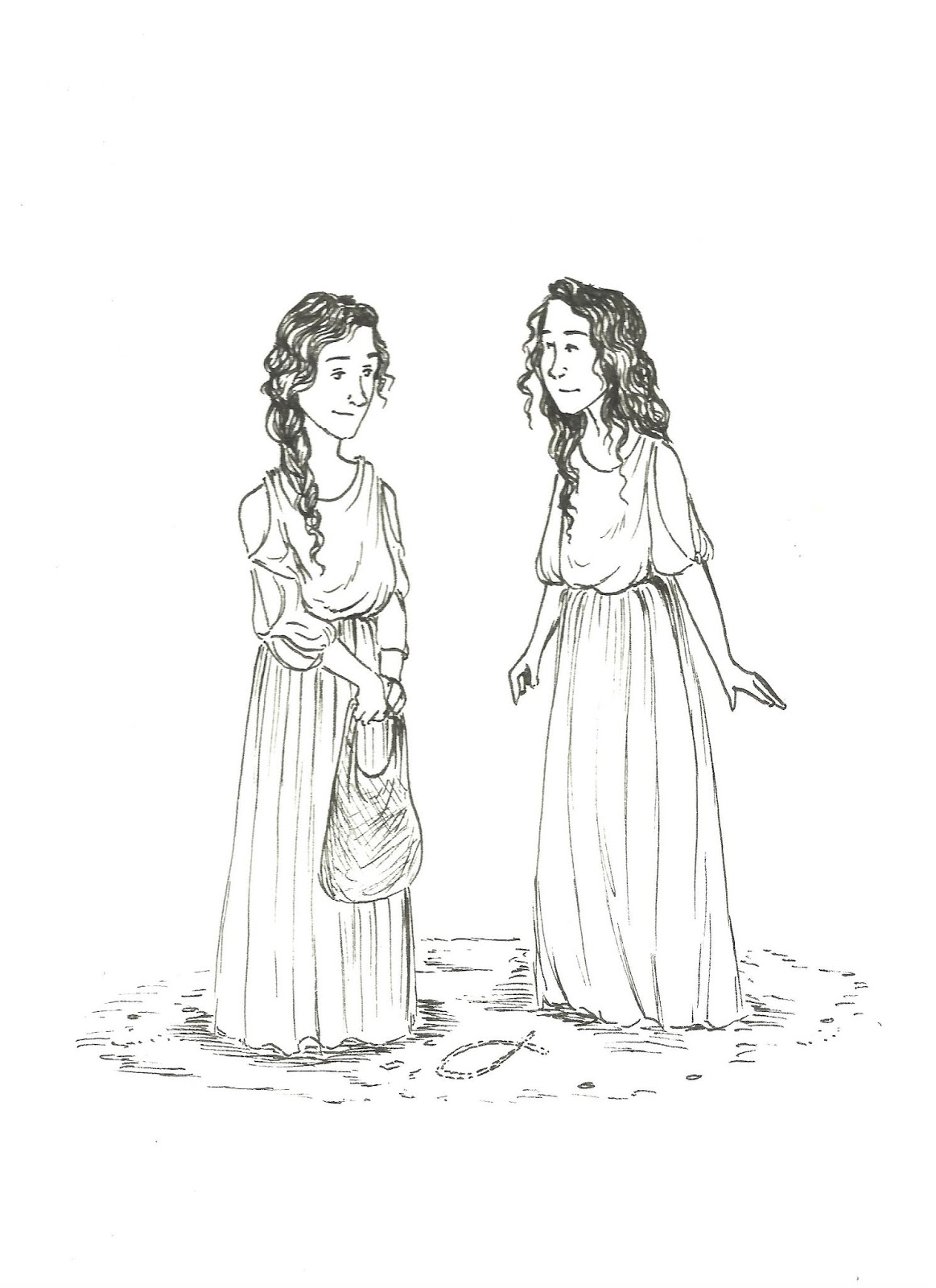
This great illustration of the insulae (Latin for tenement buildings) along the streets of Rome is done by my father, Keith McCrary.

This beautiful sunset on the hills and mountains surrounding Rome is drawn by my mother, Debbie McCrary. There are seven hills in Rome— the Palatine, the Aventine, the Quirinal, the Caelian, the Viminal, the Esquiline, and the Capitoline—and many more hills and mountains in the surrounding region.

This elegant Roman garden is by my sister Sophia. One of the characters in my story is a slave who helps tend the garden.

These charming little potted plants inside a Roman house are by my sister Sadie. In my story, my main character Abigail’s favorite room in the house where she is a slave is a room with many potted plants.

This ferocious lion is drawn by my brother Louis. The early Christians were often thrown to lions and other wild beasts in the arena for refusing to deny their faith in Christ.

This flock of speckled chickens is by my brother Levi. They’re supposed to be the Speckled Sussex breed of chickens, which originated in Britain in the first century A. D. and likely would have made it to Rome by the time of this book (A. D. 66-67).

These pretty flowers are by my niece Elizabeth. In my story, the home of a kind elderly lady is the only home on that street where flowers grow.

And this last one of my main character Abigail is by yours truly.

Well, I hope you enjoyed this little peek inside the book! Always remember, “He who calls you is faithful, who also will do it,” (1 Thess. 5:24).
All for Him,
Savannah JaneP. S. The book releases in June (Lord willing), but you can preorder it now! Click here to preorder.
April 15, 2020
I've Started a New History Blog
Hi friends! I'm so excited to share with you that I've just launched a new blog, a history themed blog. I’ll be sharing stories of people from history, informational articles on history, reviews of history-related books and movies, and other history tidbits, with the focus of all of it being on God’s hand in history—His providence, the spread of the gospel, and how Christianity has transformed the world. My goal is to do one new post a week.
Check it out here:
https://historyredeemed.blogspot.com/
This blog will still be up for you to go back and read, but all new posts will now be going to the new blog: History Redeemed.
I hope this blog will be a blessing to you!
Always remember,
"He who calls you is faithful, who also will do it," (1 Thess. 5:24).
Check it out here:
https://historyredeemed.blogspot.com/
This blog will still be up for you to go back and read, but all new posts will now be going to the new blog: History Redeemed.
I hope this blog will be a blessing to you!
Always remember,
"He who calls you is faithful, who also will do it," (1 Thess. 5:24).