Savannah Jane McCrary's Blog, page 3
February 29, 2024
What Old Testament Heroines Teach Us About Creating Strong Female Characters

Some writers create female characters who head out into combat and basically act just like men. Others create female characters who seem unable to do anything for themselves and must wait helplessly for a man to come and rescue them. Writers, there’s another option. And why not look at the greatest Book ever written to give us some ideas?
The Old Testament is full of the stories of strong women (the New Testament has its heroines, too, but that would be another article). The Hebrew midwives stood up to Pharaoh and refused to kill the baby boys they delivered. Rahab jeopardized her own safety to hide the Hebrew spies who came to her. Jael drove a tent peg into the skull of Israel’s greatest enemy. Jehosheba rescued her baby brother from the wrath of the wicked Athaliah, thus preserving the kingly line of David, from which the Messiah would eventually come. Ruth left behind all that was familiar to go and care for her mother-in-law in a strange new land. Esther risked her life by appearing before the king without being summoned to plead for the lives of her people. No doubt about it–these were some strong women.
Arguments abound for creating flawed, relatable characters. But there are many reasons why traditional heroes (or heroines) still matter. And these Old Testament women have much to teach us about what makes a real heroine.
Their strength was not their own. It came from their faith and fear of God. In the book of Exodus, it says that the Hebrew midwives, Shiphrah and Puah, “feared God and did not do as the king of Egypt commanded them, but saved the male children alive,” (Exodus 1:17). They were willing to risk Pharaoh’s wrath because they respected and revered God far more than they did the king of Egypt. Before Esther approached the king, she asked the people to fast. We can safely assume they were praying, too. Her courage sprang from her trust in God. And when Rahab hid the Hebrew spies, she testified to her belief in the true God of Israel. Author Leslie Ludy points out that one of the main differences between the modern feminist movement and biblical femininity, is that feminism celebrates the strength and glory of a woman, whereas biblical femininity celebrates the strength and glory of God.
If you want to create a real heroine, I believe the most important attribute to give her is faith in God. Of course, this will look different depending on your genre and whether you choose to portray God directly or indirectly in your story. But if you want to write about a truly strong woman, her strength needs to come from outside herself.
One of my favorite fictional characters who embodies this attribute is Lucy Pevensie in C. S. Lewis’ Chronicles of Narnia. She’s known as “Lucy the Valiant,” yet it’s clear that her courage does not come from herself, but from her faith in the Great Lion, Aslan.
They loved others sacrificially. Besides their faith in God, the other motivating factor in these women’s lives was a great love for others. Jeshosheba was willing to take a great risk to save Joash, only a baby at the time, who later became a noble king of Judah. The wicked Athaliah was having all the royal heirs killed, but Jehosheba took Joash and his nurse and hid them until the time was right to declare him king. The risks she and other Old Testament heroines took were not to satisfy some yearning for adventure or to seek glory and fame for themselves, but rather because they possessed a sacrificial love for others.
Place people in the life of your fictional heroine for her to love. And make her willing to make great sacrifices to protect those people.
One fictional woman who exemplifies this trait is Aimee in Douglas Bond’s The Resistance. Her deep love for her blind younger brother motivates her to take extreme risks and face great dangers.
They possessed wisdom. Another quality that stands out to me in reading about these Old Testament heroines is their wisdom. These were women who could think for themselves. They knew what to do and they did it. The wise woman of Abel in 2 Samuel chapter 20 was certainly a quick thinker. She orders the beheading of the traitor Shemei who took refuge in her city, negotiating with the military commander Joab to not attack in exchange for Shimei’s head. At the same time, though, we see examples of women heeding wise counsel, rather than depending only upon their own wisdom. Ruth listened to her mother-in-law’s wisdom. Esther heeded her uncle Mordechai’s advice. And most importantly, true heroines seek wisdom from God. As James 1:5 says, “If anyone lacks wisdom, let him ask of God, who gives to all liberally and without reproach, and it will be given to him.”
So create characters who seek wisdom–from God and from older, more experienced men and women–and who aren’t afraid to act on the wisdom they have gained.
An example of this in literature whom I admire is Elinor Dashwood in Jane Austen’s Sense and Sensibility. She’s a stellar model of, well, sense. She possesses a steady character, recognizing when certain actions would be unwise, and encouraging her sister to exercise discernment and wisdom.
They were seeking to glorify God where He had placed them. We’re not told that any of these women went out looking for an adventure. Rather, it seems they were simply living their lives, when adventure found them. Jael was likely preparing food for her husband or some other such domestic task, when Sisera came into her tent. But when the opportunity came, these women were prepared to act. Jesus said, “He [or she] who is faithful in what is least is faithful also in much; and he who is unjust in what is least is unjust also in much,” (Luke 16:10).
Show in your story how the seemingly small things your heroine does prepare her for larger tasks in the future. The stories I find the most inspiring are those of a woman who is faithfully performing the duties in front of her and finds herself thrust into a life-or-death situation where her faith in God gives her the strength to act with incredible courage.
Corrie ten Boom is one of my favorite examples of a real-life heroine in more recent times. She’s known for her courage in saving Jews during the Holocaust, but before that there were years of preparation in which she served her family by helping with household tasks, assisted her father in his watchmaking business, and taught Bible classes to young people and those with special needs.
They respected the men in their life and encouraged them in righteousness. The respectful way Ruth speaks to Boaz in the Bible may sound foreign to us. But that’s a characteristic we see of godly women. They know their own worth in God’s eyes. They don’t have to bash men to try to make themselves feel stronger. Rather, they know how much God loves and values them, and thus they are able to show honor to others. While being unafraid to take the initiative when the circumstances call for it, true heroines are also happy to let a man lead, when a godly man is there to do so, as in the case of Jehosheba. Unlike Athaliah who was willing to murder to be queen, we can assume Jehosheba was happy to see her brother made king. True heroines also spur men on toward what is right, rather than what is wrong. One biblical example of this is Abigail. When David was on the verge of killing Nabal and every male in his household, Abigail boldly approached him and urged him to not commit murder.
So create heroines who treat men with respect and spur them on toward good works.
One of my favorite fictional heroines is Lydia Tavish from Jessica Marinos’s Trimont Trilogy, and she is a great example of this. Throughout the story, we see her again and again respectfully urging the men around her to do what is right and pointing them to the truth.
Putting it all together. Your characters don’t have to start out exemplifying all these qualities. After all, Rahab started out in a line of work that was, ahem, not a God-honoring sort of profession. But her fear of God motivated her to take a great risk to save the Hebrew spies who came to her and leave her old life behind. A redemption arc can be a great element in a story. Perhaps you could even have your heroine start out depending upon her own strength and then have her realize that she is not enough, but God is. And even if your heroine does start out with the correct worldview and character qualities, she should still learn and grow throughout the course of her journey.
So go, create strong female characters in your stories. But remember that a woman’s true strength doesn’t come from herself, and real heroism involves sacrificial love, wisdom, faithfulness in everyday tasks, and respect for others.
And always remember, "He who calls you is faithful, who also will do it," (1 Thess. 5:24).
All for Him,
Savannah Jane
P. S. If you would like to see how I put all these elements together in a story, you can check out my books (especially A Torch in the Empire Series) here.


January 31, 2024
ANNOUNCING MY NEXT HISTORICAL FICTION BOOK
 “Pursue light even in the darkness for light remains light.” -The Dutch Ten Commandments for Foiling the Nazis
Hi friends! As we approach two years since I released my last book, Whether We Live or Die, I am ready to officially announce my next work in progress! The quote at the beginning of this post gave you a hint of what to expect. My next book will be…
…historical fiction set in the Netherlands during World War II!
Like A Torch in the Empire series, this will also be a three book series. Lord willing, I will release the first book (title forthcoming) in December 2024!
Now, more about the book…
It’s a historically accurate portrayal of life in the Netherlands during World War II, inspired by true stories such as The Hiding Place by Corrie ten Boom, Return to the Hiding Place by Hans Poley, and Things We Couldn’t Say by Diet Eman. While the main characters are fictional, nearly every event is inspired by something that really happened.
And speaking of the main characters, this book will feature four POV (point of view) characters–two boys and two girls. Let me introduce you to them…
Pieter–a university student whose desire is to stay out of conflict and danger and become a pastor, yet whose desire to do what is right is greater.
Gerrit–a young farmer who could not stand by and do nothing in the face of evil.
Marit–a young woman with dreams for her future and strong faith who chooses resistance over comfort.
Elsje–an ordinary girl who risks her life to care for a Jewish baby.
 My goal is to make this a book of page-turning adventures infused with beauty, strong family relationships, and characters who are flawed and relatable, yet inspiring in their willingness to do what is right.
 It’s a story of resistance against evil.
A story of pursuing light in the darkness.
A story of following Jesus, no matter the cost.
A story of the infinite worth of the kingdom of heaven.
A story of having faith when we cannot see.
A story of hope.
I’m excited to share more about this series in the coming months! Subscribe to my email list here to receive all the updates in your inbox and get exclusive behind-the-scenes sneak peeks!
I’ll close this post with a verse that captures the message I hope to share in these books and in all my writing:
“Again, the kingdom of heaven is like treasure hidden in a field, which a man found and hid; and for joy over it he goes and sells all that he has and buys that field.” Matthew 13:44
December 17, 2023
(A Christmas Devotional) God Keeps His Promises

“Let us hold fast the confession of our hope without wavering, for He who promised is faithful.” Hebrews 10:23
The promise that Jesus would come was given all the way back in the Garden (Genesis 3:15), repeated to Abraham (Genesis 22:18), again to Moses (Deuteronomy 18:15), and throughout the Prophets (Isaiah 7:14; 9:2; 53; Micah 5:2) and Psalms (Psalm 2; 22).
And then, in the fullness of time, the angel Gabriel was sent to a young girl in Nazareth, and God kept His promise. God was faithful, and Mary believed. “Blessed is she who believed, for there will be a fulfillment of those things which were told her from the Lord,” (Luke 1:45). Mary and Zecharias praised God in their songs for His faithfulness in keeping His promise to Israel.
If God kept the greatest promise He ever made, do you not think He will keep all His other promises? He promises to never leave us or forsake us (Hebrews 13:5). He promises that no weapon formed against us shall prosper (Isaiah 54:17). He promises that all things work together for the good of those who love Him (Romans 8:28). He promises that we will not be tempted beyond what we are able, but He will make a way of escape (1 Corinthians 10:13). And He promises that He is our help and our shield (Psalm 33:20).
During World War II, a young Dutch woman named Diet Eman was imprisoned in a concentration camp because she helped rescue Jews. One day, she was called for a hearing. Fear gripped her. What am I going to say? she thought.
And then suddenly God’s promises came to her. Don’t worry. If you appear before authorities and kings, I will give you the words. Not a hair of your head will be harmed without the will of your heavenly Father.
Okay, Diet thought. I have often broken my promises to You, Lord, but You’ll never break Your promises. You take over now. You have promised it—now You have to do it. I am going into my hearing, and You have said that You would be my God. Now I’m going to hold you to it.
And God was faithful. He gave her the words to say.
We break our promises. But God never breaks His.
Footnotes: Scripture quotations are taken from the New King James Version. Diet Eman’s story is taken from the book Things We Couldn’t Say by Diet Eman with James Schapp. Photo is of Diet Eman.
October 11, 2023
Travel Log: Poulsbo, Washington

I've been fascinated by the Vikings ever since my mother read aloud The Vikings by Elizabeth Janeway as part of our homeschool when I was a wee little lass. So I was excited to visit the town of Poulsbo, Washington, which is known as "Little Norway," and has a strong Viking theme present.
I was trying to decide what to do for a blog post this month, and asked Mama for ideas. This was one of her suggestions, and I quite liked it. I'm thinking this could be a new category for this blog--travel logs of historical sites I visit. So here you go--notes from my visit to Poulsbo, Washington.

Poulsbo was founded in the 1880s by Norwegian immigrants. It's situated on Liberty Bay, and the location reminded the Norwegians of their homeland. It officially became "Poulsbo" when one of those Norwegian immigrants grew tired of having to take a boat to Seattle to get his mail and decided to come up with an address on this side of the water. He used the name "Paulsbo" which is the Norwegian equivalent of "Paul's place," and is also a place in Norway. However, the postman misread the man's cursive handwriting, and registered the town as "Poulsbo," and thus it has been called ever since, the only "Poulsbo" in the world.
The town is proud of their Norwegian heritage, as is especially evidenced in the historic downtown area on the bay. You'll see lots of Norwegian flags, and a few flags from other Scandinavian countries, too.
We visited Sluys' Bakery, a historic bakery, famous for their "Viking Doughnuts," (which are quite large.) I ordered a "Viking Cup" which is basically the inside of a cinnamon roll which you can get filled with cream cheese icing. It was delicious!


There's also a huge mural on the side of a building of a Viking ship sailing in a fjord.

You can also buy Viking coffee, stickers with Viking ships on them, all manner of Norwegian flag souvenirs, and even the benches on the sidewalk have Viking ships on them!
You might think, "Weren't the Vikings basically pirates--plundering, capturing, and killing?" And yes, some of them were. They also took many Irish captives as slaves (and I have some Irish ancestry.) However, not all the Vikings were that way. Sometimes the word "Viking" is used simply to mean Norwegians who lived in the era of Viking ships and such. And many of them were peaceful merchants and farmers. And that book I mentioned earlier (The Vikings by Elizabeth Janeway) tells the story of Leif Erikson, who became a Christian and came to North America almost five hundred years before Christopher Columbus. Although, unfortunately, the Norwegians' encounters with the native peoples did not go very well, Leif Erikson's expedition to America is the first recorded instance of Christianity coming to the new world.
***
Well, there you have it! My visit to Poulsbo, Norway! And a little history on Poulsbo and the Vikings! I'm thankful to God for blessing me with a wonderful trip and thankful to my parents for taking my younger siblings and me!What about you? Have you ever been to "Little Norway" in Washington or to real Norway in Europe? Are you interested in Norwegian history? Would you care to read more travel logs of historical places I visit? Leave a comment and let me know!
Always remember, "He who calls you is faithful, who also will do it," (1 Thessalonians 5:24).
All for Him,
Savannah Jane
September 1, 2023
Book Review: Underground Scouts by Marie Sontag
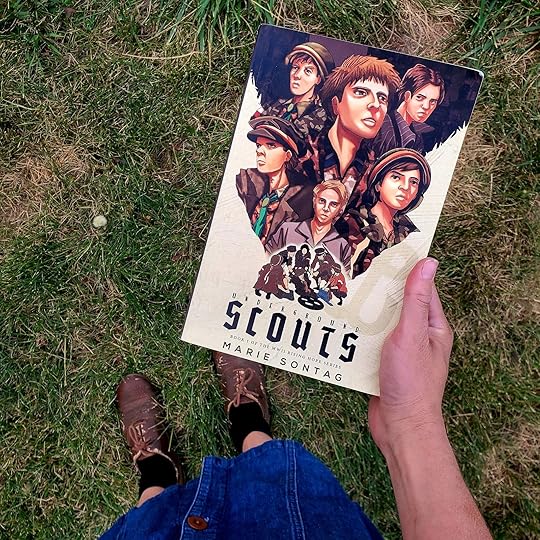
For me, the two most important elements that make a historical fiction book a good one are historical accuracy and communicating the hope of Jesus. And Underground Scouts by Marie Sontag does just that.
Set in Nazi-occupied Poland during World War II, this young adult historical fiction novel tells the story of a group of Boy Scouts and Girl Guides who were willing to give up everything to fight for a free Poland.
This book is extremely well-researched, weaving numerous real people and events seamlessly in with fictional ones. And there’s a section in the back of the book that tells which characters are real and which are fictional.
A word of warning: my mother read this book aloud to a wide range of ages, and there were some parts she skipped over–some violence and some romance. And a lot of characters die. In fact, I don’t think I’ve ever read a book in which so many named characters die! It’s realistic, though, considering the setting. And there’s hope. Some of the characters die with the words “Don’t lose hope,” on their lips. If I could sum up the theme of this book in one sentence, that’s what it would be: “Don’t lose hope.”
Don’t lose hope when evil seems to win.
Don’t lose hope when your family and friends are killed.
Don’t lose hope when you feel abandoned.
Don’t lose hope when your freedom is taken away.
God is still good no matter what. And one day, we will have a free country again.
Don’t lose hope.
The main characters are Catholic, as most people in Poland were, but the spiritual lessons in the book are ones that I think Christians of all denominations would agree on. This book sparked some great conversations amongst my family, and while there were some things I would have done differently were I writing it, I’d still give it 5 stars for being a historically accurate and hopeful World War II story.
Find Underground Scouts on Amazon here.
On Goodreads here.
And Marie Sontag’s author website here.August 1, 2023
Best Historical Movies I Watched for the First Time Last School Year (2022-23)
 Hi friends! I hope you've had a lovely start to your summer! I greatly enjoy a good historical movie and got to watch several for the first time over the last school year, so I thought I'd share my favorites with you today. Most of these are set at least fifty years ago, but one is set around twenty years and one is a contemporary; I still thought they should be included, though! Read on to find out what they are!
 Best historical dramas
 The Most Reluctant Convert: The Untold Story of C. S. Lewis Definitely my favorite movie I watched last school year, this one tells the story of C. S. Lewis (one of my favorite writers!) It's made as if an older Lewis is narrating the story, and nearly all the narration comes directly from his writings. Lewis takes us from the time he was a young boy, through his teenage years, his military service during WWI, his time as a university student, and all the way until he was in his thirties, showing all the people and experiences God was using to draw Lewis to himself until he finally surrendered his life to Christ and found what he had been searching for--joy. It's a beautiful movie that stirred in me a longing for the coming Kingdom.
 Sabina: Tortured for Christ, The Nazi Years The gospel changes us. Things that once seemed important and pleasurable now seem empty. And things that we once saw no value in become dearer than life itself. Jesus changes our hearts, our desires, our affections, our pleasures. He fills us with His light and His love. This movie is a beautiful picture of that. It's the story of how Jesus changed the lives of Richard and Sabina Wurmbrand, a young Jewish couple living in Romania, when it was taken over by the Nazis during WWII. Though it's a very sad movie, as Sabina's entire family was killed in a concentration camp, it's a movie with a powerful message.
 The Lumber Baron Set in Wisconsin near the beginning of the twentieth century, The Lumber Baron, follows Daniel Rimsdale, the oldest son of a well-to-do family, who after the unexpected death of his father, returns home and tries to save his family's struggling lumber business. He ends up undertaking an undercover investigation in the logging camp to uncover what--or who--is really behind his father's death and his family's business failing. Though not an explicitly Christian movie, it does showcase biblical values of family, hard work, and other admirable qualities.
 Little Women (2019) Of the Little Women movie adaptations I've seen, I think Greta Gerwig's 2019 one is my favorite. Again, this is not an explicitly Christian movie, and while I don't agree with all of Louisa May Alcott's beliefs, I still greatly enjoyed this movie. It has lovely costumes (which is a big deal to me!) and it's a sweet story reminding us of the importance of family.
  Mercy Streets This is the one set approximately twenty years ago. Estranged twin brothers, one a deacon in an Episcopal church and the other a con man, accidentally switch places. With a mix of humor, seriousness, action, and suspense, this is an enjoyable movie that ultimately points us to redemption in Christ and reminds us of what's most important in life. Best documentaries and shows
 Patterns of Evidence: Journey to Mount Sinai Part OneOne of my favorite documentary series is Patterns of Evidence. Like the rest of investigative filmmaker Timothy Mahoney's films, this one did not disappoint. Packed full of fascinating archaelogical and biblical evidence, this first part of the journey to Mount Sinai was excellently done. Now I'm looking forward to the continuation of the search for the location of Mount Sinai in Part Two!
 Dietrich Bonhoeffer: Memories and Perspectives One of the people from history who inspires me the most is Dietrich Bonhoeffer. He was a man of incredible courage who was willing to do what was right no matter the cost. (You can read my blog post about him here.) While pulling an overnight shift taking care of puppies (by the way, you can learn more about my family's Bernese Mountain Dog puppies here), I watched this documentary about Bonhoeffer. What I loved most about it is that it includes actual footage of Dietrich's family and friends sharing their memories of him.
 Wild West Chronicles Chronicling true stories of the American West, this docudrama (mostly drama) series was one my family and I very much enjoyed. Telling the stories of guys (and girls!) both good and bad including Bass Reeves, Annie Oakley, Butch Cassidy, and several others, this excellent series reenacts the great tales of the Wild West. Bonus
 Vindication
This is the contemporary one I wanted to include because my family and I enjoyed it so much. A Christian-produced crime drama series set in Texas, it follows Detective Gary Travis. It's intense, at times humorous, and definitely not too predictable. I thought Season 2 was better than Season 1, and now I'm eagerly anticipating Season 3. I don't think my family has ever discussed a show as much as we've discussed this one. We've had a great time trying to guess what will happen next and discussing the themes.
***
Well, there you have it! What about you? What are some of your favorite historical movies? Have you seen any of the ones I mentioned, and if so, what do you think of them? Leave a comment below!
Always remember, "He who calls you is faithful who also will do it," (1 Thessalonians 5:24.
All for Him,
Savannah Jane
June 14, 2023
5 Lessons from the Life of Darlene Deibler (Part 2)

Hello friends! A few weeks ago, I shared the first in a two part series of lessons from the life of Darlene Deibler Rose. (If you missed it you can read it here.) Here is Part Two with the final two lessons we can learn from the life of this lovely woman.
4. Share the love and hope of Christ with others.
Darlene’s passion was to share Jesus with others and she did this not only to the unreached tribes she and her husband ministered to, but also to her fellow prisoners and even the Japanese camp commander. In the camp, Darlene was willing to do the most unpleasant tasks that went along with caring for sick children in filthy living conditions and continually shared Christ through her words and her actions and example.
Mr. Yamaji, the commander of the prison camp, was a horribly cruel man. He carried a cane which Darlene witnessed him employ savagely on more than one occasion. Needless to say, it wasn’t easy to love Mr. Yamaji. One night after he’d harshly punished a young woman, Darlene was fuming. “Pray for your enemies,” went through her mind.
“All right, Lord,” she said. “I’ll pray for him. I sincerely don’t want the man to be lost eternally–but I really would like it if you would curdle the food in his stomach tonight, and would you stretch him on the rack of his conscience–at least for a while?”
Shortly after hearing the news of her husband’s death, Darlene was summoned to the commander’s office, and she took the opportunity to share the gospel with him. Slowly, she began to see a change in the man.
Years later, a priest stopped at a bicycle shop in Japan and struck up a conversation with the owner, who was none other than Mr. Yamaji himself. He asked the priest if he ever met any of the women who had been imprisoned at the camp to tell them he was sorry he had been so cruel. Later, Darlene also heard that he’d spoken on the radio, sharing the gospel with the Japanese people.
*
“For the love of Christ compels us, because we judge thus: that if One died for all, then all died; and He died for all, that those who live should live no longer for themselves,
but for Him who died for them and rose again.”
2 Corinthians 5:14
5. God delights to give us good gifts.One day while in solitary confinement, Darlene climbed up the wall to peek out the small barred window of her cell and witnessed someone sneak a bunch of bananas to a prisoner. All Darlene received to eat was worm-infested rice porridge. She began to crave a banana. “Lord, just one banana,” she prayed. But she could not see how God could possibly get her a banana. She didn’t want anyone to be punished for giving her one. So she gave up the idea.
Then one day, her cell door opened to reveal Mr. Yamaji, the commander of the prison camp she’d been at previously whom she had shared Jesus with. To Darlene, it was almost like seeing an old friend. Mr. Yamaji spoke with two officers in Japanese for a few moments, then with Darlene in English for a moment. When the cell door closed, Darlne suddenly remembered. She hadn’t bowed to them! That was a serious offense. She heard the guard coming back and expected to be punished. But the guard entered the cell and with a sweeping gesture laid at her feet–bananas!
“They’re yours,” he said, “and they’re all from Mr. Yamaji.”
Darlene sat in stunned silence and counted them. There were ninety-two bananas. Darlene didn’t even expect one, and God had given her almost a hundred! This story reminds me of how God delights to give us good gifts. He doesn’t always give us exactly what we ask for, but He always gives us good things–even better than what we thought to ask for!
***
“Now to Him who is able to do exceedingly abundantly above all that we ask or think, according to the power that works in us, to Him be glory in the church by Christ Jesus to
all generations, forever and ever. Amen.”
Ephesians 3:20
“Ask, and it will be given to you; seek, and you will find; knock, and it will be opened to you. For everyone who asks receives, and he who seeks finds, and to him who knocks it will be opened. Or what man is there among you who, if his son asks for bread, will give him a stone? Or if he asks for a fish, will he give him a serpent? If you then, being evil, know how to give good gifts to your children, how much more will your Father who is in heaven
give good things to those who ask Him!”
Matthew 7:7-11
***
When World War II finally came to an end, Darlene was freed and returned home to the United States. It had been eight years since she had left. When she first talked to her mother on the phone, Darlene was so overwhelmed all she could say was “Uh-huh.” She had a joyous reunion with her family and recovered from the hardships she had endured. Eventually, she married a missionary named Gerald Rose and they labored together for the Lord in New Guinea and had two sons. After some time, they returned to the United States where they spent their final years. Darlene went to be with her Lord in 2004.
***
Well, I hope you enjoyed those lessons from the life of Darlene Deibler Rose! What about you? Have you read her autobiography Evidence Not Seen? If so, do you have some more lessons from her life to add? Who are some other Christians from history who inspire you and what can we learn from their lives? Leave a comment below!
All for Him,
Savannah Jane
Source: Evidence Not Seen by Darlene Deibler Rose
May 6, 2023
5 Lessons from the Life of Darlene Deibler (Part One)

As a little girl of ten, Darlene prayed, “Lord, I’d go anywhere for you, no matter what it cost!”
Little did she know just how much it would cost.
As a young newlywed, Darlene and her husband, Russell Deibler, set out as missionaries to Indonesia and New Guinea. Darlene worked hard to learn the language and join Russell in his work of sharing the gospel. They were able to reach isolated natives of New Guinea with the message of Jesus and were overjoyed to see fruits from their labors.
Then war came. It was early 1942 and the Japanese took over Indonesia, also known as the Dutch East Indies. Russell was taken prisoner and later Darlene was imprisoned–separate from her husband. Darlene was taken to a prison camp for women–and children, too–where she endured great misery but was never forsaken.
Here are the first three of five lessons we can learn from her life:
God’s grace sustains in even the darkest of places.
Darlene endured sickness, cruelty, filth, and great sorrow as a prisoner of war. Worst of all was the news that her husband had died in the men’s prison camp. At one point she was transferred from the camp to a tiny prison cell, accused of being a spy, and sentenced to death.
There was a time when she could not feel God’s Presence at all. At first, she panicked, worried that some unconfessed sin was keeping her from feeling Him near. She prayed for the Holy Spirit to search her heart and could think of nothing she hadn’t confessed to the Lord. So why couldn’t she feel His comforting Presence? She began to repeat Scriptures to herself:
“God is not a man, that He should lie,
Nor a son of man, that He should repent.
Has He said, and will He not do?
Or has He spoken, and will He not make it good?” (Numbers 23:19).
Darlene prayed, “I do not need to feel You near, because Your word says You will never leave me nor forsake me.” The words of Hebrews 11:1 welled up in her mind, “Now faith is the substance of things hoped for, the evidence of things not seen.” Darlene was reminded that she did not put her trust in “feelings or moments of ecstasy, but in the Unchanging Person of Jesus Christ.”
Suddenly, she realized she was singing,
“When darkness veils His lovely face,
I rest on His unchanging grace.”
*
“And He said to me, ‘My grace is sufficient for you,
for My strength is made perfect in weakness.’”
2 Corinthians 12:9
Our lives are in God’s hands.
The air-raid alarm sounded, and all the prisoners ran to the trenches. It wasn’t the first time this had happened, and Darlene stood where she always did. But suddenly she had a thought she was sure came from the Lord, reminding her that she had borrowed another prisoner’s Bible. Darlene raced back to the barracks, rushed into the burning building, scrambled up the ladder to her bunk, grabbed the Bible, and ran back outside. But she could no longer reach the trench and was soon ordered to lie down on the ground by a Japanese guard.
When the shelling stopped, Darlene and the other prisoners surveyed the damage. An elderly woman, sobbing, told Darlene her sleeping pad had burned.
“Oh, yes, everything has burned, but we’re still alive. We have much to thank God for!” Darlene said.
“But I didn’t leave it in the barracks,” the woman said. “I threw it in the ditch where you always lie.”
Darlene felt the hair stand up on the back of her neck and a chill ran through her. She walked to the trench, and there where she had been crouching was the casing of a bomb, and the ashes of the mattress. Darlene was in awe. God had saved her life by making her think of the Bible she’d borrowed.
*
“...the hand of the Lord has done this,
In whose hand is the life of every living thing,
And the breath of all mankind.”
Job 12:9b-10
Have a close relationship with Jesus.
One of the things that stands out to me the most in reading Darlene’s story is the close relationship she had with Jesus. She talked to the Lord as one would a friend, bringing all her needs, sorrows, and praises to Him. She did this whether she was at home, on the mission field, in the prison camp, or in solitary confinement on death row. It inspires me to seek to know Jesus as she did, constantly praying and listening for His voice.
*
“Rejoice always, pray without ceasing, in everything give thanks;
for this is the will of God in Christ Jesus for you.”
1 Thessalonians 5:16-18
***
Well, there are the first three out of five lessons we can learn from Darlene Deibler Rose’s life! Check back in a few weeks for Part Two with the final two lessons.
Until then, always remember, “He who calls you is faithful, who also will do it,” (1 Thessalonians 5:24).
All for Him,
Savannah Jane
February 16, 2023
4 Lessons from the Life of Brother Andrew

I never met Brother Andrew. But that’s something about writing a book—you can impact hundreds, thousands, even millions of people whom you will never meet this side of Heaven. And such is the case with Brother Andrew’s book, God’s Smuggler. Through that book, I was introduced to his remarkable story.
Andrew was born the son of a blacksmith in a little village in the Netherlands. As a little boy, Andrew dreamed of adventure. During the Nazi occupation, he put sugar in the gas tank of the German lieutenant's car and set off fireworks dangerously close to the Nazi guards.
When he was old enough, he joined the Dutch army and went to fight the revolutionaries in the East Indies. While there, he saw and did things, horrible things, that haunted him. He turned to drinking and wanted to die. But he didn’t die. He was only wounded.
While in the hospital, he read for the first time the Bible his mother had given him before he left Holland. He went back home and reverted to his old ways, but then while in a military rehabilitation center, he again read the Bible. He experienced a deep hunger for more of the Word and found a church service to attend every day. Then one stormy night, while lying in bed, he surrendered his life to Christ.
Soon he knew that God wanted him to be a missionary. His first mission field was a chocolate factory close to home. Eventually, he went to the WEC missionary training college in Glasgow, Scotland. Shortly after graduation, he went on a trip to the Communist country of Poland. And that was the beginning of his life’s work—taking Bibles and a message of encouragement to Christians in persecuted countries.
He eventually married a nurse named Corrie and they had a happy marriage and five children. And he continued to travel to Communist countries, bringing hope to the people there. What started as one man making a few trips bringing a few Bibles into a few Communist countries grew and grew until Andrew had a team that brought hundreds, and eventually even thousands of Bibles to persecuted Christians.
After Brother Andrew’s death on September 27, 2022, my family and I listened to a message by Eric Ludy in which he shared some of the lessons he had learned from Andrew’s life (listen to it here.) That inspired me to write up my own tribute to Brother Andrew, so here it is, four lessons from his life.
1. Do what needs to be done. Shortly before beginning his training at the WEC, Andrew stayed with the Hopkinses, an elderly couple in England. Mrs. Hopkins was bedridden much of the time, and Mr. Hopkins operated a contracting business and a storefront mission. So on his first day with them, Andrew was left to himself. He found a mop and cleaned the kitchen floor. Moving on to the bathroom, he found the dirty laundry and washed it. When the clothes were dry, he ironed them. And then he cooked dinner. He was used to doing such things at home. “...anyone in my family, male or female, would have done the same,” he said.
I think this characteristic of noticing what needed to be done and doing it helped him in his later ministry. When he visited Christians in persecuted countries later, he noticed what they needed and found a way to provide for that need. It was a lot harder to smuggle hundreds of Bibles into Soviet bloc countries than it was to mop the floor for the Hopkinses. But learning to do simple things well is often how God trains us to do more difficult things well, a lesson I know I need to be reminded of.
“He who is faithful in what is least is faithful also in much; and he who is unjust in what is least is unjust also in much.” Luke 16:10
2. Have childlike faith.
In 1957, the government of Yugoslavia only allowed visitors to bring in items for their personal use. Printed material was especially suspect. And Brother Andrew was pulling up to the Yugoslav border with a car and luggage bursting at the seams with Bibles, parts of Bibles, and Christian tracts. “Lord,” he prayed, “in my luggage I have Scripture that I want to take to Your children across this border. When you were on earth, You made blind eyes see. Now, I pray, make seeing eyes blind. Do not let the guards see those things You do not want them to see.”
Andrew drove up to the barrier, and the two guards began the inspection. One guard asked Andrew to take out his suitcase. Andrew took it out and opened the lid, and the guard lifted up some shirts that lay on top. There, in plain sight, was a pile of tracts. How was God going to handle this? Andrew wondered. He struck up a conversation about the weather with the other guard, until finally, he could bear the suspense no longer and turned around. The first guard wasn’t even looking at the suitcase but listening to the conversation! When Andrew turned around, the guard caught himself and asked, “Well, then, do you have anything else to declare?”
“Only ‘small’ things,” said Andrew.
“We won’t bother with them,” said the guard. And Andrew was on his way with all of the Bibles and tracts still in his car!

This was only the first of many times that God honored Andrew's simple, childlike, faith-filled prayer and “made seeing eyes blind.” How good it is to remind ourselves that God is a good Father, and we are to simply trust Him as a small child trusts his or her parents.
“Assuredly, I say to you, whoever does not receive the kingdom of God as a little child will by no means enter it.” Luke 18:17
3. Love the brethren.
Brother Andrew’s ministry was centered around loving our persecuted brothers and sisters in Christ. The work wasn’t easy—it involved driving long distances on bad roads, and he had severe back pain. But when he felt like quitting, something always happened to push him on again. He would receive a letter from a Christian perhaps in Bulgaria or Romania telling of some new need.
How easy it is to forget that all around the world our brothers and sisters in Christ face harassment, imprisonment, and sometimes even death from their families, communities, and the government. How easy it is also to fail to reach out to our fellow Christians in our local communities and even in our own families. May God open our eyes to the opportunities we have to show love to our fellow Christians.
“Therefore, as we have opportunity, let us do good to all, especially to those who are of the household of faith.” Galatians 6:10

4. Treasure God’s Word.
And finally, Brother Andrew’s story reminds me to treasure the gift of God’s Word. Having my own copy of the Bible in my own language is a privilege many Christians have not had. Andrew tells of visiting large churches where only a few people had Bibles. During the service, they would hold them up for others to read along. He also tells of churches where not a single member owned a Bible.
One pastor he met in Ukraine did not have a Bible. While having a discussion with the pastor and elders after the service, Andrew pulled out his Bible to look up the verses they were referencing. The discussion over, he laid his Bible on the table.
The pastor picked it up tenderly, reverently. “You know brother,” he said, “I do not have a Bible.”
Andrew had one Ukrainian Bible left, a special pocket-sized edition he’d traded for with another Ukrainian congregation, intending to take it home to show the Bible society so he could get more printed. The Bible society would just have to take his word for it, he decided. He ran out to his car, grabbed the Bible, and gave it to the pastor. When Andrew left, his chest hurt from all the hugs he’d received from the elders who were overjoyed that their pastor now had his own Bible.
“I rejoice at Your word
As one who finds great treasure.” Psalm 119:162
***
Well, I hope you were encouraged by those four lessons from the life of Brother Andrew!
As always, remember, “He who calls you is faithful, who also will do it,” (1 Thessalonians 5:24).
All for Him,
Savannah Jane
Source:
God’s Smuggler by Brother Andrew with John and Elizabeth Sherrill
Note: Because of his work, Andrew found it necessary for safety reasons to not use his full name, therefore he began going by the name, “Brother Andrew.”
Pictures taken from OpenDoorsYouth.org
December 2, 2022
How Christians in History Saved Lives and How We Can Save Lives Today
 Abortion and infanticide were rampant in the Roman Empire. Slavery was commonplace. And gladiators fought—often to the death—in the arenas. The early Christians rescued unwanted children, cared for orphans and widows, bought freedom for slaves and gladiators, and cared for the downtrodden.
 The Coliseum in Rome
In the days of the transatlantic slave trade, Christians like William Wilberforce worked tirelessly to bring about the abolition of the slave trade.
 William Wilberforce During World War II in Nazi-controlled European countries, Jews were first discriminated against by being banned from certain places and made to wear an identifying yellow Star of David. Then they were rounded up and taken to concentration camps where they suffered unspeakable atrocities before being killed. And anyone who helped a Jew would be treated like a Jew. While many did nothing out fear, some Christians again risked their own lives to save the lives of others. Corrie ten Boom, a Dutch watchmaker, spent months in a women’s extermination camp for hiding Jews in her home. Several members of her family lost their lives. Yet Corrie and her family did not regret what they did.
 Jewish girls wearing the yellow Star of David
Yes, all throughout history, God’s people have been in the business of saving lives.
Today, we still have opportunities to labor for the cause of life.
The lives of millions of babies are ended by abortion. Often, the mothers feel as though they have no choice. As Christians, our job is to share the truth that every child is a gift from God, “fearfully and wonderfully made” (Psalm 139:14). We must reach these mothers with the truth and the practical help they need.
For many of us, the Christmas season is a time when we think more about giving. Which is fitting, because, after all, Christmas is when we celebrate the greatest gift ever given, the gift 2 Corinthians 9:15 refers to as the “indescribable gift” of God. The gift of Jesus. Though we are sinners and deserving of death and Hell, “God so loved the world that He gave His only begotten Son that whoever believes in Him should not perish, but have everlasting life,” (John 3:16).
So here are 5 ways you can stand for life this Christmas season:
1. Pray. How amazing that God allows us to be involved in the work He does by praying! Let’s pray for God to work in the hearts of mothers to choose life, that He would guide us on what we should do, and that He would equip more people to get involved in the fight for life.
2.Shop the Back 40 Books and More store. This month (the month of December 2022), I will be using a large portion of the proceeds from my books and other products sold on my family’s online store to support Save the Storks, a Christian-based organization that seeks to reach abortion-minded women with love, compassion, truth, and care. Learn more about Save the Storks on their website here. Shop our online store here.
3.Make a donation to Save the Storks or another pro-life organization. You can also simply make a donation to Save the Storks here. And they’re only one of many great organizations!
4. Support your Local Pregnancy Resource Center and community. Find out what your local pregnancy resource center’s needs are and how you can give of your time or money. And if you know any mothers in your community who could use some extra help, see what you can do.
5. Educate. Share the truth in love with others through everyday conversation and interaction. Another way to share truth is through apparel and accessories with a message. Save the Storks has a store with a selection of T-shirts, hats, pins, etc. And Abort73 is another great organization with an assortment of gear to choose from.
Do you have more ideas of how we can stand for life? If so, I’d love to hear from you! Leave a comment below, or contact me.
Well, that’s all for now!
Have a very merry Christmas season, and always remember, “He who calls you is faithful, who also will do it,” (1 Thessalonians 5:24).
All for Him,
Savannah Jane