Savannah Jane McCrary's Blog, page 6
October 16, 2020
A Brief History of Socialism (And Why It's Not the Answer)

When I first wrote my book Do Justly, I did not even think of explaining why I don’t believe socialism is the answer to the world’s problems. But in the last couple of years, I have seen that more and more people—especially young people—believe socialism is a good idea. I think many of these people have good intentions. They truly think socialism will help people, especially the poor, the disabled, and minority groups. But when I go to the Bible, it seems pretty obvious to me that socialism is not what God wants.
So I added an appendix to my book, and I'm sharing this here.
First off, a little history. Karl Marx, the father of communism, looked on socialism as a transition between capitalism and communism. In case you don’t know, capitalism is an economic system where businesses are privately owned, instead of controlled by the government. Communism is a system proposed by Karl Marx where everything is owned commonly. There are no social classes and no state. Karl Marx believed that to get from capitalism to communism there would need to be transitional socialist government. Put simply, socialism is government-owned property and industry and the forced redistribution of wealth. Any time a country has tried to implement communism, it’s led to disastrous effects and the deaths of lots of innocent people. And socialism is stepping toward communism. Now, of course, some Socialists are more radical than others. Not all Socialists today actually want communism. But from a Biblical perspective, there are still problems with socialism.
Here are some of them:
Socialism wants to get rid of private property. Socialism wants to get rid of privately owned property, but the Bible teaches that people do have the right to own things, and stealing is wrong. Some people are blessed with more than others, and that’s okay.
Socialism forces caring for the poor, instead of it being voluntary. Socialism wants the forced redistribution of wealth. That is, they want to heavily tax the rich and then give that money to the poor. But the Bible says that “God loves a cheerful giver,” (2 Cor. 9:7). God wants us to be generous and give to the poor, because of love, because we want to, not because the government forces us to.
Socialism encourages laziness. If the government gives food and money away and makes things very difficult for businesses, how does that encourage hard work? The Bible says that if someone won’t work, neither shall that person eat (2 Th. 3:10). As Christians, we should be generous and willing to help others in need. But if someone is physically able, they should be working. The government should not just be giving handouts.
Socialism thinks it can make a perfect world. The government is not the savior of the world. Its job is not to fix all our problems. Biblically speaking, the main function of government is to punish evildoers, especially murderers (Rom. 13:4). As Christians, we know from the Bible that the world is cursed because of sin, and we will not be able to make a perfect world. Jesus said that the poor will always be with us (Mark 14:7). We should be caring for the poor and oppressed, but we know we won’t be able to completely eliminate poverty. But Jesus came and died and rose again to save us from our sins. He is the true Savior of the world, the only One who can save us from our deepest problem: our sin. And He has promised that one day He will return and make all things new.
Well, always remember, "He who calls you is faithful, who also will do it," (1 Thess. 5:24).
All for Him,
Savannah


September 26, 2020
The Story of C. S. Lewis

On November 29, 1898, one of my favorite authors was born in Belfast, Northern Ireland. I wonder if his parents had any idea that their new baby boy would become one of the most-read Christian authors of all time. They named him Clive Staples Lewis, but when he was a small boy, he announced that his name was now “Jacksie.” He was known to family and friends as “Jack” until his death, so that’s what I’ll call him.
Jack’s early childhood was happy. He lived in a large house out in the country, and loved to explore both indoors and outdoors with his older brother Warren, whom he nicknamed “Warnie.” Jack and Warren both enjoyed reading, writing, and drawing from a very young age. Jack had a vivid imagination, inspired in part by the fairy tales told him by his Irish nurse, Lizzie. His mother homeschooled him until he was ten years old. Then she died.
His mother’s death was crushing to young Jack. He’d prayed that she would live, and yet she hadn’t.
And soon another blow came. Jack’s father sent him to boarding school in England.
The first boarding school was horrible. The headmaster was insane, often punishing the boys for no good reason, and teaching them very little. Jack was eventually sent to a different school and had more bad experiences, but some good times, too.
Finally, in his late teens, he was sent to be tutored by Professor Kirkpatrick. Those days were happy. He enjoyed learning Greek along with a variety of other subjects, read lots of books, drank tea, and took long walks in the country. And still he used his imagination. When he was sixteen, an image came into his head of a faun (a mythological creature that has goat’s legs and a man’s head and torso) carrying an armful of packages in a snowy wood. Later, that image became the beginning of a children’s fantasy that has been read and loved by millions of people around the world. But I’ll tell you about that later. Jack studied with Professor Kirkpatrick until he went to Oxford University.
Then World War I came. Like so many other young men, Jack joined the army and saw the brutalities of war firsthand. A shrapnel wound turned out to actually be a blessing because it meant he could leave the battlefield.
After his time in the military, Jack continued his studies and eventually became a respected teacher at Oxford. When he was younger, he would have said he believed in God and had prayed and attended church. Now he considered himself an atheist. But God wasn’t done with Jack.
Jack began to realize that most of his favorite authors were Christians. He met men at Oxford—including J. R. R. Tolkien, the author of The Hobbit and The Lord of the Rings—who were instrumental in bringing him to Christ. Slowly, Jack was losing his faith in atheism.
And one day, while riding in the sidecar of his brother’s motorcycle on their way to the zoo, something happened. He couldn’t explain it precisely, but somehow when he’d left that morning, he did not believe that Jesus Christ was the Son of God, and when they reached the zoo he did. Later, he knelt in his room and prayed. That was a turning point in his life.
Jack realized that all his life he had been searching for something—for joy. He could look back and see instances when he’d experienced that deep longing for joy. Now he understood that it was a longing for God and a longing for Heaven.
He’d loved writing since he was a young boy, and now he began to write books on Christianity, as well as some on literature.
During World War II, he delivered a series of broadcast talks on Christianity that later became the classic book: Mere Christianity. Also during the war, he opened his large country home to children who had been evacuated from their city homes because of the Nazi air raids.
That experience led him to write the children’s fantasy I mentioned earlier: The Lion, the Witch, and the Wardrobe. The book tells of four siblings—Peter, Susan, Edmund, and Lucy—who had to leave their home in London and stay with an old professor in the country. A wardrobe in a spare room of the house turned out to be the doorway to a magical land where first Lucy went and met a faun carrying packages in a snowy forest. Later, all four children found their way into the wondrous land called Narnia where they helped defeat the evil White Witch.
But the most important part of the story? The great Lion, Aslan. He “came bounding into it,” Jack wrote, and “He pulled the whole story together…” In The Lion, the Witch, and the Wardrobe, Aslan was killed on the stone table in a traitor’s stead and then rose again. Six other Narnia books followed. In The Magician’s Nephew, we see Aslan create the world by His song. In my personal favorite Narnia book, The Horse and His Boy, we see a beautiful picture of providence in how Aslan orchestrates the events. Jack, or C. S. Lewis, as he became known as an author, said that The Chronicles of Narnia were not strictly allegory, but a “supposal”. It was “supposing” that there was another world, and Jesus Christ manifested Himself in that world, as He has really done in ours.
In the midst of writing the Narnia books, Jack met an American lady named Joy Davidman Gresham and her two young sons, David and Douglas. He dedicated The Horse and His Boy to the boys who would later become his stepsons. When Joy’s husband divorced her, she moved to England. But the fact that she wasn’t a British citizen prevented her from staying in England and working. Jack thought it his Christian duty to legally marry her so she wouldn’t have to leave. Though legally married now, Jack told no one, and they simply acted as friends.
But then Joy became very sick. She had cancer, and while she was in the hospital, Jack realized he loved her. A minister came to the hospital and performed the marriage ceremony. Joy seemed to be getting better, and she and Jack had a blissful few years before she grew ill again and died. His wife’s death was another huge blow to Jack. But though he grieved deeply, it didn’t crush his faith. He recovered, and continued to write, speak, and teach. He had become a professor of English literature at Cambridge University, and he held that position until shortly before his death in 1963.
Sources:
Surprised by Joy by C. S. Lewis
C. S. Lewis: Master Storyteller (Christian Heroes: Then & Now) by Janet and Geoff Benge
Trial and Triumph by Richard M. Hannula
The Chronicles of Narnia series by C. S. Lewis
Beyond the Wardrobe: The Official Guide to Narnia by E. J. Kirk
September 12, 2020
My Review of Vibia Perpetua: I am a Christian by Naomi and Hannah Carrington

One of my heroes is a woman named Perpetua. She was a noblewoman born in A. D. 180 in the city of Carthage in the Roman Empire. She was a woman who loved the Lord Jesus more than life. Perpetua loved her family—her father, her mother, her younger brother, and her baby son—but she loved Jesus more and paid the ultimate price for it.
I was so excited to find this lovely book on this hero of the faith. Combine a well-told, accurate story, with beautiful, colorful illustrations, and stunning interior and cover design in a sturdy hardcover book with thick pages, and you have a real treasure.
There’s a real lack of quality children’s books today, but this one is definitely very high quality. And it’s not just for children. While a good book to read aloud to young children, it’s also great for the whole family. I, as a 20-year-old, loved it!
I keep picking up this book and poring over the amazing illustrations. I also love that words from Perpetua’s own diary are included in the story. The glossary and notes to the reader are a helpful addition, too.
Thank you Hannah and Naomi and the Carrington family for producing such an excellent book!
LEARN MORE ABOUT THE AUTHOR AND ILLUSTRATORBUY THE BOOK
September 5, 2020
Movie Review: Amazing Grace (And Some Things We Can Learn From William Wilberforce's Life)

The transatlantic slave trade was thriving. Africa was torn by tribal warfare, and tribes kidnapped members of other tribes and sold them to European slave traders. Shiploads of Africans sailed around the world in the worst of conditions, and were then sold as slaves. In England in the late 1700’s, few people believed the slave trade was wrong. Of these, even fewer were brave enough to speak against it. William Wilberforce was one of those few. So begins the movie Amazing Grace, the inspiring true story of William Wilberforce and his fight to end the slave trade in Great Britain.
William Wilberforce had a successful career in the English Parliament’s House of Commons. But then, as he puts it in the movie, God found him. William Wilberforce became a Christian. At first, he considered leaving Parliament. But then he realized God had a job for him right where he was. His eyes were opened to the horrific reality of the slave trade. His friend William Pitt, (who later became Prime Minister), Olaudah Equiano (a former slave), an abolitionist named Thomas Clarkson, and others urged him to take up the fight. Wilberforce, unsure what to do, went to see John Newton. John Newton was formerly the captain of a slave ship, but later repented of his sins, became a preacher, and wrote the famous hymn “Amazing Grace.” He encouraged Wilberforce that using his position in Parliament to fight the slave trade was what God had for him to do. So William Wilberforce presented a bill for the abolition of the slave trade to the House of Commons. When it did not pass, he presented it again. And again. And again. He later met and married Barbara Spooner, who shared his Christian faith and passion to end the slave trade. And he kept fighting.
One of the themes in this movie is being willing to stand up for something that is unpopular. In William Wilberforce’s day, it was very unpopular to speak against the slave trade. But Wilberforce cared more about what God thought than what other people thought of him. He knew the slave trade was wrong, and was willing to risk unpopularity to fight against it. In our day, it’s unpopular to speak out against abortion. But the Bible clearly teaches that an unborn baby is just as much of a human being as one who is born, and to kill an unborn baby by abortion is murder. It’s also unpopular to speak out against homosexuality and transgenderism. But the Bible clearly teaches that God created man and woman, male and female. We can’t change our gender. And marriage is supposed to be one man and one woman. (See Genesis 1:27, Matthew 19:4-5, and 1 Corinthians 6:9-11).We can’t just stand by and say nothing when so many people are being deceived and led astray. Thank God that Jesus died and rose again to save us from our sins. Because we're all sinners; whether or not we've committed the specific sins of homosexuality and abortion, we've still sinned and need Jesus to save us.
Another theme in this movie and Wilberforce’s life is perseverance. He presented his bill for the abolition of the slave trade again and again for over twenty years before it finally passed. He faced a lot of challenges including health problems, but he kept on. We can all learn a lot from that. It’s easy to give up when things get hard, but the Bible talks a lot about perseverance, keeping on doing what God wants you to do even when it’s hard. (See Hebrews 12:1, James 1:12, and Galatians 6:9).
Another theme would be what some people call not separating the sacred and the secular. We often think of parts of our lives as being sacred or spiritual and other parts as being secular. We think of some jobs as being more spiritual than others. For example, we might think, you can have an ordinary job or you can serve God by being a pastor, missionary, etc. But in reality, every part of our life belongs to God. We are to serve Him in whatever we do. The work God gives you to do might not seem extremely spiritual. But you can do it for the glory of God.
And one final theme I’d like to mention is the worth of every human being. At one point in the movie, Wilberforce says to “Remember that God made men equal.” There is only one race, the human race. It doesn’t matter whether someone is African or English or whatever else, they are still a human being created in God’s image.
I really like this movie. They kept it pretty close to the real story. There are a few fictional elements added, but for the most part it’s accurate. There are several instances of what they call “brief, mild language” which I think they could have left out. Also, one of Barbara’s dresses has a very low neckline.
But, overall, I’d say it is a very good movie. It’s made very clear in the movie that it was William Wilberforce’s faith in God that inspired him to fight the slave trade. It was God that moved him to take up the fight, and God who kept him going through all the challenges. I would definitely recommend this movie and I give it five out of five stars for an excellent, inspiring, and encouraging movie.
Through the brave efforts of William Wilberforce and others, the slave trade was finally abolished in Great Britain. However, slavery has not ended. Human trafficking and other forms of slavery still exist today. Jesus said the poor will always be with us. Poverty and slavery will not be completely eradicated until the Lord returns and makes all things new. But God has asked us to seek justice, to rescue the oppressed, to love our neighbor, to care for the poor and the sick, and to speak up for the weak and vulnerable. We need more people like William Wilberforce who will do that, following the principles God has given us in His Word.
So, have you seen the movie Amazing Grace? What are some of the best movies you've seen? How are you inspired by the life of William Wilberforce?
Always remember, "He who calls you is faithful, who also will do it," (1 Th. 5:24).
All for Him,
Savannah JaneP. S. I also recommend the book The Amazing Grace of Freedom: The Inspiring Faith of William Wilberforce by Ted Baehr and Susan Wales. It's an excellent companion book to the movie. Also, Grace Triumphant by Alicia Willis is a wonderful historical fiction book covering this time period. P. S. S. This post was previously published on my old blog, Written On Your Heart
August 28, 2020
5 Women from History You Should Know About

I’ve loved history since I was very young. I think my love of history started with the stories—historical fiction, Bible stories, biographies, etc.—my mama read aloud to me when I was little.
Today, I want to share with you a few women from history I believe you should know about. Now I could make a REALLY long list of women from history who inspire me, but I’ve condensed it to just five of my favorites. Here they are:
The Hebrew Midwives. We learn about these brave ladies, named Shiphrah and Puah, in the first chapter of the book of Exodus. Pharaoh, king of Egypt, had given orders that every male Hebrew child be killed and told the midwives that when they delivered babies, if the child was a boy, to kill him. “But the midwives feared God, and did not do as the king of Egypt commanded them, but saved the male children alive,” (Exodus 1:17). I love that these women feared God, not man, and stood for life.Perpetua. Back in the late second century and early third century A. D., there lived a young woman named Perpetua. Like many other Christians in the days of the Roman Empire, Perpetua faced death in the arena. She had many opportunities to deny Christ and live, but she knew she could not do that. She had a family whom she loved dearly—a little son, her parents, and her brother—but she loved Jesus even more than she loved all of them. Perpetua entered the arena with her face radiant, singing a psalm of praise. When the wild animals did not kill her, she was finished by a gladiator’s sword.Margaret Wilson. This girl is not quite as well known, but she’s definitely one of my favorites. She was killed at just 18 or 19 years old. Why? Because she believed that Jesus Christ was the Head of the Church, or Kirk, as the Scots called it. She was a Scottish Covenanter. The 1680’s are known as “the killing times” in Scotland, because during this time, many Scottish Covenanters were killed by order of the king of England who believed that he was the Head of the Church. Margaret Wilson was tied to a stake where the tide was coming and drowned. This courageous young woman sang Psalm 25 and recited Romans 8 before she went to be with the Lord.Corrie ten Boom. Sometime, I’ll have to do a blog post just about all the lessons we can learn from the life of Corrie ten Boom. Since she lived more recently and wrote several books, we know more about her than we do about these other ladies I’ve mentioned. Corrie ten Boom was a Dutch Christian lady, a single woman in her fifties living with her elderly father and sister when World War 2 broke out. Corrie and her family risked their lives to help rescue Jews and others from the Nazis, and eventually they were arrested. Corrie’s father died soon after their arrest. She and her sister Betsie were taken to a concentration camp where they shared Christ with the other prisoners there. Betsie died in that camp. Eventually, Corrie was set free, and she later travelled the world sharing God’s message of love, hope, and forgiveness. I hope you enjoyed reading about each of these wonderful ladies! And I hope you were inspired! Because, you see, I believe God can use each one of us just as mightily as He used them, if we will but surrender to Him. Each of our lives will look different. God writes a different story in each of our lives, but “Jesus Christ is the same yesterday, today, and forever,” (Hebrews 13:8). The same God who worked in the lives of these women from history is the same God who works in our lives.And now, what about you—who are some people from history who inspire you the most?
Let me know in the comments below!
As always, remember that, “He who calls you is faithful, who also will do it,” (1 Thessalonians 5:24).
All for Him,
Savannah JaneP. S. This post was previously published on my old blog, Written On Your Heart.
August 20, 2020
Book Review: Twice Freed by Patricia St. John
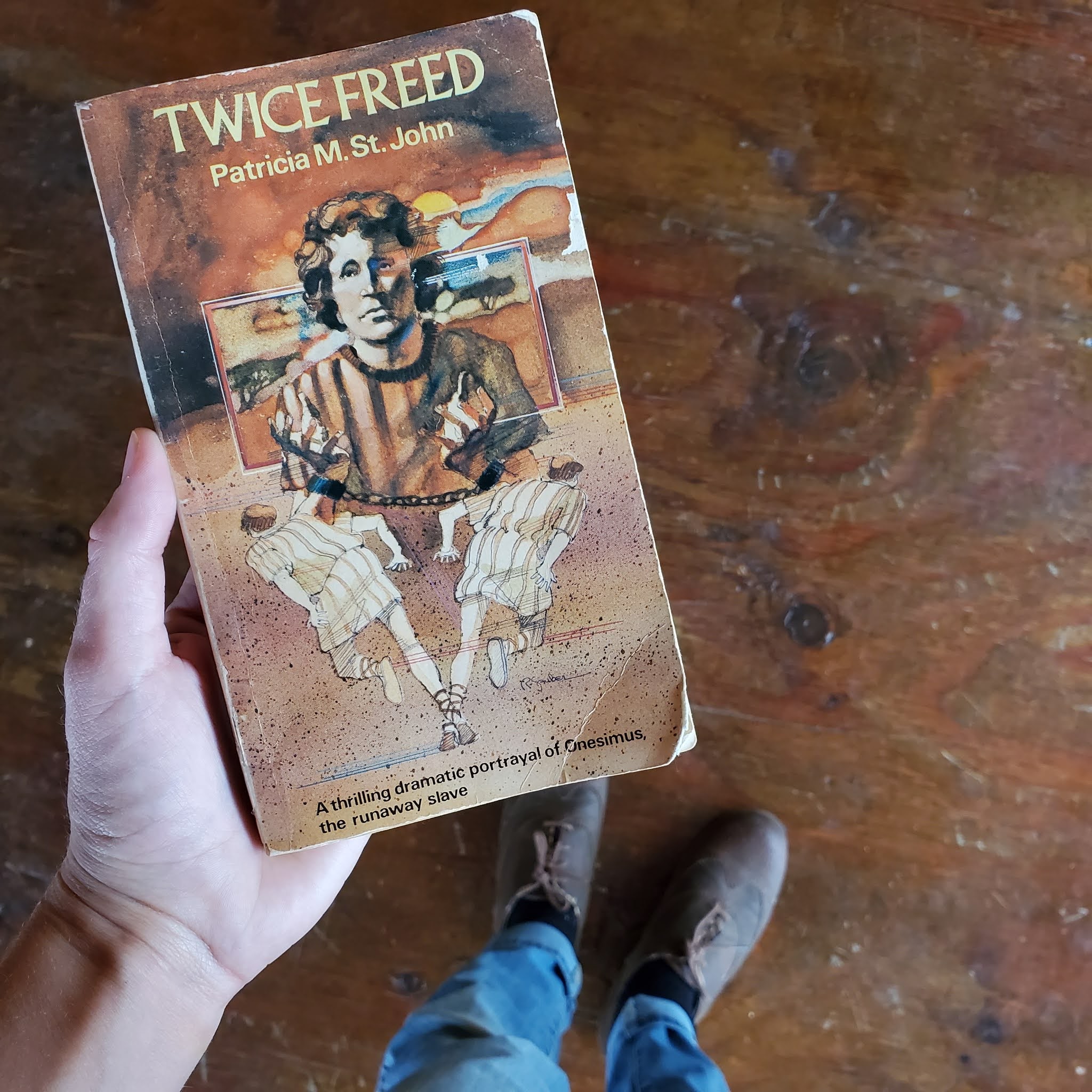
Twice Freed by Patricia St. John is definitely one of my favorite books. Historical fiction set in the first century Roman Empire (one of my favorite time periods!), it tells the story of Onesimus, the runaway slave written about in the book of Philemon in the Bible. It’s a beautiful story of redemption. There are many things I love about this book.
Historical and Biblical accuracy:
I love how historically accurate this book is. Most of the characters and many of the events are taken directly from the Bible. Where fiction is added, it’s done so in such a way that it does not stray from Scripture.
The characters:
I love the character development in this book, especially Onesimus’ struggles and victories. In addition to Onesimus, there is a variety of other characters from the pages of Scripture—Philemon, Archippus, Apphia, Paul the Apostle, Aquila and Priscilla, Luke, John Mark, and others, and I love how Patricia St. John developed their characters as well. Another reviewer mentioned that they disliked how nearly all that Paul says is adapted from his letters in the Bible, but I think that is a good thing. To me, it seems that to represent a historical figure such as Paul the Apostle, where you have a good bit of their writings available, it’s best to keep most of their dialogue similar to what we know they really said.
The writing:
I love the writing style. It reminded me both of C. S. Lewis and of Elizabeth George Speare, but yet it’s different from both of those authors’ styles, too. Her descriptions are beautiful, and she does an excellent job conveying the emotions and feel of different scenes.
The themes:
There are a lot of great spiritual truths woven into this story. I think one of the major themes is the true peace and freedom found in Christ and the emptiness found when you seek it elsewhere. The theme flows naturally in the story; it doesn’t feel forced as we see Onesimus search for beauty and happiness in the pagan gods and physical pleasures and they leave him empty. Another theme that comes into it is repentance and seeking to make things right when you realize you have done wrong.
Final thoughts:
As I mentioned earlier, this is one of my favorite books. I’ve read it myself at least three times. My mother recently read it aloud to my younger siblings and me, and we all thoroughly enjoyed it. There were a few instances when my younger brothers rolled their eyes: the parts involving the girl Onesimus loves. But there’s nothing inappropriate, and the romance is not the main focus of the story. The story does include slaves being beaten, mentions of Christians dying martyr’s deaths, and gladiator fights, but the violence and gore are kept to a minimum. Also, there are mentions of drunkenness and perversion, but it’s all handled very tastefully, and it’s mostly just mentioned, not shown and described. I think Patricia St. John did an excellent job of accurately portraying the depravity of the times without going into unnecessary graphic detail.
One of the things I love about Biblical fiction, such as this book, is that it helps you notice details in the Bible that are easy to miss. Somehow, reading a fictional story about Bible characters can actually help you understand the true account in Scripture more. I know for me anyway, I understood the book of Philemon so much better after reading this book. I do wish there was a section in the back of the book, clarifying what was fiction and what was true. Having researched this time period pretty extensively, I knew what was fact and what was speculation, but for someone who is not as familiar with this era and events, it would be helpful to have that clarification.
Overall, I give Twice Freed 5 out of 5 stars and highly recommend it.
Well, always remember, “He who calls you is faithful, who also will do it,” (1 Thess. 5:24).
All for Him,
Savannah Jane
Follow my blog with Bloglovin
August 14, 2020
My Review of Patterns of Evidence: The Red Sea Miracle II

It’s a story many of us are quite familiar with. The Israelites were slaves in Egypt, laboring under the heavy hand of Pharaoh and the whips of cruel taskmasters. Then God raised up Moses to lead His people out of slavery. After a series of plagues, Pharaoh agreed to let the Hebrews go. But then he changed his mind. His army set out in their chariots after them, and the Israelites found themselves trapped between the Egyptian army and a body of water. With nowhere to go, the people began to panic and turn against Moses for leading them there. But the Bible tells us that God split the sea and the Israelites crossed through on dry land. The Egyptian army took off after the Hebrews, but the waters closed in on them, burying the soldiers, horses, and chariots in the sea. God saved His people that day. This isn’t just a fantasy or fairy tale. The Biblical record is a reliable historical account of something that really happened. I’ve always believed this. But where did the Israelites cross the Red Sea? Or was it even the Red Sea? Should the Hebrew “Yam Suph” actually be translated differently? I have to admit I hadn’t really considered these questions before watching the Patterns of Evidence documentaries made by Timothy Mahoney. The most recent installment in the series: The Red Sea Miracle II explores where the crossing took place—was it in the depths of the Red Sea’s Gulf of Aqaba or a shallower lake in Egypt?—and whether it was a mighty miracle of epic proportions or something explained by natural causes such as wind. I thoroughly enjoyed watching it. It’s a combination of interviews with leading scholars and other people whose life and work connected with the movie in some way, re-enactments of the Biblical story, stunning special effects, on-location filming in Israel, Egypt, and other countries, and excellent narration. The film did an excellent job of seeking to find out what the Bible really says and also exploring the archaeological and other historical evidence. It represented all sides of the arguments—those who believe in a deep sea crossing by a supernatural miracle, those who believe in a shallow water crossing explained naturalistically, and those who fall somewhere in between. I personally came away freshly inspired by the fact that God did do a mighty miracle for the Israelites, and He still does miracles today. It’s easy to become so familiar with Biblical history that you lose the wonder of it. Watching these documentaries has rekindled that conviction in me that real history, and especially the history in the Bible, is truly spectacular. I enjoy an epic fantasy story like The Lord of the Rings. But I’ve come to see that these stories—these true stories—are far more amazing than even an incredible work of fiction like Tolkien’s (and I think J. R. R. Tolkien would agree with me. As a little side note, both J. R. R. Tolkien and one of my personal favorite authors, C. S. Lewis, are portrayed in the movie talking about miracles and their fantasy works.) After all, history is a story written by God Himself. Overall, I give Patterns of Evidence: The Red Sea Miracle II five out of five stars and highly recommend it. I also highly recommend watching The Red Sea Miracle I and the other Patterns of Evidence films: The Moses Controversy and The Exodus. These explore the questions—When did the Exodus take place? How many Hebrews were there who left Egypt? Did Moses write the first five books of the Bible? When and how was the Hebrew language invented?—and more. Well, always remember, “He who calls you is faithful, who also will do it,” (1 Thess. 5:24).All for Him,Savannah Jane
LEARN MORE ABOUT AND WATCH THE PATTERNS OF EVIDENCE DOCUMENTARIES
August 7, 2020
The Story of Polycarp

It was late in the first century A. D. Since the crucifixion and resurrection of Jesus, Christianity had begun to spread throughout the Roman Empire. The apostles and other early Christians preached the good news of salvation, of “repentance toward God and faith toward our Lord Jesus Christ,” (Acts 20:21), to Jew and Gentile, male and female, slave and free.
One person whose life was changed by the gospel was Polycarp. As a young slave boy, he had a kind mistress named Calisto who treated him more like a son than a slave, and it may have been from her that he first learned of Christ. He was also taught by the Apostle John, who had seen the risen Christ with his own eyes.
When Calisto died, she left her entire wealth to Polycarp. Eventually, he became a bishop, serving the church in the city of Smyrna.
In A.D. 155, when Polycarp was an old man, the Roman emperor Hadrian launched a massive persecution of the Christians. They were rounded up and then brutally tortured and killed in Roman amphitheaters as entertainment for the crowds. One of the most sought-after Christians was Polycarp.
When soldiers came to arrest him, Polycarp surprised them by inviting them to eat and asking if he could pray while they supped. They agreed, and for the next two hours, Polycarp prayed aloud to his Heavenly Father. Some of the soldiers were so impressed that they were hesitant to arrest him. But they still followed their orders and took the elderly bishop prisoner.
Polycarp was given the chance to deny Christ and save his life, but he refused. He said, “Eighty and six years have I served Christ, and He has done me no wrong; how then can I blaspheme my King who saved me?”
He was ordered to be burnt at the stake in the amphitheater. As the executioners prepared to light the fire, Polycarp prayed, “Lord God, Father of our blessed Savior, I thank Thee that I have been deemed worthy to receive the crown of martyrdom, and that I may die for Thee and Thy cause.” Like the apostles, he rejoiced that he was “countedworthy to suffer shame for His name,” (Acts 5:41).
As the crowd watched, the fire was lit, and Polycarp faced death with quiet courage. An eyewitness wrote, “He was in the middle, not as burning flesh, but as bread baking or as gold and silver refined in a furnace. And we smelled such a sweet aroma as the breath of incense or some other precious spice.”
But something strange happened. The fire kept going out. Finally, Polycarp was killed with a spear. When the flames finally did consume his body, he was already dead.
The early church father Tertullian wrote, “The blood of the martyrs is the seed of the church.” And it was. As more and more Christians were martyred, more and more people turned to Christ.
They killed Polycarp’s body, but they couldn’t kill his soul. And they couldn’t kill the message he preached. Polycarp is now in the presence of the Lord he loved, and the gospel has continued to spread to the farthest reaches of the earth.
P. S. I highly recommend watching the movie Polycarp made by Henline productions. It's a great, family-friendly movie on the life of this inspiring Christian martyr. Check it out here.
Sources:
The Mystery of History Volume II by Linda Lacour Hobar
Trial and Triumph by Richard M. Hannula
Ten Boys Who Didn’t Give In by Irene Howat
August 1, 2020
The Story of Peggy Covell

It was World War II.
Eighteen-year-old Peggy Covell was devastated. She had just learned that her parents were dead. Missionaries to Japan, they had fled to the Philippines when war broke out, but now the cruel Japanese had taken over the Philippines. When a radio was found in Peggy’s parents’ possession, they were accused of being spies, given a mock trial, and promptly executed.
At first, Peggy was angry and bitter towards the Japanese for killing her parents. But then she thought about what her parents would have done. Without doubt, she was certain her mother and father would have spent their last moments forgiving and loving their enemies.
Peggy knew she needed to forgive them, too. So she began to ask God to show her how He would have her share His love with her enemies.
On the Colorado/Utah border, near her home, was a camp for Japanese prisoners of war. Peggy began to volunteer at the camp, bringing blankets and Bibles to the soldiers and sharing the gospel with them.
She never would have guessed the impact her simple acts of love would make.
Japanese Captain Fuchida had helped lead the attack on Pearl Harbor and fought fiercely against the Americans. Now that the war was over, he had another mission. The Japanese were accused of treating their prisoners of war cruelly, and were being tried for war crimes. So Captain Fuchida set out to prove that other nations treated their prisoners just as badly. He interviewed Japanese prisoners of war, questioning them on how the Americans had treated them. One soldier told Captain Fuchida of Peggy Covell and the love she’d shown them. Captain Fuchida could not understand why she would show love to her enemies—the people who had murdered her parents. And he began a new quest; to learn about the God who would give someone that kind of love for their enemies.
In his searching, he read something written by Jacob Deshazer, an American soldier who had been cruelly treated by the Japanese as a prisoner of war, but became a Christian while in prison, and after the war, returned to Japan as a missionary. After giving his life to Christ, Captain Fuchida joined with Jacob Deshazer preaching the gospel throughout Japan. Captain Fuchida shared the story of Peggy Covell and how it had impacted him whenever he preached, and many Japanese people decided to follow Jesus.
Source:Jacob Deshazer: Forgive Your Enemies by Janet and Geoff Benge
July 21, 2020
5 Tips for Writing Biblical Fiction
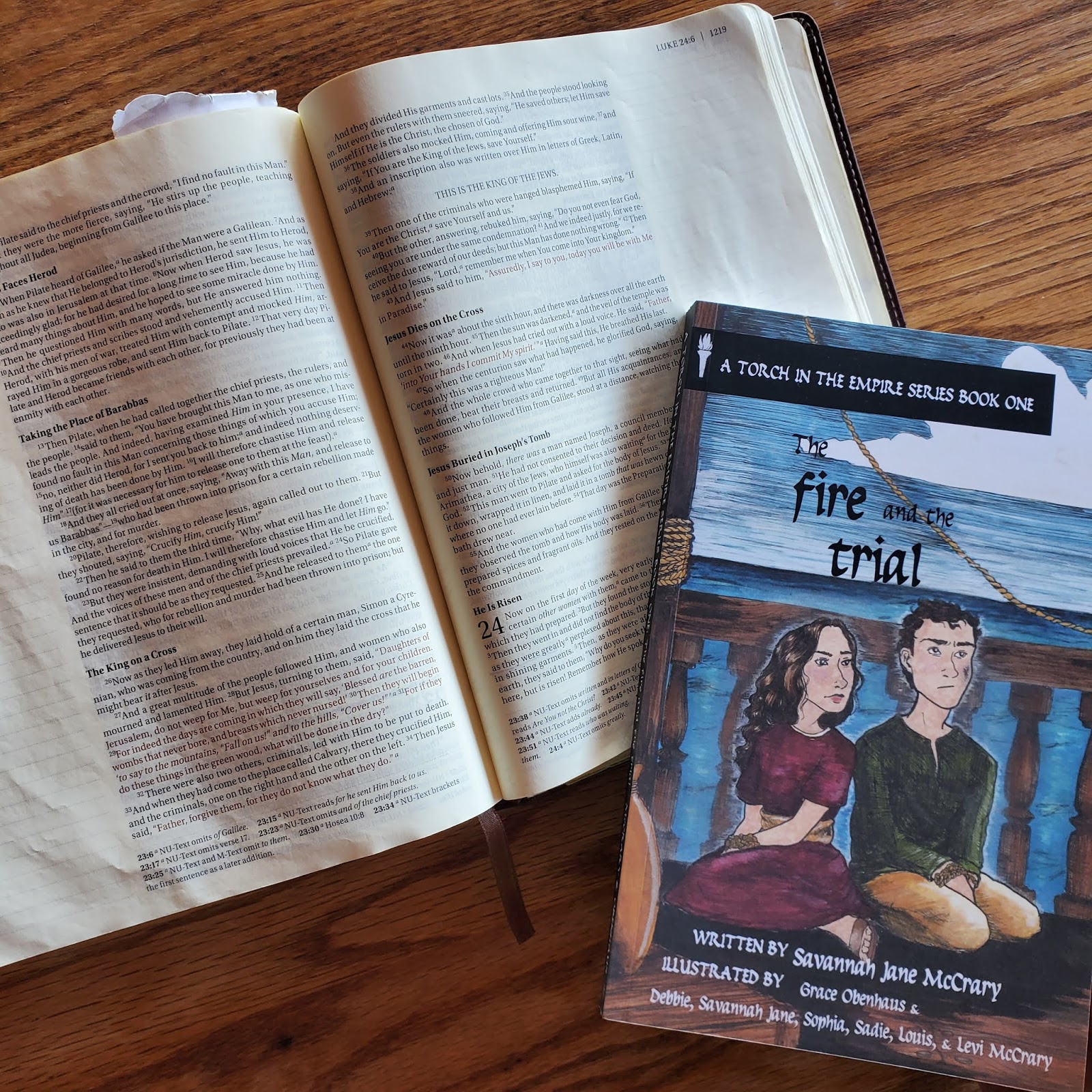
Hi friends! You may already know that I have written two books in a series set in the first-century Roman Empire (The Fire and the Trial and More Sure than the Sun). These books weave together fictional characters and events with real historical ones, including some from the Bible. This type of story is often called Biblical fiction. Today I’d like to share with you some of my tips for writing Biblical fiction. Whether you’re writing a Biblical fiction novel, short story, or reviewing one that someone else wrote, I hope you find these tips helpful.1. Make the Bible your primary source.Remember that the Bible is your only 100% reliable source. Over and over again, the Bible claims to be the inspired, infallible Word of God. 2 Timothy 3:16-17 says, “All Scripture is given by inspiration of God, and is profitable for doctrine, for reproof, for correction, for instruction in righteousness, that the man of God may be complete, thoroughly equipped for every good work.” The Bible equips us for every good work—including writing. Measure everything else you read against the Bible. And when writing your story, don’t change the facts in the Bible. Yes, add fiction, but don’t stray from what the Bible clearly says. I’ll give you a couple of examples. The movie Risen tells the story of a Roman tribune commissioned by Pontius Pilate to search for the body of Jesus when the tomb is found empty. The Bible doesn’t say that this happened, but it certainly could have. This is an example of adding fiction without changing what the Bible says. On the other hand, the movie Exodus: Gods and Kings depicts a messenger of God appearing to Moses in the form of a young boy, whereas the Bible clearly states that God spoke to Moses from a burning bush. This is an example of deliberately changing the story from what the Bible records, and that’s unacceptable. So when writing your story, make sure you know what the Scriptures really say. Don’t just go off what you’ve seen in movies. However, I will add that there are times that I see a movie and I think, “Was it really that way in the Bible? I don’t remember that.” But then I go back and read the Biblical account and find that the movie actually did get it right. It’s very important to study, study, and study the Bible.2. Look for other reliable resources.
Even though the Bible should be your primary source, I find it helpful to use a variety of other resources, too. Study Bibles and Bible study companion books can be quite beneficial (I’ve utilized the MacArthur Study Bible and The Victor Journey through the Bible while writing my Biblical fiction). I try to be careful when using the internet for research. Anyone can say anything online, so I look for articles that cite their sources, and I trust something more when they reference ancient documents and the works of notable historians. I also try to find several sources that state the same fact before accepting it as true (if it’s not mentioned in the Bible). If several articles or books all say the same thing, it seems more likely to be true than if I only find one article or book that says it, and other sources say something different. I also love looking at photos of the locations I’m writing about and watching documentaries and educational videos. 3. Make your characters act and think the way they really would have.
Humans have been humans since the very beginning and have had the same essential nature since the Garden of Eden. However, throughout different time periods and cultures, while some aspects of personality are the same, people would have viewed some things differently than we would today. For example, most girls throughout every culture and every period of history have the desire to be beautiful. That’s something that’s the same. But while most of us girls today find the thought of an arranged marriage appalling, in some time periods and cultures, it would have been simply an accepted way of life. Think about how the culture your characters live in would affect their thinking. 4. Include historical notes.
When I’m reading Biblical fiction or just historical fiction in general, I really like to know what parts of the story are true and which parts are fiction. I think it’s very important to include historical notes at the end of your book or story. Explain which characters and events are real and which are fictional, and list your sources. Something that’s a lot of fun to do is to look for random little-known historical facts that you can weave into your story and then you can mention in your notes that it really happened. For example, I discovered that the Romans had the idea for an ox-powered paddle boat, so in my book The Fire and the Trial I made my character Lucas come up with the idea, and then I put in the historical notes that the Romans really did have that idea and cited the source for it. Including historical notes also gives you a lot more credibility. It shows your readers that you’ve done your research. 5. Read other Biblical fiction.
Reading other Biblical fiction books has helped me a lot with research. I’ve actually gotten a lot of my information from fictional books, but I make sure to double-check the facts elsewhere. Not every Biblical fiction book is historically accurate. Also, when Biblical fiction books include a bibliography of what books and other resources they used for their research, that can give me some direction of where to go for my research. It’s also just very inspiring to read good Biblical fiction. Watching Biblical movies is also very inspiring. While they may not always be accurate, sometimes they are, and whether they are or not, it can be inspiring to get that visual picture. Well, I hope you found that helpful! Biblical fiction is definitely one of my favorite genres to write. I could go on for quite a while about it, but we’ll leave it at that for today!
Always remember, “He who calls you is faithful, who also will do it,” (1 Thess. 5:24).
All for Him,
Savannah Jane