Lynn McLaughlin's Blog, page 4
January 17, 2023
Would the Life Story of Your Parents or Grandparents Change Your Perspective?
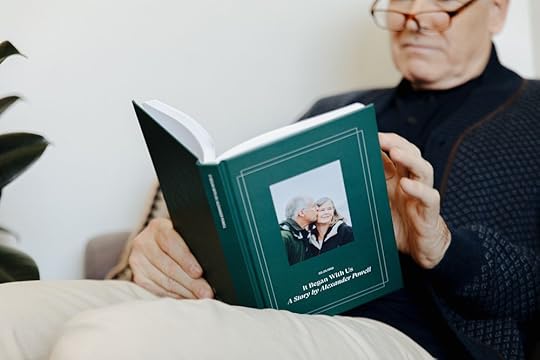
Just about a year ago, I spoke to my father (then 82 years of age) about a writing platform I had discovered called StoryWorth. He had mentioned after I published my last book that he had written a great deal during his life but never did anything about it. Over the years he had told many stories to us but they were never recorded in any way, only engrained in our memories.
11 months later, at our family Christmas, the book he had finished writing titled, “Pappa Pete, My Journey” became a Christmas gift for the family. It was a moment in time I’ll never forget and I don’t think it would have been possible without StoryWorth.
StoryWorth is the easiest way to record family stories and print them in beautiful hardcover books. I became his “partner” and every week sent him a question to respond to. I took on the editor hat and everything flowed beautifully. We searched for photos and easily added them into the chapters. When my father needed a break, we paused the questions. Dad simply replied with his story via email or the website, and at the end of a year, it became his book.
My father was a child in Scotland and recalls hiding in the bomb shelters. His recollections of the family emigrating to Canada, his teenage years, shenanigans, triumphs and tragedies are a treasure for each of us now. My daughter said, “I’m so happy he shared his journey! I will cherish it forever and loved hearing his story!”
This was the perfect gift and we kept it a secret between us for almost a full year (other than my husband). I learned so much about him and my ancestors. Of course, some of his memories differ from mine. Everyone sees things from different perspectives and our memories cloud over time. How fascinating it was to have these regular conversations with him over the year. This will now be an heirloom for generations.
On a side note, I wish I had thought of creating such a program myself! It’s user-friendly, holds every entry, allows edits at any time, has a question bank you can use (or you can write your own), and support is readily available.
In today’s world, our grandchildren won’t even have handwritten letters to hold on to for memories. Don’t hesitate to capture the life stories of the people you love by beginning the conversation. There is nothing more magical than seeing them hold their own book in their hands, knowing that generations to come can take a walk in their shoes.


January 11, 2023
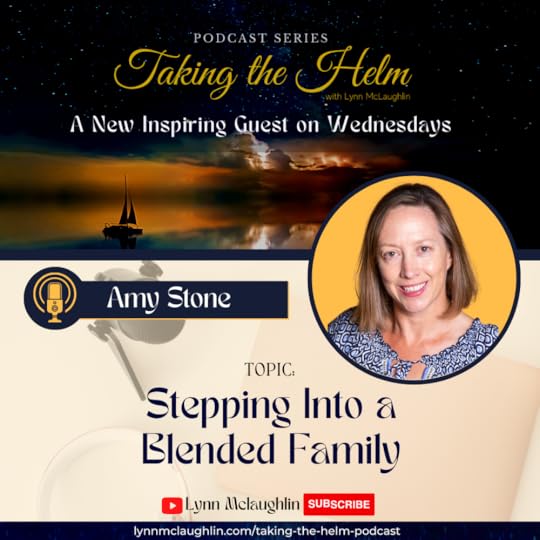
TRANSCRIPT OF AMY STONE | STEPPING INTO A BLENDED FAMILY
Listen Link
[00:00:00]
Hello, everyone, and welcome to our first episode of 2023. If you feel like your life in a blended family is hard, I hope you'll listen. Our guest today is Amy Stone.
Music Intro
Are you facing a crisis in your life or business? It's time to steer yourself in the right direction through the real experiences, passion, and courage of our guests. Where taking the helm with your host, Lynn McLaughlin .
[00:00:31]
And it's my pleasure to introduce our first guest of 2023, Amy Stone. If you are about to make a tough decision, do you want to be a step-parent? You've fallen in love with someone who has children or you're in a blended family? Amy is a life coach who's had the experience herself, and she's going to take us through some tough decisions that have to be made. How she got through it and what she's doing today to help people in this situation. All right, Amy, first guest of 2023. We're so happy that you're with us. How were your holidays? Relaxing, invigorating really a lot of fun.
[00:01:09]
Thanks for asking. I'm thrilled to be here. Thank you for having me, Lynn. Excellent. Okay, well, when we take the helm, we always go back to what took us to the place that we are now.
[00:01:19]
And why are you doing the work with parents that you are today, Amy? That's such a wonderful question. And there's so much that how much time do I have?
[00:01:32]
So why do I do the work that I'm doing? I do the work that I'm doing because I know that and this is something I sort of fell into. I work with step parents and adults and blended families. And when I started my stepparent journey many years ago, I was young, and I did not know then that this is what I would be doing. Fast forward 25 years down the line.
But like many people during the pandemic, I was picking up some extra education and really doing a lot of soul-searching about what were the things that I was doing in my life and what's the place that I could make the biggest impact. And I hit on this. I was talking to a coach one day and I said, what if I helped stepparents? And I sort of said it out loud in a very soft whisper and not realizing that the person on the other end of the conversation was a stepparent and said, oh, wow, I think that might be really helpful. And then as I leaned into it more, I realized how important it was to me to be able to help people who are in a spot similar to what I had been and how valuable it can be to really help people when they're in that spot and they need it.
[00:02:45]
So you've been doing this now for how long? About 18 months. That is fantastic. It's interesting how, despite the tragedy and the horrific things that we experienced through COVID that there has been some good that's come of it. Right.
[00:03:00]
I think we were all sick of that word pivot in about a couple of eight to ten months into it. Right. We're all really tired of that, but so many of us did it, and I think we're actually, in a lot of ways, seeing a reverse pivot now sort of slowly, like, as we go back, because everything was online. Then we got very burnt out of online stuff, and now we're looking for where's the mix? Where's the mix of what we do in our lives.
[00:03:29]
Okay, so I look at this from the opposite end. I am a child of parents who divorced with two step parents. I think we from different perspectives. Right. So what kinds of things do you do right now, Amy, to support blended families and stepparents?
[00:03:45]
So it's interesting. I did not realize that you had stepparents. My parents were divorced, but they didn't remarry, and so I didn't have stepparents. So I have part of that experience as a child, and so that definitely impacts the way I handle things because I've experienced some of the challenge of being that kid. So my focus is on my life coach. So I'm not a lawyer, and I'm not a counselor, and I'm not a doctor. I'm not diagnosing problems or assessing labels. And my goal is really I work with individuals, not the entire family and not couples. My goal is really in contentment and happiness. If you're about to make this decision to join a blended family or if you're in a blended family and your expectation is not matching your reality, right.
[00:04:44]
What are some things we can do? What are some action steps? What are some decisions you might want to make? What are some things you might want to do that are going to lead towards contentment and happiness? Like, we only get this one life, right?
[00:04:56]
We only get this one life, and we do want it to be happy, not just for us, but also for the whole family. The dream is you come home and you set down your bag, whether it's a grocery bag or a work bag or a workout bag, and you feel secure and safe and loved, and you can do things that make you happy. And it's not rainbows and unicorns, don't get me wrong, but that's the dream, right? It's not pie in the sky. It is the dream that we all want just to have happiness and contentment sorry. And joy in our lives, for sure. So to make that decision, I mean, I think about I've got a very, very good friend who's the stepmom, actually, the mom. She's raised four children, stepchildren, whatever you want to phrase it is. And that's got to be a huge decision before entering a relationship. I mean, it's enormous when you think about not having biological children of your own and then very quickly becoming a mom of four children.
[00:05:58]
Yes, there's a million ways these families come together, right? And I was a child-free stepmom, so I was young and didn't have any kids, joined a family that had two kids, and then we added two more kids. So that's my story. Other people come in when they already have kids. And then there's the Brady Bunch method, where people bring two groups of kids together, right.
[00:06:23]
And there's a lot of different combinations therein. That's a broad stroke simplification. But definitely what you talked about just then is really true. I do believe that one of the things that makes it challenging is it is a rapid change. You go from living alone, perhaps and being single to being full instant family. And that is very different than the timeline. If you are creating a family from scratch, taste like a first family where you have the pregnancy and then the little phase where the baby is like just a little worm and doesn't do very much, and you've got a pretty long time before you have this full influx family with all the people. And when you're blending a family, it is rapid. It is a really intense, rapid change. And your friend that went into I call it the instant Family with four kids, she's outnumbered because that's a huge change.
[00:07:23]
When we went to two to four, that was a gigantic change in how much work there was around the house. And it's a level of responsibility. We just go back to the example you gave of someone living alone, and now they're in a home with a partner and four children. And the level of responsibility must be like, I can't unfathomable because they're not. Used they may not be used to it.
[00:07:48]
Living with other people is a lot more complicated than we want to admit, is just an observation I have of life. When we're by ourselves, you think to yourself, what do I want for lunch? And then you just kind of do whatever that is, and you change your mind or whatever. And when you have an active family of two or four or six or eight people, every single stage of that just becomes exponentially more complicated. Not that it can't be enjoyable, but it is more complicated.
[00:08:24]
I got to throw this in my mom's second relationship, there were two children. And the ages of the children that you're bringing into your life makes a difference too. Makes a huge difference to an angry. 15 year old or those kinds of things. But my mom had a relationship. She really loved the man. I really felt she did. And she decided not to carry on with it because she'd already raised four of us almost single-handedly by herself as a single mom for many years and just said, I just can't do it again. So there's that. Yes, 100%.
[00:08:52]
And that is a completely valid, valid decision. Right. Your mom had done all of the work of raising a full batch of children and she knew exactly what was involved in it. And then to think about whether or not to do it again and to have the self empowerment to make that decision is really strong of her because a lot of times women will feel like they need to take that on for somebody else, and you may not want to once you've been through it. I'm almost at the end of the I've got two and a half more years before I'm an empty nester.
[00:09:33]
Oh, you think so? I'm just going to say you think so? Maybe not, but I'm well past diapers and everybody drives. I can see the light at the end of the tunnel and I describe it. Young children, and we talked about it is a difference between little kids, teenagers, if you're remarrying and you have adult children, completely different situations.
[00:09:57]
But young children are like a black hole of resources. They will absorb all available time, all available love. You can literally have a giant village of adults and family loving on small children. They just soak it all up. There's no limit to how much we can invest in them. There is, however, an impact on how much else we can do. It's an investment in the lives of our children and there's different levels of what everybody is able to do. But nobody goes through this journey of raising children as a step parent or a parent without investing time and energy. And once you've done that, when you look back, you think to yourself, oh, do I want to do it again? It's a decision.
[00:10:38]
It's a very empowering thing to be able to say, I have this decision. And I've worked with clients who've made the same decision that your mom did, where they said, do I want to go back and reset now and take on another twelve or 15 years of parenting small children? Or do I want to make a different decision and commit to my independent life as an adult? Some of my dreams? When you're helping individuals, I'm sure you're helping individuals through different phases of, first of all deciding, is this something I want for myself?
[00:11:07]
And then the transition. So what kinds of supports do you offer? Amy? So, yeah, people usually come to me in one of two times. One, they come before they've made the commitment, which I think is very interesting.
[00:11:17]
It was unexpected when I started that people would search me. I think that's a very tuned in and enlightened place to be because I did not do that. I charged forward, assuming I knew what I was doing. Completely wrong about that, by the way, but just barreled right through. And I really love that people will reach out and say, hey, before I do this, what are some things that I would like to know and I love to work with people on that.
[00:11:39]
And the other group of people I tend to work with are people who are they're committed in their relationship. They're either married or they've made a significant committed. They're living together and there's a mismatch between what they thought their life would be like and what it's actually like. And I describe it as a little bit of chaos, a little bit of unhappiness, a little bit of discontent, throwing a smidgen of fear that you may have made the wrong decision or taken on more than you understood you were taking on. And you're trying to find your way through into whatever you might want it to be.
[00:12:14]
So the support that I offer is as a life coach, right? So it's in helping you get clear on what's going on in your life and what are the decisions you want to make and how do you want to get there. I happily share with people the things I did, including as many mistakes as anybody wants to hear about. And I've been through it for a long time. So I can look back and say, these are some things I did that I didn't know I was doing wrong, but I really didn't know I didn't have kids when I became a stepmom.
[00:12:44]
And I openly admit that I made myself fairly miserable for a while simply because I wasn't aware of what small children were like. I really thought they should be quieter than they are. I really thought they should be a little more independent. I would have loved if they slept in a little bit all of the things that they don't do. This was normal child development stages and I didn't understand that.
[00:13:09]
And so I created some frustration for myself and I always tell people that and so I always share the things that I do, but we unpack it, figure out what's going on and figure out the things that you want to do. So I come in as support. I stand beside you in the situation that you're in, non judgmentally and supportively. Right? That's a crazy hard thing to find in a blended family. There's a lot of stigma, there's a lot of judgment. The first line of resources for stepparents and people who've gone through divorce are really often people will suggest therapists and lawyers and you don't always need a legal solution or a diagnosis, right. Sometimes you need somebody who has been there, done that can help you figure out what you want to do. And in my case, I wanted to be happy. I wanted to create a happy family.
[00:14:09]
And so the process I went through was really figuring out how to be happy in my family. What were the things that I did? We all have our own journey, but being able to be in the driver's seat of how I'm going to experience my family was very empowering to me. Yeah, I want to go back to what you said just a little while ago about things you did wrong. I'm going to throw a little bit of compassion out there.
[00:14:33]
Self-compassion. I don't think it's mistakes that we learn from right and right and wrong are different in every family based on culture, tradition, background, beliefs. Absolutely. I've got to give you credit, Amy, for what you just said about being able to walk people through side by side when people are coming from so many different places and perspectives. That's got to be tough.
[00:14:54]
It can be. I think I thought I knew a lot more about parenting before I was a parent. Right. If you had asked me about my opinions before I was a parent, I would have probably had a lot of very rigid ideas. And one of the shifts that's happened to me over the last 25 years is, as you said, there's a million ways to skin this cat and people come from different positions. And I'm so much more accepting of the fact that here's how I did this, but there are other ways to do this.
[00:15:24]
And so I honor that. I am very much more open about the fact that what I think is should the way it will be often was not the way it worked out. And that was okay. The process worked itself out and it was all right. But also that when people come to me with their situation, I just see it. I just see it and I say, all right. So it just is what it is. Right. This is the construct of your family, and these are the things that are happening right now. What are the tools that we have and what are the tools that we need to have a good day and have a good week and to love ourselves and to love the other people in the family and feel loved.
[00:16:07]
Right. Feel loved. And I'm thinking, in addition to the complexities of bringing children into your life, when you have two people from two different religious backgrounds and then navigating, what does the future look like for that blended family now with maybe two very different backgrounds and religious beliefs? My goodness. Wow.
[00:16:27]
Yeah. No, absolutely. Yes, we do have that in my family. My husband is Jewish and I was raised in a Catholic house, and so we've had lots of adventures like that, and we chose to celebrate all of the traditions, which every once in a while provides for a very busy couple of years. I forget how long ago it was.
[00:16:44]
They overlapped. We had Christmas and Hanukkah all at the same time. My kids were little, and so I had to make a rule. We did it once, and then I had to make a rule. I was like, listen, I can't do Santa Claus and Latkas all in the same day. We have to parse this out. That is exactly the situation of the friend that I was speaking about earlier, who is now the mom of four children.
[00:17:11]
Same thing, Jewish and Catholic between the two of them. Yeah. And people do it different ways because some people will pick one and move forward, and other people will do both. And sometimes we had a book when my kids were little, we had a book where the people in the book, each parent sort of took over their own traditions. So there are lots of ways to do it, and it just depends on what's the important part to your family.
[00:17:38]
And making those conscious choices and decisions moving forward, as opposed to grappling, just to, what are we going to do? What are we going to do? No, you make those decisions yes. Along the way. And that can be harder.
[00:17:48]
Right. Like, it can feel very pressuring to make the choices, and it can also take a little while before the choices feel empowering, if that makes any sense. Right. Because our beliefs are so dear, and we were raised with these beliefs. Some of us have changed our beliefs over time, and that's okay.
[00:18:05]
But being put into a situation where you love someone and want to carry on a life with them, you got to figure it out. Amy, you have something called seven action steps? Yes. All right. So as a part of this process, over the last I mentioned that I did not know I was going to do this when I started this family.
[00:18:26]
So the first thing we did, let me tell you, if you want to do something fun, tell your family that you're going to start a business about your family. That's like an underwrite number. So the first thing we did, my husband I wrote down a list of things that I thought were the lessons that we had learned over the years, and my husband signed off on those, and he thought those were good, and those were very helpful for people, but then those were not action steps. So after I talked about those for a while, I realized I was like, oh, these were just the lessons. But then what did I do?
[00:18:54]
What did I do that made the difference? And so I have seven steps, which are the things that, looking back, these are the changes that I think I made. These are the things that I did that really made a difference in our family. So that we were I was happier. We were all happier. There's truth in that phrase that if the mom is happy, the family is happy. Right. So when I was unhappy, a lot of people were unhappy. But yes, I have seven steps. Seven action steps for creating happiness in your family.
[00:19:23]
And I put that on my it's free, and I put that on my website, which is Amy says. So can you give us an example of one of the action steps? So one of the action steps is taking personal responsibility for how I'm going to feel. And that's a broad stroke thing that I break down into different things. And this is not exclusive to blended families, right?
[00:19:50]
This is a human thing, but it's harder when we're dealing with small people and the people that we love, as long as we are giving the people around us the responsibility of if you're unhappy, then I'm going to be sad. If your behavior is the way I don't like, then I'm going to feel sad. That's a limit. And by learning to take responsibility for can I be happy even if this is not exactly the way I wanted to go? If you have a tantrum, can I still be happy?
[00:20:22]
If you're late to school, can I still be happy? If the transfer between houses doesn't go the way I thought it would be, can I still be happy? If I don't feel totally comfortable in a mixed blended event, can I still be happy taking responsibility for how I feel? Fantastic. Well, that's available for free on your website.
[00:20:39]
Amy, do you have any closing comments or advice for our listeners and our viewers today? Sure. My closing piece of advice is that happiness is a totally worthwhile goal. It sounds sort of woozy and like it's like marshmallows and sunshine, but shifting to saying, you know what, what does happiness feel like? What is contentment?
[00:21:04]
What does it mean to me? And what are the things in my life that will get me? There is a totally worthwhile goal, in my opinion. And if you don't have people on your team surrounding you who agree with that, then find other people who are working with you towards happiness because it makes a big difference. Well, you know, considering this is the first podcast interview on Taking the Helm of 2023, if you haven't set a New Year's resolution yet, there's one happiness, right, conscious and positive choices to get there.
[00:21:35]
I think that's fantastic. And I thank you very much for joining us today. Amy, thank you for having me. It's been a pleasure. What a way to start by setting intentions, as you know, Taking the Helm.
[00:21:45]
We join you every two weeks with a new and inspiring guest, someone who suffered some type of crisis and has taken that to open new doors and possibilities for themselves and for other people. If you're interested in transcription, all of the notes are now on my blog for every single podcast interview for likely the last three months when we started doing the transcribed notes. Stay healthy and safe for everyone and we'll see you in two weeks.
Music Outro
Thanks for tuning in and posting your review of Taking the Helm on your favorite platform. We'll give you a shout-out in a future episode. To be inspired by people who are steering us in the right direction. Go to Lynn McLaughlin .com where you can search previous guests by the topic of your choice. And while you're there, download Lynn's gift. There’s more than one way to face a crisis!
AMY STONE | STEPPING INTO A BLENDED FAMILY
Listen Link
[00:00:00]
Hello, everyone, and welcome to our first episode of 2023. If you feel like your life in a blended family is hard, I hope you'll listen. Our guest today is Amy Stone.
Music Intro
Are you facing a crisis in your life or business? It's time to steer yourself in the right direction through the real experiences, passion, and courage of our guests. Where taking the helm with your host, Lynn McLaughlin .
[00:00:31]
And it's my pleasure to introduce our first guest of 2023, Amy Stone. If you are about to make a tough decision, do you want to be a step-parent? You've fallen in love with someone who has children or you're in a blended family? Amy is a life coach who's had the experience herself, and she's going to take us through some tough decisions that have to be made. How she got through it and what she's doing today to help people in this situation. All right, Amy, first guest of 2023. We're so happy that you're with us. How were your holidays? Relaxing, invigorating really a lot of fun.
[00:01:09]
Thanks for asking. I'm thrilled to be here. Thank you for having me, Lynn. Excellent. Okay, well, when we take the helm, we always go back to what took us to the place that we are now.
[00:01:19]
And why are you doing the work with parents that you are today, Amy? That's such a wonderful question. And there's so much that how much time do I have?
[00:01:32]
So why do I do the work that I'm doing? I do the work that I'm doing because I know that and this is something I sort of fell into. I work with step parents and adults and blended families. And when I started my stepparent journey many years ago, I was young, and I did not know then that this is what I would be doing. Fast forward 25 years down the line.
But like many people during the pandemic, I was picking up some extra education and really doing a lot of soul-searching about what were the things that I was doing in my life and what's the place that I could make the biggest impact. And I hit on this. I was talking to a coach one day and I said, what if I helped stepparents? And I sort of said it out loud in a very soft whisper and not realizing that the person on the other end of the conversation was a stepparent and said, oh, wow, I think that might be really helpful. And then as I leaned into it more, I realized how important it was to me to be able to help people who are in a spot similar to what I had been and how valuable it can be to really help people when they're in that spot and they need it.
[00:02:45]
So you've been doing this now for how long? About 18 months. That is fantastic. It's interesting how, despite the tragedy and the horrific things that we experienced through COVID that there has been some good that's come of it. Right.
[00:03:00]
I think we were all sick of that word pivot in about a couple of eight to ten months into it. Right. We're all really tired of that, but so many of us did it, and I think we're actually, in a lot of ways, seeing a reverse pivot now sort of slowly, like, as we go back, because everything was online. Then we got very burnt out of online stuff, and now we're looking for where's the mix? Where's the mix of what we do in our lives.
[00:03:29]
Okay, so I look at this from the opposite end. I am a child of parents who divorced with two step parents. I think we from different perspectives. Right. So what kinds of things do you do right now, Amy, to support blended families and stepparents?
[00:03:45]
So it's interesting. I did not realize that you had stepparents. My parents were divorced, but they didn't remarry, and so I didn't have stepparents. So I have part of that experience as a child, and so that definitely impacts the way I handle things because I've experienced some of the challenge of being that kid. So my focus is on my life coach. So I'm not a lawyer, and I'm not a counselor, and I'm not a doctor. I'm not diagnosing problems or assessing labels. And my goal is really I work with individuals, not the entire family and not couples. My goal is really in contentment and happiness. If you're about to make this decision to join a blended family or if you're in a blended family and your expectation is not matching your reality, right.
[00:04:44]
What are some things we can do? What are some action steps? What are some decisions you might want to make? What are some things you might want to do that are going to lead towards contentment and happiness? Like, we only get this one life, right?
[00:04:56]
We only get this one life, and we do want it to be happy, not just for us, but also for the whole family. The dream is you come home and you set down your bag, whether it's a grocery bag or a work bag or a workout bag, and you feel secure and safe and loved, and you can do things that make you happy. And it's not rainbows and unicorns, don't get me wrong, but that's the dream, right? It's not pie in the sky. It is the dream that we all want just to have happiness and contentment sorry. And joy in our lives, for sure. So to make that decision, I mean, I think about I've got a very, very good friend who's the stepmom, actually, the mom. She's raised four children, stepchildren, whatever you want to phrase it is. And that's got to be a huge decision before entering a relationship. I mean, it's enormous when you think about not having biological children of your own and then very quickly becoming a mom of four children.
[00:05:58]
Yes, there's a million ways these families come together, right? And I was a child-free stepmom, so I was young and didn't have any kids, joined a family that had two kids, and then we added two more kids. So that's my story. Other people come in when they already have kids. And then there's the Brady Bunch method, where people bring two groups of kids together, right.
[00:06:23]
And there's a lot of different combinations therein. That's a broad stroke simplification. But definitely what you talked about just then is really true. I do believe that one of the things that makes it challenging is it is a rapid change. You go from living alone, perhaps and being single to being full instant family. And that is very different than the timeline. If you are creating a family from scratch, taste like a first family where you have the pregnancy and then the little phase where the baby is like just a little worm and doesn't do very much, and you've got a pretty long time before you have this full influx family with all the people. And when you're blending a family, it is rapid. It is a really intense, rapid change. And your friend that went into I call it the instant Family with four kids, she's outnumbered because that's a huge change.
[00:07:23]
When we went to two to four, that was a gigantic change in how much work there was around the house. And it's a level of responsibility. We just go back to the example you gave of someone living alone, and now they're in a home with a partner and four children. And the level of responsibility must be like, I can't unfathomable because they're not. Used they may not be used to it.
[00:07:48]
Living with other people is a lot more complicated than we want to admit, is just an observation I have of life. When we're by ourselves, you think to yourself, what do I want for lunch? And then you just kind of do whatever that is, and you change your mind or whatever. And when you have an active family of two or four or six or eight people, every single stage of that just becomes exponentially more complicated. Not that it can't be enjoyable, but it is more complicated.
[00:08:24]
I got to throw this in my mom's second relationship, there were two children. And the ages of the children that you're bringing into your life makes a difference too. Makes a huge difference to an angry. 15 year old or those kinds of things. But my mom had a relationship. She really loved the man. I really felt she did. And she decided not to carry on with it because she'd already raised four of us almost single-handedly by herself as a single mom for many years and just said, I just can't do it again. So there's that. Yes, 100%.
[00:08:52]
And that is a completely valid, valid decision. Right. Your mom had done all of the work of raising a full batch of children and she knew exactly what was involved in it. And then to think about whether or not to do it again and to have the self empowerment to make that decision is really strong of her because a lot of times women will feel like they need to take that on for somebody else, and you may not want to once you've been through it. I'm almost at the end of the I've got two and a half more years before I'm an empty nester.
[00:09:33]
Oh, you think so? I'm just going to say you think so? Maybe not, but I'm well past diapers and everybody drives. I can see the light at the end of the tunnel and I describe it. Young children, and we talked about it is a difference between little kids, teenagers, if you're remarrying and you have adult children, completely different situations.
[00:09:57]
But young children are like a black hole of resources. They will absorb all available time, all available love. You can literally have a giant village of adults and family loving on small children. They just soak it all up. There's no limit to how much we can invest in them. There is, however, an impact on how much else we can do. It's an investment in the lives of our children and there's different levels of what everybody is able to do. But nobody goes through this journey of raising children as a step parent or a parent without investing time and energy. And once you've done that, when you look back, you think to yourself, oh, do I want to do it again? It's a decision.
[00:10:38]
It's a very empowering thing to be able to say, I have this decision. And I've worked with clients who've made the same decision that your mom did, where they said, do I want to go back and reset now and take on another twelve or 15 years of parenting small children? Or do I want to make a different decision and commit to my independent life as an adult? Some of my dreams? When you're helping individuals, I'm sure you're helping individuals through different phases of, first of all deciding, is this something I want for myself?
[00:11:07]
And then the transition. So what kinds of supports do you offer? Amy? So, yeah, people usually come to me in one of two times. One, they come before they've made the commitment, which I think is very interesting.
[00:11:17]
It was unexpected when I started that people would search me. I think that's a very tuned in and enlightened place to be because I did not do that. I charged forward, assuming I knew what I was doing. Completely wrong about that, by the way, but just barreled right through. And I really love that people will reach out and say, hey, before I do this, what are some things that I would like to know and I love to work with people on that.
[00:11:39]
And the other group of people I tend to work with are people who are they're committed in their relationship. They're either married or they've made a significant committed. They're living together and there's a mismatch between what they thought their life would be like and what it's actually like. And I describe it as a little bit of chaos, a little bit of unhappiness, a little bit of discontent, throwing a smidgen of fear that you may have made the wrong decision or taken on more than you understood you were taking on. And you're trying to find your way through into whatever you might want it to be.
[00:12:14]
So the support that I offer is as a life coach, right? So it's in helping you get clear on what's going on in your life and what are the decisions you want to make and how do you want to get there. I happily share with people the things I did, including as many mistakes as anybody wants to hear about. And I've been through it for a long time. So I can look back and say, these are some things I did that I didn't know I was doing wrong, but I really didn't know I didn't have kids when I became a stepmom.
[00:12:44]
And I openly admit that I made myself fairly miserable for a while simply because I wasn't aware of what small children were like. I really thought they should be quieter than they are. I really thought they should be a little more independent. I would have loved if they slept in a little bit all of the things that they don't do. This was normal child development stages and I didn't understand that.
[00:13:09]
And so I created some frustration for myself and I always tell people that and so I always share the things that I do, but we unpack it, figure out what's going on and figure out the things that you want to do. So I come in as support. I stand beside you in the situation that you're in, non judgmentally and supportively. Right? That's a crazy hard thing to find in a blended family. There's a lot of stigma, there's a lot of judgment. The first line of resources for stepparents and people who've gone through divorce are really often people will suggest therapists and lawyers and you don't always need a legal solution or a diagnosis, right. Sometimes you need somebody who has been there, done that can help you figure out what you want to do. And in my case, I wanted to be happy. I wanted to create a happy family.
[00:14:09]
And so the process I went through was really figuring out how to be happy in my family. What were the things that I did? We all have our own journey, but being able to be in the driver's seat of how I'm going to experience my family was very empowering to me. Yeah, I want to go back to what you said just a little while ago about things you did wrong. I'm going to throw a little bit of compassion out there.
[00:14:33]
Self-compassion. I don't think it's mistakes that we learn from right and right and wrong are different in every family based on culture, tradition, background, beliefs. Absolutely. I've got to give you credit, Amy, for what you just said about being able to walk people through side by side when people are coming from so many different places and perspectives. That's got to be tough.
[00:14:54]
It can be. I think I thought I knew a lot more about parenting before I was a parent. Right. If you had asked me about my opinions before I was a parent, I would have probably had a lot of very rigid ideas. And one of the shifts that's happened to me over the last 25 years is, as you said, there's a million ways to skin this cat and people come from different positions. And I'm so much more accepting of the fact that here's how I did this, but there are other ways to do this.
[00:15:24]
And so I honor that. I am very much more open about the fact that what I think is should the way it will be often was not the way it worked out. And that was okay. The process worked itself out and it was all right. But also that when people come to me with their situation, I just see it. I just see it and I say, all right. So it just is what it is. Right. This is the construct of your family, and these are the things that are happening right now. What are the tools that we have and what are the tools that we need to have a good day and have a good week and to love ourselves and to love the other people in the family and feel loved.
[00:16:07]
Right. Feel loved. And I'm thinking, in addition to the complexities of bringing children into your life, when you have two people from two different religious backgrounds and then navigating, what does the future look like for that blended family now with maybe two very different backgrounds and religious beliefs? My goodness. Wow.
[00:16:27]
Yeah. No, absolutely. Yes, we do have that in my family. My husband is Jewish and I was raised in a Catholic house, and so we've had lots of adventures like that, and we chose to celebrate all of the traditions, which every once in a while provides for a very busy couple of years. I forget how long ago it was.
[00:16:44]
They overlapped. We had Christmas and Hanukkah all at the same time. My kids were little, and so I had to make a rule. We did it once, and then I had to make a rule. I was like, listen, I can't do Santa Claus and Latkas all in the same day. We have to parse this out. That is exactly the situation of the friend that I was speaking about earlier, who is now the mom of four children.
[00:17:11]
Same thing, Jewish and Catholic between the two of them. Yeah. And people do it different ways because some people will pick one and move forward, and other people will do both. And sometimes we had a book when my kids were little, we had a book where the people in the book, each parent sort of took over their own traditions. So there are lots of ways to do it, and it just depends on what's the important part to your family.
[00:17:38]
And making those conscious choices and decisions moving forward, as opposed to grappling, just to, what are we going to do? What are we going to do? No, you make those decisions yes. Along the way. And that can be harder.
[00:17:48]
Right. Like, it can feel very pressuring to make the choices, and it can also take a little while before the choices feel empowering, if that makes any sense. Right. Because our beliefs are so dear, and we were raised with these beliefs. Some of us have changed our beliefs over time, and that's okay.
[00:18:05]
But being put into a situation where you love someone and want to carry on a life with them, you got to figure it out. Amy, you have something called seven action steps? Yes. All right. So as a part of this process, over the last I mentioned that I did not know I was going to do this when I started this family.
[00:18:26]
So the first thing we did, let me tell you, if you want to do something fun, tell your family that you're going to start a business about your family. That's like an underwrite number. So the first thing we did, my husband I wrote down a list of things that I thought were the lessons that we had learned over the years, and my husband signed off on those, and he thought those were good, and those were very helpful for people, but then those were not action steps. So after I talked about those for a while, I realized I was like, oh, these were just the lessons. But then what did I do?
[00:18:54]
What did I do that made the difference? And so I have seven steps, which are the things that, looking back, these are the changes that I think I made. These are the things that I did that really made a difference in our family. So that we were I was happier. We were all happier. There's truth in that phrase that if the mom is happy, the family is happy. Right. So when I was unhappy, a lot of people were unhappy. But yes, I have seven steps. Seven action steps for creating happiness in your family.
[00:19:23]
And I put that on my it's free, and I put that on my website, which is Amy says. So can you give us an example of one of the action steps? So one of the action steps is taking personal responsibility for how I'm going to feel. And that's a broad stroke thing that I break down into different things. And this is not exclusive to blended families, right?
[00:19:50]
This is a human thing, but it's harder when we're dealing with small people and the people that we love, as long as we are giving the people around us the responsibility of if you're unhappy, then I'm going to be sad. If your behavior is the way I don't like, then I'm going to feel sad. That's a limit. And by learning to take responsibility for can I be happy even if this is not exactly the way I wanted to go? If you have a tantrum, can I still be happy?
[00:20:22]
If you're late to school, can I still be happy? If the transfer between houses doesn't go the way I thought it would be, can I still be happy? If I don't feel totally comfortable in a mixed blended event, can I still be happy taking responsibility for how I feel? Fantastic. Well, that's available for free on your website.
[00:20:39]
Amy, do you have any closing comments or advice for our listeners and our viewers today? Sure. My closing piece of advice is that happiness is a totally worthwhile goal. It sounds sort of woozy and like it's like marshmallows and sunshine, but shifting to saying, you know what, what does happiness feel like? What is contentment?
[00:21:04]
What does it mean to me? And what are the things in my life that will get me? There is a totally worthwhile goal, in my opinion. And if you don't have people on your team surrounding you who agree with that, then find other people who are working with you towards happiness because it makes a big difference. Well, you know, considering this is the first podcast interview on Taking the Helm of 2023, if you haven't set a New Year's resolution yet, there's one happiness, right, conscious and positive choices to get there.
[00:21:35]
I think that's fantastic. And I thank you very much for joining us today. Amy, thank you for having me. It's been a pleasure. What a way to start by setting intentions, as you know, Taking the Helm.
[00:21:45]
We join you every two weeks with a new and inspiring guest, someone who suffered some type of crisis and has taken that to open new doors and possibilities for themselves and for other people. If you're interested in transcription, all of the notes are now on my blog for every single podcast interview for likely the last three months when we started doing the transcribed notes. Stay healthy and safe for everyone and we'll see you in two weeks.
Music Outro
Thanks for tuning in and posting your review of Taking the Helm on your favorite platform. We'll give you a shout-out in a future episode. To be inspired by people who are steering us in the right direction. Go to Lynn McLaughlin .com where you can search previous guests by the topic of your choice. And while you're there, download Lynn's gift. There’s more than one way to face a crisis!
December 28, 2022
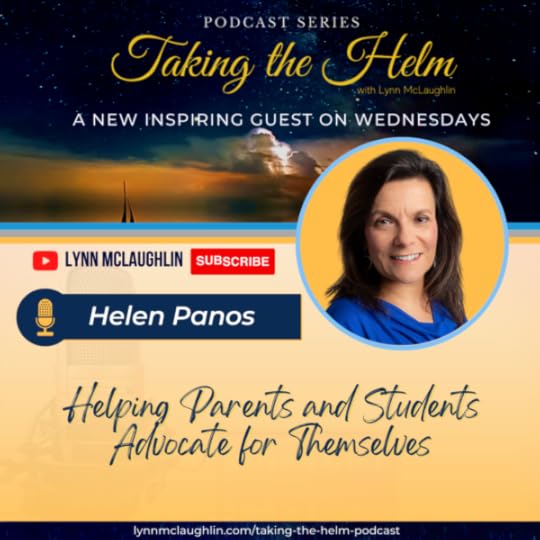
TRANSCRIPT OF HELEN PANOS | HELPING PARENTS AND STUDENTS ADVOCATE FOR THEMSELVES
[00:00:00]
Hello, everyone, and welcome to the last episode of 2022. If your child is struggling in school, this is the episode to listen to. Our guest today is Helen panel.
[00:00:14]
Muic Intro Are you facing a crisis in your life or business? It's time to steer yourself in the right direction through the real experiences, passion and courage of our guests. We're taking the helm with your host, Lynn McLaughlin .
Helen Panos is a lifelong educator, but she left teaching to open her own business called the Dynamis Learning Academy. She's offering tutoring services, is branching out into supporting students with mental health, helping students to learn to advocate for themselves and parents to understand the school system, what school systems offer and don't offer, where the gaps are, and advocating whether or not their children have special needs. All right, Helen, you are our last guest of 2022.
[00:00:58]
And what do we close out the year talking about students, students, progress, parent advocacy. Thank you so much for being with us. Thank you for having me. I'm excited to inform your guests about advocacy and helping their families be successful. Yeah.
[00:01:16]
So just to give everyone a context, Helen is in the United States, I'm in Canada. We're going to do our best to mesh the two languages and worlds together. But the bottom line is, it doesn't matter where you are in the world. Your children are in school, they're struggling, you're trying to find a better way for them. We're here to talk to you today.
[00:01:33]
That's right. That's correct. All right, Helen, tell us a little bit about your background and why you're doing this today. Where did it all start? I'm an educator of 25 plus years of a public school system in Atlanta, Georgia, in the US.
[00:01:46]
And that's one of the biggest school systems I was in is Fulton County. And so I was a teacher for many years and most of that time also gifted leave. So then I decided it was time to start my own business. While I was teaching, I just had the idea that I didn't feel even back then, this was probably about ten years ago, I was already getting the thought that I didn't feel school systems could really truly meet the needs of children. And I wanted to be able to do that.
[00:02:15]
I have a passion about that, and it's not necessarily their fault. It has a lot to do with funding, resources, all kinds of things, and personnel being appropriately trained, to be honest. And there's not enough hours of the day. But I decided to start Dynamic Learning Academy. It's a K through twelve tutoring and now student advocacy program.
[00:02:38]
And we do SATs all over the nation. We also do tutoring nationwide, virtually. Here in Atlanta, we do it virtually, and we're in person because my tutors, I have 15 tutors right now, and that's growing rapidly. So we help kids, we match. I listen to what the parent needs.
[00:02:56]
I match them up with the right type of tutor. I have that experience and knowledge from being also a 504 chair that I got promoted to. Right. As we were going into COVID. I had done it for three years, so I've heard a lot of stories and sat in a lot of meetings, almost to the point I don't want to say I will diagnose your child, but I can get pretty close to suggesting what you need to do.
[00:03:19]
And so I felt like I needed to start my own company, and then now it's branching and rebranding into advocacy, which we're going to talk about today. All right, so those of us in Ontario, Canada, the UK, who are listening, which is a lot of my audience, do not understand what 504 means. That's a good point. You might have a different program. Right?
[00:03:40]
So in America, the Section 504 plan is under the Americans with Disabilities Act. If you have a medical diagnosis of some kind, whether I think the original might have been like, diabetes is why it started in the first place, was that kids might need to leave the classroom and go get their insulin shot or something down in the nurse's office. Right? So it started with that, then it's turned into the biggest one being ADHD. So you have a medical diagnosis of something.
[00:04:06]
Anxiety is very large here in the US. Probably nationwide now, also dyslexia. So if you have a diagnosis from a doctor, a professional, then you get what's called a Section 504, and it's got accommodations to it. You meet yearly, and then you get a reevaluation every three years in this plan. So you can get accommodations, like extended time, frequent breaks for, like, Sat and act here in the US that we give as a big exam going into colleges.
[00:04:38]
So there's a lot of great things related to a 504 plan. And other countries may have something similar. It's very similar. The terminology is different, but we have AODA accessibility for Ontarioins with Disabilities Act.
[00:04:54]
We have Regulation 181, the Education Act in Ontario, where special education is ingrained in there, and the rights for students to attain accommodations, modifications, or alternative programming when they're identified. And of course, that leads us to an Individual Education Plan. And the work that you're doing now to help parents, I think, understand what that all means, what their rights are. Some people don't like me using the words rights. You have a right under the law for these types of accommodations and plans under your child's IEP.
[00:05:24]
And I love what you're doing to help people understand that and how to navigate the system. So what are some of the things, Helen, that a parent would get from you if they said, oh my gosh, my child has an IEP, and they're not getting any of the accommodations they're supposed to be getting? So I want to add two to that. As I was a gifted lead before I go into that. And I don't know about other countries, but here in the US.
[00:05:47]
You can have dual classification. So don't assume. I want parents to realize that even if you have a gifted child, I was a gifted lead for almost ten years. If you have a gifted child, what I was seeing was they can be special ed and gifted. That's called dual classification in the US.
[00:06:03]
So you shouldn't assume that you're gifted child. And I see this in my tutoring business. We've got kids that are 4.0 and they're having issues, okay? So they need a 504 plan. But to answer your question, I listen to what parent needs, and with my experience, I can pretty much either feel like we can help you ourselves in Dynamos Learning Academy, and that might be through starting with some tutoring so we can get an idea of your child to see what they can do or not do.
[00:06:34]
Then we can see, could it possibly be a disability? Could it be something medical? Then we might direct you another way to a doctor to say, go get a psychological done, or we can help you up to this point. But school systems are not going to tell you this, okay, because they don't have the funding. There's a lot to that as to why they don't.
[00:06:59]
They're afraid of lawsuits, let's say. So I also have people that I can direct that they think they need an IEP. They do not have one, or they feel like they're not being treated correctly, and they already have an IEP. I just referred a family that has a four-year-old with an IEP, and she's definitely helping them. The young lady that I've referred her to, and she's a special ed background teacher that came out of the school system.
[00:07:26]
So I feel like parents do not know where to turn because they think, yes, you should go to your school first and see what you can get from it, because there are certain schools that understand and will help, and then there's a bunch that won't for a lot of reasons. So there's other people out there that you can reach out to and get help, so you can have a conversation with them and discuss what is going on with your child. Yeah, so I have to put my superintendent hat on. Retired four years ago with the superintendent hat. And the school systems are very different.
[00:07:56]
We operate on the principle of inclusion in Ontario, right. Which has its pros and its cons, absolutely no question about it. And every school does have some supports within it. But I have to say it's the exact same thing. There's an educator or a leader in this province that won't tell you that we're short on staffing, we're short on funding. There's a waitlist for services. If your child needs counseling, for example, we'll do a referral to the community. There might be something short stop in the middle for emergency situations. But it's very much the same here. There's just not enough for what the needs are.
[00:08:29]
The needs have increased substantially, and you can change the way things are done. And I think that's what we need to be looking at. It can't be the same old, same old. The kids growing up have a different set of circumstances and challenges. Now we've got to change the way we're thinking.
[00:08:42]
And changing a school system is a long haul process. We put a reading intervention program in my school board, and it took four years to do it. It's slow-moving. Wow. And then you're behind the times.
[00:08:57]
But anyway so yes, absolutely, Helen, what you're doing is offering supports and services for parents who need something in addition outside the school. And that's a fact. It's a reality. It's out there, and it's out there across the world in different ways. So you and I talked also not only about tutoring, and I love the fact that you've got educator eyes, helping parents see from an educator's perspective what the gaps might be, because it's not just a diagnosis, it's what's the expectations and what's the gap?
[00:09:25]
And then why do we think there's a gap? I love that idea, but you've now branched out, as we all have to, into mental health. You and I were speaking about this last week. Let's talk about that umbrella. Yeah, I was just speaking to someone I refer a lot of business to that's a psychologist who saw her at tea this weekend, and she is busy until May.
[00:09:46]
So I want parents to realize there is a shortage, like you said, a psychologist. And also they're booked out for months here in the United States. And I'm sure that's everywhere then what do you do while you're waiting for five months as a parent? You're like, struggling. What do you do?
[00:10:06]
So that's why you need to reach out to these other resources and talk to different people and see what can at least be done. I don't want to say put a band Aid on it, but until if we think something is really serious going on, let's say, or there is something more that could be done, until you can be seen by a psychologist and psychiatrist and really have that thing, of course, a lot of school systems do it too. You can go inside the school system, but they're just as busy if not busy. And we're not talking about crises. And that's a different where you're taking someone into an emergency room or a crisis drop in center right when kids are really struggling.
[00:10:44]
That's a fact. And we as parents, this is all new. I wrote a book about my daughter who had debilitating anxiety for a couple of years as an adult. It's all new to us. So, I mean, there are hell and podcasts organizations like yourself. There's lots of places where you can go to get information, to inform yourself and then be able to understand it. I think if we understand the struggles that our children are going from whatever perspective, we can do that because like I said, even just social media puts pressures on them that we never had growing up. I think that's a great first step. Yeah. And even one of my tutors right now, he said to me he's going to stop teaching if he can get into this full time mental health program at Georgia State University here in downtown Atlanta.
[00:11:26]
So I'm probably going to be able to use him. He's already tutors for me and he'll be a great resource that will be down the road. But that's the kind of thing that I think businesses will have to shift to and be with the times. I hate using the word pivot because people get tired of their ears.
[00:11:47]
But really you pretty much do have to change over and kind of try to. I like to say we're like a one stop shop. People come to us at first for tutoring, right. But I have a group of people I can collaborate with that have all these variety of specialties underneath them. So I just did that this weekend.
[00:12:07]
My tutor couldn't work with this child who a teacher gave a big project to. It came from geometry into trig for a unit. She just threw it in here at the end of the year, at the end of the semester. So I had to call in another tutor who met with him for 3 hours on Saturday to get that done. And then he's got a final on Tuesday. So then he met with him again yesterday to prep for that final. But that was like my tutor was honest that I don't think I can do this. I don't even understand what this project is asking for. On top of the fact teachers are burned out across the nation, across the world. So yes, go to your teacher first.
[00:12:47]
I always say that as an educator and see them inside of the building, the principal, the assistant principal, the counselor, see what they'll do for you. If not, you can reach out to us. And I like to hook up my tutors with the permission of the parent to get with the teacher on email because they talk differently to educators. I'll just be honest about that. I'm sure you know that one.
[00:13:11]
So they know we understand the inside world, I like to call it, which is the school system. And parents are just out here trying to figure it out and just going crazy trying to figure out and all they got to do is call me and I'll say, connect me to that teacher. And then when I start talking, they realize they know what I'm talking about. Now they sit up straighter, let's say, and they're going to offer more support to the parent because everybody cannot afford all these outside services. Of course not.
[00:13:45]
I hope that's not happening. I certainly hope that administrators are treating parents as respectfully. We have our different experiences. But you've lived there too. It's happening. Burned out, right? They're burned out too. A lot of them are getting ready to retire. A lot have actually here in Ontario, I can tell you that. But I want to take it to another segue where we're helping our kids advocate for themselves as opposed to us having that responsibility.
[00:14:12]
And I've read a lot of research that's saying as young as twelve years old, we can start to talk to our children, and professionals can talk to their children about what their strengths are, what their needs are, and what tools they need to work around those needs. And if they have an Individual Education Plan to say, you're not giving me not this way, in a very respectful way, I have accommodations in my Individual Education Plan, can we talk about that? And I know twelve years old seems awfully early, but just imagine the future. If these kids are growing up saying, yeah, this is what I need to learn, and I'm going to make sure I get it. I love it.
[00:14:43]
I think it's brilliant. Everybody here in the US. Is pretty much from middle school, 6th grade on, at least, if not a little earlier, fifth grade, probably because they transitioned into a middle school, they kind of start pushing the independence, right? And having parents kind of back off a little bit. But what I'm seeing right now is you got to be careful about that.
[00:15:07]
I'm doing my own podcast, which is Smart Parents, Successful Students podcast. You can follow us on Anchor Spotify and some other places. But I just interview one of my tutors, and she's a high school teacher for many years, and she said sometimes it's too much to the extreme. So parents really need to look at their child, even if it's a 4.0 student, if they're having medical issues, like what I'm seeing right now, that child needs to slow down the independence. She's got other medical issues.
[00:15:38]
So putting the stress on herself is really causing a problem with pain and other things and concentration. So it really depends on I definitely agree with independence, but every parent needs to identify every child in their home, and they could be different in how you deal with them. So this child may be very independent and you can let them kind of go and they'll be fine, but then. It'S a different umbrella, it's a different set of circumstances. A child who's nonverbal with autism, for example, you're going to be advocating them.
[00:16:11]
That's an extreme example, but it is an example for sure, as individuals. But I think if we can all understand what our strengths are and what we need I'm not a math wizard, I'm not a math wizard, but I found some ways around it now that can get me to where I can be a long way, but I get there. Right? Yeah, definitely. We need to definitely promote.
[00:16:32]
I think families need to sit down, maybe have weekly meetings on a Sunday or whenever, pick the best time for you all and sit down and really find out what your child's strengths are. You may think you know, but I think sitting down, pausing the outside world around you and really getting to know your child in terms of what's going on, what do you have coming up this week? What can you do? Speaking of strengths, what can you do yourself and what do you think you need help with? I think it's brilliant checking, because you and I talked about this before.
[00:17:07]
We're on this go, go, go constantly. And especially if you have children in different schools or whatever, two children, three children, five children, regardless, they all come with needs. Right. And you want to be there for them whenever you can. But to have that one to one time, once a week that I'm sure they learn to look forward to. Even if they're 15, if this is. Something that you've taught them and you cherish this time with them, and it's not only about the academics either, then, Helen, what you start to do is put your eyes on when they're starting to struggle with their mental health. And I want to throw out the name Jackie Simmons. You and I talked about this. Jackie has done a TEDx Talk about talking to our kids, our teenagers, just like we would talk to them about drugs, alcohol, pregnancy, about suicide.
[00:17:47]
And she has four specific questions we should be asking them on a regular basis, and then we're going to know when our kids are struggling. So your suggestion to meet weekly has a whole larger umbrella about total to me overall well being, and I love it. I wish I'd have thought about that when my kids were younger here. We all sit in meetings all the time, right? Yeah.
[00:18:10]
Having a meeting in our own family, it's kind of strange, but my corporate families, where these guys are the fathers are executives or whatever, and they're doing that in their home, and I find that I'm listening and I'm looking at, those are the kids that seem to be communicating more. They seem to know what these children need. If they have to reach out to the tutoring company, they reach out to us. They may have a package already, so they just use it immediately as they need it. And we have a tutor available, but it's interesting to watch.
[00:18:48]
Here we all are in meetings all the time, and we don't think about, quote, having a meeting with our own children. He's sitting around the dinner table. In my family, when we're here, we all still sit around the table, but that's still not a place to have that one to one conversation. There's sibling rivalries and there's ins and outs and all those kinds of things. Okay, I want to jump over to something, Helen, you just shared with me me this morning, a report that came out.
[00:19:11]
I believe it was published in an Atlanta newspaper. And I know globally we're all struggling with this as parents. Is this a gap that was created because my child was in virtual schooling for a year, or is there something more that I need to address in terms of a possible special need? What is this report recommending? Well, they definitely are kind of confused in the school systems themselves about that because they're not sure they're very careful about who they put in special ed.
[00:19:43]
Right. Because once you get that I don't hate to call it a label, but once you get into that program, then you don't want your child in there if that's not really where they need to be. Right. So I think they're very careful in trying to determine that the pandemic cause what is being seen in your child right now, or is it something else going on? Or was this something that they had before the pandemic and then the pandemic might accelerate?
[00:20:11]
It's kind of hard. There's a gray area. They talk about that in this article, and it's in the Atlanta Journal Constitution. People can find it. If you want to, I can attach the link.
I'll attach the link to the chat. It's about, do all struggling kids need special education? And the answer to that is no. But do they need something like you're offering like a tutoring service, something to bridge that gap? Especially in my mind.
[00:20:34]
I know you work with children of all ages, but what I see in the biggest gap, gap academically is those kids who are in kindergarten, grade one and two and learning how to read, learning how to write, learning the basic math skills. And I'll speak from a teacher's perspective, doing one to one intervention or one to one instruction online. It's not doable you're going to get to a certain point. So, I mean, let's not place blame on anybody or anything. It's a fact that gap exists. So if we can find a way to fill that gap, then your child can be off and running again. But if you can't find a way to fill that gap and I'm making it very simplistic, and I'm sorry that I am, well, then there's something else that has to happen here. And maybe it's mental hospital off. Maybe it's growing anxiousness. Maybe it's those other things that are getting in the way of them, actually.
[00:21:23]
Is one big thing and confidence building. So those things all seem to be lacking, and one on one will work virtually. If there's some kids, obviously, that can't do one on one kids that might be ADHD and not medicated, if they're very high level ADHD, some good number of special ed kids may not be able to do it. We do a lot of actually 50% of my business is now virtual because high schoolers can do it and they're kind of used to that. It's because it's one on one and we can customize it to meet your child's needs and we connect with the teacher and we get more information now exactly.
[00:22:03]
Now it can kind of be done. The context I was speaking of, just to be here was a school teacher with a class of 35 students able to do one to one. Not the context, one to 30 totally different beaver. They were turning off their cameras. We didn't know what they were doing.
[00:22:20]
They weren't showing up for class. The things that the media wasn't really reporting. But I know that because I was in the school system at the time and I know that's what was happening. But there is this big gray area that they're trying to figure out, which is I mean, and parents can't wait. You can't wait around for your going, well, is it special ed?
[00:22:41]
Is it 504? What is it? So it's best to definitely reach out and get some assistance, at least at a minimum, speak to people, get on these webinars like what I'm going to have here in first quarter of 2023, where I'll just jump right in. And in January we're doing a study skills course because we find out there's three skills that we're seeing lacking. And we're going to do it for 6th to 12th graders. And anybody can join in from anywhere, the UK. Canada anywhere us. But we're going to talk about study skills. And we're inviting the kids to come on with their parents. So my assistant will be on there and or a tutor, and we will be able to do a breakout room and talk to the kids for a few minutes as well and giving them some strategies.
[00:23:27]
Because a big problem we're seeing is I don't think they realize they have to study or what that means. It's kind of interesting. And then the second one in February is going to be I know the first one is January 26 at 730 Eastern Time. That's us time. And then there'll be a replay.
[00:23:45]
So at least register it's free. You can get the replay later if you're somewhere else and you can't watch it because of your time zone. But in February we're also going to do a time management one because that's a whole other issue about habits. And then in March, we're going to do test taking strategies because here in Georgia, they have Georgia milestones that they take. So there's a lot of kids that are taking Sat Act in June and so that will be very helpful for them as well.
[00:24:12]
So that's what we're doing around three series of what I call skills webinars. I love that you've identified. And I teach in post secondary, and I'll go back a year ago when we had students coming into college and they'd been virtual learning for two years, they hadn't experienced exams. And here they were, first year college in a larger class in a different setting, wearing a mask, not able to really communicate, move from their desks, all of these kinds of things happening and then exams. It's a huge transition for them.
[00:24:40]
And I think that empathy part, that giving them self compassion and caring and understanding, but at the same time saying, all right, we're moving on. And these are the things that you now need, and teaching them to look for them themselves too. I think that's fantastic. Yeah. So there's going to be a bitly link and it'll be in the podcast notes and you can just register to come on free and join us for that.
[00:25:04]
Excellent. And those skills apply to anybody anywhere in the world. That's right. And in the workplace, these are skills you need to have in life. Absolutely.
You're right. The parents joining in can learn as well. Right. I mean, we went through our own challenges in the last few years with COVID and these things were happening prior to COVID but the gaps are now so much more larger because more services are needed that are not. And while we could get into staffing shortages, let's not get into that, because that's another reality.
[00:25:32]
Supply teachers that aren't being covered because there isn't someone to educational assistance, and they're pulling people off the street because there's not enough people to do the job. So when the needs become so extreme that we can't fill them, that's a whole other kettle of fish to address. And that's a system. Yeah, right. Especially today, the middle and high schoolers especially.
[00:25:54]
Even though the elementary, too. The kids are very involved here in the US with sports. I'm sure it's like this everywhere, church things. They're involved in dance troops and dance groups, and then those have big conferences and they have to practice more often to be a part of a competition. There's just so much going on that I don't think children are mature enough in their mind.
[00:26:19]
Of course, to everybody cannot manage that time and don't know how to balance it, and they don't know how to make it happen. Or it may come down to, I just need to give up this one thing and this just frees up a bunch of my time. Setting your priorities. What's most important to you? What brings you Passion? Yeah, for sure.
Helen, where can people reach out? What's your website? My website is Dynamis.
[00:26:44]
https://www.dynamislearningacademy.com. And my podcast are all on there, the shows right now, we're just replaying some very popular ones, so you can catch all my seasons in the back. We're recording number seven right now and actually, Lynn will be on season seven, so you'll have to catch her episode. Thank you. And that hits every Thursday morning. On my website starting in January. Season seven will, but all seasons one through six are on there. Plus I have blogs that are awesome and a lot of information in there. And we run those every Tuesday at night on my Facebook page, my Instagram, my LinkedIn. We're doing Facebook Live, so just follow us on Dynamos Learning Academy.
[00:27:31]
On Facebook. And my assistant does Tuesday tips. We'll pick those back up in January. Took a break here in December and I usually come on on Thursday sometimes. And I'll do interviews with people like Lynn or anybody else out of my podcast group.
[00:27:48]
I'll put them back on again so we could talk a little longer and again about other things. So, yeah, reach out and you can join my newsletter on my website as well. There's also a smart goal planner. I wanted to mention that that's a free gift on my website that you can get. You could just sign up to get that and it's awesome.
[00:28:06]
I would suggest everybody start off the new year in 2023, 1st semester with this goal planner. Smart goal planner. So we can find you everywhere and anywhere it looks like. Helen. Yeah, we pop up everywhere and we'll be talking more about the advocacy piece come January as well.
[00:28:23]
All right, well, it is the end of December, and I guess we'll end this by wishing everyone a very happy transition into 2023 and celebrate what we've accomplished in the past year and moving on to even greater things. Yes, I can't wait for 2023 and making new plans for it as well and helping more families. Looking forward to it. Awesome. I am as well.
[00:28:47]
Thank you so much. Take care. Thank you for having me. Take care. Bye bye.
[00:28:51]
Now, carrying on with the parenting connection, and we are talking an awful lot about children's mental health, and so we should as well as our own, amy Stone is going to be our first guest of 2023. If you're in a blended family, you're a stepparent, or you're about to make a huge decision in your life about whether or not this is going to be your future, tune in for our first guest of 2023, Amy Stone. She's been through it and she's helping families and individuals just like you. Stay healthy and safe. Everyone will see you in 2023.
[00:29:48]
Thanks for tuning in and posting your review of taking the helm on your favorite platform. We'll give you a shout-out in a future episode to be inspired by people who are steering us in the right direction. We'll give you a shout-out in a future episode to be inspired by people who are steering us in the right direction. Go to lynmclaucklin.com, where you can search previous guests by the topic of your choice. And while you're there, download Lynn's gift. There's more than one way to get through a crisis.
HELEN PANOS | HELPING PARENTS AND STUDENTS ADVOCATE FOR THEMSELVES
[00:00:00]
Hello, everyone, and welcome to the last episode of 2022. If your child is struggling in school, this is the episode to listen to. Our guest today is Helen panel.
[00:00:14]
Muic Intro Are you facing a crisis in your life or business? It's time to steer yourself in the right direction through the real experiences, passion and courage of our guests. We're taking the helm with your host, Lynn McLaughlin .
Helen Panos is a lifelong educator, but she left teaching to open her own business called the Dynamis Learning Academy. She's offering tutoring services, is branching out into supporting students with mental health, helping students to learn to advocate for themselves and parents to understand the school system, what school systems offer and don't offer, where the gaps are, and advocating whether or not their children have special needs. All right, Helen, you are our last guest of 2022.
[00:00:58]
And what do we close out the year talking about students, students, progress, parent advocacy. Thank you so much for being with us. Thank you for having me. I'm excited to inform your guests about advocacy and helping their families be successful. Yeah.
[00:01:16]
So just to give everyone a context, Helen is in the United States, I'm in Canada. We're going to do our best to mesh the two languages and worlds together. But the bottom line is, it doesn't matter where you are in the world. Your children are in school, they're struggling, you're trying to find a better way for them. We're here to talk to you today.
[00:01:33]
That's right. That's correct. All right, Helen, tell us a little bit about your background and why you're doing this today. Where did it all start? I'm an educator of 25 plus years of a public school system in Atlanta, Georgia, in the US.
[00:01:46]
And that's one of the biggest school systems I was in is Fulton County. And so I was a teacher for many years and most of that time also gifted leave. So then I decided it was time to start my own business. While I was teaching, I just had the idea that I didn't feel even back then, this was probably about ten years ago, I was already getting the thought that I didn't feel school systems could really truly meet the needs of children. And I wanted to be able to do that.
[00:02:15]
I have a passion about that, and it's not necessarily their fault. It has a lot to do with funding, resources, all kinds of things, and personnel being appropriately trained, to be honest. And there's not enough hours of the day. But I decided to start Dynamic Learning Academy. It's a K through twelve tutoring and now student advocacy program.
[00:02:38]
And we do SATs all over the nation. We also do tutoring nationwide, virtually. Here in Atlanta, we do it virtually, and we're in person because my tutors, I have 15 tutors right now, and that's growing rapidly. So we help kids, we match. I listen to what the parent needs.
[00:02:56]
I match them up with the right type of tutor. I have that experience and knowledge from being also a 504 chair that I got promoted to. Right. As we were going into COVID. I had done it for three years, so I've heard a lot of stories and sat in a lot of meetings, almost to the point I don't want to say I will diagnose your child, but I can get pretty close to suggesting what you need to do.
[00:03:19]
And so I felt like I needed to start my own company, and then now it's branching and rebranding into advocacy, which we're going to talk about today. All right, so those of us in Ontario, Canada, the UK, who are listening, which is a lot of my audience, do not understand what 504 means. That's a good point. You might have a different program. Right?
[00:03:40]
So in America, the Section 504 plan is under the Americans with Disabilities Act. If you have a medical diagnosis of some kind, whether I think the original might have been like, diabetes is why it started in the first place, was that kids might need to leave the classroom and go get their insulin shot or something down in the nurse's office. Right? So it started with that, then it's turned into the biggest one being ADHD. So you have a medical diagnosis of something.
[00:04:06]
Anxiety is very large here in the US. Probably nationwide now, also dyslexia. So if you have a diagnosis from a doctor, a professional, then you get what's called a Section 504, and it's got accommodations to it. You meet yearly, and then you get a reevaluation every three years in this plan. So you can get accommodations, like extended time, frequent breaks for, like, Sat and act here in the US that we give as a big exam going into colleges.
[00:04:38]
So there's a lot of great things related to a 504 plan. And other countries may have something similar. It's very similar. The terminology is different, but we have AODA accessibility for Ontarioins with Disabilities Act.
[00:04:54]
We have Regulation 181, the Education Act in Ontario, where special education is ingrained in there, and the rights for students to attain accommodations, modifications, or alternative programming when they're identified. And of course, that leads us to an Individual Education Plan. And the work that you're doing now to help parents, I think, understand what that all means, what their rights are. Some people don't like me using the words rights. You have a right under the law for these types of accommodations and plans under your child's IEP.
[00:05:24]
And I love what you're doing to help people understand that and how to navigate the system. So what are some of the things, Helen, that a parent would get from you if they said, oh my gosh, my child has an IEP, and they're not getting any of the accommodations they're supposed to be getting? So I want to add two to that. As I was a gifted lead before I go into that. And I don't know about other countries, but here in the US.
[00:05:47]
You can have dual classification. So don't assume. I want parents to realize that even if you have a gifted child, I was a gifted lead for almost ten years. If you have a gifted child, what I was seeing was they can be special ed and gifted. That's called dual classification in the US.
[00:06:03]
So you shouldn't assume that you're gifted child. And I see this in my tutoring business. We've got kids that are 4.0 and they're having issues, okay? So they need a 504 plan. But to answer your question, I listen to what parent needs, and with my experience, I can pretty much either feel like we can help you ourselves in Dynamos Learning Academy, and that might be through starting with some tutoring so we can get an idea of your child to see what they can do or not do.
[00:06:34]
Then we can see, could it possibly be a disability? Could it be something medical? Then we might direct you another way to a doctor to say, go get a psychological done, or we can help you up to this point. But school systems are not going to tell you this, okay, because they don't have the funding. There's a lot to that as to why they don't.
[00:06:59]
They're afraid of lawsuits, let's say. So I also have people that I can direct that they think they need an IEP. They do not have one, or they feel like they're not being treated correctly, and they already have an IEP. I just referred a family that has a four-year-old with an IEP, and she's definitely helping them. The young lady that I've referred her to, and she's a special ed background teacher that came out of the school system.
[00:07:26]
So I feel like parents do not know where to turn because they think, yes, you should go to your school first and see what you can get from it, because there are certain schools that understand and will help, and then there's a bunch that won't for a lot of reasons. So there's other people out there that you can reach out to and get help, so you can have a conversation with them and discuss what is going on with your child. Yeah, so I have to put my superintendent hat on. Retired four years ago with the superintendent hat. And the school systems are very different.
[00:07:56]
We operate on the principle of inclusion in Ontario, right. Which has its pros and its cons, absolutely no question about it. And every school does have some supports within it. But I have to say it's the exact same thing. There's an educator or a leader in this province that won't tell you that we're short on staffing, we're short on funding. There's a waitlist for services. If your child needs counseling, for example, we'll do a referral to the community. There might be something short stop in the middle for emergency situations. But it's very much the same here. There's just not enough for what the needs are.
[00:08:29]
The needs have increased substantially, and you can change the way things are done. And I think that's what we need to be looking at. It can't be the same old, same old. The kids growing up have a different set of circumstances and challenges. Now we've got to change the way we're thinking.
[00:08:42]
And changing a school system is a long haul process. We put a reading intervention program in my school board, and it took four years to do it. It's slow-moving. Wow. And then you're behind the times.
[00:08:57]
But anyway so yes, absolutely, Helen, what you're doing is offering supports and services for parents who need something in addition outside the school. And that's a fact. It's a reality. It's out there, and it's out there across the world in different ways. So you and I talked also not only about tutoring, and I love the fact that you've got educator eyes, helping parents see from an educator's perspective what the gaps might be, because it's not just a diagnosis, it's what's the expectations and what's the gap?
[00:09:25]
And then why do we think there's a gap? I love that idea, but you've now branched out, as we all have to, into mental health. You and I were speaking about this last week. Let's talk about that umbrella. Yeah, I was just speaking to someone I refer a lot of business to that's a psychologist who saw her at tea this weekend, and she is busy until May.
[00:09:46]
So I want parents to realize there is a shortage, like you said, a psychologist. And also they're booked out for months here in the United States. And I'm sure that's everywhere then what do you do while you're waiting for five months as a parent? You're like, struggling. What do you do?
[00:10:06]
So that's why you need to reach out to these other resources and talk to different people and see what can at least be done. I don't want to say put a band Aid on it, but until if we think something is really serious going on, let's say, or there is something more that could be done, until you can be seen by a psychologist and psychiatrist and really have that thing, of course, a lot of school systems do it too. You can go inside the school system, but they're just as busy if not busy. And we're not talking about crises. And that's a different where you're taking someone into an emergency room or a crisis drop in center right when kids are really struggling.
[00:10:44]
That's a fact. And we as parents, this is all new. I wrote a book about my daughter who had debilitating anxiety for a couple of years as an adult. It's all new to us. So, I mean, there are hell and podcasts organizations like yourself. There's lots of places where you can go to get information, to inform yourself and then be able to understand it. I think if we understand the struggles that our children are going from whatever perspective, we can do that because like I said, even just social media puts pressures on them that we never had growing up. I think that's a great first step. Yeah. And even one of my tutors right now, he said to me he's going to stop teaching if he can get into this full time mental health program at Georgia State University here in downtown Atlanta.
[00:11:26]
So I'm probably going to be able to use him. He's already tutors for me and he'll be a great resource that will be down the road. But that's the kind of thing that I think businesses will have to shift to and be with the times. I hate using the word pivot because people get tired of their ears.
[00:11:47]
But really you pretty much do have to change over and kind of try to. I like to say we're like a one stop shop. People come to us at first for tutoring, right. But I have a group of people I can collaborate with that have all these variety of specialties underneath them. So I just did that this weekend.
[00:12:07]
My tutor couldn't work with this child who a teacher gave a big project to. It came from geometry into trig for a unit. She just threw it in here at the end of the year, at the end of the semester. So I had to call in another tutor who met with him for 3 hours on Saturday to get that done. And then he's got a final on Tuesday. So then he met with him again yesterday to prep for that final. But that was like my tutor was honest that I don't think I can do this. I don't even understand what this project is asking for. On top of the fact teachers are burned out across the nation, across the world. So yes, go to your teacher first.
[00:12:47]
I always say that as an educator and see them inside of the building, the principal, the assistant principal, the counselor, see what they'll do for you. If not, you can reach out to us. And I like to hook up my tutors with the permission of the parent to get with the teacher on email because they talk differently to educators. I'll just be honest about that. I'm sure you know that one.
[00:13:11]
So they know we understand the inside world, I like to call it, which is the school system. And parents are just out here trying to figure it out and just going crazy trying to figure out and all they got to do is call me and I'll say, connect me to that teacher. And then when I start talking, they realize they know what I'm talking about. Now they sit up straighter, let's say, and they're going to offer more support to the parent because everybody cannot afford all these outside services. Of course not.
[00:13:45]
I hope that's not happening. I certainly hope that administrators are treating parents as respectfully. We have our different experiences. But you've lived there too. It's happening. Burned out, right? They're burned out too. A lot of them are getting ready to retire. A lot have actually here in Ontario, I can tell you that. But I want to take it to another segue where we're helping our kids advocate for themselves as opposed to us having that responsibility.
[00:14:12]
And I've read a lot of research that's saying as young as twelve years old, we can start to talk to our children, and professionals can talk to their children about what their strengths are, what their needs are, and what tools they need to work around those needs. And if they have an Individual Education Plan to say, you're not giving me not this way, in a very respectful way, I have accommodations in my Individual Education Plan, can we talk about that? And I know twelve years old seems awfully early, but just imagine the future. If these kids are growing up saying, yeah, this is what I need to learn, and I'm going to make sure I get it. I love it.
[00:14:43]
I think it's brilliant. Everybody here in the US. Is pretty much from middle school, 6th grade on, at least, if not a little earlier, fifth grade, probably because they transitioned into a middle school, they kind of start pushing the independence, right? And having parents kind of back off a little bit. But what I'm seeing right now is you got to be careful about that.
[00:15:07]
I'm doing my own podcast, which is Smart Parents, Successful Students podcast. You can follow us on Anchor Spotify and some other places. But I just interview one of my tutors, and she's a high school teacher for many years, and she said sometimes it's too much to the extreme. So parents really need to look at their child, even if it's a 4.0 student, if they're having medical issues, like what I'm seeing right now, that child needs to slow down the independence. She's got other medical issues.
[00:15:38]
So putting the stress on herself is really causing a problem with pain and other things and concentration. So it really depends on I definitely agree with independence, but every parent needs to identify every child in their home, and they could be different in how you deal with them. So this child may be very independent and you can let them kind of go and they'll be fine, but then. It'S a different umbrella, it's a different set of circumstances. A child who's nonverbal with autism, for example, you're going to be advocating them.
[00:16:11]
That's an extreme example, but it is an example for sure, as individuals. But I think if we can all understand what our strengths are and what we need I'm not a math wizard, I'm not a math wizard, but I found some ways around it now that can get me to where I can be a long way, but I get there. Right? Yeah, definitely. We need to definitely promote.
[00:16:32]
I think families need to sit down, maybe have weekly meetings on a Sunday or whenever, pick the best time for you all and sit down and really find out what your child's strengths are. You may think you know, but I think sitting down, pausing the outside world around you and really getting to know your child in terms of what's going on, what do you have coming up this week? What can you do? Speaking of strengths, what can you do yourself and what do you think you need help with? I think it's brilliant checking, because you and I talked about this before.
[00:17:07]
We're on this go, go, go constantly. And especially if you have children in different schools or whatever, two children, three children, five children, regardless, they all come with needs. Right. And you want to be there for them whenever you can. But to have that one to one time, once a week that I'm sure they learn to look forward to. Even if they're 15, if this is. Something that you've taught them and you cherish this time with them, and it's not only about the academics either, then, Helen, what you start to do is put your eyes on when they're starting to struggle with their mental health. And I want to throw out the name Jackie Simmons. You and I talked about this. Jackie has done a TEDx Talk about talking to our kids, our teenagers, just like we would talk to them about drugs, alcohol, pregnancy, about suicide.
[00:17:47]
And she has four specific questions we should be asking them on a regular basis, and then we're going to know when our kids are struggling. So your suggestion to meet weekly has a whole larger umbrella about total to me overall well being, and I love it. I wish I'd have thought about that when my kids were younger here. We all sit in meetings all the time, right? Yeah.
[00:18:10]
Having a meeting in our own family, it's kind of strange, but my corporate families, where these guys are the fathers are executives or whatever, and they're doing that in their home, and I find that I'm listening and I'm looking at, those are the kids that seem to be communicating more. They seem to know what these children need. If they have to reach out to the tutoring company, they reach out to us. They may have a package already, so they just use it immediately as they need it. And we have a tutor available, but it's interesting to watch.
[00:18:48]
Here we all are in meetings all the time, and we don't think about, quote, having a meeting with our own children. He's sitting around the dinner table. In my family, when we're here, we all still sit around the table, but that's still not a place to have that one to one conversation. There's sibling rivalries and there's ins and outs and all those kinds of things. Okay, I want to jump over to something, Helen, you just shared with me me this morning, a report that came out.
[00:19:11]
I believe it was published in an Atlanta newspaper. And I know globally we're all struggling with this as parents. Is this a gap that was created because my child was in virtual schooling for a year, or is there something more that I need to address in terms of a possible special need? What is this report recommending? Well, they definitely are kind of confused in the school systems themselves about that because they're not sure they're very careful about who they put in special ed.
[00:19:43]
Right. Because once you get that I don't hate to call it a label, but once you get into that program, then you don't want your child in there if that's not really where they need to be. Right. So I think they're very careful in trying to determine that the pandemic cause what is being seen in your child right now, or is it something else going on? Or was this something that they had before the pandemic and then the pandemic might accelerate?
[00:20:11]
It's kind of hard. There's a gray area. They talk about that in this article, and it's in the Atlanta Journal Constitution. People can find it. If you want to, I can attach the link.
I'll attach the link to the chat. It's about, do all struggling kids need special education? And the answer to that is no. But do they need something like you're offering like a tutoring service, something to bridge that gap? Especially in my mind.
[00:20:34]
I know you work with children of all ages, but what I see in the biggest gap, gap academically is those kids who are in kindergarten, grade one and two and learning how to read, learning how to write, learning the basic math skills. And I'll speak from a teacher's perspective, doing one to one intervention or one to one instruction online. It's not doable you're going to get to a certain point. So, I mean, let's not place blame on anybody or anything. It's a fact that gap exists. So if we can find a way to fill that gap, then your child can be off and running again. But if you can't find a way to fill that gap and I'm making it very simplistic, and I'm sorry that I am, well, then there's something else that has to happen here. And maybe it's mental hospital off. Maybe it's growing anxiousness. Maybe it's those other things that are getting in the way of them, actually.
[00:21:23]
Is one big thing and confidence building. So those things all seem to be lacking, and one on one will work virtually. If there's some kids, obviously, that can't do one on one kids that might be ADHD and not medicated, if they're very high level ADHD, some good number of special ed kids may not be able to do it. We do a lot of actually 50% of my business is now virtual because high schoolers can do it and they're kind of used to that. It's because it's one on one and we can customize it to meet your child's needs and we connect with the teacher and we get more information now exactly.
[00:22:03]
Now it can kind of be done. The context I was speaking of, just to be here was a school teacher with a class of 35 students able to do one to one. Not the context, one to 30 totally different beaver. They were turning off their cameras. We didn't know what they were doing.
[00:22:20]
They weren't showing up for class. The things that the media wasn't really reporting. But I know that because I was in the school system at the time and I know that's what was happening. But there is this big gray area that they're trying to figure out, which is I mean, and parents can't wait. You can't wait around for your going, well, is it special ed?
[00:22:41]
Is it 504? What is it? So it's best to definitely reach out and get some assistance, at least at a minimum, speak to people, get on these webinars like what I'm going to have here in first quarter of 2023, where I'll just jump right in. And in January we're doing a study skills course because we find out there's three skills that we're seeing lacking. And we're going to do it for 6th to 12th graders. And anybody can join in from anywhere, the UK. Canada anywhere us. But we're going to talk about study skills. And we're inviting the kids to come on with their parents. So my assistant will be on there and or a tutor, and we will be able to do a breakout room and talk to the kids for a few minutes as well and giving them some strategies.
[00:23:27]
Because a big problem we're seeing is I don't think they realize they have to study or what that means. It's kind of interesting. And then the second one in February is going to be I know the first one is January 26 at 730 Eastern Time. That's us time. And then there'll be a replay.
[00:23:45]
So at least register it's free. You can get the replay later if you're somewhere else and you can't watch it because of your time zone. But in February we're also going to do a time management one because that's a whole other issue about habits. And then in March, we're going to do test taking strategies because here in Georgia, they have Georgia milestones that they take. So there's a lot of kids that are taking Sat Act in June and so that will be very helpful for them as well.
[00:24:12]
So that's what we're doing around three series of what I call skills webinars. I love that you've identified. And I teach in post secondary, and I'll go back a year ago when we had students coming into college and they'd been virtual learning for two years, they hadn't experienced exams. And here they were, first year college in a larger class in a different setting, wearing a mask, not able to really communicate, move from their desks, all of these kinds of things happening and then exams. It's a huge transition for them.
[00:24:40]
And I think that empathy part, that giving them self compassion and caring and understanding, but at the same time saying, all right, we're moving on. And these are the things that you now need, and teaching them to look for them themselves too. I think that's fantastic. Yeah. So there's going to be a bitly link and it'll be in the podcast notes and you can just register to come on free and join us for that.
[00:25:04]
Excellent. And those skills apply to anybody anywhere in the world. That's right. And in the workplace, these are skills you need to have in life. Absolutely.
You're right. The parents joining in can learn as well. Right. I mean, we went through our own challenges in the last few years with COVID and these things were happening prior to COVID but the gaps are now so much more larger because more services are needed that are not. And while we could get into staffing shortages, let's not get into that, because that's another reality.
[00:25:32]
Supply teachers that aren't being covered because there isn't someone to educational assistance, and they're pulling people off the street because there's not enough people to do the job. So when the needs become so extreme that we can't fill them, that's a whole other kettle of fish to address. And that's a system. Yeah, right. Especially today, the middle and high schoolers especially.
[00:25:54]
Even though the elementary, too. The kids are very involved here in the US with sports. I'm sure it's like this everywhere, church things. They're involved in dance troops and dance groups, and then those have big conferences and they have to practice more often to be a part of a competition. There's just so much going on that I don't think children are mature enough in their mind.
[00:26:19]
Of course, to everybody cannot manage that time and don't know how to balance it, and they don't know how to make it happen. Or it may come down to, I just need to give up this one thing and this just frees up a bunch of my time. Setting your priorities. What's most important to you? What brings you Passion? Yeah, for sure.
Helen, where can people reach out? What's your website? My website is Dynamis.
[00:26:44]
https://www.dynamislearningacademy.com. And my podcast are all on there, the shows right now, we're just replaying some very popular ones, so you can catch all my seasons in the back. We're recording number seven right now and actually, Lynn will be on season seven, so you'll have to catch her episode. Thank you. And that hits every Thursday morning. On my website starting in January. Season seven will, but all seasons one through six are on there. Plus I have blogs that are awesome and a lot of information in there. And we run those every Tuesday at night on my Facebook page, my Instagram, my LinkedIn. We're doing Facebook Live, so just follow us on Dynamos Learning Academy.
[00:27:31]
On Facebook. And my assistant does Tuesday tips. We'll pick those back up in January. Took a break here in December and I usually come on on Thursday sometimes. And I'll do interviews with people like Lynn or anybody else out of my podcast group.
[00:27:48]
I'll put them back on again so we could talk a little longer and again about other things. So, yeah, reach out and you can join my newsletter on my website as well. There's also a smart goal planner. I wanted to mention that that's a free gift on my website that you can get. You could just sign up to get that and it's awesome.
[00:28:06]
I would suggest everybody start off the new year in 2023, 1st semester with this goal planner. Smart goal planner. So we can find you everywhere and anywhere it looks like. Helen. Yeah, we pop up everywhere and we'll be talking more about the advocacy piece come January as well.
[00:28:23]
All right, well, it is the end of December, and I guess we'll end this by wishing everyone a very happy transition into 2023 and celebrate what we've accomplished in the past year and moving on to even greater things. Yes, I can't wait for 2023 and making new plans for it as well and helping more families. Looking forward to it. Awesome. I am as well.
[00:28:47]
Thank you so much. Take care. Thank you for having me. Take care. Bye bye.
[00:28:51]
Now, carrying on with the parenting connection, and we are talking an awful lot about children's mental health, and so we should as well as our own, amy Stone is going to be our first guest of 2023. If you're in a blended family, you're a stepparent, or you're about to make a huge decision in your life about whether or not this is going to be your future, tune in for our first guest of 2023, Amy Stone. She's been through it and she's helping families and individuals just like you. Stay healthy and safe. Everyone will see you in 2023.
[00:29:48]
Thanks for tuning in and posting your review of taking the helm on your favorite platform. We'll give you a shout-out in a future episode to be inspired by people who are steering us in the right direction. We'll give you a shout-out in a future episode to be inspired by people who are steering us in the right direction. Go to lynmclaucklin.com, where you can search previous guests by the topic of your choice. And while you're there, download Lynn's gift. There's more than one way to get through a crisis.
December 7, 2022
TRANSCRIPT OF NATASHA FEGHALI | WHEN DOORS SLAM SHUT, NEW OPPORTUNITIES OPEN UP
[00:00:00]
Again as we take the helm. If you are interested in exploring other options in your life, if you're one of these people that is a two or three year person and you gotta have a change, or you are interested in philanthropy, opening your own business, and coming to the realization that when doors close for you, new ones will open. If you have the right mindset, listen up. Our guest today is Natasha FeFeghali.
Music Intro Are you facing a crisis in your life or business? It's time to steer yourself in the right direction through the real experiences, passion and courage of our guests. We're taking the helm with your host, Lynn McLaughlin .
[00:00:46]
Now, let's do a little introduction before I bring Natasha on. Natasha FeFeghali is an award-winning Canadian awarded for her philanthropy and community and dedication to education. She is a recipient of the 40 under 40 United Way Leadership Windsor Essex Award the Sovereign Canadian Medal, the Odyssey Award from the University of Windsor. She owns her own business and is currently also teaching internationally. Welcome, Natasha, all the way from the other side of the world. [00:01:22]
I always remember seeing you at work, actually. Very often. No, maybe like not so often, but often enough. And I am also from southern Ontario. But now I live in Kuwait.
[00:01:40]
Let's make that connection then. Okay, so you're working with a public school board as I was as well. But now you've accepted an international teaching contract overseas. First of all, how's does that happen? There's a lot of new graduates out there or people who are saying, I want to try something else in my life.
[00:01:57]
How did that happen anyway that you are now over in Kuwait? And then I have to ask the second question of the same thing and why Kuwait when there are many other countries to choose from internationally? So it happened because in around 2014, 2015, I had kind of a life event happen. And so I wanted a change. I was also kind of wanting just a life change.
[00:02:28]
And I saw a show on TV about these people living in Kuwait and they had this very luxurious, glamorous life and they had a boat. It's so simple, they had a boat. And I was like, I'm going to go live there, I want to do that too. And as that happened, then my life event happened. Then my sister had a friend working here at the school where I start.
[00:02:54]
I got a job, I just applied and they were looking ironically, for a French teacher. But then when I got here, that kind of changed. I became like team lead for Junior. The whole thing massaged itself. However, I loved it.
[00:03:13]
And so I came back and there are so many reasons that I love it. And I think one of the biggest ones is that I kind of felt at home here, and I felt like I wasn't deviating too much from my regular life that I have in Canada. It's a really seamless transition. And the first time I came, I just connected with the principal or sorry, the superintendent of the family of schools, and they gave me a job. And then this time, actually, another life event happened.
[00:03:52]
And you'll never believe this. Lynn a headhunter found me and knew that I was already working in the family of Intervention instructional coaching itinerant, and found me and offered me a position. And it all kind of happened. Like it's as if it manifested itself. And that's how I got back here.
[00:04:18]
And it's as if everything kind of worked itself together so that I could come back, because it was always kind of in the back of my mind that I'd like to do it again and again and again and again. And then I don't know, it just all worked itself out and massaged itself. And I was on the path, and I got a leave of absence for the second time. I'm so grateful and blessed. I need to say that.
[00:04:49]
And I always say that. I'm so grateful and I was able to come back and work again. And I work in the same position, which I love. I love doing this. And it just worked out.
[00:05:03]
And I think it is easy for people to go abroad if you're open, you're open-minded, you're easygoing, and you're ready to be uncomfortable because there are things that are different. Well, I'll just jump in and share. My daughter is teaching English through English First, which is an approved agency through Canada. Actually, she's more of a teaching assistant, and she's in Indonesia. And, yes, it's a really, really different way of looking at things and living, and she's adjusting and she's doing okay, but being open-minded to that.
[00:05:37]
I love what you said, Natasha. If you're open-minded to those experiences and, you know, I said to her before she left, what's the worst-case scenario? You pack up and you leave. And yes, you have to end your contract. But you describe Kuwait as being similar to Chicago, which is very surprising to me.
[00:05:53]
Yeah, I would say that the Gulf countries, for the most part, so, like, you know, the Emirates and Qatar, Kuwait, Bahrain, Oman, they are very, very modern, opulent countries. And everything is functioning a lot like it would in any Western nation, if not better. And, yeah, living here is a lot like living in Chicago. We have really big, beautiful malls. We have main strips, we have a lot of shopping, we have a lot of beautiful restaurants.
[00:06:36]
It's really calm. There are some desert areas where I would say, like, some nomadic people might live, but you can't even really call them nomadic in 2020. They just have different attitudes and behaviors and say, we would have culturally however, very friendly. And we have all the same kinds of brands and restaurants. There's obviously like local business too, but everybody's really Westernized, I guess I could say, and everyone speaks English.
[00:07:17]
Not that that's a prerequisite. However, it makes it a lot easier and it's a very international community, all kind of a lot like Chicago. And it's got a great nightlife and it just has all the amenities that you would need in a big city, I guess you could say. But it's also kind of a small city because Chicago, although being really big, it's kind of really homey too, like different communities. OK, so when we had our pre discussion, Natasha, the way you described and we got to get into your property management piece as well, because I'm blown away that not only are you working full-time internationally in an educational setting, you also run a property management company here in southern Ontario, in Windsor, Ontario.
[00:08:06]
But you describe it as when doors have closed. You've seen it as actually new opportunities have opened for you in your life. Yeah, every door that's closed led to a new opportunity, I would say. I have to be fair, I was kind of born into properties. My grandparents did it, my dad did it.
[00:08:33]
I was kind of ruined into it. I would say that I started basically when my dad was like, my grandparents have passed on and all those properties got sold. And my dad was kind of at the tail end. And I had a life event. And I met a mentor at that time because I was doing makeup for free with the Windsor community for film.
[00:09:04]
They were looking for makeup artists just to come in. And makeup is kind of like I love makeup and hair as a side passion, you know, something I like to do. And I met somebody who was also in real estate. And he was like he made an assumption based maybe on my look. And he was like, you know, you're kind of going to be not maybe on the income that you want in your life.
[00:09:29]
And you look like you like to enjoy the finer things in life. So you might want to get a second income. That is easy enough to do because you really love your work as well. So you don't want to be so over-exhausted. And let me show you what I do.
[00:09:50]
And he managed to get to a point where he doesn't even work anymore. He just does film, his passion. And then he has so much property that he's just a full-time investor but does his passion as well. So he kind of showed me a little bit and then I would talk to my parents about it. And I bought my first property with my brother.
[00:10:18]
And I also had something happen where someone closed doors on me. I didn't do it. They closed doors on me. And I was like, I was so devastated. I felt like, you know, oh, my gosh, because I was on one trajectory, and then that person closed doors on me.
[00:10:38]
Obviously, they had a reason, but that wasn't a good reason. And then I decided I'll give it a shot. And within a month, I bought my first property. And then I've just continued to grow from there. And now you grow, you change.
[00:10:56]
So now I'm doing some other things, which is like, working with other investors, and then we sort of come together as a team, and we invest, but not exactly in brick and mortar. We invest in housing, but not in brick-and-mortar. And so in saying that, I've kind of been able to offload the arduous part of it on to, I guess you could say, my team, because I see them more as like family than my team because they do everything to help me and work together well. Because otherwise, it could become a 24 7th thing with your phone always in your hand, always putting out fires. I don't know how anybody could manage something like that.
[00:11:43]
And still we always talk about Natasha and still manage our own well-being with some level of balance. And we all have a different description of what balance means to us, but as long as we can get to what we believe is balance in our lives, that's the goal, isn't it? You know, Lynn, I've had to put up something that I'm very uncomfortable with, which is boundaries. I never really did that before. And I've had to explain to people in my life who I love that, and I do always have my phone.
[00:12:14]
I'm not going to lie. I always have my phone. And I've had to explain to them that we're all different and I have a different lifestyle, and it's not a bad one. I'm not doing anything to hurt or harm myself or others, and just please be accepting of this. And you know, as well, like, there are like, my family gets some benefits from this, you know, like, my nieces and nephews get some benefits, my mom gets some benefits.
[00:12:47]
So please just be patient with me. And I've had to just explain that I can't attend this right now because I have to take care of this. But I guess a gift that I was born with was I'm really organized. I'm very organized, which can be a. Wonderful thing or can be a detriment as well, when we only get back on those kinds of things.
[00:13:17]
I think being organized, but also being open and flexible. And any teacher, anybody who's in the role of education is definitely someone who's flexible, then you can shift, right? You can shift, but you've got that plan to always fall back on. I'm not wait too. Absolutely.
[00:13:32]
Yeah. And I see it a lot like teaching because it's kind of like, as we were sharing earlier, I have a lot of spreadsheets and I have a lot of different digital portfolios that I look at, and everything is digitized, and it's organized and everybody's color-coded, and everybody's got a number, and it's a lot like teaching. All you got to do what I realized very early on is you set up that these are the rules and regulations. These are the provincial rules and regulations, the municipal rules and regulations. So this is what we're going to do.
[00:14:18]
And if you're uncomfortable with that, well, then maybe this isn't a good fit. It's just like a classroom. These are my norms. I always kept a tidy, organized classroom. If you're not okay with that, well, unfortunately, you might have to sit out this activity until you're ready to join and participate.
[00:14:39]
And when I come to your room at your house, your parent's house, and you like, it messy, well, I'll just leave my plate and my shoes and my stuff everywhere. I've done party things. So it's like, people got to meet you where you're at. And obviously, kids are so beautiful. They are so flexible.
[00:14:58]
They start to become cleaner than you. I don't know.
And the tenants, well, they are also loving it, too, because they don't live in a pixel. Oh, boy. Okay, well, let's talk about something, another thing that we have in common, because we have so much in common, and that's early intervention, helping kids identify where they're having challenges early and getting in there so that we can change that trajectory to a positive one. So you also are working with ESL. I'm just going to throw it out.
[00:15:33]
I'm not the person who's at the board or anything, but having you come back to the board after your sabbatical, Natasha, you come with all these additional skills and levels of expertise, courses that you've taken internationally. My goodness, you scoop you up in a second. You should think about going into administration. I'll just put that plug in. Oh, my gosh.
[00:15:52]
Everybody tells me that a former colleague of ours would put the principal application on my desk every day. And I was like, oh, no, I. Tell you a story. I was in a different county, and my husband and I wanted to move back here. Both our families are very much in this area.
[00:16:09]
We wanted to move back here. I was pregnant with my third child, and I came down for a vice principal interview with the public school board in the area that we're at. And I wore a bright red dress, and that was in 1997, when, you know, you think that might not work in your favor. Yeah, awesome. I got a job offer for September.
[00:16:28]
I had to decline it because I had a baby on September 17, but we came down several months later and yeah. So you're moving from different boards. Moving from different yes. There's lots of opportunities, and I'm speaking to all of the listeners and the viewers who might be looking at, hey, I need a change. Right?
[00:16:42]
And you're not stuck with who you are. You just have to be saying, hey, what are some options I maybe haven't thought about before? So if you're a teacher and you think, I want to make a change, it might be to administration and then you can move to another board, right? Yeah. You know, Lynn, it's so interesting you say that.
[00:16:58]
And I have to preface this by saying that Lynn was always an amazing dresser. You always dress very elegantly and professionally. And I'll never forget that day when I saw you with that brown suit. It was just so beautiful and you had a little belt and she looks great. It's hard for us to take compliments, isn't it?
[00:17:1]
So, I mean, that's the other thing where in the past I would be embarrassed and now it's, you know, okay, thank you very much. If we did that more for each other, just imagine how we could lift each other up. Thank you. That made my day.
[00:17:30]
Yeah. I think that is part of our self-appreciation. And as we said earlier, self-forgiveness is to accept compliments because we don't see ourselves. And especially sometimes when you're very organized, you might I'm just saying people might be very A type. We don't see ourselves, we see our fault sexually and we think we're imposters.
[00:17:57]
And for a very long time in this job, in this role, I thought I was an imposter. And I would look around and be like, what am I doing here? I don't need to be here. And then I realized, no, I also come with skills and abilities. And one of them is ESL, because I'm really good at language, so I can speak to the families and explain to them.
[00:18:21]
Because part of our culture I am Middle Eastern as well, and part of our culture is that we're coming hopefully to terms with the fact that kids have special needs. And that's something that I do here as well in intervention, is I work with families and I explain to them that it doesn't mean that you did something wrong. It just is and it's okay. And it's a part of diversity. And your child will have other gifts.
[00:18:54]
And just because they can't read right now doesn't mean that in five years they won't be able to read that's right. We just have to look at it in a different way. Alright. I hate because we could go on with this forever, but we got to talk about philanthropy. You and I didn't discuss this before, but you are described as a philanthropist.
[00:19:13
So help us understand how did that all happen and what is it that you're doing Natasha?
So I've done a lot of work in the community. I still do a lot of work in the community. I don't give like I used to say, I kind of invented different good products. At one point I had a chapstick and I would sell that in salons and all the money I would donate to downtown Mission or different things.
[00:19:41]
When I started my business, what we were doing is taking 10% of the monthly rent and giving that to different charities or anybody who had a call out. So united Way would do a lot. We would give a lot with United Way. And I just felt like, you know, because I invest in Windsor, Essex and my tenants are living and working in Windsor, Essex and I feel like the more a community is supported, the better living they have. And if we can give back to the community, they're giving to us.
[00:20:14]
So I felt like as a business, we should give back to the community and support them the way they're supporting us. And because we invest locally, we should give locally. And so we were doing that and we still do it. We still do it whenever anybody contacts us or we see something. And when I say we, that's because I have accountants and lawyers.
[00:20:39]
So whenever something comes up and then so we just cut a check for whatever it might be. And I feel that it's really important because if you're blessed, then you should be a blessing to others. You know what? I need to have a sidebar conversation with you because my niece and I, who just published the children's book series right, we're on book three out of book five. We've been making donations to various places in the community, but we are looking for a not-for-profit that is not under a larger umbrella where we can do a partnership with some type of permanent partnership where a certain percentage of our sales or there's all kinds of different ways that you can do.
[00:21:17]
Right. I'll just put that out there for anyone in Essex County. Yeah, absolutely. Oh boy. And you're just going to have to model what we talked about earlier.
[00:21:29]
You've received many awards. I'll put you on the spot. Could you just speak about one in particularly? I'm sure they all move you in a different way. What's one you can focus on today?
[00:21:42]
I'm really grateful for all of them. I just think I'm kind of a hard worker and I'm a little bit ambitious and I like doing things and it's nice that people recognize that. But what I'm really proud of is I was able to go to Stanford this year and I did a fellowship at Stanford. So I'm a Stanford fellow and I did have a fellow in law and policy and I was there to defend the fact that we need to change that law and we need to change 100-year-old law that was under colonial rule and it's not okay in 2022 and it just is just not okay. And so I'm really grateful that I was accepted after applying so many times and I'm really proud of myself because there was a lot of very important people there.
[00:23:01]
And I'm proud that I was able to speak on this subject and let it be known that it's just not okay. Well, and so that leads me to another branch because I'm really proud about that. But in your professional speaking, too. So you're so busy right now. Are you still able to accept invitations to be a professional speaker at any forum at any event?
[00:23:30]
I do. I mean, I do accept, and I do like, workshops and talks and things like that. I slowed down a little tiny bit, only because I've had to focus a lot more on my work and my business. And I think I've kind of focused my lens a little bit more, and I think that that has taken up a lot of my time. But of course, I don't decline invitations.
[00:24:00]
And I also seek people out where I think their audience might like to know, they might feel uplifted. And everything is possible if you focus and you plan and you organize, and everything is possible, and you don't have to do it. All. I have to say, I'm not married and I don't have children, so of course I have extra time. I also live in a country currently where health is very readily available, and it's very cheap.
[00:24:37]
So I don't have to clean my own house, I don't have to do my own laundry. That buys me a lot of time. Yeah, but, you know, which goes to my mission to making conscious and positive choices. Right? So where do you spend your time? And some people don't have a choice.
[00:25:00]
They have to go to a job they hate, because there's just not an option for right now. They have to pay the bills out around the table, but that doesn't mean they can't start looking or keeping their eyes open for other opportunities. Those of you who are listening and watching, all right, we've got to jump over to something because you just had an experience. You weren't guitar for the World Cup games, for the FIFA games. All right?
[00:25:20]
So just give me a little bit. Where were we? Oh, I can't remember. Three years ago, four years ago for the World Cup juniors, and we were in Lisbon. And I'll tell you, the energy whoa, boy, do you fly off.
[00:25:33]
I can't imagine. What was it like?
I have never been to something like this before. I've been to games, local games, house games, school games, and stuff like that. I wasn't going to go, but my mom was like, this is an iconic game because A, Canada managed after 36 years to get back in. B, they're playing in Qatar for the first FIFA in the Middle East, and they're playing against Croatia, which is my mom's home country. And my favorite Premier League team is a Croatian team.
[00:26:20]
And so it was like, you gotta go. And at first, I was like, no, I don't have time, I'm too busy. And then a friend of mine from Canada is there for a month and he was like, you have to come. You are a 1-hour plane ride. What's wrong with you?
[00:26:41]
You need to be here. So I got it. I don't even know how I got a ticket and to that specific game. And then I went and it was from the moment I got off the plane, it was as if I was in a magical land. First off, Qatar is the richest country in the world, fuel and gorgeous.
[00:27:05]
And they have this thing organized, like down to the tea, nothing is missing. And it was phenomenal. Like, I've never seen fireworks.
[00:27:25]
You cut out there. Go back to I've never seen fireworks.
[00:27:31]
Okay? I have never seen something like this. Fireworks, people on stilts, bands playing. It was like a carnival dancing. And I mean, the opening ceremonies for this game, I didn't even know that they did something like that for a game. It was out of this world. And, you know, they had this, like, this World Cup, like, spinning in the air and I was just I was in awe for the last two days. In awe. I got back home and I was thinking, do I have to go back to work?
[00:28:12]
It was amazing. Amazing. As you know, you've seen it. Yeah. And we're hoping to go in 2024 or just you think ahead. Oh, well, you should start thinking about you start planting the seed right, to make it happen. Listen, we could talk forever. And I want to apologize to people who are viewing because we've had some ins and outs with the internet here. We're doing our best from two sides of the world. But do you have any final closing comments, Natasha?
[00:28:36]
And where can people find you if they want more information? Sure. So they can always find me on all my social media. It's all the same at Nefese Feghali and that's all my social media. Or Natasha FeFeghali on basically my name, you can find me online.
[00:29:01]
And I would say that when you don't think that you have any more courage left and you can't be brave, that's when you can be your bravest. And where you will find that little ounce of courage inside of you somewhere to push you to the next path or dream or idea. And even if the idea doesn't go anywhere, at least you tried. Who can fault you for having an idea? No one.
[00:29:37]
I just have nothing else to say because those are perfect and beautiful and inspiring closing contractors. And that's what you do. It just comes to you naturally. So thank you so much for joining, for joining us from overseas, and I wish you all the very best. Natasha thank you, Lynn, for having me.
[00:29:55]
And I feel like this won't be the last time. No, I'm very grateful. I'm very grateful to you. I'm grateful to you. Right back at you.
[00:30:05]
I just love it when there's so much energy and I connect with my guests. We just have this two-way connection. It's fantastic. That was awesome, Natasha. And our next guest will be Helen panels.
[00:30:15]
And Helen's doing some really fascinating things in the United States around advocacy for parents. She is the CEO of the Dynamics Learning Academy, and she and I have connected pretty well as well. So we'll see you in two weeks’ time. Stay healthy and safe.
[00:30:37] Music Outro
Thanks for tuning in and posting your review of taking the helm on your favorite platform. We'll give you a shout-out in a future episode to be inspired by people who are steering us in the right direction. Go to lynmclaucklin.com, where you can search previous guests by the topic of your choice. And while you're there, download Lynn's gift. There's more than one way to get through a crisis.
NATASHA FEGHALI | WHEN DOORS SLAM SHUT, NEW OPPORTUNITIES OPEN UP

[00:00:00]
Again as we take the helm. If you are interested in exploring other options in your life, if you're one of these people that is a two or three year person and you gotta have a change, or you are interested in philanthropy, opening your own business, and coming to the realization that when doors close for you, new ones will open. If you have the right mindset, listen up. Our guest today is Natasha FeFeghali.
Music Intro Are you facing a crisis in your life or business? It's time to steer yourself in the right direction through the real experiences, passion and courage of our guests. We're taking the helm with your host, Lynn McLaughlin .
[00:00:46]
Now, let's do a little introduction before I bring Natasha on. Natasha FeFeghali is an award-winning Canadian awarded for her philanthropy and community and dedication to education. She is a recipient of the 40 under 40 United Way Leadership Windsor Essex Award the Sovereign Canadian Medal, the Odyssey Award from the University of Windsor. She owns her own business and is currently also teaching internationally. Welcome, Natasha, all the way from the other side of the world. [00:01:22]
I always remember seeing you at work, actually. Very often. No, maybe like not so often, but often enough. And I am also from southern Ontario. But now I live in Kuwait.
[00:01:40]
Let's make that connection then. Okay, so you're working with a public school board as I was as well. But now you've accepted an international teaching contract overseas. First of all, how's does that happen? There's a lot of new graduates out there or people who are saying, I want to try something else in my life.
[00:01:57]
How did that happen anyway that you are now over in Kuwait? And then I have to ask the second question of the same thing and why Kuwait when there are many other countries to choose from internationally? So it happened because in around 2014, 2015, I had kind of a life event happen. And so I wanted a change. I was also kind of wanting just a life change.
[00:02:28]
And I saw a show on TV about these people living in Kuwait and they had this very luxurious, glamorous life and they had a boat. It's so simple, they had a boat. And I was like, I'm going to go live there, I want to do that too. And as that happened, then my life event happened. Then my sister had a friend working here at the school where I start.
[00:02:54]
I got a job, I just applied and they were looking ironically, for a French teacher. But then when I got here, that kind of changed. I became like team lead for Junior. The whole thing massaged itself. However, I loved it.
[00:03:13]
And so I came back and there are so many reasons that I love it. And I think one of the biggest ones is that I kind of felt at home here, and I felt like I wasn't deviating too much from my regular life that I have in Canada. It's a really seamless transition. And the first time I came, I just connected with the principal or sorry, the superintendent of the family of schools, and they gave me a job. And then this time, actually, another life event happened.
[00:03:52]
And you'll never believe this. Lynn a headhunter found me and knew that I was already working in the family of Intervention instructional coaching itinerant, and found me and offered me a position. And it all kind of happened. Like it's as if it manifested itself. And that's how I got back here.
[00:04:18]
And it's as if everything kind of worked itself together so that I could come back, because it was always kind of in the back of my mind that I'd like to do it again and again and again and again. And then I don't know, it just all worked itself out and massaged itself. And I was on the path, and I got a leave of absence for the second time. I'm so grateful and blessed. I need to say that.
[00:04:49]
And I always say that. I'm so grateful and I was able to come back and work again. And I work in the same position, which I love. I love doing this. And it just worked out.
[00:05:03]
And I think it is easy for people to go abroad if you're open, you're open-minded, you're easygoing, and you're ready to be uncomfortable because there are things that are different. Well, I'll just jump in and share. My daughter is teaching English through English First, which is an approved agency through Canada. Actually, she's more of a teaching assistant, and she's in Indonesia. And, yes, it's a really, really different way of looking at things and living, and she's adjusting and she's doing okay, but being open-minded to that.
[00:05:37]
I love what you said, Natasha. If you're open-minded to those experiences and, you know, I said to her before she left, what's the worst-case scenario? You pack up and you leave. And yes, you have to end your contract. But you describe Kuwait as being similar to Chicago, which is very surprising to me.
[00:05:53]
Yeah, I would say that the Gulf countries, for the most part, so, like, you know, the Emirates and Qatar, Kuwait, Bahrain, Oman, they are very, very modern, opulent countries. And everything is functioning a lot like it would in any Western nation, if not better. And, yeah, living here is a lot like living in Chicago. We have really big, beautiful malls. We have main strips, we have a lot of shopping, we have a lot of beautiful restaurants.
[00:06:36]
It's really calm. There are some desert areas where I would say, like, some nomadic people might live, but you can't even really call them nomadic in 2020. They just have different attitudes and behaviors and say, we would have culturally however, very friendly. And we have all the same kinds of brands and restaurants. There's obviously like local business too, but everybody's really Westernized, I guess I could say, and everyone speaks English.
[00:07:17]
Not that that's a prerequisite. However, it makes it a lot easier and it's a very international community, all kind of a lot like Chicago. And it's got a great nightlife and it just has all the amenities that you would need in a big city, I guess you could say. But it's also kind of a small city because Chicago, although being really big, it's kind of really homey too, like different communities. OK, so when we had our pre discussion, Natasha, the way you described and we got to get into your property management piece as well, because I'm blown away that not only are you working full-time internationally in an educational setting, you also run a property management company here in southern Ontario, in Windsor, Ontario.
[00:08:06]
But you describe it as when doors have closed. You've seen it as actually new opportunities have opened for you in your life. Yeah, every door that's closed led to a new opportunity, I would say. I have to be fair, I was kind of born into properties. My grandparents did it, my dad did it.
[00:08:33]
I was kind of ruined into it. I would say that I started basically when my dad was like, my grandparents have passed on and all those properties got sold. And my dad was kind of at the tail end. And I had a life event. And I met a mentor at that time because I was doing makeup for free with the Windsor community for film.
[00:09:04]
They were looking for makeup artists just to come in. And makeup is kind of like I love makeup and hair as a side passion, you know, something I like to do. And I met somebody who was also in real estate. And he was like he made an assumption based maybe on my look. And he was like, you know, you're kind of going to be not maybe on the income that you want in your life.
[00:09:29]
And you look like you like to enjoy the finer things in life. So you might want to get a second income. That is easy enough to do because you really love your work as well. So you don't want to be so over-exhausted. And let me show you what I do.
[00:09:50]
And he managed to get to a point where he doesn't even work anymore. He just does film, his passion. And then he has so much property that he's just a full-time investor but does his passion as well. So he kind of showed me a little bit and then I would talk to my parents about it. And I bought my first property with my brother.
[00:10:18]
And I also had something happen where someone closed doors on me. I didn't do it. They closed doors on me. And I was like, I was so devastated. I felt like, you know, oh, my gosh, because I was on one trajectory, and then that person closed doors on me.
[00:10:38]
Obviously, they had a reason, but that wasn't a good reason. And then I decided I'll give it a shot. And within a month, I bought my first property. And then I've just continued to grow from there. And now you grow, you change.
[00:10:56]
So now I'm doing some other things, which is like, working with other investors, and then we sort of come together as a team, and we invest, but not exactly in brick and mortar. We invest in housing, but not in brick-and-mortar. And so in saying that, I've kind of been able to offload the arduous part of it on to, I guess you could say, my team, because I see them more as like family than my team because they do everything to help me and work together well. Because otherwise, it could become a 24 7th thing with your phone always in your hand, always putting out fires. I don't know how anybody could manage something like that.
[00:11:43]
And still we always talk about Natasha and still manage our own well-being with some level of balance. And we all have a different description of what balance means to us, but as long as we can get to what we believe is balance in our lives, that's the goal, isn't it? You know, Lynn, I've had to put up something that I'm very uncomfortable with, which is boundaries. I never really did that before. And I've had to explain to people in my life who I love that, and I do always have my phone.
[00:12:14]
I'm not going to lie. I always have my phone. And I've had to explain to them that we're all different and I have a different lifestyle, and it's not a bad one. I'm not doing anything to hurt or harm myself or others, and just please be accepting of this. And you know, as well, like, there are like, my family gets some benefits from this, you know, like, my nieces and nephews get some benefits, my mom gets some benefits.
[00:12:47]
So please just be patient with me. And I've had to just explain that I can't attend this right now because I have to take care of this. But I guess a gift that I was born with was I'm really organized. I'm very organized, which can be a. Wonderful thing or can be a detriment as well, when we only get back on those kinds of things.
[00:13:17]
I think being organized, but also being open and flexible. And any teacher, anybody who's in the role of education is definitely someone who's flexible, then you can shift, right? You can shift, but you've got that plan to always fall back on. I'm not wait too. Absolutely.
[00:13:32]
Yeah. And I see it a lot like teaching because it's kind of like, as we were sharing earlier, I have a lot of spreadsheets and I have a lot of different digital portfolios that I look at, and everything is digitized, and it's organized and everybody's color-coded, and everybody's got a number, and it's a lot like teaching. All you got to do what I realized very early on is you set up that these are the rules and regulations. These are the provincial rules and regulations, the municipal rules and regulations. So this is what we're going to do.
[00:14:18]
And if you're uncomfortable with that, well, then maybe this isn't a good fit. It's just like a classroom. These are my norms. I always kept a tidy, organized classroom. If you're not okay with that, well, unfortunately, you might have to sit out this activity until you're ready to join and participate.
[00:14:39]
And when I come to your room at your house, your parent's house, and you like, it messy, well, I'll just leave my plate and my shoes and my stuff everywhere. I've done party things. So it's like, people got to meet you where you're at. And obviously, kids are so beautiful. They are so flexible.
[00:14:58]
They start to become cleaner than you. I don't know.
And the tenants, well, they are also loving it, too, because they don't live in a pixel. Oh, boy. Okay, well, let's talk about something, another thing that we have in common, because we have so much in common, and that's early intervention, helping kids identify where they're having challenges early and getting in there so that we can change that trajectory to a positive one. So you also are working with ESL. I'm just going to throw it out.
[00:15:33]
I'm not the person who's at the board or anything, but having you come back to the board after your sabbatical, Natasha, you come with all these additional skills and levels of expertise, courses that you've taken internationally. My goodness, you scoop you up in a second. You should think about going into administration. I'll just put that plug in. Oh, my gosh.
[00:15:52]
Everybody tells me that a former colleague of ours would put the principal application on my desk every day. And I was like, oh, no, I. Tell you a story. I was in a different county, and my husband and I wanted to move back here. Both our families are very much in this area.
[00:16:09]
We wanted to move back here. I was pregnant with my third child, and I came down for a vice principal interview with the public school board in the area that we're at. And I wore a bright red dress, and that was in 1997, when, you know, you think that might not work in your favor. Yeah, awesome. I got a job offer for September.
[00:16:28]
I had to decline it because I had a baby on September 17, but we came down several months later and yeah. So you're moving from different boards. Moving from different yes. There's lots of opportunities, and I'm speaking to all of the listeners and the viewers who might be looking at, hey, I need a change. Right?
[00:16:42]
And you're not stuck with who you are. You just have to be saying, hey, what are some options I maybe haven't thought about before? So if you're a teacher and you think, I want to make a change, it might be to administration and then you can move to another board, right? Yeah. You know, Lynn, it's so interesting you say that.
[00:16:58]
And I have to preface this by saying that Lynn was always an amazing dresser. You always dress very elegantly and professionally. And I'll never forget that day when I saw you with that brown suit. It was just so beautiful and you had a little belt and she looks great. It's hard for us to take compliments, isn't it?
[00:17:1]
So, I mean, that's the other thing where in the past I would be embarrassed and now it's, you know, okay, thank you very much. If we did that more for each other, just imagine how we could lift each other up. Thank you. That made my day.
[00:17:30]
Yeah. I think that is part of our self-appreciation. And as we said earlier, self-forgiveness is to accept compliments because we don't see ourselves. And especially sometimes when you're very organized, you might I'm just saying people might be very A type. We don't see ourselves, we see our fault sexually and we think we're imposters.
[00:17:57]
And for a very long time in this job, in this role, I thought I was an imposter. And I would look around and be like, what am I doing here? I don't need to be here. And then I realized, no, I also come with skills and abilities. And one of them is ESL, because I'm really good at language, so I can speak to the families and explain to them.
[00:18:21]
Because part of our culture I am Middle Eastern as well, and part of our culture is that we're coming hopefully to terms with the fact that kids have special needs. And that's something that I do here as well in intervention, is I work with families and I explain to them that it doesn't mean that you did something wrong. It just is and it's okay. And it's a part of diversity. And your child will have other gifts.
[00:18:54]
And just because they can't read right now doesn't mean that in five years they won't be able to read that's right. We just have to look at it in a different way. Alright. I hate because we could go on with this forever, but we got to talk about philanthropy. You and I didn't discuss this before, but you are described as a philanthropist.
[00:19:13
So help us understand how did that all happen and what is it that you're doing Natasha?
So I've done a lot of work in the community. I still do a lot of work in the community. I don't give like I used to say, I kind of invented different good products. At one point I had a chapstick and I would sell that in salons and all the money I would donate to downtown Mission or different things.
[00:19:41]
When I started my business, what we were doing is taking 10% of the monthly rent and giving that to different charities or anybody who had a call out. So united Way would do a lot. We would give a lot with United Way. And I just felt like, you know, because I invest in Windsor, Essex and my tenants are living and working in Windsor, Essex and I feel like the more a community is supported, the better living they have. And if we can give back to the community, they're giving to us.
[00:20:14]
So I felt like as a business, we should give back to the community and support them the way they're supporting us. And because we invest locally, we should give locally. And so we were doing that and we still do it. We still do it whenever anybody contacts us or we see something. And when I say we, that's because I have accountants and lawyers.
[00:20:39]
So whenever something comes up and then so we just cut a check for whatever it might be. And I feel that it's really important because if you're blessed, then you should be a blessing to others. You know what? I need to have a sidebar conversation with you because my niece and I, who just published the children's book series right, we're on book three out of book five. We've been making donations to various places in the community, but we are looking for a not-for-profit that is not under a larger umbrella where we can do a partnership with some type of permanent partnership where a certain percentage of our sales or there's all kinds of different ways that you can do.
[00:21:17]
Right. I'll just put that out there for anyone in Essex County. Yeah, absolutely. Oh boy. And you're just going to have to model what we talked about earlier.
[00:21:29]
You've received many awards. I'll put you on the spot. Could you just speak about one in particularly? I'm sure they all move you in a different way. What's one you can focus on today?
[00:21:42]
I'm really grateful for all of them. I just think I'm kind of a hard worker and I'm a little bit ambitious and I like doing things and it's nice that people recognize that. But what I'm really proud of is I was able to go to Stanford this year and I did a fellowship at Stanford. So I'm a Stanford fellow and I did have a fellow in law and policy and I was there to defend the fact that we need to change that law and we need to change 100-year-old law that was under colonial rule and it's not okay in 2022 and it just is just not okay. And so I'm really grateful that I was accepted after applying so many times and I'm really proud of myself because there was a lot of very important people there.
[00:23:01]
And I'm proud that I was able to speak on this subject and let it be known that it's just not okay. Well, and so that leads me to another branch because I'm really proud about that. But in your professional speaking, too. So you're so busy right now. Are you still able to accept invitations to be a professional speaker at any forum at any event?
[00:23:30]
I do. I mean, I do accept, and I do like, workshops and talks and things like that. I slowed down a little tiny bit, only because I've had to focus a lot more on my work and my business. And I think I've kind of focused my lens a little bit more, and I think that that has taken up a lot of my time. But of course, I don't decline invitations.
[00:24:00]
And I also seek people out where I think their audience might like to know, they might feel uplifted. And everything is possible if you focus and you plan and you organize, and everything is possible, and you don't have to do it. All. I have to say, I'm not married and I don't have children, so of course I have extra time. I also live in a country currently where health is very readily available, and it's very cheap.
[00:24:37]
So I don't have to clean my own house, I don't have to do my own laundry. That buys me a lot of time. Yeah, but, you know, which goes to my mission to making conscious and positive choices. Right? So where do you spend your time? And some people don't have a choice.
[00:25:00]
They have to go to a job they hate, because there's just not an option for right now. They have to pay the bills out around the table, but that doesn't mean they can't start looking or keeping their eyes open for other opportunities. Those of you who are listening and watching, all right, we've got to jump over to something because you just had an experience. You weren't guitar for the World Cup games, for the FIFA games. All right?
[00:25:20]
So just give me a little bit. Where were we? Oh, I can't remember. Three years ago, four years ago for the World Cup juniors, and we were in Lisbon. And I'll tell you, the energy whoa, boy, do you fly off.
[00:25:33]
I can't imagine. What was it like?
I have never been to something like this before. I've been to games, local games, house games, school games, and stuff like that. I wasn't going to go, but my mom was like, this is an iconic game because A, Canada managed after 36 years to get back in. B, they're playing in Qatar for the first FIFA in the Middle East, and they're playing against Croatia, which is my mom's home country. And my favorite Premier League team is a Croatian team.
[00:26:20]
And so it was like, you gotta go. And at first, I was like, no, I don't have time, I'm too busy. And then a friend of mine from Canada is there for a month and he was like, you have to come. You are a 1-hour plane ride. What's wrong with you?
[00:26:41]
You need to be here. So I got it. I don't even know how I got a ticket and to that specific game. And then I went and it was from the moment I got off the plane, it was as if I was in a magical land. First off, Qatar is the richest country in the world, fuel and gorgeous.
[00:27:05]
And they have this thing organized, like down to the tea, nothing is missing. And it was phenomenal. Like, I've never seen fireworks.
[00:27:25]
You cut out there. Go back to I've never seen fireworks.
[00:27:31]
Okay? I have never seen something like this. Fireworks, people on stilts, bands playing. It was like a carnival dancing. And I mean, the opening ceremonies for this game, I didn't even know that they did something like that for a game. It was out of this world. And, you know, they had this, like, this World Cup, like, spinning in the air and I was just I was in awe for the last two days. In awe. I got back home and I was thinking, do I have to go back to work?
[00:28:12]
It was amazing. Amazing. As you know, you've seen it. Yeah. And we're hoping to go in 2024 or just you think ahead. Oh, well, you should start thinking about you start planting the seed right, to make it happen. Listen, we could talk forever. And I want to apologize to people who are viewing because we've had some ins and outs with the internet here. We're doing our best from two sides of the world. But do you have any final closing comments, Natasha?
[00:28:36]
And where can people find you if they want more information? Sure. So they can always find me on all my social media. It's all the same at Nefese Feghali and that's all my social media. Or Natasha FeFeghali on basically my name, you can find me online.
[00:29:01]
And I would say that when you don't think that you have any more courage left and you can't be brave, that's when you can be your bravest. And where you will find that little ounce of courage inside of you somewhere to push you to the next path or dream or idea. And even if the idea doesn't go anywhere, at least you tried. Who can fault you for having an idea? No one.
[00:29:37]
I just have nothing else to say because those are perfect and beautiful and inspiring closing contractors. And that's what you do. It just comes to you naturally. So thank you so much for joining, for joining us from overseas, and I wish you all the very best. Natasha thank you, Lynn, for having me.
[00:29:55]
And I feel like this won't be the last time. No, I'm very grateful. I'm very grateful to you. I'm grateful to you. Right back at you.
[00:30:05]
I just love it when there's so much energy and I connect with my guests. We just have this two-way connection. It's fantastic. That was awesome, Natasha. And our next guest will be Helen panels.
[00:30:15]
And Helen's doing some really fascinating things in the United States around advocacy for parents. She is the CEO of the Dynamics Learning Academy, and she and I have connected pretty well as well. So we'll see you in two weeks’ time. Stay healthy and safe. Thanks for tuning in and posting your review of taking the helm on your favorite platform.
[00:30:37] Music Outro
We'll give you a shout-out in a future episode to be inspired by people who are steering us in the right direction. Go to lynmclaucklin.com, where you can search previous guests by the topic of your choice. And while you're there, download Lynn's gift. There's more than one way to get through a crisis.
November 23, 2022
TRANSCRIPT OF KATIE GROSS | A SPRITUAL AWAKENING IN AFRICA: THE HEALING TOUCH, CANNABIS AND ENERGY AS MEDICINE
[00:00:00]
Katie Gross had a spiritual awakening in Africa. We're going to be talking about the healing touch, the use of cannabis and energy healing in general.
[MUSIC INTRO
Are you facing a crisis in your life or business? It's time to steer yourself in the right direction through the real experiences, passion and courage of our guests. We're taking the helm with your host, Lynn McLaughlin .
[00:00:31]
Hello and welcome back as we take the helm again with our guest, Katie Gross. I've never done this before on the podcast and we're in our third year, episode 105. I think we're going to actually do an exercise of energy healing after towards the end of our conversation. This is new and very different for many of us to be thinking this way. And let's just enter this conversation with curiosity.
[00:00:55]
All right, Katie, I am so thrilled that you're with us today. We're going to discuss something that really is not. It's really just been the last year or so that I think we've been talking about these things publicly with laws changing and all of us thinking about new ways to heal ourselves. So thank you so much for being with us. Well, thanks for the opportunity to share my passion and my story.
[00:01:18]
Well, let's go back to where well, it didn't really begin there, but you were in Africa and you had a spiritual awakening. Let's share with our viewers and listeners. I am so intrigued. Yeah. So, in 2016, as part of my role as a parishioners coordinator, so I was a member of a 5000 member congregation and my role was to do health programming and spiritual health and healing.
[00:01:40]
In that role, I was with seven other women and we traveled to Malawi, Africa, for a medical mission trip. And it was an incredible experience. Even mentioning it. My whole body goes on the chills. I mean, it was just a life-changing life will never be the same past this moment, right?
[00:02:02]
So I was in my early 30s. Most of my twenties I suffered with pretty significant anxiety. I wouldn't have called it that then, but that's exactly what it was. I was constantly hyper-vigilant. I was constantly trying to control my environment so that I could remain safe.
[00:02:18]
So here I am in a developing country across the world and for the first time in my life, I wasn't scared, I wasn't anxious, I wasn't fearful, I wasn't hyper-vigilant.
[00:02:30]
I felt safe the whole time. We actually got stranded in the African safari park at dusk with two flat tires, right? The elephants are coming back from the Nile, they are coming back into the bush. And I am just like, this is Africa. Like, I am just grateful for this experience, but it was so earth-shattering for me.
[00:02:51]
It took me time to unpack what that was about for me. Why did it take going to Africa to finally feel comfortable in my own. Skin in a place where you think you'd be frightened. There's so many unknowns. And the opposite occurred for you.
[00:03:06]
Absolutely. And it was just we served I don't even remember the numbers, but it was an extremely it was the biggest trip that International Medical Relief had ever seen. How many we served. In three days, I get back to the United States. I don't take any time for integration, as in, like, really taking a look and to reflect and to really integrate the experience.
[00:03:27]
I went right back to work in the hospice, and I was walking down the hallway, and so I was really in a place of burnout and compassion fatigue and then put that amazing experience in Africa on top of that. I just didn't know how to make sense in my life anymore. I needed time to reconcile the two worlds, and you can't reconcile the two worlds, but I needed time to really get processed. And walking down the hallway and the chaplain of our hospice took one look at me and she said, do you value yourself by who you are or do you value yourself by what you can do? And I didn't know what to say.
[00:04:06]
I was like, wow, I have a lot of reflection and work to do here. And it wasn't long after that that I found Healing Touch, which is the primary modality that I practice in my business. And it was that experience in Africa that allowed me to realize that I can get myself into a state of being that is not anxious. And so that was really what kind of spurred my awakening into my own health journey and my own mental health. And then being able to find this practice, that was totally my gift.
[00:04:39]
And to be able to give that to people and use that in service for others, healing, it's the best thing ever. Oh, my gosh. Okay, let's talk about well, you just mentioned it. What's the healing touch? What's the principle behind that?
[00:04:53]
And how does it work? Yeah, so Healing Touch is an energy medicine modality. I was a nurse for 14 years, and I was in a variety of different settings, but I always knew that there was, like, this missing entity, this missing piece that was unseen, that was influencing people's health. And I didn't have a name for it. I didn't have context around it.
[00:05:14]
And so I get home from Africa and with one of my patients, my hospice patient, who is transitioning into her final days, and the family hired a Healing Touch practitioner. And so there's this radiant, amazing, beautiful woman who is waving her arms above this patient's body. And I had seen Healing Touch a couple of times in my career when I was an ICU nurse, when I was a parish nurse. And now this was my third time witnessing it. And I watched my patient’s respirations just get so slow and so relaxed, and she looked so peaceful and just so peaceful.
[00:05:49]
And I asked the woman, I said, what are you doing? And she said, I'm doing healing touch. And she goes, are you familiar? And I said, oh yeah, that's come up a couple of times in my nursing career. And she looked at me with this like fierceness in her and she's, well then you're being called to this work and you're not paying attention.
[00:06:06]
And I feel like it was the Africa experience that opened me up to where my path was. And then it was a clear like, okay, this is my path. And so then I find we have an energy system, right? Like we are not just physical body, we have this biofuel that reaches out way beyond our physical body. And then when I started looking and researching more about the energy system and the Chakras and meridians, I was like, wow, this is really what I had in my mind.
[00:06:34]
And intuitively knew that we are all so connected and that that is where our spirit and our physical bodies connect, is within the energy system. When we can bring balance to that, the mind, the body all falls in line. It's fascinating. I had one experience and it's a very simple place to compare to. I'm not talking about someone in hospice, but I had a glass of wine.
[00:06:56]
All this was years ago, red wine, drank the wine and there was a bee in my glass and I was stung in my throat. Everything started to swell up and out of the blue comes this woman. And she started to do if you're watching, you can see, taking her hand over my mouth and pulling away from me. Pulling away from me. My niece, who was about twelve at the time, was there with me and she referred to the woman as the voodoo lady.
[00:07:21]
But I could feel, I could feel her pulling that pain that swelling away from me. Several family members came back about a half an hour later and you wouldn't even know anything had happened to me. So that was just out of the blue, but very real. It was very powerful experience for me at that time. Yeah, that's so cool.
[00:07:41]
One of my favorite things to do when I was early on in my career, I still wasn't quite confident in my skills yet. I still needed a lot of external validation that this is real. How you're supporting people through this healing journey is real. I actually worked at a hospital for a short period of time. And so I was working with people who had no idea what healing touch or energy medicine was.
[00:08:03]
And they were in with knee replacements and hip replacements. And it was so awesome to walk in the door and be like, I'm going to wave my arms around your knee and you will have pain relief. And so people were totally nonbelievers. They didn't even know what they were getting in themselves. And they're like, how did my pain go from a nine out of ten to a four out of ten?
[00:08:22]
Well, it's that intention, it's the healing presence that we as healers bring to the table, to the bedside, and that connection with their energy systems that makes that change that then brings relief. So is this the same as Reiki, or sophrology is it all under the same umbrella of energy healing? How would we define that question? Reiki and Healing Touch are very, very similar in that they are both working within the energy system. I think the difference is, you know, Reiki has been around for hundreds and thousands of years.
[00:08:54]
It comes from a Japanese tradition. Healing Touch was actually started by a nurse, and that's what allowed me, I think my medical scientific brain connected more with that because it was very linear. It was set up in the nursing process. And so Janet Minkin founded Healing Touch back in, I think, the late 1980s. Excuse me.
[00:09:17]
Okay.
[00:09:20]
She traveled around to all different kinds of healers and took multiple different techniques and traditions from different places and then formed her own program. And so, yeah, we're still going strong, and she has transitioned to the next life, but her work lives on, and we do all that through Healing Beyond Borders and Healing Touch program are kind of her children, if you will. I didn't realize it was that recent. So it's literally 40 years old. My goodness.
[00:09:49]
Yeah. Right. So in addition to the Healing Touch, there are many other ways that we all should be considering rather than the traditional medical approach, am I right? Yeah. You know, I think I can say this from the United States, right.
[00:10:03]
Our medical system is really overburdened right now. They're in Canada as well. No question. It's really the time for the consumers to be empowered to take healing into their own hands in so many ways. And there's a lot of things that we can be doing in lifestyle and in these healing modalities that can bring great relief where we don't have to rely on the medical system.
[00:10:24]
Now, I am very much still a licensed nurse, and I will advocate that Western medicine has a place and a time. Absolutely. And that not everything can be cured or supported and healed through holistic measures. But one of the things I think the big player is right now is up and coming is cannabis. You're legal in Canada.
[00:10:45]
We're getting closer and closer here in the United States, and so people have access to cannabis medicine. I started using cannabis in my practice first. In the early days when CBD was out, my husband developed a pretty significant health issue, and we used CBD for his pain management. And it was at that point that I started using it myself and saw that the relief and anxiety and the hypervigilance, and I was like, okay, there's something to this plant. But in 2021, I was diagnosed with complex posttraumatic stress, and I also had a surgical error, if you will, where they severed the nerve to my vocal cord.
[00:11:22]
And so I lost my voice, and I used cannabis to help heal myself in that respect. And I think that's a really it's an important plant. It's a plant spirit. It's been used for thousands of years, and spiritual traditions. How we're using it today, though, does not give respect and the reverence to the plant as medicine, as sacred medicine.
[00:11:44]
And that's what I aim to do in my cannabis meditations. I also have a monthly meeting. I call high counsel, and we come together and we bless our plant medicine, and we consume together and use it with meditation and allowing the plant medicine to circulate and to work within the endocannabinoid system, being open to her lessons, and then having time for integration of what are those experiences look like. Because my job as the space holder is to help you feel the divine in your body. When you can feel divine presence in your body, things change.
[00:12:19]
And that's how we heal, is allowing that divinity within us to move. When we get stuck, when we get tightened down, when we get congested in our energy system, that's when disease manifests. Cannabis is a medicine of energy, and that's why I love working with it. And I've never thought of it that way. I was diagnosed with an autoimmune disorder a couple of years ago, and because it's legal here in Ontario, in Canada, where I live, I was referred to a doctor, a practicing doctor, who specialized in the use of marijuana and gave me CBD oil to lessen inflammation, which comes along with an autoimmune disease.
[00:12:58]
And it worked. I've got it under control. I've been able to back off on a lot of things, but I never thought of it, Katie, as an energy healer and connecting the other piece that you have with meditation that is such a higher level. Right? So right now we're talking about oh, my goodness.
[00:13:16]
So the healing touch, the use of marijuana meditation, all to bring us to a place of inner peace, of connecting to the divinity, whatever we think that is. Call that the universe, call that God, call that whatever you want it to do, but whatever is bigger than us is that basically in a nutshell. Exactly. And that resides within us. Right.
[00:13:41]
We all have our inner teacher. We all have our inner healer. It's just how do we get to access those states of being where we are out of the default mode of our brain and we're embodied, and cannabis is a medicine of embodiment, and healing touch does the same thing. We're out of our brain, and we're in our bodies, and we're connected to that spirit that dwells within us. And that's where magic happens.
[00:14:04]
That's where musicals happen. Yeah. I want to go back to your experience in Africa and, you know, I hate to say it, but there's so many of us caught up in the go go do do that many of us might have missed what you realized, missed the fact that they were finding peace, missed the fact that they were connecting and being present. And I think there's a lesson here for us to pay attention because those signs are around us, right? I'm much better today than I was five years ago at seeing those signs, at following my intuition, at connecting, I'm moving in the right direction.
[00:14:39]
But I think we miss those things that are in front of us. Absolutely. And for me, it took such a drastic change in environment for me to get it. I think that's what it took for me as I had been kind of in the same environment that just kept retrigging anxiety. And so it was just this huge shift and change that it was like, what is this feeling?
[00:15:03]
This does not feel normal and it's great. And then I remember it feeling so wonderful and yummy that it was like I wrote a blog post when I got home. It was like, how do I hold on to this feeling? I want this feeling forever. I don't ever want this feeling to go away.
[00:15:22]
And you know, as I was in Healing Touch and the times before when I actually had come into contact with it, when people described what they did and how it worked, I was like, oh yeah, I could never shut my brain off long enough to be effective. I constantly spinning up here. I could never do that. That's the way to describe it. That's right.
[00:15:40]
Yup. And so then when I had that experience in Africa, when I was calm, I was like, oh, maybe I could do Guilty Touch because there is a piece of me that can be in that calm state. And that's, I think, where things really came full circle. And then I realized that I was like, wow, these hands have a gift. You know, people can feel the energy and the transfer of love through my hands.
[00:16:02]
My hands on their face or holding that space allows them to have a vision of their inner teacher, of their inner healer. And that's pretty cool to be able to say that that's how I get to interact with people every day. Now, you can't put your hands on our faces right now on a podcast, but you have offered to take us through a healing exercise and I would love it if we could do that. I would love that too. Well, for those of you who are listening to this while they're in the car, please either pause or pull over.
[00:16:36]
But.
[00:16:39]
I will go ahead and just lead us to a really simple body scan. So when we're stuck up in Monkey mind and we're trying to solve our problems and we're trying to find solutions, right, we're disconnected from our physical body. And that is the temple for where our spirit dwells, right? And so when we're more connected to our bodies, we're more connected to our spirits. And so I will just go ahead and invite you to close your eyes and we're going to slowly drop into the body through a very simple body scan.
[00:17:11]
I suggest doing this in the mornings when you're doing your coffee, when you're waiting for your coffee to brew, your tea to brew. It can be done just in those quiet, simple moments in your morning, begin to bring your attention and your awareness to your breath.
[00:17:30]
Just notice what you notice in your body as you breathe. You don't have to change your breath and then begin to bring your awareness to the tip of your nose and feel that breath and that air move through your nostrils as you breathe in and as you exhale.
[00:17:56]
We're going to take three nice breaths here.
[00:18:03]
Feeling that air enter and exit.
[00:18:31]
And now we're going to bring our attention and awareness to the tops of our heads. This is the place where we connect to that energy source that is above us. We're just going to work our way down. We're going to notice those places where we may can, we may hold tightness or congestion resistance, I call it. So checking in and just relaxing your face and relaxing your jaw, relaxing your tongue from the roof of your mouth, bring your attention and awareness down through your throat, beginning with your collarbones and your shoulders.
[00:19:25]
We carry so many burdens on our shoulders.
[00:19:30]
See if you can relax that space.
[00:19:38]
We hold our shoulders up to our ears. We're not allowed, we don't have energy circulating through there. So maybe it feels good to roll those shoulders down and back now, down into the heart space, into the center of the chest, creating a couple of breaths here, allowing that ribcage and that sternum to relax and allow yourself to get a deeper breath into that space.
[00:20:25]
Checking in with your back body as well. Are you holding any tension or resistance in your back that you can wiggle loose?
[00:20:41]
Dropping down again into your high abdomen.
[00:20:49]
This is a place where we carry so much tension and stress and anxiety. If it feels good, you can place your own healing hands over that space. Give her a little extra love.
[00:21:15]
Dropping your attention and awareness now into the lower abdomen and pelvis. This is the center of our creativity, our emotional processing center. We have so much going on in this part of our body.
[00:21:42]
Relaxing the hips, easing any tension resistance you're holding in your lower back.
[00:21:53]
Sometimes we get further in, the mind can begin to wander and come up with goofy thoughts. Every time we bring our attention and our awareness back to the body, it's a win.
[00:22:10]
Checking in with your glutes and your buttocks, that's a commonplace we hold tension and resistance. We hold our fear. Feeling your feet on your chair, allowing that chair to support you, relaxing your quads and your hamstrings.
[00:22:45]
Coming down now to the lower legs. Feet, feeling your feet on the floor.
[00:22:55]
Giving thanks for all the places that your legs carry you every day.
[00:23:05]
And then I always like to end my body scan with seeing if you can find your second to littlest toe on your left foot. How long does it take you to feel that little toe?
[00:23:23]
I invite you to take a nice deep breath here.
[00:23:30]
You can open your eyes. That is just a simple body scan that you can use in three to five minutes to just kind of calm the mind, bring attention, awareness back to the body and release that tension that we carry all around. I feel very relaxed, cool, very relaxed. I hope everyone who's listening and watching does too. Oh, wonderful.
[00:23:54]
Oh, my goodness. Katie. Okay, so on that note, I'm sure where can people find more information about energy healing and all of the modalities? Is that the right word that you offer? Yeah, I think modalities is a great word.
[00:24:09]
The modalities that I primarily offer is group work. I do group energy medicine in a group we call the Moonsters. We meet on the Tuesday of every full moon in the moon. We do these kind of energy techniques together in a virtual space. The best place to find, though, is my website at your higherpathealing.com.
[00:24:27]
You can join my newsletter here and get updates on any upcoming events. And then I will also include a link for you to share on Facebook. I meet at 1230 every Monday with my community, and I offer a grounding exercise for the week. And I do that. Live on Facebook.
[00:24:43]
And then we check in on Wednesdays with one another and just see how we're staying grounded through a week. We hear a lot about in the spiritual community, about manifestation and abundance and all that, but when we're not coming at those intentions from a good place, that really means nothing. And so that's what I like to do, is to hold space for people to find that grounding similar to what we just did there. Well, I can't let you go because you just mentioned it very quickly about the full moon. Help us understand that.
[00:25:11]
I mean, I'm an educator. My husband is a retired police officer. He didn't believe in it, but he did see changes in the way people were behaving every time we're coming to a full moon. How does that happen and why?
[00:25:28]
It's such a juicy question.
[00:25:34]
Okay, so we're 80% water, right? And when the full moon? So if we think about the foot, is the full moon through the ocean, right, it changes the tide. Yes. There's a change in a magnetic pole from the moon, and we are full of water.
[00:25:48]
And so there is this electric there's electric change, there's an electricity change with the full moon that impacts our energy system. In my experience, emotions run much higher, things feel bigger, and I think from a police officer's standpoint, people are probably led to behave differently based on their emotions. But from my perspective as an energy medicine person, that is like the key time when our intentions can be manifested in bigger ways because of what's happening with the energy of the moon. When I started following the moon cycle, so it was about a year after I got into energy medicine, I started following the moon cycle and my personal moon cycle, my menstrual cycle, life completely changed for me because I was finally in sync with myself in a new way. And yeah, it was a game-changer for my creativity as well.
[00:26:43]
I love the way you just flipped my belief systems into, oh, the full moon is coming and watch out to now embracing it and saying that's now an opportunity. Yeah. A juicy time.
[00:26:56]
To lay those intentions and to plant those seeds for what you want to grow and dream of and create in the future. Well, I'm going to head off for a walk in this biting cold weather today and just really reflect on everything that you've helped me understand today. And I hope everyone who's listening and watching will take the time to look you up, research things that might be a possible solution for you. Just be curious, look into it, and you never know what door might open. Yeah.
[00:27:26]
And isn't it such a different place when we approach life through curiosity, right? Agreed. Yeah. You just never know. Well, thank you again.
[00:27:36]
Thank you, Lynn. It's been a pleasure to have this conversation with you. Agreed. Agreed. Well, I'm excited to introduce our guest in two weeks time.
[MUSIC OUTRO 00:25:49] Thanks for tuning in and posting your review of taking the helm on your favorite platform. We'll give you a shout-out in a future episode to be inspired by people who are steering us in the right direction. Go to Lynnmclaughlin.com, where you can search previous guests by the topic of your choice. And while you're there, download Lin's gift. There's more than one way to get through a crisis.
[00:27:44]
It's Natasha Figali from right here in Windsor Ethics. She is an award winning Canadian philanthropist and I'll just name a few awards that she is the recipient of the 40 under 40 United Way leadership Windsor Essex award, the Sovereign Canadian award medal, the Odyssey award from the University of Windsor. She specializes in second-language education and has worked in countries such as China, France, Kuwait and Canada for more than 13 years. There's so much more to share with you when we speak with Natasha in two weeks time. Stay healthy and safe, everyone.
[00:28:18]
We'll see you then.
November 9, 2022
TRANSCRIPT OF IRINA SHEHOVSOV | HOW TO OVERCOME THE STRUGGLES OF SINGLE PARENTING
[00:00:01]
Hello everyone. It's time again to take the helm. If you're a single parent or about to enter the world of single parenting, stay tuned. Irina Shahab Sod is our guest today and she's got a lot to share. Alright, let's welcome Irina.
[MUSIC INTRO]
Are you facing a crisis in your life or business? It's time to steer yourself in the right direction through the real experiences, passion and courage of our guests. We're taking the helm with your host, Lynn McLaughlin.
She's a best selling author about to release a book in December called Sole Parent Inspirational Stories, which is a compilation of men and women who come together. There is hope, there are strategies. She's a wellness coach, an NLP trainer, a podcast host, single parent, Success stories and so much more. Hi, Irina. Well, Irina, we're looking at this from two different lenses. You as a single parent who are leading single parents around the world, and myself. I mean, growing up in an interesting set of circumstances with my father who was a musician on the road all the time, and my mother was thrown into that role of being a single parent. So I can see it from two different perspectives. And I really want to jump into this conversation. Thank you so much for being with us.
[00:00:59]
Thank you. It's a pleasure to be here. Awesome. Now let's go back in time because you've done so much in such a short here we did it. Okay, here we go.
[00:01:10]
Now let's go back in time because you've done so much to bring into light the struggles, the triumphs, the successes, the strategies that single parents can use to manage a really, really early trying time in their lives. Where did it all start? It started with me becoming a citropearant. Back eight years ago. I had a newborn and I had a five year old.
[00:01:35]
And I was at this crossroads. First I was living in a year in despair, depression and anxiety because everywhere I looked I saw complete families. And here I was, this outlier defining what normal is and realizing that I couldn't continue living on like that and making a decision that I got to change something. I didn't know how I'm going to do it, but however I was living wasn't working. And so I embarked on a personal development journey, little by little, reclaiming my life and making it what it is today.
[00:02:11]
Putting pieces of physical, emotional, mental and spiritual health, working on those components to realize what's possible. And that doesn't have to be divorce or breakup, doesn't have to be the end of the world. We can actually use it as a point to reenergize our life and define how we want to live going forward. So, bringing it forward, what happened in two and a half years ago, this Singleparent Success Stories podcast was born. And it came as an inspiration as I saw a series of YouTube interviews and I said, that's a great idea, people coming in, sharing their stories because this is how we relate to each other, sharing stories.
[00:02:53]
And I decided Questionable Parents because there was no resource like that when I started out. I know right now there are so many communities and groups and things like that. But back then, there was nothing that I knew. And that's how podcast was born, by speaking to parents who used to be single parents or present single parents, sharing their stories, sharing their struggles, because this is how we relate to each other. And maybe someone's story can inspire somebody else to be a page in their survival guide, how they can move forward.
[00:03:24]
And in fact, I have had you on the podcast as well, sharing your perspective, growing up as a child of a single parent. Because I often wonder, like, when we're raising our children, making the right choice, maybe we can see from somebody who already have done the journey, have gone through the process, and what do they learn? What they can impart on others? So interviewing parents as well as children who grew up in a single parent household, seeing it from their perspective, because oftentimes as parents, when we are raising the children, maybe there is something that some kind of a culprit or some kind of a golden nugget that you learned on your journey as a child of a single parent that we can implement. Okay, so I'll take that as a question that you've posed to me.
[00:04:16]
So just to put it in context, my father was, if you live in Essex County, Pete Michael, he traveled across the United States, Canada, a musician. And, you know, those trips were sometimes months on end, right? My parents did eventually divorce, but that was much later in my I was in my probably 16 or 17 at the time. And I stepped in, as the oldest of four, really into a lot of responsibility at a young age. I don't know.
[00:04:40]
It was my personality. It was part of it. But if I could go back and tell my mother now what I know, she was one of these very proud people. Never accept help from anyone. Go to work at 630 in the morning, came back, everything had to be just the way it had to be. A very proud woman. She didn't take care of herself. Now we talk about selflessness. Now we talk about giving ourselves some time to be present. That wasn't the talk back when, 40 years ago or whatever time it was.
[00:05:08]
And so I would say to people, now, if you're going through something like that, whatever the struggle is, whatever the circumstances are, you've got to take time for selfcare. And if you're too proud or whatever your reasons are, your background, your heritage, where you don't want to go to counseling, maybe it's a friends group, maybe it's a walking excursion, maybe it's a daily time, half an hour in the bathtub by yourself. But you really, really, really have to find some time to stay connected to how you're feeling, because everybody else always came first. Her four children, the four of us were always number one. And she took the backburner.
[00:05:43]
We lost her 20 years ago to lung cancer. And I'm not suggesting that had anything to do with that. That was a whole different circumstance with where she was working and everything else. But yeah, take care of ourselves in whatever way we can. And that's hard.
[00:05:54]
Like, Irina, if you go back to you have little, little, little ones, how do you take care of yourself when you have little ones? You have the answers to those questions because you've built a community of people that have figured out how. So let's jump over to that side. Sure. Yeah.
[00:06:08]
I think it's all about the habits that we implement. Other habits taken away from us, are they pulling our energy or the habits are beneficial because all habits by default are good because they produce a result. And if you don't like the result that they produce, all you have to do is change the habit. Just like energy that cannot be extinguished, it goes from one place to another. A habit cannot be eliminated.
It can be changed. So sometimes smokers, what they do is they replace smoking with exercise, which is beneficial for their bodies. But they didn't just completely eliminate it, they just switched it. So similarly, for single parents or anybody who wants to have a clear state of mind, wants to have energy in their life. I'm a great believer in the morning routine.
[00:06:56]
How you set your start your morning is very important. What kind of attention you set for yourself and actually programming your mind and feeding yourself. Good ideas, good thoughts, just like you put good food in your mouth so you have good budget. We got to clear up our head, our mind and simple things like implementing gratitude practices. Because even in the midst of a difficult situation, there are always things we can be grateful for.
Number 1. Second thing is forgiveness. I think forgiveness should be practiced on a daily basis. Let's say you have a negative conversation with somebody, somebody triggers you off. Don't go to bed with that thing still on your mind.
Clear it out so the next morning you can start fresh. Because every day is a present. It's a gift, the fact that we are awake. So why not make the best of our day by starting a day with a clean plate, by practicing those things? And another thing I want to introduce is practicing ten minutes of joy.
Create some kind of a happiness ritual, some kind of thing that you do every single day. And it's not it's non negotiable. So no matter what happens, you do that. You look forward to it so that you can train your happiness muscle. I love that.
[00:08:10]
I just tell a quick little story. Actually, I had a Benier. He's also another podcast host, music. I guess he has a playlist. So he has a confidence building playlist and an upbeat whatever it was.
[00:08:23]
And I was just off walking on the trail and I listened to his playlist. And I don't even know if this sounds I'm sorry, everybody. It sounds crazy. I got filled with this joy and I started to cry. I started dancing.
I'm dancing away on the trail in this moment of time where I was all by myself. I don't even care if anybody else would have been around. Actually. I don't even know if the moment would have occurred if other people had been around. But I go walking every single day, and that's my time.
[00:08:47]
Yes, I listen to music. Sometimes I turn the music off and listen to playlists. Sometimes I turn the music off and listen to nature. Right. It's a beautiful time in Southern Ontario right now with everything changing in nature and migration and all of it.
[00:09:01]
That, for me, is my 45 minutes. But I also don't have little people at home, and I'm not a single parent, so maybe that's a bad comparison. But that time really makes a difference in my mindset and my positivity. Yes, we have to set aside time for ourselves before we take care of others, before we fill other people's agendas. We got to kill our own agenda.
[00:09:26]
And maybe it sounds selfish, but it's not really selfish, because you're giving off worst version of you. If you are depleted, if you're lacking energy, lacking sleep, if you didn't set that time for yourself and you start giving people things, you just find yourself on a burnout rather quickly. Yeah, and that burnout is your kids experience that burnout as well. All right, let's talk about a block that you've got coming out in December. It's called the new soul parent inspirational stories.
[00:09:57]
What can we expect when we purchase your book? Irina so the book came as a result of a podcast, and it's single parents sharing their stories of struggles, of things they overcome, lessons they learn to help inspire single parents who are on the journey. It's kind of a dream that I had when I became a single parent. I wish there was a guidebook or some kind of a resource that you could have on hand. When you make a recipe, you have a cookbook that you can follow.
[00:10:26]
Maybe this could be a recipe for in someone else's life because it's coming from different authors. It's both men and women who are sharing their stories. It's international, so from all over the world. And stories are about inspiration, about what it is to be like a single parent. And it's not to promote single parenting by any means, but it's to share stories again, as we relate to each other by sharing stories of inspiration, of learnings, of positive things to help inspire single parents, to remind them that there is life in the end of the tunnel, that nothing is lost.
[00:11:08]
I love it. Okay, well, I look forward to your book. You're also an NLP trainer, a wellness coach. What do you do for individuals? I help them with their mindset and with their wellness.
[00:11:19]
So by combining four state of beings approach to physical health, this is where wellness comes in. I got certified by Mind Valley in wellness. It's nutrition. It's how much we rest, how much we sleep, and how much we move because our bodies were created for movement. I'm also certified in fitness.
[00:11:40]
And this is about longevity, how to create a lifestyle. Because I don't believe in diets, I don't believe in short term fixes. I think anything we implement is going to become a part of our lifestyle. And this is how we live a life. And this is where fitness comes in.
By spending 30 minutes per week, by two workouts, 15 minutes each, building strong muscles, creating longevity into your life, getting rid of pain and have that energy that we want. Day to day living. And then with NLP, I help with mindset. How do you change your beliefs in order for you to create a better life for yourself? Because oftentimes we operate, we never actually question our beliefs until some kind of a negative event occurs in our lives.
[00:12:33]
We just have to go like, you go, this is how you live. You go to school, you create a family, you create a career. And if nothing major happens, that's how you're going to live. Now actually sit down and like, where's my life going? Where is it going?
[00:12:52]
Or let's say if there is a pattern in certain things, like you're getting into bad relationships all the time, or you're not getting a promotion at work, or something is happening and there is a pattern to that. I help people uncover what that pattern is and help them create a better future for themselves. Alright, okay. So not every relationship that ends in divorce is amicable. Many people are caught in a lot of conflict.
What kind of guiding words would you give someone who's in the midst of that right now. Evaluate your values and your beliefs? Because as two people, they always in any relationship, there are two sides of the story. And it's not to say somebody is good or bad. We just come into relationship with two sides of beliefs and values.
[00:13:42]
And yes, when we are in a relationship, we need to make compromises. But if the compromise goes against your beliefs, you must ask yourself, you must speak up and not be quiet. Because in my case, I wanted to be complacent. I didn't want to create any havoc or trouble. So I often didn't speak my voice.
[00:14:04]
I would agree to things that went against my will. So I recommend to people, if you are in a conflict, to see what kind of conflict, is it a big deal? Is it something you need to speak about? Or can we resolve it? Can we find some common ground instead of making it personal?
See what kind of agreement you can create with each other instead of setting expectations upon each other. Look what kind of agreement you can create with the other person. And then it becomes not personal anymore because it's agreement is not working. It's not personal like, oh, you per person, you didn't pick up your dirty saxopho, or you don't do this, but set out your expectations. Speak without using those personal negative things.
[00:14:56]
Confrontations. Speak in terms of agreements. This is what I expect. And how is it working for the other person? Oftentimes we stay quiet, and we assume that the other person knows how we want to be treated.
[00:15:09]
So if something goes against and you say nothing, they would assume that this is okay. And I want to throw in the children, right? So I'm putting them on my hat as well as the oldest child of a couple that I separated over a period of time. And neither my father or my mother ever, ever said anything negative about the other. Your kids are always listening.
Kids are always picking up on those clues. And even in a moment of anger, you hang up the phone and say they're listening and they're hearing, your mom is your mom. Your dad is your mat dad, regardless of what happened with their relationship. So, I mean, I encourage people when I speak to them. If you can find a way, maybe you're letting that go somewhere else.
[00:15:50]
Maybe it's a friend's night with a glass of wine or a couple of beer or just getting together for a walk. Where that's? Where you do your venting, but not in front of your children. Yes. All right.
[00:16:01]
We must not involve our children in our adult relationship. Yeah, you got it. Got it. Okay, I'm going to pause here for a minute, Irina, and look at my notes. I don't have to pause, but I'm going to.
[00:16:16]
So, Irina, earlier we talked about starting your morning off on a positive routine, setting your intentions for the day with some gratitude. You've got something that you're offering to listeners and viewers. Yes. So you have a miracle morning, a little mini course that you can take at your leisure that allows you to create a perfect bare morning for yourself. Just try it out, because I know we are all different, and it doesn't matter when you wake up, but it matters how you wake up.
[00:16:47]
What do you do for yourself? How do you feed yourself? And in the morning, when we wake up, it's not just waking up our body. We got to break up our mind, and we got to do those things for ourselves. In fact, as soon as you step out of bed, say three things you're grateful for, and don't just blabber them with your mouth, but really feel them.
[00:17:05]
Deepen your heart. Say it out loud so you can hear it, you can speak it, and you can feel it inside. As kind of as the first thing, then introducing movement into your routine. So going for a morning walk or doing something pilates however you like to move, and meditation, because oftentimes we seek answers for outside of ourselves. Meanwhile, the answers are always inside, waiting to be heard.
[00:17:34]
We always hear the loud voice of our ego when somebody mistreated us or something didn't go away. But there is also this other voice, the inner voice, that is quiet, that wants to be heard if you allow it to be. But it only happens when you quiet down the chatter, but the ego side shut aside and ask yourself whatever is troubling you? And then reading a good book. 30 minutes of reading something new, inspiring, amazing.
[00:18:08]
In the morning, feed your mind with good, positive things, just like you brush your teeth, brush your mind first, meditation to clean the slate. And then put something positive in there. Not so much of a reader in the morning, but listening to podcasts in the morning. If you find those podcasts that bump you up, that make you feel inspired or the music playlist or whatever, yeah, I love it. Irina it will, right?
[00:18:34]
Because we can get caught up so much in the negativity around us just by having that focus first thing in the morning. Really sets off your day on the right track. Appreciate that. And people just have to go to your website to get that resource correct. Irinashuko.com okay.
[00:18:49]
And we'll put that in the show notes. Okay. Is there anything you'd like to say in closing comments today Irina?
Sure. I want people to believe in themselves and believe in the ability to figure things out. No matter how difficult the situation is, there are always multiple solutions. In fact, you can implement that practice into your life. So anytime there is a problem, write down 19 solutions for that problem. 19? Yes, 19.
[00:19:19]
I want to know why that number, but go ahead. You can create a practice, just like any practice on a given day, because you want to build a habit, right? Today, I know in the beginning this is my problem. I only see one solution to that problem, because this is what you see. But sleep on it.
[00:19:43]
See what you can add tomorrow, as you start to open up your mind to the possibility that there is another way, you start coming up with more and more and more. And it's building that practice, consistent practice, to have your mind open to the possibility that there is something else out there. It's not just black and white. Oh, so true. So there are so many colors in between.
[00:20:09]
Oh, that's a brilliant closing. I thank you so much. You're welcome.
Now, in two weeks time with our next guest, we're going to look at things from a different and very unique perspective. Our guest is going to be Katie Gross. And she's a spiritual health nurse as well as an integrative care consultant. We'll be discussing cannabis meditation and doing some simple, energetic exercises where you can have a takeaway at the end of the podcast. We'll see you in two weeks. Stay healthy and safe, everyone.
MUSIC OUTRO Thanks for tuning in and posting your review of taking the helm on your favorite platform. We'll give you a shout-out in a future episode to be inspired by people who are steering us in the right direction. Go to Lynnmclaughlin.com, where you can search previous guests by the topic of your choice. And while you're there, download Lin's gift. There's more than one way to get through a crisis.
October 26, 2022
TRANSCRIPT OF ALLLISON LIVINGSTON | THE POWER OF PARENTING: STEPPING BACK TO CONNECT WITH YOUR STRONG-WILLED CHILD
[00:00:00]
Hello and thanks for joining us. Again, if you have a combative child, stay tuned. We'll be speaking with Allison Livingston who is a parent coach and she's going to help us see things in a different way, get out of our heads and into our hearts.
[00:00:16]
[MUSIC INTRO 00:00:04]
Are you facing a crisis in your life or business? It's time to steer yourself in the right direction through the real experiences, passion and courage of our guests. We're taking the helm with your host, Lynn McLaughlin.
[00:00:33]
Now, Allison is the founder and coach of Five Steps to Connect with your Strong-willed Child. She helps parents and guardians with a five-step framework and helps us to connect rather than react. Allison, I'm so excited to have you with us today. We're going to be talking about all things parenting, children's, mental health well-being, and we have so much to learn from and with you. Thank you so much for being here.
[00:00:57]
Thank you. It's an honor. And this information is so important to me. I just am passionate and I want to get it out into the world. Well, I will help you do that.
[00:01:06]
So let's go back to like, where did this all start from? Why are you doing why are you so passionate about what you're doing today? Yeah, it became that I am super overachiever. I'm a highly achieving person and that was great throughout my life until I had my strong-willed daughter. And when she was born, we just became power struggle center and I just didn't get her and she didn't get me.
[00:01:34]
And because I was never taught emotional intelligence, my parents didn't know then I just would just tell her what to do. I try to control her. This works in all these different areas of my life. I was very accomplished as a corporate salesperson. I made a lot of money, I had a great relationship.
[00:01:52]
But then this daughter came along and I could not get her to do anything because she had her own way. She was so spirited and I didn't want to not like my daughter. And so I went out and got all these tools that I've developed into the Five Steps to Connect because I realized it didn't have to be so hard. And all I yearned for was to connect with her and all she yearned for was to connect with me. And instead we just missed each other.
[00:02:20]
And so that's what I do for parents now. And whenever anything gets hard, I keep their faces in the forefront of my mind because these kid’s temperament are so strongwilled and they come off as defiant, obstinate, melting down, blowing up, and they are so triggering to the parents that they receive a ton of negative energy and that's not what they want. All kids just want to be seen, heard and accepted. And so that's my mission in life, is to work with really difficult, intense family dynamics like mine was. And help them have more balance and more connection.
[00:02:59]
When we spoke before and first met each other absolutely. With you. Been there, done that. With my daughter's now in her twenty s and doing remarkably well and we're actually closer than we've ever been. Just love it.
[00:03:08]
But there are many people listening and watching who have let's use the combative children. Let's not combative children when we look at the whole picture. Because we all have a responsibility in that behavior too. And I look back now and I did a lot of reflection, I've gone to meditation, I did some deep soul searching into why I'm such a control person. I think we have to do all of that and just want to save, want to save, want to save.
[00:03:31]
When actually we're just making the relationship a little bit much more volatile, shall we say. And you've found some strategies, so let's just jump in. What would you say? I just had a battle with one of my children. What do I need to be doing as I step back and say I don't really want to live this way.
[00:03:48]
And I don't think he or she does either. Yeah. So the first is stop to connect. And the stop stands for what we are doing is just pouring gasoline on the fire and making it worse. So they're feeling more shamed, more misunderstood, less seen, heard and accepted.
[00:04:08]
And so it stops to connect. And the stop is realize something matters, something is very important to them and it's not about me. So the key is, is there a threat or not a threat? And so often our limbic system, our biology actually feels like we are being threatened. But it's actually the thoughts we're thinking about the situation, that they are defiant, that they are doing this to me, that they're disrespectful all the thoughts were putting on top of no.
[00:04:43]
They're just saying no. And the O is owning and opening to what's going on underneath for them. What's going on underneath for me. I have an unmet need. They have an unmet need.
[00:04:57]
It's not about each other, it's not a fight, it's not a power struggle. We both have an unmet need. So we need to get our detective’s hat on and open to what's really going on. And then the P is perspective and purpose. That my purpose is really to connect with them, not to get to a result.
[00:05:18]
We get so focused on our result, managing to get to the end thing and instead of relationship first, it's really about the relationship. And when I can get that perspective, then I'm able to connect. Because otherwise all this thinking I'm doing, I'm judging that they're wrong, that they shouldn't be acting like this, that's putting armor in front of each other. And we can't connect when I'm in that state or they're in that reactive state. So it's really helping each other not be reactive.
[00:05:48]
So we can actually relate with each other. I love that perspective. So I'm going to put that stop in place and obviously that means I, as a parent, need to take a step back and follow that process. But where do I go from there? Yes, I've identified every behavior as an educator, a lifelong educator.
[00:06:04]
Every behavior has a purpose. We all know that. It's about digging deep and trying to figure that out. That's not easy all of the time. And I always from my perspective and call me crazy, when one of my children came home and ripped things off the walls, it was that type of volatility.
[00:06:20]
I thought, okay, that's because she's in her safe place and this is the place where she feels safe. And she's bottling this up all day long. And that's what the blow up. It's not against me. It's just because that's all she's been able to take.
[00:06:33]
And it's hard for us sometimes to go back and say, so how do we get to figuring out what does our child really need? Yeah, that's such a great question. And the key thing is that in that moment, we don't really have a lot of cognitive, like calmness because we're triggered too. They're triggered. We're triggered.
[00:06:54]
And so we're not regulated at all. And what we need to do is help ourselves co-regulate so that we can help them co-regulate. And like you said, in the moment, we just need to be where we are. We're pissed. They just kicked a hole in my door.
[00:07:10]
We're like, I am late and you are being a little twist. That's real for me. So the whole thing is don't be where you should be. Be where you are. And I call broadcast.
[00:07:23]
Acknowledge. I'm dysregulated. I'm pissed. I'm just reacting myself. And then you go to your body.
[00:07:31]
I'm hot. My heart is going fast. My jaw is tense. That was the lifeline for me when I'm in this reactive place and I'm trying to think and make it stop and giving her all this negative change energy. Wait you turn.
[00:07:47]
I need to go to myself. I'm dysregulated. I need to go take a break because if I say anything to her, it's just going to make it worse. So for me, the first step is to go to my body and realize I am so dysregulated we're not relating at all. So I tell her I broadcast, I am hot.
[00:08:08]
I am feeling like I'm going to blow. And I know you're doing your best. I'm doing my best. I need to take five minutes because we're having trouble right now and just doing that uturn to go if I'm wanting to go like this at her. Something's going on with me.
[00:08:26]
Some young part of me has been activated and it's probably from my own childhood, something that my parents did. And then it gets all convoluted and we're ameshed and that's, like you said, it's intense. So a lot of compassion for parents in that moment, a lot of compassion for the child in that moment. That's the worst time to direct it at each other. So if we name it, we have a better chance of just being angry and directing it at the sky or the ground, not at each other.
[00:08:57]
And I would hope. And I've learned a lot about social-emotional learning. I'm from the suck it up buttercup generation, right? I learned a lot from my niece, who we had the same birthday. It's kind of cool.
[00:09:07]
She's just 30 years old. I'm 60 years old. About self-compassion, emotional literacy, and one of the things that I think because we're these role models of parents, am I right in saying once I've taken that time and I come back to my child, what's wrong with saying, I'm really sorry, I was angry, I shouldn't have taken it out of you? Maybe it's at the end of the day, it was a terrible day at work. It has nothing to do with you.
[00:09:36]
I apologize. And then they see us as being human and I think it ends up being reciprocated and it becomes more of a calm relationship built based on respect, I think, for each other even as they grow older, as teenagers. And that's brilliant. That's exactly it. And I say it's never too late to make a repair.
[00:09:55]
And when we're able to be vulnerable like that. Bernee Brown is one of my gurus and she's all about vulnerability and the courage it takes because vulnerability is actually super uncomfortable for us. I was taught, like, you be strong, be together, keep it all together, be the A student, be good. All these conditions, beliefs I have, and that's not real. And that's just sort of a mask I'm putting on.
[00:10:25]
And again, it's that armor that actually disconnects us. We can't relate. When I'm trying to do it right and be together, I'm not in the present moment and I'm just putting on a performance instead of I'm a mess. And like you just said, just own what's going on for you. I really was off track and I'm sorry.
[00:10:46]
I was having a reaction and I directed it at you and it wasn't about you. I love it. I love it. And you introduced me to Berna Brown. And I'm just going to read the quote because I did some research before this.
[00:10:58]
Walk through vulnerability to get courage, embrace the suck. Wow. Yeah, this sucks. There are times in our lives where things suck, but nothing happened for a reason and it's to take us to a new level of learning and understanding, is it not? And that is the actual key I was taught the whole time, is my goal was to feel better, to feel happy, to feel all these things.
[00:11:22]
And the embrace the suck for me is this whole intolerance of discomfort that we have as a culture and what we're taught is the goal. That's what we're striving for, when in reality, it's the opposite. When we can tolerate discomfort when we can embrace the suck and just feel uncomfortable. Jill Boltz Taylor says that the emotion lasts six to 90 seconds. So when I can remember that this feeling of discomfort that I've spent my entire life trying to run away from is actually informative, for me, it has a message.
[00:11:58]
It's critical for me to be there because that hard emotion of disappointment or anger or sadness or embarrassment is all telling me about my unmet needs. And when I cover those up, I break that vital link to how we're actually designed. So important, okay, just finish that up, and I'll speak what I'm supposed to speak. Yeah. So when we are trying to feel what we're feeling, and we have all these messages that we're not supposed to, so we armor up, we judge, we offload, we repress, we numb, we do all these strategies to try and not feel uncomfortable, that's the actual opposite.
[00:12:48]
It's a paradox. It's counterintuitive. We really need to feel the discomfort to be able to learn about our unmet needs, and then it can release, and that's when we're in balance. And then I want to jump in with self-compassion because I've just been practicing self-compassion for the last little while. I'll tell a little story about the children's book series that you've been so helpful in giving us some feedback on, that I'm writing with my niece, and we weren't meeting goals.
[00:13:17]
We weren't meeting the timelines. There was a delay because, you know, she got married, and our illustrator is in university, and I'm one of those people. That boy, she taught me a lot. Okay, so what? It didn't work out.
[00:13:30]
Whose timeline is it anyway? Lynn? It's just yours. It's just ours. The world will get the books when the world is meant to get the books.
[00:13:36]
So I think we have to give ourselves we have to give ourselves permission to say, it's okay, back off, and, yeah, I need a break today, or, yeah, I blew it. So what? I learned something from it and just move on and forgive ourselves. Yeah. And when we can do that and model that for our children, then they can do that for themselves.
[00:13:55]
And this whole growth mindset about learning to make mistakes and learning to forgive ourselves is often talked about, but so rarely actually lived. I hated making mistakes. I have a fear of failing. And instead, that's how we learn. That's how we get creative.
[00:14:13]
And so when I can embrace the suck, then I can feel that discomfort of failing or of not meeting my own goal. I can be compassionate with myself, and then I can iterate and move on instead. For me, when I was a child, I learned it was not okay. It was just it was not okay not to know. It was not okay to get a bad grade.
[00:14:37]
It was not okay. There was so much shame attached to it. And so that's why I totally avoid it. Whereas if I can just embrace the discomfort, then I can grow. And it's so much of a more.
[00:14:50]
Enjoyable life and model being human for our children, which is what it all comes down to for me as well. And when we talk about social, emotional learning and self-awareness empathy, and self-compassion, that all goes with it. And if we're modeling it as parents but what I discovered, Allison, as we've been publishing these children's books, is the adults are coming back to us and saying thank you, because they didn't know there was a four step strategy to teaching children how to actually make conscious choices. They didn't know that we can help kids go step by step by step to say, the stuff that's happening in my mind isn't really yeah, I got to field some of that stuff out cause it's not correct, it's not right. It doesn't reflect who I really am.
[00:15:29]
So adults are saying thank you because we were never taught these things. So I think it goes twofold, we have to help adults in any way we can to understand and have the tools to teach their children. And then we've got to get to the kids at a very, very young age, because as you well know, there are far, far, far too many people in this world suffering from debilitating anxiety to the point where it's affecting their daily lives. We have day treatment programs for kids as young as five years old, and there's not one reason right there's many complicated reasons based on the individual. But I want to move us, and you do too.
[00:16:04]
And so many people are on this movement. Now, let's go back to the proactive piece. Let's go back to being human. Let's go back to the teaching and learning in a way that makes a difference, that gives kids the tools they need for life. That is such a great point.
[00:16:17]
And the whole thing is that when we go from our heads and try to be intellectual, which is what our school system and what our parents were taught, then we're not getting to our social, emotional learning. We're not making time and to pay attention to what we're feeling. That used to be a soft thing, and it was very discounted. And what you said is exactly right on. The parents were never taught.
[00:16:41]
I was never taught. You were never taught because our parents were. This is a multigenerational cycle breaking movement we're finding. And I love that your books are teaching the adults because they need that, or else they can't teach the kids. It's the put that your oxygen mask on first.
[00:16:57]
And if you don't know how to be emotionally intelligent, if you don't know how to accept a difficult emotion instead of armouring up, which is almost instinctive at this point, then how can you model that for your kids. So your books are doing an amazing role. And all the coaching of social-emotional learning, it has to start with the parents so that they can teach the kids. Thank you. Well, I want to mention empathy here, and I'm going to throw an email.
[00:17:24]
Margaret Borsma, she's a retired educator in Ontario, but she is actually going into school boards. She's gone across the world, Denmark, a few other places, and using drama to teach social-emotional learning, to teach kids empathy in real life situations that they can engage with, not just little people. Grade six, seven, eight, even high school, I believe. So if you're an educator and you need help bringing this into your classroom I know she's working specifically with board. I'm just going to throw up Margaret Boersma and Alison, if I haven't connected you with her yet, I will.
[00:17:55]
That's wonderful. And the more we can create safe spaces to be real, to feel these hard things, to give them permission, to give them acceptance like you said, then that's when empathy can flourish. And I've actually had an empathy practice for over 20 years because it's one of the bedrocks of nonviolent communication, which is what I learned when I was struggling so much with my children. And if we can't be empathetic with ourselves and then with our children, I call it life-saving listening. And it is absolutely transformative when we cannot interrupt each other and just hold safe space to listen to their heart, what is raw and real.
[00:18:38]
And that's the fundamental piece that I do with parents because they've really not gotten this. They have what we should do and when we live from how we should do and how we are trying to be right. That's not an empathetic place. That's not a heart-safe space. No.
[00:18:54]
I so agree with this person who's able to teach those really fundamental skills for how to be human and how to relate to each other. Yeah, let's talk about now. I've been following you and learning quite a bit from your Facebook group, the Bernade Brown. Talk a little bit about that, and because I know there are many people listening, going, what's my first step? I really want to know more.
[00:19:14]
Where am I going to go? Yeah. So there's two things. The Bernade Brown Book Club was actually started by another woman, and I took it over because I am just an uber fan of hers. I've taken a number of classes from her.
[00:19:28]
I have read every book, every word, podcast, everything. And she has so much learning about how to go from our heads to our hearts. And that drop is what is the vital thing. And it's a complex thing. It's not easy, it's not intuitive, it's paradoxical.
[00:19:47]
And so we do need coaching, we do need support. So the first thing is you can join the book club. We walk through the books, there are Facebook lives I have guests on to really integrate. What does it mean? What are these concepts mean when they're in our heads?
[00:20:02]
How do we get them into our hearts so we can actually live and integrate them into our lives? And I have a lot of free materials also on my website, which is Five Steps to Connect. And I specifically work with parents who have really intense family dynamics, like mine was, who have strong-willed children because they're in such a dysregulated state and it's not comfortable. And so that's where you can get the infographic, how to stop to connect, and just a lot of great information. If I'd have had that 20 years ago, what a difference it would have made.
[00:20:39]
I was a teacher, a principal, superintendent. But it's interesting, your professional hat in your home hat. I don't know. It's just hard to explain how you separate the two of them and you think you're going to be able to deal with something, but when it gets that intense and so personal and it's your child right in front of you, it's a whole different dynamic, right? It's a whole different dynamic because it is actually in our bodies.
[00:21:00]
So the somatic learning and getting to our hearts is something we've been culturalized. Don't do that. Live from your neck up, live from your head. That's where you get results. That's where you get the A.
[00:21:12]
But no, being a wholehearted person is how we connect. That's how we relate. And our kids are just starving for this. We come to them with, Let me fix your problem, and they just want us to listen to their pain. So the first step is to open-heartedly listen, just to find out what is their inner experience.
[00:21:35]
And that's hard to do when we don't know how to connect to our own hearts. So that's why I always work with the parents, because that's the stuff they need to do so that they can meet their child from their heart. 20 to 25 minutes is not anywhere near enough time to cover such a complex topic, which not only has the potential, but is making a dramatic difference in the lives of many people around the world. And I just want to help to spread this word, to get as many people thinking in a different way with their hearts. So how would you wrap this up in your closing comments, Allison?
[00:22:10]
That's a tricky one, I'm sure. Yes. There's so much to say. I guess I just want to leave parents and all humans with a message of hope that these are skills we can learn, they are concepts that are not easy, but they are possible, and that we can relate better. We can connect with our children.
[00:22:32]
We can realize when we're reactive and do something else. It's never too late to make a repair. And that modeling and that experience for a child will make amazing strides to how they show up in the world and just meeting them from your heart to their heart will make incredible differences in your relationship. And so just it doesn't have to be so hard. And I just want to encourage you that even when it feels hard, just stop to connect and put your relationship.
[00:23:06]
First and you're not alone. Reach out to Allison Livingston. How can people find you? The number fivestepstoconnect.com is my website and that's a great place to start because I just want to break these concepts down and again, let them know that these are possible. And there's infographics, there's videos, I have really affordable courses.
[00:23:29]
One on how to face an angry and flexible child and there's also coaching. And it's such an invaluable priceless time that has reaped such benefits. For myself, I wish I'd had this information like you said sooner, because I have a lot of people that I've worked with where they've actually been estranged from these strongwilled kids because they just never connected, they never understood each other. And when you can get these crucial skills and learn these skills and practices, it makes a world of difference. It sure does.
[00:24:05]
And so you do individual one-on-one coaching as well? Yes, and I actually have free coaching as the first time. I will always leave you with something valuable. I listen to what your dynamic is in your own home and give you something actionable that you can use today to start turning the relationship around. So I invite anyone who's listening to take that as a first step to go to my website, schedule your free coaching call and to download the infograph about how to relate with your kids with the stop to connect.
[00:24:36]
So much we can do in such a short time and we'll put all of those, all of that information in the show notes, people. So it's a quick click, book your call, do some research. And I thank you for the so gracious, so kind. Thank you very much for joining us today, Alison. It's an honor and I just so appreciate you and your books and all of your own perspective because you've clearly done your own work and I'm sure that shows in your relationship with your kids.
[00:25:04]
Well, thank you very much and I do hope to have you back as a guest again, maybe in a little bit of time down the road and see what else has changed and come around. Wonderful, wonderful. Thank you so much. You're welcome. So when we talk about children's mental health, obviously there's a direct connection to our own as adults.
[00:25:20]
We're going to continue the conversation with a different guest next week, Krista Lockwood, she is the host of Motherhood Simplified is a podcast with over 4000 downloads. She's also a content strategist and an organic marketing expert. Stay healthy and safe everyone, and we'll see you in two weeks.
[MUSIC OUTRO 00:25:49] Thanks for tuning in and posting your review of taking the helm on your favorite platform. We'll give you a shout-out in a future episode to be inspired by people who are steering us in the right direction. Go to Lynnmclaughlin.com, where you can search previous guests by the topic of your choice. And while you're there, download Lin's gift. There's more than one way to get through a crisis.