Lynn McLaughlin's Blog, page 3
April 28, 2023
WE-SPARK Health Institute Research

What is WE-Spark Health Insitute all about?
“WE-SPARK Health Institute is an innovative partnership between Erie Shores HealthCare, Hôtel-Dieu Grace Healthcare, St. Clair College, University of Windsor and Windsor Regional Hospital that brings together health research strengths, expertise, and infrastructure froREm across the Windsor-Essex region of Ontario, Canada. We are establishing research pipelines to address pressing health issues, advancing discovery, innovation and technology, training and promoting excellence among our health professionals, and engaging our community.” Click here to view the brochure.
Reference: https://www.wesparkhealth.com/
As someone who has experienced firsthand what the power of research can do, I am honoured to be writing for this forward-thinking organization. Research brings us more options and opportunities when faced with treatment decisions. Each person I have the pleasure of meeting is delving into something new and exciting and I’m excited to help them share their work.
I’ll be posting links to the articles as they are published in this blog.
Research Into the Trends of Pediatric Diabetes and How Families Can Thrive Dr. Jessica Kichler, Associate Professor, Department of Psychology, University of Windsor (published April 28, 2023).


April 13, 2023
Some Bursaries and Awards For KDHS Grads Had No Applicants Last Year
I hope this article that I wrote brings light to unclaimed funding for graduating students not only in the town of Kingsville but provincially. It was published by The Kingsville Times
If you know of a student graduating in June, please read on! There are over 130 scholarships and/or bursaries available in our community alone that range from $300 to $10,000.
Thousands of dollars go unawarded every year. It’s more than worth the time to look at all the options as things have changed in recent years. Essays are not always required. Some allow submissions which include video, audio, podcast or artistic representations. Reference letters are also not required by many.
Specific details about each application are posted for the grade 12s in the Greater Essex County District School Board’s Edsby folder titled “Scholarship Applications 2022/23.” Deadlines for applications begin mid-April.
There are applications for students who are pursuing studies in horticulture, health care, food service or hospitality, entering law or emergency service, science, history, public relations, civics, technology, engineering, math, criminology, law, agriculture, border services, education, business and more.
Students do not always need to have an academic standing to apply for many scholarships or awards. Some are based on other factors such as:
Having a financial need
Exemplifying kindness, compassion, optimism and living each day to its fullest
Achieving a level of excellence in Drama
Having overall involvement in KDHS including music and sports
Consistently displaying exemplary citizenship (and does not have to be going to college or university)
Having overcome personal challenges (physical health or emotional health)
Having experienced the impact of cancer either personally or within his/her immediate family
Being a Canadian Citizen or permanent resident of Canada diagnosed with Crohn’s or Colitis
Having a learning disability
Being of African descent
There are many more memorial awards to review as well as those from the Town of Kingsville and financial institutions.
Community organizations such as the Rotary Clubs of Cottam, Harrow and Kingsville, The Royal Canadian Legion, Knights of Columbus, the Optimist Club, Kingsville Horticultural Society, COPPS for Charity, local businesses and churches are also very generous in supporting our graduating students.
Additional options are posted on the Board’s website.
As a community, Kingsville thanks every local organization that supports the future of our students by opening doors to funding opportunities.
This would also not be possible without the dedication of the K.D.H.S. staff. A special thank you to our senior secretary, Madeleine Kirzinger for sharing this information.

April 5, 2023
ANNA ESPARHAM | HARNESSING STRATEGIES CHILDREN CAN BEGIN USING FOR THEIR OWN EMOTIONAL WELL-BEING
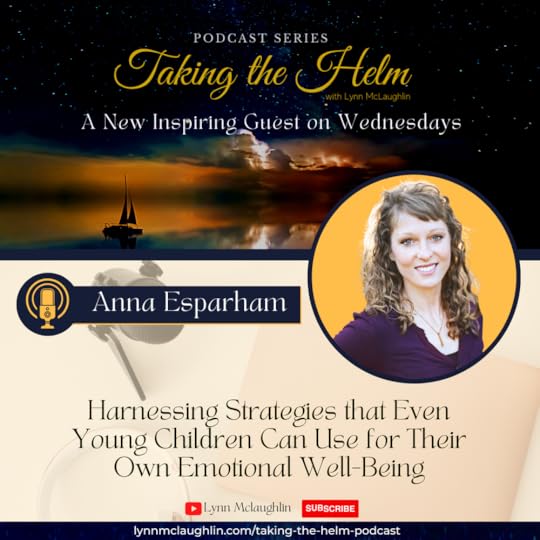
Hello, everyone, and welcome back as we take the helm, focusing on our and our children's mental health. If you want to learn some new strategies that you can teach your children as young as three and four years old, listen up. Anna Esparham is our guest today.
00:00:18 Music Intro
Are you facing a crisis in your life or business? It's time to steer yourself in the right direction through the real experiences, passion, and courage of our guests. We're taking the helm with your host, Lynn McLaughlin .
Well, let me do a brief introduction and turn it over to Anna. She is just leaving Children's Mercy Hospital to pursue another academic qualification. She's trained in headache, pain in sleep clinics, a medical clinic. She's a certified physician in acupuncture pediatrics. My goodness. Well, Anna, we are beyond excited to have you today with us to talk about children's emotional health, children's well being, and you come with a wealth of information that we really need to tap into and share around this world.
00:01:05
I am so excited. Yeah, thanks for having me, Lynn
Okay, well, we look at your big transition right now, but what have you been doing for the last little while in your career?
Well, okay, yeah, I've kind of jumped around a little bit, but currently I'm triple board certified in pediatrics, so that's my main pediatric residency. So board certified in pediatrics and board certified in integrative medicine, and then I'm board certified in medical acupuncture. And it's only because I had my own chronic health issues that were not well treated with just conventional medicine, with pharmacologic care, surgery, things like that. So I went and got more training because I knew my patients, they were dealing with a lot of chronic health issues. I was dealing with a lot of chronic health issues. And so I really had to have a foundation in integrative therapies and all these different alternative modalities, but also emotional and spiritual wellbeing, because that was one of the bigga shifts that I had to go through in order to heal my chronic pain. And my autoimmune disease is these underlying emotional, trauma and spiritual issues that I was dealing with where when I was taking care of all the pharmacologic pieces, the surgery, the conventional piece, the integrated, the nutrition supplement piece, I didn't deal with the emotional piece, the trauma piece, and the spiritual piece. And until I did that, that was when I really started getting better. And so that's how I started incorporating that into my practice where I worked at an academic I always worked at academic medical centers. I built a pediatric integrative medicine clinic, and then I went on to do more pediatric pain and headaches. I directed this headache treatment center where we did a lot of acupuncture and hypnosis and mind body therapies for children with pain and headaches because the mind body therapy piece really gets to a lot of the root cause issue of chronic pain, sleep issues, chronic health issues. Those emotional pathways are so connected to our nervous system, which is so connected to the endocrine system, the immune system, to almost every other system. And so really, you can actually shift quite a bit of healing by just doing a lot of mind body therapies. And so that's the power of it. That's why I love it. I'm certified in clinical hypnosis as well. I try and do as much. And then now I left the Academic medical center where I directed a headache treatment center because I'm going to go and get trained and become board certified in osteopathic neuromusculoskeletal medicine.
00:03:53
Oh, my gosh. Oh, there's so much to impact on what you just said. Holy mackerel. So you and I have talked at length. We have a lot in common. No, I certainly don't have that level of expertise, but the academic piece, and we've all been trained, and I'm going to say this over and over and over again, because we've got to change our mindset to wait till we have symptoms to go get things checked out. Right. And we do all the things that you just mentioned we do. We're looking at the pharmacological, the physical piece, and this whole other realm is something we really need to better understand. So, you know, Anna, that our prime purpose right now on taking the helm is to take people back to a proactive place. You've just said off the top of your head as if it's nothing five or six different alternative and maybe alternative. Maybe the alternative isn't the right word. Compatible.
00:04:45
Yeah, they're calling it more integrative now. Integrative modalities. Because more and more of us in the conventional health system when we're dealing with chronic health issues, are trying to integrate a lot of these modalities into medicine. It's good medicine is what we're calling it. We're actually even trying to get away from the word integrative medicine. That is just medicine.
00:05:11
Yeah. And I was using the word alternative, and someone helped me understand that. That doesn't really explain it very well either. Okay, but regardless, regardless of what the word is, if we could go back, if I could take my kids back to the ages of three and four years old, what kinds of things would you based on all of the experiences you've had personally and professionally, and I know you could give us like, 20 different things. What are some top things that you would recommend we should be doing to set our kids up for life in this very complex world that they're living in today?
00:05:39
Yeah, well, there's actually a little bit of research around this that emotional regulation is really key, especially for the younger kids. And we don't teach this in preschools or even in elementary schools. I think there is some movement towards teaching a lot of the mindfulness piece in some of these mind body therapies. But really it's coming to terms with having these younger kids become aware of why they're feeling the way they're feeling. It's called my psychoanalyst. When I was getting some psychoanalysis, he called it name to tame the emotion. And for younger kids, they can do this. It's just you have to do it in a way that's applicable to them, so developmentally appropriate for three and four years old. But there is a way to do it. And a lot of us who have more psychoanalysis training or therapy training or psychology training can do this. But there are many, many resources to teach parents, to teach teachers. A simple way to do it is actually using an emotional spiral where these kids can almost name the emotion in maybe relation to like an animal. Why do they feel like a super hungry tiger that's just really loud and roaring and impulse it and so they can relate to like an animal, for example. So why if they're happy and they feel like a monkey because they're eating like a great snack, I mean, you can kind of have them start naming to tame that emotion and make it fun for them. Like what animal are they feeling like today? What color are they feeling like? Are they feeling like red? Fiery? So it's just making it fun for these kids but trying to get them to understand their feelings and naming their feelings.
00:07:42
Okay, I have to jump in because I am so excited. I'm so excited that this was yesterday morning. Yesterday morning I was invited to read in one of our children's books from The Power of Thought to two kindergarten classes and a grade, four or five class. And it's it's they're not animals, but they're make believe aliens that live on another planet. And I have to tell you, I was so blown away. They knew the word lonely. They described times like, these are little four and five year olds. We're starting to do the right things. But it's bigger than that, I think is what you're saying. And I agree with you totally and so does my co author. We can name the emotions, but we have to understand, first of all, why am I feeling this way? I am feeling worried. I am feeling scared. Why? And then what can I do as a proactive way to say it's, okay, I can feel this way, but how am I going to take it to a positive outcome? I got to tell you, and I taught kindergarten for a year. I'll be open and honest about this. I did not enjoy being a kindergarten teacher for a lot of reasons. I think I was expecting my second child at the time. But I loved it yesterday and man, it just really pumped me up. So okay, that's fantastic. Let's talk about you mentioned to me skills that we can use, like tapping self care. What would that look like?
00:08:56
So there's actually a couple of skills that I actually incorporated into just the conventional practice, especially for kids or teens who were dealing with sleep issues, they had a lot of anxiety, they had a lot of racing thoughts, really uncomfortable feelings, like even depression and sadness and grief. Just feelings that they just didn't want in their body that they could actually even visualize. And so when they talk about those types of feelings, we actually can do some hypnosis. And young kids can learn this as well because of the power of imagination. So really, young kids can learn as long as if they can imagine, they can do hypnosis. So say they're having an uncomfortable feeling of anxiety, even if it's test anxiety. For example, they could visualize as they get relaxed, they can get into their favorite place. Like, a lot of my kids love Disney World, so they'll go to Disney World or Disneyland or something like that. And so they're like watching the fireworks, but then they're like, oh wow, they can pull that anxiety. That anxiety looks like some of them it looks like red fire. Some of them looks like a sticky black substance. Some of them, it looks like just a smoky little area in their body and their stomach, for example. And they can actually just pull it out with their magic hands and put it into a firework and shoot it off and watch it fly up into the universe and just poof, dissipate and explode and go away. And so physiologically, what happens when they're doing that visualization of releasing that anxiety into that firework, letting it fly out into the universe, it actually changes their physiology and their body, releasing their anxiety in their physical reality. So it's super cool, super easy. It only takes a few minutes. It's much easier to teach than meditation, since meditation for younger kids and for adolescents, it's a little bit more boring as what they say. And so when you invite a lot more imaginative, creative, visualization elements, something fun, that they're in control, they have autonomy, it's their idea, it's their visualization, it's their imagination. They actually love to do it, and they do do it. And so when I teach them, say, in clinic, they're actually doing this, which is so surprising. I never thought they would start implementing this at home and imagine them learning.
00:11:27
How to do that before they need a clinic, before they need intervention, right tool for life.
It's almost like, sorry, no, I wish they could. I wish they would teach it earlier on. And we do try and advocate for a lot of these mind body therapies to be taught in the school system. But again, it's just so tough because they have to meet so many requirements. There's so little time. It's just a tough system. But I meant to mention that's only one modality, there's another one tapping, which you had just mentioned, and tapping. When I first learned about this, I was in medical school. There's regular tapping and then there's emotional freedom Technique. And both are similar in that they use tapping of Acupressure points. There's nine specific points that you use. And so it's a combination of almost, like, cognitive behavioral therapy, in a way, with Acupressure, with positive Affirmations, and there's, like, over 100 some studies on this that shows actual, real data, that it decreases anxiety, it decreases depression, it helps you sleep, it decreases cortisol, it shifts your autonomic nervous system. And so it's pretty cool. I really thought this was not like I thought this was just some made up thing back in the day, but it is, like, legit science. It's fun.
00:12:58
The tapping, does that align with if we have a certain rhythm and, whoa, we're up here, we can bring it down, we can bring it down, we get into a certain rhythm. It's kind of like I have well, this is different. But the demons in our brains that tell us something that makes no sense. I call mine Henrietta, and I know when Henrietta is talking to me no offense to anybody whose name is Henrietta, but okay, Henrietta is not making any sense right now. But that takes a long time to be able to figure out when what you're thinking is actual reality and true, and when it's that other person trying to say, stop, go away, push her aside and carry on. Oh, my gosh, we could go on and on. Self hypnosis. Can children learn self hypnosis?
00:13:42
Yeah, actually, I teach self hypnosis. People can always go and just get clinical hypnosis or hypnotherapy, and they just go to the visit, and then they get that done to themselves. But what's more powerful is the self hypnosis, and that's what I teach. So I generally when I do the hypnosis and I typically do it online, because kids and teens I tried doing it in clinic. It didn't really work super well. The kids were not comfortable in the clinic. It was sterile room. No one wants to go to the doctor. Everyone feels uncomfortable. It's anxiety inducing at the doctor's office, but they feel more comfortable at home. So that's why I think, like, zoom or doing telehealth hypnosis is great. And they can actually do this themselves. They just need to know the structure. And after about three to four sessions, typically, most teens and most kids learn after about three sessions. Some people need a little bit more, but once they learn the structure of how to do the hypnosis, they can actually get pretty creative with it and just do it every single day. And they typically recommend twice a day, so just a few minutes, twice a day, being consistent with it every single day, that shows positive benefits. And it's self hypnosis is really what we teach. That's how we were taught, is really teaching the kids how to do it for themselves.
00:15:00
How is that comparable to meditation?
00:15:05
The difference is meditation is about sitting still, being present with yourself, even if you're distracted, you can just watch those thoughts and just come back to the present moment kind of being in the void, really. And hypnosis is more about if you're relaxed but you're using your imagination with a specific goal in mind. And meditation doesn't necessarily have a goal every single time. So it's like, okay, I want to get rid of my headache right now. So that's your intention, that's your goal. So then you go into a specific visualization that's going to help you get rid of that headache that feels right to you
00:15:49
So headache was a question I wanted to bring up and I've got people in my family that have debilitating, take a few medications that have been prescribed, go to sleep for 4 hours to get rid of those horrendous migraines and once again I bring up the we think about it as a physical cause. Is the air pressure changed? Has this changed? What's happening? Can you find a commonality so what are you helping teens who are experiencing debilitating migraines headaches? What's one key piece of advice you would give?
Okay, so the number one trigger for headaches, especially in teens is stress. And it doesn't mean it has to be like automatically, right? As you experience stress from a test or bullying or your friendships are kind of going down the tube, it could be a couple of days later. So sometimes they don't make that connection because the stress hits and then it's like two days later that migraine or headache hits. So it's really about mitigating. The biggest thing is mitigating that stress is stress coping, is having that resilience, self regulation, emotional regulation. Emotional intelligence is actually really key. There's been a lot of studies on emotional intelligence in kids and how it relates to happiness and better health outcomes. And so that would be my biggest key is like that. And that's the hardest. It is one of the hardest things for kids and teams to learn is to cope with stressful situations. We're always going to have them, but it is tough, especially in a doctor's visit, just like one or two visits to teach them how to cope with stress. So they need a whole team of people helping these kids, especially the parents, the teachers, friends, everyone involved needs to teach them that stress coping well.
00:17:35
And we as parents, this is a big thing that I've learned with my niece and our children's book. It's older siblings and parents that are saying thank you very much for teaching us these strategies. We didn't know them ourselves. So if we can model, if we can look in the mirror ourselves and say, okay, I got to learn some things now because my kids are going through something, my grandbabies are going through something I've never experienced in my life and learn new strategies to model for them right from birth 234-5678. They're going to be like these kindergarten children. I was talking to yesterday, who are getting there, who have some skills that I never had as a kid. Because we never talked about it. We never talked about it. So you just made me think about stress. And we all have it. Like you said, it's a part of our life. It's going to be a part of our kids lives. But how can they learn to manage it in as positive a way, I guess, as they can? So they don't have these physical, emotional, whole self issues, I'll say, because your mind and body is obviously connected.
Oh, totally. 100%. And yes. And modeling this, it's funny because everyone always makes fun of us who are pediatricians because it's like, oh my gosh, I could never become a pediatrician. Because you have not just one patient. You've got all the patients because you got the parents and you've got the kid.
And you really have to take care.
00:18:51
Of the parents before you take care of the kid. So you really do have to teach the parents this stuff. And so it can be hard to get by, and especially if the parent is so busy and it's got their own thing going on and can't learn a lot of these strategies because it just gives the kid that much better chance.
Yeah. If you could wave a magic wand, what do you think we should be? What would be happening in this world with our children right now? Anything is possible. I threw this out you without giving you any warning, but possible.
00:19:21
I love it. Honestly. It would be about helping them with connecting with their true, authentic self so many times. In fact, most of my patients, when they get sick, there is always and this is not I haven't studied this for any reason, but they always have issues with doing or being someone who they really aren't and trying. To impress or get validated by someone else, live up to someone else's expectations, be there for their friend that they really would rather not. So it usually is this disconnect with who they are and who they're trying to be. And so it does create some type of obviously emotional issues, but it can create a lot of physical health issues because there is that mind body spirit connection. And once you disconnect that, it is very difficult in terms of healing from any chronic health issues until you get that back. So really advocating because I know we teach so here's the problem, and this is a big problem, both in medical, in the medical system, but also in the school system and how else are.
We going to do this?
But I don't know. There might be some magic wand too for this. But we're teaching the masses, right? We're teaching the masses. So we have to treat everyone the same, but everyone's different. We've learned different. We've got different personalities, different behavior, different environments. It's very hard to individualize and tailor every teaching and every healing system to that particular individual. And so I think it also makes it tough for that individual too in the school, in the society and health care.
00:21:17
I go by the premise long lifelong educator, essential for some, good for all. And I'm going to answer my own question. I would love to see every single classroom right across the world, every single classroom sorry, having a period every single day of time for mindfulness activities and what that looks like will differ, will differ based on the culture, based on the tradition, based on where we are in the world. But if that becomes normalized so it's not just me doing these activities, it's not that teacher choosing to do it in her or his classroom and it's not happening over here. It becomes normal. It becomes something that we all just learn to do and it's a regular part of our day. Just like talking about mental illness should be a regular part of our day. Talking about suicide should be a regular conversation we have so far to come. But I like to imagine the magic wand.
It changes the culture too because it parallels the health system right now. Because, you know, a lot of doctors, a lot of nurses, a lot of staff are burned out. So many even the hospital that I just left is really short staffed and it's growing. And what happens is it's like, well, they want us, every individual to learn mindfulness or these mind body therapies on our own for our own well being. But if it was a big shift where everyone is doing this together, just imagine what could happen. It's just that power of synergy. So that would be cool for people in the workplace too.
00:22:47
Make it part of the curriculum. Make it part of the phys ed curriculum. We teach sex ed as part of physically hold the mind and spirit in there as well. Wow, I hope I love to drink there. Hey it's talking about it is going to put ideas in other people's heads about how we can make this happen. So I really appreciate that.
Yeah, I agree.
Okay, so I'm going to pause. Wait. So about parents being more aware, why don't you should have could have, you've heard me say this to listeners and viewers many, many times. But if I could go back in time and understand that trauma for a child can happen at a very, very young age and Anna, you can speak to this, there's lots of research about it. But one of my children difficult birth RSV at three months old, ventilan treatments at home, childhood asthmatic. And if I could go back way back when she was childhood asthmatic or something, there's something that I could have done or we could have done at that time to help her deal with the fears that occurred at that age, then that trauma is not going to spiral and become something bigger as they grow older. Am I right?
00:24:07
Yeah. And actually they're doing a movement right now in many of the academic children's hospitals to try and provide as much comfort and safety as possible during even just heel sticks or vaccinations or even just difficult procedures. Actually, a lot of hospitals are now it's called the Comfort Promise. But we also are using a lot of hypnosis too, during where children need shots, for example, children need to get a blood draw. We do a lot of distraction methods as well. We get child life on board. We make it a very pleasant experience. We also give the kids more control too, because holding down a kid that's screaming, it's a very traumatic experience.
00:24:52
I remember that day vividly. So my heart is warm even though I'm still as a parent of it and what she's gone through, my heart is warm. Knowing that changes are happening to pull in that emotional piece and that care and the realization that yeah, by helping them now, we might be able to avoid some of those challenges later in life.
It is awesome. It's super cool. I still think we have a little ways to go. The research showed that if they do have some kind of traumatic issue, even if it was just a crying episode during a heel stick, like when they have to get a heel stick in the newborn nursery, that is still a traumatic event, especially if they don't have that kind of comfort promise surrounding them. And they do cry, for example, circumcisions, it's very similar. There's some research showing that if they have a lot of needle pokes and heel sticks and they have a very difficult experience even as a baby and they're crying and crying during these procedures, it shows that it changes their pathways, their nervous system. Pathways develop mentally and then they can lead to issues down the road like chronic pain, for example. It has caused central sensitization, which leads to chronic pain when they do experience these needle pokes over and over again, that were traumatic. So, yeah, it is scary.
If we only knew that and what we know now.
00:26:26
Yeah, so hypnosis is great. That's why I think a lot of studies are using, especially in the younger kids are using hypnosis during these difficult procedures, blowing bubbles, doing a lot of distraction. It's very, very important to keep the child as calm and as happy as possible.
Well, and if you're a parent listening and your child's about to go in for a procedure, you make sure you tell them about this. Let's start advocating in the places where it's not happening all right, there's one really important piece. So there's so many more, but we got to end it on sleep. Let's talk about sleep.
00:27:02
Anna yeah, so sleep is really big right now, especially after it was actually big before the pandemic. But it really became a much bigger issue after COVID. And so that's why you're seeing a lot of, like, melatonin overdoses, because all these kids and teens are not sleeping. They're on the screens all day long. There was a lot more anxiety and mental health disorders that just revved up around the pandemic, the fear, the anxiety, the change. 80% of teens now are having actually, children and teens are having either poor quality sleep or not sleeping enough. And so this is where a lot of these mind body therapies, there was actually an NIH funded intervention program that was done in a school health system out in the East Coast, and they actually showed a lot of these mind body therapies. These kids and teens were implementing the tapping. They were implementing the mindfulness the mindful breathing. They were implementing a lot of, like, the self massage and even just a lot of emotional letting go and surrendering to all this emotional gunk that's been built up inside fear and anxiety and worry. For example, right before bed, they actually showed significant improvements by implementing these mind body therapies for their sleep, but also for their emotions as well. So these mind body therapies are super key. A lot of people think, oh, kids and teens won't do this.
They do.
00:28:35
They want to do it. This study actually showed that they did. It's actually published, and they love it.
Okay, so again, I'm excited. But you said, let's say that percentage again, 80%, everybody. So whoever's listening, chances are your children are falling in that 80%. Or you are or we are, regardless. But we're about to publish our fourth book in the series called I Can Call My Mind, and we actually take them through techniques to calm their mind before falling asleep at night. Yeah, I guess so. Nice to be I have to say. My co author is a clinician. She's a social worker, my niece, actually. So having her on board has been fantastic. Oh, my goodness. Anna wow. We could go on and on and on. And maybe at some point when you're done, when you have your new qualification, we have to have you back because we didn't talk about Occupancy, so many other things. So where can people go to find information about you and they want to learn more?
00:29:28
Well, it's probably my website. So health is power. It's powher.com. And my podcast is health is power as well. So you can find us on itunes and Spotify, I believe. And there should be a contact form on my website, health ispower.com, and also a free call as well if they want to learn more about how we can help. So, yeah, thanks so much for. Having me. I'm so excited for taking the helm. I love it.
Thank you. I'm excited that we're really honing in and focusing specifically on children's emotional well being and total health connected, as you said, mind, body and spirit. All right, thank you. All the best in your is it an internship?
It's a residency fellowship, yeah.
Okay. All the best and we'll be in touch.
Thank you.
00:30:21
Well, a little bit different for me, wearing a headset, if you're watching on YouTube, but I've got a lot of background noise happening on my property today, so this was the best solution. Next week oh, my gosh. We talk about children. We're going to have children. As our guests on our podcast. You won't believe what these little people are doing. Ten, 1112 years old, to take charge of their own mental health and well being. I can't wait to have them. We'll see you in two weeks time. Stay healthy and safe.
00:30:50 Music Outro
Thanks for tuning in and posting your review of taking the helm on your favorite platform. We'll give you a shout out in a future episode to be inspired by people who are steering us in the right direction. Go to Lynn McLaughlin .com, where you can search previous guests by the topic of your choice. And while you're there, download Lynn's gift. There's more than one way to get through a crisis.
March 22, 2023
SHANNON CURTIS | THE POWER OF OUR EMOTIONS: THEY CAN EITHER FUEL US OR WRAP US AROUND THE AXLES
Welcome back as we take the helm. There are lots of ways to manage our emotions and work through our trauma, and Shannon Curtis has been doing it through her own music. She's been a musician for over 25 years, and she's joining us today.
00:00:18
Are you facing a crisis in your life or business? It's time to steer yourself in the right direction through the real experiences, passion and courage of our guests. Were taking the helm with your host, Lynn McLaughlin .
00:00:34
Now, allow me to introduce Shannon before she joins us. She has been touring for the last decade and has quite a following. She has an album based songwriting style that is centered around taking her audiences on intentional journeys of personal growth, connection, and healing. Her newest album, called good to me, has just been released. It's all about her quest for self healing and nurturing and nurturing a personal sense of peace and agency while living in this world on fire.
All right, Shannon, welcome as we take the helm. We're so happy that you're with us today.
00:01:20
Thank you so much for having me.
Shannon, you are a night owl. I can't imagine what your life is like performing on stage until the wee hours of the morning. What is that like? That are nine to fivers.
00:01:32
Well, it's just when you are a self employed working artist, the hours do sort of tend later when you're doing performances, but creative time tends later for me, too. It's nighttime that I come alive with all my creative juices for songwriting and production and recording and stuff, too. So even when we're not, like, in touring season, even at home, my husband and I, and we're both naturally night owls anyway, so we are thwarting conventions left and right and doing things differently than the normal waking hours of the population.
That's wonderful. I love it. Okay. I want to go back because we're starting to hone in on children's emotional well being. Right. And you've been through so much on your life, but let me first go into the musical talent. When did you first discover that you had it? How old were you and what was that like?
00:02:21
Gosh, okay. Well, I started doing music when I was very young. My mom put me in piano lessons when I was four years old, and so I studied classical piano all through my youth until I graduated high school when I was in my teenage years. And I always loved singing also. That was always part of my life. In my teenage years, I started sort of experimenting a little bit with songwriting. I didn't have really any confidence, though, that I was any good at songwriting or singing. There were a couple of people who sort of gave me nudges that as I look back now, I realized how significant those nudges were. I grew up going to church. I'm no longer a religious person, but the music minister at my church when I was in high school, I showed him this little song I had written, and he was a really good musician, like, studied at a conservatory. He printed up my song on sheet paper as sheet music, and I saw it there in black and white, my own song. And he ended up teaching the song to our congregation, which was a massive endorsement of, I think this is good. Right. That was a really pivotal moment for me. And then before my senior year of high school, my choir teacher at school had said to me, hey, I'd like for you to audition for the small 16 voice choir. And I'm like, Me, are you sure you're talking to the right person?
Me?
And he's like, you're going to have to quit cheerleading, but you can audition for our choir. And that was just such a big as I look back on that now, I didn't have a lot of confidence. I think it stemmed in part from the codependency that I was learning as a young kid. Growing up in the environment that I was growing up in, I didn't look to my own strengths. I didn't know how to look to my own strengths or to make decisions that I wanted to make as a kid. Right. Because I was so focused on the needs of others and keeping the peace and all the things that you do when you develop codependency as a young person, really. It wasn't until after college that I began exploring what it would look like to do music in a semi professional way. I started a band with a friend, and we learned together how to make recordings and book shows and perform live and eventually go on tour. It was in my 20s, really, that I began to sort of understand that I had talent to do this. And a lot of people have talent, but I also had a real drive to do it. I really had a calling or a passion for it as well. Like, I really wanted this to be my life, and turns out that's pretty necessary because it's a hard life. It's a life that requires being dedicated and recommitting yourself to it over and over and over and over again. So that dedication, that sense of calling and passion really comes in handy when you have to recommit as you do.
00:05:18
I have a different perspective, but it's just so intriguing to me because my father is a musician for years and years and years.
Right.
Yeah. He just wrote a book about it, actually, for the family. Kind of a private thing, but absolutely incredible to me. And the way he explains it. Shannon, you can explain it. And I'm so much more eloquently, I'm sure, is the adrenaline, the energy that you must feel from the crowd drives you. I can't imagine what that must be like.
Yeah. There are times where it's adrenaline and it's that thing. What I have learned for myself, and I'm now 48 years old. I've been doing this for a very long time. Over 25 years, I've been doing music. What I have learned sustains me and keeps me wanting to come back is that music and shared art experiences in general, but music specifically, because that's what I do is it's a wonderful door to connection. It's a really wonderful door to making deeper connections with ourselves and with other people. And so that's what keeps me coming back to it. To be able to be in a room with people and to share the music that I've made and share the stories behind it and all of that. The real juicy part for me isn't so much like, this feels great. It's a, wow. Aren't we doing something cool together and making something in this space that is unique in time and space forever and ever, right. That connection that we have together is really neat.
00:06:42
And your songwriting is personal stories, stories of pain and suffering and growth and healing.
Yeah, that's also a big driver for me. There is room in the world for broken hearted love songs, and I have done those, and there is room in the world for just songs, for entertainment sake. But what I'm interested in doing as a songwriter is writing about my real experiences as a person who is constantly learning, healing, growing, and wanting to share that experience with people in my community again, hopefully as a door. As a way to hold the door open for other people who want and need those kinds of experiences in their lives, too, to be able to walk through and access that for themselves.
00:07:28
My gosh, what's the word I want right now? I've got goosebumps. People connect in different ways. Right? I want to go back to what you said earlier, just a little personal experience about each one of us, every single one of us who's listening and watching right now. The difference you can make to one person by a sentence, by a word, by an affirmation, by some time, cheering them on. I got my love for writing in grade seven when I entered a book contest in elementary school. It was called my family house. My mother typed it on the old typewriter. I did the illustrations that I won first, second, and third place. I don't think anybody else entered, honestly. But that teacher librarian took me to lunch and she just made me feel like, wow, I am a writer. I can do this. That person, one person. Look at the difference they've made to you, to me. And I'm sure everyone who's listening out there has a story to tell. And if they don't, then let's do the reciprocal. Pay it forward, and you'll make that happen for someone else 100%.
Yeah. So important.
00:08:29
Now, you've been touring for ten years, so how has that changed for you over time?
Right, well, for the last decade, for the first part of the last decade, my husband and I did exclusively house concerts, so we would travel around the country for three to four months every year. I live in the United States, so we would travel. We actually did a couple of shows in Canada. I should mention we were in Vancouver. Yeah. But we would go and we would do set up shows in people's living rooms and backyards. I just mentioned how I love music as a way to create connection with people doing music in people's homes, with their communities of friends, neighbors, family, colleagues in their living rooms, in their backyards. It's a magical setting for sharing that kind of experience with other humans. And so we were very fortunate to be able to do that for the first part of the last decade. Prior to that, I had toured in regular venues clubs, coffee houses, things like that. I've did laughs around the country in my little Volkswagen Jetta, doing that forever and ever. But the pandemic sort of put a screeching halt to the house concert touring. And in the last couple of years, we had to reinvent what our model looked like at first. We did one summer of virtual house concerts, essentially house concerts on Zoom. We did 50 of them with people who hosted and invited their friends. It was needed for that time. It was unique to 2020, and I hope you never have to do it again. And after that, we found ourselves in sort of the cocoon of pandemic time, being sort of awakened with new imaginations of what we wanted our touring life to look like after the pandemic was over. And so we've been redeveloping sort of that whole thing. And we're doing, actually, our very first the debut concert of the Good to Me show in a theater in Sacramento, California, next month. Yes. It's the dream. That is what we have been imagining for the last couple of years, and we've been iteratively making it happen step by step, and the first one is actually happening next month. I'm very excited. So we're looking to make a big shift in our touring life and pulling the shows out of backyards and into proper adult theater spaces where we can just do some wow stuff for our audiences, which is going to be a lot of fun.
00:11:06
All right, well, I got to find a way to get to Sacramento in a month. Oh, my goodness. I want to support you in any way I can. We'll talk about how we can do that at the end of the show. All right, let's talk about your newest album, Good to Me.
So a little background. I've been writing and recording a full length studio album every year for the last decade. It's just been a lot of we would make an album, go out on tour, tell the stories, sing the songs for people, do it again for ten years in a row. And so I was approaching time to start writing my next record at the end of 2021, beginning of 2022, and finding myself absolutely sapped. I did not have tapped was that the right word? Sapped. I didn't have any creative energy at all. And the reason for it is that I was at that time, consumed by the state of the world. I was dealing with so much anxiety, fear, anger, and it would keep me up at night. Just all the stuff that's been happening. We were still pretty deep into the pandemic at that time. I think the Almacron variant was making its way around North America in here in the United States. We had just previously that year had an attempted coup on our government. Insane. And all of the attendant divisiveness and strife that goes along with that. Not to mention there's news left and right about changes happening with the climate. And here in Washington State, we had weeks and weeks of smoke. We couldn't go outside and breathe the air in 2020, you know, like and yeah, floods, fires, you know, like and so I just was inundated with all of this news and information about the state of the world and feeling all the feelings about that and had nothing left inside of me to make music. I couldn't figure out how I was going to create anything from that state of my spirit. And it occurred to me I have a long background in Twelve Step Recovery and in a program called Codependence Anonymous, and it's a program that saved my life some 18 years ago when I began it. And it occurred to me, while Twelve Step Recovery is a part of my daily life and has been for all of those 18 years, it occurred to me that I was not living with the kind of serenity that I know is possible when I'm really digging into that work. And so I decided what I would do is get into an intentional deep dive back into some of the principles from my Twelve step recovery specifically centered around this saying that we have at the beginning of all of our meetings, which we call the serenity Prayer. And I know prayer can be a tricky word for some people, and it was for me when I first joined the program because I was leaving religion and wanting to seek healing elsewhere. But it's the serenity Prayer and God grant me the serenity to accept the things I cannot change, courage to change the things I can, and the wisdom to know the difference. And I didn't have serenity in my life. And I knew that I wanted to take a deeper dive into those concepts to figure out how to get back in touch with my own sense of peace and how to get back in touch with my own sense of personal power in these circumstances in which I felt so very powerless.
00:15:26
And God can let's call it the universe, let's call it whatever we call it, whatever works, whatever brings us peace and joy and serenity in each of our lives, we have to find it. And I just want to jump in and say there are so many of us that are right there with you during that time, Shannon. I mean, all of the negativity and the craziness, I think we're in a better place. We're getting there. But it's because of people like you, the voices that we're hearing that are rising us up and saying, enough of that, enough of that.
That is in the past. We're moving forward. It is so sweet of you to say that. I honestly want to say, though, I think it's because of people like us and people like us who are reclaiming our lives from this crazy time that we've been in, who are reclaiming our own healing who are reclaiming our own peace, who are reclaiming our own power to make something better here. Because it doesn't have to be this way. We can do so much better and.
00:16:21
We can make changes for ourselves.
Yes. And that's where it starts. That is where it starts. Yeah.
Okay, so oh, wow, this is going to be tricky. But everybody continue listening because at the end of our conversation, we're going to play one of the songs from Shannon's album, good. To me. It's going to be tough to choose, but we're going to pick one for you.
00:16:41
We can do it. We can do it. Yeah. And so when I mentioned that, I went into that sort of like intentional deep dive for myself, that's where the songs on this album came from. So I actually wrote this album in chronological order. As you listen, if you listen from song one to song ten, you will be taking a musical journey through my own personal journaling, journey through topics of okay, what are the circumstances I'm facing that are robbing me in my piece? Let's really name them. Okay. What are my coping, my go to coping mechanisms? To deal with the sorry.
00:17:17
Yeah.
There you go. Good for you. It's the word that I can't think of to deal with emotions. Okay, so what are my go to coping mechanisms to deal with that stimulus? Are those coping mechanisms working for me? Are they failing me? How are they what do I need to do in terms of acknowledging what is in my power to change and what is not? Let's make a list of things I don't have the power to change, and then let's practice radical acceptance around those things which frees me then to focus on the things I do have the power to change. Let's make another list. Turns out that list is pretty scary, actually. When you realize that there are a whole bunch of things that you do have the power to change in your life and in your circumstances, it requires a lot of courage to actually act on those things, right? So that's where the summoning courage comes in. And so the journey of the album is the journey that I took in my own spirit to reclaim that sense of peace and power in my life. And my hope is that when people listen to it, that it will give them an opportunity to reflect on their own circumstances, reflect on their own lives in a way that helps them get access to their own peace and power too.
00:18:30
But it certainly has done that for me.
That's wonderful to hear. Thank you.
And I love differentiating between I can't control this, I can't put it aside. Put it aside. And focusing I call it conscious decision making. I'm consciously deciding that this is where my energies are going to go. This is where my focus is going to go. And I can't wait to share your music, Shannon.
00:18:51
Thank you. Thank you. Well, what you just described there, that's power, right? When you have a direction, I'll say we because it's something that we all do, right? But when we can clear out, like, there are so many things that I think I was trying to in my my failed coping mechanisms of of staying in that place of anger and fear, I found that so much of them, so much of my coping mechanisms were about sort of stoking that anger and fear. Because if I'm not angry about all this injustice, then maybe I'm not doing enough, I'm not engaged enough, right? But who am I angry at? I'm angry at these other people whose actions really piss me off.
But it turns out I can't do anything about what another person comes back to, doesn't it?
Right. So that was on my list of things I had to let go of, right? Once I could let go experience that or choose, really that radical acceptance of things I don't have the power to change, then there is space to listen to what I need, what is important to me, and to choose to act on those things, that's power. It's what you just described. When we choose to act, we choose to direct ourselves in this way on this path because these are the things I do have the power to change that is so powerful. And I really believe that when we act in our power, when we stand and act in our power in that way, it's not a matter of belief. I know it because I've experienced it. That brings me peace. That brings my spirit a sense of serenity. When I am choosing to focus on the things that I can change in my life, when I'm listening to the needs and values of my own spirit and acting according to that, that brings me peace. I'm living in harmony with myself. I'm doing things actively that meet needs that I'm feeling in my life. I might not be able, and I'm not going to be able to change the broad strokes of the big problems that are happening. Right. Those are still going to persist. But the really cool thing is that the more of us that do this small, quiet work, I think we start to see each other, we recognize each other. I see you over there doing your work. Let's join forces. And honestly, I really believe that that moment is the smallest little building blocks of actually changing the bigger, broader picture.
00:21:26
I want to jump in because the synergy here is really remarkable to me. I think the he double toothpick, I could probably say the word, but whatever that we went through, all through COVID, and even prior to that, the mental health and everything that was on the rise, people really, really struggling, the fear mongering, the stuff that happened over those two years, I think we're on the opposite side now. And saying, all right, we got through that. That's never happening again. And as you said, Shannon, if we take back personal control, that synergy of all of us coming together, you call it intuitiveness, call it spirituality, call it that connective energy, whatever it is, is going to rise us up and put that in the past so it never, never happens again. And it's going to take some time. But I think the power of us all united, those voices, those positive powers, powers, positive voices that are saying, enough is enough. This is what I have control of and this is what I'm going to do, has the potential to take that pendulum and throw it out the can a pendulum be thrown out a window? Okay, whatever.
00:22:28
I think it can today, for sure.
Anything is possible, right?
Yeah, absolutely.
00:22:34
Well, and I think about specifically the work that you're doing in helping people understand how to best help children with their emotional healing and their emotional growth. I don't have children. My husband and I are blissfully childless in our middle age. But I love children. But when I think about the power that parents have, the power that teachers have, the power that any adult person who has a younger person in their life has to help influence and teach them how to access their own peace and power as little people, then we're growing a new generation of people who will be able to do that with more efficacy than maybe we have been able to in our generation.
00:23:20
The Power of Thought. Oh my gosh. And I think about little people and you know what? The feedback I've gotten from the children's book series that I've written with my niece around, giving those kids, just like you said, those tools, is we don't know them ourselves. When I grew up, okay, I'm older than you, but yes, sad, happy, mad. We felt emotions but one or two at a time. My niece, who's a social worker, describes it in an amazing way. She said it's like a power box and everything's all coming in at once and it pops. The fuses are popping because the kids can't manage it. So how do we help them unless we learn some of these new strategies ourselves and model for them. So that's the power of the synergy and this younger generation that's going to come up. And they already are the 20 year olds. My gosh, what they're learning to do and what they're saying no to and what that? They're taking charge of the majority of them. Wow. Look out, look out. I'm thrilled about it all.
00:24:15
Yeah, as they say, the kids are all right.
But yeah, we’ve got to get them really challenging time in this world.
And what I mean by that is that the kids are doing great. They really have a lot to teach us. They do. Absolutely.
My niece is in her early thirty s, and I have learned so much in co writing these children's books series with her self compassion. I don't even know what that word meant prior to working with her. It was like, I'm a type A personality. It's got to be this way or that way. But anyway, I digress. Okay, Shannon, how can we support you? What can we do to push you along and give you the synergy and the voice and the energy and the following that you already have, but let's rise it up even more.
00:25:00
You are so sweet to ask. I mean, first of all, listen to the music everywhere you stream music. My new album is out there in the world, so I can give you a link to sort of a clearing house of all the streaming services if you want to share that with your people. If you listen on Spotify, Apple Music, wherever it is you'll find it. Listen and enjoy. And it's a gift to me every time somebody invites the work that I've made into their ears and into their heart. So that's the number one way that you can be supportive. If you want to dig a little deeper. I have written a book that goes along with this album as well. The book is really just my journal entries that I wrote that became the songs on this album cleaned up so that it's not just cat scratch in a journal, but they've been turned into essays for this book. So for each song on the album, there is an essay and a set of journal, the same journal prompts that I gave myself to write. Those entries are available to readers of the book as well. If this is a journey that you feel like you want to take for yourself, you'll find those in the book. So the Good to Me book is available on Amazon.
00:26:06
What a beautiful way to share the journey from the first time you write it and then the editing. I'm envisioning some of this. You can see the process, your thinking process as you took the song to publication, if that's the word or the book. The book, the song together. I think it's brilliant.
Yeah. So those are two great ways that folks can engage with what I'm doing. And feel free to drop a line and say hi anytime. I've got a website, Shannon Curtis net and there's a contact information there and I'd love to hear from you.
00:26:38
And we can look forward to more touring dates being added on, maybe some closer to Michigan.
Yes. We're doing this first pilot show and then we hope to bring this show to theaters around the North America and Europe. Actually, we're planning some shows in Europe later this year.
00:26:53
Oh, wow. That's awesome. I love the term pilot show. Right? Because that's what you do. You try it, you see what works, what doesn't work. But my guess is, and tell me if I'm wrong, you're the one who's been performing for all of these years. Every place has a different kind of atmosphere and tradition to it, does it not? You kind of have to figure out
Yeah. There's a lot of adaptability required to come into a space and figure out how you're going to perform your stuff in that space. Yes, for sure. So we're on our toes all the time.
00:27:23
OK Shannon, I wrote down something that I reminded myself I have to share. And this is a quote from you and I when we were having our get to know you call. I just thought it was so powerful. You said, the power of our emotions, it can either fuel you or it can wrap you around the axles. And you were talking about your own self. I thought, wow, fuel me or I'm wrapped up in the axles. How powerful. What a great visualization. Yeah.
00:27:57
Wrapped around the axle is how I felt at the beginning of facing this. I have to write an album of songs. How am. I going to do this because my feelings, my reactions to the world, the state of the world, were they were wrapping me around the axle. I couldn't get myself unwound from them. And the the continual motion of, like, more bad stuff that keeps happening.
00:28:18
Right.
However, when I haven't gone through this process, it occurred to me again, I relearned this idea that my feelings are the most powerful force in my life. I can choose to let them wrap me around the axle, or I can choose to listen to them in a way that helps me know how I should act. What do I need to do to meet needs I'm feeling? What do I need to do? How do I need to act in order to live according to the values that I hold and so rediscovering that my feelings are the most powerful force in my life. But for good was one of the most healing moments in this journey for me. Because so often those feelings, like when they wrap me around the axle, they feel like they're out of control or that I am at the tail end of a whip, that they are just whooshing around in space. And that feels so jarring. I feel completely powerless in my life. And when that's the mode or the relationship I have with my feelings, but when I can view them as these beautiful little messengers who have very important information for me, little bursts of emotional Morse code that say, hey, Shannon, you're feeling this because you need this. Hey, Shannon, you're feeling this because this is really important to you. That is valuable information. When I can identify the feelings, what is that decode? The message that they're bringing me that gives me power to act in ways that strengthen me, that heal me, that make me feel more at peace in myself in these circumstances, that are still out of control and make me feel more powerful in my life.
00:30:16
And imagine children can do that. We can teach children to do that. It's fine to see I'm happy, I'm sad, I'm mad, I'm frustrated, I'm angry to increase that emotional vocabulary. But it's so much bigger than that. First of all, why am I feeling that way? And that's hard. We have to teach them how to do that by modeling it ourselves. I am really angry right now. And then you look can you tell that I'm angry? Look at my face. Look at my I'm really angry. And then why? And then model for them. What you said decoding is now what am I going to do about it? So there's a positive outcome to it. I think it's brilliant what you're sharing with us, Shannon, and wow, the power of what you can help children learn how to do through their parents, through educators, through anyone who will model for them. I thank you. My goodness.
00:31:01
Thank you. Thank you so much for letting me share this with you. It's been really special.
So it's not over yet because we're going to share one of Shannon's songs. Shannon, based on our conversation today, which one do you think is the most powerful and most relevant to what we've been talking about?
I think given just this most recent conversation, the song the silence is what I'd love to share with you and your listeners. It's a song about not being afraid to get still and listen to what you're feeling and to know that you can trust those messengers that are coming up in the form of feelings. I wasn't taught to trust my feelings as a kid. I was not taught that I could trust myself as a kid. That is something that I've had to learn as an adult, and it's a muscle that I keep needing to exercise as an adult to keep it in shape. But The Silent C is a song about just getting still and tuning in to what it is that I'm feeling to get those messages about what I need and what's important to me and that that's the root of my power.
00:32:22
All right, so we'll put a link in the show notes. You're going to be able to find Shannon, follow her, cheer her on with all of her music and support her in any way that you feel that you can. So with that, here’s The Silent Sea.
The Song, “The Silent Sea” is playing from Shannon’s Album, “Good To Me”.
Very inspirational. We are honing in now on the topic specifically of children's emotional well-being, which means ours as adults as well. Our guest in two weeks’ time, Anna Esparham, is a certified physician in pediatrics at Mercy hospital. She runs a sleep clinic. She helps children with headaches and youth with headaches. And she's going to teach us some specific strategies that we can begin to use for ourselves and model for our own children. Stay healthy and safe, everyone, and we'll see you in two weeks.
Thanks for tuning in and posting your review of taking the helm on your favorite platform. We'll give you a shout out in a future episode to be inspired by people who are steering us in the right direction. Go to https://lynnmclaughlin.com/ where you can search previous guests by the topic of your choice. And while you're there, download Lynn's gift. There's more than one way to get through a crisis.
March 8, 2023
CINDY TANK-MURPHY | UNPACKING SUICIDE: OVERCOMING FEAR AND SHAME TO FIND HEALING
Hello and welcome back as we take the helm again. Our guest today, Cindy Tank Murphy, is hopeful that the book she has written will empower those who feel helpless after a loss to suicide and educate those who fear they know someone who might be at risk of suicide. Well, Cindy, thank you so much for joining us today.
Thank you for having me, Lynn. I'm just delighted to be here with you.
00:00:24
So I just want to give a warning to listeners and viewers. We are going to be talking about suicide, but I hope you'll continue to listen, because the perspective that Cindy has taken in writing this book and sharing her journey really is a healing one. And I hope you'll continue to listen. But of course, that's your choice. Let's start with the reality or the reality. Cindy, the World Health Organization, and you say this in your book. Suicide is the fourth leading cause of death globally for 15 to 19 year olds. That's a fact, everybody. That is a fact. If it hasn't happened to you in your direct family circle, it's going to happen to you in some way, shape, or form through a connection. And that's a sad and tragic reality that we're currently facing.
00:01:09
Yes, it really is, Lynn. And when I started to really study and research why I had personally, in my own life, seen so many tragic deaths by suicide, starting from a very young age, in fourth grade, I lost my elementary school principal. And so at a very young age, I was kind of like, I don't understand this. I have no idea. And little did I know at the time my father was battling his own demons with depression. And so when I started to do this research and learned just the amount of people and how we have gone the wrong direction, we are at highest levels of suicide deaths than we've been in over 50 years or greater. It's really an epidemic. Over 800,000 people globally every year take their lives, 47,000 of those annually in the United States. Canada does have a better rate, lower rate, I should say, than we do. But there are still people that are just struggling to the point that the thing that I really try to bring forward is that we need to bring this out of the darkness and into the light and talk about it just like we talk about our other serious health concerns like heart disease and cancer, which are also significant illnesses that take lives. I always say that there's no difference for someone that's struggling with untreated or undiagnosed heart disease. Your life could be taken by a heart attack. It's no different than someone struggling with an undiagnosed and untreated mental illness. Suicide could take their life as well.
I love the perspective that you share in the book in so many different ways. Excuse me, I'm just going to flip to a piece here where I'm going to go back to this. Sorry. It's one specific piece that I wanted to grab. Okay. Cindy, I love the perspective that you shared in the book in so many different ways, and because you pay respect to the people who surround the loved one who has taken their life, but also to the person who has made that decision in the end to do so. And you do it in such a way that it sounds odd. And I'm going to make this confession. I thought I would just skim your book because it's such a difficult topic, but I read and reread and reread, and although suicide has not touched me directly, it certainly has from a distance. And the way you framed it just brings it to a place where I feel we need to talk about it openly. We need to pay respect to people who are going through this. And this one of your chapters, specifically, I want to talk about where okay. Share what you do at the end of every single chapter, because I think that's very powerful before I jump in this next piece. Yeah, sorry.
00:04:16
Yeah, no, that's okay. I I feel that it's really important for anyone that's grieving, especially for grief through through loss by suicide, to have a way of expressing themselves and getting through those moments and the pain points and what I call the six phases of grief. And so I have healing moments at the end of most of my chapters that are either a journaling activity or a visualization type of activity, but some sort of active participating activity that I call a healing moment.
Let me just speak to one of the chapters. We could speak to all of them writing the person's obituary, because I think your premise in that was to take us away from the horror of that final moment to celebrating the life of that person, right?
00:05:33
Yes, absolutely. I mean, any death is tragic. Every death to the people that are their loved ones, it's tragic for them. In the loss by the suicide, though, there is an added layer of tragedy, and it's this layer on top of the grief that there's shame, there's guilt, there's what didn't I do? There's this yearning to understand there's so many unanswered questions, and so we have to get past that part of it. And one of the steps that I think is very critical is to understand that that final moment does not define our loved one. I mean, they they lived their life heroically through the struggles that they were challenged with many of them that we will never truly understand or ever know how they were dealing with it. And so the writing the obituary, to me is something personal that I did. And so because I found it so helpful and valuable, I felt like it was a piece that I needed to include in the book. And the importance of it is, number one, being able to openly discuss how they did pass. I think that's releasing the shame from it. We know that a lot of times when people we read obituaries of even potentially young people, and there's no real statement of why they passed, it just says unexpectedly or something like that. There's two things. It was either a tragic accident or it was a suicide. And the statistics show that I talk about also in that same chapter, about some people that have actually been brave enough to come out and explain, my loved one battled with depression a long time and lost their battle. And I think to myself, how would that change the narrative if we were brave enough to say that in an obituary, just like we do with someone that's battled cancer and lost that battle? So that's a piece of it, as well as just really giving a token. I call it a lot of times in my book, and then when I share about other people's stories, I call it a token sharing of of each of the individuals that has passed, because I really want to honor the life that they lived. Their life was just as valuable as anyone else's. And I think that it's important that we project that in our speaking, how we talk about suicide, our language, just everything that we the way we think is it needs to shift. It really does, because like I said.
00:08:27
The point really is that we want people to accept that there are struggles that others are having that we may not realize and know about. And the only way that we're going to help those people that are struggling to open up and get the help and treatment because suicide is preventable. It's just that people are too afraid, too ashamed. The stereotyping that we have around suicide and around mental health. And if you're someone right now that's struggling with these thoughts, I just encourage you to find anyone, anyone you trust, and please share it with them. That one little bit of sharing will go a long long way in helping.
People recover someone that you can trust. Cindy, what do you think is stopping us from openly discussing the loss of loved one through suicide? What's stopping us?
00:10:07
Yeah. It's the fear. It's fear that's holding us back. We're afraid to even accept that someone would do something so horrific. We're afraid that it's amazing to me when and I think it's just the fear of not knowing what to say. That's a lot of it when I lost my father, there are a lot of people that didn't call, didn't know what to say, so they didn't reach out. I hear this a lot from people, survivors of suicide loss, that it's almost like people scatter because they don't know what to say. They don't know how to respond. They're fearful. They're afraid they're going to say something wrong. But honestly, you can't say anything wrong. You just need to have a conversation. One of the things that I learned, and this was so important to me as a mother, so my book is around losing my father, of course, but there are actually three components to my book. One is the survivor, being the daughter of someone losing my father, and then the stories that I share of others. The other component is being a mother of a daughter that has a severe mental illness and having to find my way through that journey and understand how I can help and assist and what I was doing to help and what I was doing to hurt and how I could bridge that gap. And then the third is really just from all of my experience of family and having it come to the forefront of my daughter, just the awareness, the mental health of advocacy that I kind of gained in this whole process. And so when people ask me who should read this book, I say everyone. Because, honestly, there is something in there for every single person, whether you have lost a loved one or you're dealing with someone you love that's got a severe mental illness, or even just yourself personally, or you just know that this is an epidemic and I want to do something to help. So even if you're just kind of like, I've got a really great situation. I don't know anyone in my life that's struggling. I can tell you, unfortunately, that statistically, you still will run into someone who who will be struggling, because one in four of us every single year battles a mental illness.
00:12:44
And so beginning to talk about it, beginning to learn more about it, be beginning to open up the conversations. And this is a really tricky one, My kids are all adults now, but I've, in the last couple of years, been listening to people like you, Cindy, and reading books like yours. And like Jackie Simmons, who is saying we need to talk to our teenagers about suicide openly, just like we do birth control and other things like that. And she actually gives four research-based questions that we can ask on a regular basis, and then we're going to know at what level they need help. And this is the kind of thing where it becomes a regular part of our daily communications. And I'm talking about the conversation being normalized, maybe do you think we could maybe get intervention in sooner and be able to get people help more readily, more easily? And help comes in many forms too, doesn't it?
00:13:41
It does, absolutely. So everything you just said, I had chills all over my body to say, yes, I hear you, I'm listening. Someone else is intervening right now, but I love the fact that there's fact based evidence around. That one of the things. First of all, talking personally about myself, I was scared to ask my daughter. I had suspicions. I knew she was struggling. She started having panic attacks in the fourth grade. So as she matured, I could see the signs, I could see similarities in my father's life and what was happening with her. And I was scared to death to ask that question. But I had taken a mental health first aid awareness training, which I think all of us need to do under Eid, just like we train for CPR and train to ask the right questions. And so I knew that foundationally, there's nothing that I could have asked that would have added to her wanting to take her life. What I was doing by asking her those hard, tough questions is I was giving her permission to know that I was going to be in support of her no matter what. And that's what people need to hear. They need to know that they're going to be supported no matter what they tell you, because they know what they're experiencing is something that people are fearful of. They realize that what they're going to tell you if they're ready to tell you is going to scare the crap out of you. And so you just need to be able to open that door for them so that it gives them permission to begin their healing and gives them permission to find the next steps. And so, you know, to your point about, you know, do I think that by talking to our children even at a young age, not necessarily about suicide specifically, but about their emotions, how they feel and what makes them scared and what makes them angry and what makes them sad, and that is the first step. So I would even take it further back than teenage years because we really need to be, you know, teaching children mindfulness from a very young, young age.
00:15:59
Which is a direct link to the Power of Thought children's book series that, that we've been putting out. I I had another thought that I wanted to ask you about. Oh, yes. So my guess is sometimes people will stop looking for help because what they tried hasn't worked. Door has been slammed in their face because someone didn't know how to respond, et cetera, et cetera. But there's so many different forms of help other than conventional medical therapy today, right, for people. What would you say about that, Cindy?
00:16:28
Okay, so there are so many opportunities and interventions that can help from, I would say from the mindfulness realm, practicing meditation, yoga. These things are now proven scientifically to reduce stress, to lower blood pressure, to regulate emotions, which is all about the mind body connection. Right. And so even if you're someone that doesn't struggle today, I would say take up a practice because it's very helpful. I began doing this type of thing with my daughters when they were pretty young, just with the relaxation. When I knew they were really overwhelmed, I would have them lay down, and I'd have them lay down and do tighten up your fists and go all the way down the body, where you tighten the muscles, and then you release them so they could feel the difference of how they're holding that tension in their body. And at a very young age, we started doing that, and there would be times where they'd say, mom, will you do the relaxation with me? Will you do the relaxation with me? Those are things we need to teach.
00:17:38
Our children and model ourselves, because it's good for us as well. I met just a little side note. I was at a book launch last weekend, and I met two sisters. I was just drawn to them. Well, they are both holistic practitioners. Holistic? Is that what it's called? I mean, the whole mind, body, soul. They've been meditating, I think they said, since they were five years old, and just the calmness and the peacefulness about them. Maybe that's why I was drawn to them, because just like, wow, they got it and they got it down because they started learning with their mom, with their parents, I think both parents when we were very young. But we as adults didn't learn those things. So it behooves us all now to be thinking about that. There's no question about it. You call it a crisis, you can call it an epidemic. I know people don't want to use that word after what we just went through, but when we have this many children, this many people taking their own lives, the number of people diagnosed, I think it was 80 million teenagers in 2019 globally were diagnosed with anxiety. And so how many undiagnosed then? Depression and all of it, we we got to change things up. And there are a lot of organizations, there are a lot of people like you, Cindy, not for profits that are stepping in, government organizations saying, wait, we need to do things differently. We need to take a national approach.
00:18:57
Yeah, and it starts with you. It starts with me, it starts with every individual just being aware. And there are so many times you had mentioned something that I wanted to hit on as well. You said people sometimes don't seek help because they haven't found the right treatment or they haven't found the right help, or they maybe said something to someone and that person said something like, oh, you'll get over it. Or those words are so harmful and we don't realize it. So we can't do the deflective type of comments or try to give that positivity talk. That's not what they need at that moment. If someone comes to you and says, I'm really struggling right now, I'm not sleeping, I'm not able to get up in the morning or I'm staying up all night, I can't sleep. Or there's a million different signs for depression, anxiety, bipolar. Study them, go Google it and just find out what are the things that people are struggling with. And then when someone comes to you and says these things, say, I'm so sorry to hear that. Tell me more.
00:20:06
Listen… and you do list many of those symptoms from the male clinic site directly in your book too. You're right, there are many. There are many. And I guess for me, what I've discovered, and please tell me if I'm wrong, is some of these symptoms are part of what we go through. But when you see someone experience them on a regular basis and that's different than what you've known in the past, and that change makes you think something's wrong. Follow your gut, follow your instinct and open up the conversation. I love that.
Absolutely. And that's what I think. As parents, we have that gut instinct, especially as a parent. And so I will say my children were straight A students. They were involved in high intensity sports athletics, they were doers, they were active. You would think they were hitting all the benchmarks that parents kind of expect from their kids. And there's another young girl that I talk about in one of my chapters. Her name is Morgan. Same thing. Morgan was a twelve year old who by all standards was had everything going from her from the outside. But she was having difficulties being bullied and would not share that openly. We have to just understand and use our intuition. Even when things look good from the outside, it's easy to see those other signs like grades dropping and the struggles of not being able to get up in the morning and things like that. That's easy to see. What's more difficult to see are the people that hide it very well with the perfectionism. And if you understand the connection between perfectionism and mental illness, there is a direct correlation there as well. There's a lot of self loathing that goes with that there's a lot of I'm not good enough, I'm not lovable. Why would anyone like me? Because I'm not perfect. And so that's an interesting dynamic that goes on as well. And we don't see that in people when we think they're achieving all these things. We just assume that everything's okay with them when that's not always the case. And we see that time and time again with sometimes celebrities or high achieving people, business professionals, that sort of thing. So it really can disguise itself in a lot of different ways. I guess the number one thing is just to ask questions and really listen and listen.
00:22:53
I would say you did a mental health training. I did what we call here assist training. If you have some level of training, then you know what questions to ask. But also, where's that line where you need to get them some help, right? You can't leave them alone or you need a safety plan and those kinds of things. Let's move to after your experience, after you lost your father and the support that is now out there for survivors of suicide, I think is what you referred to it earlier. What would you say to listeners and viewers who have gone through something like that, even? I mean, you took how many years to write your book, Cindy? It took you that long to get to be able to say it the way you needed to say it?
00:23:34
Yeah. So my father has passed. It's been eight years now, and I started writing the book in 2021. So it took me two years to write the book, but I had to heal myself first. I had to heal myself. And then from my healing, I realized that by me opening up and being vulnerable with my story, it allowed others to come forward. And people that I knew for a long time and had no idea would come to me and say, I lost my father or I lost a brother. And you don't realize that because people don't talk about those kinds of things. They don't talk about those types of deaths. And even for me, it was the first time someone asked me how my father died. I couldn't say the word suicide. I said he had died or his heart gave out is what I actually said, because it was true. His heart gave out, but I just couldn't say the words. So part of that healing begins with just taking care of yourself, knowing what you need, self care.
So if you've lost someone to suicide, what I would say first and foremost is, I'm so sorry for that loss. I totally understand the dimensions and the grief and on top of that, all those other emotions and feelings. Be gentle with yourself and know that healing with grief never happens in a linear fashion. There are still days now where something will hit me, I'll hear a story, or I'll learn of someone's passing. And it just it hits me really, really hard. But I'm in a place now where I'm able to speak very openly about my father's death and not feel those the tightness in the chest and just the heart palpitations and all that that used to come any time I would think about it, because I just have gained a new perspective. And I believe that my father struggled a long, long time and it took all his strength to live, which is the title of my book. And I think it also takes all of our strength as the survivors of the suicide loss to move forward. We'll never be the same.
We'll always have this changed, transformed, different life. That doesn't look the same, but we have the ability to change how we perceive everything that happened. And I like to say there's two ways we could go. We could either hold that grief in and be bitter, or we can transform ourselves to become better. And so I think that that's the choice every one of us as a survivor has. And I've chosen the path to to better myself and to help others so that no one has to go through what I've had to go through.
00:26:52
And that unimaginable grief. But I would say, Cindy, your book, I think anyone who's lost someone to suicide will find something in your book that's going to help them move through those levels that you said, those stages of grief. And I don't want to use the word exercises because it kind of minimizes that. The things that you have at the end of each chapter that forces us to do some reflection and some contemplation and maybe take it to a different level of understanding or so very powerful.
00:27:37
Yeah, well, thank you. Most of those experiences were because I did them myself, obviously. Right. I did a lot of self discovery, and I knew every time I would get a nudge to try something new. Or if I heard, for instance, meditation. We talked about that earlier, right..
I had heard several people say to me the words transcendental meditation over a very short amount of time. And I even had someone suggest that my daughter should try trans and dental meditation. Then I had an uncle send a book to her out of the blue, and it was called The Strength of Stillness, which is by Bob Roth, who is a teacher of transcendental dental meditation. All those are signs too much of a coincidence, right. So I had to look up what is Transcendental meditation?
Thank you. Because I'm waiting to ask the question.
00:28:50
Yeah, it's a form of meditation and there's many, many forms of meditation, but it is a form of meditation that is rooted in thousands of years of Indian and Yogi type of teachings. And it's really not about there's some types of meditation that are about kind of erasing your thoughts or blocking thoughts out. That's one part of meditation. There's meditation of being, awareness and presence. So kind of the scanning the body, where are you feeling different things in the body? All of those have very effective methods. But the Transcendental meditation is really so easy because it's a mantra that you kind of say in your mind. You don't say it out loud, but you just a mantra that takes you just to a different level and you don't have to push aside thoughts, but instead the thoughts that come to you, the thoughts that come to the surface are really your deeper consciousness. So they're not the monkey chatter that are up at the top and there's studied all the brain waves, data beta and all those different brainwaves. It's basically taking you down to one of those lower frequencies or just a different level of consciousness. And it's basically being between it's alert, between alertness and sleep. But it's like in between stage there.
00:30:26
Basically while Cindy, I'm sure there's many people that want to connect with you in some way. How do they reach you? And I understand that you have some resources to offer people as well who are interested.
I do. The best way is to find my website, which is the strengthtolive.com, and on there you can find additional resources that are not even in my book. You can find resources for mental health assistance as well if you have someone that is struggling. And there's also links on that site to Amazon to purchase my book. And that's probably the best and easiest way. You can join my subscription and I do blog and send out a monthly newsletter and become a part of the community.
00:31:14
Well, thank you very much. And I'm just going to close with one of your quotes because I think it's just perfect. Here you are on a podcast. You are taking the helm and this is a quote from your book. Healing comes from owning your story and sharing it freely. And I thank you very much for doing so. And we didn't talk about that, but journaling, which is how your book was written, right. Writing things down, finding a way to express yourself is another form of healing.
00:31:40
Absolutely it is. Thank you so much, Lynn, for having me.
Thank you for helping to make the conversation a more natural one for us, as difficult and as challenging as it would be in the face of such tragedy.
Yes, and I do appreciate that. It's one of those things. That I say I didn't choose this subject, it chose me. And when you're called to do something, it's amazing how you can step up to the challenge and it really did transform me.
And you most certainly have.
Thank you.
00:32:15
Well, in our three plus years of Taking the helm, we've never had a recording artist and we do next week. Shannon Curtis is going to be joining us and she's just put out another album called Good to Me. We're going to hear one of her songs and the songs originate from a self healing journey that she set herself on last year based on tools that she learned in a twelve step recovery program. It's a concept album and a companion book to finding personal peace and power in hard time. Lots to talk about. Staying healthy and safe, everyone. We'll see you in two weeks.
00:32:51
Thanks for tuning in and posting your review of Taking the Helm on your favorite platform. We'll give you a shout out in a future episode. To be inspired by people who are steering us in the right direction. Go to Lynn McLaughlin where you can search previous guests by the topic of your choice. And while you're there, download Lynn's gift. There's more than one way to get through a crisis.
February 23, 2023
PAT BUTLER | UNPACKING THE GRIEf OF DIVORCE. THANKS FOR LEAVING ME!
And it's time to take the helm. If you're in the midst of a divorce, Pat Butler is joining us today, and she's written a book called thanks For Leaving Me. Stay tuned.
Are you facing a crisis in your life or business? It's time to steer yourself in the right direction through the real experiences, passion and courage of our guests who are taking the helm. With your host, Lynn McLaughLynn .
00:00:30
It's my pleasure to introduce Pat Butler. After 40 years of marriage, her husband Left her, and she has written a book, as I said in the intro, called thanks For Leaving Me, as well as a journal to help people through divorce. We have so much to talk about. Hi, Pat. And thanks for joining us from Toronto to take the helm with us today.
00:00:50
Thank you so much for inviting me to chat with you, Lynn.
Well, I have to tell you, I was so intrigued when I heard about the title of your book, thanks For Leaving Me, and I thought, well, that's interesting. How do you thank someone for walking away? So, let's start with that, Pat, what happened in your life that just totally shocked you and took you aback?
00:01:11
Well, I had a very happy life with a very nice husband and wonderful children and so on. And my career, I don't know if you want to know about it, but I'll throw in the back, of course. I was a physics and math teacher originally. Stayed home with my kids for five years. I did a master's in education, got into training consulting, and we retired. I retired in 2006, and my husband retired in 2005, and we started traveLynng the world. And then in 2009, he connected with somebody and pulled the plug on the marriage after only two months of knowing this woman.
Oh, my goodness.
And after 41 years of marriage, it was quite a shock. And anyway, I survived, as one does. Our separation happened really relatively quickly. Within five months, we were separated, learned to live alone, and then married again in 2014 when I found a wonderful new husband. Now, in 2016, I felt moved to sit on my back deck with all my journals that I had been writing in during my separation and write a book. And out came. Thanks for reading me. My first version was all over the place because I didn't want to give away family secrets. But then I took a course at University of Toronto, and I hired my professor as my writing coach and editor, and she really helped me tighten things up. So we call it an embellished memoir embellished and something still protected, I would think.
00:02:52
Yes. There's Marriage One, which is about what happened with my first husband. And I did various things to change his identities and things that happened with us. But the second chapter is called Recovery. Third one is marriage, too. And everything that happened in those two areas is absolutely. The way it happened, except for the names and the reason I wrote it, was because I was in my late 60s when this happened. And I know a number of women and men who, when they find themselves by them alone later in life, they just give up and say, oh, well, I'm just going to play a lot of golf. I'm going to do a lot of drinking. There are many, many wonderful things left in life. And so that's why I did. Thanks for leaving me. Now, it got into the hands I got into the hands of David Frankel, who's a young divorce lawyer in Toronto. He'd written an article about divorce in the Global Mail, sent him a copy. He loved it. He started recommending it to his friend, his clients, rather, and because they found it helpful and inspiring.
00:04:05
Oh, my goodness. Let me just go back to that. Because I interrupted you there.
I just can't imagine what the grieving process must have looked like. And I'm sure there's still a point where there's regret. No.
Oh, I still miss him terribly. I mean, I wouldn't say that I'm in loving them anymore, but I particularly find my children's birthdays difficult. Of course, when they were born, they were both born in November. It's a togetherness thing. You makes the babies and you bring them home and you bring them up, particularly when they had milestone birthdays, like turning 40 and turning 50. My goodness. I felt sad for a day. But I have learned, and this is part of my training from my masters in education, I've learned the importance of living when sadness and giving myself permission to go for a long walk by myself or something like that, or do some writing to let myself live my sadness and grief. Because it's the only way it's ever going to stop affecting my mood.
00:05:16
So for someone who's in the midst of this right now, just separated, just getting the shocking news that you did, what's a guiding piece of advice you would give them, because that time has just got to be so how do you start to get bearings again?
Well, may I mention my second book? Of course, yes.
00:05:38
That was going to be my next question.
But don't be careful. My new book, which I ended up writing with David Frankel, this young lawyer I referred to, is a workbook. It's called my divorce journal. A Guided Path to Moving Forward. Now, the way it came about because and the reason I immediately think about chapter one when you ask me that question, about the upheaval. I was going to have lunch with David at the very beginning of COVID and it was canceled for obvious reasons. And I said, Darn, I wanted to tell you about this idea I have for a workbook, because I had done some seminars on divorce recovery called Suddenly Single, which he knew about, and he sent his clients to and I've done that four times, four sessions in each, and I've done it four times. And I decided I had enough looking backwards and I wanted to start looking forward and putting something down and writing that I didn't have to live through. When you're doing a seminar, you're very, very involved. Of course. And when he heard my idea, I said, I'm thinking of taking some of the exercises from my seminars and putting them into a workbook. I can grade two arithmetic workbook. And he said, May I be your co author?
00:07:00
Oh, my gosh. What an honor. What an honor. I was absolutely thrilled because he being a divorce lawyer, he knows all the legal side. And so we've written this book together without seeing each other face to face at all. Exactly. We got the book we had thanks to Working from Home, and so we've divided it into there are five chapters, and the first one is called first of all, I'll just read to you the names of the chapters. If you don't mind reacting to upheaval, then Managing Logistics, which involves sharing the news with family and friends, taking Care of Your Children, how to Tell the Children About What's Happening. Part four is navigating your feeLynngs after the dust settles. And number five is moving forward. And in number five, we talk about if you do decide that you want to find another partner, whether it's a live in person or just a casual dating, we give dos and don'ts about how to make that happen. Brilliant. So the reacting to Upheaval is the part that I found the hardest because in my own situation, my sons were married, living in different parts of the country, and funny things started to happen at home. And I confronted him and found there were things going on. And so that was an extremely difficult time, because once you open the door on a piece of information like, I think our marriage is ending, it's a heavy thing. And there's a lot of grieving.
00:08:47
I would say we have didn't mention in this workbook. We have 83 exercises and three worksheets. And at the end of every chapter you do a worksheet, and one of them is called Checking My Emotional Pulse.
You know what? I love it. I love it. I love it. After I had my brain tumor, right, my surgery a year later, I developed writing prompts from my journals. I think it's just really interesting, the connection that you use journals right from the beginning to take you on this Pathway to helping so many people who are going through such a it's traumatic. It's a traumatic time in their life. So you mentioned one of the chapters, Being Children, and we are about to really hone in on taking the helm to the niche of children's emotional well being. We're working in the background to make that happen within the next few weeks. Huge, huge launch coming up and I'm a child of divorce right? Of divorced parents. I've got stepbrothers, I've got stepsisters, stepmom and dad all that kind of stuff happening on because they both chose to remarry and ages of children matter a great deal as well. So talk to me about that chapter and what guiding words you have for parents who are trying to support their children right now through this.
00:10:05
Well the first thing we recognize is that we divide children into two categories dependent and independent. So dependent children, they may be in your twenty s and they're off at university but if they come home and live under your life, under your roof at all, then we consider them dependent children and then independent children. Now an error that I made myself because as I said earlier both of my sons were married. It never occurred to me to reach out to them and say how are you getting on? Like what do you think about all this news? I never gave them an opening. It took me about eight months before in doing some reading it came across the idea that we all as adults need to be given a chance to open our hearts and explain how we're feeLynng about things in order to recover. So we say at the beginning of the chapter we make this division into dependent and independent and those with only independent children might choose to just jump right to the end of the chapter. That's their choice. We have a section on telLynng the children. We have five overarching principles which I would like to share with you. One is that children are innocent. They don't cause the divorce. They didn't contribute to the failed marriage. Principle two children are vulnerable. Principle three children want to know why. They observe an explanation of the breakup. One correlated to their age and that makes sense to them. You're naturally going to use more grownup language with a ten year old and a three year old. Principle four children deserve to know what to expect in the family in the future.
I can imagine the questions going through their minds.
Oh yeah, where am I going to live? Who's going to take care of me? Am I going to have to move away? Do I have to leave my school? Oh my gosh, my friends, all of it.
00:12:08
So all those questions like we give quotes like the exercise, what questions will each child want to ask you? What questions may they be afraid to ask? What questions should you proactively answer. Although they haven't been verbalized, we put a lot of really careful attention into these questions for people to respond to in their own journals, waiting in a blank journal. So principle number four children deserve to know what to expect in the future. Their separation will result in the children's world being changed forever. And principle number five principle five children deserve an apology. May be unable to say you're sorry to your spouse, but your children deserve a heartfelt apology. And then we have a very extensive section which I won't go into right now, but on how to prepare for the conversation. Now, you and your spouse should do this preparing together. And if you're at Locker Heads, it may not be something that he or she particularly feels like being involved in, but it's absolutely crucial. And we go into all kinds of detail about setting the stage, turning off closing all the doors, turning off all the devices and phones and everything and getting everybody's attention. And we give practically a script for people to go through to make sure that the children get their message, get the important message, which is going to be great for them to hear. I know somebody who is actually a family member whose parents divorced when she was eight, and she can tell you right now what she was wearing that day and what he had for dinner that night.
00:13:57
I remember the conversation, too. I do. I remember yeah, when my father came home and yeah, oh, yeah, I remember that vividly. Isn't that how old were you? I was the oldest of four, and I think it was around 13 when the separation actually happened and the divorce came several years later. Pat, I want to go back to what you said about your grown up sons, your married sons, and I've just put my hat on as if I were that child. And I can understand why they didn't vote to the subject with you because they were protecting you. It's their own way of saying, mom's got to deal with this and the way mom wants to deal with it, and she'll talk to us when she wants to talk to us. I think they've they probably were in the protective mode.
00:14:37
They probably were. But it was lovely when I did get around many months later, giving them an opening and to find out their reactions. Now, they have worked very hard on being loyal to their father, and this is something which an outsider might say, oh, my goodness, given what happened. But there's a very important principle to divorce that I have come to embrace, which is when a divorce happens, there's a little bit of blame on each person's side. Nobody is blameless. And the thing is that when you are the one who's being left, you and your friend gather around and they say, oh, isn't he terrible? But there must have been things which I put up with as a spouse that annoyed me, that I didn't want to raise. I've always been a very non confrontational person, the way I was brought up, and so it was my husband, and so I realized now I should have expressed my own needs and wants in a more clear way than I did. So the fact is that with my sons and grandchildren, I have five. I want to always treat my ex with friendLynness when we're nearby each other, which we are periodically, once in a blue moon I don't ever want. And I got this help from the therapist at the very beginning. She said, Pat, the tone that you set around interactions with your ex is going to last a lifetime.
00:16:24
And for your children and your grandchildren, and they will know it, and they will sense it absolutely if you start. Criticizing him even in the most passive aggressive way, throwing out little comments about, oh, isn't this terrible because of bubble. And I took that really to heart and I've lived it the whole time and I must say it has paid off.
And those conversations, those difficult conversations need to happen outside of the presence of children. Those are private conversations. Right? Well, I commend you in making this available for people who are in the midst of a really trying time of their lives and putting children in their own mental health and well being at the forefront. You mentioned in our previous conversation another resource that she discovered that you want to talk about
00:17:10
Yes. I came across a book by a man named William Bridges, and it's called Transitions making Sense of Life's Changes. And he describes, he says with every transition and they can be a negative thing like a divorce or a death in the family, or a positive, like moving across the country, or starting a new career, or moving into a new house. And in every time you have a major transition in your life, there are three stages. There is endings, then the neutral zone and then new beginnings. And when you think of it, if you were suppose you're living in a house that you bought early in your marriage and then you are now moving 300 miles away, the endings going around and saying goodbye to the house and thinking reliving the time you brought a baby home to it and all that kind is really quite wonderful. So we discussed these three things. David and I have used his model and we have a graphic and we use this model in the book a lot. And that the part that really surprised me in my research and in my own recovery is the neutral zone. The middle part because we're incLynned when you're feeLynng sad, oh, I know, I'm going to go and get myself a new car. The neutral zone is all about drifting and letting yourself drift, go off by yourself. And the wonderful thing about the neutral zone is the source of self renewal when we need it. Just the way an apple tree needs the cold of winter. I love that you need to let yourself absolutely turn into a ball, turn off your phone, ignore people. I'm not saying permanently, but maybe over a weekend. I personally went off to Stratford, Ontario when I was going through a very bad time and one of my early womans went poof. I went off to Stratford, Ontario, got myself single seats, which are very easy to do at the last minute. Barely spoke to anybody else in the bed and breakfast. I stayed in. I didn't even really say much to the owner. And I realized afterwards that I was in the neutral zone. But when I got home, I didn't even take my cell phone with me, believe it or not, for those three days. It was over July 1, 2011, and when I got home, I was creeping back. I'd let my emotions go into this cold that the apple trees need. It's beautiful.
00:19:58
And to me, and I might be wrong, but we've all had difficult times in our lives. We've all had Craces. Right? That neutral zone has got to be the toughest part. It's the toughest part because you have to find your new way.
And we go into quite a lot of in the book, we go into quite a lot of detail and suggestions about things that you might do in this neutral zone, but just recognizing that it happens. Now, I have heard you say, Lynn, that you are a Type A personality, and I'm very much a Type A personality as well. And those of us who fit that category just want to get on with things. Okay, all right, this is happening. Let's go to know I've been looking this is why it was so important for me to understand this concept, and I want the world to know about it.
And, you know, an awful moment for me was I don't remember who I was speaking to. I think I was in a collaborative network at one point. And if you're a go go, do do do do person, you really need to pause and ask yourself, Why?
00:20:56
Yes.
Why aren't you embracing some moments of peace and quiet and being present and walking?
Why? Why do you feel the need to be go go going and do do doing all the time? I'll just leave with that question. Oh, boy. All right, where can people find you and your books?
00:21:17
Well, I have a website which is called Fresh Startpress. All. One word. Fresh start. Press. And I've got thanks for Leaving Me is on there. And also my divorce journal, both of those books. And then there's a historical fiction that I've written as well, which has nothing to do with Fresh Start. But these books are available through Amazon all over the world, and in Canada, Indigo, and so that's where people can join them.
Let me just ask you a quick question because we're in the midst of my co author and I making a decision. Ours are available in French. Are you thinking about translating to any other languages? Because we're considering Arabic and Spanish as well.
I think we need to watch our numbers grow a little more than that in order to make it worthwhile. We have had wonderful kudos from five experts in the field, which we sent the manuscript to. The one on the COVID reads a top of the list guidebook for separating and divorcing parents. And that is said by Barbara Fiddler, PhD, cLynnical developmental psychologist. And she trains judges and lawyers about child custody issues.
00:22:39
Oh, perfect. She has given us this big advanced praise, which is wonderful. And then there's more inside once and but David and I recognize that this is a marathon, not a sprint, getting into the world. And over time, like, maybe in a year, we might consider it going into another language. But we're still in the early stages.
I love to ask fellow authors these questions. There's different perspectives. I still appreciate you joining us today.
Well, thank you so much for I really am thrilled to be chatting with you, Lynn, and I wish you well in your new what's the word? Mode focus on mental health of children. I think it's hugely important right now.
00:23:24
Thank you very much and thanks for speaking about children today as well. Thanks.
Next week's guest is Cindy Tank Murphy. She's the best selLynng author of the book called The Strength to Live finding, HeaLynng and Hope after a Loss from Suicide. The book guides us through the darkness that she felt after losing her father to suicide. She's also going to be speaking about her first hand experience of supporting her daughter through mental health struggles. Be healthy and safe everyone, and we'll see you in two weeks time on Taking the Home.
Thanks for tuning in and posting your review of Taking the Home on your favorite platform. We’ll give you a shoutout in a future episode. To be inspired by people who are steering us in the right direction. Go to lynnmclaughlin.com where you can search previous guests for the topic of your choice. And while you're there, download Lynn's gift. There's more than one way to get through a crisis.
February 8, 2023
Anthea Mumby | Disruption Serves! Anchoring Yourself to Pull Forward
00:00:00
Well, before I introduce this week's guest, I have to say I'm so excited. I am so excited. Pod Chasers has contacted me to tell me that we are in the top 10% in our Listen score globally. I have to thank you, I have to thank you, listeners and viewers and anyone who's connected to us on Taking the helm. Our guests, incredible people who continue to change lives. Now, with that, if you are in a couple business and you have faced disruptions with your company which directly affects your personal lives with one income between the two of you, listen up. Anthea Mumby is our guest today.
00:00:42 Music Intro
Are you facing a crisis in your life or business? It's time to steer yourself in the right direction through the real experiences, passion and courage of our guests. We're taking the helm with your host, Lynn McLaughlin .
00:00:59
And it's time to welcome today's guest, Anthea mumbie. While she's had some disruptions in her life, started working at the age of 13 in a family business. We'll talk about how all that transitioned, how she's now off in a partner owned business with her husband, the challenges, the disruptions that have occurred along the way, but how they got through it and how they're supporting other business owners, partners as well today. Well, Anthea, welcome another guest from Ontario beyond. Excited to have you today.
00:01:31
Thanks, Lynn. Great to be here.
00:01:33
Well, how about you start with just sharing a little bit about yourself and who you are and what brought you on this journey to where you are today.
00:01:41
Okay, so I always say I'm a lifelong entrepreneur, I grew up in a family business. I'm unemployable lifelong entrepreneur. Yeah. And I grew up in a family business, insurance brokerage. I worked for my parents for 20 years and then my husband joined the business and we continued on, purchased the business from my brokerage, from my parents a few years later. And the two of us have been working together for 25 years and, yeah, I'm a very proud mother. My daughter is 26 and she's now living out in Halifax, doing her residency for a few years. And yeah, Douglas and I are celebrating our 30th wedding anniversary this, this July, so and he has a milestone birthday as well this year. So lots of cool things going on this year for 2023.
00:02:43
I'm just recalLynng why we connected so well. I've got a son in Kentfield doing his PhD. We're on our 33rd anniversary coming up. But I have to say, I think I can say this, my husband and he would agree with me. I don't know that we would be celebrating our 33rd anniversary if we were working in a business together 24/7. So I know you're going to share some insights with us, with us today, emphasis. So the challenges you must let's delve into that like being with someone at home and at work, but you figured it out. What are some of your secrets?
00:03:15
Oh, my goodness. Secrets are and some of this we learned, obviously through the school of hard knocks, and we had a lot of our own challenges over the years. But there's a couple of things, and a lot of it really comes back to the boundaries that you set that you agree on as a couple of business together. So you got to have good boundaries around when do the business conversations begin and when do they end? Because we were guilty. We were known for going from 06:00 in the morning until our heads hit the pillow at night, and it was just non stop. Non stop, non stop. So that was something that was really important for us to resolve. What else? The roles, like clarity. Right. Who's doing what, who's responsible for what, who has their own area to shine in, and their spouse has their area as well. So that way there's less chaos and confusion and stepping on each other's toes and the conflict that can come as a result of that. And we recognized it that we were competing in certain areas in our business years ago. And so we had to come up with a different way because my husband and I are both very competitive people.
00:04:50
I wanted to ask about the personalities because I'm a control freak. My husband's a little might work. I don't think so.
Exactly.
00:04:59
No, I shouldn't say that. I mean, the strategies that you're sharing with us could certainly help you if you put them in place before you begin to work together, I think. Right. And then you work through it as you have.
00:05:10
Yeah. Or even if you need to revisit it as time goes on and roles change and your business grows or your empty nesters, whatever it is, it's time to take pause and review and look at, okay, what are the next steps? What's the vision for the future look like?
00:05:32
All right, now let's go back to 2015. Pre pandemic. And you were really facing a difficult time in your business.
Yeah. We call it the staffing tsunami that we have at the outset of 2015. And this was when it was a series of personal challenges and difficulties that our team members were experiencing at that point in time. And because of those personal reasons, they all needed to step away. They all needed to take a break from working for us and deal with the challenges they were experiencing at the time. And so where that left Douglas and I is that within a matter of a few weeks, we were down. There were two of us and one his assistant that were left in the team. So it was tough. It was really, really tough.
Yeah. Because you have the same number of clients, the same number of demands, and three people are now doing the work. How did you get through Anthea?
00:06:40
Well, we were very resilient. We were very committed to we had just drawn up a vision. It was interesting because we had just drawn up a three year vision right before this happened for our business. So we kind of said, well, we've decided this is what we want to do, so how do we become more resourceful? And what are some things that we could do that will allow us to get through this period of time? And, yeah, I mean, it wasn't all rainbows and unicorns. We didn't make perfect decisions on all of it, but we made enough of the right decisions that, yeah, we kept our business open and we got it back on track. And ultimately, we ended up achieving that vision that we had cast.
00:07:31
So having something concrete that you could fall back on, can you give me one specific example of what you did? Did it involve maybe tech and streamLynning things some way? I'm just curious.
Yeah, it involved outsourcing our customer service for a period of time. So one of our insurance companies that we dealt with that had a lot of our clients, we had insured, many of our clients were insured with them. And they actually had a structure, a call center, and that allowed us to funnel the calls, the client calls, into their call center for a period of time because we had thousands of clients. There was no way. There was no way. And more so is the fact that my husband and his assistant were not licensed for the type of insurance that these clients had with our business. So literally, it would have all fallen on me. So thank goodness we approached one of this insurance company partner and said, here's the situation. Could you give us help us out here for a few months while we restaff? And they did.
00:08:41
Not something you ever would have considered before, but it is how we get through challenging times, is trying to find different, unique solutions right, that will serve us and get us to that end point where we can breathe again. So kudos to you. Kudos to you. All right, so you are now helping partners, the businesses who are run by partners, spouses, give us some insights into what that looks like.
00:09:05
Yeah, so it looks like for me, it's about helping them get some of the structure in place so that they will be ahead of the game and don't maybe have to go through some of the challenges that Douglas and I did over the years. Because what we do is we cast a vision right at the beginning that helps them to have just clarity, and it's something that they can keep coming back to, just like I do. I share my story where things start to come off track and off rails, and it embodies the values that you agree upon for the business. So keep coming back to those values. You'll make better business decisions as a result of that. Business decisions that are in alignment with your core values.
00:09:56
And I have been in hiding for about a month now, totally re envisioning my mission and my vision. Does that make sense? But really, working behind the scenes, I do this. I have this whole wall of brainstorming. Nope, that doesn't work. Oh, this fits here, that fits there. And, yeah, I can see the clarity now. I have a session, actually, next week with my resource team, the people that I go to, to say, what do you think? And we're going to throw it all out there. I guess you don't want to do that alone, right. Anthea, that's why you're helping people. The clarity comes when people throw ideas at you that you never possibly would have even thought about yourself.
00:10:36
Exactly. This is it. Things just show up that you never would have considered. Right. Or even hat your eyes open. Just light bulb moments, I call them. That's where it makes it really interesting and fun and gives them the opportunity to get outside of their own fish bowl. Sometimes we tend to do that as entrepreneurs. We get into our own little fishbowl.
00:10:58
And we need to or we grab the new fanciest thing that's out there that isn't going to serve us well. So if you have a clear vision and vision and maybe some goals set out not maybe goals set out, then you could say, no, that's not going to work for me. Especially when all of these vultures come at us all the time trying to sell us something, right?
00:11:17
Yeah. All day, every day.
00:11:19
So I want to go back to the beginning of our conversation, Anthea, where you mentioned you were working with your father in a family business, and that ended up closing. That must have been a difficult process. I mean, you went from a network of people to branching off on your own and taking your husband with you.\
00:11:36
Yeah, it was quite a process. And it took some time. I felt I had fully prepared for that business sale, and I realized it was probably about a year and a half after the sale had closed that I was grieving. I was grieving that business and that I had gone from thousands of clients, and I had said, I'm going to go into the unknown and start over with no clients. Right. And things weren't being done the way I had done them, you know, and things were things were different. And it was really it took some time for me to realize, like, you know what? You're actually grieving you're you're grieving this business, and it's okay. Right. Like, again, I worked in it since I was 13 years old. Right. So it had really been a big part of my identity for decades, for sure. So to say it's okay, you're grieving this, and then to have a process to go through that and to come outside the other side and go, yeah, you know what? I'm all right, and I'm excited about the future.
00:13:02
You just raised a very good point about delayed. Sometimes those emotions don't come to us right away. That's what PTSD is all about, isn't it? Right. It's things that hit us afterwards. So you found your way through, and you and I actually met at a retreat up in Oakville where we had several business owners trying to define what their future past were and be able to let some things go and then be very clear on where we were going. And it was a pleasure to meet you there.
Yeah, absolutely. It was a wonderful day.
00:13:34
All right, so let's go back in time again, because we always talk about children's emotional well being. So with everything that you and your partner went through during those times, if you could go back and say, what could I have? And we don't do, should have, could have, would have. We're only asking these questions because we can help young parents today maybe do things better than we did. Right. No judgment. No judgment at all. Totally honesty. What could you have done for self care, maybe for yourself, that you would have been able to model for your daughter?
00:14:07
Yeah, that's a great question. I think what I could have done differently or what I would offer to others is how to make that transition from your business to your home life at the end of the day. So I would come home, and oftentimes my husband would pick up our daughter from school. He'd be running out to get her before the school day, the pickup time, and I'd be running home, and I'd be running around trying to get dinner on the table. And I would give myself that break to just sort of, okay, let's take half an hour, like 20 minutes, half an hour to just, you know, decompress, like, go for a walk, meditate, journal, like, process that day. And instead, I would, you know, just go right into more activity. Like, let's keep the activity going. And I'd be famous for, like, I'd be cooking dinner, and I'd say to my husband, I really need to go to the Watchroom right now, but I got to get this done. And he'd say, no, what is this? And I'd be like, well, that past is boiLynng, or this is doing this. And honestly, if I go back in time, I think of my daughter. What would have been better for her mental health and her experience would have been a mom who was a little more balanced and had had some time to kind of let that frenetic work day go and be fully present at the dinner table instead of continuing on and talking about the challenges of the day and business. Still with my husband, there like, we're here, this little kid. So, yeah, I would offer that to others. Whether you're an entrepreneur or whatever, anybody have that find a way to give yourself that space between what you're doing in your in your work day and then transitioning into your your evening.
00:16:28
Don't just pause the treadmill. Stop the treadmill. So much of what you're saying is resonating with me and hundreds of thousands of listeners because that treadmill is going faster and faster these days. Thank you for those words of wisdom.
Yeah, my pleasure.
Okay. All right. So as we close out today, Anthea, what are you offering people?
00:17:37
Yeah, what I'm really excited about right now, Lynn, is helping these entrepreneurial couples get them set up for success by casting their vision together, their co created vision. And the other thing that I'm excited to offer this year is to provide help for insurance broker principal owners who may be going through a period of disruption where maybe there's been a health challenge or maybe they need to take some time off because they have a family member who's unwell or they just need a break. So I'm able to step in and provide because of my background in the insurance industry, I can help there as well. Yeah. Awesome.
00:18:23
And how can people reach you? We'll put this in the show notes, everyone.
Yeah, my website is https://www.dreamteamconsulting.ca/
and I'm on LinkedIn and my name is very unique, so I'm easy to find.
Anthea Mumby. I love it. Okay, well, thank you so much for joining us and sharing your insights. We haven't had a guest yet in I think we're up to 112 of you who've joined us, who has talked about this topic. So much appreciated.
Oh. Thanks, Lynn. It's been a wonderful discussion today. Appreciate it.
00:18:57
All right, take care. And let me introduce our next guest in this way. She's written a book called “Thanks for Leaving Me”. Pat Butler was stunned by the departure of her husband. After 40 years. She's written this book, taken it a journey, rediscovered herself and everything happens for a reason. We'll find out why and much more. See you in two weeks’ time. Stay healthy and safe.
00:19:23 Music Outro
Thanks for tuning in and posting your review of taking the helm on your favorite platform. We'll give you a shout-out in a future episode to be inspired by people who are steering us in the right direction, go to lynnmclaughlin.com, where you can search previous guests by the topic of your choice. And while you're there, download Lynn's gift. There's more than one way to get through a crisis.
January 30, 2023
Taking a Proactive Approach to Children's Emotional Well-Being
"In 2019, 301 million people were living with an anxiety disorder including 58 million children and adolescents … Symptoms are severe enough to result in significant distress or significant impairment in functioning." (1)
The World Health Organization (WHO) has developed the Comprehensive Mental Health Action Plan 2013-2030 based on the predecessor of 2005. Yet, many countries do not have a national action plan that can be implemented, measured for success, and revised. How powerful it would be to have programs and services that are researched, evidence-based, and consistently supported throughout a country, from state to state or province to province.
We don't need to reinvent the wheel but learn and adopt aspects of what is working elsewhere. Thankfully, we do have countries in the world with national policies in place for children. There are many, but I'll cite two. Australia has Headspace, a National Youth Mental Health Foundation that provides early intervention mental health services to 12-25-year-olds. It includes online and phone counselling services, vocational services, and presence in schools. Ireland has Jigsaw which can be seen in session rooms, classrooms, lecture halls, on sports grounds, workplaces, homes and more, both physically and digitally. What do these two models have in common? From my perspective, they are available across the whole country, integrated and working well beyond the restricted umbrella of “The Ministry of Health”.
What’s working? What’s not? I’m throwing out one theory of my own. We act when we recognize symptoms in our children. When something seems “off”, we seek help. We’ve got it backward! We do the same thing when we make an appointment with our doctor – we’ve had an illness or injury and a reason to call! We’ve become accustomed to being responsive rather than proactive with all aspects of our health.
This world is more complex than ever. Our growing number of struggling children demands an urgent response. How can we, as adults, understand and be able to provide what the children of today need for their own emotional well-being when we weren’t raised with the challenges they now face? I’m suggesting we need to seek out resources and learn for ourselves so we can model for our children. The first step is to admit that we need help to do this.
I’ve seen early years and primary classrooms practice mindfulness or yoga activities daily, children who understand and embrace closing their eyes and breathing to calm their minds and bodies.
I walk daily, where my thoughts become clear, and I am totally present in nature. One cold snowy day, I stopped and called my niece Amber Raymond (a studying social worker at that time) and threw some crazy ideas at her. I then excitedly asked her if she would like to write a children’s book series with me. She jumped right in and so it began!
We’ve taken evidence-based strategies that clinicians use to support struggling teens and adults and simplified them to create children’s books as teaching tools. In each of the books we’ve titled, The Power of Thought, we beam children away to a fictitious planet where childlike beings glow in the colour they are feeling. They haven’t learned to recognize or deal with their emotions yet. A conflict is introduced that any child can relate to and by the end of the book, the situation has been resolved using a fun, step-by-step process. Imagine children learning to integrate these strategies into their own daily practice while they are still sponges, soaking everything up around them! We’re developing a resource package for parents and educators.
Taking the Helm, the podcast I’ve been hosting for three years is shifting its focus to children’s emotional well-being. Our guests are going to help us all flip to a proactive state of mind. What’s working out there? What can we do to PREVENT our children from developing symptoms of anxiety or depression? I can’t wait to learn from and with them.
Our focus is now crystal clear. We're passionate about reaching children before they finish the primary grades. Having tools, strategies and a positive mindset can only serve them well for life. It’s a piece of this very complex puzzle but a critical one.
The icing on the cake? Learning to be proactive for our kids gives us tools that we can begin to use for ourselves. I for one, have learned so much while writing with my niece, including self-compassion. Imagine a world where children learn to embrace their emotions at a young age, are self-confident, empathetic, can self-regulate and develop strong social and problem-solving skills! Our children are the future – our future.
(1) Institute of Health Metrics and Evaluation. Global Health Data Exchange (GHDx), (https://vizhub.healthdata.org/gbd-results/, accessed 14 May 2022).

January 25, 2023
Julia DeLucca-Collins | Find Your Confident You! Overcoming Saboteurs and Reaching Your Dreams
[00:00:00]
Good day, everyone. If you are a woman who wants to launch a business or who has launched a business and you've got some saboteurs, things aren't moving along the way they should be. You want to find that confident you join us today with Julie Delucca Collins.
[00:00:19]
Music Intro
Are you facing a crisis in your life or business? It's time to steer yourself in the right direction through the real experiences, passion and courage of our guests. We're taking the helm with your host, Lynn McLaughlin .
[00:00:36]
Our guest, Julie Delucca Collins, was forced to stop in a very successful career and find a new way just over three years ago. Julie is going to talk to us about that, where she is now, what she's offering women entrepreneurs, and how we can find our confident us. You can find your confident you. She's a podcast host, she's the best selling author and so much more. Hi, Julie.
[00:01:01]
Well, Julie, it's a new year. You are a second guest. And I am humbled and honored to have someone who is so renowned, so knowledgeable, and you have so much to share with us and our listeners and viewers that it's really hard to hone in and focus on two or three main topics because you have such a wealth of information. So thank you for being with us, Lynn. The pleasure is mine.
I am so honored to be here. You're an incredible woman. You're doing some incredible work. I am so happy that we connected, found each other, and thank you again for the opportunity to be here. Yeah, and let's just talk because the power of collaboration everyone, I have a friend, Trisha and I amazing lady.
[00:01:42
Collaboration over competition. And that's how Julie and I met, right? And that's how a lot of these things happen, is when you reach out and open the doors to new possibilities. I guess I'll say.
100%. All right, so, Julie, taking helm, as you and I have discussed, we've got to go back to where you what happened in your life, to take you to where you are today with this amazing business and helping other business owners become successful. What happened? You know, taking the helm, I think it's been a theme throughout my life, and I bet that it is in the lives of many people, and yet we don't recognize that. When I look back, the one moment among many.
[00:02:23]
But the one defining moment for me in taking the helm was really at the beginning of the Pandemic. I was chief innovation officer for an educational company out of New York. I've been in the education industry for over 20 years and had grown up through and up the corporate ladder. I was loving what I did. I really felt so committed and passionate about helping school districts and students and parents overall.
[00:02:48]
And when the Pandemic hit, I knew that we needed to refocus Pivot, do what we needed to to be able to provide support at the same time in my personal life, I knew that eventually I wanted to do something different. I volunteered in a lot of programming leadership programs here in colleges and universities. At the time, I was part of the Connecticut Advisory Board for the Governor for Women and Girls, and I knew that that was something that I really felt passionate about. And then the dreaded call came in on a Tuesday from the CEO of the company in New York and he said, Hi, I have to do something very difficult. We are not in a great position, and you and another one of our C level team members, we have to offer you a separation package.
[00:03:39]
And when he said that, the first thought I had, I'm like, oh, my God, yes, of course. How did I not get this? This would be the right thing for the company to survive, especially not being able to provide services in school, not knowing where we were going to be. And then the second thought that came was, okay, that's fine. I know exactly what I'm going to do.
And not to take away from the level of grief because there was a level of grief that came in after the shock. After the shock. I have a friend that he has the smile method and his second pillar, and that first is shock. And then you go into mock septins. And I went into the mock septence of the situation, but I knew that I was going to launch my own thing, go on my own, do something that I was passionate about, which was helping other women lift them up.
Throughout my career, I would always hear Lynn from women, oh, I wish I was as confident as you are. I want to fill in a blank and I don't find myself to be extra confident. Yes, I am confident. I am assertive. I raise my hand readily.
[00:04:59]
But I also suffer from that imposter syndrome. I also suffer from not having it together. And yet I keep showing up in that consistent action of showing up and creating the right habits for me. And again, not perfect at it, but I wanted to help other women leverage those tools, and that's how I knew what I was going to do. And that was my moment of taking the helm.
And that's how go Confidently Services was born. And that is taking the helm. And it's been how long now? It's going to be three years. Exactly. That's a short time. For a long time. My goodness. Okay, wild ride. It's been an amazing ride.
[00:05:43]
Yeah. Well, let's do the connection to your podcast. Well, when I launched Go Confidently Services and in the very beginning, I was like, well, I could do this and I could do that, and I was all over the place, right? Pearl. I call it pearl.
I call it attention Deficit of O'shiny. So I was in that moment and I immediately was working with a couple of different organizations. I was doing some consulting for them and kind of settling in. It was the beginning of April, no, beginning to second week of April, and I was supposed to have a big birthday in 2020 that I had been planning a big party. I was going to have friends and family and huge.
Now I still in my brain thought, oh, this party is definitely going to happen. This Lockdown thing is only a couple of weeks. But my husband, he knew better and he started to, in his very wise way, think to himself, okay, so I have a wife that is an extrovert in Lockdown who's not going to have this big party she's been planning and she got laid off. What can I do to do something that will distract her from what could be chaos? And he ordered podcasting equipment.
[00:07:03]
And when they came in, he said, Happy birthday, you're starting a podcast. And I said, what? I don't know. What do you mean? He's like, well, you've always talked about it.
You wanted to get your companies to start one and they never did. I think that you would be great. And I thought, I wouldn't even know what to do. And he said, of course you do. So he's like, I will edit it.
[00:07:26]
I will do the editing because that's something that comes easily. He's done sound in college and he is very techy. And he put me in front of a microphone. So we had to come up with a name. And I thought, well, I don't know what I would call it because I still was, not necessarily I knew the business was.
[00:07:45]
We named the business Go Confidently Services after the quote from Henry David Thoreau, go confidently in the direction of your dreams, which was a quote my dad said to me forever ago. And that became my mantra in my life. So Go Confidently Services was the name of the business and again, could not figure out. And then as we were sitting in the dining room, we have a sign that says Casa de Collins. Because I'm DuLuca and he's Collins.
[00:08:13]
We are Casa de Collins is what we call it. And then I thought maybe the podcast is Casa de Confidence, where you come and you talk about how you go constantly in the direction of your dreams. In the first episode, my husband interviewed me and we talked about my story. And that's how the podcast began. And that's how he created a little role for him as co host and psychic for himself, which he didn't intend.
But now I make him do it. I love that. I mean, the connection to how you came up with the name, that's fantastic. But every episode in your podcast series, you and your husband have a conversation. And as you've explained to me, it's not scripted.
It's just a natural thing that happens. And that's just it's real. It's down to earth. And I thank you for making that available to all of us. Well, thank you.
[00:09:03]
And the thing is that friends that know as well will say this is exactly how Julie and DNA are in real life. It's just us. It's our personality. It's how we merge together. And certainly I love being able to one, talk about our life, give people a glimpse into me, into our business, because now it's grown into go constantly.
Services is not only my business in which I'm helping women launch and grow a business, but there is also the component of our family, our home, Casa, the confidence, and Casa Collins is helping others. My husband now has his own little thing in which he is supporting women launch and grow a podcast if that's something they desire, because what we found is that many individuals have a message, and yet that tech part is the part that creates a lot of difficulty in challenges and takes away their confidence from doing so. So we wanted to change that for them. Well, it's certainly a learning curve. I'll speak to that from my own personal experience, for sure.
[00:10:10]
All right, so let's jump into and I'll just give a little context here. My listeners, my regular listeners understand understand this piece, but when I retired in 2018, I have a full time educator working 60, 70 hours a week in that role. I did that squirrel thing for about a year. I really, really did. And I made the mistake of not reaching out to someone like you, Julie, to find a mentor when I knew what I wanted to launch my own business, right?
So I kind of grappled with it. I'm in a great place now, but it's four years out. It's four years out. So let's go back to 2018 or any other person who's thinking about launching a business. You and I are talking about Saboteurs.
[00:10:53]
How is that getting in our way? Well, here's the thing, and this is one of the things that I've been working with a lot of my clients. And I will tell you that when I work on anything with my clients, it is because I've done the work myself and I've coached myself. I am my first and most successful client, but also my hardest client to work with. All of us have a judge inside of us that is really always finding fault in what we do.
[00:11:20]
And this is that cognitive distortions that we say to ourselves and the things that cause a lot of anxiety and suffering and conflict in what we do. We question ourselves and we can visit as to what causes this judge and what are the things and the lies that is always repeating to you. But also the judge primarily started because it was trying to keep you safe as a child. It was trying to keep you mentally and physically safe. And eventually those thoughts and behaviors are the ones that actually sabotage you later on as adults and for us, every time as an individual when we're launching a business, oh, you're not doing it well enough.
[00:12:10]
Look at right. And we see the gurus online who are doing all the work, and we start to compare and despair. That's our judge. Or the one that says, who are you to think you can help someone? Or who are you to think it can start a podcast?
Julie or who are you? You don't have it all together, you're a mess. That's our judge. Now, depending on who you are, there are other cast characters. Who are these other Saboteurs that can also create a lot of the nonsense and behaviors and things that will keep us from being successful.
[00:12:48]
There's an avoider Saboteur, the controller, the hyper achiever, the hyper rational, the hyper vigilant, the Pleaser, which many of my clients have a pleaser Saboteur, the Stickler, the Restless, and all these saboteurs end up creating the behavior that directly keeps us from having the success that we want in our lives. So learning how to one, be aware of the Saboteurs, who they are and how they're sabotaging you is one of the ways in which we can overcome them and really begin to tap into our sage, tap into the things that help us being empathetic, being able to find the gifts in the circumstances of life. So these are the things that I teach my clients. We identify their saboteurs because anybody can teach you. Use this.
[00:13:45]
This is a business plan. These are the things that you need to have in place. But even if you have a website in place, even if you know you need to do this, that and that, if your mind is sabotaging you, you're not going to be able to get very far and you're not going to be able to get the consistent action to grow your business. So I don't think I'm alone. I think a lot of our audience is, as you were naming the list of Saboteurs, I was like, yes, there's more than one.
There's more than one in there. And I guess the bottom line is there's a lot of work to do to get past those. But once we have wow, the possibilities are endless. Absolutely. And I will tell you that for me, finding the saboteurs, and this is something that I've done in the last year, I've been going through the Positive Intelligence Program and I'm going through my certification in that because I have other coaching certifications.
[00:14:35]
But again, I did this for my own personal growth. I've been dealing, as most of us really through navigating the remnants of what the pandemic did for all of us mentally, emotionally. So I wanted to be able to grasp at what are these things that continue to trip me up. For me, I will tell you that my top Saboteurs, in addition to the judge number one is the hyper achiever. And the hyper achiever, for as much as it sounds like, why would that be a saboteur?
Well, they're always constantly depending on performing, achieving, and when you are not hitting the perfection mark, then you make yourself feel bad. Yes, there's some strengths to being a hyper achiever. I'm goal oriented. I'm efficient, I'm driven, I'm pragmatic. But all these things, again, are things that at the end can distract me.
[00:15:34]
I can be looking at productivity as opposed to really focusing on the process. At times the process may be broken, and that's why you're not productive. But I'm always looking for that piece, and I'm thinking that if I'm achieving, I'm going to have happiness. And I end up not being as self accepting as I could. So understanding that helps me.
When I am not moving in the direction that I want or I'm giving myself a hard time, I begin to look at, well, maybe this is a gift that we're not hitting that mark. Maybe I need to be empathetic for myself. I can't judge myself, and this is what I teach my clients as well. Oh my gosh.
[00:16:20]
I'm doing a lot of work around emotional literacy, especially with children and helping adults as well, because we didn't ever use that language growing up. But I'll tell you something I've learned from my niece. She's a co author of a children's book series we've written. It's self compassion. So if you're that high achiever like you're talking about, and we haven't met the publication date, oh my goodness, we found an error in the print proof. We have to go back at it again. It's being able to say, that's okay, that's okay, moving forward and not being so stringent. I guess an old terminology might have been
Type A personality. Is that part of it too? Absolutely.. The Type A personality can also be someone who is very hyper vigilant on everything. And these things, again, although they're strengths, like you are very aware of danger and you're loyal and reliable and hardworking. You end up really giving yourself burnout from always being on and not giving yourself grace. Because the reality is that, again, as an author, I worked so hard on my book, and I think that publishing is a very real hit to yourself, to your character, because all of a sudden someone can come in and say, you're not good enough. You're putting yourself out there, you're becoming very vulnerable.
[00:17:51]
And we want to put a product or content that someone will find meaning and really embrace. But when there's something wrong with it, it's very easy to take that personally. And I know that I did that well. And that's one of the biggest, the hugest blocks to people who want to be an author, who want to publish. It's the vulnerability.
[00:18:13]
What will people think? People will judge me. Exactly what you just said a minute ago, Julie, why does she think that she could write something like this? So your book is called Be Confident. Oh, so confident.
Confident. You all right. Share with us a little bit. Give us one of your let's talk about what your favorite piece in writing the book was. And that's hard because I'm sure you love it all, but if you could pull out one thing that would resonate.
Yeah. So I will tell you and this is right to support what we've been talking about, one of my favorite things about writing the book, and I always knew I was going to write a book, actually, this is not what is my first published book, but I wrote another book, and that's what I wanted to put out. And when I started to work with an editor or one of the publishing team, they said, no, this is not your first book. And I thought what? What do you mean?
[00:19:02]
So that was very tough. And then I started going through the process of writing this, and I knew that this was really what I wanted to share with others. I got to a point in which I got the first edit the comments from the editor, and I was frozen. Oh, no, I can't do this. And I really did not think at that point, and I kind of, like, put it away, did not go back to it.
And it wasn't until I was getting close to a deadline that my husband again, and he's my partner in life and business, and he said, let's work on that. And I'm like, no, I can't do it. And he basically pulled up a chair and he said, let's do it together. And if it wasn't for him, there were times in which, again, I would resend another draft, and the editor would say, you need to expand on this. And I'm like, what do you mean?
[00:19:58]
I'm running it very well. And this is as clear as it can get at my husband. Knowing me so well, he's like, not really. I know what you're trying to say, but this doesn't make sense. And then he gets an editing award because he really sad.
And it was a labor of love. He really was there to support me because I did a lot of the writing first. Early in the morning, I would get up super early in the morning, and I would do a lot of the writing. But toward the end, we would work on it together, and then I would go back and do more writing at the end of the day. And that's how it happened.
[00:20:34]
That's another key thing, is to find out what works for you and where you can write. It always came back to me about creating scenes, creating a scene where people who are reading can actually be there sitting with you. And that brings your book to an entirely different level. That's hard to do, to learn how to do that. It takes a lot of practice. So editors know what they're doing. Everybody. It does pay off to listen to them. Julie okay. You have so many different umbrellas, so many things that you're offering.
[00:21:01]
Let's just share with our audience some of the tidbits you have, some of the resources that you have available. Well, so a couple of different things. And as I mentioned, I am going through the positive intelligence certification, but I'm already coaching as a mental fitness coach. A lot of my clients and other corporate clients as well. But predominantly the mental fitness program in which I help you identify your saboteurs is really something that goes hand in hand with tiny habits.
[00:21:29]
I'm a tiny habits certified coach and I use both of these things to help you either build or grow a business. Again. My signature program is confident. You and depending on where you are in your business, you can start off with confident you build it. That's if you're starting out, you don't even know what comes 1st, 2nd, or third in launching a business.
And then there's confident you grow it. This is maybe you've been in business for a while yet. Maybe you are stuck in that seesaw or that feast or famine phase in which you're doing really well. One month and another month you're not getting anybody. So depending on where you are, we really identify what are the things, what are your saboteurs, what are the habits, the tiny habits.
[00:22:16]
And I teach you the tiny habits framework so that you can create the right structure for yourself, to create the action that actually helps you sustain and grow your business consistently. And then I give you all of the other different tools that a regular business coach would do. We talk about email marketing, productivity. We talk about how do you create a quarterly plan? Because this is the other thing that many people do, is they do not have a plan.
When I started my business, I sort of knew what I was doing. But it wasn't until I said to myself, wait a minute, I need to run my business like a business. When I was incorporated and I was part of the C suite, we created a strategic plan. We had a business plan, we had a marketing plan, we had a sales calendar. So when you are very clear and you are a teacher, you're a former teacher I was a former teacher too.
[00:23:08]
I know that you need to follow a lesson plan. So everything long, long-range plans. That's right. And I have a little scope and sequence for my business and for my clients. So I bring in the approach of that teacher mentality along with the business world and help individuals.
And again, this is very tailored and individualized to my clients. Whether you're working with me in a group or whether you're working with me on a one to one basis, it's really tailored to the individuals and where they are in their business. And that's my coaching program. I also have, of course, a radio show, but I have the podcast. But now the radio show.
[00:23:48]
And the radio show is an opportunity to really grow in community with confident you. I have some incredible resident experts that are part of the radio show in addition to the interviews of people like you. And this is how we met. I brought you one for the radio show and the podcast because I want to bring stories of really incredible people who are living in their purpose and really making an impact and creating the ripple effect to change the world. You're so kind.
[00:24:17]
Okay, I want to just a few things going back to what you all just said. And, you know, my memory sometimes doesn't kick in right away, but action plans. Thank you so much. Because I am done, and I know so many people are done with the philosophical. Let's say, for example, you help me identify my saboteurs.
And they said, oh, okay, see you later. I need those step-by-step actions. And then the other piece about having a plan. If we don't have a plan, we flounder and being able to hold ourselves accountable, right? I haven't met okay. I haven't met that. I got to flex my plan. I have to back things up. I got to move things over, or maybe I have to rebrand a few years in. That's all.
Okay. But without having a plan, you just kind of what do you do? Floating. You're just floating on the ocean going, wow, where am I going to find a boy? Somewhere?
[00:25:04]
I don't know. The plan for me is very key. Once a year, I host my CEO retreat. And again, this is probably airing a little bit after the CEO retreat takes place, but on a quarterly basis. I also help people who attended the retreat, and anybody who is interested come in and we go back and revisit the plan that you created for the year and the individual 90 day plans, because we break that into manageable chunks.
Many of us create and say, oh, I want to do this for the year, but you're not breaking it down into a 90 day plan, into a monthly plan weekly and daily. And for me, and I know for my clients as well, having that roadmap, because life happens. Lynn right. There's a lot of different things that end up hitting and coming up. And for instance, my mom is visiting, right?
[00:26:00]
And I love having my mom here. It's been a terrific thing. However, if life and it can sidetrack. Me, well, look where I am. I'm not in my studio.
I just sat it out temporarily because we have people home and visiting, and the studio becomes a guest room. So for me, on the days that I could be kind of off kilter, I can come and I know that every Monday is an administrative day for me. I know that Tuesdays is typically the days that I record. Wednesday is my days that I work with clients. Thursdays is a networking day.
[00:26:37]
And content creation, because our brain really that's the other thing that we don't realize. Our brain cannot go from one task to the other. You're either in a creative mode or a logical mode, and many people think, I'm going to work on this, and I'm going to go to that, then you're really distracted or unable to stay on task because your brain is having to switch from one to the other task. Whereas for me, if I'm doing the tasks that are very creative, like content creation, then that's great, and I can be very creative, and it flows. And on the days that I need to be very logical and look at my PNLs and say, okay, am I being profitable?
[00:27:18]
Is this working? How is it not working? What do I need to change that's on a separate day? And I'm working at my optimal, and those are the things that really help my clients. I have one in particular who unfortunately had her son pass away over the summer, and it was devastating for her.
But one of the things that she said to me when she actually came and we did an intensive day for her because she was having a big event for her business, and she decided to move forward with it. And she said, I would have never been able to know where to start had it not been for me having a plan that was sort of that roadmap. And it became a place where I could find comfort in the chaos of everything else that was going on. And that's what I'm hoping to continue to help others do. Well, it's a new year.
[00:28:13]
You're the second, I think, person in 2023. So we've talked about what's the word? The cognitive piece. We've talked about the planning piece, a little bit of creative. Let's go into the emotional, mental well being.
What would you suggest to us as we start out a new year? One of the biggest things that I do, and I actually just finished a blog post, and it's a second blog post on this topic, and it's so important to me. You're going to see it a lot at the end of the year, beginning of the year in which you can create your goals, you can create an intention. For many years before it was even in vogue, I always picked a word for the year. Since 1989, I started doing this, and yes, I can tell you how old I am.
[00:29:06]
We won't do it. Let's not go there. That's not a word. At the time, it was sort of a phrase, and I decided I don't like these resolutions. And I decided I would pick a phrase at that time that would make me.
Feel connected to how I wanted to show up for the rest of the year. And my phrase for 1989 is like, what the hell? I love it. Anytime that I had a choice to make, I'm like, what the hell is 1989? I'll do it.
[00:29:34]
And it really helped me step out of my comfort zone and try new things and make decisions when sometimes you become so paralyzed by life or you procrastinate doing the thing. But it really helped me, and I noticed that, unlike having a resolution that into February, you're done or forgotten, you start to beat yourself up again, right? Your judge starts to show up, oh, you couldn't do it, and you don't measure up, et cetera. I started to notice that that was a great way to propel me. And again, over the years, I typically will say, well, what do I want to accomplish?
[00:30:08]
Where do I want to be? What's important to me? What are the priorities right now in my life? And I look back at the year and what I did the year before, and then I come up with one word now, and that word is the one that helps me, and I will encourage the listeners. Lynn there are so many different choices of what we can do, but at the end of the day, what is your legacy going to be?
And when you want people to describe you or you want to be talked about, what are the attributes, the adjectives? And what were the things that you had to do to embody those things? That is always something that helps me connect to the person that I want to become. And again, I am not perfect, let me tell you. I can be here all day naming flaws.
[00:30:56]
But in the middle of beating myself up with my saboteurs or being in the middle of a behavior that maybe is not what I want right, I reconnect with that embodiment of who I want to become. For this past year, my word was connection. And I knew that I wanted to create deep, lasting relationships, connections with people that were aligned. And here you are.
[00:31:27]
Throughout my days, even if I was not looking at my plan right, I would go back and actually, that's my word up there in that little thing behind my desk. You can't see it because it's on the sidewall, but when I walk into my office every morning, that's the first word I see connection. So it reminds me that, am I connecting? Am I creating deep, meaningful connections throughout the day? So find the thing that you want for your life.
[00:31:54]
Find that word and use it throughout your life so that it can reconnect it to your purpose. It can reconnect it to the action that you need to get to your purpose. All right. There's a challenge for all of us.
I have five, six, seven words, but, I mean, I need to sit down. This probably takes for me, it's going to take about a week. Got to find that column time, that present time, that absolutely, you know, what. I'm looking and I would say almost narrow it down. I have three, and I'm not going to announce it yet because I don't want to announce it here.
[00:32:29]
And then all of a sudden, pick something else. I have three, and I'm thinking, okay, what do I want? What does that mean? And what will bring me joy? And at the end of the year, in December of 2023, why?
It would make me feel like, okay, I did it. Well, you definitely did the connection for 2022. I'll give you that for sure. All right, Julie, you have so much. So where can people find you on your website?
[00:32:59]
And I understand that you have a couple of freebies that people can look into right away, see if there's a connection, and then possibly reach out to you. Well, the first way that you can find me is goconfidentlycoaching.com, I'm Julie delicac Collins on all of the social media platforms, including TikTok, by the way. Yeah, but here I am. It's probably my favorite platform right now because it's very uncurated, I guess. Definitely.
[00:33:30
And connect with other people, and you. Are and you're doing some really unique you talked about creativity. I don't mean to jump in, but I do, because I'm following you on TikTok. I'm kind of grappling I haven't find that just be you and free and who cares what the camera looks like and everything? I'm not quite there yet, but I mean, I love watching a lot of it.
Some of it is ridiculous, but that's okay. Some of it is ridiculous when I see it, and I think, oh, that's not me. But that's what it's all about, right? And I think when I'm in TikTok and I have to tell you a quick story, my mom has been visiting, like I said, and she and my husband were on TikTok. My husband was showing her, and the first thing she says to me, she's like, you went on TikTok.
[00:34:11]
You didn't have any makeup on in your eyebrows. You could have at least cone your eyebrows. And I'm thinking, did you hear what I said? I was really sharing something like that was being a homo anyhow. But I think that that's what it is, that we we still have those Saboteurs who are telling us, hey, you need to have makeup on.
Why would you say that? Or who are you to think that you can be there? So that's the key. Speaking of Saboteurs, if you go to Goconfidentlycoaching.com, which is my website, but then do forward slash links, you can take the Saboteur quiz and you can see who your top saboteurs are and it will give you some tips. On how to really begin to not only be aware of them, but really be able to start to make them be quieter voices in your life.
[00:35:08]
And the other thing you can find in that quick links is you can find tiny habits. If you want to figure out how to incorporate tiny habits method to your life so that you can create big change to the habits you have, I teach you tiny habits method and it's free. All of these resources are free to anybody who goes there and of course how to create a plan, how to my top resources, you can find all of that in there. Tiny habits, everybody who's listening, tiny, tiny does not make it sound like, oh, I could do that, right? Maybe that's the first step.
[00:35:46]
Just go in and take a look at the tiny habits and then go from there. Because from my experience and all of the people who've been on taking Helmet, I think you are guest 112. I think now it comes down very often to baby steps and then celebrating and celebrating what all those baby steps add up to. By the way, Dr. Fogg who wrote the book Tiny Habits and is the founder of the behavioral lab at Stanford, he's been doing research, behavior research for a long time.
[00:36:16]
Your brain changes when it feels good. So when you actually accomplish something and you celebrate yourself, it's what actually helps you create the new behavior you want. When we beat ourselves up for not doing the thing right. And if your new Year's resolution is that you're going to go to the gym every day and then you don't do it because you're not working out for an hour or running 5 miles a day, you're going to beat yourself up and pretty soon your brain is like, no I'm out, I'm not doing that. Motivation is not what actually creates new behavior, it's something doable and then creating the automation in your brain and that's what the Tiny habits method will help you do.
[00:36:58]
And I am happy to walk you through the five day free challenge and you get coaching for five days on how to create your tiny habits and incorporating them into your life. And I am making it a habit shall we say, no, I'm going to resave this, okay? And I'm making sure in every single episode we make a connection to children's emotional health. And just imagine everyone, if we're in the best place that we can possibly be, how that just permeates, how that our children see it, our children feel it, our children, they model us, they follow us. So if we can do better for ourselves, we're doing better for the children around us in our lives.
[00:37:38]
Absolutely. And you know, my niece who is a little mini me at times, I have taught her little tiny habits and I have taught her a lot of identifying also some of this framework of the saboteurs. And she's learning violin, she's a high achiever as well. I don't know how this happened, but the other day she's practicing and she had a recital and wasn't able to she didn't perform as well. And I said, well, what was the one good thing about it?
[00:38:09]
Because it's really easy. And so if we learn this, then we can help to model that behavior for the children coming behind us. Wonderful way to close. I thank you so much for joining us. Julie and I wish you all the best.
[00:38:24]
And I know that we will stay connected, and I look forward to hearing what your word for 2023 is going to be. Yes, you will get my email with the big advancement. Oh, and there's another thing. Sign up for Julie's email list because her tidbits you get emails very often that are funnels that are just I actually just leave them. I unsubscribe right away.
[00:38:43]
But yours are very helpful, Julie, and they resonate. A lot of it is, oh, I have to think about that and then go back to it. So I thank you for that as well. Well, thank you for saying that. It means the world to me.
Again, my aim has been to connect for this year and will continue to be so for years to come. Congratulations. Well done. Thank you, Lynn. Okay.
[00:39:08]
And I can't wait to see you. Bye bye. That's okay. I've got to do my intro and outro, so I'll just keep running. Take care.
Bye. Okay. Bye. Bye.
[00:39:19]
Mindset. It just blows me away when we think about the possibility. Stay healthy and safe everyone.
Music Outro
Thanks for tuning in and posting your review of taking the helm on your favorite platform. We'll give you a shout out in a future episode. To be inspired by people who are steering us in the right direction, go to Lynn McLaughlin .com, where you can search previous guests by the topic of your choice. And while you're there, download Lynn's gift.
January 17, 2023
Would the Life Story of a Parent or Grandparent Change Your Perspective?
Just about a year ago, I spoke to my father (then 82 years of age) about a writing platform I had discovered called StoryWorth. He had mentioned after I published my last book that he had written a great deal during his life but never did anything about it. Over the years he had told many stories to us but they were never recorded in any way, only engrained in our memories.
11 months later, at our family Christmas, the book he had finished writing titled, “Pappa Pete, My Journey” became a Christmas gift for the family. It was a moment in time I’ll never forget and I don’t think it would have been possible without StoryWorth.
StoryWorth is the easiest way to record family stories and print them in beautiful hardcover books. I became his “partner” and every week sent him a question to respond to. I took on the editor hat and everything flowed beautifully. We searched for photos and easily added them into the chapters. When my father needed a break, we paused the questions. Dad simply replied with his story via email or the website, and at the end of a year, it became his book.
My father was a child in Scotland and recalls hiding in the bomb shelters. His recollections of the family emigrating to Canada, his teenage years, shenanigans, triumphs and tragedies are a treasure for each of us now. My daughter said, “I’m so happy he shared his journey! I will cherish it forever and loved hearing his story!”
This was the perfect gift and we kept it a secret between us for almost a full year (other than my husband). I learned so much about him and my ancestors. Of course, some of his memories differ from mine. Everyone sees things from different perspectives and our memories cloud over time. How fascinating it was to have these regular conversations with him over the year. This will now be an heirloom for generations.
On a side note, I wish I had thought of creating such a program myself! It’s user-friendly, holds every entry, allows edits at any time, has a question bank you can use (or you can write your own), and support is readily available.
In today’s world, our grandchildren won’t even have handwritten letters to hold on to for memories. Don’t hesitate to capture the life stories of the people you love by beginning the conversation. There is nothing more magical than seeing them hold their own book in their hands, knowing that generations to come can take a walk in their shoes.