Brett Ann Stanciu's Blog, page 169
April 17, 2016
Daughters
In my usual, take-your-kids-to-work-with-you way, the girls came, too, when I read at Vermont’s Norwich Bookstore, in the first real sunny day of spring.
Afterward, my daughters and I walked around Dartmouth College, where the enormous green was filled with students and flying frisbees. The young women wore strappy dresses; the daffodils spread their buttery petals; we ate homemade cherry gelato. All was budding and new in the world. Driving back along Vermont’s sparsely travelled interstate, we passed fields turning toward emerald from the dull brown they’ve held for weeks. The rivers and lakes had thawed, and flocks of birds darted in quick waves.
All the way home, needing no map, we laughed and told stories.
…You are born a woman
for the sheer glory of it,
little redhead, beautiful screamer.
You are no second sex,
but the first of the first;
& when the moon’s phases
fill out the cycle
of your life,
you will crow
for the joy
of being a woman,
telling the pallid moon
to go drown herself
in the blue ocean,
& glorying, glorying, glorying
in the rosy wonder
of your sunshining wondrous
self.
– Erica Jong
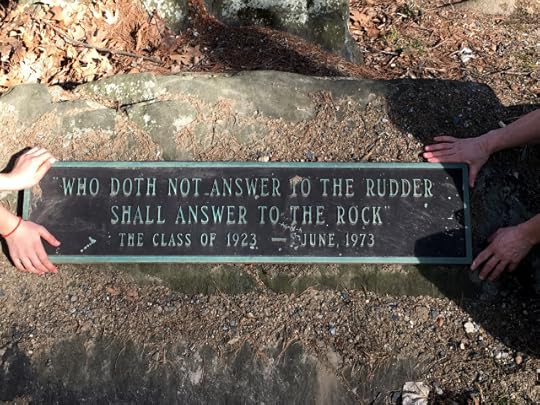
Hanover, New Hampshire


April 15, 2016
Marriage is a Rope
Writer Andre Dubus, master of dialogue, of marriage and its dissipations, pulled over years ago on an interstate as a good samaritan, was hit by a car and never walked again. Last night, I again reread his novella We Don’t Live Here Anymore, and I was thinking of this story at my child’s school this afternoon.
The afternoon was breezy and sunny. The children, from little kindergarteners to the big sixth-grade kids, were outside, chalking on the pavement, playing basketball, swinging, avoiding the wasps stirring in the heat.
One element of Dubus’s genius is to illuminate marriage as a unique configuration between two people with no cliches – all the loving, lust, resentment, frustrated dreams – woven into a particular rope of a marriage. Any rope put to use has its strength tested: will the material fray or snap? Or it is woven well and truly?
When I was a child, jump roping on a school playground, I imagined infinity was the blue sky, never envisioning our interior worlds are as mysterious as the endless sky. On the way home, I bought my daughter her first cremee of the summer.
In a marriage there are all sorts of lies whose malignancy slowly kills everything, and that day I was running the gamut from the outright lie of adultery to the careful selectivity which comes when there are things that two people can no longer talk about. It is hard to say which kills faster but I would guess selectivity, because it is a surrender: you avoid touching wounds and therefore avoid touching the heart.
– Andre Dubus, We Don’t Live Here Anymore

Hardwick, Vermont


April 14, 2016
Watching the Light
I walked into work yesterday morning with a woman who didn’t grow up in this country. She’s learning to drive, an oddity here for a woman in her thirties. In rural Vermont, just about every kid – usually long before the requisite 16-years-old – drives.
Although like most Americans I’ve had a romantic fling with the happy motoring years (just how many times have I driven around the country?), I told this woman part of me longs to hang up the keys and know the earth only through the soles of my boots.
Our world is so overly, crazily full of images – mine as much as anyone’s. As one kind of antidote, our after-dinner twilight walks are as much about the walking and conversation as wandering through the lingering bits of daylight and spying the first stars twinkling overhead. Spring, drenchingly wet, raw, gloriously full of minute surprises, tugs us.
Last evening, my younger daughter and I stood outside as the cool night came down, listening for the peepers. These tiny creatures haven’t stirred in our neck of the woods yet, but the streams tumbled melted snow, in a steady song, to Lake Champlain.
My sister-in-law is a painter, and I’ll say, how long did it take you to paint that painting. She’ll say, It took me maybe three days, but it took me all my life to get the skills to paint that painting.
– Anthony Doerr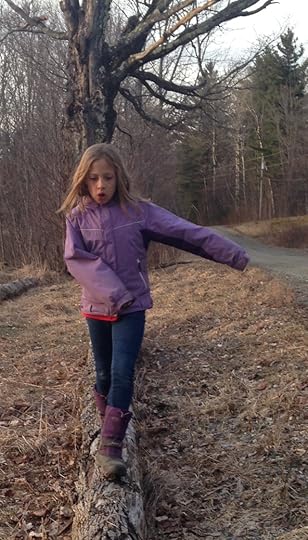


April 12, 2016
April Showers Bring….
Sometimes all day, days, rain falls, writes poet Janisse Ray.
Waiting for the school bus this morning at the driveway’s bottom, with the robins and redwing blackbirds silent, and not even a solitary crow winging its way through the mist, the children waited under our one umbrella, surrounded by greasy mud.
This is the season of last year’s debris rising from the thawing earth: split garden hose, broken bits of sap lines, sodden paper from who knows what, piles of lumber never put to use, a shattered red plastic shovel from a childhood friendship long worn out.
At breakfast, I told the children, Two days from now, the sun will appear, the green emerge, and we’ll find coltsfoot.
My teenage daughter said, Keep hoping, mom.
I am.
…Let it not be said that in passing through this world
you turned your face and left its wounds unattended.
Instead, let it be said that when your friends
cut open your chest to partake of its courage,
a loon was calling.
– Janisse Ray, “Courage,” in A House of Branches

Garden, West Woodbury, Vermont


April 10, 2016
Sabbath Day
A breezy Sunday, full of intent talk and laughter, seedlings – onions, tomatoes, nasturtiums – sprouting by the day, leftover rainbow cake from a birthday, the neighbor boy who pogo-sticked down the muddy road.
Sunlight splashing in puddles from melting snow, brilliant as chips of broken mica.
… But once I held
a kingfisher
in my hands,
I touched its blue power.
That may be the only time
I ever do….
– Janisse Ray, “Kingfisher,” in A House of Branches


April 9, 2016
Happy April is Poetry Month
The other night I heard Leland Kinsey read from his new book of poems, Galvanized, at the Galaxy Bookshop in Hardwick. Leaving home on a weeknight is always a pain, with homework rearing up, dinner dishes, and – although it’s only ten minutes – the ten minutes in the car to drive. I’m always glad when I get to the bookstore, though. The company is familiar and jovial; the books are terrific.
I’ve been to many, many readings at this Hardwick bookstore, but this reading was particularly fine. I’d brought my knitting, but I left it in my lap, untouched. A couple in the back had come with their baby, and the little’s one babbles wove beneath Leland’s voice. Leland’s from a lengthy line of Vermont farmers, and his poetry is strewn with glacial erratics, swallows, ponds – with a keen awareness of mortality, of hard physical work, of human frailty, and love. Perhaps what I admire most about his poetry is that constant thread of beauty, winding all through his words like that baby’s murmur.
Galvanized is a collection of poems suffused with life, penetrating into the deepest recesses of our lives, a book of laughter and tears and beauty, the matter of our everyday lives. Isn’t that what poetry is all about?
…. The same uncle said recently about a blue suit,
“I bought it to be laid out in;
now I’m wearing it to the wakes of others.
Life takes so long.”
Wear.
From “Deer Camp,” Leland Kinsey, in Galvanized
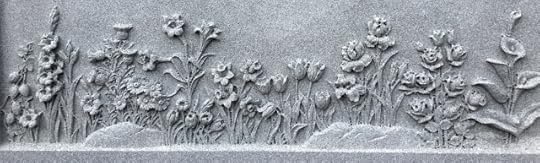
Barre, Vermont/Photo by Molly S.


April 8, 2016
Love Better
What makes a life? A friend of mine told me she once took stock of her life, tallying.
How to measure a life? By a house, bank accounts, grandchildren at the Thanksgiving dinner table? Or perhaps none of this. When I look at my sprawl of past and present, the one thing I think is: love better. The best and most fulfilling things I have done have been freely given. Perhaps this is why to love as a parent (while unbelievably difficult at times) is so fulfilling; any morsels of childish love passed back are pure gravy, savory sweetness.
I’ve never known love as greeting card, prettied up with pastel hearts. Love is as indomitable a force as a woman’s contractions in labor, bearing down to bring a new being into this world, or slender coltsfoot blossoms cracking apart winter’s ice. Love better: surely that would mean widening your heart in unexpected ways.
Today, in this April brown and beige world, I saw a cardinal fly into a thicket, a rare bright bird this far north. I went looking for the hidden little feathered creature. I knew it harbored in those tangled branches, its tiny heart hammering away fiercely in this cold.
And now, I have my own household of teenage girls to attend to, with their own laughing and open hearts……
Locking Yourself Out,
Then Trying to Get Back In
You simply go out and shut the door
without thinking. And when you look back
at what you’ve done
it’s too late. If this sounds
like the story of a life, okay….
I stood there for a minute in the rain.
Considering myself to be the luckiest of men.
Even though a wave of grief passed through me.
Even though I felt violently ashamed
of the injury I’d done back then.
I bashed that beautiful window.
And stepped back in.
– Raymond Carver
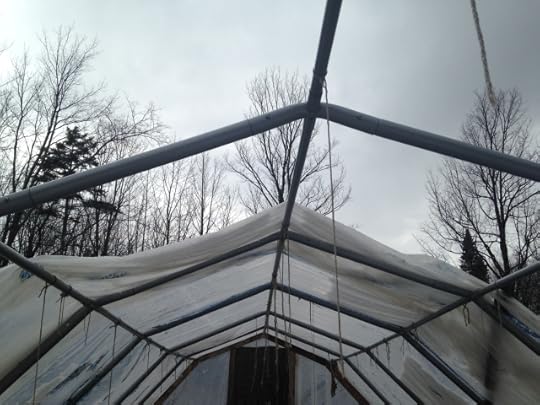
April in Vermont


April 7, 2016
The Footprint of Where You Live
I live in a Vermont town which has very little pavement. Route 14 heads north-south right through the village’s tiny center. In the village, a small amount of pavement fronts the post office, volunteer fire station, and the currently-closed general store. The elementary school has a square in the dooryard, none in the playground or dirt parking lot. Our town is wood, field, and a great deal of water in lakes, ponds, running streams.
The schoolkids took a field trip to Barre, and I met them in the morning, standing beside their one school bus, in a sunny but cold morning, eating apples on cracked asphalt. I laughed.
If you’re a kid, does it matter that your school garden’s footprint is larger than your pavement’s print? Does it matter as adult that you have both winter boots and mud boots? That your horizon is framed by trees and not rooftops?
I tend to think, whether we notice or not, where the soles of our feet walk matters.
Instructions for living a life.
Pay attention.
Be astonished.
Tell about it.
– Mary Oliver
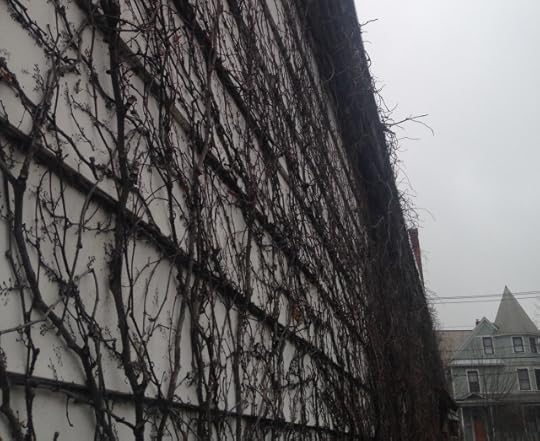
Burlington, Vermont


April 5, 2016
This Small, Good Moment
When I was 17, I was infatuated with James Joyce. I remember watching a documentary with a woman who knew Joyce and described the undercurrent of his life as filled with tristesse. I was learning French at the time and found that notion so romantic. What would that mean, to have tristesse in one’s life? Oh, naiveté.
As a young mother, I endeavored (oh, how hard I tried) to never let unhappiness or want cross my daughter’s life. I failed, of course, miserably and utterly predictably. Now, I’m at that place in my life where I know human life is filled with tristesse and also fear, longing, happiness, and laughter: an ever-changing sky boundless with wind and cloud, studded with arcs of rainbows, their roots eternally concealed.
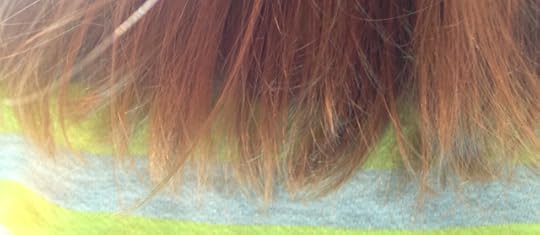
Over and over, I have wondered what I could give my daughters instead, what arms might they raise against the inevitable slings and arrows of their earthly lives? At the very least, this: my own pleasure in this tangible world, in a handful of strawberries, a kite cartwheeling across the spring sky, a daughter’s haircut. In this moment, in this time together.
One of the things I know about writing is this: spend it all, shoot it, play it, lose it, all, right away, every time. Do not hoard what seems good for a later place in the book or for another book; give it, give it all, give it now. The impulse to save something good for a better place later is the signal to spend it now. Something more will arise for later, something better. These things fill from behind, from beneath, like well water. Similarly, the impulse to keep to yourself what you have learned is not only shameful, it is destructive. Anything you do not give freely and abundantly becomes lost to you. You open your safe and find ashes.
– Annie Dillard


April 4, 2016
A Need for a Nap
The other day, I sat beside a woman who was breastfeeding her baby, and I remembered just how physical were those early years, so much milk and baby holding, so much need and so much affection. Mothering growing girls remains remarkably physical, too.
Who ate all the strawberries? Braid this girl’s hair, race down to the mailbox, rule on which friend is now taller than me. Sweep dried mud from boots, bake chicken legs with sage scavenged from the garden, whisper good night.
No wonder mothering can be so exhausting. Like writing, parenthood is something we take in, our very bodies forever expanding with this dimension.
Only after the writer lets literature shape her can she perhaps shape literature. In working-class France, when an apprentice got hurt, or when he got tired, the experienced workers said, “It is the trade entering his body.” The art must enter the body too. A painter cannot use paint like glue or screws to fasten down the world. The tubes of paint are like fingers; they work only if, inside the painter, the neural pathways are wide and clear to the brain. Cell by cell, molecule by molecule, atom by atom, part of the brain changes physical shape to fit the paint.
– Annie Dillard
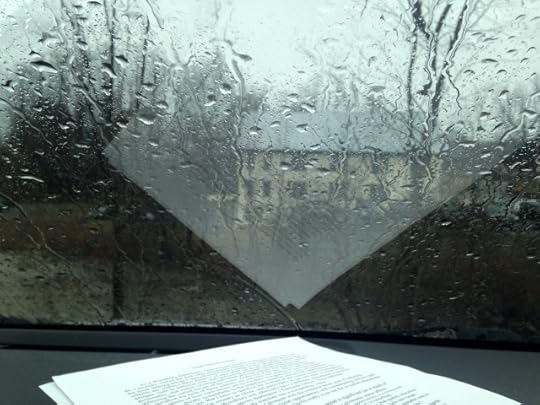
Hardwick, Vermont