Brett Ann Stanciu's Blog, page 168
April 30, 2016
Rough Draft
The ten-year-olds are at their fort building again; odd pieces of plywood have been scavenged, a long 2×6″, silver spray paint glistens a joyous arc in this early morning dew. The project is all rough draft. No terminal point of placing Ma’s china shephardess over the mantle will ever occur. Lacking the need for a finished project, the kids’ creation is all joy and curiosity. Could these old pallets be used? A split hose?
At select moments, the daughter opens her door and invites me in for a tour. What do you think? she asks. What more can I do?
And then: Pull up that bench I made. Sit down and enjoy.
So many of us fail: we divorce our wives and husbands, we leave the roofs of our lovers, go once again into the lonely march, mustering our courage with work, friends, half pleasures which are not whole because they are not shared. Yet still I believe in love’s possibility, in its presence on the earth….
Andre Dubus, Broken Vessels
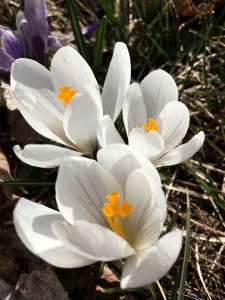
Photo by Molly S.



April 28, 2016
Here.
In the internet world, hardly anyone ever writes where they live. Who claims to be from Maple Falls, Washington? Or Ivy, Virginia? On my hillside, in West Woodbury, Vermont, the trilliums have pushed up but are folded over, awaiting warmth to spread their velvety petals. This afternoon, the sun shines undiluted, while the maples host those raucous robins.
In this April’s Poetry Month, I’ve heard Vermont poets read about desire and loss and joy, and about drinking cold sap, cedar waxwings huddled in a snowstorm, hand-churned ice cream, lost rings….
All this violence: wars and cruelties…
now as always
back to the beginning of time….
Yet and still every day the sun rises,
white clouds roll across the sky,
vegetables get planted and grow,
and late in the afternoon someone
sits quietly with a cup of tea.
– David Budbill, “Little Poem Written at Five O’Clock in the Morning”
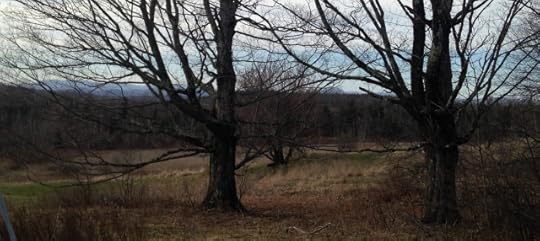
Woodbury, Vermont, April afternoon


April 27, 2016
Hope Springs
Some unexpected events in our thawing patch of Vermont:
dinner guests of chatting children eating grilled eggplant and chicken wings, with gusto
exquisitely beautiful poems read at the Galaxy Bookshop last night – and adult companionship, too
clouds of frog eggs, knots of trillium blossoms, profuse sunshine and clothes drying on the line
a rotten tooth mended
But hope is not about what we expect. It is an embrace of the essential unknowability of the world, of the breaks with the present, the surprises. Or perhaps studying the record more carefully leads us to expect miracles – not when and where we expect them, but to expect to be astonished, to expect that we don’t know.
Rebecca Solnit, Hope in the Dark
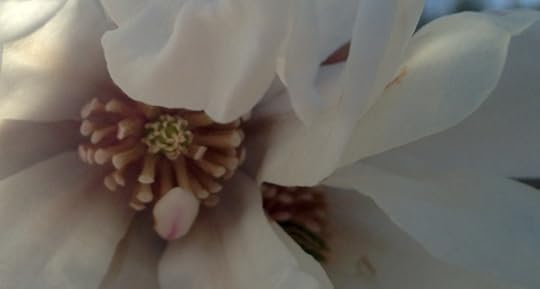
Brattleboro, Vermont/Photo by Molly S.


Slow Learner
At breakfast at the hotel, my ten-year-old is mesmerized by fruit loops. I’ve never tried those, she says, looking at the rainbow bits yearningly.
Go for it, I tell her.
Nearing the end of the milky bowl, she lays down her spoon and comments that Cheerios are better. Those colored rings have failed to hold up to their promised joy. It’s a loss she takes easily, mere observation. When her older sister was that age, I would have leapt forward to fill that moment: disappointed with a cereal? Try this. Or this. This time around, I let it lie. It’s the slightest sadness, and I just let it be. Second time around, I let her keep that sadness for herself.
That evening, she floats on her back in the hotel’s pool, then raises her dripping face and smiles radiantly, sparkling clean, thoroughly happy with buoyancy. I can’t help but stretch for her chlorine-scented hand, and then we flip over and float again, together.
Bring on winter, bring on
disease, & rot & fracture,
because the more broken
we become, the more music
we can spin out of our bones.
– Stephen Cramer, Bone Music
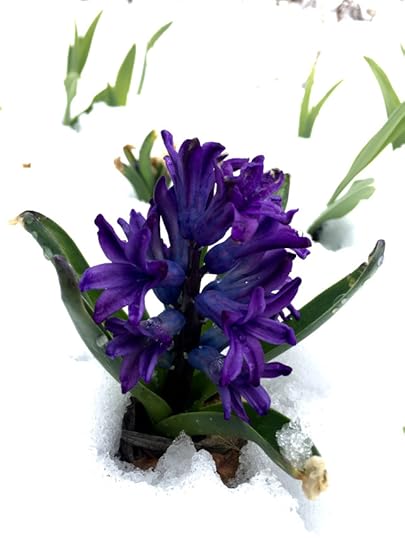
Woodbury, Vermont/April/Photo by Molly S.


April 25, 2016
Roadside Schooling
The kids and I stood at an exit off I-91 today looking for an old maple tree. The tree wasn’t hard to find, right near a park-and-ride, the fieldstone remains of a former barn or house nearby. My younger daughter noted the upper, dying branches of the tree had been wired together, and remarked that, rather than taking a chainsaw to the trunk, someone had taken the time to care for this tree. This ancient beauty may yet linger for years.
The evening before, we had listened to a poet read about this former Vermont farm, in his collection Vermont Exit Ramps II. At the terribly sad ending of this story about Romaine Tenney, I watched in the dim theatre as my older daughter’s mouth visibly opened in shock.
On our drive home, I realized how carefully she had listened to the poem, as she gave me solid directions. While the midmorning commuter traffic rolled in and out of the lot, we studied the mountains and the bend of the land, living in the facets of the past’s stone and trees traces, the sunny and breezy present, and the poem, binding the two.
Hello black fly. Thanks for the welcome.
Now I know what Romaine Tenney cursed
and loved here on Tenney Hill Road: the sting
inside blossoming, the black bother
at the center of the eye bent on spring beauty….
– Neil Shepard, “Romaine Tenney”
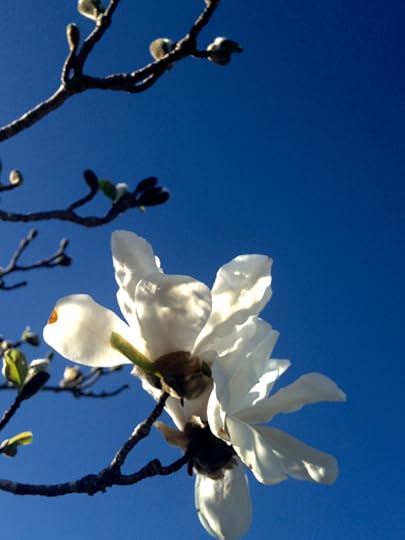
Brattleboro, Vermont/Photo by Molly S.


April 24, 2016
Ah, Monet
When my older sister was a student at Williams College, I often rode the Greyhound and visited her. While she was in German or physics class, I walked to the Clark Art Museum. Entrance was free for students, so I could visit over and over. As I read a lot, too, I learned about Monet and his garden, and Renoir and his women.
Although I didn’t realize it at the time, I was learning art is a physical craft. None of the guards cared if I leaned into the paintings and admired brush strokes, bending in to see the raised curved of paint Sisley’s brush had left. I studied how a particular shade of yellow lent a certain light. I became a writer and not a painter, but those hours in the Clark were invaluable to me. I learned to step into light, to realize darkness as moving force, and to see what is there, rather than what I expected to be there.
Yesterday, I visited with my daughters. In a room suffused with natural light, filled with Impressionist beauties, my younger daughter walked to my most beloved painting in the whole museum – Monet’s ‘Geese in the Brook’ – a golden, sunlit beauty. This child, who had been more interested in the possibility of ice cream rather than Pissarros, said that was her favorite.
When I asked her why, she said, Because it’s beautiful. Look at it, mom.
Bingo, I thought to myself. That was worth the trip alone.
I was learning something from the painting of Cézanne that made writing simple true sentences far from enough to make the stories have the dimensions that I was trying to put in them. I was learning very much from him but I was not articulate enough to explain it to anyone. Besides it was a secret.
Ernest Hemingway, A Moveable Feast
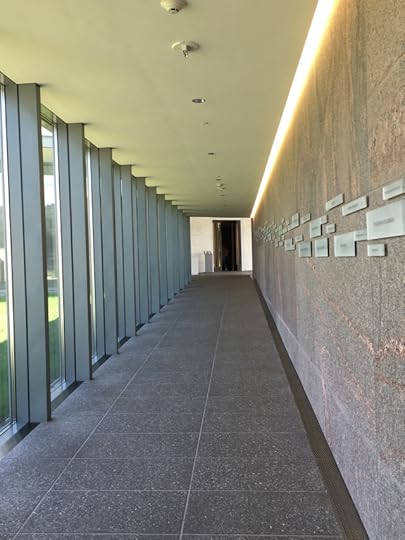
Williamstown, MA


April 22, 2016
The Undertow
Deep in the night, I woke thinking of a Raymond Carver story I had been reading, “Will You Please Be Quiet, Please?” My children had found this title infinitely amusing, riffing on it as a joke between the two of them.
All night long, while the girls and I had been sleeping, cumulus clouds floated over our house, the full moon shining through like a light at the bottom of an ocean turned upside down. I opened the door and stood on the balcony, imaging myself a clipper ship surrounded by this sea of luminescence. In the distant east, just over Woodbury Mountain’s black ridge, shone a single star. In the moonlight, I saw through the sparse woods the edge of the town’s tiny cemetery, where the slatted fence peels white paint.
The Carver story, simply, is about marriage, and it’s not a funny story at all. It’s about conundrums and paradox, about the mysterious, hidden parts of our lives. And yet, standing beneath that marvelous night sky, I watched the moonlight rush cloud shadows over the earth. I was glad to be awake.
…We could have some arrangement
By which I’d bind myself to keep hands off
Anything special you’re a-mind to name.
Though I don’t like such things ’twixt those that love.
Two that don’t love can’t live together without them.
But two that do can’t live together with them….
From “Home Burial” by Robert Frost
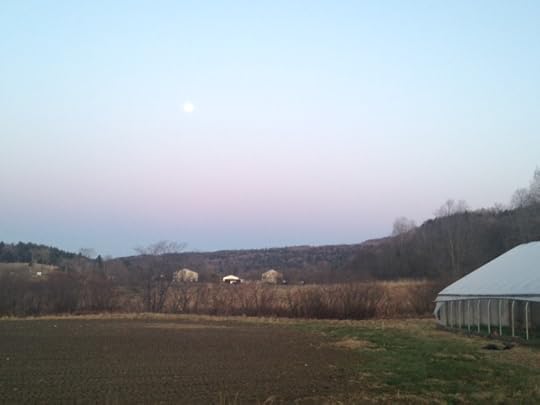
Hardwick, Vermont


April 20, 2016
Frog Chorus
I hate it when my daughters bicker.
Stop, stop, stop, I demand. Are you listening to yourselves?
They look at me oddly, and insist, This isn’t fighting, mom.
Recently, I’ve been forcing myself to close my eyes and simply listen to the cadence of their voices. Not the words, not even the tone, but only the rhythm and motion of their voices together. They pick at each other; they laugh; their voices dive at each other again.
Late this afternoon, I walked to our woods pond. Before I could even see the water, I heard the cacophony of frogs, so rusty this early in the season I might have mistaken it for a few stray geese. When the frogs heard my footsteps on dried leaves, they vanished under the water. I remained crouched for a good long while before the frog-chatter chorus cranked up again, a tentative bleat here, then another.
Walking back, I challenged myself to think of my daughters as those calling creatures and listen carefully to the song beneath their singing.
Old pond…
a frog jumps in
water’s sound.
– Basho
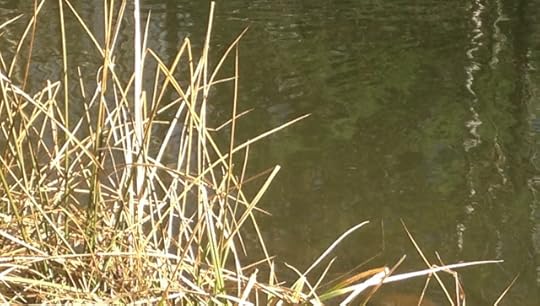
Woodbury, Vermont


April 19, 2016
The Middle Ages, Vermont 2016
One way I’ve (unintentionally) annoyed my daughters is my insistence that, every now and then, I’m inhabiting the Middle Ages. This afternoon, in a stretch of breezy sun, at that optimum seventy degrees, I dug my fingers into the warming garden beds and unearthed worms, threadlike strings of root, lifting handfuls of johnny-ups for a friend.
Somehow, in my fictive Middle Age world, there’s only sunlight and soil, the constellations overhead undiluted by manmade light. This world lacks the drone and pollution of the internal combustion engine, contrails, the unending pressure to earn a living, get the kids one place or another, be accountable to the world out there. I have this vision of a world in perpetual growth, the earth still solidly at the center of the universe, the sun orbiting my serf’s homey patch of soil.
Conveniently, the Pope remains distant, the Children’s Crusade hasn’t happened yet, the Black Plague and smallpox are on hiatus. The thatch over my head is rat-free, famine hasn’t reared its head, and – of course – family life is just fine.
It’s a nice reverie, though, when I remain for these hours in my hands-on-the-land dreamlike stance, gathering tangy greens for dinner, my cheeks sun-kissed.
But you may be surprised to hear that the Middle Ages were like a starry night. Let me explain. Have you ever heard people talking about the Dark Ages? This is the name given to the period which followed the collapse of the Roman empire when very few people could read or write and hardly anyone knew what was going on in the world.
– E.H. Gombrich, A Little History of the World
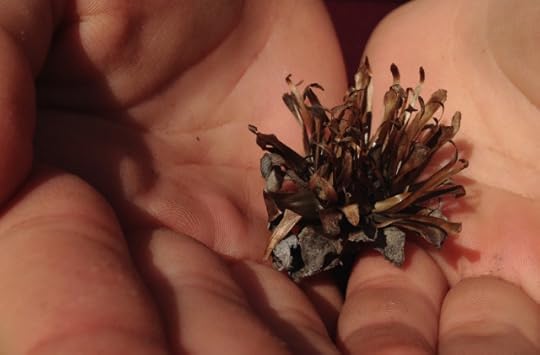
Woodbury, Vermont


April 18, 2016
Listening
Last evening, walking along our dirt road with my daughter, she chattered about our shadows in the lingering daylight, how the sun had merged us into one person, and we appeared to be one being with four legs and a curious kind of goose neck she had made from her hands.
While we were standing there, I suddenly realized I had been listening to the robins singing in a nearby maple tree, without any particular consciousness – and yet on some level I must have been listening keenly. Just recently returned, a whole flock of red-chested couples are nesting in the maples around the garden.
When we first moved to this house, we had two bird-stalking cats and the field was wooded then: the songbirds are not prolific as they are now. But, as all things go, our terrain has changed, and one benefit is this spring melody. How funny is the human mind: winter and cold has now fled our immediate memory, and it’s spring and seeds and the garlic pushing up through a mulch of rotting leaves.
We don’t have to live great lives, we just have to understand and survive the ones we’ve got.
– Andre Dubus