Brett Ann Stanciu's Blog, page 170
April 3, 2016
When Traveling Through a Storm….
Here’s one good reason to read:
Captain Bligh, in his ill-fated, famous Mutiny on the Bounty story, sailed from dreary, oatmeal-eating England to Tahiti, lush land of coconuts and little clothing. He naturally headed across the Atlantic to curve around Cape Horn, situated way down at the bottom of South America. But the ship, plagued by fierce winter storms, was unable to navigate that Cape. Instead, after weeks of battling fierce weather and sailing backwards rather than making headway, Captain Bligh ordered a change in course around the Cape of Good Horn (at the southern-most tip of Africa), adding over 10,000 more miles to the Bounty‘s journey.
In the midst of the sleet, snow, and wind that eventually turned him back:
Bligh could note that blue petrels and pintados, “two beautiful kinds of bird,” followed their wake. – Caroline Alexander, The Bounty
When to turn? When to change direction in a life?
Remember this: in the harshest, most ungodly conditions, note unexpected beauty, following your travels.
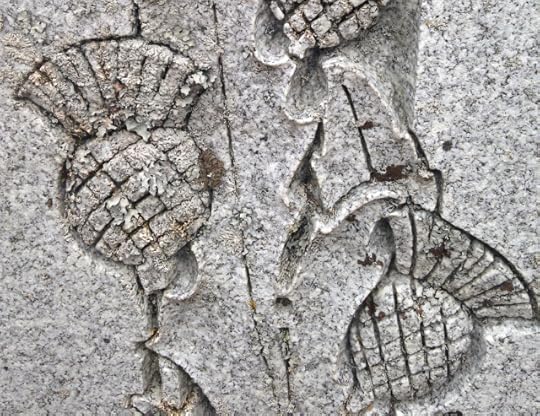
Hope Cemetery/Barre, Vermont



April 1, 2016
Birthday Present
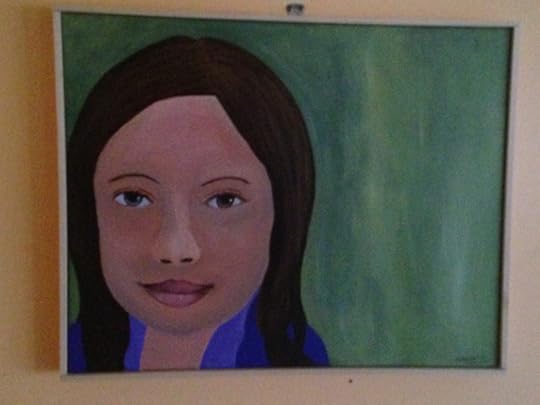
For my birthday present, my teenage daughter painted a portrait of her younger sister. Beyond the gesture of a gift, the painting pleased me immensely, as it captures my younger daughter’s level way of gazing at the world, a steadiness she exhibited since very early childhood.
This painting also illuminates my teenager, decidedly and unselfconsciously off-center, without glitz, deeply attuned to beauty. When I first became a mother, 17 years ago, I lived in a world of my own expectations – of what I wanted for my children. Oh naive woman, I think back to my younger self. Relax. Worry less. But, as a new mother, I had no idea I would someday receive this gift of windows into my daughters’ souls.
The truth is that life is hard and dangerous; that he who seeks his own happiness does not find it; that he who is weak must suffer; that he who demands love will be disappointed; that he who is greedy will not be fed; that he who seeks peace will find strife; that truth is only for the brave; that joy is only for him who does not fear to be alone; that life is only for the one who is not afraid to die.
– Joyce Cary


March 31, 2016
Inner Lives
With the kids at school this afternoon, we gathered goldenrod galls. On an old board, I cut the galls open with a knife somewhat too dull for the work. Inside, we discovered the hidden world of the larvae, curled up in its spongy nest. All winter, these miniature creatures have lived in their solitary round homes, steadily growing, with a single shaft of light illuminating their passing days.
50 weeks – 50 weeks! – are needed to create this fly: roughly 350 days. Then, those that survive the winter, those that are lucky enough to be passed over by chickadees or curious children, live for two weeks: perhaps 14 days.
Our children, intently curious, good-humored in a light mist, have a life cycle fortunately (generally) so much different. How many long days and night have gone into my mothering? I wouldn’t begin to count. It’s not a mathematical equation.
Nor was it really mathematics we explored today beneath that rough covering. It was life.
BLUEBIRD
there’s a bluebird in my heart that
wants to get out
but I’m too tough for him,
I say, stay in there, I’m not going
to let anybody see
you.
there’s a bluebird in my heart that
wants to get out
but I pour whiskey on him and inhale
cigarette smoke
and the whores and the bartenders
and the grocery clerks
never know that
he’s
in there…..
– Charles Bukowski
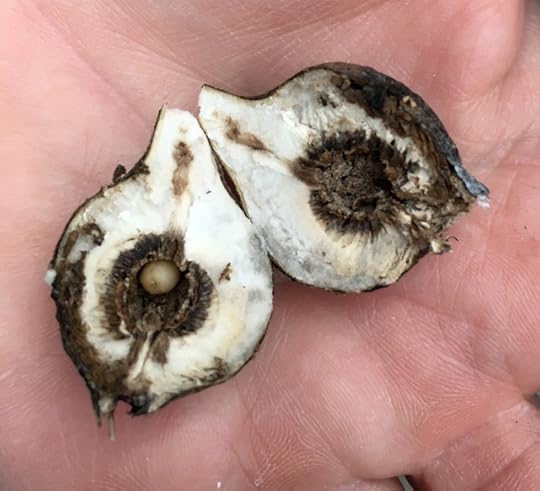
Photo by Molly S.


March 30, 2016
Travels Around the Globe & Through the Centuries
Late into last night and early this morning – two periods of darkness – I read Caroline Alexander’s The Bounty, the travels of Captain William Bligh and his misfortunes. She writes of the exquisite natural beauty of Tahiti, and about the chaos of Western men sailing on their rampage for vengeance, men sailing the seven seas, the seven deadly sins rioting through this story.
This evening, walking with my daughter in the early spring evening, the robins singing, I imagined how divine that virgin land must have been, with its contrasts of color and elevation, its welcoming inhabitants, the plethora of food. As a writer, I can’t help but admire the endless metaphorical possibilities….
Reading about the great strife and literal journeys of others deepens the geography of my own domestic Vermont life, reflecting my black sandy beaches. Greater misery of others doesn’t diminish the suffering of those in my world, but widens the landscape, per se, of what it means to be human.
… under cloudless skies and mild breezes…. the lush, dramatic peaks of Tahiti. Closer in, and the mountain cascades, the graceful palms, and the sparkling volcanic black beaches could be seen beyond thundering breakers and surf. The few ships that had anchored here had all attempted to describe the vision like beauty of the first sight of this island rising into view from the blue Pacific. Bligh had called Tahiti “the Paradise of the World.”
– Caroline Alexander, The Bounty: the True Story of the Mutiny on the Bounty
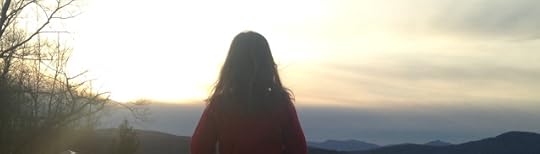
Woodbury, Vermont


March 28, 2016
Children & Flies: Biosphere Companions
A rainy March day yielded existential questions regarding flies in my fifth-grade daughter’s day. At supper, she chatted about catching a fly in the minutes before the first class and another hidden in a friend’s desk all day, allegedly feasting on granola bars.
The Woodbury schoolhouse is 200-years-old, with filled with all kinds of corners and crannies, high ceilings and gorgeous windows: delightful habitat for flies. I asked if she thought the flies might be back tomorrow. She didn’t know. Tomorrow, she guessed, their companions could be wasps or ladybugs. In third grade, the children kept a keen eye on a mouse hole concealed behind the teacher’s desk. It’s not long until the birds begin nesting in the trees around the school, and the snapping turtles emerge from the wetland to bury their eggs in the ball field.
At the end, while I was laughing, my daughter said simply and matter-of-factly, “We are all in the biosphere.”
All the time I pray to Buddha
I keep on
killing mosquitoes.
– Issa
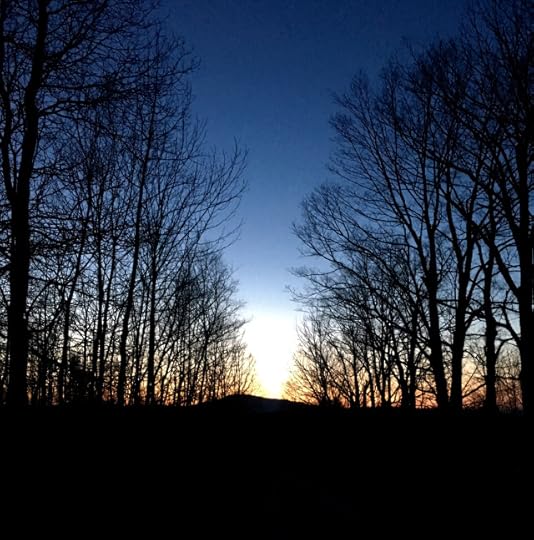
Woodbury, Vermont/Photo by Molly S.


March 27, 2016
Reflections
Long after sunset last night, my daughters and I went walking, in that thick rural dark broken only by the lights of the single house across the road, the lights of our kitchen behind us, and overhead all those stars. The little girl, fearful of the dark, walked between her sister and me. Those glimmering, oh-so-bright stars twinkled in the treetops, still bare and leafless at this time of year.
Earlier that day, the younger girl had dug quartz pebbles from the roadside mud, washed them clean in a puddle, and gave them to me to put in my pockets for safekeeping. My diamonds, she called them.
Shiny bits of stars, bright bits of stone.
As we walked back to our house, guided by the compass of our kitchen light, the older daughter told us she parted her curtains every night and slept every night with a windowful of stars over her bed.
I asked my daughters to imagine our world without stars, with only darkness, none of the constellations cartwheeling across the sky, no dipper pouring luck over our roof, no Orion standing sentry through those bitter winter nights, no Milky Way – that mesmerizing arc of the eternally and ever-beautiful mysteriously ineffable. What kind of world would this be without the lights of the great heavens that have endured, before and after, any human stirrings on this green and blue planet?
My daughter, age 17, pondered this as we stood with our faces tipped upward. Then she said, That would suck.
Indeed, daughter.
I experience a period of frightening clarity in those moments when nature is so beautiful. I am no longer sure of myself, and the paintings appear as in a dream.
– Vincent Van Gogh
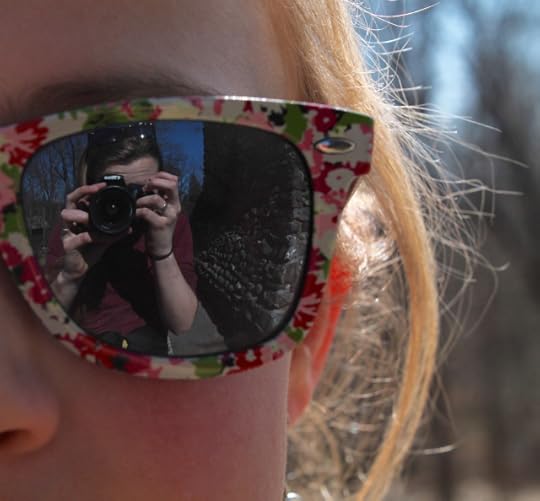
Montpelier, Vermont/Photo by Molly S.


March 26, 2016
The Civility of Vermont
Like anywhere else, Vermont has its share of injustices, but also a steady practicality. People generally lend a hand in need, to friend or stranger.
This afternoon, the girls and I took a teenage friend on a steep walk. Why? she inquired.
Because it’s fun, I answered.
On a day like today, full of sunlight, the grass beginning to green even in March, with no bugs and no ice, what a joy to be human, and not a machine.
We are born with some things in our veins…
Virginia Reeves, Work Like Any Other
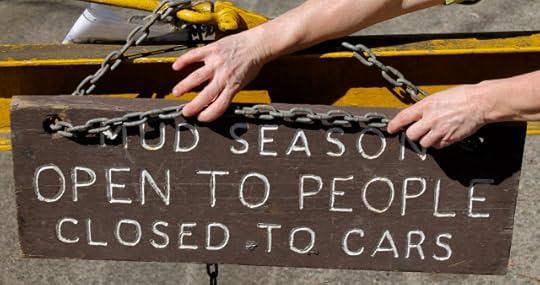
Montpelier, Vermont/Photo by Molly S.


March 25, 2016
Surprise
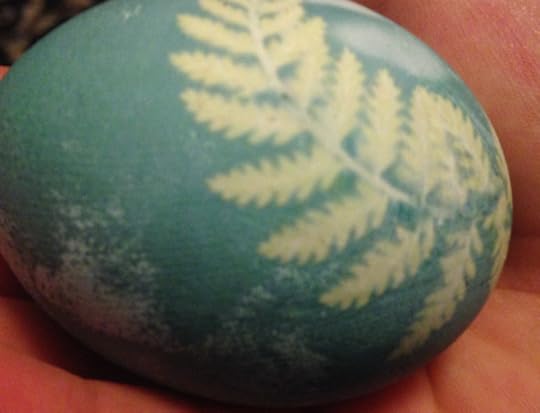
On a lark, my daughters and their friend found a lacy fern today, pressed it over a hard-boiled egg, wrapped it in a piece of tights one of the girls had worn to ballet class, and buried the egg in a nest of red cabbage leaves in a pot. I added vinegar and water. When it had boiled and cooled, the older daughter pushed away the soft cabbage leaves.
She held the wrapped egg in her hands for a moment while we guessed what would happen.
The egg was a beautiful shade of blue, the fern hazy enough to be clouds in a summer sky.
Could this be the appeal of egg hunts, beyond the chocolate? A wholly unexpected bit of beauty, sized to fit your hand? At the time of year in Vermont when all is variations of mud, scattershot with slushy snow?
…Nothing is so beautiful as spring —
When weeds, in wheels, shoot long and lovely and lush…
Gerard Manley Hopkins


March 23, 2016
Maize v. Corn
When I was ten, my family and I camped one summer all the way from New Hampshire to Wyoming to Mexico. One of the places we visited was Mesa Verde, in Colorado. In the visitors’ center, we saw an ancient urn found in a cave (as I remember), filled with corn seed. The archeologists planted some of the precious seed; the kernels germinated. The seedlings grew and thrived.
A few summers ago, I returned to Mesa Verde as a grown woman with my family, and that urn was still there, in that same visitors’ center. For a few days, we stayed with friends, who took us to one of the many once-upon-a-time villages, which had been excavated and filled back in, and now seemed traversed mainly by wildlife. We walked among the remains of walls and abode houses, theorizing where these families might have planted crops, how they harbored water, what kind of lives they might have lived.
Water and maize: clearly the narrative of life for these people: material and undoubtedly spiritual, too. As I begin planting seeds again this season, I can’t help but think of that ancient clay vessel, so reverently crafted and painted, its dear contents preserved. And, 21st woman that I am, I can’t help but remark what a far distance those precious seeds have travelled to the industrial giant of King Corn.
This is the yin and yang of the earth, an energetic feedback. What happens below relates directly to what is happening on the surface and in the atmosphere and vice versa. Tectonics does not end at the ground beneath your feet. It is a dynamic system from the earth’s interior all the way into the sky and back.
–– Craig Childs


March 21, 2016
Koyaanisqatsi: Unbalanced Life
Not long ago, one of my daughter’s friends remarked that everyone desires the warm feeling of home. And yet, why is it so darned hard to keep the home in balance? The stuff of literature is family, never wholly at ease, always shifting and turning, brimming with hunger and unmet desire…. the stuff of life: this material I write about; this very matter I live.
This winter, even a mouse came to die beneath my wood stove, spreading out its little furry body, relinquishing fear of us in its desire to expire on the hearth. The snow is all gone but the hard ugly leavings of dirtied lumps. Vermont in March should be heavy winter, sun bright over fresh snow, and we should be skiing in t-shirts, sunburning. The wind has been blowing every night, bringing neither spring nor storm. It’s off, all of it, this winter that never was.
Long after dinner tonight, the girls and I sat at the table, talking, myself knitting, pulling together through language. They tell me, this happened today, and we did that, while I’m thinking of those sunny faces of coltsfoot, the deep yellow blossoms that push up through the rockiest and poorest of soils. When will they return? I rely on language and story, yes, to bind us together, and my other old stand-by – resilience – thinking…
Surely some revelation is at hand…
– Yeats
March, Vermont