
Emily Conrad's Blog, page 12
April 13, 2017
When Effort Fails: A Lesson from a Houseplant
by Emily Conrad

I have a track record of killing houseplants. African violets and cyclamen shriveled up almost as soon as I brought them in the house. I once killed a cactus in spectacular fashion by putting it too close to the hot oven. I kept an anthurium alive and flourishing at work for months, but it died shortly after I brought it home. And when I put our two-feet-across jade plant outside for the summer, the squirrels nibbled it to death. Some of my other victims include an aloe, a dieffenbachia, an umbrella plant, and a Norfolk Island pine.
Changing my habits to try to take better care of my plants proved dangerous, too. I would get too extreme, killing them with too much water or too much sun or... well, if I knew, I wouldn't have killed so many.
Read more »

I have a track record of killing houseplants. African violets and cyclamen shriveled up almost as soon as I brought them in the house. I once killed a cactus in spectacular fashion by putting it too close to the hot oven. I kept an anthurium alive and flourishing at work for months, but it died shortly after I brought it home. And when I put our two-feet-across jade plant outside for the summer, the squirrels nibbled it to death. Some of my other victims include an aloe, a dieffenbachia, an umbrella plant, and a Norfolk Island pine.
Changing my habits to try to take better care of my plants proved dangerous, too. I would get too extreme, killing them with too much water or too much sun or... well, if I knew, I wouldn't have killed so many.
Read more »


April 11, 2017
Taming the Inspiration Lion: a poem and 5 tips from a full-time creative
by Emily Conrad

Taming the Lion
Inspiration sits at the top of the list
of things I’d like to tame.
If only he liked the scent of coffee
(but, honestly, what lion would?)
I could brew him a cup,
lure him into coming close.
He would nuzzle my shoulder
with his massive head,
tickling my ear with his mane,
purring ideas from his deep throat.
Instead, he flicks his tail and paces
the end of the room.
His claw-heavy paws dig
into the hardwood,
his sharp brown eyes lick the kitchen.
He roars and swipes at the lamps.
Light bulbs shatter.
The sun saves the day by beaming
through the window.
The pads of his paws
sense the warmth
and like a dog or a tabby,
he slumps, haunches first, onto the floor.
Only then I approach and record
his happy sighs as best I can.
Then, the sun eases past,
the shadows fall,
the day and its work is done.
What’s written will have to do,
and tomorrow, we’ll begin again.
_____________________________________

As the poem suggests, inspiration can be a battle for me. To feed my writing, I find I have to invest time in idea generation and capture. Feel free to borrow these tactics and please share your own in the comments!
Reading. I gather the names of books and authors to check out from writer friends who understand my taste and aspirations, and from other sources I trust, like thought-provoking blog posts, and, most recently from a couple of book reviews in an older issue of Ruminate magazine.
Journaling. Writing in a journal takes the pressure off, since it's not for public consumption...unless that's what I choose to make it. Since inspiration is part of the problem, I find using journals with prompts like this one from Art of Adventure helps get me going. Having learned from that journal, I now sometimes write my way through passages in the Bible. Some--but nowhere near all--of what I write ends up being usable for posts.
Lists. If inspiration steps from the shadows when I don't have time to do it justice, I jot down the basics. I have a document on my laptop of blog ideas and partial posts. I have a running memo on my phone with snatches of stories. If I failed to at least capture the essence of the idea, it would be gone by the time I sat to write next. Even if months pass before I use something I've entered, that reserve of ideas serves as a safety net, catching me when I'm all out of ideas.
Continuing education the free and/or easy way. I read books on writing fiction. I take the occasional free course on blogging. These help give me new ways to approach my subjects or new tools to use, and new approaches and tools can inspire new ideas.
Find or make prompts. The Five Minute Friday blogging community is great for supplying a weekly prompt. Inspired by them, I made word salsa so I could have a fresh prompt whenever the need struck. From my word salsa jar, I drew the word "tame" and that's how I ended up with the poem at this post's opening.

Does your job rely on inspiration? How do you tame your inspiration lion? I can always use more tips!

Taming the Inspiration Lion: a poem + 5 tips from a full-time creative via @novelwritergirl

Taming the Lion
Inspiration sits at the top of the list
of things I’d like to tame.
If only he liked the scent of coffee
(but, honestly, what lion would?)
I could brew him a cup,
lure him into coming close.
He would nuzzle my shoulder
with his massive head,
tickling my ear with his mane,
purring ideas from his deep throat.
Instead, he flicks his tail and paces
the end of the room.
His claw-heavy paws dig
into the hardwood,
his sharp brown eyes lick the kitchen.
He roars and swipes at the lamps.
Light bulbs shatter.
The sun saves the day by beaming
through the window.
The pads of his paws
sense the warmth
and like a dog or a tabby,
he slumps, haunches first, onto the floor.
Only then I approach and record
his happy sighs as best I can.
Then, the sun eases past,
the shadows fall,
the day and its work is done.
What’s written will have to do,
and tomorrow, we’ll begin again.
_____________________________________

As the poem suggests, inspiration can be a battle for me. To feed my writing, I find I have to invest time in idea generation and capture. Feel free to borrow these tactics and please share your own in the comments!
Reading. I gather the names of books and authors to check out from writer friends who understand my taste and aspirations, and from other sources I trust, like thought-provoking blog posts, and, most recently from a couple of book reviews in an older issue of Ruminate magazine.
Journaling. Writing in a journal takes the pressure off, since it's not for public consumption...unless that's what I choose to make it. Since inspiration is part of the problem, I find using journals with prompts like this one from Art of Adventure helps get me going. Having learned from that journal, I now sometimes write my way through passages in the Bible. Some--but nowhere near all--of what I write ends up being usable for posts.
Lists. If inspiration steps from the shadows when I don't have time to do it justice, I jot down the basics. I have a document on my laptop of blog ideas and partial posts. I have a running memo on my phone with snatches of stories. If I failed to at least capture the essence of the idea, it would be gone by the time I sat to write next. Even if months pass before I use something I've entered, that reserve of ideas serves as a safety net, catching me when I'm all out of ideas.
Continuing education the free and/or easy way. I read books on writing fiction. I take the occasional free course on blogging. These help give me new ways to approach my subjects or new tools to use, and new approaches and tools can inspire new ideas.
Find or make prompts. The Five Minute Friday blogging community is great for supplying a weekly prompt. Inspired by them, I made word salsa so I could have a fresh prompt whenever the need struck. From my word salsa jar, I drew the word "tame" and that's how I ended up with the poem at this post's opening.

Does your job rely on inspiration? How do you tame your inspiration lion? I can always use more tips!

Taming the Inspiration Lion: a poem + 5 tips from a full-time creative via @novelwritergirl
April 6, 2017
Proverbs 3 Answers a Prayer for Direction
by Emily Conrad

She's more precious than rubies. It's a well-known phrase from the Bible, variations of which appear at least twice in Proverbs. Once, in Proverbs 31, it's referring to a godly woman. However, when I searched the phrase to find the reference this morning, I learned that it also shows up in another context.
Read more »

She's more precious than rubies. It's a well-known phrase from the Bible, variations of which appear at least twice in Proverbs. Once, in Proverbs 31, it's referring to a godly woman. However, when I searched the phrase to find the reference this morning, I learned that it also shows up in another context.
Blessed is the one who finds wisdom,'She' refers to wisdom in this case, the very thing I've been asking God for, so His leading me to stumble my way to this chapter of the Bible was an answer to prayer, one I would like to share with you.
and the one who obtains understanding.
For her benefit is more profitable than silver,
and her gain is better than gold.
She is more precious than rubies,
and none of the things you desire can compare with her.
Proverbs 3:15, NET
Read more »
April 4, 2017
Questions to Consider Before Taking On More (or Less)
by Emily Conrad

When I look back on the day, I sometimes feel I didn’t accomplish enough. It seems there is never a shortage of opportunities to contribute more with extra work, extra ministry time, extra chores. It's tempting to say yes to these to somehow justify myself and my schedule. Maybe if I take on enough, I'll be able to look back at my day and say, "See, I did enough today."
It helps none that as a people-pleaser, I'm extra-susceptible to suggestions by others. Even their examples of taking on what appears to be more than what I feel is right for me pressure me to compete. If they can be involved in a church event three or four nights a week, why do I resist my 2.5 average?
Maybe I should do more. The idea haunts me until the 'maybe' drops right off.
And yet the idea of taking on more leaves me certain my reserves of time and attention are already maxed out.
So which is it? Am I doing too much or too little? How can I tell? How can you tell?
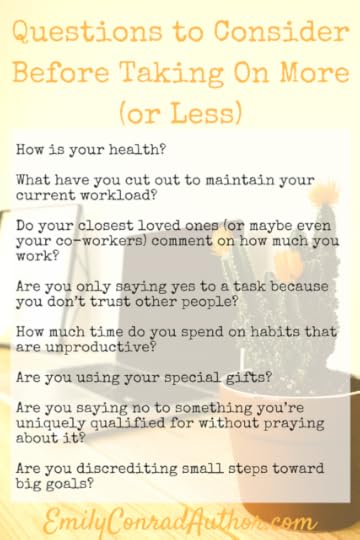
Deciding how much to take on and for which causes is a personal matter, but I've come up with a list of questions to help guide the process of building a schedule that works.
How is your health? Headaches, migraines, a racing heart, fatigue, difficulty sleeping or concentrating are all signs that something is off, and that something just might be your schedule. Of course, I’m not a doctor and cannot replace one, so get help if you need it.
If schedule-induced stress is beginning to affect your body, it's time for a change. Look for commitments you can trim out, delegate, or obtain help to cover. Say no, and recharge so you can contribute in healthy ways in the future.

What have you cut out to maintain your current workload? Breaks? Relaxation on weekends or in the evening? Quality time with family or friends or Jesus? For me, I once found I’d cut out a hobby that’s really more of a calling in order to keep up with a job. When I just couldn’t reconcile the job with the calling, I eventually had to choose between the two. You can read that story here.
Now that I'm writing full-time, my work is always at hand, so I still have to monitor how I spend evenings and weekends. It's hard to write when I'm not also living life from which to draw experiences, just like it's hard to bring your best to any job when you're burned out.
Do your closest loved ones (or maybe even your co-workers) comment on how much you work? Your closest loved ones are your inner circle for a reason. If they spy a problem, it’s time to take note. Being the one who’s in the office the most may say something about dedication, but those who leave on time while still turning in quality work prove that they can manage their time wisely and possibly work smarter rather than longer. Time-management and smarts? Those sound like excellent selling points on a resume.
Are you only saying yes to a task because you don’t trust other people? I chair a committee at church, but I got sick and didn’t sleep well the night before a meeting. I asked someone else to lead the meeting for me, but at the last minute, I considered going to the meeting after all. But I had already also cancelled fun plans for the next day because of the cold (so I wasn’t just trying to get out of the meeting) and the whole committee certainly didn’t need to come down with a cold just in time for our event on Saturday. So, I stayed away…guiltily.
When my sub went over everything they worked out at the meeting, I learned they’d gotten way more done than I’d planned to do. With that, I learned that though it’s good to contribute when I can, I’m also free to sit out when the situation warrants it. We’re a team for a reason, and I can (and should!) trust them.
How much time do you spend on habits that are unproductive? This includes tasks that could be delegated or that are duplicating work unnecessarily, as well as finding more effective ways to complete tasks that need to be on your plate. Maybe instead of throwing all that paperwork in a drawer, filing it could save you time when your boss comes around looking for that receipt you know is in there somewhere.
Also, look at downtime, because, it’s possible to “rest” in unproductive ways, too. If I’m working and am having trouble coming up with an idea, it’s easy to click over to social media and spend time scrolling. That doesn’t help me work—it’s not supposed to because it’s supposed to be a break, but the truth is, social media also doesn’t refresh me. It’s just a tool that helps me procrastinate away time that would be better spent elsewhere.
Are you using your special gifts? God’s given you talents for such a time as this. There may be seasons where you use one gift more than others, but take time to consider where your time will be best invested. Me? I’m much more useful volunteering in my church’s library once in a while than I’d ever be in the nursery.
Are you saying no to something you’re uniquely qualified for without praying about it? We're instructed to pray without ceasing, and if we're praying that much, should any schedule issue ever go without being brought to God? Um, no. Yet I’ve fallen into believing sometimes that God will give me a desire to do what He wants me to do without my even asking Him where I should spend my time.
For example, I’m a high school youth leader, and I enjoy it. However, when I chaperoned the lock in last year, I was tired for days afterward and wasn’t really sure my presence at the lock in had been important. This year, I really wanted to limit my commitment to the event by saying I could only do half the night, but my husband insisted we pray about it.
In the end, he and I both decided we’re able to be there, and I now see the night as an opportunity to build relationships with some of the girls—and youth ministry revolves around relationships.
Including this question, however, isn't meant to turn all your 'no's' into 'yeses.' Incidentally, I felt similarly about the summer mission trip and even after praying decided to say no to the trip. It seems this is a chance to trust that God will ensure they have all the leaders they need… or maybe He’ll ask me to revisit the decision again, but for now, the answer seems to be no.
Are you discrediting small steps toward big goals? Feeling as though you haven't accomplished much in a day can lead to wanting to take on more. However, it takes a long time to write a book, grow a platform, train a puppy, raise a child, or make your first million. Most of that time passes without fanfare, and it's easy to discount the day's work because it didn't involve a milestone. But that work does add up.
A few months ago, I decided I would save $75 out of each paycheck. I set it on auto and left it alone. When I visited the account recently, I was surprised to find that the small transfers had accumulated over $1000. Just like those deposits added up, so will the small-but-regular investments we contribute toward our biggest aspirations.
Our culture preaches more must be better, but failing to consider if this is really the case can leave us unhealthy, burned out, and ineffective. When we take on too much, we risk being unavailable when God does call us to action. Then again, we must show up and put in the time when He asks us to if we're to fulfill the purpose for which He created us. I hope this list will help as you wrestle with your commitments.
What other questions might help with making healthy choices about how much to take on?
Questions to consider before taking on more-or less #timemanagement #priorities @novelwritergirl

When I look back on the day, I sometimes feel I didn’t accomplish enough. It seems there is never a shortage of opportunities to contribute more with extra work, extra ministry time, extra chores. It's tempting to say yes to these to somehow justify myself and my schedule. Maybe if I take on enough, I'll be able to look back at my day and say, "See, I did enough today."
It helps none that as a people-pleaser, I'm extra-susceptible to suggestions by others. Even their examples of taking on what appears to be more than what I feel is right for me pressure me to compete. If they can be involved in a church event three or four nights a week, why do I resist my 2.5 average?
Maybe I should do more. The idea haunts me until the 'maybe' drops right off.
And yet the idea of taking on more leaves me certain my reserves of time and attention are already maxed out.
So which is it? Am I doing too much or too little? How can I tell? How can you tell?
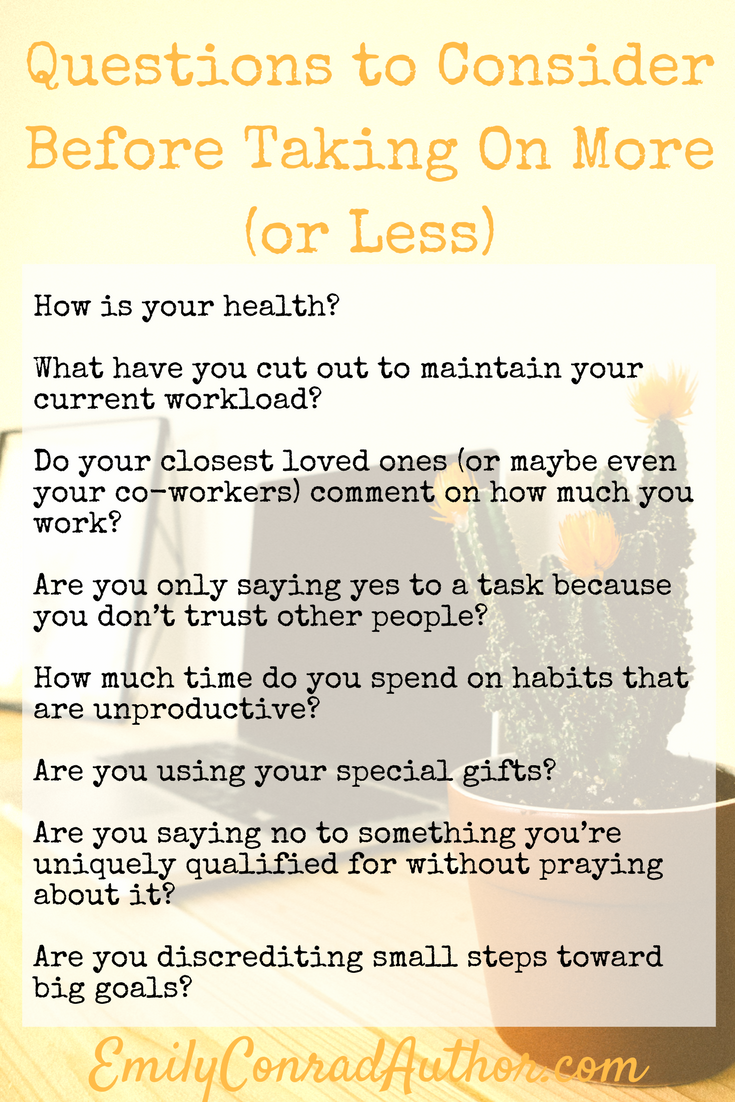
Deciding how much to take on and for which causes is a personal matter, but I've come up with a list of questions to help guide the process of building a schedule that works.
How is your health? Headaches, migraines, a racing heart, fatigue, difficulty sleeping or concentrating are all signs that something is off, and that something just might be your schedule. Of course, I’m not a doctor and cannot replace one, so get help if you need it.
If schedule-induced stress is beginning to affect your body, it's time for a change. Look for commitments you can trim out, delegate, or obtain help to cover. Say no, and recharge so you can contribute in healthy ways in the future.

What have you cut out to maintain your current workload? Breaks? Relaxation on weekends or in the evening? Quality time with family or friends or Jesus? For me, I once found I’d cut out a hobby that’s really more of a calling in order to keep up with a job. When I just couldn’t reconcile the job with the calling, I eventually had to choose between the two. You can read that story here.
Now that I'm writing full-time, my work is always at hand, so I still have to monitor how I spend evenings and weekends. It's hard to write when I'm not also living life from which to draw experiences, just like it's hard to bring your best to any job when you're burned out.
Do your closest loved ones (or maybe even your co-workers) comment on how much you work? Your closest loved ones are your inner circle for a reason. If they spy a problem, it’s time to take note. Being the one who’s in the office the most may say something about dedication, but those who leave on time while still turning in quality work prove that they can manage their time wisely and possibly work smarter rather than longer. Time-management and smarts? Those sound like excellent selling points on a resume.
Are you only saying yes to a task because you don’t trust other people? I chair a committee at church, but I got sick and didn’t sleep well the night before a meeting. I asked someone else to lead the meeting for me, but at the last minute, I considered going to the meeting after all. But I had already also cancelled fun plans for the next day because of the cold (so I wasn’t just trying to get out of the meeting) and the whole committee certainly didn’t need to come down with a cold just in time for our event on Saturday. So, I stayed away…guiltily.
When my sub went over everything they worked out at the meeting, I learned they’d gotten way more done than I’d planned to do. With that, I learned that though it’s good to contribute when I can, I’m also free to sit out when the situation warrants it. We’re a team for a reason, and I can (and should!) trust them.
How much time do you spend on habits that are unproductive? This includes tasks that could be delegated or that are duplicating work unnecessarily, as well as finding more effective ways to complete tasks that need to be on your plate. Maybe instead of throwing all that paperwork in a drawer, filing it could save you time when your boss comes around looking for that receipt you know is in there somewhere.
Also, look at downtime, because, it’s possible to “rest” in unproductive ways, too. If I’m working and am having trouble coming up with an idea, it’s easy to click over to social media and spend time scrolling. That doesn’t help me work—it’s not supposed to because it’s supposed to be a break, but the truth is, social media also doesn’t refresh me. It’s just a tool that helps me procrastinate away time that would be better spent elsewhere.
Are you using your special gifts? God’s given you talents for such a time as this. There may be seasons where you use one gift more than others, but take time to consider where your time will be best invested. Me? I’m much more useful volunteering in my church’s library once in a while than I’d ever be in the nursery.
Are you saying no to something you’re uniquely qualified for without praying about it? We're instructed to pray without ceasing, and if we're praying that much, should any schedule issue ever go without being brought to God? Um, no. Yet I’ve fallen into believing sometimes that God will give me a desire to do what He wants me to do without my even asking Him where I should spend my time.
For example, I’m a high school youth leader, and I enjoy it. However, when I chaperoned the lock in last year, I was tired for days afterward and wasn’t really sure my presence at the lock in had been important. This year, I really wanted to limit my commitment to the event by saying I could only do half the night, but my husband insisted we pray about it.
In the end, he and I both decided we’re able to be there, and I now see the night as an opportunity to build relationships with some of the girls—and youth ministry revolves around relationships.
Including this question, however, isn't meant to turn all your 'no's' into 'yeses.' Incidentally, I felt similarly about the summer mission trip and even after praying decided to say no to the trip. It seems this is a chance to trust that God will ensure they have all the leaders they need… or maybe He’ll ask me to revisit the decision again, but for now, the answer seems to be no.
Are you discrediting small steps toward big goals? Feeling as though you haven't accomplished much in a day can lead to wanting to take on more. However, it takes a long time to write a book, grow a platform, train a puppy, raise a child, or make your first million. Most of that time passes without fanfare, and it's easy to discount the day's work because it didn't involve a milestone. But that work does add up.
A few months ago, I decided I would save $75 out of each paycheck. I set it on auto and left it alone. When I visited the account recently, I was surprised to find that the small transfers had accumulated over $1000. Just like those deposits added up, so will the small-but-regular investments we contribute toward our biggest aspirations.
Our culture preaches more must be better, but failing to consider if this is really the case can leave us unhealthy, burned out, and ineffective. When we take on too much, we risk being unavailable when God does call us to action. Then again, we must show up and put in the time when He asks us to if we're to fulfill the purpose for which He created us. I hope this list will help as you wrestle with your commitments.
What other questions might help with making healthy choices about how much to take on?
Questions to consider before taking on more-or less #timemanagement #priorities @novelwritergirl
March 30, 2017
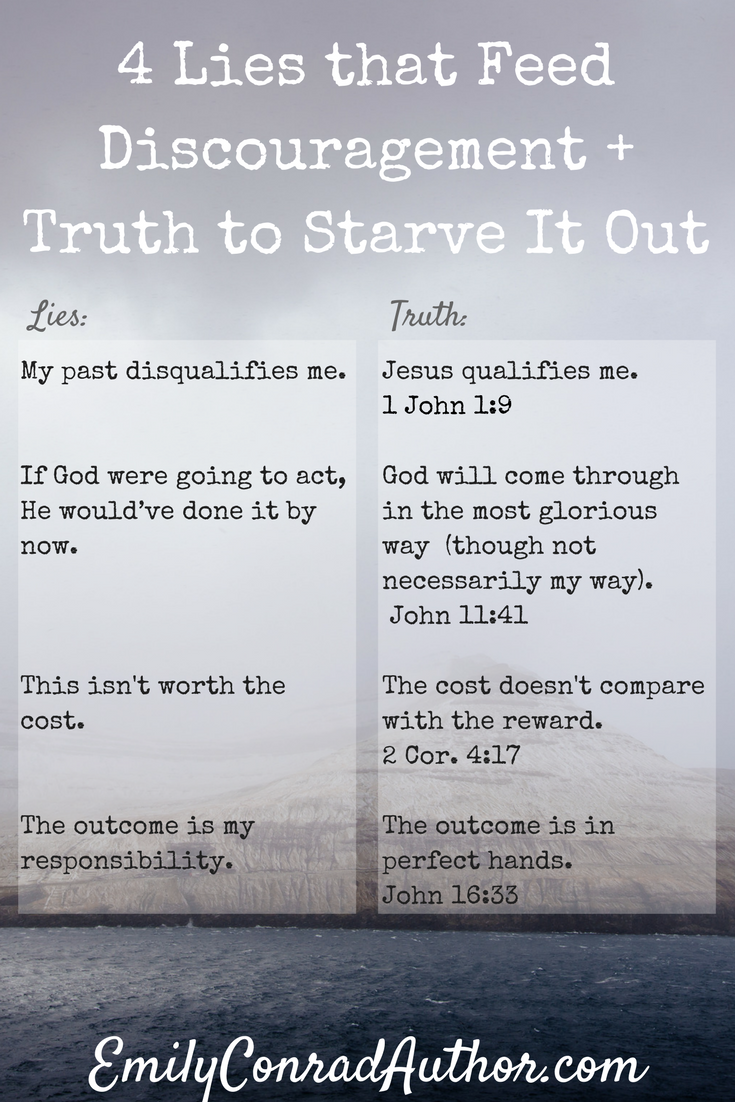
4 Lies that Feed Discouragement + Truth to Starve It Out
by Emily Conrad

When I was dealing with some discouragement a few months ago, one of my friends suggested that discouragement is one of the devil's favorite weapons. I’m inclined to agree. Why else take everything from Job but leave his three “friends” who thought Job had brought calamity on himself and the wife who would suggest he to give up and curse God?
Another reason I believe the devil is entwined with discouragement? When it starts to flourish in my life, lies are feeding it.
But for every lie, Jesus offers life-feeding truth.
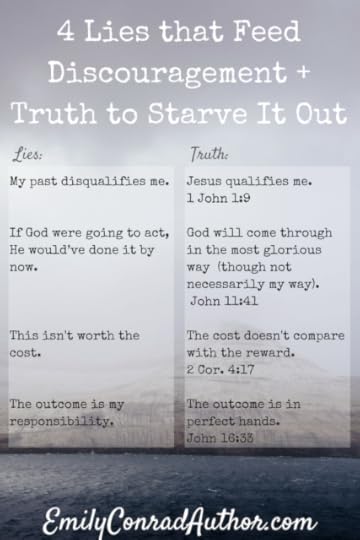
Here are some of the lies I've found feed discouragement and truths to starve it:
Lie 1: My past disqualifies me. Mistakes, sins, and failures can leave us in a pit of shame we can’t seem to escape though we have confessed our sin the way the Bible instructs us to. This shame isn’t from God.
As 1 John 1:9 says, But if we confess our sins, he is faithful and righteous, forgiving us our sins and cleansing us from all unrighteousness. (NET)
He cleanses. He continues to use us. The Bible is full of murderers and adulterers and blundering followers who blew it again and again. Yet God forgave, restored, and used them. If He did it for them, He’ll do it for you.
Truth: Jesus qualifies me.
Lie 2: If God were going to act, He would’ve done it by now. I think of Mary and Martha, sending for Jesus when their brother Lazarus is sick. Imagine their hope. They have a personal relationship with the Messiah, and He loves Lazarus. Surely, He won’t let their brother die. In fact, He promises otherwise in John 11:4: When Jesus heard this, he said, “This sickness will not lead to death, but to God’s glory, so that the Son of God may be glorified through it.” (NET)
But then Jesus delays coming, and Lazarus slips away. Lazarus has been in the grave four days when Jesus arrives, and the sisters struggle with understanding why Jesus didn’t come sooner. Moments before raising Lazarus back to life, Jesus says to Martha words that can encourage us today as we wait for God in situations in our lives: Jesus responded, “Didn’t I tell you that if you believe, you would see the glory of God?” (John 11:41, NET)
Maybe in our lives, this will look the way we hope it will. Maybe it won’t. But whatever the case, when we follow Jesus in belief, we will see the glory of God. This is no trite thing.
Truth: God will come through in the most glorious way.
3. This isn’t worth the cost. When we face rejection, criticism, and setbacks of all kinds, those negatives can discourage us from speaking truth, loving like God loves, and following the Holy Spirit’s prompting. After all, there is sometimes a price to pay for doing the right thing, and we don’t always see the fruit we long for.
Hebrews 12:1-2 says Therefore, since we are surrounded by such a great cloud of witnesses, we must get rid of every weight and the sin that clings so closely, and run with endurance the race set out for us, keeping our eyes fixed on Jesus, the pioneer and perfecter of our faith. For the joy set out for him he endured the cross, disregarding its shame, and has taken his seat at the right hand of the throne of God.
Jesus faced rejection, criticism, and setbacks, too, but deemed it worth the cost in light of eternity. We can do the same. As Paul writes in 2 Corinthians 4:17, For our momentary, light suffering is producing for us an eternal weight of glory far beyond all comparison.
Truth: The cost doesn’t compare with the reward.
4. The outcome is my responsibility. This lie reaches into the past, loading guilt and feelings of inadequacy on our backs because of situations that didn’t turn out the way we’d hoped, even when we weren’t in the wrong. It also reaches into the future, casting fear of failure over tasks we’re called to.
But God doesn’t ask us to be self-sufficient. He asks us to have faith, to believe, and to follow Him.
For example, when Jesus sent the disciples out in Matthew 10, He gave instructions about what to do if “if anyone will not welcome you or listen to your message” (v. 14, NET). If success were guaranteed, he would not have done that nor warned us of other problems we’ll face. What we’re left with then, is to follow Jesus and rest assured God has the outcome.
As Jesus said, “I have told you these things so that in me you may have peace. In the world you have trouble and suffering, but take courage– I have conquered the world.” (John 16:33, NET)
Truth: The outcome is in perfect hands.
Have you noticed any lies feeding discouragement in your life? How do you combat them?
Don't let one of these 4 lies feed your #discouragement! Fight back with #truth! via @novelwritergirl

When I was dealing with some discouragement a few months ago, one of my friends suggested that discouragement is one of the devil's favorite weapons. I’m inclined to agree. Why else take everything from Job but leave his three “friends” who thought Job had brought calamity on himself and the wife who would suggest he to give up and curse God?
Another reason I believe the devil is entwined with discouragement? When it starts to flourish in my life, lies are feeding it.
But for every lie, Jesus offers life-feeding truth.

Here are some of the lies I've found feed discouragement and truths to starve it:
Lie 1: My past disqualifies me. Mistakes, sins, and failures can leave us in a pit of shame we can’t seem to escape though we have confessed our sin the way the Bible instructs us to. This shame isn’t from God.
As 1 John 1:9 says, But if we confess our sins, he is faithful and righteous, forgiving us our sins and cleansing us from all unrighteousness. (NET)
He cleanses. He continues to use us. The Bible is full of murderers and adulterers and blundering followers who blew it again and again. Yet God forgave, restored, and used them. If He did it for them, He’ll do it for you.
Truth: Jesus qualifies me.
Lie 2: If God were going to act, He would’ve done it by now. I think of Mary and Martha, sending for Jesus when their brother Lazarus is sick. Imagine their hope. They have a personal relationship with the Messiah, and He loves Lazarus. Surely, He won’t let their brother die. In fact, He promises otherwise in John 11:4: When Jesus heard this, he said, “This sickness will not lead to death, but to God’s glory, so that the Son of God may be glorified through it.” (NET)
But then Jesus delays coming, and Lazarus slips away. Lazarus has been in the grave four days when Jesus arrives, and the sisters struggle with understanding why Jesus didn’t come sooner. Moments before raising Lazarus back to life, Jesus says to Martha words that can encourage us today as we wait for God in situations in our lives: Jesus responded, “Didn’t I tell you that if you believe, you would see the glory of God?” (John 11:41, NET)
Maybe in our lives, this will look the way we hope it will. Maybe it won’t. But whatever the case, when we follow Jesus in belief, we will see the glory of God. This is no trite thing.
Truth: God will come through in the most glorious way.
3. This isn’t worth the cost. When we face rejection, criticism, and setbacks of all kinds, those negatives can discourage us from speaking truth, loving like God loves, and following the Holy Spirit’s prompting. After all, there is sometimes a price to pay for doing the right thing, and we don’t always see the fruit we long for.
Hebrews 12:1-2 says Therefore, since we are surrounded by such a great cloud of witnesses, we must get rid of every weight and the sin that clings so closely, and run with endurance the race set out for us, keeping our eyes fixed on Jesus, the pioneer and perfecter of our faith. For the joy set out for him he endured the cross, disregarding its shame, and has taken his seat at the right hand of the throne of God.
Jesus faced rejection, criticism, and setbacks, too, but deemed it worth the cost in light of eternity. We can do the same. As Paul writes in 2 Corinthians 4:17, For our momentary, light suffering is producing for us an eternal weight of glory far beyond all comparison.
Truth: The cost doesn’t compare with the reward.
4. The outcome is my responsibility. This lie reaches into the past, loading guilt and feelings of inadequacy on our backs because of situations that didn’t turn out the way we’d hoped, even when we weren’t in the wrong. It also reaches into the future, casting fear of failure over tasks we’re called to.
But God doesn’t ask us to be self-sufficient. He asks us to have faith, to believe, and to follow Him.
For example, when Jesus sent the disciples out in Matthew 10, He gave instructions about what to do if “if anyone will not welcome you or listen to your message” (v. 14, NET). If success were guaranteed, he would not have done that nor warned us of other problems we’ll face. What we’re left with then, is to follow Jesus and rest assured God has the outcome.
As Jesus said, “I have told you these things so that in me you may have peace. In the world you have trouble and suffering, but take courage– I have conquered the world.” (John 16:33, NET)
Truth: The outcome is in perfect hands.
Have you noticed any lies feeding discouragement in your life? How do you combat them?
Don't let one of these 4 lies feed your #discouragement! Fight back with #truth! via @novelwritergirl
March 28, 2017
The Key to Surviving the Wait
by Emily Conrad
The woman laughed quietly, as if embarrassed to have come across a secret. She kept her eyes on the computer screen and said, “The test reports on emotions, too. It says you’re frustrated and unsettled.”
I smiled and agreed. The test, which I had taken to help with my food sensitivities, had seen me in what often felt like an invisible war: the war of waiting. The acknowledgement was a relief I hadn't known I craved.
I had an entire journal dedicated to the topic of waiting, but back then, I didn’t pen many entries. If I had, most probably would've been uneventful. Today, nothing happened.
God is present and good to those who fear Him. He has a purpose in all our waiting. He refines and prepares us, setting us on the slow, right road, the narrow path that leads to the heights. So, when I found myself waiting on that narrow path, I knew I needed to have faith. Since there wasn't much I could do to rush things along anyway, I resigned myself to waiting.
I think a lot of us tend to do this.
Unfortunately, waiting in resignation doesn’t relieve frustration and feelings of being unsettled.
Read more »
The woman laughed quietly, as if embarrassed to have come across a secret. She kept her eyes on the computer screen and said, “The test reports on emotions, too. It says you’re frustrated and unsettled.”
I smiled and agreed. The test, which I had taken to help with my food sensitivities, had seen me in what often felt like an invisible war: the war of waiting. The acknowledgement was a relief I hadn't known I craved.
I had an entire journal dedicated to the topic of waiting, but back then, I didn’t pen many entries. If I had, most probably would've been uneventful. Today, nothing happened.
God is present and good to those who fear Him. He has a purpose in all our waiting. He refines and prepares us, setting us on the slow, right road, the narrow path that leads to the heights. So, when I found myself waiting on that narrow path, I knew I needed to have faith. Since there wasn't much I could do to rush things along anyway, I resigned myself to waiting.
I think a lot of us tend to do this.
Unfortunately, waiting in resignation doesn’t relieve frustration and feelings of being unsettled.
Read more »
March 23, 2017
The Secrets of Birch Bark and Pine Cones
by Emily Conrad

It started with curls of birch bark, littered on the sidewalk like scrolls of ancient paper. The clean lines on the white bark, like the marks of an exact graphite pencil I could read if only I knew the code. The blushing pink, the feel of it in my hand, as if I'd captured a a paper bird mid-flight.
Then came the pine cones. Maybe it was the way the light hit the winding pattern. Perhaps the rich brown revealed when they open, or the green-white scales growing on the tops.
Winter is officially over, the snow has receded, and what lay underneath for so long has been revealed. The world we live in is an unparalleled work of art that sings of its Creator.
As I've been walking around my neighborhood, noticing scraps of birch and ice and pine and moss with spring-hungry eyes, I've begun to listen more closely to that song.
Spring, my favorite season, leads me to consider how much greater of an artist God is than any human.

If I tell you there's a vase of daffodils next to my laptop, with a few words, I have glossed over galaxies of details God has imbued. I've failed to mention the way the light shines through one extended petal, the scent which has grown stronger the more the flowers age, the popping yellow color, the sheen of the texture, the tiny gray lines, either veins or fold marks. And still, there's more.
Words fail.
Pictures, do, too. When an artist paints, they don't paint each of these details. Often, a smudge conveys a flower petal, a splotch a tree. And even the most beautiful photograph can't capture scent or warmth. We can't walk through it and see each little detail present in the original landscape.
When artists of any kind try to replicate the real world in our work, we can't help but simplify His complex artistry.



The fact that God's work is so complex, however, tells us He is different. All things are in His focus. Each moment, each detail. Rocks, moss, pine cones, birch bark, dripping sap, all speckled with intricate detail crafted by a God big enough to create and sustain.
The God who went to such lengths in creation tends to the needs of sparrows and grass. And He who clothes these flitting, fleeting things in gowns of detail and provision, tends to our needs, as well.
The next time you notice tulips pushing up through the mulch or the earthy scent of damp ground or the way sunshine lends warmth even when the air is cold, let these serve as a reminder that you are not alone. You have not been left to fend for yourself. You have not fallen beneath the notice of the good and loving God who is reaching out to reconcile you with Himself.
No detail is left unattended. No scrap of dirt, no moment of your life is haphazard or carelessly placed. When we follow Jesus, we follow a God who cares about the details. Nothing is outside His focus. All things are held together in Him.
He will never leave you or forsake you. Jesus will never fill in a spot of your life with a smudge instead of intricate, loving detail.
Jesus will never fill in your life with a smudge instead of intricate, loving detail via @novelwritergirl

It started with curls of birch bark, littered on the sidewalk like scrolls of ancient paper. The clean lines on the white bark, like the marks of an exact graphite pencil I could read if only I knew the code. The blushing pink, the feel of it in my hand, as if I'd captured a a paper bird mid-flight.
Then came the pine cones. Maybe it was the way the light hit the winding pattern. Perhaps the rich brown revealed when they open, or the green-white scales growing on the tops.
Winter is officially over, the snow has receded, and what lay underneath for so long has been revealed. The world we live in is an unparalleled work of art that sings of its Creator.
As I've been walking around my neighborhood, noticing scraps of birch and ice and pine and moss with spring-hungry eyes, I've begun to listen more closely to that song.
Spring, my favorite season, leads me to consider how much greater of an artist God is than any human.

If I tell you there's a vase of daffodils next to my laptop, with a few words, I have glossed over galaxies of details God has imbued. I've failed to mention the way the light shines through one extended petal, the scent which has grown stronger the more the flowers age, the popping yellow color, the sheen of the texture, the tiny gray lines, either veins or fold marks. And still, there's more.
Words fail.
Pictures, do, too. When an artist paints, they don't paint each of these details. Often, a smudge conveys a flower petal, a splotch a tree. And even the most beautiful photograph can't capture scent or warmth. We can't walk through it and see each little detail present in the original landscape.
When artists of any kind try to replicate the real world in our work, we can't help but simplify His complex artistry.



The fact that God's work is so complex, however, tells us He is different. All things are in His focus. Each moment, each detail. Rocks, moss, pine cones, birch bark, dripping sap, all speckled with intricate detail crafted by a God big enough to create and sustain.
The God who went to such lengths in creation tends to the needs of sparrows and grass. And He who clothes these flitting, fleeting things in gowns of detail and provision, tends to our needs, as well.
The next time you notice tulips pushing up through the mulch or the earthy scent of damp ground or the way sunshine lends warmth even when the air is cold, let these serve as a reminder that you are not alone. You have not been left to fend for yourself. You have not fallen beneath the notice of the good and loving God who is reaching out to reconcile you with Himself.
No detail is left unattended. No scrap of dirt, no moment of your life is haphazard or carelessly placed. When we follow Jesus, we follow a God who cares about the details. Nothing is outside His focus. All things are held together in Him.
He will never leave you or forsake you. Jesus will never fill in a spot of your life with a smudge instead of intricate, loving detail.
Jesus will never fill in your life with a smudge instead of intricate, loving detail via @novelwritergirl
March 19, 2017
The Dream that Used to Seem Impossible
by Emily Conrad

I’m married to my high school boyfriend, the only man I ever dated. I went to college in my hometown. Even now, at age 33, I live half a mile from my childhood home.
I’m either content with my lot in life, or I’m the queen of avoiding change. So the important part of my new beginning isn’t what happened after I started over, but rather how God turned me from the natural course of my life to the wholehearted pursuit of a dream He gave me long ago.
That dream was writing. I fell in love with crafting stories as a child, and I went to college expecting to never use my degree. My plan was to work part-time and spend the majority of my energy on penning novels.
When I first veered from that plan, it was out of necessity. Having married young, I needed to put my husband through school. In 2005, true to my change-resistant ways, I applied for a full-time position at the company where I already worked part-time.
A couple of years later, my husband finished his degree and began his career. Though I sometimes fantasized about quitting to write more, the hours had become habit, and the income made life easier. I kept my day job.
I was comfortable until God jolted me out of my routine, starting in 2012 with a broken wrist.
To find out what events that set in motion, follow me over to my post in the Begin Again series on Cisneros Café! I'm so excited to be a part of this beautiful series. While you're over there, be sure to check out the other posts.
P.S. This replaces my normal Tuesday post, so I'll see you all on Thursday. Praying that God meets you this week with renewal and new beginnings only possible by His supernatural power.
The #Dream that Used to Seem Impossible by @novelwritergirl part of the #BeginAgain series on @CisnerosCafe

I’m married to my high school boyfriend, the only man I ever dated. I went to college in my hometown. Even now, at age 33, I live half a mile from my childhood home.
I’m either content with my lot in life, or I’m the queen of avoiding change. So the important part of my new beginning isn’t what happened after I started over, but rather how God turned me from the natural course of my life to the wholehearted pursuit of a dream He gave me long ago.
That dream was writing. I fell in love with crafting stories as a child, and I went to college expecting to never use my degree. My plan was to work part-time and spend the majority of my energy on penning novels.
When I first veered from that plan, it was out of necessity. Having married young, I needed to put my husband through school. In 2005, true to my change-resistant ways, I applied for a full-time position at the company where I already worked part-time.
A couple of years later, my husband finished his degree and began his career. Though I sometimes fantasized about quitting to write more, the hours had become habit, and the income made life easier. I kept my day job.
I was comfortable until God jolted me out of my routine, starting in 2012 with a broken wrist.
To find out what events that set in motion, follow me over to my post in the Begin Again series on Cisneros Café! I'm so excited to be a part of this beautiful series. While you're over there, be sure to check out the other posts.
P.S. This replaces my normal Tuesday post, so I'll see you all on Thursday. Praying that God meets you this week with renewal and new beginnings only possible by His supernatural power.
The #Dream that Used to Seem Impossible by @novelwritergirl part of the #BeginAgain series on @CisnerosCafe
March 16, 2017
When the Journey Is Too Much For You
by Emily Conrad

I am familiar with discouragement. Just ask my friends.
Actually, please don’t. Just take my word for it that I have a tidy little list of things that aren’t going my way, and at times, it overwhelms me. The list says I am inadequate, alone, left to fend for myself in a world beyond my power to control.
In this kind of desperation, I want to run to God, but what will He say to me?
Something about my upbringing or my perfectionist heart insists that He will tell me to buck up, get back to work, do more, and do it with a better attitude. Having faith and living for eternity, when merged with my German stoicism and good girl mentality, translates to a kind of faith that insists I fake it until I make it.
I tend to think there’s Biblical basis for this belief even as I’m a desperate for a different response from the One I’m told is my Father, the Lover of my Soul, my Redeemer.

In a time like this, I remembered that a prophet once ran through the wilderness to meet with God in the midst of discouragement. I didn’t remember which prophet it was, or where to find the account of his journey, so I paged through the Old Testament to find out what happened, how this off-course, desperate prophet was received by his God.
The prophet is Elijah, and immediately, I was forced to admit my life is nowhere near as dramatic as his. My highs don’t involve successfully asking God to send down fire from heaven. My lows don’t involve queens threatening my life. I’ve never made my bed in the desert and asked to die in my discouragement. But this is where we find Elijah in 1 Kings 19, on his way to meet with God.
After asking to die, Elijah lies down and sleeps. He’s woken by an angel who says, “Arise and eat, for the journey is too great for you.” (1 Kings 19:7b, ESV)
The journey is too great for you.
I nod along. It’s too great for me, too. I long to join Elijah on this run to God, but still, I don’t know how an exhausted, discouraged servant will be received.
Elijah has a death wish anyway, so maybe this isn't a concern for him. Or maybe he knows something about God that I sometimes doubt. Either way, he completes the journey and arrives at Mount Horeb (aka Mount Sinai, where God met with Moses).
God greets him with a question. “Why are you here, Elijah?” (1 Kings 19:9c, NET)
God had provided the nourishment Elijah had needed to complete this journey, so Elijah’s presence is clearly no surprise to Him. Not that anything ever is a surprise to God, which means God knew full well why Elijah had come. So, in asking this question this way, God did two things that give me hope:
He gave Elijah the opportunity to pour it all out.
He subtly reminded his servant that He knows him by name.
As I read this, I feel God doing the same for me. For you.
Why have you come, beloved? Tell me all about it.

Elijah rattles off his list of worries. You can read it in verse 10, but it goes something like this: I love You, and I hate to see You disrespected, but that’s all the people around me do. They tear down and kill. I’m alone, and I’m afraid.
God doesn’t interrupt. Instead, after listening, He responds in the most extraordinary way. He passes by. This is the beautiful passage where we hear of winds tearing the mountains and an earthquake shaking the ground and a fire appearing—but God isn’t in the wind or the quaking or the fire. God is in the whisper that follows.
In this context, I imagine God repeating His question in the most tender whisper, “What are you doing here, Elijah?”
Emily, why have you come?
Elijah repeats his list. Did he miss the wonder of the God of the universe calling him by name? Did God passing by, revealing Himself in such amazing ways, not knock all the fear and worry and self-pity right out of this guy?
Apparently not, and I can’t claim I would’ve behaved any differently. I think of the list of my concerns that I’ve repeated to friends, practically word for word each time. And I’ve repeated it to God, too. Does He have patience for this kind of thing, or is He ready to kick us out?
Praise God, He lavishes mercy and grace on His children.
After hearing that list through again, God gives Elijah instructions. Yes, those instructions do send Elijah back to work, but they also provide guidance to call a new prophet who would assist Elijah. And a reminder that Elijah isn’t alone. There are thousands who have been faithful.
Can you imagine the relief? God met Elijah’s great needs along this journey that was too much for him. God met with Elijah, who ran to Him. God listened. God appeared. God gave direction. God gave help.
Join me in running, won’t you? Our Father will not refuse us. We can head for the spiritual hills knowing we will not be sent away empty. We are invited to get away and meet with our God. We are His children, whom He loves.
We cannot muscle right attitudes into existence by maintaining a stiff upper lip. This is not a fake it until you make it kind of religion. This is a relationship where we bring our struggles to our God and allow Him to do the impossible in our hearts. He alone can take us from our lists of worries to renewed faith in His goodness and power.
Why have you come, Emily?
The journey is too great for me. But You, God, are greater. Renew my perspective. Give me direction. Change my heart to match Yours.
#Encouragement for when the journey is too much for you via @novelwritergirl

I am familiar with discouragement. Just ask my friends.
Actually, please don’t. Just take my word for it that I have a tidy little list of things that aren’t going my way, and at times, it overwhelms me. The list says I am inadequate, alone, left to fend for myself in a world beyond my power to control.
In this kind of desperation, I want to run to God, but what will He say to me?
Something about my upbringing or my perfectionist heart insists that He will tell me to buck up, get back to work, do more, and do it with a better attitude. Having faith and living for eternity, when merged with my German stoicism and good girl mentality, translates to a kind of faith that insists I fake it until I make it.
I tend to think there’s Biblical basis for this belief even as I’m a desperate for a different response from the One I’m told is my Father, the Lover of my Soul, my Redeemer.

In a time like this, I remembered that a prophet once ran through the wilderness to meet with God in the midst of discouragement. I didn’t remember which prophet it was, or where to find the account of his journey, so I paged through the Old Testament to find out what happened, how this off-course, desperate prophet was received by his God.
The prophet is Elijah, and immediately, I was forced to admit my life is nowhere near as dramatic as his. My highs don’t involve successfully asking God to send down fire from heaven. My lows don’t involve queens threatening my life. I’ve never made my bed in the desert and asked to die in my discouragement. But this is where we find Elijah in 1 Kings 19, on his way to meet with God.
After asking to die, Elijah lies down and sleeps. He’s woken by an angel who says, “Arise and eat, for the journey is too great for you.” (1 Kings 19:7b, ESV)
The journey is too great for you.
I nod along. It’s too great for me, too. I long to join Elijah on this run to God, but still, I don’t know how an exhausted, discouraged servant will be received.
Elijah has a death wish anyway, so maybe this isn't a concern for him. Or maybe he knows something about God that I sometimes doubt. Either way, he completes the journey and arrives at Mount Horeb (aka Mount Sinai, where God met with Moses).
God greets him with a question. “Why are you here, Elijah?” (1 Kings 19:9c, NET)
God had provided the nourishment Elijah had needed to complete this journey, so Elijah’s presence is clearly no surprise to Him. Not that anything ever is a surprise to God, which means God knew full well why Elijah had come. So, in asking this question this way, God did two things that give me hope:
He gave Elijah the opportunity to pour it all out.
He subtly reminded his servant that He knows him by name.
As I read this, I feel God doing the same for me. For you.
Why have you come, beloved? Tell me all about it.

Elijah rattles off his list of worries. You can read it in verse 10, but it goes something like this: I love You, and I hate to see You disrespected, but that’s all the people around me do. They tear down and kill. I’m alone, and I’m afraid.
God doesn’t interrupt. Instead, after listening, He responds in the most extraordinary way. He passes by. This is the beautiful passage where we hear of winds tearing the mountains and an earthquake shaking the ground and a fire appearing—but God isn’t in the wind or the quaking or the fire. God is in the whisper that follows.
In this context, I imagine God repeating His question in the most tender whisper, “What are you doing here, Elijah?”
Emily, why have you come?
Elijah repeats his list. Did he miss the wonder of the God of the universe calling him by name? Did God passing by, revealing Himself in such amazing ways, not knock all the fear and worry and self-pity right out of this guy?
Apparently not, and I can’t claim I would’ve behaved any differently. I think of the list of my concerns that I’ve repeated to friends, practically word for word each time. And I’ve repeated it to God, too. Does He have patience for this kind of thing, or is He ready to kick us out?
Praise God, He lavishes mercy and grace on His children.
After hearing that list through again, God gives Elijah instructions. Yes, those instructions do send Elijah back to work, but they also provide guidance to call a new prophet who would assist Elijah. And a reminder that Elijah isn’t alone. There are thousands who have been faithful.
Can you imagine the relief? God met Elijah’s great needs along this journey that was too much for him. God met with Elijah, who ran to Him. God listened. God appeared. God gave direction. God gave help.
Join me in running, won’t you? Our Father will not refuse us. We can head for the spiritual hills knowing we will not be sent away empty. We are invited to get away and meet with our God. We are His children, whom He loves.
We cannot muscle right attitudes into existence by maintaining a stiff upper lip. This is not a fake it until you make it kind of religion. This is a relationship where we bring our struggles to our God and allow Him to do the impossible in our hearts. He alone can take us from our lists of worries to renewed faith in His goodness and power.
Why have you come, Emily?
The journey is too great for me. But You, God, are greater. Renew my perspective. Give me direction. Change my heart to match Yours.
#Encouragement for when the journey is too much for you via @novelwritergirl
March 14, 2017
Escaping Distraction to Find All My Needs Already Met
by Emily Conrad

I'm sitting here, wasting time. Everyone is quiet, but my mind isn't having it. Like a ping pong ball, it refuses to hit and land. What do I expect to miss by focusing instead of constantly checking my social media, email, and blog stats?
I am not my best self and I think it's partly due to not maintaining the slower, reflective practices of reading for pleasure and writing fiction for long periods. Instead, I blog and bounce around from email to website improvements to Facebook, Instagram, and Pinterest, and in so doing, I've trained my brain not to settle in and create.
Sitting to scribble this down is a challenge in itself. But now that I've been here a minute, it gets easier.
I try breathing like I believe I need the air.
Ironically, this glimpse into an old journal entry ends there, abruptly. Something distracted me after I'd written less than a page.
What was I afraid I'd miss? The first moment when I would receive empirical proof of my significance in the form of likes, shares, and emails. The fact that those can never be enough to satisfy can whip me into a frenzy of checking and rechecking, just waiting for events to turn and for my worth to finally be a fact tallied for all to see.
This is a poisonous way to live.
As last month's series on God's love was meant to convey, our need to be seen, known, and loved is met perfectly in God through Jesus Christ. Our worth is there, regardless of how many people like our posts on social media, regardless of how many friends text throughout the day, regardless of how many invitations we get for any particular weekend.

Because Jesus supplies for my most basic needs each moment of each day whether I am conscious of that or not, I'm free to be calm. To breathe like I need the air. To see how God is already meeting my needs, and abundantly so I don't even have to pause to think about them. To live like I already have all the love I need, because I do.
Life becomes simpler. I can cut the distractions that would have me scrambling to fulfill needs that can only be (and have already been) met in Jesus. I'm free to feed my creative mind with reading and reflection, with prayer and meaningful connections. I can relearn to focus.

And focus does take practice.
If I've been mentally hopscotching for too long, it takes determination to write just a half page in my journal. It takes a really good book to distract me from distraction. These are worth the effort. Dedicating my mind to one pursuit for longer and longer periods of time becomes easier each time I push myself to do it.
With practice, I can pray like I need the relationship, relate with friends like I need the connection, read like I need the words, and write like I need the purpose. Because I do. Just like I need the air God breathes into my lungs.
How do you slow down and put the focus on the things that matter?
I try breathing like I believe I need the air. via @novelwritergirl #focus #givemeJesus

I'm sitting here, wasting time. Everyone is quiet, but my mind isn't having it. Like a ping pong ball, it refuses to hit and land. What do I expect to miss by focusing instead of constantly checking my social media, email, and blog stats?
I am not my best self and I think it's partly due to not maintaining the slower, reflective practices of reading for pleasure and writing fiction for long periods. Instead, I blog and bounce around from email to website improvements to Facebook, Instagram, and Pinterest, and in so doing, I've trained my brain not to settle in and create.
Sitting to scribble this down is a challenge in itself. But now that I've been here a minute, it gets easier.
I try breathing like I believe I need the air.
Ironically, this glimpse into an old journal entry ends there, abruptly. Something distracted me after I'd written less than a page.
What was I afraid I'd miss? The first moment when I would receive empirical proof of my significance in the form of likes, shares, and emails. The fact that those can never be enough to satisfy can whip me into a frenzy of checking and rechecking, just waiting for events to turn and for my worth to finally be a fact tallied for all to see.
This is a poisonous way to live.
As last month's series on God's love was meant to convey, our need to be seen, known, and loved is met perfectly in God through Jesus Christ. Our worth is there, regardless of how many people like our posts on social media, regardless of how many friends text throughout the day, regardless of how many invitations we get for any particular weekend.

Because Jesus supplies for my most basic needs each moment of each day whether I am conscious of that or not, I'm free to be calm. To breathe like I need the air. To see how God is already meeting my needs, and abundantly so I don't even have to pause to think about them. To live like I already have all the love I need, because I do.
Life becomes simpler. I can cut the distractions that would have me scrambling to fulfill needs that can only be (and have already been) met in Jesus. I'm free to feed my creative mind with reading and reflection, with prayer and meaningful connections. I can relearn to focus.

And focus does take practice.
If I've been mentally hopscotching for too long, it takes determination to write just a half page in my journal. It takes a really good book to distract me from distraction. These are worth the effort. Dedicating my mind to one pursuit for longer and longer periods of time becomes easier each time I push myself to do it.
With practice, I can pray like I need the relationship, relate with friends like I need the connection, read like I need the words, and write like I need the purpose. Because I do. Just like I need the air God breathes into my lungs.
How do you slow down and put the focus on the things that matter?
I try breathing like I believe I need the air. via @novelwritergirl #focus #givemeJesus


