
Connie Willis's Blog
November 28, 2025
THANKSGIVING POST
Dear Everybody:
It’s Thanksgiving Day! And, as Robert Louis Stevenson pointed out, “The world is so full of a number of things, I’m sure we should all be as happy as kings.”
Things I’m thankful for (besides the obvious like friends and family):
–Shakespeare
–Jane Austen
–Heather Cox Richardson
–the Hampton Court maze
–spring
–fall
–capers (the food)
–cats–especially Jenny and her dear departed sister Claudia
–cocoa in front of the fireplace
–counted cross-stitch
–GKChesterton
–chocolate-covered orange peel
–romantic comedies
–lilacs
–London
–Oxford
–fairy lights
–waterfalls
–P.G. Wodehouse
–Primeval
–Dorothy Sayers
–the movie Dreamchild
–Agatha Christie
–bulldogs–in particular, my bulldog Bunter and all the bulldogs who came before him–Kutuzov and Montmorency and Grace and Bertie and Smudge
–thunderstorms
–Jerome K. Jerome’s THREE MEN IN A BOAT
–rainbows
–bacon
–moon jellyfish
–The Fairy Glen just outside Betys-e-Coed, an enchanted place that makes you believe in fairies
–fireflies
–Casablanca
–crumpets
–snow outside your window
–Monty Python
–Seth Meyers
–TWELFTH NIGHT
–laburnum arbors
–Abraham Lincoln
–clouds, from puffy piles of cumulus clouds to majestic thunderheads
–St. Paul’s Cathedral
–kittens
–P.G. Wodehouse
–Abraham Lincoln
–Lenora Mattingly Weber’s BEANY MALONE books
–the hot pool at Glenwood Springs, where you sit on the stone steps and watch the steam rise
–Heinlein’s HAVE SPACE SUIT, WILL TRAVEL
–cotton candy
–Tolkien’s LORD OF THE RINGS
–Emma Thompson
–L.M. Montgomery’s ANNE OF GREEN GABLES books
–the Welsh rabbit at Fortnum and Mason’s
–mojitos
–STAR WARS
–Harrison Ford
–Mark Hamill, who has turned out to be just like Luke Skywalker
–George Takei
–sangria
–scones with clotted cream and jam
–Mueller She Wrote
–mojitos
–Rachel Maddow
–Yeats’s “The Song of Wandering Aengus”
–Walter Lord’s A NIGHT TO REMEMBER
–Harry Belafonte
–Tennyson’s poem, “The Lady of Shalott” and Waterhouse’s painting of the same name
–Christmas carols
–church choirs
–Cary Grant
–crossword puzzles
–aspens
–the smell of fresh cut hay
–John Rutter’s cantata, “Requiem”
–Bud and Travis
–the Pirates of the Caribbean movies
–and Norah Ephron, who said about Thanksgiving: “I have a fairly serious theory about Thanksgiving dinner, and it’s this: don’t mess with it. What most people make for Thanksgiving dinner is what their mothers made, and you stray from this at your peril. “And so, Thanksgiving. It’s the most amazing holiday. Just think about it–it’s a miracle that once a year so many millions of Americans sit down to exactly the same meal as one another, exactly the same meal they grew up eating, and exactly the same meal they ate a year earlier. The turkey. The sweet potatoes. The stuffing. The pumpkin pie. Is there anything else we all can agree so vehemently about? I don’t think so.”
Finally, this is one of my favorite poems, and one that I think is especially appropriate for Thanksgiving Day and for the times we’re in:
SOMETIMES by Sheenan Pugh
Sometimes things don’t go, after all, from bad to worse.
Some years, muscadel faces down frost, green thrives; the crops don’t fail.
Sometimes a man aims high, and all goes well.
A people will sometimes step back from war, elect an honest man,
decide they care enough that they can’t leave some stranger poor.
Some men become what they were born for.
Sometimes our best intentions do not go amiss; sometimes we do as we meant ti.
The sun will sometimes melt a field of sorrow that seemed hard frozen;
May it happen for you.
Keep calm and carry on,
and Happy Thanksgiving!
Connie Willis
[image from ABC News]


Quick News Roundup
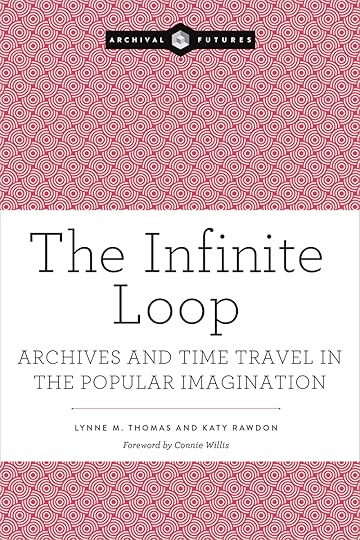 Something a little different, now available for pre-order. Connie Willis has written a forward for the book “The Infinite Loop: Archives and Time Travel in the Popular Imagination“, edited by Lynne M. Thomas and Katy Rawdon. Lynne co-founded Uncanny Magazine and Katy Rawdon has written romance novels and other genre fiction. Both are fans that are also librarians for special collections.
“Spanning H. G. Wells’s The Time Machine to Marvel’s Loki, this delightful book considers how science fiction stories portray archives and archivists, analyzes the ways in which these portrayals affect readers’ views, and shows how archivists can leverage these insights to improve the public’s understanding of the discipline.”
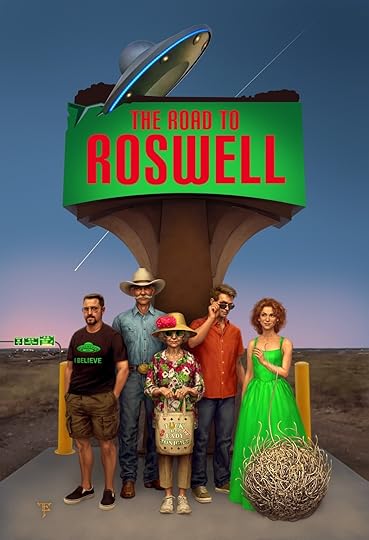
Subterranean Press has revealed the cover art for their limited edition of Road to Roswell. Art is by Tristan Elwell. Likely to be released sometime in 2026.
Greeley Arts Legacy – Connie Willis
From Greeley Arts Legacy:
Each of our Hall of Fame inductees – currently numbering 24 in total – has a tribute video personally created by the Greeley Arts Legacy for the recipient, giving an incredibly informative and heartfelt story centering on the honoree, highlighting significant contributions, and creating a morable testimonial of a life of Legacy lived. Enjoy!
Allow us to present Connie Willis – a local hero, humble celebrity, and an inspirational, world-renowned author – who has for nearly her entire life, called Greeley…HOME. Although she’s now forever in our “Hall,” she continues to author her legacy…
All things video creation & narration: Kevin Johnston & Noel Johnston
“OUR STATE FAIR IS THE BEST STATE FAIR IN OUR STATE…”
“OUR STATE FAIR IS THE BEST STATE FAIR IN OUR STATE…”
Rodgers and Hammerstein
This last couple of months 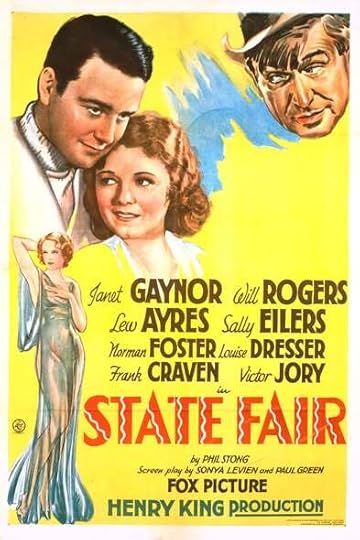 has been State Fair season, which for me means I get to do two of my favorite things–find out what bizarre and dreadful foods are new at the fair this year and watch the movie STATE FAIR. I love state fairs, with their hog pavilions and midways and home-made quilts and flower-arranging competitions and life-size butter sculptures.
The tradition of having a life-sized cow sculptured out of butter originated at the Iowa State Fair in 1911 and spread to other dairy-producing states. The most famous butter cow is at the Wisconsin State fair and is made out of 600 pounds of butter, but the Ohio State Fair holds the record for the largest butter sculpture exhibit, made with 2000 pounds of butter and featuring a cow AND her calf. Other fairs have branched out, with butter sculptures of everything from Mt. Rushmore to Marilyn Monroe, Harley-Davidson motorcycles, Bruce Springsteen, and the characters from The Wizard of Oz and Toy Story, all done in butter and kept at 40 degrees Fahrenheit in refrigerated display pavilions.
There are other oddities, too, things that you can’t find anywhere but at a state fair–pig races and largest pumpkin competitions and camel rides and spitting contests and art shows featuring pictures made entirely out of corn, wheat, and barley seeds. And of course there’s that other art form: state fair food.
The food you find at state fairs–and ONLY at state fairs–is a breed apart. It includes, along with the popcorn and caramel apples and sno-cones that you would expect, delicacies like funnel cakes and lemonade and turkey legs and ribbon fries (a potato cut into a single long, spiraling potato chip that fills an entire plate which is then, of course, fried in a deep fat fryer. Because, except for the “all the milk you can drink” dairy stand at the Minnesota State Fair, state fairs are not big on health foods. Sweet and calorie-laden and deep-fat-fried are the order of the day.
State fairs have a long, proud history of introducing new foods. Ice cream cones made their first appearance at a state fair, and so did cotton candy (originally called fairy floss) and the cream puff made its debut at the Wisconsin State Fair in 1924. And every year they try to outdo themselves with new and bizarre foods, like Krispy Kreme burgers (hamburgers and all the fixings on a Krispy Kreme donut instead of a bun) and deep-fried Oreos and roast corn on a stick.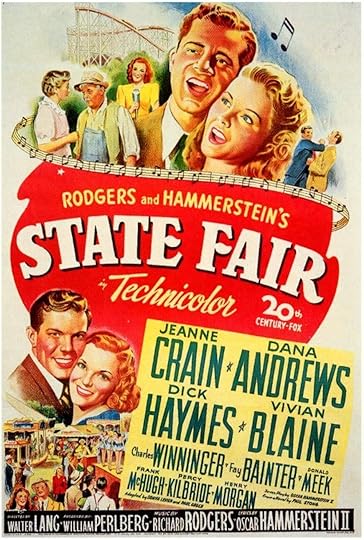
Stuff on a stick seems to be a common theme–corn dogs and pork chops and roast-corn-on-a-stick. There doesn’t seem to be anything they won’t put on a stick at the fair–candied apples, pork chops, chocolate-covered bananas, even chocolate-covered bacon. The on-a-stick thing actually makes sense when you’re walking around looking at the pigs and the butter sculptures and the quilts and the flower arranging, though it is definitely possible to carry it too far, as in, for instance, ranch-dressing-on-a-stick (don’t ask,) breakfast-pn-a-stick (skewered scrambled eggs and sausage wrapped in a pancake,) and sangria-on-a-stick, which is really just an alcoholic popsicle. My personal favorite, though, has to be “hot dish on a stick,” which combines both the best and worst aspects of state fairs and Lake Woebegone.
The other major theme for food at a fair is “deep-fat-fried”–deep-fried Twinkies and deep-fried s’mores and and deep-fried ice cream and deep-fried Snickers bars (a huge disappointment–it just tastes like a very gooey chocolate chip cookie) and deep-fried Pop-Tarts, deep-fried olives, deep-fried alligator bites, deep-fried Coca-Cola (made by freezing Coke into balls and dipping them in batter), and even deep-fried butter. And of course foods that combine both, like the deep-fat-fried pineapple upside down cake on a stick.
The new foods this year included chicken parmesan on a stick, hot beef sundaes (no, I am not making this up,) and soft-serve raspberry beer. A recurring theme seemed to be pickles, for some reason–pickle pretzels, pickle lemonade, pickle pizza, pickle beer, pickle fudge, pickle beef jerky, and fried pickles on a stick–all of which sounded really terrible.
There’s also the food of the fair itself, foods that are made by the local people and brought to be judged: the pies and pickles and canned peaches and jellies and jams and piccalilli–and of course the mincemeat.
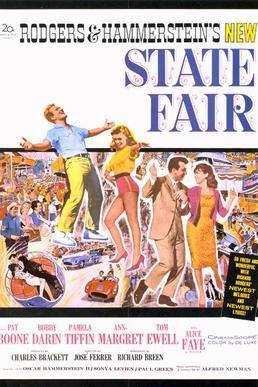 Which brings us to the movie–or rather, movies–STATE FAIR. There are three of them–the 1933 Will Rogers and Janet Gaynor movie, the 1945 musical based on it, and the 1962 re-remake of the musical with Pat Boone and Ann-Margret. The 1932 novel on which all three movies are based, STATE FAIR, by Philip Stong, is much darker and more cynical than any of the movies made from it. It saw the state fair, with its swindlers and floozies and fast-talkers as a symbol of the urban life that was then intruding on rural life in America–and not necessarily in a good way. (Note: I read the novel after seeing the 1933 and 1945 movies, and I liked the movies much better.)
The story in all three movie versions is basically the same–after a family friend makes a bet with Abel Frake that Frake’s prize hog Blue Boy won’t win the blue ribbon at the fair, and even if he does, something bad might happen to one of the family, and besides, no good will come from going to the fair, the Frake family sets off for the state fair, where the son, Wayne, is determined to avenge himself on the carnival barker who swindled him the year before and determined to show he’s not a sucker (and who ends up being an even bigger one when he falls for someone who works at the fair), where Margie longs for something different and romantic to happen to her, and where mother Melissa hopes her mincemeat wins first prize.
That may not sound like much–it’s said that when Rodgers and Hammerstein were first approached about the project, they thought the premise was too slim–“It’s basically about a man who makes a five-dollar bet with a friend”–but the 1933 movie was a huge hit, and so was the 1945 musical, and it’s easy to see why. The movie’s charming and fun and has people (and pigs) you really care about. It also has Will Rogers, who was born to play the part of Abel Frake and who is worth the price of admission all by himself, but everybody else is great, too, especially Janet Gaynor, who plays Margie. She’s perfect as the sweet, innocent daughter who charms the jaded reporter. The script is great, too, with a far more optimistic ending than the book’s, and there are games of chance, candied apples (on a stick), roller coaster rides, and everything else you’d expect to see at a state fair.
The 1945 musical version has the music of Rodgers and Hammerstein, which means there are classics like “It’s a Grand Night for Singing” and “I’d Say that I Had Spring Fever.” Charles Winninger and Fay Bainter play the parents, and they’re very funny, but probably the best person in the cast is Vivian Blaine, who plays the singer Wayne falls in love with. (If you don’t recognize the name, she went on to play the immortal Adelaide in GUYS AND DOLLS, who had developed a cold because Nathan Detroit wouldn’t marry her.) Also wonderful is Frank McHugh, who plays the song-pusher who lays the situation all out for Wayne and then takes him out to get drunk. Jeanne Crain, who plays Margy, is very good, too, though she can’t sing a note. Her singing was dubbed, which was fine, except that after STATE FAIR, all she was offered was musical roles, and they finally had to put the singer who dubbed her (Louanne Hogan) under contract just to do Jeanne Crain’s movies
.
Interestingly, unlike all the other Rodgers and Hammerstein movies, STATE FAIR didn’t start out as a Broadway musical which then got made into a movie. It was written directly for the screen–and THEN it became a musical. It premiered on Broadway in 1969, well after all three movie versions, and has gone on to be performed almost constantly by high-school and community theater groups.
The 1962 STATE FAIR is a mess (I rank the movies as #1–the 1948 version, #2–the Will Rogers version, and #3–this one a distant third.) They’re trying to be cool when the subject is anything but, so they stick in a steamy number of Ann-Margret, have Wayne be a race-car driver instead of a rube, and take a boys-will-be-boys attitude to sex that was awful even back then. But there are a few good things in it–Tom Ewell, the guy in THE SEVEN YEAR ITCH who got to see Marilyn Monroe’s white pleated skirt billow up as she stood on the sidewalk grate, is the father, and his wife is Alice Faye, who was a big singing star and precursor to Betty Grable in the thirties, and they both act circles over the younger generation. Especially Pamela Tiffin, who plays Margy and who was being groomed to be “the new Audrey Hepburn,” except that she can’t act at all. Or sing (she was dubbed, too.) Or do anything, really, except stand around looking pretty. You won’t realize just how bad she is until you see Janet Gaynor in the same role.
In all three movies, the best parts are the story of the hog Blue Boy–will he win the blue ribbon? Will he find happiness with his true love, a redheaded sow named Esmeralda (Zsa Zsa in the 1962 movie–which may be the best romance of the three in the movie. Or four, if you count the comfortable, charming romance of the long-married parents. And the mincemeat. And the fair itself. (In the first two STATE FAIRs, it’s the Iowa State Fair, and in the third they’ve moved it to Texas. ) And the tension of whether Abel Frake will win his bet, which underlies the whole story.
Finally, some fun facts about the movies:
–The crooked barker in the 1933 version is played by a menacing Victor Jorre, who played Oberon in the 1935 Max Reinhardt production of A MIDSUMMER NIGHT’S DREAM and was magnificent and other-worldly as the fairy king. (If you’ve never seen that movie, you definitely should. It’s magical.)
–In the 1945 version, the barker is played by Harry Morgan, who went on to play Colonel Potter in the TV series, MASH. There’s an episode where the medical team, desperate for entertainment, hears that the movie THE MOON IS BLUE is racy–it actually wasn’t all that racy, but at the time it was controversial for being the first movie to have ever said the word “virgin” on-screen–but anyway, they requisition the movie for their unit–and get STATE FAIR instead–and Harry Morgan–for a very clever inside joke.
–Rodgers and Hammerstein wrote the first song in the movie, which is all about spring, and then realized that NO state fairs take place in the spring. So they had to rewrite the lyrics to say that “It Might As Well Be Spring.”
–The prize-winning Hampshire boar who plays Blue Boy in the 1933 movie was the grand champion from the actual Iowa State Fair, Dike of Rosedale.
Enjoy the movies–and when you get the chance, go to your state’s state fair. And be sure to have some ribbon fries and a candied apple and something-or-other-on-a-stick. (But skip the pickle lemonade. Trust me.)
Connie Willis
BUBONICON 2025 AND SUNFLOWERS
BUBONICON 2025 AND SUNFLOWERS
Last week my husband and I went down to Albuquerque to their science-fiction convention, Bubonicon. It’s always a great convention, and this year was no exception, though in some ways you could call this year’s convention a cursed one. My husband had to replace a panelist on the “Ask a Scientist Probing Questions” panel because one of the panelists had gotten COVID, a bookseller friend ended up in the hospital, and one of the main convention organizers had a migraine all Saturday.
In spite of those mishaps, the con itself went off without a hitch, with lots of interesting panels and activities. I was on a panel about “Balancing Message and Story” with Melinda Snodgrass, Serena Ulibarri, and John Barnes, which examined how to work theme into your story without it looking like the moral at the end of an Aesop’s fable, and one about “Designing the Future World” with Wil McCarthy, John Stith, and Lauren Teffau, which talked about everything from technological advances to the social backlashes which always accompany them. And I moderated a really interesting panel on “Making Plot Decisions” with Stephen R. Donaldson, Arkady Martine, and David Gerrold which delved into how writers actually write, from how they come up with their initial ideas to what they do after they’ve painted themselves into a corner.
In recent years I have been doing an hour-long presentation on writing at Bubonicon. This year I talked about the writing rules that new authors are bombarded with. These rules are often contradictory and most aren’t actually rules. As Jack Sparrow says in Pirates of the Caribbean, “They’re more like guidelines.”
I talked about the rule that says works have to have a happy ending (they don’t–they have to have the RIGHT ending) and the one that says “Coincidences aren’t allowed.” (Actually, they are, but only in certain circumstances. You can use them to set up your story or get your characters in trouble, but not to get them out of a jam or at the end. This is such a no-no, there’s even a name for it: the deus ex machina.)
I also talked about the “Write what you know” rule (if that were true, what would happen to science fiction–and fantasy?) and other rules you can safely ignore. (The only really iron-clad rule, as far as I’m concerned is “Use the Oxford comma.” And, no, there aren’t two sides to that argument.)
The best part of a convention is always seeing everybody, and this year’s Bubonicon was especially nice. One of the guests of honor was Joe Haldeman, who we hadn’t seen in forever, and my husband and I had a really fun breakfast with him and his wife Gay, talking about old friends, old times, and oldness in general. Joe also told us about the book he’s working on. (He’s also writing lots of articles and blogs.)
We also got to spend time with screenwriter Michael Cassutt and his wife Cindy, two of our favorite people in science fiction, and talk to Jeffe Kennedy and George R.R. Martin and Daniel Abraham and, oh, lots of people.
We connected with the people from the Jack Williamson Lectureship and the Albuquerque gang, and also the people from Colorado, who live very close by but who we still hardly ever see, like John and Karen Stith, Rose Beetum, and Cynthia Felice. It’s disgraceful that we have to travel out of state to see them, but that’s the nature of science fiction, I guess. The great thing is that, no matter how long it’s been since you saw them, you can pick right up where you left off. That’s always been one of my favorite things about the field.
The other fun thing about the trip this year was that, on the way down, northern New Mexico was simply covered with sunflowers. They were experiencing a superbloom, which is a rare desert phenomenon which happens when an area’s had a lot of rain and/or snow, and this year northern New Mexico had both. From Raton all the way south to Wagon Mound the roadside ditches and fields were full of the black-centered, bright yellow flowers. Van Gogh would have been in heaven.
I found out a couple of things I didn’t know about sunflowers. First, they’re native to North America, and second, they don’t actually follow the sun. Apparently, only the developing flower buds and leaves do that. The mature flowers always face east.
Anyway, a fun convention from beginning to end. And all along the way.
Connie Willis
July 4, 2025
From Locus: Connie Reads from “A Spanner in the Works”.
From Locus Magazine:
Memorial Day Reading by Connie Willis!
It was a slow weekend, and we are only at $38k right now. If you have a platform where you can shout about supporting Locus, we’d greatly appreciate it! Your voice is our best advertising!
Our Memorial Day Monday The Storytellers reading is from Connie Willis, reading A Spanner in the Works!
A Spanner in the Works is part of Willis’ Oxford Time Travel Series encompassing six titles, the first of which was published in 1982. The series has garnered Hugo, Nebula, and SF Chronicle awards as well as many Locus Award nominations. You can see more of her work at http://conniewillis.net
Watch on YouTube https://www.youtube.com/watch?v=jmePTzhquqM…CONSTANCE ELAINE TRIMMER WILLIS was born December 31, 1945 in Denver CO and has lived in Colorado most of her life. She earned a BA in English and elementary education from the University of Northern Colorado, Greeley, in 1967, and taught elementary and junior high school from 1967-81. She made her first SF sale to Worlds of Fantasy with “The Secret of Santa Titicaca” (1971), and earned her first Hugo Award nomination for “Daisy in the Sun” (1979). In 1982, she received a National Endowment for the Arts grant, which enabled her to write full time. That year, Hugo- and Nebula Award-winning novelette “Fire Watch” and Nebula Award-winning story “A Letter from the Clearys” appeared, the first of her many winners, which so far include 11 Hugos, seven Nebula Awards, and a dozen Locus Awards.
Thank you for all of your support! We are super grateful for every donation, no matter how big or small.
As part of the 2025 Locus Awards Ceremony, Connie presented A History of Locus prior to the start of the ceremony. https://www.youtube.com/live/OHC4BKH47v0
“THE TUMULT OF LIBERTY”–A MESSAGE FOR THE FOURTH OF JULY
“THE TUMULT OF LIBERTY”–A MESSAGE FOR THE FOURTH OF JULY
Dear Everybody:It’s the Fourth of July, and I personally can’t remember a grimmer one, with bigotry and cruelty and greed in the ascendancy and the bad guys winning on so many fronts. But America has known lots of Independence Days when the outlook for the country was just as bleak, like, say, the one in 1776 when the Congress signed the Declaration of Independence. The signers were facing not only possible defeat at the hands of the British Army, but the loss of everything if they lost. And Ben Franklin wasn’t kidding when he said, “We must, indeed, all hang together, or most assuredly we shall all hang separately.”
The American rebels were a ragtag band of country boys with no uniforms (and often no shoes), very little ammunition, and often not enough food to eat. They were outgunned, outmanned, and up against what was considered to be the best Army in the world, and General Washington wrote in his dispatches, “Many of us are lads under fifteen and old men, none of whom can truly be called soldiers. How it will end, only Providence can direct. But dear God, what brave men I shall lose before this business ends.”
Or look at July 4th, 1942, when America was facing a war against Hitler AND Japan after losing a huge part of its fleet at Pearl Harbor, and everything was going the Axis’s way–the Japanese had taken the Philippines and forced American soldiers into the Bataan Death March, the Allies were losing in North Africa, the Germans seemed to be unstoppable, and the first unbelievable reports of Nazis gassing Jews were starting to come to the United States.
Or look at July 4th, 1944, when America had lost 30,000 of their sons and brothers and husbands in the D-Day invasion and they were facing the prospect of losing many more as the troops battled their way toward Paris and then toward Germany against an enemy who thought nothing of lining prisoners up and shooting them.
Or July 4th, 1948, when America, having vanquished the enemy, turned on itself. The country was in the grip of the McCarthy Red Scare and Housemaids and Hollywood stars alike, (like Ring Lardner, Jr., screenwriter Dalton Trumbo, Betty Comden, and Adolph Green (who wrote “Singin’ in the Rain” and “On the Town”) were being hauled up before Congress and told they either had to “name names” and betray their friends and neighbors or lose their jobs, and you could have your life ruined just because Joe McCarthy decided he didn’t like you.
Or July 4ths in the early 1980s, as AIDS raged unchecked through the gay community, decimating Broadway and Hollywood and all of the arts, and prejudice kept anyone from even trying to stop the disease.
Or nearly all Independence Days during the 17 and 1800s and the Jim Crow years when blacks were enslaved or had crosses burned on their yards or were beaten or lynched and weren’t allowed to go to school or check books out of the library.
Or at any of the July 4ths of the Civil War, when the country was literally being torn apart at the seams, families were fighting families, men who had served in the US Army together were facing each other in battle, and young farm boys were being slaughtered in cornfields and orchards, at Shiloh and Antietam and Gettysburg and Chancellorsville, and it didn’t look like the nation was even going to survive.
And now it’s our turn face a doubtful future and to rise to the occasion. But thankfully, we don’t have to do it alone. We have a long history of people who have gone before us and who know firsthand the challenges we face.
So I thought it might be helpful to hear what some of them had to say about the threats facing us. And what words of wisdom they have to offer us:
Like the Founding Fathers:
–John Hancock: “We have all one common cause; let it therefore be our only contest, who shall most contribute to the security of the liberties of America.”
–Thomas Jefferson: “I prefer dangerous freedom over peaceful slavery.” (It’s the translation of what he actually wrote in Latin. It can also be translated, “I prefer the tumult of liberty to the quiet of servitude.”)
–Ben Franklin: “Those who would give up essential liberty to purchase a little safety, deserve neither liberty nor safety.”
–John Adams: “Our obligations to our country never cease but with our lives. We ought to do all we can.”
Past Presidents:
–Woodrow Wilson: “The history of liberty is a history of resistance.”
–Harry Truman: “America was not built on fear. America was built on courage, on imagination, and unbeatable determination to do the job at hand.”
–Ulysses S. Grant: “If we are to have another contest in the near future of our national existence, I predict that the dividing line will not be Mason and Dixon’s, but between patriotism and intelligence on the one side, and superstition, ambition, and ignorance on the other.”
–Franklin Delano Roosevelt: “Remember, remember always, that all of us, and you and I especially, are descended from immigrants and revolutionists.”
–Abraham Lincoln: “Those who deny freedom to others, deserve it not for themselves.”
–Barack Obama: “If we want democracy to flourish, we will have to fight for it.
And other patriots:
–Thomas Paine: “It is impossible to conquer a nation determined to be free!”
–Davy Crockett: “Liberty and independence forever.”
–Dr. Martin Luther King Jr.: “Injustice anywhere is a threat to justice everywhere.”
–Harvey Milk: “All men are created equal. No matter how hard they try, they can never erase those words. That is what America is about.”
–Clarence Darrow: “True patriotism hates injustice in its own land more than anywhere else.”
I find it very comforting that we don’t have to do this alone.
And that all the good guys are on our side.
Finally, some hopeful words for this Fourth of July, from two of my favorite people:
–John Adams: “(Independence Day) ought to be commemorated as the Day of Deliverance by solumn Acts of Devotion to God Almighty. It ought to be solemnized with Pomp, Parade, with Shews, Games, Sports, Guns, Bells, Bonfires, and Illuminations from one End of this Continent to the other, from this time forward forevermore. I am well aware of the Toil and Blood and Treasure that it will cost Us to maintain this Declaration, and support and defend these States. Yet through all the gloom I can see the rays of ravishing light and glory. I can see the end is more than worth all the means. And that posterity will triumph…”
–Eleanor Roosevelt: “Surely, in the light of history, it is more intelligent to hope rather than to fear, to try rather than not to try. For one thing we know beyond all doubt: Nothing has ever been achieved by the person who says, “It can’t be done.”
Have a happy Fourth of July, everybody!
And keep calm and carry on,
Connie Willis
January 20, 2025
SOME THOUGHTS TO GET YOU THROUGH INAUGURATION DAY–AND THE NEXT FOUR YEARS
SOME THOUGHTS TO GET YOU THROUGH INAUGURATION DAY–AND THE NEXT FOUR YEARS
I know many of you are worrying about how to get through Inauguration Day (me included) so here’s some good news, plus some comments that might help you:
The good news:
–The first three hostages were released in the Gaza ceasefire deal that Biden engineered. They are all young women and seem to be in good health. They were smiling, and their families were overjoyed at their release, but of course they’ve been through hell, and their recoveries will take a very long time. Still, Biden got them out, with the promise of more to come.
–Biden pre-emptively pardoned a number of people Trump and Kash Patel have announced their intention of going after: Dr. Fauci, General Mark Milley, the members of the January 6 Committee (including Liz Cheney, Trump’s number one target) and all their staffers, plus the police officers who testified before the January 6th committee.
–Biden said of the pardons: “The issuance of these pardons should not be mistaken as an acknowledgement that any individual engaged in any wrongdoing, nor should acceptance be misconstrued as an admission of guilt for any offense. Our nation owes these public servants a debt of gratitude for their tireless commitment to our country.”
–Here’s Dr. Fauci’s response, which I think is pitch perfect: “Let me be perfectly clear: I have committed no crime, and there are no possible grounds for any allegation or threat of criminal investigation or prosecution of me. The fact is, however, that the mere articulation of these baseless threats and the potential that they will be acted upon, creat immeasurable and intolerable distress for me and my family. For these reasons, I acknowledge and appreciate the action that President Biden has taken today on my behalf.”
–The sputtering fury from MAGAs and Republican Congressmen and Senators, screaming that they’ll go after them in state courts and open new investigations into their actions, shows that these pardons were completely necessary. Thank God Biden did it. And that he did it at the very last minute so that Trump didn’t have the chance to forestall the pardons.
–Oh, and in an absolutely hilarious bit of schadenfreude, you know how Mike Johnson ordered that all the flags at the Capitol and the White House be raised to half-staff for Trump’s inauguration, even though it broke the law. Well, this morning when they tried to raise them, the cords had all frozen to the staffs and they couldn’t get them unstuck to raise the flags. (Suggestion: You could try licking the flagpoles with your tongue.)
Some comments that might help:
–pelagicray: “We are all going to have to embrace the chaos, ride it out. That “ride it out” is something the sea taught me. Before actually being out there I simply raged at chaos. I still have that rage, but it is tempered by that “ride it out’ attitude one has to have with long times at sea. Caught in a storm one cannot avoid, and that is nearly impossible if one spends much time out there, and about which one can do not a thing, teaches the “ride it out’ way. In my case we were not even “crew’ who had real work to do keeping the ship riding it out. We did what of our work we coud do in conditions that made it near impossible, but sometimes even that was not possible. We became total passengers. And some storms are scary, even for the experienced. One has to learn self control when the rolls are beginning to test the limits of the ship’s righting moment, knowing that any next wave could be the one to tip the balance, hearing things break loose that should not have broken loose and sometimes themselves endangering the ship. That is when the crew may endanger limb and even life controlling that problem. But one learns to go with the rolls, ride it all out, trust in survival, or, as some I knew did, break down and react to everything. And that itself risks survival. We are all going to be riding a lot of bad stuff out. We will ride it out–or not.”
–rugbymom: “You also learn, I gather, to always keep that safety line clipped on. And that survival requires teamwork and taking care of each other. That’s what I hold onto. Whatever happens, we have to take care of each other, our neighbors, our friends, our family members, our community. Don’t let anyone be stuck in the storm alone.”
–lpeacock: “I have no illusions as to how fucked up things are going to be. I’m just glad and thankful that we have so many good people in the fight to try to combat the fascism…”
–Steve Schmidt: “Everything Donald Trump has ever done has been chaotic, shambolic, and, in the end, a failure. All of it.”
–Howard Zinn: “To be hopeful in bad times is not just foolishly romantic. It is based on the fact that human history is a history not only of cruelty, but also of compassion, sacrifice, courage, kindness. What we choose to emphasize in this complex history will detemine our lives. If we see only the worst, it destroys our capability to do something.”
–Douglas Wood: “I…know that in the midst of constant, hourly assaults by bad news and worse news, of awful people doing awful things, and all of it rolling over us faster than we can understand or process it…I know that there is this. Always this. The wild, unnamable beauty of the natural world. Of the same shining moon that the Buddha and Jesus and Lao Tse and Shakespeare and Da Vinci and Galileo knew. Of winter trees standing like ladders to the stars. Of the impenetrable silence of the universe. Of humble feet standing on a tiny plot of ground while eyes gaze upward into the mysterious All of which we are a part. And suddenly one realizes the simple, saving truth…that the News is not the world.”
–J.R.R. Tolkien, on Sam in the depths of Mordor: “Far above the Ephel Duath in the West the night-sky was still dim and pale. There, peeping among the cloud-wrack above a dark tor high up in the mountains, Sam saw a white star twinkle for awhile. The beauty of it smote his heart, as he looked up out of the forsaken land, and hope returned to him. For like a shaft, clear and cold, the thought pierced him that in the end the Shadow was only a small and passing thing: there was light and high beauty forever beyond its reach.”
Today is also Martin Luther King, Jr. Day, and that’s sort of fitting because he above any other American knew what it was like to live under a cruel and unjust system for generations and still not give up–or become embittered and cynical and just as hateful as the other side. So here are some MLK, Jr. quotes:
–“If you can’t fly, then run. If you can’t run, then walk. If you can’t walk, then crawl–but whatever you do you have to keep moving forward.”
–“The ultimate measure of a man is not where he stands in moments of convenience and comfort, but where he stands at times of challenge and controversy.”
–“We will be able to hew out of the mountain of despair a stone of hope.”
–“We must walk on in the days ahead with an audacious faith in the future.”
–“I believe that unarmed truth and unconditional love will have the final word in reality. This is why right, temporarily defeated, is stronger than evil triumphant.”
And finally, from Hakeem Jeffries: “Success is not final. Failure is not fatal. All that matters is the courage to continue.”
Think of this as Dunkirk. It’s a bad day, and there are many worse to come. But it’s not over.
Keep calm and carry on,
Connie Willis
A COMMONPLACE CHRISTMAS GIFT
A COMMONPLACE CHRISTMAS GIFT
A commonplace book is a compilation of thoughts, quotations, poems, song lyrics, and other things that speak to you. E.M. Forster kept one, and so did Mark Twain and Isaac Newton and W. H. Auden and Virginia Woolf and John Milton. I have kept one for years, and I have also kept a Christmas commonplace book. As my Christmas present to you, here are some of my favorite things from it:
“Christmas is the day that holds all time together.”–Alexander Smith
“Christmas is a three-day festival dedicated to the birth of Bing Crosby.”–Willis Hall
“Unless we make Christmas an occasion to share our blessings, all the snow in Alaska won’t make it white.”–Bing Crosby
“A lovely thing about Christmas is that it’s compulsory, like a thunderstorm, and we all go through it together.”–Garrison Keillor
“To perceive Christmas through its wrappings becomes more difficult with every year.”–E.B. White
“I like to compare the holiday season with the way a child listens to a favorite story. The pleasure is in the familiar way the story begins, the anticipation of familiar moments of suspense, and the familiar climax and ending.”–Mr. Rogers
“We are having the same old things for Christmas dinner this year…relations.”–Mark Twain
“There are some people who want to throw their arms around you simply because it is Christmas; there are other people who want to strangle you simply because it is Christmas.”–Robert Wilson Lynd
“I refuse to believe it’s all commercial. To me, the holly, the tinsel, the multicolored lights and ornaments, the Christmas trees, are still magic. Nobody deserves to be grown up in December.”–George Grim
“Christmas may be a day of feeling or of prayer, but always it will be a remembrance–a day in which we think of everything we have ever loved.”–Augusta E. Rendell
“Christmas is a matter that humanity has taken so deeply to heart that we will not have our festival meddled with by bungling hands. No efficiency expert would dare tell us that Christmas is inefficient; that the clockwork toys will soon be broken; that no one can eat a peppermint cane a yard long; that the curves on our chart of kindness should be ironed out so that the ‘peak load’ of December would be evenly distributed through the year. No sourface dare tell us that we drive postmen and shopgirls into Bolshevism by overtaxing them with our frenzied purchasing or tht it is absurd to send to a friend in a steam-heated apartment in a prophibition republic a bright little picture card of a gentleman in Georgian costume drinking ale by a roaring fire of logs. None in his senses, I say, would emit such sophistries, for Christmas is a law unto itself and is not conducted by card-index. Even the postmen and shopgirls, severe though their labors, would not have matters altered. There is none of us who does not enjoy hardship and bustle that contribute to the happiness of others.”–Christopher Morley
“They bring us sorrow touched with joy, the merry, merry bells of Christmas.”–Alfred, Lord Tennyson
“Sing glory to God and good-will to men. All, all, all of them. Run to Bethlehem.”–W. H. Auden
“Just for a few hours on Christmas Eve and Christmas Day, the stupid, harsh mechanism of the world runs down and we permit ourselves to live according to untrammeled common sense, the unconquerable efficiency of good will.”–Christopher Morley
“May you have the greatest two gifts of all on these holidays–someone to love and someone who loves you.”–John Simon
“Merry Christmas to uncertified accountants, to tellers who have made a mistake in addition, to girls who have made a mistake in judgment, to grounded airline passengers, and to all those who can’t eat clams…Merry Christmas to intellectuals and other despised minorities! Merry Christmas to the musicians of Muzak and men whose shoes don’t fit! Greetings of the season to unemployed actors and the blacklisted everywhere who suffer for sins uncommited; a holly thorn in the thumb of compileers of lists! Greetings to wives who can’t find their glasses and to poets who can’t find their rhymes! Merry Christmas to the unloved, the misunderstood, the overweight. Joy to the authors of books whose titles begin with the word ‘How’ (as though they knew!) Greetings to people with a ringing in their ears; greetings to growers of gourds, to shearers of sheep, and to makers of change in the lonely underground booths! Merry Christmas to old men asleep in libraries! Merry Christmas to people who can’t stay in the same room with a cat! We greet, too, the boarders in boarding houses on 25 December, the duennas in Central Park in fair weather and foul, and young lovers who got nothing in the mail. Merry Christmas to people who plant trees in city streets. Merry Christmas to people who save prairie chickens from extinction!…Merry Christmas to the defeated, the forgotten, the inept; Joy to all dandiprats and bunglers!…Merry Christmas to couples unhappy in doorways! Merry Christmas to all who think they are in love but aren’t sure! Greetings to people waiting for trains that will take them in the wrong direction, to people doing up a bundle and the string is to short, to children with sleds and no snow!…Greetings, too, to the inhabitants of other planets: see you soon!”–E.B. White on Christmas 1952
A very merry Christmas to all of the above and everyone else,
and, as Tiny Tim said, “God bless us, one and all.”
Connie Willis
November 26, 2024
THANKSGIVING –2024
THANKSGIVING –2024
This year I, like maybe many of you, found it difficult to find things to be thankful for with Trump and his thugs marauding around the country, trying to destroy our democracy, but after I’d thought about it awhile, I found I had quite a bit to be thankful for:
First of all, on a personal level:
–I’m thankful for modern medicine, especially my new hip, which has made it possible for me to move without pain (mostly) and actually function like a human being again, and I’m VERY thankful for the doctors who found my husband’s heart blockage, which was completely asymptomatic, and put in a stent before he had the heart attack he would almost certainly have had.
–I’m thankful for the Olympics, which came along in my hour of need (right after my hip surgery, when my husband and I ALSO got COVID) and gave us something great to watch while we were recovering–especially the opening ceremonies, the beach volleyball competition, the track and field events, the road bicycle racing, Snoop Dogg, and the silver horse galloping in the middle of the Seine.
–I’m thankful that my family is all well, including our dog and cat–especially the cat–and safe for the moment, which is all anybody can be, and that we can all spend Thanksgiving together.
–I’m thankful for rimadyl and gabapentin, which make it possible for our elderly bulldog to rest comfortably and spend his time blissfully asleep on the couch.
–I’m beyond thankful our cat, who was lost for nearly a month in the middle of winter last year, through several snows and some bitter cold nights, is safely home with us again, spending her time between lying on the fleece blanket on the couch, on the heating pad, in front of the fire, and on our laps.
–I’m thankful for my ever-patient husband and my wonderful, caring, kind, brilliant daughter, two people who give me faith in humanity when it’s otherwise hard to come by.
–I’m thankful for H.L. Mencken (WHERE is he when we need him?), who said, H.L. Mencken: “In this world of sin and sorrow, there is always something to be thankful for. As for me, I rejoice that I am not a Republican.”
–And I’m thankful for the TV show, TED LASSO, which took our troubled minds off the awful election outcome, made us laugh, and taught us all kinds of lessons, like “Doing the right thing is never the wrong thing,” and “BELIEVE!”
On a broader level, I’m thankful that:
–As Martin Luther King said, “The arc of the universe is long, but it bends toward justice.” I think it really helps to sometimes take the long view because the long view is really encouraging (except for that part about the dinosaurs getting wiped out by a meteor.) Slavery used to be worldwide, torture, beheadings, and drawing and quartering were routine, the concept of thinking of anyone other than only your very small area or tribe as human didn’t exist, the average person had no rights whatsoever until VERY recently, and gays and trans people had no rights at all. And even on a shorter timeline, black Americans, including famous baseball players, were treated like garbage when they just wanted a meal or a place to sleep, interracial couples couldn’t marry, gays had to stay in the closet forever, and gay couples couldn’t marry or have children. Progress doesn’t always march forward–it sometimes feels like it’s one step forward, two steps back, but gradually things DO move forward and things DO get better, even though sometimes we can’t see it.
–Reality can’t be manipulated or twisted or ignored or rationalized away or dismissed as a hoax, in spite of what Trump’s people have said about creating their own reality. There’s no such thing. Reality is what it is. Climate change is real, the laws of physics still apply, vaccines work, ivermectin doesn’t, JFK is not coming back to declare Trump king of the world, the Democrats aren’t murdering children in the basements of pizza parlors, and Hitler wasn’t a good guy. And reality has a way of reasserting itself, so a regime based on lies and deceptions and mis- and dis-information is doomed to fail in the end. As Galileo said, after being forced to recant his findings that he could see moons going around Jupiter, that the heavens were not unchanging, and that the earth wasn’t the center of the universe, “Nevertheless, it moves.” And it does, no matter what anybody says.
–Even though lots of people are predicting certain doom with Trump’s re-election (and it certainly looks like it) it’s impossible to tell whether something that happens is a good thing or a bad thing, as witness the classic Chinese parable of the old farmer: A farmer lost his horse and all his friends said, “Oh, that’s terrible,” and the farmer said, “Maybe.” He was right, the horse came home leading several wild horse he’d hooked up with, and all the farmer’s friends said, “That’s wonderful,” and the farmer said, “Maybe.” He was right, because his son tried to ride one of the wild horses, was bucked off, and broke his leg. All the farmers said, “That’s terrible!” and again the farmer said, “Maybe.” And several days later the Chinese army came through the village, impressing all the young men into service and almost certain death in battle, but the farmer’s son couldn’t go because of his broken leg. All of the farmer’s friends said, “That’s wonderful,” and the farmer said, “Maybe…” Seemingly awful events can have unexpectedly good consequences, seeming successes can turn out badly, and irony, in spite of what everybody says, is alive and well.
–Nobody knows what’s going to happen. This is so true. You can game out trend lines and probabilities and historical precedent, all of which can help, but in the end, as Yogi Berra said, “It’s difficult to make predictions, especially about the future.” The Spanish Armada was almost certain to win its sea battle with England–until a storm came along and scattered the fleet in all directions, making them easy pickings. During the D-Day landings, Hitler had taken a sleeping pill and his men were afraid to waken him, so he slept through the critical first hours–and General Rommel, probably the smartest general Hitler had, was in Berlin celebrating his wife’s birthday instead of at his headquarters. During the Battle of Waterloo, Napoleon sent a note to one of his generals, telling him where to attack, and if he’d done what the note said, they would have won–but the general couldn’t read his writing, made the wrong guess, sent his men to the wrong place, and the rest is history. Hitler was within two weeks of utterly destroying the RAF and their bases, making it possible for him to march unopposed into London–until two Luftwaffe pilots got lost in the fog and dropped their bombs on what they thought was the target but was actually a London suburb, leading to Churchill’s bombing Berlin, which made Hitler lose his temper and stop his assault on the RAF and begin bombing London.
So just remember, as L. Frank Baum of WIZARD OF OZ fame said: “Never give up. Nobody knows what’s going to happen.”
And finally, don’t feel guilty about enjoying yourself at Thanksgiving. Some people have said they worry that being happy while such terrible things are happening is a sign that they’re not doing everything they can, but that’s just not true. Kindness, being with friends, happiness, and laughter are some of our most important weapons against tyranny, and they also tell tyrants their power is finite, that there are all kinds of things they don’t–and never will–rule over. One of my favorite stories is about Virginia and Leonard Woolf. Virginia was in the garden in the midst of the war when Leonard came to the window and called her in to listen to Hitler, who was about to speak. Virginia refused. “I’m planting iris,” she said, “and they will still be here when Hitler is dead and gone.” She was right. Hitler’s long gone. And if you go to her house, now a museum, you can see the irises she planted.
So plant irises, cook, gather with friends, laugh, love one another–
And have a wonderful Thanksgiving!
Connie Willis
Connie Willis's Blog

- Connie Willis's profile
- 4674 followers

