
“OUR STATE FAIR IS THE BEST STATE FAIR IN OUR STATE…”
“OUR STATE FAIR IS THE BEST STATE FAIR IN OUR STATE…”
Rodgers and Hammerstein
This last couple of months 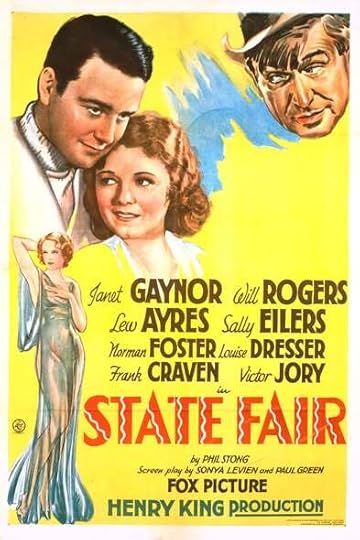 has been State Fair season, which for me means I get to do two of my favorite things–find out what bizarre and dreadful foods are new at the fair this year and watch the movie STATE FAIR. I love state fairs, with their hog pavilions and midways and home-made quilts and flower-arranging competitions and life-size butter sculptures.
The tradition of having a life-sized cow sculptured out of butter originated at the Iowa State Fair in 1911 and spread to other dairy-producing states. The most famous butter cow is at the Wisconsin State fair and is made out of 600 pounds of butter, but the Ohio State Fair holds the record for the largest butter sculpture exhibit, made with 2000 pounds of butter and featuring a cow AND her calf. Other fairs have branched out, with butter sculptures of everything from Mt. Rushmore to Marilyn Monroe, Harley-Davidson motorcycles, Bruce Springsteen, and the characters from The Wizard of Oz and Toy Story, all done in butter and kept at 40 degrees Fahrenheit in refrigerated display pavilions.
There are other oddities, too, things that you can’t find anywhere but at a state fair–pig races and largest pumpkin competitions and camel rides and spitting contests and art shows featuring pictures made entirely out of corn, wheat, and barley seeds. And of course there’s that other art form: state fair food.
The food you find at state fairs–and ONLY at state fairs–is a breed apart. It includes, along with the popcorn and caramel apples and sno-cones that you would expect, delicacies like funnel cakes and lemonade and turkey legs and ribbon fries (a potato cut into a single long, spiraling potato chip that fills an entire plate which is then, of course, fried in a deep fat fryer. Because, except for the “all the milk you can drink” dairy stand at the Minnesota State Fair, state fairs are not big on health foods. Sweet and calorie-laden and deep-fat-fried are the order of the day.
State fairs have a long, proud history of introducing new foods. Ice cream cones made their first appearance at a state fair, and so did cotton candy (originally called fairy floss) and the cream puff made its debut at the Wisconsin State Fair in 1924. And every year they try to outdo themselves with new and bizarre foods, like Krispy Kreme burgers (hamburgers and all the fixings on a Krispy Kreme donut instead of a bun) and deep-fried Oreos and roast corn on a stick.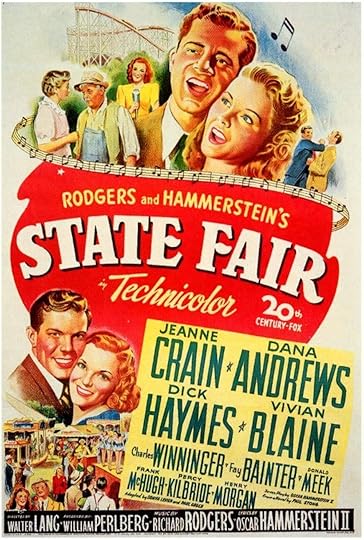
Stuff on a stick seems to be a common theme–corn dogs and pork chops and roast-corn-on-a-stick. There doesn’t seem to be anything they won’t put on a stick at the fair–candied apples, pork chops, chocolate-covered bananas, even chocolate-covered bacon. The on-a-stick thing actually makes sense when you’re walking around looking at the pigs and the butter sculptures and the quilts and the flower arranging, though it is definitely possible to carry it too far, as in, for instance, ranch-dressing-on-a-stick (don’t ask,) breakfast-pn-a-stick (skewered scrambled eggs and sausage wrapped in a pancake,) and sangria-on-a-stick, which is really just an alcoholic popsicle. My personal favorite, though, has to be “hot dish on a stick,” which combines both the best and worst aspects of state fairs and Lake Woebegone.
The other major theme for food at a fair is “deep-fat-fried”–deep-fried Twinkies and deep-fried s’mores and and deep-fried ice cream and deep-fried Snickers bars (a huge disappointment–it just tastes like a very gooey chocolate chip cookie) and deep-fried Pop-Tarts, deep-fried olives, deep-fried alligator bites, deep-fried Coca-Cola (made by freezing Coke into balls and dipping them in batter), and even deep-fried butter. And of course foods that combine both, like the deep-fat-fried pineapple upside down cake on a stick.
The new foods this year included chicken parmesan on a stick, hot beef sundaes (no, I am not making this up,) and soft-serve raspberry beer. A recurring theme seemed to be pickles, for some reason–pickle pretzels, pickle lemonade, pickle pizza, pickle beer, pickle fudge, pickle beef jerky, and fried pickles on a stick–all of which sounded really terrible.
There’s also the food of the fair itself, foods that are made by the local people and brought to be judged: the pies and pickles and canned peaches and jellies and jams and piccalilli–and of course the mincemeat.
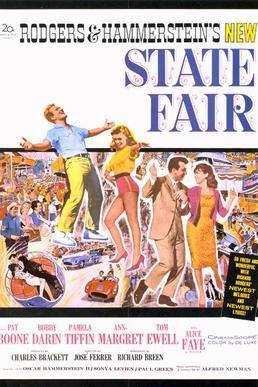 Which brings us to the movie–or rather, movies–STATE FAIR. There are three of them–the 1933 Will Rogers and Janet Gaynor movie, the 1945 musical based on it, and the 1962 re-remake of the musical with Pat Boone and Ann-Margret. The 1932 novel on which all three movies are based, STATE FAIR, by Philip Stong, is much darker and more cynical than any of the movies made from it. It saw the state fair, with its swindlers and floozies and fast-talkers as a symbol of the urban life that was then intruding on rural life in America–and not necessarily in a good way. (Note: I read the novel after seeing the 1933 and 1945 movies, and I liked the movies much better.)
The story in all three movie versions is basically the same–after a family friend makes a bet with Abel Frake that Frake’s prize hog Blue Boy won’t win the blue ribbon at the fair, and even if he does, something bad might happen to one of the family, and besides, no good will come from going to the fair, the Frake family sets off for the state fair, where the son, Wayne, is determined to avenge himself on the carnival barker who swindled him the year before and determined to show he’s not a sucker (and who ends up being an even bigger one when he falls for someone who works at the fair), where Margie longs for something different and romantic to happen to her, and where mother Melissa hopes her mincemeat wins first prize.
That may not sound like much–it’s said that when Rodgers and Hammerstein were first approached about the project, they thought the premise was too slim–“It’s basically about a man who makes a five-dollar bet with a friend”–but the 1933 movie was a huge hit, and so was the 1945 musical, and it’s easy to see why. The movie’s charming and fun and has people (and pigs) you really care about. It also has Will Rogers, who was born to play the part of Abel Frake and who is worth the price of admission all by himself, but everybody else is great, too, especially Janet Gaynor, who plays Margie. She’s perfect as the sweet, innocent daughter who charms the jaded reporter. The script is great, too, with a far more optimistic ending than the book’s, and there are games of chance, candied apples (on a stick), roller coaster rides, and everything else you’d expect to see at a state fair.
The 1945 musical version has the music of Rodgers and Hammerstein, which means there are classics like “It’s a Grand Night for Singing” and “I’d Say that I Had Spring Fever.” Charles Winninger and Fay Bainter play the parents, and they’re very funny, but probably the best person in the cast is Vivian Blaine, who plays the singer Wayne falls in love with. (If you don’t recognize the name, she went on to play the immortal Adelaide in GUYS AND DOLLS, who had developed a cold because Nathan Detroit wouldn’t marry her.) Also wonderful is Frank McHugh, who plays the song-pusher who lays the situation all out for Wayne and then takes him out to get drunk. Jeanne Crain, who plays Margy, is very good, too, though she can’t sing a note. Her singing was dubbed, which was fine, except that after STATE FAIR, all she was offered was musical roles, and they finally had to put the singer who dubbed her (Louanne Hogan) under contract just to do Jeanne Crain’s movies
.
Interestingly, unlike all the other Rodgers and Hammerstein movies, STATE FAIR didn’t start out as a Broadway musical which then got made into a movie. It was written directly for the screen–and THEN it became a musical. It premiered on Broadway in 1969, well after all three movie versions, and has gone on to be performed almost constantly by high-school and community theater groups.
The 1962 STATE FAIR is a mess (I rank the movies as #1–the 1948 version, #2–the Will Rogers version, and #3–this one a distant third.) They’re trying to be cool when the subject is anything but, so they stick in a steamy number of Ann-Margret, have Wayne be a race-car driver instead of a rube, and take a boys-will-be-boys attitude to sex that was awful even back then. But there are a few good things in it–Tom Ewell, the guy in THE SEVEN YEAR ITCH who got to see Marilyn Monroe’s white pleated skirt billow up as she stood on the sidewalk grate, is the father, and his wife is Alice Faye, who was a big singing star and precursor to Betty Grable in the thirties, and they both act circles over the younger generation. Especially Pamela Tiffin, who plays Margy and who was being groomed to be “the new Audrey Hepburn,” except that she can’t act at all. Or sing (she was dubbed, too.) Or do anything, really, except stand around looking pretty. You won’t realize just how bad she is until you see Janet Gaynor in the same role.
In all three movies, the best parts are the story of the hog Blue Boy–will he win the blue ribbon? Will he find happiness with his true love, a redheaded sow named Esmeralda (Zsa Zsa in the 1962 movie–which may be the best romance of the three in the movie. Or four, if you count the comfortable, charming romance of the long-married parents. And the mincemeat. And the fair itself. (In the first two STATE FAIRs, it’s the Iowa State Fair, and in the third they’ve moved it to Texas. ) And the tension of whether Abel Frake will win his bet, which underlies the whole story.
Finally, some fun facts about the movies:
–The crooked barker in the 1933 version is played by a menacing Victor Jorre, who played Oberon in the 1935 Max Reinhardt production of A MIDSUMMER NIGHT’S DREAM and was magnificent and other-worldly as the fairy king. (If you’ve never seen that movie, you definitely should. It’s magical.)
–In the 1945 version, the barker is played by Harry Morgan, who went on to play Colonel Potter in the TV series, MASH. There’s an episode where the medical team, desperate for entertainment, hears that the movie THE MOON IS BLUE is racy–it actually wasn’t all that racy, but at the time it was controversial for being the first movie to have ever said the word “virgin” on-screen–but anyway, they requisition the movie for their unit–and get STATE FAIR instead–and Harry Morgan–for a very clever inside joke.
–Rodgers and Hammerstein wrote the first song in the movie, which is all about spring, and then realized that NO state fairs take place in the spring. So they had to rewrite the lyrics to say that “It Might As Well Be Spring.”
–The prize-winning Hampshire boar who plays Blue Boy in the 1933 movie was the grand champion from the actual Iowa State Fair, Dike of Rosedale.
Enjoy the movies–and when you get the chance, go to your state’s state fair. And be sure to have some ribbon fries and a candied apple and something-or-other-on-a-stick. (But skip the pickle lemonade. Trust me.)
Connie Willis


Connie Willis's Blog

- Connie Willis's profile
- 4674 followers

