
Kenneth C. Davis's Blog, page 83
February 15, 2015
Pop Quiz: Which vice president was arrested for treason?
Answer: Aaron Burr
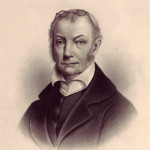
On February 19, 1807, Burr was arrested in what is now Alabama.
Burr (1756-1836), the third vice president of the United States from 1801-1805 under President Thomas Jefferson, had famously killed political rival Alexander Hamilton in a duel in 1804. (He was never charged in that case.) He was arrested in what is now Alabama in 1807, accused of plotting to split the nation or planning to invade Spanish territories.
Courtesy of Alabama Department of Archives and History
A few weeks before Burr was arrested, Thomas Jefferson had addressed Congress on the “Burr Conspiracy.”
“Message to Congress (January 22, 1807)“
Burr was acquitted in what was then the “Trial of the Century.”
The complete story of Burr’s arrest, trial and life is the opening chapter in A NATION RISING.


What day is it? Don’t Know Much About® George Washington
It’s that time of year. Time once again to explain that the upcoming national holiday is not “Presidents Day.”
Yes, I cannot tell a lie. The day we celebrate on the third Monday in February is really called “George Washington’s Birthday.” Ask the National Archives.
Want to learn a little more?
Here is the website for the National Park Service’s Birthplace of Washington site.
And here is the National Park Service website for Fort Necessity, scene of Washington’s surrender and “confession.”
February 12, 2015
Teachers- A new round of classroom Skype visits
As the 150th anniversary of the final days of the Civil War approach, I will once again offer a round of free, classroom visits via Skype. These sessions are conversations not lectures and I welcome student questions. They typically last 40 minutes to one hour.
To learn more about this offer and register for a possible visit, please visit the FOR TEACHERS page linked here.
Don’t Know Much About the Civil War (Harper paperback, Random House Audio)
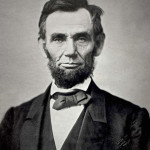
Abraham Lincoln (November 1863) Photo by Alexander Gardner
NEW BOOK IN STORES ON MAY 5, 2015
“A fascinating exploration of war and the myths of war. Kenneth C. Davis shows how interesting the truth can be.”
—Evan Thomas, New York Times-bestselling author of Sea of Thunder and John Paul Jones
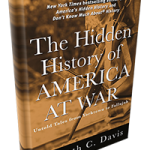
I am very excited to announce the publication of my new book, THE HIDDEN HISTORY OF AMERICA AT WAR: Untold Tales from Yorktown to Fallujah. A collection of “war stories” about six important battles in American History that have been overlooked, forgotten or mythologized, the hardcover book and audio will be available on May 5 from Hachette Books and Random House Audio.
Going beyond strategy and tactics, winners, losers and casualty counts of traditional military accounts, these six stories reveal who has fought America’s wars and how America’s military has changed over more than two centuries –going from from the legendary “Minutemen” who fought 240 years ago at Lexington and Concord to the technologically advanced, global power America is today. In these stories I also examine the human side of war, from the point of view of those who fight and those civilians who are often trapped in a combat zone.
To learn more about the book. see more advance praise, and preorder copies, please visit The Hidden History of America At War.
Don’t Know Much About® Abraham Lincoln’s Birthday
February 12 used to mean something special — Abraham Lincoln’s Birthday. It was never a national holiday but it was pretty important when I was a kid and we got the day off from school in my hometown.
The Uniform Holidays Act in 1971 changed that by creating Washington’s Birthday as a federal holiday on the third Monday in February. It is NOT officially “Presidents Day.”
But it is still a good excuse to talk about Abraham Lincoln, especially since his real birthday is on the calendar.c
“Honest Abe.” “The Railsplitter.” “The Great Emancipator.” You know some of the basics and the legends. But check out this video to learn some of things you may not know, but should, about the 16th President.
Here’s a link to the Lincoln Birthplace National Park
This link is to the Emancipation Proclamation page at the National Archives.
And you can read much more about Lincoln in Don’t Know Much About the American Presidents, Don’t Know Much About History and Don’t Know Much About the Civil War.
Don’t Know Much About the Civil War (Harper paperback, Random House Audio)
Don’t Know Much About® the American Presidents (Hyperion Paperback-April 15, 2014)
Abraham Lincoln (November 1863) Photo by Alexander Gardner
Don’t Know Much About® George Washington
It’s that time of year. Time once again to explain that the upcoming national holiday is not “Presidents Day.”
Yes, I cannot tell a lie. The day we celebrate on the third Monday in February is really called “George Washington’s Birthday.” Ask the National Archives.
Want to learn a little more?
Here is the website for the National Park Service’s Birthplace of Washington site.
And here is the National Park Service website for Fort Necessity, scene of Washington’s surrender and “confession.”
December 5, 2014
Pop Quiz: Which two Presidents not named Roosevelt were born in New York?
Answer: Millard Fillmore and Martin Van Buren
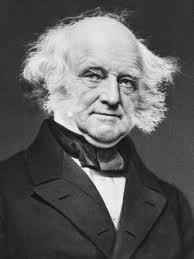
Martin Van Buren- 8th President of the United States (Photo Courtesy of Library of Congress)
Van Buren was born on December 5, 1782 in Kinderhook, New York. His later home, Lindenwald, is a National Historic site. That makes the eighth president the first born an American citizen, even though Dutch was his first language.
Fillmore, the 13th President,was born in Summerhiill, New York on January 7, 1800. His later home is also a national historic site in East Aurora, New York.
Unlike the two Roosevelts, Theodore and Franklin, , Van Buren and Fillmore do not make anyone’s “Greatest Presidents list” –including mine.
Read more about both men in Don’t Know Much About the American Presidents.

DON’T KNOW MUCH ABOUT® THE AMERICAN PRESIDENTS (HYPERION PAPERBACK APRIL 15, 2014)
December 2, 2014
Pop Quiz: Which Constitutional Amendment repealed another?
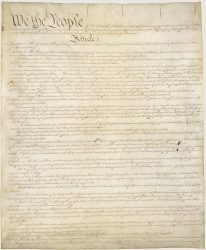
United States Constitution (Image Courtesy of the National Archives)
Answer: The 21st Amendment, ratified on December 5, 1933, repealed the 18th Amendment and with it the federal Prohibition of alcohol. (The Amendment gave the states extensive authority to regulate alcoholic beverages.)
Amendment XXI
Section 1.The eighteenth article of amendment to the Constitution of the United States is hereby repealed.
Section 2.The transportation or importation into any state, territory, or possession of the United States for delivery or use therein of intoxicating liquors, in violation of the laws thereof, is hereby prohibited.
Section 3.This article shall be inoperative unless it shall have been ratified as an amendment to the Constitution by conventions in the several states, as provided in the Constitution, within seven years from the date of the submission hereof to the states by the Congress.
Source: Legal Information Institute: Cornell University Law School
The 21st Amendment is unique among amendments because it was the only one that overturned an existing Amendment and the only one ratified by state ratifying conventions rather than state legislatures. These statewide conventions were specially elected for that purpose, according to Linda Monk in The Words We Live By. Adds Monk:
“Approximately seventy-three percent of the twenty-one million citizens who voted in those elections supported the Twenty-first Amendment.” (The Words We Live By, page 248)
The 18th Amendment (Text) had taken effect on January 17, 1920 and the prohibition of alcohol was widely blamed for creating widespread corruption and organized crime, ultimately leading to its repeal.
An excellent history of the Prohibition period is Last Call: The Rise and Fall of Prohibition by Daniel Okrent.
You can also read more about the Prohibition era in Don’t Know Much About History.
Don’t Know Much About® History: Anniversary Edition (Harper Perennial and Random House Audio)
November 26, 2014
Lincoln, Thanksgiving and the Civil War
As the Civil War raged on 150 years ago, Abraham Lincoln issued his second annual Thanksgiving Proclamation.
That piece of Thanksgiving history is the subject of my post How the Civil War Created Thanksgiving in the New York Times Disunion blog series.

Abraham Lincoln (November 1863) Photo by Alexander Gardner
The partial text of Lincoln’s Proclamation can be found in this Who Said It? post
Read more about Lincoln and the Civil War in Don’t Know Much About History, Don’t Know Much About the Civil War and Don’t Know Much About the American Presidents.

Don’t Know Much About the Civil War (HarperPerennial Paperback/Random House Audio)
Don’t Know Much About® the American Presidents (Hyperion Paperback/Random House Audio)
Don’t Know Much About® History: Anniversary Edition (Harper Perennial and Random House Audio)
November 25, 2014
Thanksgiving Pop Quiz- A Videoblog
(Original video created and directed by Colin Davis)
With Thanksgiving around the corner, cutouts of Pilgrims in black clothes and clunky shoes are sprouting all over the place. You may know that the Pilgrims sailed aboard the Mayflower and arrived in Plymouth, Massachusetts in 1620. But did you know their first Thanksgiving celebration lasted three whole days? What else do you know about these early settlers of America? Don’t be a turkey. Try this True-False quiz.
True or False? (Answers below)
1. Pilgrims always wore stiff black clothes and shoes with silver buckles.
2. The Pilgrims came to America in search of religious freedom.
3. Everyone on the Mayflower was a Pilgrim.
4. The Pilgrims were saved from starvation by a native American friend named Squanto.
5. The Pilgrims celebrated the first Thanksgiving in America.
Read about America’s real “first Pilgrims”–French Huguenots who landed in Florida more than fifty years before the Mayflower sailed– in this New York Times Op-Ed, “A French Connection” and in my book America’s Hidden History
America’s Hidden History, includes tales of “First Pilgrims” and “Forgotten Founders”
The site of Plimouth Plantation is definitely worth a visit.
Answers
1. False. Pilgrims wore blue, green, purple and brownish clothing for everyday. Those who had good black clothes saved them for the Sabbath. No Pilgrims had buckles– artists made that up later!
2. True. The Pilgrims were a group of radical Puritans who had broken away from the Church of England. After 11 years of “exile” in Holland, they decided to come to America.
3. False. Only about half of the 102 people on the Mayflower were what William Bradford later called “Pilgrims.” The others, called “Strangers” just wanted to come to the New World.
4. True. Squanto, or Tisquantum, helped teach the Pilgrims to hunt, farm and fish. He learned English after being taken as a slave aboard an English ship.
5. False. The Indians had been having similar harvest feasts for years. So did the English settlers in Virginia and Spanish settlers in the southwest before the Pilgrims even got to America. And the Mayflower Pilgrims weren’t even America’s “first Pilgrims.” That honor goes to French Huguenots who settled in Florida more than 50 years before the Mayflower sailed.
Don’t Know Much About History (Revised, Expanded and Updated Edition)


