
Kenneth C. Davis's Blog, page 80
May 4, 2015
Who Said it (5/4/2015)
The flags of freedom fly all over Europe.
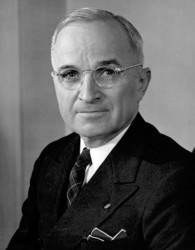
President Harry S. Truman
(Photo: Truman Library)
“This is a solemn but glorious hour. General Eisenhower informs me that the forces of Germany have surrendered to the United Nations. The flags of freedom fly all over Europe.”
–President Harry S. Truman, “The President’s Press Conference on V-E Day” (May 8, 1945)
Source: Harry S. Truman: “The President’s News Conference on V-E Day,” May 8, 1945. Online by Gerhard Peters and John T. Woolley, The American Presidency Project.
Read more about the Fall of Berlin and the end of World War II in THE HIDDEN HISTORY OF AMERICA AT WAR: Untold tales from Yorktown to Fallujah
The Hidden History of America At War-May 5, 2015 (Hachette Books/Random House Audio)


THE HIDDEN HISTORY OF AMERICA AT WAR-Speaking Calendar

Porter Square Books
List of Speaking Engagements:
May 6 Kramerbooks Washington DC 6:30 PM
May 13 Porter Square Books, Cambridge, MA 7:00 PM
May 14 RJ Julia Booksellers Madison CT 7:00 PM
May 17 US Army Heritage and Education Center Carlisle, PA 1:00 PM
May 18 Enoch Pratt Free Library Baltimore, MD 6:30 PM
May 23 Barnes & Noble William and Mary Williamsburg, VA TIME TBA
June 6 Printers Row Lit Fest Chicago, IL TIME TBA
June 11 Fraunces Tavern Museum New York City 6:30 PM
June 14 Barnes & Noble Tidewater College Store Norfolk, VA TIME TBA
June 18 Mount Vernon Public Library, Mount Vernon, NY 6:30 PM
THE HIDDEN HISTORY OF AMERICA AT WAR: Untold Tales from Yorktown to Fallujah (May 5-Hachette Books/Random House Audio)
May 1, 2015
The Fall of Berlin-May Day 1945
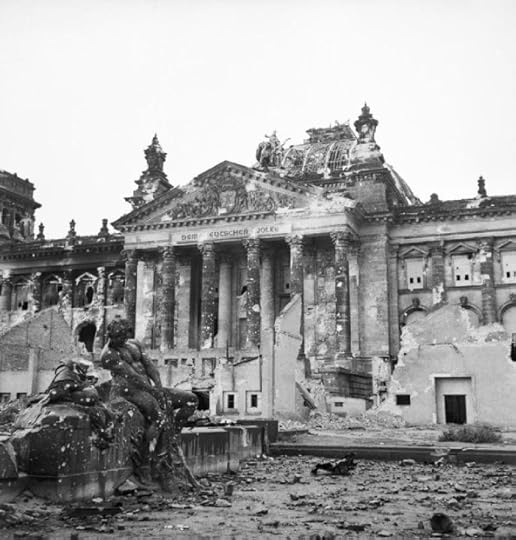
The Reichstag in Berlin, pictured in June 1945, a few weeks after Berlin fell to the Soviet Red Army. (Source: Imperial War Museum)
For Soviet leader Joseph Stalin’s commanders, the grand prize was the Reichstag, Germany’s parliament building. Stalin had pitted his generals against one another, daring them to be the first there. The Russians wanted to fly their flag over the dome of the Reichstag in time for May Day, the international celebration of socialism. And they achieved their goal. On May 1, 1945, the red hammer and sickle flag flew over Germany’s fallen capital….
The Americans did not take part in the land battle and wouldn’t reach Berlin for several weeks after the city fell. The British and American role in attacking Berlin had been the large-scale air campaign meant to bomb Germany into submission. In postwar American history books, the contribution of the Soviet Union in fighting Hitler—along with the astonishing toll the war had taken on Russia— was largely brushed aside as the tensions between the American and Western European countries on the one side and the Soviet Union and its bloc of communist nations grew increasingly fraught during the Cold War.
Excerpted from “Berlin Stories” in THE HIDDEN HISTORY OF AMERICA AT WAR
The Hidden History of America At War-May 5, 2015 (Hachette Books/Random House Audio)
April 30, 2015
Death of Hitler-April 30, 1945
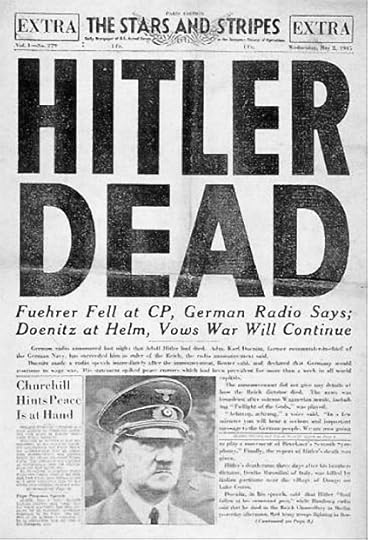
Stars and Stripes reported Hitler’s death on May 2, 1945
Told the next day that Berlin’s defenders were nearly out of ammunition, Hitler and Braun committed suicide. She took poison; he used a shot to the temple. Their bodies were cremated by loyal followers in a garden not far from Hitler’s bunker in the Reich Chancellery.
Under the terms of Hitler’s will, Grand Admiral Karl Donitz, the German naval commander, became the president of Germany. It was Donitz who would soon officially surrender to the Allies, bringing the war in Europe to a close.
The shock of the Red Army’s arrival in Berlin was more than just a grotesque nightmare that confirmed the worst fears of Berliners, and would play out mercilessly in the city in the months ahead. It was the end of the world as Berliners knew it. The people of Berlin, the home of the Thousand-Year Reich, had been pummeled by airstrikes, more than three hundred of them since early 1944, when the daily raids on the city began.
Excerpted from Chapter Four, “Berlin Stories,” THE HIDDEN HISTORY OF AMERICA AT WAR
The Hidden History of America At War-May 5,2015 (Hachette Books/Random House Audio)
© 2015 Kenneth C. Davis All Rights Reserved
April 29, 2015
“Two Societies, One Black, One White”
The news and images out of Baltimore are unfortunately all too familiar. “Civil Disorders” are nothing new and a sad reminder of the violence that tore across the country in the 1960s.

Grand Rapids Michigan-1967
Responding to a series of violent outbursts in predominantly black urban neighborhoods, President Lyndon B. Johnson established an 11-member National Advisory Commission on Civil Disorders on July 28, 1967. Later known as the Kerner Commission after its chairman, Governor Otto Kerner, Jr. of Illinois, the Commission issued a stark warning in 1968:
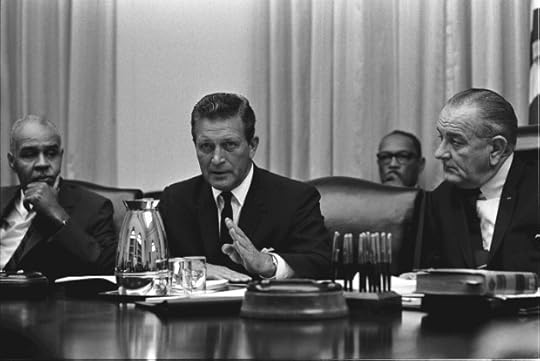
Governor of Illinois Otto Kerner, Jr., meeting with Roy Wilkins (left) and President Lyndon Johnson (right) in the White House. 29 July 1967 Source LBJ Presidential Library
“Our Nation Is Moving Toward Two Societies, One Black, One White—Separate and Unequal”
The Committee Report went on to identify a set of “deeply held grievances” that it believed had led to the violence.
Although almost all cities had some sort of formal grievance mechanism for handling citizen complaints, this typically was regarded by Negroes as ineffective and was generally ignored.
Although specific grievances varied from city to city, at least 12 deeply held grievances can be identified and ranked into three levels of relative intensity:
First Level of Intensity
1. Police practices
2. Unemployment and underemployment
3. Inadequate housing
Second Level of Intensity
4. Inadequate education
5. Poor recreation facilities and programs
6. Ineffectiveness of the political structure and grievance mechanisms.
Third Level of Intensity
7. Disrespectful white attitudes
8. Discriminatory administration of justice
9. Inadequacy of federal programs
10. Inadequacy of municipal services
11. Discriminatory consumer and credit practices
12. Inadequate welfare programs
Source: “Our Nation is Moving Toward Two Societies, One Black, One White—Separate and Unequal”: Excerpts from the Kerner Report; American Social History Project / Center for Media and Learning (Graduate Center, CUNY)
and the Roy Rosenzweig Center for History and New Media (George Mason University).
Issued nearly half a century ago, the list of grievances reads as if it could have been written last week.
But this list identified 45 years ago speaks to the gross inequities in modern America — a rising tide of economic inequality that increasingly cuts across racial lines. According to the Associated Press:
Four out of 5 U.S. adults struggle with joblessness, near-poverty or reliance on welfare for at least parts of their lives, a sign of deteriorating economic security and an elusive American dream.
(Source: Associated Press “Signs of Declining Economic Security” July 29, 2013)
Nearly half a century later, the Kerner Commission’s warnings still ring true: “Moving Toward Two Societies…Separate and Unequal.”
Read more about the unrest of the Civil Rights era in Don’t Know Much About® History. The crucial role of race in the American military is also treated in the forthcoming The Hidden History of America at War. (May 5)
The Hidden History of America At War-May 5,2015 (Hachette Books/Random House Audio)
Don’t Know Much About History (Revised, Expanded and Updated Edition)
April 28, 2015
Three April Deaths
Three men dominated European and American affairs for more than a decade.
Two unleashed an unthinkable era of tyranny and destruction on Europe. One tried to stop them. All three died over the span of a few weeks in April 1945 –70 years ago.
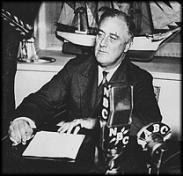
President Franklin D. Roosevelt died on April 12, 1945 in Warm Springs, Georgia. (The FDR Library offers brief biographical facts.) Elected for the first of four terms in 1932, Roosevelt was a towering figure in American politics. His death shocked America and came just weeks before the final victory over the Axis powers he had battled for years.
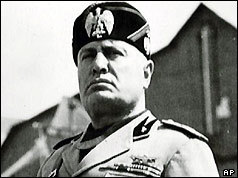
Partisan fighters executed Benito Mussolini –known as “Il Duce” (“The Leader”)– and other Italian Fascist leaders on April 28, 1945 near Lake Como. Hitler’s Italian ally, Mussolini and his Fascists had ruled Italy since 1922, taking dictatorial power in 1925. The bodies of the dead were taken to Milan and publicly displayed hanging upside down. (A BBC report of the death of Mussolini.)
Adolf Hitler committed suicide on April 30, 1945. He had ruled Germany since 1933.
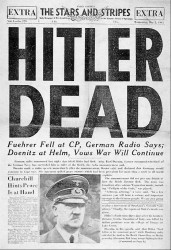
Stars and Stripes reported Hitler’s death on May 2, 1945
On 30 April 1945, with the Red Army only streets away, Hitler killed himself in the Führerbunker beneath the Reich Chancellery in the city centre. His body was then taken out into the open, doused in petrol and set alight in a bomb crater.
“Hitler’s Ghost Still Haunts Berlin’s Psyche,” The Guardian April 25, 2015
Their deaths came as the war in Europe entered its final phase. American and British armies were racing through Germany from the West while the Soviet Red Army was crushing Nazi resistance from the East. The final assault on Hitler’s lair and the once mighty capital of Berlin was a brutal battle that left the city in ruins. This ghastly fight and the violent sexual assaults on Berlin’s women that followed were the prelude to a divided Berlin and Germany and fifty years of Cold War. That battle and its aftermath are the subjects of the “Berlin Stories” chapter in THE HIDDEN HISTORY OF AMERICA AT WAR.
The Hidden History of America At War-May 5, 2015 (Hachette Books/Random House Audio)
April 24, 2015
Kicking off at Kramerbooks
I am delighted to announce that my first event marking the publication of THE HIDDEN HISTORY OF AMERICA AT WAR: Untold Tales from Yorktown to Fallujah will take place at one of my longtime favorite bookstores Kramerbooks and Afterwords Cafe in Washington, D.C.
The date is WEDNESDAY MAY 6 at 6:30 PM.
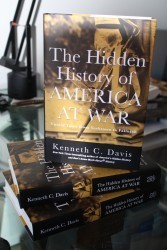
Kramerbooks, located at Dupont Circle, is a long established independent bookseller and was among the first bookstores to introduce the café-in-a-bookstore concept. I have visited there many times over the years and am delighted that my first bookstore event will take place in Kramerbooks.
For more information about the event and directions, visit the Kramerbooks website.
Who Said It? (4/24/15)
Under existing conditions the negro votes the Republican ticket because he knows his friends are of that party.
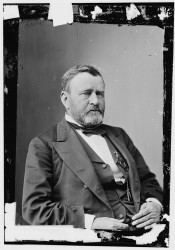
Answer: President Ulysses S. Grant “Sixth Annual Message” (December 7, 1874)
Under existing conditions the negro votes the Republican ticket because he knows his friends are of that party. Many a good citizen votes the opposite, not because he agrees with the great principles of state which separate parties, but because, generally, he is opposed to negro rule. This is a most delusive cry. Treat the negro as a citizen and a voter, as he is and must remain, and soon parties will be divided, not on the color line, but on principle. Then we shall have no complaint of sectional interference.
Source and Complete Text: Ulysses S. Grant: “Sixth Annual Message,” December 7, 1874. Online by Gerhard Peters and John T. Woolley, The American Presidency Project.
Ulysses S. Grant commanded the Union armies that defeated the Confederate armies in the Civil War. He became the 18th President of the United States in 1868, winning a second term in 1872. Grant was born in Ohio on April 27, 1822.
April 20, 2015
Who Said It? (4/20/15)
“America can regain the sense of pride that existed before Vietnam.”
Answer: President Gerald Ford, “Address at a Tulane University Convocation”
(April 23, 1975)
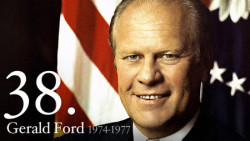
Today, America can regain the sense of pride that existed before Vietnam. But it cannot be achieved by refighting a war that is finished as far as America is concerned. As I see it, the time has come to look forward to an agenda for the future, to unify, to bind up the Nation’s wounds, and to restore its health and its optimistic self-confidence.
In New Orleans, a great battle was fought after a war was over. In New Orleans tonight, we can begin a great national reconciliation. The first engagement must be with the problems of today, but just as importantly, the problems of the future. That is why I think it is so appropriate that I find myself tonight at a university which addresses itself to preparing young people for the challenge of tomorrow.
I ask that we stop refighting the battles and the recriminations of the past. I ask that we look now at what is right with America, at our possibilities and our potentialities for change and growth and achievement and sharing. I ask that we accept the responsibilities of leadership as a good neighbor to all peoples and the enemy of none. I ask that we strive to become, in the finest American tradition, something more tomorrow than we are today.
Source and Complete Text: Gerald R. Ford: “Address at a Tulane University Convocation,” April 23, 1975. Online by Gerhard Peters and John T. Woolley, The American Presidency Project.
One week after this speech was delivered, Saigon fell to the forces of North Vietnam.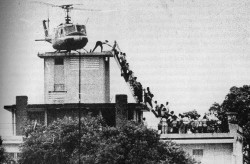
April 20, 1945-The Red Army Nears Berlin on Hitler’s Birthday
“By April 20, Adolf Hitler’s birthday, there was still no sign of the Soviets in the city. . . . This day, the usual propaganda pronouncements promised a swift defeat of the approaching Allied armies, then called on German teenagers to join the home guard defending the Reich. Many Berliners still believed some last-minute German miracle would scatter their enemies, a last-gasp aura of the “master race” invincibility that the German people had made an article of faith since Hitler’s rise to power. There were even rumors going around of a mysterious and frightful new super weapon that would turn back the enemy at the gates.”
–From “Berlin Stories” in THE HIDDEN HISTORY OF AMERICA AT WAR: Untold Tales from Yorktown to Fallujah
The Hidden History of America At War-May 5,2015 (Hachette Books/Random House Audio)
Adolf Hitler was born on April 20, 1889 in the small Austrian town of Braunau am Inn, in Upper Austria on the Austrian-German border. The BBC offers this timeline of his life and death.


