
Kenneth C. Davis's Blog, page 30
June 20, 2021
“Lives, Fortunes, Sacred Honor:” Whatever Became Of 56 Signers? (1st in a series)
(Post updated 6/19/2021)
Now that Juneteenth has become a national holiday observed as the other “Independence Day,” it is time to look back on the first Independence Day –July 4th, 1776. As the nation is going through an examination of the role slavery played in American History, it is important to recognize its role at Philadelphia. You cannot teach American History without acknowledging the role slavery played. And talking about the men who signed the Declaration is one way to do that.
This is the first in a series of posts about the men who signed the Declaration of Independence and what became of them. Most of these men are obscure to many Americans and they have also been mythologized in some online forums. Many of them played a significant role in the early republic before, during, and after July 4, 1776.
Slavery existed in all thirteen of the future states and at least 40 of the 56 signers enslaved people or were involved in the slave trade. One focus of the series is to show which of these men enslaved people or otherwise participated in the slave trade. A “Yes” after their listing means they enslaved people; a “No” means they did not.
They pledged:
“... our Lives, our Fortunes, and our Sacred Honor.”
Then what happened?
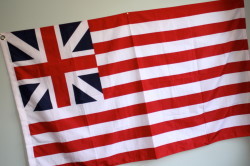
The Grand Flag of the Union, the “first American flag,” originally raised in 1775 and later by George Washington in early 1776 in Boston. The Stars and Stripes did not become the “American flag” until June 14, 1777. (Author photo © Kenneth C. Davis)
…We mutually pledge to each other our Lives, our Fortunes , and our Sacred Honor.
Those strong words concluded the Declaration of Independence when it was adopted by the Continental Congress on July 4, 1776.
There is little question that men who signed that document were putting their lives at risk. The identity and fates of a handful of those Signers is well-known. Two future presidents — Adams and Jefferson— and America’s most famous man, Benjamin Franklin, were on the Committee that drafted the document.
But the names and fortunes of many of the other signers, including the most visible, John Hancock, are more obscure. In the days leading up to Independence Day, I will offer a thumbnail sketch of each of the Signers in alphabetical order. Some prospered and thrived; some did not: How many of those Signers actually paid with their Lives, Fortunes, and Sacred Honor?
–John Adams (Massachusetts) Aged 40 when he signed, he went on to become the first vice president and second president of the United States. By 1790, Adams was convinced that his place in the history to be written would be diminished.
“The history of our Revolution will be one continued lie from one end to the other,” he wrote fellow Founder Benjamin Rush in 1790.
“The essence of the whole will be that Dr. Franklin’s electrical rod smote the earth and out sprang General Washington. That Franklin electrified him with his rod –and thenceforward these two conducted all the policies, negotiations, legislatures, and war.”
Adams died on the 50th anniversary of the Declaration in 1826 at age 90. (Jefferson died that same day) NO
–Samuel Adams (Mass.) Older cousin to John, Samuel Adams was 53 at the signing. He went on to a career in state politics, initially refused to sign the Constitution because it lacked a Bill of Rights, and was governor of Massachusetts. He died in 1803 at 81. NO
–Josiah Bartlett (New Hampshire) Inspiring the name of the fictional president of West Wing fame on TV, Bartlett was a physician, aged 46 at the time of the signing. He helped ratify the Constitution in his home state, giving the document the necessary nine states to become the law of the land. Elected senator he chose to remain in New Hampshire as governor. Three of his sons and other descendants also became physicians. He died in 1795 at age 65. YES
–Carter Braxton (Virginia) A 39-year-old plantation owner, Braxton was looking to invest in the slave trade before the Revolution. Initially reluctant about independence, he helped fund the rebellion and lost a considerable fortune during the war — not because he was a signer, but because of shipping losses suffered during the war itself. He later served in the Virginia legislature and died in 1797 at age 61, far less wealthy than he had been, but also far from impoverished. YES
–Charles Carroll of Carrollton (Maryland) A plantation owner, 38 years old and one of America’s wealthiest men at the signing, Carroll was the only Roman Catholic signer and the last signer to die. With hundreds of enslaved people on his properties, Carroll considered freeing some of them before his death and later introduced a bill for gradual abolition in Maryland, which had no chance of passage. At age ninety-one, he laid the cornerstone of the Baltimore and Ohio Railroad as a member of its board of directors. He died in 1832 at age 95. YES
Update: Carroll’s cousin was John Carroll, a Jesuit priest, first Roman Catholic bishop in the United States, and a founder of Georgetown College. The New York Times has reported how, in 1838, Georgetown sold 272 enslaved people to keep the college financially afloat.


Who Said it (4/13/20)
Thomas Jefferson, in 1820, discussing the fate of the Missouri Compromise –legislation which was supposed to resolve the question of the future of slavery’s extension in America.
Read more about Jefferson in this post.
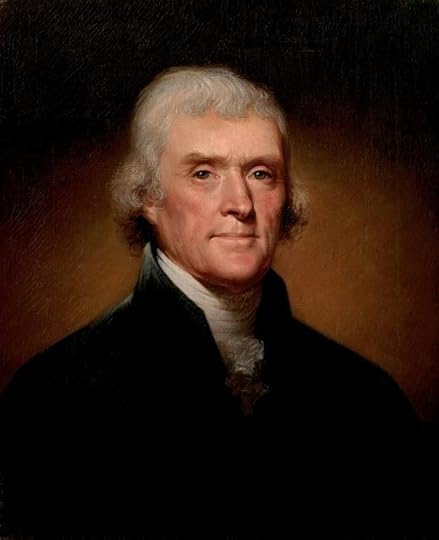
Thomas Jefferson, third president of the United States.Official portrait by Rembrandt Peale. http://www.whitehouseresearch.org/ass...
“But as it is, we have the wolf by the ear, and we can neither hold him, nor safely let him go. Justice is in one scale, and self-preservation in the other.”
Jefferson discussing the Missouri question and slavery to John Holmes April 22, 1820. Ford, Paul Leicester, ed. The Works of Thomas Jefferson, Volume 12. New York: G.P. Putnam’s Sons, 1905, p. 159.
June 7, 2021
Juneteenth: The “Other” Independence Day
(Revise of a post first published June 2015)
“The people of Texas are informed that, in accordance with a proclamation from the Executive of the United States, all slaves are free…” –General Gordon Granger, June 19, 1865
Each year, JUNE 19 is a day to mark “Juneteenth” –a holiday celebrating emancipation at the end of the Civil War.
“SOME two months after Gen. Robert E. Lee surrendered on April 9, 1865, effectively ending the Civil War, Maj. Gen. Gordon Granger steamed into the port of Galveston, Tex. With 1,800 Union soldiers, including a contingent of United States Colored Troops, Granger was there to establish martial law over the westernmost state in the defeated Confederacy.
On June 19, two days after his arrival and 150 years ago today, Granger stood on the balcony of a building in downtown Galveston and read General Order No. 3 to the assembled crowd below. “The people of Texas are informed that, in accordance with a proclamation from the Executive of the United States, all slaves are free,” he pronounced.” (New York Times June 19, 2015)
Read more of the complete story of Juneteenth in my New York Times Op-ed, “Juneteenth is for Everyone”.
TO the emancipated people of Texas, the day would be celebrated as “Juneteenth,” a festive holiday marking liberation. It would become a widely shared day of picnics, barbecue, singing, and joy in the African-American community, gradually spreading across the former Confederacy and eventually moving north.
I believe that we have two histories in this country — one white, one black — and they have largely been separate and unequal. The story of Juneteenth is a perfect example of how one of these histories has largely been hidden when we teach American history.
Now more than ever, it is time to fix that.

The official Juneteenth Committee in East Woods Park, Austin, Texas on June 19, 1900. (Courtesy Austin History Center, Austin Public Library)
For centuries, slavery was the dark stain on America’s soul, the deep contradiction to the nation’s founding ideals of “Life, liberty and the pursuit of happiness” and “All men are created equal.”
When Abraham Lincoln issued the Emancipation Proclamation on January 1, 1863, he took a huge step toward erasing that stain. But the full force of his proclamation would not be realized until June 19, 1865—Juneteenth, as it was called by enslaved people in Texas freed that day.
“Juneteenth: Our Other Independence Day” My article in Smithsonian (June 15, 2011)

Foods on the Juneteenth altar include beets, strawberries, watermelon, yams and hibiscus tea, as well as a plate of black-eyed peas and cornbread. Credit Jim Wilson/The New York Times
The celebration of the the holiday and its traditions of foods is highlighted in this New York Times article, “Hot Links and Red Drinks”

The question of how we teach and talk about enslavement is also the subject of my recent article in Social Education, the Journal of the National Council for the Social Studies. (NCSS). Read: The American Contradiction: Conceived in Liberty, Born in Shackles.
June 5, 2021
Who Said It?
On the night of June 6, 1944, President Roosevelt went on national radio to discuss the invasion of Normandy — D-Day — with the American people.
 President Franklin D. Roosevelt, “D-Day Prayer” (June 6, 1944)
Almighty God: Our sons, pride of our Nation, this day have set upon a mighty endeavor, a struggle to preserve our Republic, our religion, and our civilization, and to set free a suffering humanity.
Lead them straight and true; give strength to their arms, stoutness to their hearts, steadfastness in their faith.
They will need Thy blessings. Their road will be long and hard. For the enemy is strong. He may hurl back our forces. Success may not come with rushing speed, but we shall return again and again; and we know that by Thy grace, and by the righteousness of our cause, our sons will triumph.
They will be sore tried, by night and by day, without rest-until the victory is won. The darkness will be rent by noise and flame. Men’s souls will be shaken with the violences of war.
His address took the form of this prayer. (Full text from Franklin D. Roosevelt Presidential Library and Museum)
The day before, future president Dwight D. Eisenhower, addressed the troops of the Allied Expeditionary Force and told them,
The hopes and prayer of liberty-loving people everywhere march with you.
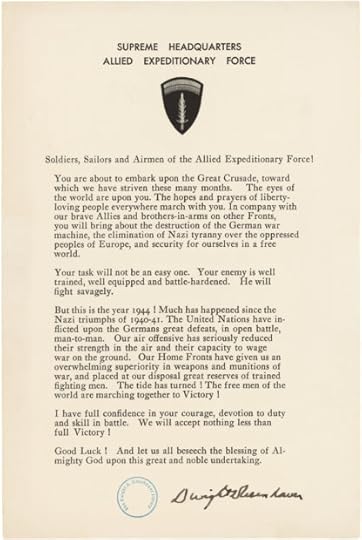
00763_2003_001.tif
Don’t Know Much About® D-Day
President Franklin D. Roosevelt, “D-Day Prayer” in an announcement to the nation of the invasion of Normandy (June 6, 1944)
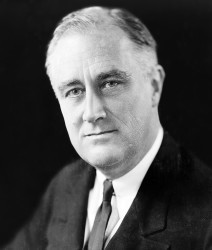
Franklin D. Roosevelt in 1933
My fellow Americans: Last night, when I spoke with you about the fall of Rome, I knew at that moment that troops of the United States and our allies were crossing the Channel in another and greater operation. It has come to pass with success thus far.
And so, in this poignant hour, I ask you to join with me in prayer:
Almighty God: Our sons, pride of our Nation, this day have set upon a mighty endeavor, a struggle to preserve our Republic, our religion, and our civilization, and to set free a suffering humanity.
Lead them straight and true; give strength to their arms, stoutness to their hearts, steadfastness in their faith.
They will need Thy blessings. Their road will be long and hard. For the enemy is strong. He may hurl back our forces. Success may not come with rushing speed, but we shall return again and again; and we know that by Thy grace, and by the righteousness of our cause, our sons will triumph.
They will be sore tried, by night and by day, without rest-until the victory is won. The darkness will be rent by noise and flame. Men’s souls will be shaken with the violences of war.
Franklin Roosevelt’s D-Day Prayer Source: Franklin D. Roosevelt Library and Museum
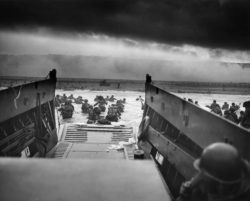
“Into the Jaws of Death – U.S. Troops wading through water and Nazi gunfire” by Robert F. Sergeant (National Archives)
In the largest amphibian assault in history, Allied armies crossed the English Channel to land on five beaches in Normandy in northern France. The invasion force involved 700 ships, 4,000 landing craft, 10,000 planes, and some 176,000 Allied troops from twelve countries. The allied forces were commanded by future President, Gen. Dwight D. Eisenhower.
The day was chaotic, brutal and bloody.
Steven Spielberg’s World War II epic, Saving Private Ryan, brought the reality of combat home to millions, but many moviegoers did not know which battle the film depicted, or when and why it happened. The assault, code-named Operation Overlord, occurred June 6, 1944, against Hitler’s Germany.
By the of the day on June 6, 1944, the allies had taken all five beaches that had been targeted. The combined allied losses on that day have been recently stated at 4,415 dead, according to the National D-Day Memorial.
The German army did not formally surrender until May 7, 1945. May 8, 1945 was declared V.E. (Victory in Europe) Day.
More D-Day resources can be found at the FDR Library and Museum
Read more about FDR’s life and administration and World War II in Don’t Know Much About® History and Don’t Know Much About® the American Presidents
Don’t Know Much About ® the “Marshall Plan”
(Originally posted in 2012)
“Foreign aid” is not just “do-gooder” national policy. It is an effective means to influence future outcomes. There is no better example than the program that came to be called the “Marshall Plan.”
On June 5, 1947, Secretary of State George C. Marshall gave Harvard’s commencement address, introducing and justifying the European Recovery Program, which became known as the Marshall Plan.
Marshall (born December 31, 1880) had been the Chief of Staff of the U.S. Army during World War II and Winston Churchill hailed him as the “true organizer of victory.” The plan, part of the Cold War program of “Containment” championed by George F. Kennan, and put forth by President Harry S. Truman, is credited with restoring the economies of post-World War II western Europe. At Harvard, Marshall said:
The truth of the matter is that Europe’s requirements for the next three or four years of foreign food and other essential products—principally from America—are so much greater than her present ability to pay that she must have substantial additional help, or face economic, social and political deterioration of a very grave character. …Aside from the demoralizing effect on the world at large and the possibilities of disturbances arising as a result of the desperation of the people concerned, the consequences to the economy of the United States should be apparent to all. It is logical that the United States should do whatever it is able to do to assist in the return of normal economic health in the world, without which there can be no political stability and no assured peace. Our policy is directed not against any country or doctrine but against hunger, poverty, desperation, and chaos.
Conceived by Undersecretary of State Will Clayton and first proposed by Secretary of State Dean Acheson, the Marshall Plan pumped more than $12 billion into selected war torn European countries during the next four years. (The countries participating were Austria, Belgium, Denmark, France, West Germany, Great Britain, Greece, Iceland, Italy, Luxembourg, the Netherlands, Norway, Sweden, Switzerland and Turkey.)
It provided the economic side of President Truman’s policy of “Containment” by removing the economic dislocation that might have fostered Communism in Western Europe. It also set up a Displaced Persons Plan under which some 300,000 Europeans, many of them Jewish survivors of the Holocaust, were granted American citizenship. By most accounts, the Marshall Plan was the most successful undertaking of the United States in the post-war era and is often cited as the most compelling argument in favor of foreign aid.
By most measures, the Marshall Plan must be considered an enormously successful undertaking that helped return a devastated Europe to health. allowing free market democracies to flourish while Eastern Europe, hunkered down under repressive Soviet controlled regimes, stagnated socially and economically.
Marshall was awarded the Nobel Peace Prize in 1953 before his death on October 16, 1959. For more about Marshall, here is a link to the nonprofit Marshall Foundation.
You can read more about the Marshall Plan and the Cold War era in the newly revised and updated edition of Don’t Know Much About History.
May 24, 2021
The Divisive & Partisan History of “Memorial Day”
MEMORIAL DAY -MONDAY MAY 31, 2021
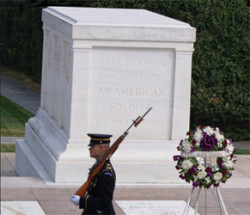
Tomb of the Unknown Soldier (Photo: Arlington National Cemetery) This memorial was created after the great losses of World War I.
(Revise of 2015 post)
Do we need to rethink Memorial Day? Is this Memorial Day unlike the others? Has the holiday’s meaning changed with the pandemic?
If we have been at war with Covid, should a holiday honoring the war dead include the grievous losses of the pandemic?
As happened last year, many traditional public celebrations and family gatherings will be curtailed again.
But a debate over Memorial Day –and more specifically what it means and who it honors? America’s most solemn holiday should be free of rancor. But it never has been.
The heated arguments over removing the Confederate flag and monuments to heroes and soldiers of the Confederacy in New Orleans and provide examples and reminders of the birth of Memorial Day.
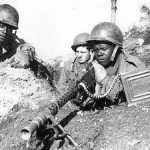
In the Korean War, the U.S. military was integrated. (Source: Library of Congress)
Waterloo, New York claimed that the holiday originated there with a parade and decoration of the graves of fallen soldiers in 1866. But according to the Veterans Administration, at least 25 places stake a claim to the birth of Memorial Day. Among the pack are Boalsburg, Pennsylvania, which says it was first in 1864.( “Many Claim to Be Memorial Day Birthplace” )
And Charleston, South Carolina, according to historian David Blight, points to a parade of emancipated children in May 1865 who decorated the graves of fallen Union soldiers whose remains were moved from a racetrack to a proper cemetery.
Born out of the Civil War’s catastrophic death toll as “Decoration Day,” Memorial Day is a day for honoring our nation’s war dead. A veteran of the Mexican War and the Civil War, John A. Logan, a Congressman and leader of the Grand Army of the Republic, established the first somber commemoration on May 30, 1868, in Arlington Cemetery, the sacred space wrested from property once belonging to Robert E. Lee’s family.( When Memorial Day was No Picnic by James M. McPherson.) The Grand Army of the Republic was a powerful fraternal organization formed of Civil War Union veterans and Logan issued “General Order N.11” calling for a day to decorate the graves of the fallen Union soldiers with flowers.
What can aid more to assure this result than cherishing tenderly the memory of our heroic dead, who made their breasts a barricade between our country and its foes? Their soldier lives were the reveille of freedom to a race in chains, and their deaths the tattoo of rebellious tyranny in arms. We should guard their graves with sacred vigilance.

Abraham Lincoln (November 1863) Photo by Alexander Gardner
From its inception, Decoration Day (later Memorial Day) was linked to “Yankee” losses in the cause of emancipation. Calling for the first formal Decoration Day, Union General John Logan wrote, “Their soldier lives were the reveille of freedom to a race in chains…”
In other words, Logan’s first Decoration Day was divisive— a partisan affair, organized by northerners.
In 1871, Frederick Douglass gave a Memorial Day speech in Arlington that focused on this division:
We are sometimes asked, in the name of patriotism, to forget the merits of this fearful struggle, and to remember with equal admiration those who struck at the nation’s life and those who struck to save it, those who fought for slavery and those who fought for liberty and justice.
I am no minister of malice. I would not strike the fallen. I would not repel the repentant; but may my “right hand forget her cunning and my tongue cleave to the roof of my mouth,” if I forget the difference between the parties to that terrible, protracted, and bloody conflict.

But the question remains: what inspired Logan to call for this rite of decorating soldier’s graves with fresh flowers?
The simple answer is—his wife.
While visiting Petersburg, Virginia – which fell to General Grant in 1865 after a deadly, year-long siege – Mary Logan learned about the city’s women who had formed a Ladies’ Memorial Association. Their aim was to show admiration “…for those who died defending homes and loved ones.”
Choosing June 9th, the anniversary of “The Battle of the Old Men and the Young Boys” in 1864, a teacher had taken her students to the city’s cemetery to decorate the graves of the fallen. General Logan’s wife wrote to him about the practice. Soon after, he ordered a day of remembrance.
The teacher and her students, it is worth noting, had placed flowers and flags on both Union and Confederate graves.
As America wages its partisan wars at full pitch, this may be a lesson for us all.
More resources at the New York Times Topics archive of Memorial Day articles
The story of “The Battle of the Old Men and the Young Boys” is told in THE HIDDEN HISTORY OF AMERICA AT WAR (Now in paperback)
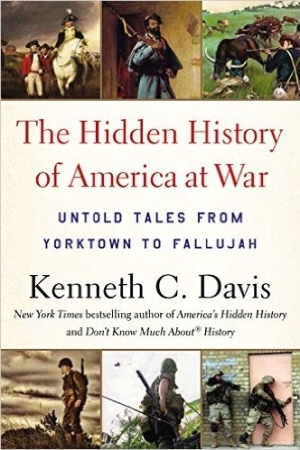
Now In paperback THE HIDDEN HISTORY OF AMERICA AT WAR: Untold Tales from Yorktown to Fallujah
May 23, 2021
Who Said It (5/24/2021)
I always suggest reading this for Memorial Day
Abraham Lincoln, The Gettysburg Address (November 19, 1863)
“Fourscore and seven years ago our fathers brought forth on this continent a new nation, conceived in liberty and dedicated to the proposition that all men are created equal. Now we are engaged in a great civil war, testing whether that nation or any nation so conceived and so dedicated can long endure. We are met on a great battlefield of that war. We have come to dedicate a portion of that field as a final resting-place for those who here gave their lives that that nation might live. It is altogether fitting and proper that we should do this. But in a larger sense, we cannot dedicate, we cannot consecrate, we cannot hallow this ground. The brave men, living and dead who struggled here have consecrated it far above our poor power to add or detract. The world will little note nor long remember what we say here, but it can never forget what they did here. It is for us the living rather to be dedicated here to the unfinished work which they who fought here have thus far so nobly advanced. It is rather for us to be here dedicated to the great task remaining before us–that from these honored dead we take increased devotion to that cause for which they gave the last full measure of devotion–that we here highly resolve that these dead shall not have died in vain, that this nation under God shall have a new birth of freedom, and that government of the people, by the people, for the people shall not perish from the earth.”
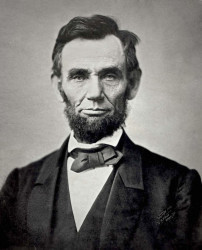
Abraham Lincoln (November 1863) Photo by Alexander Gardner
Complete Text Source: Avalon Project/Yale Law School
Learn more about the Gettysburg Address in Don’t Know Much About the Civil War and more about American slavery and the presidency in IN THE SHADOW OF LIBERTY.

Don’t Know Much About® History: Anniversary Edition
Don’t Know Much About the Civil War (Harper paperback, Random House Audio)
Don’t Know Much About® Memorial Day
https://www.youtube.com/watch?v= (This video was originally posted May 2012. It was produced, edited and directed by Colin Davis.)
Memorial Day brings thoughts of duty, honor, courage, sacrifice and loss. The holiday, the most somber date on the American national calendar, was born in the ashes of the Civil War as “Decoration Day,” when General John S. Logan –a-veteran of the Mexican and Civil Wars, a prominent Illinois politician and leader of the Grand Army of the Republic, a Union fraternal organization –called for May 30, 1868 as the day on which the graves of fallen Union soldiers would be decorated with fresh flowers in his “General Orders No. 11.”
“We should guard their graves with sacred vigilance. All that the consecrated wealth and taste of the Nation can add to their adornment and security is but a fitting tribute to the memory of her slain defenders. Let no wanton foot tread rudely on such hallowed grounds.”
Pointedly, Logan’s order was seen as a day to honor those who died in the cause of ending slavery and opposing the “rebellion.”
Every year at this time, I spend a lot of time talking about the roots and traditions of Memorial Day.
It’s not about the barbecue or the Mattress Sales. Obscured by the holiday atmosphere around Memorial Day is the fact that it is the most solemn day on the national calendar. This video tells a bit about the history behind the holiday.
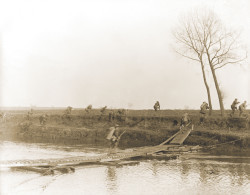
Soldiers of the 146th Infantry, 37th Division, crossing the Scheldt River at Nederzwalm under fire. Image courtesy of The National Archives.
One of the most famous symbols of the loss on Memorial Day is the Poppy, inspired by this World War I poem by John McCrae, “In Flanders Fields”
In Flanders fields the poppies blow
Between the crosses, row on row,
That mark our place, and in the sky,
The larks, still bravely singing, fly,
Scarce heard amid the guns below.
We are the dead; short days ago
We lived, felt dawn, saw sunset glow,
Loved and were loved, and now we lie
In Flanders fields.
Take up our quarrel with the foe!
To you from failing hands we throw
The torch; be yours to hold it high!
If ye break faith with us who die
We shall not sleep, though poppies grow
In Flanders fields.
Source: The poem is in the public domain courtesy of Poets.org
Have a memorable Memorial Day!
The U.S. Dept. of Veterans Affairs offers more resources on the history and traditions of Memorial Day.
(Images in video: Courtesy of the Library of Congress and Flanders Cemetery image Courtesy of the American Battle Monuments Commission)
March 16, 2021
Don’t Know Much About® Mr. Madison
March 16 marks the anniversary of the birth of America’s fourth President, James Madison, also known as “The Father of the Constitution.”
While small in stature, and sometimes overshadowed by his more famous Virginian predecessors, George Washington and Thomas Jefferson, Madison is generally considered one of the greatest of the Founding Fathers for the breadth and influence of his contributions. Like many of the Founders, Madison had reservations about slavery as a contradiction to this ideals, but did little to end the institution. He hoped that slavery would end after the foreign trade was abolished and thought that enslaved African-Americans should be emancipated and returned to Africa.
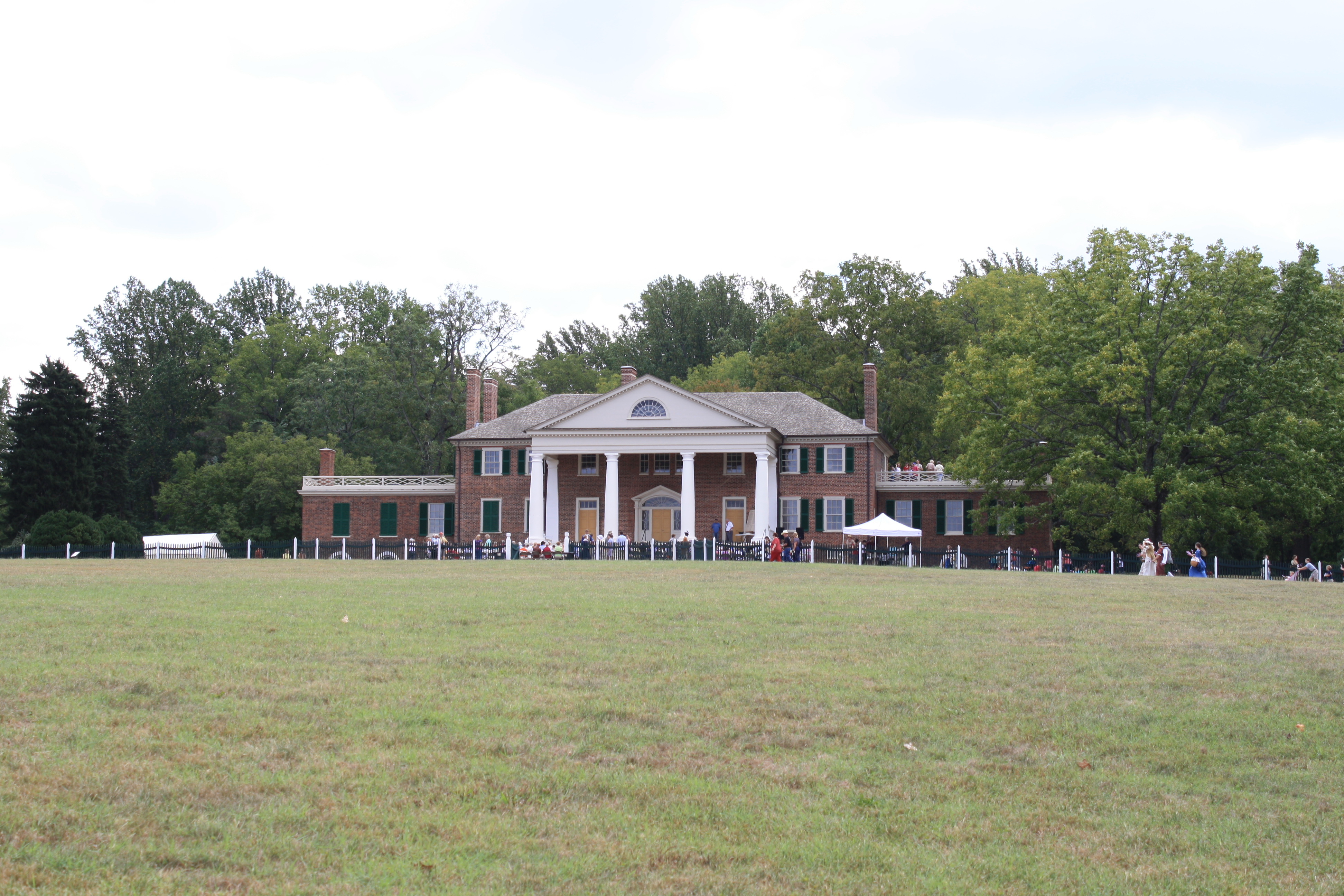
Montpelier, home of James Madison (Photo: Kenneth C. Davis, 2010)
James Madison was born on March 16, 1751 in Port Conway, Virginia. The son of a tobacco planter, he chose the unusual course of going north to study at the College of New Jersey (now Princeton). There he came under the influence of the college President, John Witherspoon, a future signer of the Declaration of Independence, and made a friend of fellow student, young Aaron Burr, son of the College’s founder.
Returning to Virginia, Madison became involved in patriot politics and became a close colleague of his neighbor Thomas Jefferson, serving as Jefferson’s adviser and confidant during the war years while Jefferson was Governor of Virginia.
In 1794, he married the widow Dolley Payne Todd, having been formally introduced by his college friend Aaron Burr.
A few Madison Highlights–
•Secured passage of the Virginia Act for Establishing Religious Freedom (1786), an act that is a cornerstone of religious freedom in America. As part of that effort, he wrote the influential Memorial and Remonstrance Against Religious Assessments. (I discuss the “Remonstrance” in my article “America’s True History of Religious Tolerance” in the October 2010 Smithsonian.)
•Was the moving force behind the Constitutional Convention and was one of the principal authors of the Constitution. Madison’s support of the electoral system is laid out in this essay by Yale professor Akhil Reed Amar “The Troubling Reason the Electoral College Exists.”
•With Alexander Hamilton and John Jay was one of the authors of The Federalist Papers, arguments in favor of the ratification of the Constitution
•Was principal author of the Bill of Rights, which he originally thought unnecessary
Following ratification of the Constitution, Madison was a member of the House of Representatives from Virginia and a powerful Congressional ally of George Washington.
•Drafted the first version of Washington’s Farewell Address
•Supervised the Louisiana Purchase as Thomas Jefferson’s Secretary of State
•Presided over the ill-prepared nation during the War of 1812, the “second war of independence”
I believe there are more instances of the abridgment of the freedom of the people by gradual and silent encroachments of those in power than by violent and sudden usurpations. –June 16, 1788
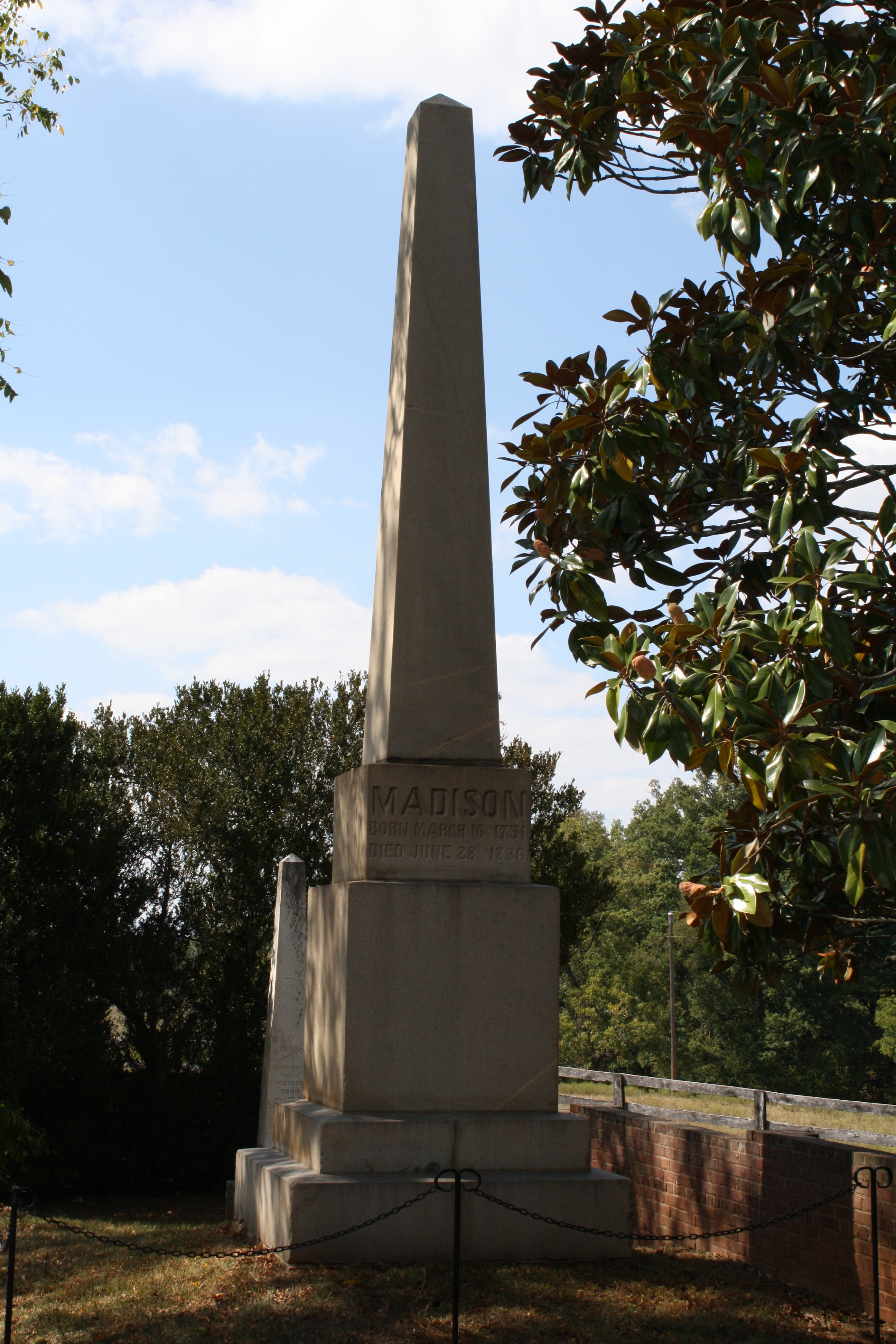
Madison’s grave at Montpelier (Author photo 2010)
Madison died on June 28, 1836 at Montpelier, at age 85. Enslaved servant Paul Jennings was at his bedside and later recalled in a memoir that Madison died, “as quietly as the snuff of a candle goes out.”
James Madison is buried at Montpelier.
The story of Paul Jennings, who was enslaved by Madison and wrote a memoir of working as a servant in the White House, is told in my recent book IN THE SHADOW OF LIBERTY.
LINKS:
The Library of Congress Resource Collection on James Madison.
Madison’s Major Papers and Inaugural Addresses can be found at the Avalon Project of the Yale Law School.


