Jamie Parsley's Blog, page 64
February 14, 2016
1 Lent
 February 14, 2016
Luke 4.1-13
+ Lent is a strange time. It’s so different than the rest of the Church year, for me anyway. Because, what we’re forced to do in Lent is do something I don’t like doing sometimes.
I’m not talking about fasting or confession or giving up something for Lent. No, what Lent forces me to do that I don’t really want to do is: look in the mirror. And not just look—but really look—honestly, bluntly—in the mirror.
That is not fun to do. It is not a pleasant experience to look at ourselves honestly and bluntly in the mirror. It is not fun to confront ourselves. It’s probably easier for most of us to confront the Devil—however we might view this personification of evil—in our own lives.
But, if you notice in our Gospel reading for today, that three-fold commandment of Jesus is all about looking in the mirror and confronting ourselves. We find Jesus repudiating the Devil’s temptations with some strongly worded quotes from Scripture:
“One does not live by bread alone”
“Worship the Lord your God, and serve only [God]”
and
“Do not put the Lord your God to the test.”
When we look at them, these commandments are really all about us. About me—the ego. The Devil becomes this almost peripheral character in our reading, if you notice. He’s kind of like a whispering shadow at the edge of the story. The main characters of this story are, of course, Jesus and us.
So, in our Gospel reading, we hear first that we do not live by bread alone. Looking in that mirror, looking at ourselves, we find that, yes, honestly, we’ve had too much bread—too many carbs—too much of everything. This season of Lent is the prime time for us to look long and hard at our eating practices.
For the most people, we simply eat without giving a second thought to what we’re eating or why we’re eating it. And this goes for drinking too. Certainly we have doctors who tell us that this is one of the leading causes of a good many of our health problems in this country. Nutrition. Food. And too much food. And too much bad food.
When we realize how high the rate of obesity and related illnesses are, we know that food really is a major factor in our lives. When we look at issues like obesity and eating disorders and alcoholism and all kinds of addictions, we realize that there is often a psychological reason for our abuse of food or alcohol.
We do eat and drink for comfort. We do eat physically or partake of others things thinking that it will sustain us emotionally. We put food or drink into that place in which God should suffice. A time of fasting is a time for us to break that habit and to nudge ourselves into realizing that what should be sustaining us spiritually is the spiritual food we receive from God.
Then, we hear “Worship the Lord your God, and serve only [God].” Here again is a major temptation for us. Let’s face it, for us: the world revolves around us. Around me. And one of the sources of our greatest unhappiness is when we realize others don’t feel that way.
We want people to notice us, to like us. Ideally, we would like to have people fall at our feet and adore us. We have all thought about what it would be like to be noticed—truly noticed—when we enter a room, like a movie star at the Oscar’s. OK. Maybe that’s a bit extreme. But, just think about it for a moment. Look at how we feel when we send an email—and there’s no response. Or when we post something meaningful on Facebook—and no one likes it. I hate that!
But, it’s not about others. That’s all about me and my ego. And I’m the only one angry or frustrated. And I put myself in this position. Yes, I might be mad at others, but it’s ultimately MY fault for feeling this way.
We are all susceptible to self-centeredness, to that charming belief that the world revolves me—the individual. That, we believe, will make us truly happy. If we can be fully accepted, fully loved and appreciated.
But Jesus again nudges us away from that strange form of self-idolatry and reminds us that there is actually someone who knows us better than we know ourselves, who knows our thoughts better than we do. We aretruly loved, truly accepted, truly appreciated—by God. And we shouldn’t worry about the rest. Rather than falling to the self-delusion of believing our world revolve around ourselves, we must center our lives squarely and surely on God.
Finally, we are warned not to put the Lord our God to the test. We’ve all done this as well. We have railed at God and shaken our fists at God and bargained with God. We have promised things to God we have no intention of truly keeping. We have all said to God, “If you do this for me, I promise I will [insert promise here].”
Again, like all the previous temptations, this one also revolves around self-centeredness and selfishness. This one involves us controlling God, making God do what we want God to do. This one involves us treating God like a magic genie or a wishing pond.
I’ve done this. I’ve been here. I’ve shaken that fist at God and railed loudly at God.
The realization we must take away from this final temptation is that, yes, God always answers our prayers. But the answer is not always what we want. Sometimes, it’s yes. Sometimes it’s no. Sometimes it’s not yet.
But what we fail to realize in all of this is that those moments in which God does grant us the answer to prayer in the way we wanted, it is only purely out of God’s goodness and God’s care for the larger outcome. It has nothing to do what we do. We cannot manipulate God and make God do what we want. None of us are in the position to do that. And if we had a God that we could do that to, I’m not certain I would truly want to serve that God.
These are the temptations we should be pondering during this Lenten season. When I said earlier that these confessions of Jesus are the basis for our understanding of Lent, they really are. Each of these statements by Jesus are essentially jumping off points for us as we ponder our relationship with God, with each other and with ourselves during this season. What Jesus experienced in that desert, we too experience this Lent—and at many other times in our lives. The confrontation with the Devil in the desert, is often a confrontation with ourselves in the mirror. It is a confrontation with that difficult and dark side of ourselves—that gossipy, self-centered, controlling, manipulative person we sometimes are.
These ego-centric behaviors really don’t promote our egos. They actually hurt our egos in the long-run. Yes, we might have full stomachs, Yes, we might be loved and appreciated and accepted, yes, we would have a fairy-godmother-God who grants all our wishes—but we would not ultimately be very happy. We would still want more and more. But, in our core of cores—in our very spirits—we would still be incomplete and unfulfilled.
At some point during Lent, our job is to stop gazing in the mirror and to turn toward God. Our job is to recognize this God who does truly grant us everything we really need and want, just maybe not in the way WE think those things should be given to us. It is for that realization that we should be thankful during this season of Lent.
So, let us, when emerge from the desert, do so re-focused—not on ourselves, but on the God who truly does provide us with everything we need in this life, and the life to come.


February 11, 2016
Listening to Sufjan Stevens’ “No Shade in the Shadow of the Cross”
Listening to Sufjan Stevens’“No Shade in the Shadow of the Cross”
What we long forhas turned from us,revealing its long backside
and its even longer shadow.And still,even here,
a voice as pristineas distilled waterflows. It murmurs
in this desolate place,which we find so familiarand so terrible
The voice causes that which we long forto pause,
to glance back for a momentinto the agonizing wakeit leaves. From
that raised-up place,from that agony and bloodabove us, there
is movement and recognition.There is a moment ofdistraction from what
must be accomplishedand fulfilled.In this awful place, in
this long and exhaustingrealm, it is the voicethat sustains.
It ripples andcuts through the murk.It is then—
the curtain tornthe hands wrung out,the knees bruised to
the color of monarch-wings—the song ends,and we can stand up
from the dark, bloody earthin a groping mannerand shiver.
Copyright (c) 2016
What we long forhas turned from us,revealing its long backside
and its even longer shadow.And still,even here,
a voice as pristineas distilled waterflows. It murmurs
in this desolate place,which we find so familiarand so terrible
The voice causes that which we long forto pause,
to glance back for a momentinto the agonizing wakeit leaves. From
that raised-up place,from that agony and bloodabove us, there
is movement and recognition.There is a moment ofdistraction from what
must be accomplishedand fulfilled.In this awful place, in
this long and exhaustingrealm, it is the voicethat sustains.
It ripples andcuts through the murk.It is then—
the curtain tornthe hands wrung out,the knees bruised to
the color of monarch-wings—the song ends,and we can stand up
from the dark, bloody earthin a groping mannerand shiver.
Copyright (c) 2016
February 10, 2016
Ash Wednesday
 February 10, 2016
2 Corinthians 5:20b-6:10; Matthew 6.1-6,16-21
+ Fourteen years ago—in 2002—Ash Wednesday fell on February 13. On that Wednesday, I was here, at St. Stephen’s. My friend, Andrea, and I had eaten supper at Juano’s that night and came over for the Ash Wednesday mass. I wasn’t a priest yet. But, I was, to be bluntly honest, in a bad place in my life on that Ash Wednesday. I had just been laid off from a job. And physically I was not feeling well. Later that week, I would have to face that fact that something physically was not right in my life. And a week later to the day, on February 20, I was diagnosed with cancer.
It was a very hard Lent for me that year. For some reason, I think of that Ash Wednesday often in my life. It was an important night for me. I remember, on that night in 2002, that I had made a concentrated resolve to change my life, to “turn my life around.” And just when I thought that was exactly what I was doing, the bottom dropped out.
Not only did something bad happen to me. Something life-threatening happened to me. And I was faced not only with the unpleasantness of life. I was faced with sickness. And death. My own death.
Maybe that’s why that Ash Wednesday and that Lent of 2002 was so important to me. Because, let’s face it: that’s what Ash Wednesday and Lent are all about. Ash Wednesday—and these ashes we are using tonight—are also ways in which we too face these harsh realities of our lives. They are reminders that we, one day, will die. I hate to be the one to tell you that news, just in case you hadn’t realized that before. We are all, one day, going to die.
The traditional phrase for a reminder of our death is Momento Mori. Back “in the day”—we’re talking the medieval and renaissance day—it was common for people to keep some kind of momenti mori around—a reminder of death. Often, that was a human skull- a real human skull. Of course, when you think of it, what makes a better reminder of death than a skull? In those days, one was encouraged to look at the skull as one would look into a mirror, realizing that what one was looking at was really themselves.
Well, tonight, we have our own momento mori. These ashes that we are about to receive are, truly our momento mori—our reminder that we are al going to die one day. To some extent, as morbid as it might seem, I think it wouldn’t hurt us to think about and ponder such things in our own lives.
In our lives, we do go about oblivious to death. We go around as though we are invincible, that we are eternal, that this moment in which we are living will last forever. As much as we might wish for that and hope for that, the fact is, it is simply not the case. We don’t realize that we are bones and ash essentially.
In this service this evening, we are reminded in no uncertain terms that one day each every person in this church this evening will stop breathing and will die. It’s sobering, but it’s what we are reminded of this evening and throughout this season of Lent. We will stop breathing. We will die. Our bodies will be made into something that will be disposed of—either by cremation or burial in the ground.
In my life as a priest, I have presided over many, many funerals, with embalmed bodies and cremated bodies. And, let me tell you, doing so certainly puts into perspective the fact that we are all physically disposable. With cremation so prevalent these days, out momemto mori is not so much a human skull anymore. Our momento mori is nowadays ashes.
I thought about that a lot back during Lent in 2002. I can tell you that that Lent was one of the most difficult Lents of my entire life. But it was also, I have to say, one Lent in which the real meaning of this season was driven home for me.
As I went through the shock of diagnosis, the emotional and physical roller coaster of treatment, I found myself thinking a lot about the fact that I will one day die. I thought about things like the disposition of my body and came to conclusions such as my decision to be cremated and have my ashes buried in the family plot at Maple Sheyenne Lutheran Cemetery in Harwood. Or what the kind of funeral I wanted for myself (which is, of course, a High Requiem Mass with lots of incense).
And I thought a lot about what comes after all that. I thought about where I was going and what that place toward which I was going was going to be like. I thought about my relationship with God, about how faithfully (or unfaithfully) I had followed Jesus in my life. And I thought about Jesus’ own encounter with his mortality in the Garden of Gethsemane.
Sometimes, as horrible as experiences like cancer are, they can be gateway events. They can be events in which we find ourselves opened up to a new understanding and new perspectives on the world and our relationship with God.
That essentially is what Ash Wednesday and the season of Lent are all about. It is a time for us to stop, to ponder, to take a look around us and to take a long, hard, serious look at ourselves and our relationship with God. It isn’t easy to do. It isn’t easy to look at where we’ve failed in our lives and in our relationship with others. It isn’t easy to look at ourselves as disposable physical beings that can so easily be burned to ashes or buried. It isn’t easy to imagine there will be a day—possibly sooner than later—when life as we know it right now will end.
It isn’t easy to shake ourselves from our complacent lives. Because we like complacency. We like predictability. We like our comfortable existence.
However, we need to be careful when we head down this path. As we consider and ponder these things, we should not allow ourselves to become depressed or hopeless. Yes, our mortality is frightening. Yes, it is sobering and depressing to think that this life we find so normal and comfortable will one day end. But this season is Lent is also a time of preparation. It is a preparation for the glory of Easter.
It would be depressing and bleak if ashes and the skull were the end of our story. It would be sad and sorrowful if all we are reminded of when we ponder these ashes is the finality of this life. It would be horrible if we were not able to see the momento moris of our lives as gateways to something larger and more wonderful.
But for us, death is a gateway. Death does lead not to eternal non-existence, bur rather to eternal existence. The darkness of death leads to the glorious light of Easter.
What I like about Lent is that is shows us that, even though we are living in the glorious light of Easter, bestowed on us at our Baptism, it’s not always sunshine and flowers and frivolous happiness all the time. If our Christian faith was only that, it would be a frivolous faith. It wouldn’t be taken seriously because it would ignore a very important part of our lives. But Lent shows us that, as Christians, we are to reflect about where we have failed—where we have failed God, failed others and failed ourselves. And it reminds us that death—death of our loved ones and our own deaths—is simply a fact of life. It is a part of who we are and what we are. It forces us to realize that we are wholly dependent upon God for our life and for what comes after death.
Of course Ash Wednesday is not a time to disparage our bodies, to believe that our bodies are some kind of prisons for our souls. All we do on this Ash Wednesday is acknowledge the fact that we are mortal, that our bodies have limits and because they do, we too are limited. Lent is not a time for us to deny our bodies or see our bodies as sinful, disgraceful things. Rather it is simply a matter of not making our bodies our treasures.
Jesus tells us in tonight’s Gospel not to lay up our treasures on earth, in corrupting things, but to store up our treasures in heaven. A lot of us put more store in our bodies than we need. We sometimes don’t take great joy in our bodies at all, but rather abuse our bodies or become inordinately obsessed with our bodies and in what used to be called “the way of the flesh.” We eat too much. We drink too much. We get lazy sometimes. And we let our bodies go sometimes. This time of Lent is a time for us to find a balance with our physical selves as well as with our spiritual selves. That is really the true meaning of Lent.
Where are our treasures? Are they here, in the corruptible, or in they in the incorruptible? This is the question we must ask. This is the question we should be pondering throughout this season.
So, as we head into this season of Lent, let it be a truly holy time. Let it be a time in which we ponder whatever momento mori we might have in our lives. Let it be a time in which we recognize the limitations of our own selves—whether they be physical or emotional or spiritual.
But more than anything, let this holy season Lent be a time of reflection and self-assessment. Let it be a time of growth—both in our self-awareness and in our awareness of God’s presence in goodness in our life. As St. Paul says in our reading from this evening: “Now is the acceptable time.” “Now is the day of salvation.” It is the acceptable time. It is the day of salvation. Let us take full advantage of it.
February 6, 2016
3 Years Vegetarian
 When I went vegetarian for the first time for any real length of time, it was March 1, 1994. I was 24 years old, and doing so was an accomplishment for someone who thought he had no discipline about food choices. But for 3 years, 11 months and 9 days, I was a very faithful and strict vegetarian. One of the biggest regrets of my youth was giving up my vegetarian diet in 1998.
When I look back as to why I gave it up, it had to do mainly with my health. To be blunt, I wasn’t feeling well, and I blamed my diet. My blame was partly true. It WAS my diet, but it was not my vegetarianism per se, I now realize, that was making me sick. It was all the cheese and dairy I had been using to replace the meat I had given up in 1994. But in 1998, I was still under the impression that dairy was not a bad thing.
Sadly, if I thought I wasn’t feeling well in 1998, I had no idea what was in store for me. Four years later, of course, came my cancer diagnosis. I do believe my diet had something to do with my cancer. But those realizations would only come much later, after much more trial and error.
Over the years I would go back to be a vegetarian, following the same patterns: give up meat, eat more cheese and dairy. Ethically, I still did not think that eating dairy was an issue. I was still living under the impression that cows needed milking, so partaking of milk and cheese certainly doesn’t hurt them. And, although I always felt slightly better as a vegetarian than as a meat-eater, I still believed that any issues with my health had little to do with my diet.
Three years ago I decided finally to give up meat for good, after several years of struggle. Meat was just no longer tasting good for me. I found myself suffering minor bouts of food poising (or suffering from symptoms like food poisoning) more and more often. And my body just wasn’t able to take it as it used to. So, after coming home from my annual Florida vacation, I had one final chicken burrito (of which I ate only a few bites). That poor chicken was the last meat I have eaten since.
It would take me another nine months or so to finally decide that it was the dairy that was making me feel somewhat rotten. Only then did the whole diet start coming together and my health improved drastically.
But, for now, I celebrate this first step down that road to health. I am thankful for this day and all it holds for me.
The big anniversary, of course, will happen on January 11, 2017, when I will make it past that 3 years, 11 months and 9 days threshold I didn’t make it to in my twenties.
January 24, 2016
3 Epiphany
 January 24, 2016
Luke 4.14-21
+A few months, you might remember, I shared a poem by the German poet and theologian, Dorothee Soelle. It was a poem called “Credo,” and it received quite a bit of positive feedback.
Here it is again:
Credo
by Dorothee Soelle(adapted by Jamie Parsley) I believe in a Godwho created earthas something to be moldedand formedand tried,who rules not by lawswritten in stonewith no real consequencesnor with distinction between thosewho have and those who have notexperts or idiotsthose who dominate and those who are dominated
I believe in a Godwho demands that creationprotests and questions God,and who works to changethe failures of creationby any means.
I believe in Jesuswho, as “someone who could do nothing”as we all areworked to change every injusticeagainst God and humanity.In him, I can now seehow limited we are,how ignorant we can be,how uncreative we have been,how everything attemptedfalls shortwhen we do not do as he did.
There is not a dayin which I do not fearhe died for nothing.Nothing sickens me morethan the thoughtthat he lies at this momentdead and buriedin our ornate churches,that we have failed himand his revolutionbecause we feared insteadthose self-absorbed authoritieswho dominate and oppress.
I believe in a Christwho is not deadbut who livesand is resurrected in usand in the flame of freedomthat burns awayprejudice and presumption,crippling fear and destroying hatred.I believe in his ongoing revolutionand the reign of peace and justice that will follow.
I believe in a Spiritwho came to us with Jesus,and with all thosewith whom we sharethis place of tearsand hungerand violenceand darkness—this city of God—this earth.
I believe in peacewhich can only be createdwith the hands of justice.I believe in a life of meaning and purposefor all creation.And I believebeyond all doubtin God’s future worldof love and peace.Amen.
One of the things I did not mention about Soellee was what KIND of theology it was she followed.
Dorothee Soelle was a Liberation Theologian. And when I first read her back when I was a teenager, Liberation Theology was not only being widely discussed, it was also quite controversial. (Which is why I liked it, of course). Soellee’s books and poems were very important to me back then. And they still are.
And so is Liberation Theology. Liberation Theology jarred me out of my old way of thinking about the Gospels and forced me to look at the message of Jesus as truly a proclamation of liberation to the poor and the disenfranchised. Liberation Theology, which originally focused on the poor in Latin America, is now much more than it was back in those early days. Liberation Theology has spread and been defined and redefined many times. It now encompasses liberation theology for women, for GLBT people, black people, for Asian people, for African people. It’s an important theological expression. The current Pope, Francis, is no doubt a child of this movement, although he is very careful not to associate it with per se.
Back in those early days, Liberation Theology and Marxism were often used together and, as a result, Liberation Theology was seen being ultra-radical. Whatever the case, Liberation Theology is important.
In our Gospel reading for today, we find this seed for all liberation theology. I’ll get into that in a second. First of all, I want to stress that my view of liberation theology has not been political, per se. I know that it’s easy to let this message of Jesus become a political statement.
I once even heard a pastor preach on the fact that Jesus died as a political prisoner, not a religious one—that ultimately the message of Jesus was not religious at all but political. As someone who daily ponders the message of Jesus, who wrestles with it, meditates on it, and who tries, more often not failing in my attempt, to live out the message of Jesus, I am solidly convinced that Jesus’ message was and remains purely religious. It’s all about our relationship with God and with one another. That doesn’t mean that this religious understanding of care for the poor and oppressed shouldn’t fire our political understanding, but I remain firmly convinced that it is ultimately religious.
So, back to our Gospel for today. By Jesus standing and proclaiming who is and what he has come to do, he really sets the standard for us as well.
We too should proclaim our faith in God in the same way. Now, as I say that I don’t mean we should be obnoxious and fundamentalist in our views. I think too many Christians proclaim themselves as Christian with their lips, but don’t live it out in their lives and by example (and I am guilty of this myself).
As the great theologian Richard Rohr famously says, “We worshipped Jesus instead of following him on his same path. We made Jesus into a mere religion instead of a journey toward union with God and everything else. This shift made us into a religion of “belonging and believing” instead of a religion of transformation.”
Because the Spirit of God was upon Jesus, and because he was appointed to bring good news to the poor, that truly becomes our mission as well because we follow Jesus. Because Jesus breathes God’s Spirit upon us, that same mission that the Spirit worked in Jesus is working in us as well. And we should, like Jesus, stand up and proclaim that mission to others. We, like Jesus, should breathe God’s Spirit on others. That is our mission as followers of Jesus.
How do we do that? Jesus has empowered us to do what he says in today’s Gospel: We are to proclaim release to the captives, and recovery of the sight to the blind, to let the oppressed go free and to proclaim the year of the Lord’s favor.
Well, that sounds great. But…how do I do that in my life? It’s easy for priests and poets to do that, you might say. But how do I do that in my own life? What does that mean to us—to us who are here, in this place?
This is what it means: It means that we are not to go about with blinders on regarding those with whom we live and work. It means that we are surrounded by a whole range of captives—people who are captive to their own prisons of depression and alcohol and drugs and conforming to society or whatever. Our job in the face of that captivity it to help them in any way we can to be released.
It means that we are not to go about blind and not to ignore those who are blinded by their own selfishness and self-centeredness. I am still so amazed by how many people (especially in the Church, amazingly enough) who are so caught up in themselves. (I, like all of us, have been guilty of this) I really think self-centeredness is a kind of blindness.
One of the greatest sins in the Church today is not all the things Bishops and church leaders say is dividing the Church. The greatest sin in the Church today:
Hubris.
Self-centeredness. Selfishness. That “Jesus and Me” attitudes that essentially throws everyone else to wayside. Hubris causes us to look so strongly at ourselves (and at a false projection of ourselves) that we see nothing else but ourselves.
By reaching out others, by becoming aware of what others are dealing with, by helping others, we truly open our eyes and see beyond ourselves. When we do these things, we are essentially letting the oppressed go free. And I would add here that our job isn’t only to do this for others. It’s also to do this for ourselves. Just as people become self-centered, so conversely I think some people also deny themselves so completely that they slowly and systematically destroy themselves. They neglect themselves. Which anyone who does ministry on a regularly basis knows we simply cannot do. We cannot help others if we are not taking care of ourselves to some extent. This liberation from oppression, blindness and captivity is just as clearly proclaimed to ourselves as it is to others.
It’s all about balance.
Finally, we are called to proclaim the year of the Lord’s favor. This is simply the icing on the cake. Once we have proclaimed liberation, we must then proclaim God’s blessings on us. God favors a liberated people. God does so , because God can only effectively work through a people who have been liberated from captivity, blindness and oppression.
This to me is where the heart of true liberation theology lies. Although I still believe that liberation theology needs to speak to the poor and oppressed of the world, I also have realized quite acutely that the poor and oppressed of our world—here and now—are not only those who are poor financially. The poor and oppressed of our world are those who are morally, spiritually and emotionally poor, as well.
The oppressed are still women and Gay and Lesbian and bisexual and transgender and asexual people and those who don’t fit the social structures of our society. They are the elderly and the lonely. They are the criminals and those who are leading quietly desperate lives in our very midst. We, as followers of Jesus, are to proclaim freedom to all those people who are on the margins of our lives both personally and collectively. And often those poor oppressed people we need to be proclaiming this year of the Lord’s Favor to might be our own very selves.
This is the year of the Lord’s favor. I am not talking this particular Year of Our Lord. I am talking about this moment and all moments in which we, anointed and filled with God’s Spirit, go out to share the Good News of Jesus by word and example.
This moment we have been given is holy. And it is our job is to proclaim the holiness of this moment. When we do so, we are making that year of the Lord’s favor a reality again and again.
So, let us proclaim the good news. Let us bring sight to the blind, and hope to those who are oppressed and hopeless. Let us be liberation theologians in our deeds to those who are crying out (in various ways) for liberation which only Jesus and his followers can bring. And when we do, we will find the message of Jesus being fulfilled in our very midst.
January 17, 2016
2 Epiphany
 Annual Meeting SundayJanuary 17, 2016
Isiah 62.1-5; John 2.1-11
+ Today is our Annual Meeting Sunday. And I’m always pleased when we can get together to celebrate St. Stephen’s. There’s a lot to celebrate, after all.
Now, I know some of you might be groaning. Not another celebration, you’re thinking. We, that’s what we do here. We do that a lot here. And we do it very, very well. It’s very natural to us. We celebrate at the drop of a hat here. And that’s a very good thing to do. After all, God is doing very good things here. We should celebrate that.
Now, I know it might not seem like there’s a lot to celebrate maybe in our larger Church. This week, of course, the Primates of the Anglican Communion met—the primates are the presiding bishops of each church body of the Anglican Communion. The meeting was, for the most part…let’s say…a bit disappointing. We, in the Episcopal Church, were reprimanded by them in that meeting for our so-called “breech” of Catholicism by our vote last summer for marriage equality. And as a result, we had our wrist slapped. And a collective finger was wiggled at us. And we were scolded.
*shrug*
So be it.
As Bishop Chilton Knudson of the Episcopal Diocese of Maryland wrote to her diocese:
“The sky is not falling!”
It’s discouraging, yes. It’s disheartening. It’s disappointing to see that equality is still not a common denominator in the Church.
For us at St. Stephen’s, that’s no surprise. We’ve been here before. But, we know this: We as a congregation certainly made the right choice for us in what did in December. We sided with Christ and his Gospel, as we try to live them out in our congregational life. And oftentimes, as I have said again and again, choosing in such a way often means receiving wrist slaps (or much worse). It often means treading through discouragement and disappointment. It often means being seen by others as representing everything wrong so we can do what we feel is right.
But, God is doing very good things for us, despite what Bishops and Archbishops might say. Well, there was another Bishop who said some good things. Our own presiding Bishop, Michael Curry, probably said it best—and his words are words that could be used for everything we do and have done here at St. Stephen’s:
"Our commitment to be an inclusive church is not based on a social theory or capitulation to the ways of the culture, but on our belief that the outstretched arms of Jesus on the cross are a sign of the very love of God reaching out to us all. While I understand that many disagree with us, our decision regarding marriage is based on the belief that the words of the Apostle Paul to the Galatians are true for the church today: All who have been baptized into Christ have put on Christ. There is no longer Jew or Gentile, slave or free, male or female, for all are one in Christ.”
All are one in Christ. See, the sky is not falling In fact, look! There’s a wide and beautiful sky before us. And we should celebrate that.
In our Gospel reading for today, we also get another celebration. It is the wedding at Cana. It’s such a great celebration the good wine has run out and the wedding feast is about to crash quickly. Yup, I’ve been at those weddings too. But Jesus of course—as always—saves the day. What does he do? He turns water into wine. And when he does, there is a renewed sense of joy and exultation.
That I think is the gist of this experience from our gospel reading. It is not just some magic trick Jesus performs to wow people. It is not some action he performs at the whim of his mother. He performs this miracle and in doing so instills joy in those gathered there.
But more than that, by doing this he does what we always does when he performs a miracle. He performs miracles not just for the benefit of those at the wedding. It is for our benefit of us as well. Because by performing this miracle, he is giving us a glimpse of what awaits us all.
If we look closely at the story and at some of the details contained in it, we will find clues of the deeper meaning behind his actions.
First of all, let’s look at those jars of water. This is probably the one area we don’t give a lot of thought to. But those jars are important. They are not just regular jars of water. They are jars of water for the purification rites that accompany eating in the Jewish tradition. That water is essentially sacred. We talked about this last week when we talked about the waters of baptism. It is used to purify people and things. A good Jew at that time would wash their hands in this water so they could eat their food.
There’s a wonderful phrase that perfectly captures what Jesus did: he turns the “waters of purity into wine.” And not just any wine. But abundant wines that bring about a joy among those gathered.
In a sense, what Jesus has done is he has taken the party up a notch. What was already probably a good party is now an incredible party. It’s a beautiful image and one that I think we can all relate to.
And I think it speaks loudly to us on this Annual Meeting Sunday. We, at St. Stephen’s are planning this coming year. We are looking ahead. We are planning a year in which there are so many great and wonderful opportunities and possibilities for us as a congregation.
God has blessed us—and blessed us abundantly, here. Look around at all the wonderful ministry we are experiencing. Look around at all the improvements and the good and positives changes that are happening here.
When God blesses, it is not just a little blessing here and there. It is abundant blessings. It is like the purification water turned into abundant wine.
The best part of this view of the wedding at Cana is that Jesus is saying to us that, yes, there is joy here in the midst of us, but a greater joy awaits us. Greater joys await us in our future together here at St. Stephen’s And an even greater joy waits when the Kingdom of God breaks through into our midst.
When these things happen, it is very much like a wonderful wedding feast. When they happen, the waters of purification are turned into the best-tasting wine because we will no longer have to worry about issues like purity. When we see these wonderful things happening in our midst, we can look closely at it and see God in our midst.
We can certainly see God working in the ministry we do together here at St. Stephen’s. There are abundant blessings in our midst. They are surrounding us on this day in which we gather to plan another year.
As we plan another year of looking for and finding Christ in our midst. Another year of following Jesus in all that we do. And as we do, there is a sense of joy at this—a joy very much like the joy one feels at a wedding feast—that is, a wedding in which true love is celebrated and blessed. That is our joy today. That is the way we celebrate—and celebrate well—here.
So, let us look and find Christ in this water turned to wine. Let us continue to find Christ in all the wonderful blessings we have been granted here in our congregation and in our own lives. And when we do, we too will be amazed at all the wonderful and amazing ways God has blessed us and supplied us to continue to do what we do best—to love, and to love fully and completely. To accept and to accept radically.
The sky is not falling. There is beauty, even today, even despite the bitter cold, despite the hardships of life, despite the scolding from those in authority, despite the frustrations of ministry.
The prophet Isaiah says in our reading today,
“You shall be a crown of beauty in the hand of the Lord,And a royal diadem in the hand of God.
“You shall no more be termed Forsaken,And your land shall no more be termed Desolate…For the Lord delights in you.”
God delights in us. How amazing is that? God delights in us! That is what we should be celebrating today! Amen.
January 12, 2016
Dorothy Tronnes funeral
 The Funeral Liturgy forDorothy Tronnes(June 19, 1023-January 9, 2016) Hanson-Runsvold Funeral Home
Fargo, North DakotaJanuary 12, 2016
+ As I said earlier, it is a real honor for me to be here and to officiate at this service. As I said at the beginning of the service, I am a cousin of the family. Dorothy has been a very important and vital part of our family for a very long time.
I loved Dorothy, as most of us did who are here today. And I am going to miss her very, very much. Although we all knew this day was coming, although there is a relief that Dorothy isn’t suffering anymore, I gave to say: this is hard. I don’t want to be saying goodbye to Dorothy today. Yes, I know she had a long life. Yes, I know she was tired. I know it was time for her to go. But, it’s still so hard. And I am going to miss her very much.
I will miss so much about her. Every time I would visit her, she would always be so happy to see me. She would brighten right up when I would I come in to see her. And I enjoyed that. I have always been very grateful for that. And I will miss that.
As I said, I, like everyone here, will miss Dorothy dearly. I will miss her laugh—that smile of hers. I will miss her great sense of humor. And I will miss her strength.
I know that her life wasn’t always easy at times. There were set-backs in her life. But, she was a great example to us of how, even despite hardships, even despite difficulties, these hard things in life won’t defeat us. She could be tough and very strong. And that always impressed me. And we saw that strength in her dying as well.
I can tell you that she was prepared. Last Thursday I went to Villa Maria and spent some time with her. I prayed with her, I anointed her and just spent some time with her. And I have no doubt that, as she was making that transition to the next life, we was fully prepared. She knew what awaited her after this life. And it did not frighten her.
As she approached the end of her life, she knew she was loved—and loved deeply—here, by her family and all of us who loved her. But she was ready to go and be with her one, true love—Oscar.
And that is where she is right now. She is there. She left here surrounded in love and she arrived there surrounded in love.
That thought comforts us today. For us who did love her, this is still hard. But, as difficult as it is right now, the reality is this. We are saying goodbye, yes. But it is only a temporary goodbye. It is a goodbye until we see each other again. Dorothy, I can tell you, had a very deep faith and belief that we would, one day, all see each other again.
The scripture readings we have today speak clearly to us. Our reading from Proverbs could have been written with Dorothy very much in mind. For some reason, we don’t hear this particular scripture very often. And I don’t understand why, because I think it’s beautifully. In it, the author writes,
“An excellent wife who can find?
She is far more precious than jewels.She dressed herself with strength and makes her arms strong.”
That’s Dorothy, if I ever heard it! A bit later we hear,
“Strength and dignity are her clothing,
and she laughs at the time to come.”
Dorothy was certainly clothed in strength and dignity—and anyone who is certainly does not fear the future or anything this life can throw at us. A bit later we hear,
“She looks well to the ways of her household
and does not eat the bread of idleness.
Her children rise up and call her blessed;
her husband also, and he praises her…”
I don’t think I need to add much to that. Anyone who knew Dorothy knew she definitely did not eat the bread of idleness. And no one is praising more loudly today than her children. And yes, even Oscar today is praising Dorothy. Yes, this was the Dorothy we knew and loved. And the consolation we can take away today is that the God she knew has now gathered all that was good and strong and joyful about her into the land of unending Light. All that joy, all that love, all that life that was contained within her—all of that is not gone today. It is not lost.
Today, all the good things that Dorothy Tronnes was to us—that woman of life and strength and joy—all of that is not lost. It is not gone. Rather all of that is alive and dwells now in a place of beauty and Light inaccessible. All of that dwells in a place of peace and joy, where sorrow and pain are no more, neither sighing, but life everlasting. In a place in which, there never again be any more tears. Dorothy will never cry another tear again.
Sadly, we’re not at that point yet in our own lives. We will shed more tears. Certainly today and tomorrow we will shed more tears.
But, for us who are left, we know that that place awaits us as well. That place of light and joy awaits each of us as well. And we will have the opportunity to dwell there. Yes, I am brutally honest today. I will miss Dorothy very, very much. We will all miss her and will feel her loss for a long time to come. But, on this day in which we bid her this temporarygoodbye, let us also be thankful. Let us be thankful for this woman whom God has been gracious to let us know and to love. Let us be thankful for her example to us. Let us be thankful for all that she has taught us and continues to teach us. Let us be grateful for the love she felt for us and the love we felt for her. And let us be grateful for all she has given us in our own lives.
Into paradise may the angels lead you, Dorothy. At your coming may the martyrs receive you, and bring you into the holy city Jerusalem.
Amen.
January 10, 2016
1 Epiphany
 Baptism of Our Lord
January 10, 2016
Luke 3.15-17, 21-22
+ I know it’s not something we want to hear about today, on this bitterly, bitterly cold morning. In fact, just thinking about it makes us even colder. But there’s no getting around it. If there’s a theme for this Sunday it’s…
Water.
And it’s a very good thing to be considering. It is probably the natural element we most take for granted. And yet it is one of our most vital. We depend upon water. It nourishes us. It cleans us. It delights us.
In our Western society, we take for granted the fact that our water is clean. In other parts of the world, water isn’t so clean. In other parts of the world, water sometimes is a source of illness. In some parts of the world they have little idea of the luxury of something like cold water—or even ice for that matter.
As we’ve known here in this part of the country over the years, water can also be a destructive force when it comes to the matter of floods. Water, as vital as it is, can also destroy. It can destroy property, hopes, dreams and even lives.
For us, as Christians, water truly is the source of our spiritual lives. Throughout Scripture, we find ourselves nourished by and reminded of the importance of water. The authors of our scriptures, coming as they did from such an arid place as the Middle East, no doubt appreciated water in ways we don’t. And that appreciation certainly affected their spirituality. Certainly, we find the image of water returning again and again in scripture. Each time Scripture references water, it does so as a source of life, as a source of renewal, as a source of God’s saving grace—even in the instance of Noah’s flood.
Water is important to us as humans. And it is important to us as Christians.
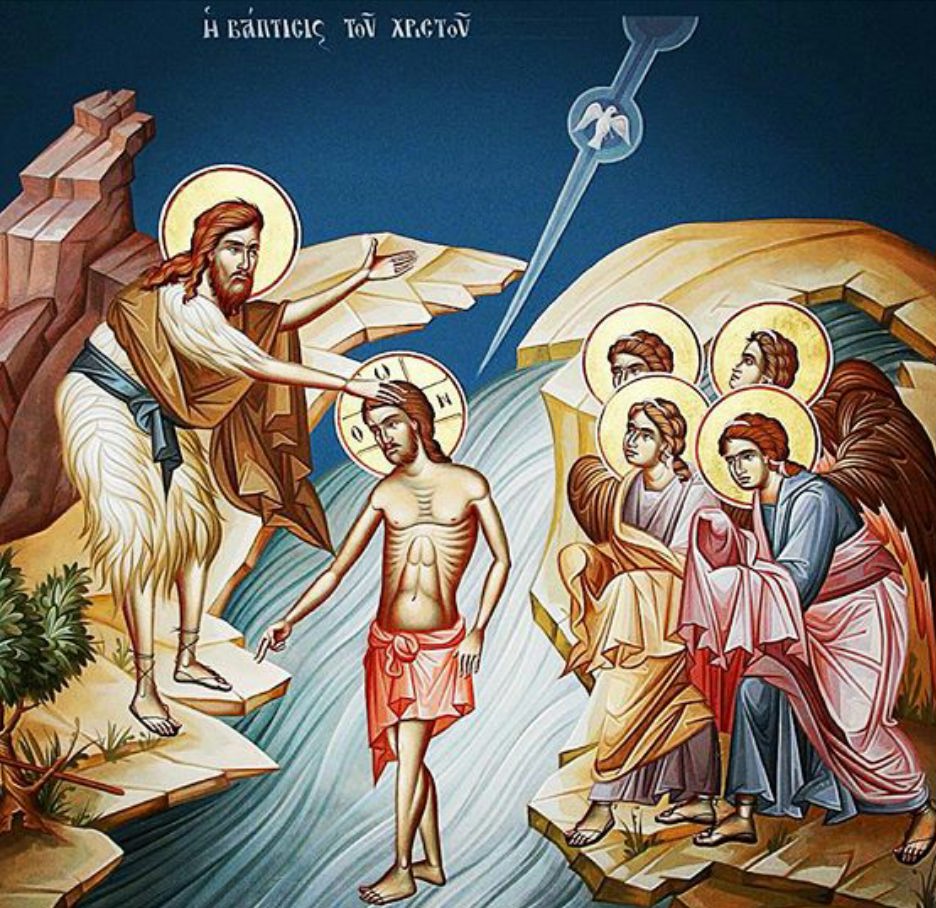
In today’s Gospel reading, we find probably the most profound expression of how important water is to us as Christians. We find that first great example being set. As Jesus comes out of those waters, as the Spirit, like a dove, descends upon him, he hears the words:
“You are…my Beloved; with you I am well pleased.”
Here the standard is set. Here the breakthrough has happened. From now on, this is essentially what has been spoken to each of us at our own baptisms:
“You are my Beloved; with you I am well pleased.”
For most of us, we have no doubt taken for granted our baptisms, much as we have taken for granted water itself. We have viewed baptism as no more than a christening service for babies—a kind of dedication ceremony. Baptism is, obviously, much, much more than that. Baptism is THE defining moment in our lives as Christians. Whether we remember the event or not, it was the moment when our lives changed. It was the moment we became new. It was, truly, our second birth. When some Christians ask you, “Have you been born again?” you can tell them in no uncertain terms: “Oh, yes!”
But event that doesn’t truly convey what baptism is for us. What happened to Jesus in those waters, happened to us as well. In the waters of our baptism, we were reborn as children of our loving and caring God. We became what was Jesus is. We became children of God. We can, from the very moment of our baptism, trace our relation with God our Parent—the God who recognizes us and loves us and accepts us and embraces us.
I have preached this so much over the years about this, but because of this relationship formed in our baptism, our own baptisms are important to us. You have heard me many times encouraging people to celebrate the anniversary of their baptism much as they would celebrate any other important anniversary in their lives. I always encourage people to find out the date of their baptism. Or, I encourage them to let me help them find out. That is why here, at St. Stephen’s, we remember the anniversary of our baptismal dates in our intercessions during the Eucharist.
Now, my baptism date is February 8. I actually framed a copy of my baptismal certificate and have hung it on my wall, along with those other certificates of meaning for me—my certificates of ordination to the diaconate and priesthood, my masters degrees, my oblation certificate from when I became an Oblate of St. Benedict. In fact, my baptismal certificate is probably more meaningful in many ways that any of them because without my baptism I wouldn’t have most of those other certificates. Well, except for maybe one of my Master’s Degrees. I also celebrate the anniversary of my baptism, as well as the baptism anniversaries of my loved ones. And whenever I baptize anyone, I write down the date in my own personal ordo of dates and pray for them on the anniversary.
So, why the importance of this one single event? Well, the bond that is made at baptism is one that truly can never be broken. That relationship that was formed with God in those waters is eternal.
In baptism, we become God’s child. Forever. It is a bond that can never be broken. We can try to break it as we please. We can struggle under that bond. We can squirm and resist it. We can try to escape it. But the simple fact is this: we can’t. For ever is for ever.
Now, we might not want to have this bond anymore. Some of those babies who grow up will make clear later on that they don’t want this bond anymore. But, no matter how much we may turn our backs on God, God never turns away from us. No matter how much we try to turn away from God, to deny God, to pick God apart and make God something other than who God is, God never turns away from us. God never denies us. Why? Because that bond, formed in those waters, is eternal and binding. And God will never turn away one of God’s children.
What Baptism shows us, more than anything else, is that we always belong to God. It is shows us that God will never deny us or turn away from us. It shows us that, no matter what we might do, we will always belong to God. Always. For ever.
In this way, Baptism is truly the great equalizer. In those waters, we are all bathed—no matter who we are and what we are. We all emerge from those waters on the same ground—as equals. And, as equals, we are not expected to just sit around, hugging ourselves and basking in the glow of the confidence that we are God’s own child. As equals, made equal in the waters of baptism, we are then compelled to go out into the world and treat each other as equals. We are called to go out into the world and make a difference in it. And we are called to act like Children of a loving God.
That means we have to fight ourselves sometimes. We have to fight to not become negative people. We, as loved children of a loving God, must work hard to not be manipulative, controlling, gossipy, backbiting, unloving people. We must not be what our critics accuse of us being.
We must love and respect each other equally. Our baptism doesn’t set us apart as special people. It forces us out into the world to be a part of the world and, by doing so, to transform the world.
So, in those waters of baptism, something truly incredible happened for us. We went into those waters one person, and emerged from those waters as someone else completely. It was an incredible moment in our lives, just as it was in the life of Jesus, who led the way and showed us that Baptism was an incredible outpouring of God’s love and light into our lives.
So, with this knowledge of how important it is, let us take the time to meditate and think about your own baptism and the implications it has in your life. And when we do, let us remember and celebrate the bond that was formed with our loving God in those waters on that marvelous day we were baptized. Find out the date of your baptism and celebrate it.
In a few moments, I will come through the nave and will sprinkle you with water. As that water touches, remember how God loves you and cherishes you. And when you enter this church, and when you leave it, pay attention to the baptismal font in the narthex and the blessed water in it. Touch that water, bless yourselves with it, and when you do, remember it as a reminder of that wonderful event in your life which marked you forever as God’s very own.
Those words spoken to Jesus on the day of his baptism are being spoked to us again and again. Let us listen to those words. Let us believe those words. And let us celebrate those words that Gods speaks to each of us—
“You are my Beloved; with you I am well pleased.”
January 3, 2016
Epiphany
 January 3, 2016
Matthew 2.1-12
+ Now, I try. I try very hard to read the “signs” when I see them or hear them. God sends us signs as times in our lives. Little reminders. Sometimes, those signs in our lives are blaring at us. Other times, they are so subtle, we wonder: is that a sign from God? Should I be responding to it in some way?
I wish I could have a sign like these wise men. I mean, look at them. A star! Not very subtle.
Still, even if a star like that appeared as a sign, I’m still not certain I would follow it. I doubt any of us would. We certainly wouldn’t follow a star with some vague notion of a king being born. It probably wouldn’t mean much to us, prophecy or not. It would take great faith and great bravery to load up everything, including valuable like gold and spices into that time of high jacking and robbery and just head off into the unknown.
But these men did just that. These “wise” men did something that most of us now days would think wasn’t that wise—in fact, it was naïve and dangerous.
Originally, of course, the word used was “astrologers,” which does add an interesting dimension to what’s occurring here. Astrologers certainly would make sense. Astrologers certainly would have been aware of this star that appeared and they would have been able to see in that star a unique sign—a powerful enough of a sign that they packed up and went searching for it. And it certainly seems like it was a great distance. They probably came from Persia, which is now modern-day Iran. And they would’ve come in a caravan of others.
These Magi are mysterious characters, for sure. We popularly see them as the three wise men, but if you notice in our Gospel reading for today, it doesn’t say anything about there being three of them. There might have been four or five of them for all we know. But, I love the whole story.
Certainly, it might seem strange that I am talking about the Christ child and the Magi. It’s the beginning of January, after all. Christmas happened almost two weeks ago. Most of us have put away our Christmas decorations. Trees came down quickly in the first few days after Christmas, the rest in the days immediately after New Years. Since we’ve been hearing about Christmas for months, we are maybe a little happy to see the Christmas season go away for another by this time. I, for one, am happy we don’t have Christmas commercials and songs all over the place.
We’re ready to put those trappings aside and move on. The other day I saw St. Patrick’s decorations for sale. So, we’re definitely ready to move on. The fact is: the Christmas season, for the Church, began on Christmas Eve and ends on Wednesday evening with the actual feast of Epiphany, which we re celebrating today.
So, what is the Epiphany really? Well, the word itself—Epiphany—means “manifestation” or “appearing.” In this context, it means the manifestation of Christ among us. God has appeared to us. And in the story that we hear today, it is the appearing of God not only to the Jews, but to the non-Jews, as well, to the Gentiles, which we find represented in the Magi—those mysterious men from the East.
Epiphany is the manifestation of God in our midst. Epiphany is a moment of realization. In this feast we realize that God is truly among us—all of us, no matter our race or our understanding of this event. Epiphany is the realization that God is among us. Not in some blazing cloud. Not in some pillar of fire. But in the person of this little child, Jesus.
Over the last month or so, we, as the Church, have gone through a variety of emotions. Advent was a time of expectation. We were waiting expectantly for God to come to us. Christmas was the time of awe. God was among us and there was something good and wonderful about this fact.
Epiphany, however, gets the rap for being sort of anti-climactic. It is the time in which we settle down into the reality of what has come upon us. We realize what has happened and we accept it. A bit of the awe is still there. A bit of wonder still lingers.
In the Gospel, the wise men are overcome with joy when they see the star stop over Bethlehem. But, for the most part, despite the joy they felt, we are now moving ahead. There are no more angels singing on high for us. The miraculous star has begun to fade by this point. The wise men have presented their gifts and are now returning to home to Persia. It is a time in which we feel contentment. We feel comfortable in what has happened.
But, in a few weeks, this is all going to change again. We will soon face the harsh reality of Ash Wednesday and Lent. Now, I know it’s hard even to think about such things as we labor through the winter, as mild as it has been. But it is there—just around the corner. The time of Christmas feasting will be over. The joys and beauty of Christmas will be replaced by ashes and sackcloth and, ultimately, by the Cross.
But that’s all in the future. Christmas is still kind of lingering in our thoughts today though and, in this moment, we have this warm reality. God has appeared to us, as one of us. When we look upon the face of the child Jesus, what do we see? We see ourselves. But we see more. We see God as well.
In this Child the divine and the mortal have come together. And for this moment—before the denial of our bodies in Lent, before the betrayal and torture of Holy Week, before the bloody and violent murder of Good Friday, we have in our midst, this Child. And this Child reminds us that we are Children of this God as well.
Today, we are definitely being reminded that we are children of God. Today, we celebrate the baptism of Parker. Our baptism reminds us very clearly that we are children of a loving and caring God.
The Episcopal priest and biblical scholar, Bruce Chilton, once wrote about baptism:
“Baptism…was when…God sends [the] Son into every believer, who cries to God, ‘Abba, Father.’ The believer becomes a [Child], just as Jesus called upon his father…The moment of baptism, the supreme moment of faith, was when we discovered one’s self as a [Child] of God because Jesus as God’s Son was disclosed in one’s heart.”
For now, we are able to look at this Christ Child and see God in our midst. But we are also able to look at this holy Child and see ourselves as well. And, in looking at this Child, we see ourselves as holy too. We are able to see ourselves as truly loved children of our loving God. That was made possible through the waters of baptism.
Today, as Parker is reminded that he is a beloved child of his God and is washed in those waters of life, so we are reminded of our own special relationship with God. Epiphany is the realization that Christ has appeared to us where we are—here in our own midst. Christ has appeared to us, in us. We realize at Epiphany that we often find Christ in our own mirrors, staring back at us.
And this is what we can take away with us this morning. This is the consolation we can take with us as we head through these short winter days toward Lent. No matter where we are—no matter who we are—Christ is here with us and within us. Christ is with us in all that we do and every place we look.
So, like those wise men, let us look for him. Let us, like them, see him in your midst—here in your life. Let us adore him as he stares back at us from our very own eyes. And whenever we recognize him—that is our own unending feast day of Epiphany.
January 1, 2016
New Year's Day 2016/Holy Name
 I did something I don’t think I have ever done in my entire life: after a very fine supper out with friends and a nice drive around town to look at fireworks, I went home…and went to bed fairly early on New Year’s Eve. And… I woke up early this morning. I woke up to a beautiful New Year’s morning! It was an amazing experience—waking up early on New Year’s Day. With no alcohol and definitely no hang-over, I greeted 2016 with a clear mind—an open mind. This is the real way to begin the year on a very positive note.
 I don’t now why I have never done this before. I don’t know why I’ve never heard anyone share this little bit of simple wonderfulness before. I have always been at a loss at how to begin the New Year in a proper way. I have hosted parties. I have went out on the town.
And here I am, at 46, just starting to figure it out. Two years vegan. Not a drop of alcohol for eight months (eight months today). I have never felt this healthy and this clear-headed before in my life.
I have no idea what 2016 is going to hold for me, but I can say I am greeting the right way for me.
Of course, today is also the feast of the Holy Name, which is also has been
 one of my favorite feasts.
I found two wonderful little prayers from the New Zealand Prayer Book that really sum up the beauty of this day:
God of time and eternity, as we enter this new year day by day open us to your new age.
Eternal God, to whom a thousand years are no more than a moment; renew us in your Holy Spirit so that we may serve with courage while we have life and breath; through the grace of Jesus your Son.