Jamie Parsley's Blog, page 58
December 1, 2016
Stewardship Letter
November 29, 2016
Dear St. Stephen’s family,
This Sunday, December 4, is our Pledge Ingathering—the day when we gather our pledge cards and time-and-talent sheets. I was recently asked a very important question: “what is this pledge package we are receiving?”
My answer is a fairly simple one. Your pledge is a way to say,
“I love this place. I love what it stands for. I love its uniqueness. I love that St. Stephen’s has accepted me when I needed acceptance. I love that it accepts others who need acceptance. I love this place so much I am willing to support it with my creativity, my energy and my financial resources.”
St. Stephen’s is definitely not your typical Episcopal Church—or your typical church by any definition. We are unique. We are eclectic. We do things a bit different than other churches.
Everyone knows we are welcoming. It is not secret that we are fully-accepting. But we are definitely not push-overs. We are also very strong and committed. And when we stand up for something, we STAND UP. And we speak out.
This is how we follow Jesus and this is how we live as his Presence in this sometimes scary and uncertain world that needs Christ’s radical goodness, radical acceptance, radical love. In the 1960s and 1970s, St. Stephen’s was at the forefront of full-acceptance of women in all ministries of the Church at a time when such a stand was often unpopular. In the 1980s and 1990s, we were the first congregation in the Diocese of North Dakota to seek full support of GLBT Christians in the Episcopal Church. And last year, we were the first congregation in the Diocese to stand up for marriage equality for all people.
Your pledge makes sure we continue to be the congregation we have always been. Your pledge helps us to continue to be a radical, loving and safe place for all.
I have said it many times before: if you want to see the Episcopal Church of the future—it is right here. We are it. St. Stephen’s is what it means to be alive and vital as Christians. We are what it means to be all-inclusive, even if that means being inclusive to a fault. We are what it means to accept everyone—no matter their sexuality, their color, their gender, their political party, no matter if they are spiritual skeptics -- everyone is welcome here and fully ACCEPTED here. This is who we are.
And in the face of whatever may come, socially, government-wise, if the skies turns dark and the moon falls into the ocean, we will still be who we are and what we are. That is what your pledge supports here.
Please return your pledge package this Sunday, December 4 for our ingathering . If you have not received a pledge card or a time-and-talent sheet, please let me know and I will make sure you receive one.
Your financial offering is essential for us to continue to be who we are here. We cannot be the radical, accepting, loving congregation we are without your help and support.More than anything, however, please know how grateful and humbled I am to be serving as your priest. I am truly blessed by God to be serving a congregation that is excited about what it is doing, that is renewed by its energy and committed to its following of Jesus. Thank you for all you have given to me.
-peace,Fr. Jamie+
Dear St. Stephen’s family,
This Sunday, December 4, is our Pledge Ingathering—the day when we gather our pledge cards and time-and-talent sheets. I was recently asked a very important question: “what is this pledge package we are receiving?”
My answer is a fairly simple one. Your pledge is a way to say,
“I love this place. I love what it stands for. I love its uniqueness. I love that St. Stephen’s has accepted me when I needed acceptance. I love that it accepts others who need acceptance. I love this place so much I am willing to support it with my creativity, my energy and my financial resources.”
St. Stephen’s is definitely not your typical Episcopal Church—or your typical church by any definition. We are unique. We are eclectic. We do things a bit different than other churches.
Everyone knows we are welcoming. It is not secret that we are fully-accepting. But we are definitely not push-overs. We are also very strong and committed. And when we stand up for something, we STAND UP. And we speak out.
This is how we follow Jesus and this is how we live as his Presence in this sometimes scary and uncertain world that needs Christ’s radical goodness, radical acceptance, radical love. In the 1960s and 1970s, St. Stephen’s was at the forefront of full-acceptance of women in all ministries of the Church at a time when such a stand was often unpopular. In the 1980s and 1990s, we were the first congregation in the Diocese of North Dakota to seek full support of GLBT Christians in the Episcopal Church. And last year, we were the first congregation in the Diocese to stand up for marriage equality for all people.
Your pledge makes sure we continue to be the congregation we have always been. Your pledge helps us to continue to be a radical, loving and safe place for all.
I have said it many times before: if you want to see the Episcopal Church of the future—it is right here. We are it. St. Stephen’s is what it means to be alive and vital as Christians. We are what it means to be all-inclusive, even if that means being inclusive to a fault. We are what it means to accept everyone—no matter their sexuality, their color, their gender, their political party, no matter if they are spiritual skeptics -- everyone is welcome here and fully ACCEPTED here. This is who we are.
And in the face of whatever may come, socially, government-wise, if the skies turns dark and the moon falls into the ocean, we will still be who we are and what we are. That is what your pledge supports here.
Please return your pledge package this Sunday, December 4 for our ingathering . If you have not received a pledge card or a time-and-talent sheet, please let me know and I will make sure you receive one.
Your financial offering is essential for us to continue to be who we are here. We cannot be the radical, accepting, loving congregation we are without your help and support.More than anything, however, please know how grateful and humbled I am to be serving as your priest. I am truly blessed by God to be serving a congregation that is excited about what it is doing, that is renewed by its energy and committed to its following of Jesus. Thank you for all you have given to me.
-peace,Fr. Jamie+


November 27, 2016
1 Advent
 November 27, 2016
Romans13.11-14
+ I have realized this in my life: there are two types of people in the world. There are morning people. And there are people who are not morning people. I don’t know what you would call those people.
I don’t think it comes as surprise to anyone here that I am a morning person. I love mornings. I love getting up early in the morning, and I love getting most of my work done early. I always have. There is nothing like that moment of waking up to a new day. It’s always been special to me. And I think I’m not the only one.
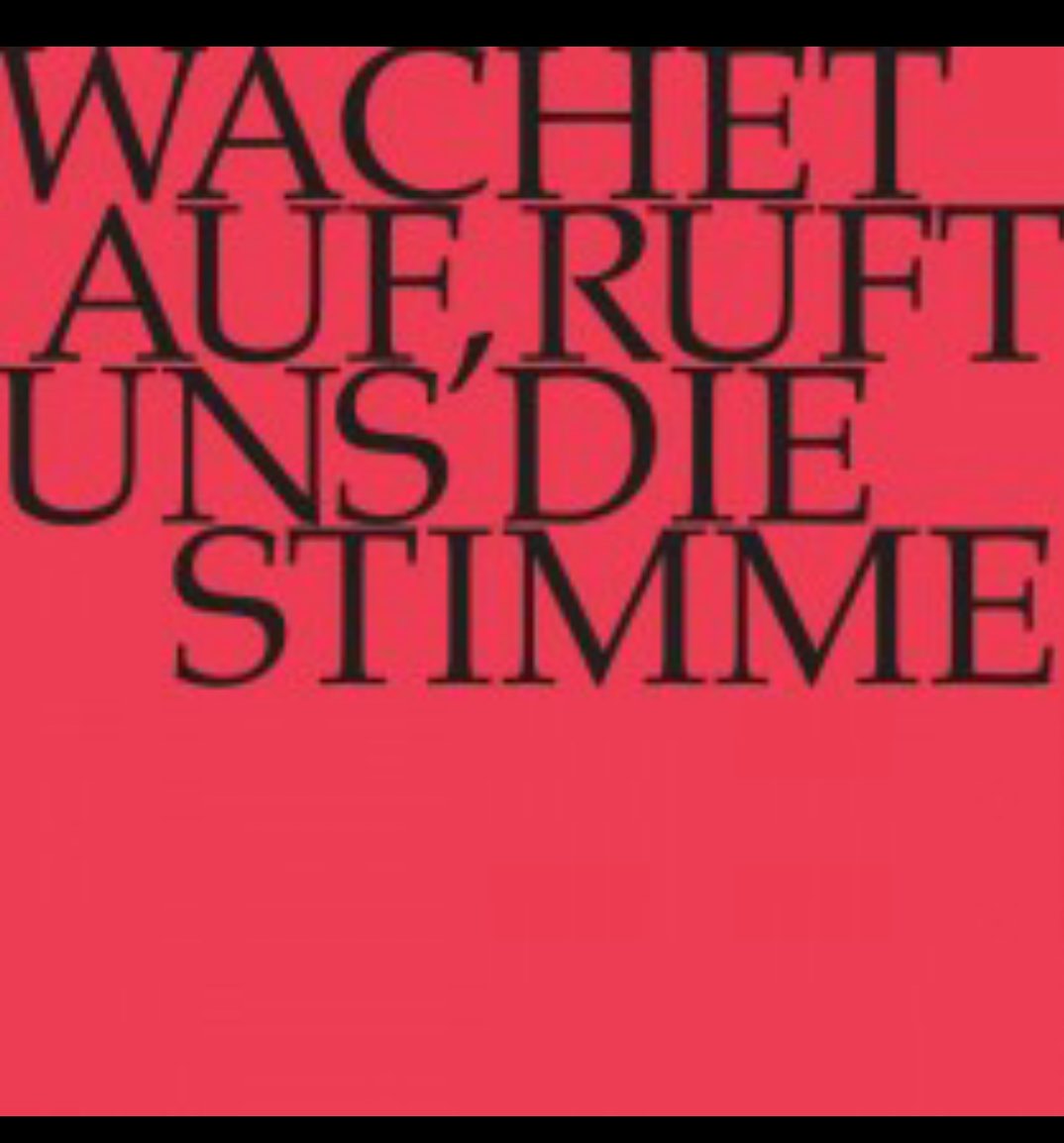
You know I’m a morning person when I tell people that one of my favorite pieces of music of Johann Sebastian Bach has been, of course, Wachet auf, which was based on a hymn by Phillip Nicolai about a plague that hit his village of Unna in 1598. James will be playing this piece after Mass this morning. And of course, we’ll actually sing the hymn as our final hymn today, "Sleepers, awake!"
It is so appropriate for this season of Advent—and always! That whole theme of waking up, the night and darkness fleeing is just so wonderful in my opinion. Which is why I love, on this first Sunday of Advent, this theme of waking up. That is what Advent is all about, after all.
Waking up.
Waking up spiritually.
It’s an important theme for us as Christians. Buddhists also place great importance on being awake spiritually. Because, let’s face it, oftentimes, we are not. Oftentimes we just go through the motions of our faith—of our lives. Oftentimes we do not live our faith or ponder our faith with a fully awakened sense. We take for granted all the good things God does for us. We take for granted all the incredible people God sends to us in our lives. We often take God’s goodness for granted. We just sort of stumble through our prayers, our attendance at church, our Christian lives in kind of a fog—in a kind of half-sleep. But, to truly live our faith, to truly embody our faith, we must be spiritually awake.
In our reading from Paul’s letter to the Romans today, we find Paul saying to us:
“You know what time it is, how it is now the moment for you to wake from sleep.”
Just a bit later Paul gives us that wonderful image,
“…the night is far gone, the day is near. Let us lay aside the works of darkness and put on the armor of light…”
What a great image for us! We know that feeling. Any time any of us have been through hardship in our lives, any time we have known the dark night of the soul in our lives, we know that true joy that comes in the morning after those dark situations. We know how glorious the light can be in our lives after having lived in spiritual darkness.
On this First Sunday of Advent—the beginning of the Church Year—there is no better image for us that this. This season of Advent is all about realizing that we, for the most part, are living in that hazy world. Advent is all about realizing that we are living in that sleepy, fuzzy, half-world. Advent is all about recognizing that we must put aside darkness—spiritual darkness, intellectual darkness, personal darkness, anything that separates us from God—and put on light. For us, this Advent season is a time for us to look into that place—that future—that’s kind of out of focus, and to focus ourselves again.
I love the image that Paul puts forth this morning of “putting on the Lord Jesus Christ.” That is perfect and precisely to the point of what this Advent season is all about. Our job during Advent season is to “put on” the Lord Jesus. The “theme” of every Advent season is
“Come quickly, Lord Jesus.”
And, in a sense, we make that prayer a reality when we “put on” Jesus. But how do we do this? How do we “put on” Jesus, as though he were some sweatshirt or fancy blue vestment?
The fact is, we have already put him on. We put him on that wonderful day we were baptized. We were clothed in Jesus on that day and we remained clothed in him to this day. Still, even clothed in Jesus as we may be, we still occasionally fail to recognize this wonderful reality in our lives.
This moment of spiritual agitation and seeking after something more has been called the “Advent situation” by the great Anglican theologian Reginald Fuller. The “Advent situation” is recognizing the reality of our present situation. We are living now—in this present moment. At times this present moment does seem almost surreal. This moment is defined by the trials and frustration and tedium as well as the joys and all the other range of emotions and feelings that living entails.
But, for the most part, we don’t feel like it all “fits” for some reason. It seems like there must be more than just this. Instinctively, spiritually, we yearn for something more, though we aren’t certain exactly what that might be. And that might possibly be the worst part of this situation. We don’t know what it is we want.
The Advent situation of Reginald Fuller reminds us that yes, this is the reality. Yes, we are here. Right now. Right here. In this moment. But we are conditioned by (and for) what comes after this—the age to come.
Many, many times you have heard me share a quote from the great Jesuit priest and paleontologist Pierre Teilhard de Chardin once said,
“We are not physical beings having spiritual experiences; we are spirits having a physical experience.”
Or as I saw on Facebook recently,
“You’re a ghost driving a meat-covered skeleton made from stardust, riding on a rock hurtling through space. Fear nothing.”
Baptism—that physical event in which we were spiritually clothed with Christ, in which we “took on” the Lord Jesus—essentially translates us into this Advent situation. And the Baptismal life—a life in which we are constantly reminded that we are clothed with Christ—is one in which we realize that are constantly striving through this physical experience toward our ultimate fulfillment. We are spirits having this physical experience. It is a wonderful experience, despite all the heartache, despite all the pains, despite all the set-backs and frustrations. And this physical experience is making our spirits stronger. We should be fully awake for this wonderful experience our spirits are having. We should be sharpening our vision as we proceed so that we can see clearly what was once out of focus.
In this Advent season, in which we are in that transparent, glass-like world, trying to break out, let us turn and look and see who it is there in the future. Let us look and see that that Person who is standing there, the One we have been looking for all along. That Person is the Person we have been searching for all along. That Person is, in fact, the very person we have clothed ourselves with, but have been unable to recognize. It is Christ. Right there. Beckoning us forward.
Advent is here. Night is nearly over. Day is about dawn. He for whom we are longing and searching is just within reach. Our response to this Advent situation is simply a furtive cry in this blue season.
Come quickly, we are crying
Come quickly, Lord Jesus.
November 25, 2016
Contrails forming a cross near Leonard, North Dakota
 Contrails forming a cross near Leonard, North Dakota
November 20, 2016
Christ the King
 November 20, 2016
Colossians 1.11-20; Luke 23.33-43
+ I think I’ve shared this confession with you before. If not, I’m sure it doesn’t come as a great surprise to any of you who know me. I love horror movies. And not just any horror movies. I’m not fond of the slasher, violence-for-the-sake-of-violence kind of horror film. (I’m vegan, after all). My favorite kind of horror films are the apocalyptic ones. You know the ones. The ones like the M. Night Shyamalan film Signs, which deals with an Episcopal priest, played by Mel Gibson, who has lost his faith just before aliens invade the earth and attempt to wipe out the human race.
Or another Shyamalan’s film (which was universally panned by critics), The Happening, about a neurotoxin released by plants and carried by wind that caused people to commit suicide in mass numbers and in very gruesome ways. (I was just watching this yesterday while waiting for the cable guy).
I also really love zombie films (I LOVE The Walking Dead). I have a whole theological system of thought worked out regarding the zombie genre. I won’t inflict that on you today, but I really believe these zombie films and shows give voice to the fear we all have inherently of death.
All of these deal with the issue of (as the old R.E.M. song proclaimed) it’s-the end-of-the-world-as-we-know-it kind of situation. Recently, as I thought about the guilty pleasure I have in these films, I realized that my love of this genre has its roots firmly in my faith life as a Christian. I know that sounds weird, but…
In the secular world, these films and books are called apocalyptic, or post-nuclear, or whatever. But we Christians have a term for this kind of genre as well. That term is eschatology.
Eschatology, to quote my trusty old Westminster Dictionary of Theological Terms, is defined as: the study of the “last things” or the end of the world. It goes on to further define it in this way: Eschatology means “Theological dimensions including the second coming of Jesus Christ and the last judgment.”
These films, seen, for me, through the lens of my being a Christian and as a priest, are very eschatological. But for others they might not seem so.
At first glance, there is a bleakness to them—a hopelessness to them. For the most part, these films and movies show a kind of evilness—whether it be supernatural evilness or natural evilness, or even extraterrestrial evilness—as prevailing. In most of the films that deal with these issues, the perspective is almost always from a seemingly non-Christian perspective. This world of bleakness and purposelessness is seems, on the surface anyway, wholly void of God or Christ. Which actually makes them even more bleak and horrendous.
But for me, I don’t see it as clearly. For me, I love them because they jar me. They jolt me out of my comfort zone and make me imagine—for a few hours anyway—what the end of the world might be like. These films also make me ponder and think about Christ’s place in these situations.
For most of us here this morning, we feel fear and shock over situations that have actually happened—in our own lives, in our collective lives. For those of us who never gave eschatology a second thought, we found ourselves at times in our lives wondering, even for a moment, if this might actually be the end of the world.
Certainly we, in the Church, get our glimpses of the end of the world in our liturgical year. As you probably have guessed, I always love preaching about beginnings. Beginnings are always a time of hope and joy. They hold such promise for everything that can possibly happen. But occasionally, we all must face the fact that, in the Church and in our lives, we also must confront the ending.
Now for most people, the ending is a time to despair. Certainly that is where I think so much of the darkness in those zombie films come from. That is where we are when really horrible, bad things happen in our lives. Despair reigns. And when despair reigns, it is a bleak time. The ending is a time to dig in one’s heels and resist the inevitable.
But for us—for Christians—we don’t have that option. For us, the ending is not the ending at all. It is, in fact, the beginning. For us, what seems like dusk to others, is actually dawn, though we—and they— sometimes can’t recognize it.
Today is an ending as well, in our Church calendar, Today, of course, is Christ the King Sunday. It is the last Sunday in that very long, green season of Pentecost.
Last Wednesday, after Mass, I hung up my green chasuble and green stole with a bit of sadness. It will be a while before I wear them again. But, it’s not so bad. Next week, I get to wear the Sarum blue (which I really enjoy wearing).
Today, for the Church, it is New Year’s Eve. The old church year of Sundays ends today. The new church year begins next Sunday, on the First Sunday of Advent.
So, what seems like an ending today is renewed next week, with the coming of Advent, in that revived sense of longing and expectation that we experience in Advent. So even then, at that beginning, we are still forced to look ahead. We are forced to face the fact that the future does hold an ending that will also become our beginning—a beginning that will never end. And as we face that future, we do so on a Sunday in which we proclaim Christ to be King. That is very important!
In our Gospel reading for this morning, we find that title of King being used in a derogatory way. The King of the Jews, as Jesus is called today in our Gospel reading, is meant to be a demeaning title. It is a way to mock him. Those taunting people did not recognize the royalty present within Jesus. Rather they saw him as a little man with thoughts of grandeur.
But what we know and celebrate on this Christ the King Sunday is that, yes, he is King. And his Kingdom—that Kingdom that we, as his followers are called to bring forth into this world, is not a kingdom of the privileged. It is not a Kingdom of those in power—of those who use power and abuse power. It is, in fact, a kingdom of the outcasts, the marginalized, the downtrodden. It is a kingdom of those people, uplifted by their King.
As the Anglican theologian Reginald Fullers says,
“It is not just an abstract idea; it involves the doctrines of creation, redemption and reconciliation of the universe, and of the Church as the sphere in which his reign is already acknowledged and proclaimed.”
It is a celebration of not only who Jesus was, but who Jesus is and will be. It is a celebration of the fact that, although it seems, at times, as though this Kingdom of God is not triumphant, at times it seems, in fact, to have failed miserably, we know that ultimately, in all that we do, in our ministries, it does break through into this world again and again.
Which causes me to return to those horror moves I love so much. I said earlier that it seems they are absent of Christ. But that isn’t entirely true. In many of those films, there always comes a moment of grace. There is always a moment when it seems evil prevails—when darkness has encroached on the earth and human kind is about to be obliterated. In the case of the zombie films, it is more profound. It seems as though death—symbolized by these walking “living dead”—has prevailed over life itself It is in that moment, that there is a turning point. The heroes of these films, at this point, usually recollect themselves. They find an inner strength. They find some kind of renewed hope that motivates them to rise up and to fight back. And, in the end, they are able to push back—or, at the very least, hold at bay—the forces of darkness, death and evil.
For us with eyes that see and ears that hear, that hope is very Christ-like. For those of us who are afraid or despairing, we find Christ in those rays of hope that break through into our lives. It is very similar to the hope we are clinging to in this moment as we enter Advent—that time in which the light of Christ is seen breaking into the encroaching darkness of our existence. At moments it seems that the Kingdom of God is over and done with.
But, as we know, in our ending is our beginning. And the Kingdom of God always triumphs, again and again. Goodness always prevails over evil and darkness. Always!
We—the inheritors of that Kingdom—are the ones who birth that Kingdom. We bring that Kingdom into our midst whenever we love radically, we welcome radically, when we accept radically, when we serve radically in the Name of Jesus. We do so when we become the conduits of hope.
That’s why we celebrate this incredible day on this last Sunday before Advent begins. Advent, after all, is that time for us to look toward the future, and to hope, even if that future might seem bleak. It is a time for us to gaze into the dark and the haze and all that lies before us and to see that it is not all bleak, it is not all frightening and scary, but that, in the midst of that darkness, there is a glimmer of light.
This Sunday and the season we are about to enter, is all about the future and hope. We, on this Christ the King Sunday, are looking forward into the darkness of the future and eternity, and we are seeing the rays of light shining through to us. For us, as followers of Jesus the King, as inheritors of that Kingdom , it is a hope. It is a time to remind ourselves that we must continue bringing about that Kingdom of God into our midst.
So, let us rejoice on this Christ the King Sunday. Let us move forward into our future together. Let us go together into that future with confidence and joy and gladness at all the blessings we have been given and that we are able to give to others. And let us to do all that we do, as Paul tells us today in his letter to the Colossians, “made strong with all the strength that comes from [God’s] glorious power…”
November 15, 2016
These roadside memorials fascinate me. This one is southw...
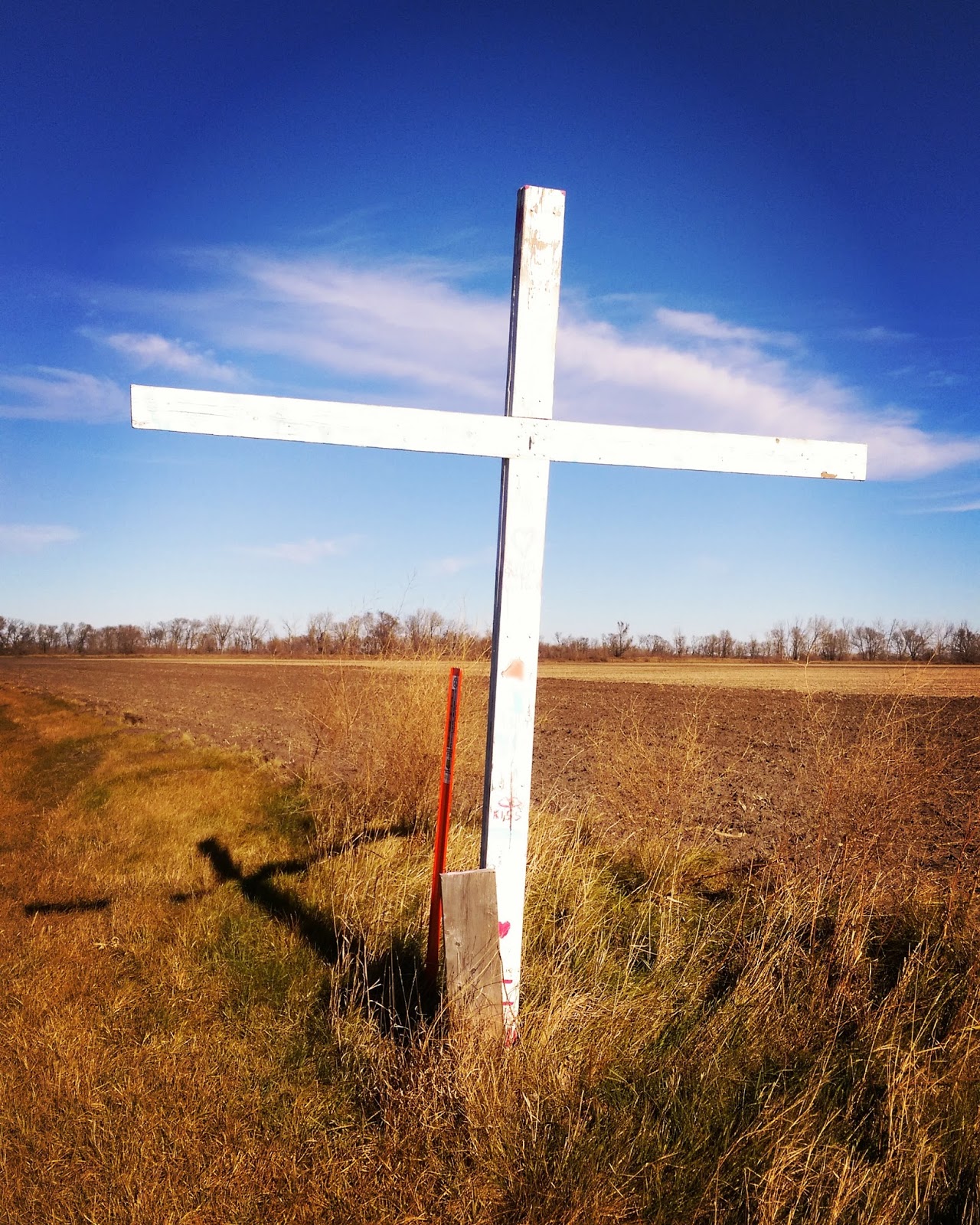 These roadside memorials fascinate me. This one is southwest of Kindred, North Dakota.
November 13, 2016
26 Pentecost
 STEWARDSHIP SUNDAY
November 13, 2016
Malachi 4.1-2a; 2 Thessalonians 3.6-13; Luke 21.5-19
+ This past week was…well…it was something. For some, it was a week of victory. For others, it was…a week of devastating loss. And one does not have to look far to see that many, many people in this country are feeling fear and uncertainty about the future. Just take a quick glance at Facebook.
To be brutally honest, I don’t know what to say about any of it. I, like many of you, feel helpless. And that is where most of us are when things happen that affect our future. We feel helpless. We feel as though there is nothing we can do. We feel as though we are at the whim of whatever may happen.
But…but……there are things we CAN do.
We can do what we’ve always done here at St. Stephen’s. We can choose compassion. We can choose selflessness. We can choose personal decency. We can choose to do what we have always done, as Christians, as followers of Jesus, as members of St. Stephen’s. And we will.
In the face of whatever may happen, in the f ace of whatever life or governments or nature may throw at us, we can stand up, we can stand firm and we can not only profess our faith, we can live it out. Bravely and surely. Without fear.
Fear is a potent force right now in our country. In the 60 years of St. Stephen’s ministry, things have come and things have gone. Presidents and governments have come and gone. There have been bleak times and there have been very good times.
I am not going to say to those who have felt fear or anger over the presidential race to buck up, to get over it. That’s not helpful either.
But this is one thing I do know: St. Stephen’s will continue to be a place of openness and acceptance, no matter what. I sent out a message on the morning after the election that I hope you read. If you did not, I am going to read part of it this morning.
No matter what may happen, please be assured: St. Stephen’s will remain a place of safety. It will remain a place in which all will continue to be welcomed and accepted. It will be a place in which the divisions are erased and the love of God and of one another is upheld.
We must continue to strive to uphold this radical inclusiveness. We must strive to be the living, breathing presence of God’s love and acceptance of all. We must strive to be the hands, feet, face and heart of Christ in a world that truly needs Christ’s all-accepting love.
Please pray for our nation. Please pray for our leadership. Please pray for our future. And let us not let our fears and anxieties defeat us.
On this Stewardship Sunday, this is where we are. And today, at our lunch, you will receive pledge cards and time-and-talent sheets. Some of you have asked (and it’s a good question to ask), what is this pledge package we are receiving? I am going to tell you what it is.Your pledge card is a way for you to say you agree with what we do what here. Your pledge package is a way to say, “I love this place. I love what it stands for. I love its uniqueness. I love that St. Stephen’s has accepted me when I needed acceptance. I love that it accepts others who need acceptance. I love this place so much I am willing to support it with my creativity, my energy and my financial resources.”
Your pledge package is a way for you to say “yes, I will strive in my own way to DO something. To DO something in a place that has been so radically different.” I don’t think I need to tell anyone here that St. Stephen’s is not your typical Episcopal Church—or your typical church by any definition. We are unique. We are eclectic. We do things a bit different than other churches. That is why you are here. We are welcoming. We are accepting.
But we are not push-overs. We are also very, very strong. And when we stand up for something, we STAND UP.
Yes, we are contemplative. We are prayerful. We love God, we follow Jesus and we embody the Holy Spirit.
We, in the shadows of much larger congregation, might seem to be just a blip. People drive by our church and might not see it. We don’t have a tall steeple. We don’t have fine architecture. We don’t have matching pews.
But…we do have a voice. We do have our integrity. And when we speak out, we speak LOUDLY. And, let me tell you, people hear us. And we change things—or help things change anyway.
For us the Word of God is not something that can be placed in some nice, neat box—it is not something we can gaze at and admire from afar. For us, the Word of God is what we live, what we speak. It comes bubbling up from within us and is lived out in our lives and the ministries we do here.
I have said it before, I will say it again. If you want to see the Episcopal Church of the future—if you want to see the Church, capital C, of the future—you don’t need to go to fancy, massive churches, with lots of glitz and not lots of people. THAT is not the future of the Episcopal Church. What is the future of the Episcopal Church—of the Christian Church? You are. Right here. We are it. We are what it means to be alive and vital as Christians. We are what it means to be all-inclusive, even if means to being inclusive to a fault. We are what it means to accept everyone—gay or straight, black or white or brown or red, woman, man, transgender, Democrat and Republican, agnostic, atheist -- everyone is welcome here and accepted here. And ACCEPTED here.
This is who we are. And in the face of whatever may come, socially, government-wise, if the skies turns dark and the moon falls into the ocean, we will still be who we are and what we are. That is what we pledge to support here.
I hate to be this person to say it, but the reality we can’t do these things without you—without your hands, without financial resources. We can’t do these things without the hard work of all of us. We have prided ourselves over the years in not having to beg for money very often. And we have given much in outreach—to those places that need our help. But we can’t do the things we do—we can’t be who we are—without resources.
I am always struck when I hear the flight attendants tell us before we take off, that we must place the oxygen mask on ourselves first before we do so for our children. That is the exact opposite of what our instinct might tell us. But the fact is this: we can’t help them if we don’t have oxygen. We need those financial resources, we need those hands and hearts and muscles and creativity if we are going to help others. We need your physical presence here on Sundays—and not just when you are scheduled to do a ministry here. To be this unique and amazing place, this place in which radical things happen, in which we love radically and accept radically, in which Jesus’ Holy Spirit now only dwells, but is embodied, we need to be strong at the base.
And we need to not let fear win. Jesus tells us not to be afraid. When we hear of wars and insurrections, Jesus tells us today, do not be terrified.
DO NOT BE TERRIFED.
Not a hair of our head will perish to them, Jesus tells us. By our endurance, we will gain our souls. And, I would add, not only our souls…but the souls of those we encounter. And God will be with us through it all.
As we look around here, we know—God is here. God is with us. That Spirit of our living, breathing God dwells with us. And God is being proclaimed in the message we carry within each of us.
When we welcome people radically, when we embrace those no one else will embrace, when we love those who have been hated, when we are hated for loving those who are hated, we know that all we are doing is bringing the Kingdom of God not only closer, but we are birthing it right here in our midst. And we have nothing to fear, because, as Jesus says today,
“I will give you words and wisdom that none of your opponents will be able to withstand or contradict.”
When we do these radical, incredible things in Jesus’ name, we are, in fact, blessed. We are blessed, here at St. Stephen’s. And that is what we are thankful for today.Paul tells in in his letter to the Thessalonians this morning: “do not be weary in doing what is right.”
“Do not be weary in doing what is right.”
Those words are our battle cry for our future here at St. Stephen’s. Those words are the motto for the new Church we represent. Those words are the motto for all us at this time in our history.
Do not be weary in doing what is right.
Yes, I know. We are weary. We are tired. And there is much work still to do. But we are doing the work God has given us to do. And we cannot be weary in that work, because we are sustained.
And we cannot be terrified. We are held up. We are supported by that God. But we must keep on doing so with love and humility and grace.
St. Stephen’s is incredible place. We know it. Others know it. God knows it. So, let us be thankful. Let us continue our work—our ministries. Let us give from what we have been given. And as we do, as we revere God’s Holy Name, see what happens.
The Prophet Malachi is right. For those of us who continue our work, who continue to revere God’s holy Name, on us—on US!— that Sun of Righteousness shall rise, with healing in its wings. Amen.
November 11, 2016
November 9, 2016
In the wake of last night's election
In the wake of last night’s election, I know there are some who are celebrating and some who are devastated and numb with shock. This very divisive election certainly brings a sense of uncertainty about our common future. Some of us feel helpless today. Some of us feel angry. There is no doubt that we are, today, a divided nation.
No matter what may happen, please be assured: St. Stephen’s will remain a place of safety. It will remain a place in which all will continue to be welcomed and accepted. It will be a place in which the divisions are erased and the love of God and of one another is upheld.
We must continue to strive to uphold this radical inclusiveness. We must strive to be living, breathing presences of God’s love and acceptance of all. We must strive to be the hands, feet, face and heart of Christ in a world that truly needs Christ’s all-accepting love.
Please pray for our nation. Please pray for our leadership. Please pray for our future. And let us not let our fears and anxieties defeat us.
O God, you have bound us together in a common life. Help us,
in the midst of our struggles for justice and truth, to confront
one another without hatred or bitterness, and to work
together with mutual forbearance and respect; through Jesus
Christ our Lord. Amen.
No matter what may happen, please be assured: St. Stephen’s will remain a place of safety. It will remain a place in which all will continue to be welcomed and accepted. It will be a place in which the divisions are erased and the love of God and of one another is upheld.
We must continue to strive to uphold this radical inclusiveness. We must strive to be living, breathing presences of God’s love and acceptance of all. We must strive to be the hands, feet, face and heart of Christ in a world that truly needs Christ’s all-accepting love.
Please pray for our nation. Please pray for our leadership. Please pray for our future. And let us not let our fears and anxieties defeat us.
O God, you have bound us together in a common life. Help us,
in the midst of our struggles for justice and truth, to confront
one another without hatred or bitterness, and to work
together with mutual forbearance and respect; through Jesus
Christ our Lord. Amen.
November 8, 2016
Election Day
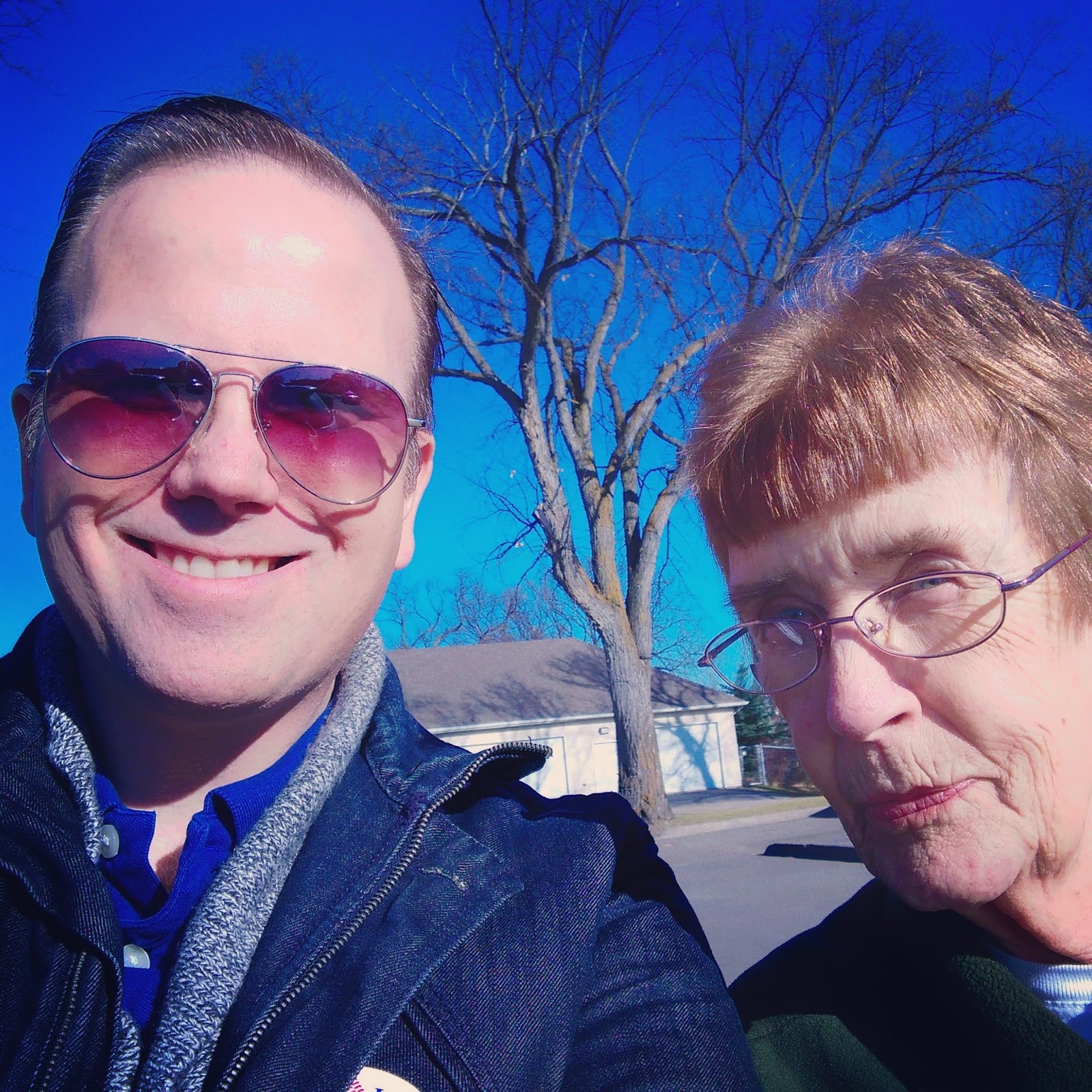 The Duchess and I did our civic duty...
I hope...
My grandmother, Phoebe Olson, was an amazing woman. She was, for many years, the breadwinner in her family. She sacrificed many times for her children during the Depression. She suffered much in ways no one but God now even knows. She was a committed Teamster who, during a strike, sat down on a railroad track to stop a train. In her own way, she (along with my mother) was a supporter of gay rights when such a thing was rare (she refused to buy Florida orange juice in the 1970s because of Anita Bryant’s anti-gay campaigns and spoke out vocally against such hatred). My personal relationship with her was often tense. We were both vocal in our opinions and sometimes those opinions clashed. She was particularly vocal in her opposition to my converting to Roman Catholicism when I was 15. But she and my mother taught me vital lessons about politics. Phoebe was a committed Democrat who believed that voting and political awareness were vital to our society. I know where she would be standing politically today and I know who she would be supporting with her vote. I honestly wish she could be alive to see this potentially historical day. I do not vote for her today (I cannot vote for the dead). I vote for myself and for the future of our country. But in my vote, I vote for all that my grandmother stood for in her life. I vote today for the hope she no doubt saw back then, and I vote for an ideal she could only vaguely imagine in her day. I hope this is a day that would make my grandmother smile and, in her subdued Protestant way, rejoice.