
Jamie Parsley's Blog, page 56
March 2, 2017
Ash Wednesday
 March 1, 2017
Joel 2.1-2,12-17; 2 Corinthians 5:20b-6:10; Matthew 6.1-6,16-21
+ Most of us, when we think of Ash Wednesday and Lent, think of a time of…dare I say, dread. This is, for most of us, a season of lamenting. A season of giving up something dear to us. Of being confronted with unpleasant things, like sin and our own mortality.
And that’s true. Yup. That’s exactly what it’s all about. That is exactly what we do tonight and for these next 40 days. We will be hearing about sin. We will be hearing about repentance. We will be reminded of the fact that, yes, we have fallen short in our lives.
And tonight especially, we will be reminded that one day, each of here tonight will one day stop breathing and die. We are reminded tonight in very harsh terms that we are, ultimately, dust. And that we will, one day, return to dust.
Yup. Unpleasant. But…
…sometimes we need to be reminded of these things. Because, let’s face it. We spend most of our lives avoiding these things. We spend a good portion of our lives avoiding hearing these things. We go about for the most part with our fingers in our ears. We go about pretending we are going to live forever. We go about thinking we’re not really like everyone else. We think: I’m just a little bit more special than everyone else. Maybe…maybe…I’m the exception.
Of course we do that. Because, for each of us, the mighty ME is the center of our universe. We as individuals are the center of our own personal universe.
So, when we are confronted during Lent with the fact that, ultimately, the mighty ME is not the center of the universe, is not even the center of the universe of maybe the person who is closest to me, it can be sobering.
And there we go. Lent is about sobering up. It is about being sober. About looking long and hard at the might ME and being realistic about ME. And my relationship with the God who is, actually, the center of the universe and creation and everything that is. It’s hard, I know, to come to that realization.
It’s hard to hear these things. It’s hard to have hear the words we hear tonight as those ashes are placed on our foreheads, “You are dust and to dust you shall return.”
You are dust. We are dust. We are ashes. And we are going to return to dust. Yes. It’s hard. But…
Lent is also about moving forward. It is about living our lives fully and completely within the limitations of the fact that are dust.
Our lives are like jazz to some extent. For people who do not know jazz, they think it is just free-form music. There are no limits to it. But that’s not true. There is a framework for jazz. Very clearly defined boundaries. But, within that framework there is freedom.
Our lives are like that as well. Our mortality is the framework of our lives. We have boundaries. We have limits. But within those limits, we have lots of freedom. And we have the potential to do a lot of good and a lot of bad.
Lent is the time for us to stop doing the bad and start doing the good. It is time for us to store up for ourselves treasure in heaven, as we hear Jesus tell us tonight in our Gospel reading. It is time for work on improving ourselves. And sometimes, to do that, we need to shed some things.
It is good to give up things for Lent. Look at me. I gave up something even before Lent started: The brown pigments in my hair.
No, it is good to give up things for Lent. But let me just say this about that. If we give up something for Lent, let it be something that changes us for the better. Let it be things that improve us. Let us not only give up things in ourselves, but also things around us.
Yes, we can give up nagging, but maybe we should also give up those voices around us that nag. Or maybe confront those voices that nag too much at us. Maybe Lent should be a time to give up not only anger in ourselves, but those angry voices around us.
Lent is a time to look at the big picture of our lives and ask: what is my legacy? How am I going to be remembered? Are people going to say of our legacies what we heard this evening from the prophet Joel?
“Do not make your heritage a mockery…”
Am I going to be known as the nag? As that angry, bitter person? Am I going to be known as a controlling, manipulative person who always had to get my way? Am I going to be known as a gossip, as a backbiter, as a person who professed my faith in Christ on my lips, but certainly did not live it out in my life? If so, then there is no better time than Lent to change our legacy.
In these last few months, one of the best rallying cries I have heard is this:
choose to be on the right side of history.
That is our rallying cry during Lent as well. Choose to be on the right side of history. Choose to be a good, compassionate, humble, love-filled follower of Christ. That is the legacy we should choose during this season, and from now on.
After all, we ARE ashes. We are dust. We are temporary. We are not immortal. But our legacies will outlive us. In fact, in many ways, they are, outside of our salvation, ultimately, the most important thing about our future.
Live in to the legacy that will outlive us. This is probably the best Lenten discipline we can do. Most importantly, let this holy season Lent be a time of reflection and self-assessment. Let it be a time of growth—both in our self-awareness and in our awareness of God’s presence in the goodness in our life. As St. Paul says in our reading from this evening: “Now is the acceptable time.”
“Now is the day of salvation.”
It is the acceptable time. It is the day of salvation.


February 21, 2017
15 years cancer-free
Today, I am 15 years cancer-free.
I am very grateful!
I am very grateful!
February 11, 2017
February 7, 2017
Something different...
 Hey, I'm on vacation. Why not bleach the hair?
4 years without meat

4 years ago last night I ate meat for the last time. It was the best decision I ever made.
February 6, 2017
Paper Doves, Falling at 25
 25 very long years ago today, my first book of poems, Paper Doves, Falling and Other Poems, was published. It seems like a lifetime ago.
February 5, 2017
5 Epiphany
[image error]
February 5, 2017
Matthew 5.13-20
+ Every so often, you will hear me talk about a saint or a famous person on Sunday mornings. Often times, that person ties in to the saint we commemorate on Wednesday nights. The reason I put these people forward for you is simple. Sometimes we need to see that we are not alone in our struggles as Christians. And our Christian lives can often feel like a major struggle. And you know what: it should. Nobody promised us an easy romp through sunlit flower gardens as Christians. To be a Christian should be a brave thing. It should be a radical, countercultural thing. It should mean that we live our lives just a bit differently than everyone else. It means that we see life a little bit differently than everyone else.
I know a lot of people these last months have been talking about Dietrich Bonhoeffer. Certainly, we, here at St. Stephen’s, have been speaking of him as a result of William’s study last fall. And I think he is VERY appropriate for our times.
But, for me, the person I have found myself going to in these last few months is someone I have mentioned before to you. The writer and theologian I have been returning to again and again to help me sort out my feelings about what’s going on in this world is none other than William Stringfellow.
You may remember me talking about him. If not, no worries. I’ll catch you up.
William Stringfellow was an amazing theologian, writer, lawyer, who was active in the mid-to-late twentieth century. As a lawyer, he defended poor black and Hispanic people in Brooklyn in the 1950s. In the 1960s he defended such unpopular causes as clergy who marched on Selma, as well as the always enigmatic Bishop James Pike when he was brought up on heresy charges. In the 1970s, he actually subpoenaed the Presiding Bishop of the Episcopal Church, John Allin, regarding women priests presiding in churches (Allin was opposed to women priests). In 1970, he very famously harbored the late, great Roman Catholic Jesuit priest and activist, Father Daniel Berrigan, at his home when the FBI was seeking to arrest Father Berrigan on charges of burning files from a draft board. Stringfellow later called for the resignation of Richard Nixon’s presidency years before Watergate.
His private life too was very radical for its time. Stringfellow lived openly and unashamedly from the 1960s through the 1980s with his partner, the poet Anthony Towne. In 1967, he and Towne moved to Block Island, off the coast of Rhode Island, where they developed a semi-monastic life together and were eventually wholeheartedly welcomed into the somewhat insular year-round community at Block Island.
But in addition to all of this, Stringfellow was also, brace yourselves, an Evangelical Episcopal Christian. He was an ardent student of the Bible and wrote extensively on how our lives as Christians must be based fully and completely on the Word of God. Mind you, he was no fundamentalist. He was no Bible-thumper. But he was an evangelical, before that word got hijacked and made into something else. An evangelical in the best sense of the word is someone who looks at life through the lens of scripture. And that is what Stringellow most certainly did. He was a careful, systematic theologian who simply saw all life through the lens of scripture.
And, very importantly, he was a radical. A true radical Christian. He was a conduit, at times, through which the Word of God was proclaimed. Stringfellow, who died in March 1985, was and is an important theologian for us right now.
I have asked myself many times what Stringfellow would be thinking of the world in which we now live. And actually, it wouldn’t be that hard to figure out the answer to that question. Stringfellow was often described as a stranger in a strange land. I love that description. I certainly have often felt that same way in my own life at times. Maybe that’s why I like him so much. Because, let’s face it, if we, as Christians, don’t feel like strangers in a strange land in our following of Jesus, we’re not doing it right.
So, why this talk of William Stringfellow? Well, in our Gospel for today, Jesus talks about salt and light. You are the salt of the earth, Jesus says. But our usefulness as “salt” is only good enough while we still have “taste.” He then goes on to say, “You are the light of the world” but then proceeds to say that the only effective light is one that is uncovered.
In our lives as followers of Jesus, our calling is to be salt with taste and unhindered light. Salt with taste. Unhindered light. This is what we should be. Not sweet, nice, polite Christians. Not Christians who hide behind their Bibles and the status quo. We are to be salty and bright as the dawn.
Yes, it’s good to be a follower of Jesus. But—and I firmly believe this—to really follow Jesus, to really follow him to the end, we have to do one very important thing:
We need to be radicalin our following, radical in being salt with taste, radical in being unhindered light to this world. Radical like Stringfellow. Radical like those first followers. Radical like Dietrich Bonhoeffer and Desmond Tutu and all the great followers of Jesus.
Being radical in all of these ways means being salt with taste and unhindered light. It means stepping out into the unknown and actually doing something about the unfairness and injustice of this world. And doing that is frightening to most of us. It certainly is to me at times. Or, rather, it might simply not be practical. We have lives, after all. We have families. We have jobs.
OK. Maybe most of us will never be Desmond Tutu. And I hope no one here this morning will have to make the ultimate sacrifice that Bonhoeffer made with his life. But we can be William Stringfellow, looking at life and the events of this life through the lens of scripture. And doing so, trust me, will make one radical in our own lives.
We can—and should—stand up and speak out for Christ and for all of those people Christ commands us to love. In our own lives, when we hear people being racist or homophobic or sexist or running down Muslims or simply being rude, we can simply say, “No!” “Stop it!” We don’t have to be jerks about it. We don’t have to overturn tables and break things. We don’t need to throw a tantrum.But we can’t be silent. Silence in the face of injustice is not an option for us who follow Jesus. Our simple “no,” our simple “stop it!” said with conviction and purpose, often carries the greatest weight. Simply refusing to listen to such rhetoric, simply refusing to allow such talk or action in our presence is often a quite radical statement. And do so with our understanding that this is exactly what Jesus is saying we must do to be his followers is the way we can truly embody the Gospel.
When we do so, even in some small way, we are the effective salt of the earth. When we live our radical lives as followers of Jesus, we are a light set on a lampstand.
As I said, none of this is easy. Remaining tasty salt is not easy. Being a light on a lampstand leaves us exposed and open to every wind that blows through.In our lives as followers of Jesus, there will be moments when it is hard. Hard to be a Christian. Hard to believe as a Christian. And, often times, hard to live with other Christians. It gets a lot harder when we take our Christian faith that next step and become radical Christians—Christians who, in the holy name of Jesus, stands up and speaks out in love to those forces at work in this world that seek to undermine peace and justice.
But these are just the realities of what it means to be a light on a lampstand. This is what it means to live in community with one another. And the only response we can have to all of that is love.
We must love. Our love must shine brightly. The Holy Spirit, which dwells inside each of us, must be the fuel for the light within us. And loving people who hurt us, or intimidate us, or make us uncomfortable is incredibly hard. Let me tell you! I have been there. I know.
But we don’t have any other options as Christians, as followers of Jesus. We don’t have the option of curling up and shutting down. Silence and inactivity are not options for us who follow Jesus.
The only option we have is the love that was infused in us by the God of love, whom we serve. And that love is not silent. That love is not sweet and safe. That love is quite loud. There are times when I wish I didn’t have the deal with these things. There are times when I wish everyone just liked me and I liked them. There are times when I really just don’t want to speak out. There are times when I just want to listen to the news and just not be angry or frustrated. Or better yet, I wish I could just simply ignore the news. Life would be so much easier. But, sadly, that’s not reality. We are here. We share this earth. And what effects one person effects us too. We’re all in this thing together, as a song by Old Crow Medicine Show goes.
No one is expecting us to be perfect Christians. Trust me, we all fail. We all falter.We all make mistakes. Following Jesus does not mean that we will never trip up or fail. Following him does guarantee that we can pick ourselves up and continue on, broken and wounded as we are sometimes.
I can tell you this: my life as a follower of Jesus has never been easy. Oh, have I fallen more than once on that path. I’ve tripped up majorly at times. There were moments when I wasn’t even certain I wanted to go any further. But I have. We all have. All of us here this morning have pressed on, going forward, striving and failing and striving again. And it’s all good . Even the trip-ups are all right. It’s part of our journey in Christ.
Yes, our Christian life is hard at times. Loving each other is hard at times. Loving ourselves as God loves us is sometimes the hardest of all. Living our lives in Christ is really hard. And living radically in Christ is especially hard.
But when we do this, we truly do become the salt of the earth. We truly do become a light set on a lampstand. And when we are—when we are a light unhindered, a Christ-infused light shining brightly for all the world to see, sharing the light of Christ with others—we are doing what are meant to do as Christians, as followers of Jesus.
So let us not put our light under a bushel. Let us not grow frustrated. Let us not let the tiredness and fatigue that sometimes comes upon us win out. But let us be infused. Let us be rejuvenated.
And let us shine! Shine brightly! Shine radically! Shine without apprehension or fear. Let us shine! And when we do, others will, as Jesus tells us, see our good works, and we will truly be giving glory to our God in heaven. Amen.
Matthew 5.13-20
+ Every so often, you will hear me talk about a saint or a famous person on Sunday mornings. Often times, that person ties in to the saint we commemorate on Wednesday nights. The reason I put these people forward for you is simple. Sometimes we need to see that we are not alone in our struggles as Christians. And our Christian lives can often feel like a major struggle. And you know what: it should. Nobody promised us an easy romp through sunlit flower gardens as Christians. To be a Christian should be a brave thing. It should be a radical, countercultural thing. It should mean that we live our lives just a bit differently than everyone else. It means that we see life a little bit differently than everyone else.
I know a lot of people these last months have been talking about Dietrich Bonhoeffer. Certainly, we, here at St. Stephen’s, have been speaking of him as a result of William’s study last fall. And I think he is VERY appropriate for our times.
But, for me, the person I have found myself going to in these last few months is someone I have mentioned before to you. The writer and theologian I have been returning to again and again to help me sort out my feelings about what’s going on in this world is none other than William Stringfellow.
You may remember me talking about him. If not, no worries. I’ll catch you up.
William Stringfellow was an amazing theologian, writer, lawyer, who was active in the mid-to-late twentieth century. As a lawyer, he defended poor black and Hispanic people in Brooklyn in the 1950s. In the 1960s he defended such unpopular causes as clergy who marched on Selma, as well as the always enigmatic Bishop James Pike when he was brought up on heresy charges. In the 1970s, he actually subpoenaed the Presiding Bishop of the Episcopal Church, John Allin, regarding women priests presiding in churches (Allin was opposed to women priests). In 1970, he very famously harbored the late, great Roman Catholic Jesuit priest and activist, Father Daniel Berrigan, at his home when the FBI was seeking to arrest Father Berrigan on charges of burning files from a draft board. Stringfellow later called for the resignation of Richard Nixon’s presidency years before Watergate.
His private life too was very radical for its time. Stringfellow lived openly and unashamedly from the 1960s through the 1980s with his partner, the poet Anthony Towne. In 1967, he and Towne moved to Block Island, off the coast of Rhode Island, where they developed a semi-monastic life together and were eventually wholeheartedly welcomed into the somewhat insular year-round community at Block Island.
But in addition to all of this, Stringfellow was also, brace yourselves, an Evangelical Episcopal Christian. He was an ardent student of the Bible and wrote extensively on how our lives as Christians must be based fully and completely on the Word of God. Mind you, he was no fundamentalist. He was no Bible-thumper. But he was an evangelical, before that word got hijacked and made into something else. An evangelical in the best sense of the word is someone who looks at life through the lens of scripture. And that is what Stringellow most certainly did. He was a careful, systematic theologian who simply saw all life through the lens of scripture.
And, very importantly, he was a radical. A true radical Christian. He was a conduit, at times, through which the Word of God was proclaimed. Stringfellow, who died in March 1985, was and is an important theologian for us right now.
I have asked myself many times what Stringfellow would be thinking of the world in which we now live. And actually, it wouldn’t be that hard to figure out the answer to that question. Stringfellow was often described as a stranger in a strange land. I love that description. I certainly have often felt that same way in my own life at times. Maybe that’s why I like him so much. Because, let’s face it, if we, as Christians, don’t feel like strangers in a strange land in our following of Jesus, we’re not doing it right.
So, why this talk of William Stringfellow? Well, in our Gospel for today, Jesus talks about salt and light. You are the salt of the earth, Jesus says. But our usefulness as “salt” is only good enough while we still have “taste.” He then goes on to say, “You are the light of the world” but then proceeds to say that the only effective light is one that is uncovered.
In our lives as followers of Jesus, our calling is to be salt with taste and unhindered light. Salt with taste. Unhindered light. This is what we should be. Not sweet, nice, polite Christians. Not Christians who hide behind their Bibles and the status quo. We are to be salty and bright as the dawn.
Yes, it’s good to be a follower of Jesus. But—and I firmly believe this—to really follow Jesus, to really follow him to the end, we have to do one very important thing:
We need to be radicalin our following, radical in being salt with taste, radical in being unhindered light to this world. Radical like Stringfellow. Radical like those first followers. Radical like Dietrich Bonhoeffer and Desmond Tutu and all the great followers of Jesus.
Being radical in all of these ways means being salt with taste and unhindered light. It means stepping out into the unknown and actually doing something about the unfairness and injustice of this world. And doing that is frightening to most of us. It certainly is to me at times. Or, rather, it might simply not be practical. We have lives, after all. We have families. We have jobs.
OK. Maybe most of us will never be Desmond Tutu. And I hope no one here this morning will have to make the ultimate sacrifice that Bonhoeffer made with his life. But we can be William Stringfellow, looking at life and the events of this life through the lens of scripture. And doing so, trust me, will make one radical in our own lives.
We can—and should—stand up and speak out for Christ and for all of those people Christ commands us to love. In our own lives, when we hear people being racist or homophobic or sexist or running down Muslims or simply being rude, we can simply say, “No!” “Stop it!” We don’t have to be jerks about it. We don’t have to overturn tables and break things. We don’t need to throw a tantrum.But we can’t be silent. Silence in the face of injustice is not an option for us who follow Jesus. Our simple “no,” our simple “stop it!” said with conviction and purpose, often carries the greatest weight. Simply refusing to listen to such rhetoric, simply refusing to allow such talk or action in our presence is often a quite radical statement. And do so with our understanding that this is exactly what Jesus is saying we must do to be his followers is the way we can truly embody the Gospel.
When we do so, even in some small way, we are the effective salt of the earth. When we live our radical lives as followers of Jesus, we are a light set on a lampstand.
As I said, none of this is easy. Remaining tasty salt is not easy. Being a light on a lampstand leaves us exposed and open to every wind that blows through.In our lives as followers of Jesus, there will be moments when it is hard. Hard to be a Christian. Hard to believe as a Christian. And, often times, hard to live with other Christians. It gets a lot harder when we take our Christian faith that next step and become radical Christians—Christians who, in the holy name of Jesus, stands up and speaks out in love to those forces at work in this world that seek to undermine peace and justice.
But these are just the realities of what it means to be a light on a lampstand. This is what it means to live in community with one another. And the only response we can have to all of that is love.
We must love. Our love must shine brightly. The Holy Spirit, which dwells inside each of us, must be the fuel for the light within us. And loving people who hurt us, or intimidate us, or make us uncomfortable is incredibly hard. Let me tell you! I have been there. I know.
But we don’t have any other options as Christians, as followers of Jesus. We don’t have the option of curling up and shutting down. Silence and inactivity are not options for us who follow Jesus.
The only option we have is the love that was infused in us by the God of love, whom we serve. And that love is not silent. That love is not sweet and safe. That love is quite loud. There are times when I wish I didn’t have the deal with these things. There are times when I wish everyone just liked me and I liked them. There are times when I really just don’t want to speak out. There are times when I just want to listen to the news and just not be angry or frustrated. Or better yet, I wish I could just simply ignore the news. Life would be so much easier. But, sadly, that’s not reality. We are here. We share this earth. And what effects one person effects us too. We’re all in this thing together, as a song by Old Crow Medicine Show goes.
No one is expecting us to be perfect Christians. Trust me, we all fail. We all falter.We all make mistakes. Following Jesus does not mean that we will never trip up or fail. Following him does guarantee that we can pick ourselves up and continue on, broken and wounded as we are sometimes.
I can tell you this: my life as a follower of Jesus has never been easy. Oh, have I fallen more than once on that path. I’ve tripped up majorly at times. There were moments when I wasn’t even certain I wanted to go any further. But I have. We all have. All of us here this morning have pressed on, going forward, striving and failing and striving again. And it’s all good . Even the trip-ups are all right. It’s part of our journey in Christ.
Yes, our Christian life is hard at times. Loving each other is hard at times. Loving ourselves as God loves us is sometimes the hardest of all. Living our lives in Christ is really hard. And living radically in Christ is especially hard.
But when we do this, we truly do become the salt of the earth. We truly do become a light set on a lampstand. And when we are—when we are a light unhindered, a Christ-infused light shining brightly for all the world to see, sharing the light of Christ with others—we are doing what are meant to do as Christians, as followers of Jesus.
So let us not put our light under a bushel. Let us not grow frustrated. Let us not let the tiredness and fatigue that sometimes comes upon us win out. But let us be infused. Let us be rejuvenated.
And let us shine! Shine brightly! Shine radically! Shine without apprehension or fear. Let us shine! And when we do, others will, as Jesus tells us, see our good works, and we will truly be giving glory to our God in heaven. Amen.
February 4, 2017
Gretchen Carlson Kost
 (July 1, 1974-January 30, 2017)
Gethsemane Episcopal CathedralFargo, ND
Revelation 7.9-17
+ For those of you who do not know me, I am Gretchen’s priest. For almost 13 years, I have very gratefully served in that capacity. Now, I know that on the surface that sounds so nice. It sounds so…holy. If you didn’t know Gretchen or me, you would think, just by my saying that, that we were nice, sweet, clean-cut, cookie cutter Episcopalians.
But…sadly, no. The reason our relationship worked so well is that there was nothing sweet or clean-cut in either of us. Well, she was sweet at times. But, we were boisterous, outspoken, unabashed liberal Christians, who shared very clear and vocal opinions on almost every issue, whether it be women’s right, or GLBTQ rights, or just basic equal rights. We were pretty much outraged about all the same things. We talked politics and social issues.
And music. We shared a very deep love of music and many of the same bands, especially from the 1980s and early 1990s. It was not, as you can guess, the typical priest/parishioner relationship
I first got to know Gretchen and Rob in that fortuitous hot summer of 2004. Weirdly enough, Gretchen and I shared many friends for years before that. We knew many of the same people. But somehow we never really knew each other, outside greetings here at Gethsemane Cathedral on Sunday mornings.
Gretchen was diagnosed in May of 2004. The following month, in June, I was ordained a priest. And the following month after that, in July, the Dean of this Cathedral at that time, Steve Easterday, called me into his office (I was serving here at the time as a priest at that time). He asked me if I would be willing to pay a visit to Gretchen and Rob. There were two reasons he asked me, I think: the first reason was that there was only four years difference between us in age. And the second reason was that two years before, in 2002, I also was diagnosed with cancer, which, let me tell you, was a very traumatic in my life. So I knew in a unique way where Gretchen and Rob were in their lives in the aftermath of that diagnosis. So the Dean no doubt thought I would be the perfect one to visit her.
But as I drove over to their house in Moorhead that hot summer afternoon, I really didn’t know what I was going to say or do. I wasn’t certain what Gretchen would want from me. And I wasn’t certain where she would be emotionally in the whole process.
Well, I didn’t need to fret that much. Although Gretchen was scared, although the future was unknown, the person I came to know that day was a strong woman filled with life. And she was a fighter! And we very quickly bonded, as did Rob and I, and Gretchen’s parent’s Kathy and Bruce.
Slowly, as time went on, she was healed. It was truly a miracle! We were all were amazed and thankful. Life went on. I visited first of all, every week, then every month. In fact, in those almost 13 years, I don’t think there was a month I didn’t visit.
Gretchen fought back, became stronger than ever, lived her life fully and completely. And soon, there was Hattie and then Beck. I got to baptize each of them.
Now, again, it all sounds idyllic. But, there were issues sometimes. We didn’t always see things face to face. The biggest issue we had in this time was my becoming vegan. Oh, poor Gretchen—and especially Gretchen’s mom, Kathy—it was a decision that was not met well. It became too hard to feed this crazy, insane vegan priest a meal. So, we would have dessert instead whenever I visited. But, Kathy, I’m just letting you know: I really missed those meals. And it’s really the only time I’ve ever actually regretted being vegan.
Those visits were wonderful though. Every time I visited Gretchen, she always wanted me to do one thing: She always wanted me to anoint her for healing, even when I thought: why are we still doing this? You’re healed, Gretchen. We don’t need to be doing this anymore.
But there was always a bit of fear in the back of her mind. It’s a fear I know well—that any of us who have had cancer knows well—that fear that it will come back. Now, as I’ve shared this story with people, I hear again and again: “everyone should be so thankful for those 12, almost 13 years.” And, trust me, I am. But…I am also really angry today. I am selfish. Maybe I’m ungrateful. But...there should’ve been more. It should’ve been more than 13 years. It should’ve 30 years. Gretchen should’ve seen those children grow. She should’ve grown old with Rob. There was so much life ahead of her.
And in this last month, and especially last few weeks and days, let me tell you: my most common prayer has been a fist shaken at the sky. Now, mind you I love God. Anyone who knows me knows I love God. But I am angry today at God too. (We know we can be angry at someone we love). And it’s all right to be angry about this.Maybe I’m not really angry at God. But I really am angry at death, and I’m angry at that damn tumor, and I am angry at the unfairness of this all. It’s unfair. This should not have happened to someone like Gretchen. This should not have happened to Rob and Hattie and Beck and Kathy and Bruce and Greg and Grady and their families. And to all of us, who loved her.
Gretchen did not deserve this. And that makes me very angry! I’m really angry that there wasn’t more time.
But, for those of us who have faith—faith like Gretchen—and let me tell you, Gretchen had faith—a fierce, strong faith in Christ—for us, even in the face of this gut-wrenching pain we feel today, even in the face of our frustration and anger and sadness, we know…
We know that the God of love in which Gretchen believed so strongly, really was with her. The fact is, she was spared so much of what she feared. She was spared a nursing home. She was spared paralysis. She left this world surrounded by those who loved her. She left here knowing she was loved and cherished. She left here hearing all those wonderful, amazing comments people were texting and leaving on Facebook and on her CaringBridge site. She heard them.
For those of us who have faith, we know: This is not the end. In that beautiful reading we just heard from Revelation, we heard:
These are they who have come out of the great ordeal; they have washed their robes and made them white in the blood of the Lamb.
For this reason they are before the throne of God,
and worship him day and night within his temple,
and the one who is seated on the throne will shelter them.
They will hunger no more, and thirst no more;
the sun will not strike them,
nor any scorching heat;
for the Lamb at the centre of the throne will be their shepherd,
and he will guide them to springs of the water of life,
and God will wipe away every tear from their eyes.’
God has wiped away every tear from Gretchen’s eyes. She will never cry another tear. We…well, we are not so lucky. At least right now. We have not yet emerged from our great ordeal. But we do know that, one day, our tears will be wiped away for good. These tears we cry today will be wiped away. And it will be a great day.
All this reminds us that our goodbye today is only a temporary goodbye. All that we knew and loved about Gretchen is not gone for good. It is not ashes, in that beautiful urn. It is not lost forever from us. All we loved, all that was good and gracious and beautiful in Gretchen—all that was fierce and strong and amazing in her—all of that dwells now in a place of light and beauty and life unending. And we will see that dimpled face again. And we will hear that wonderful, incredible laugh again. We will see her again. And it will be beautiful.
Anyone who knew Gretchen well knew there was one book that meant everything to her—To Kill a Mockingbird. A few days ago, after she passed, I got out my well-worn copy of the book, and found a passage I underlined many, many years ago. In so many ways, it captured Gretchen. And I think these words speaking loudly to who she was and to how we can respond to so many things in our world at this time (which weighed heavily on Gretchen in these few months). Harper Lee writes:
“I wanted you to see what real courage is, instead of getting the idea that courage is a man with a gun in his hand. It's when you know you're licked before you begin, but you begin anyway and see it through no matter what.”
Gretchen saw it through, even when she knew was licked. She showed us all true courage, true strength, true determination. She showed us what real courage was. And we should be grateful for that.
We will all miss her so much. I want to say I will miss her, but I know that if I make that statement as a statement, I will start crying. And I’m going to try real hard to not cry right now. We will all miss her.
But I can tell you we will not forget her. Gretchen Kost is not someone who will be easily forgotten. She is not someone who passes quietly into the mists. Her fierce determination lives on in us. Her strength, her dignity lives on Hattie, in Beck, in Rob and Kathy and Bruce and Grady and Greg and in all of us who knew her and loved her.
At the end of this service, we will all stand and I will lead us in something called the Commendation. The commendation is an incredible piece of liturgy. As a poet, I can say it’s an incredible piece of poetry. But it’s more than poetry. In those words, we will say,
Give rest, O Christ, to your servant with your saints,
where sorrow and pain are no more,
neither sighing, but life everlasting.
And it will end with those very powerful words:
All of us go down
to the dust; yet even at the grave we make our song: Alleluia,
alleluia, alleluia.
That alleluia in the face of death is a defiant alleluia. It is fist shaken not at God, but it is a fist shaken at death. It is the fist Gretchen shook at death. Not even you, death, not even you will defeat me, Gretchen seems to say. I will not fear you. And I will not let you win.
Let me tell you, death has not defeated Gretchen Kost. Even at the grave, she makes her song—and we with her:
Alleluia, Alleluia, Alleluia.
It is a defiant alleluia we make today with her.
So let us be defiant. Let us shake our fists at death today. Let us say our Alleluia today in the same way Gretchen would. Let face this day and the days to come with gratitude for this incredible person God let us know. Let us be grateful. Let us be sad, yes. But let’s remind ourselves: death has not defeated her. Or us. Let us be defiant to death. Let us sing loudly. Let us live boldly. Let us stand up defiantly. That is what Gretchen would want us to do today, and in the future.
Into paradise may the angels lead you, Gretchen. At your coming may the martyrs receive you. And may they bring you with joy and gladness into the holy city Jerusalem.
Oh, Gretchen, how I will miss you!
Amen.
January 29, 2017
4 Epiphany
 January 29, 2017
Annual Meeting
1 Corinthians 1.18-31; Matthew 5.1-12
+ Today, of course, is our Annual Meeting. And my sermon on Annual Meeting Sunday is a sort “State of the Union” address.
I think it is particularly appropriate that we also hear Paul this morning. And we don’t only hear Paul. This morning, we heard Paul quoting the prophet Jeremiah. Paul’s quote, that we heard today, is, “Let the one who boasts, boast in the Lord.” You know Paul was definitely a boastful kind of guy, I think.
The actual quote from Jeremiah is this,
“…let those who boast boast in this, that they understand and know me, that I am the Lord; I act with steadfast love, justice and righteousness in the earth, for in these things I take delight, says the Lord.” (Jeremiah 9.24).
I’m going to repeat that.
“I act with steadfast love, justice and righteousness in the earth, for in these things I take delight, says the Lord.”
Now, that could be our motto here at St. Stephen’s on this Annual Meeting Sunday. But, let’s face it, boasting is not something most of us do well. Boasting for most of us means being prideful.
But, certainly armed with these scriptures, holding them close, we realize we actually can boast. Certainly, here at St. Stephen’s, it’s all right that we boast a bit. We can boast, because we are not boasting in ourselves. We are not boasting because we think we did any of these great things we have done all by ourselves, in some arrogant way, nor that we are better than anyone else. We boast because we are joyful God continues to do what God does here. We boast because we know that God does act with steadfast love, with justice and with righteousness in the earth.
Even if it might not seem like it right at this moment in our world. And we boast because we are simply trying be the conduits through which God can continue to act in such a way. We boast in the fact that the work God has called us to do here at St. Stephen’s is the work of steadfast love, justice and righteousness. We boast because we are able to recognize the blessings of God in our midst.
What we have done and what we continue to do here is a true reason to rejoice. We rejoice in the blessings God has granted us here. And as we rejoice in these blessings we rejoice too in the ministries we do beyond these walls, as we strive to be conduits of God’s steadfast love, justice and righteousness in our lives and in our community.
Our job here, in following Jesus, in being conduits of God’s love, in working toward steadfast love, in working for justice, in working for righteousness, it is a nonstop job. Doing so is not easy. Doing so may seem at times like something weirdly absurd.
Why even try? we might ask ourselves, when the world seems to be unraveling around us at times. Doing these doesn’t seem to be making a difference in the face of such overwhelming nastinesss in the world.
I know the feeling. Every single day those moments haunt me as well.
Our reading from Paul this morning somewhat echoes this absurdity. Paul says that for the Romans of the day, the crucifixion of Jesus seemed like the ultimate failure. For them it was foolishness.
You idiots, they no doubt said. Why worship a failure?
A failed prophet in some conquered province was condemned and tortured and was executed on a cross.
For Jews, this same failed prophet, because he was hung on a cross, was cursed. According to Judaic Law, anyone hung on a tree was a curse. You couldn’t even touch that person, or tree on which that person hung. So, to them, it was truly a stumbling block.
Would God work through a curse? They would wonder. By other people standards, it all seemed absurd or cursed. But for us, who follow Jesus, who know Jesus right now, his death on that cross was not foolish or a curse at all. It was rather life and glory. What seemed like defeat to others was victory to those who followed Jesus.
We understand this here at St. Stephen’s. We understand what it’s like to see who we are and what we do through the eyes of others.
As I said at Stewardship time, our supposed little church up here in north Fargo should not be what it is—by other people’s standards. We do not have fancy architecture. Our steeple is not seem for miles. We are not on some busy thoroughfare that be easily accessed. One must actually seek us out here on this side street in north Fargo. Our pews don’t match. We aren’t fancy. We smell of incense and regular intense worship. By some people’s standards, why would anyone worship here?
But…but… we are a spiritual powerhouse! And we make a big difference in the lives of the people who seek us out, who worship here, who benefit from the ministries we do here. We make a difference in those who find a safe place to know the God of love and acceptance here.
This is an amazing place. But I don’t need to tell you that. You, who are here this morning, you know that. And you know full well that this is a great time to be at St. Stephen’s.
This past year, as always, you really just stepped up to the plate, again and again. We have a very solid acolyte corps. We have a great Altar Guild. We have people stepping up to do things like Lectoring and Worship Leader and Eucharistic Visitor and Preaching. We have people working in the gardens and on the maintenance of our building. We have a gorgeous Memorial Garden in which people are buried with dignity and beauty and Christ’s blessing. We have people helping out in the Pride Parade and Sundaes on Sunday and in ministry in East Africa and in many other areas. Our liturgical and musical life here at St. Stephen’s rivals that of many cathedrals. And look at these gorgeous stained glass windows! In the next few months, it is going to look different in here.
And most importantly—most importantly of all—we continue to stand up for the refugee, for the vulnerable, for the marginalized, for those who are being excluded. And let me tell you, there ARE people this morning who are being marginalized and it is us—the followers of Jesus, the Body of Christ in this world—who need to speak out for them!
Yes, this so-called little church in northeast Fargo is a true spiritual power house. There is an abundance of spiritual energy emanating from this place, emanating from the people here, emanating from this altar. It is an amazing place to be, as we all, this morning, know full well. This seemingly little congregation in north Fargo continues to be a force to be reckoned with—in our city, in the Diocese, in our country and in the world.
To others, it just doesn’t seem possible. But to us, who are here, who are living our ministries, we know it is true.
But like any State of the Union address, I have to say this as well. We do still have much more to do. We have not even begun to exhaust the resources we have here in this congregation. There is still much more potential. There are still many opportunities for growth here. There are still more opportunities to stand up and speak out! We still have much ministry to do.
And God is calling us. God is pushing us. God is moving us to proclaim the Good News of Jesus and to further the Kingdom of God in our very midst. God is moving us to work for steadfast love, for justice and for righteousness in an unraveling world.
It is a great time to be here at St. Stephen’s. As you have heard me say many, many times, things are “popping.” As someone who hasn’t had a day off in two weeks, I can tell you: things are popping here. And this outpouring of the Holy Spirit’s love and grace in our congregation should be bringing smiles to our faces and joy to our hearts.
But it should also be bringing a jolt of energy to our feet and hands. It is not the time to sit back complacently and revel in these blessings. It is time to share them. It is time to get up and make sure those channels of the Spirit of Jesus—Jesus, the ultimate Refugee— in our midst remain open and flowing. It is time to make sure that the flow of the Holy Spirit’s life and love through the conduit of this congregation to others remains unhindered and free.
We proclaim things not because we are bragging. Rather we boast, in the proper way of boasting, in all that we are doing for God. And we should be boasting in all that God is doing for us here at St. Stephen’s.
The successes here at St. Stephen’s are not a result of anything any one single person here is doing. The successes here at St. Stephen’s are a result of we all are doing together. We are all working hard. We are all stepping up to the plate and making this place a place of holiness, of renewal, of radical hospitality to those who needs radical hospitality. We together are making this a place in which God’s presence and love can dwell and from which it can emanate.
So, my fellow ministers here at St. Stephen’s, let us boast in a humble and thankful way. Let us rejoice. Let us celebrate. And let us together give thanks to God who is present among us this morning. Let us give thanks to God, who has come to us as a Spirit of steadfast love and justice and righteousness. Let us rejoice in the God who is present with us in Jesus, whose Body and Blood we will share at this altar. And let us celebrate the God who is present in us as a Holy People, blessed and renewed and commissioned to go out to share this blessing and renewal with others.
January 22, 2017
3 Epiphany
 January 22, 2017
1 Corinthians 1.10-18; Matthew 4.12-23
+ I know this won’t come as too much of a surprise to many of you. Or maybe it will. Either way, I feel the need to confess this, I think. I have never found this idea of “following” a great one. I know I preach a lot about following Jesus and how a Christian is a follower. But, deep down, such talk really grates on me at times. Being a follower in my understanding has never been something I enjoyed.
I was never a follower. I’ve always kind of done my own thing. And so when we come across this talk of Jesus telling us to follow him, I will do it. I get it. I understand it. And I try hard to do it. But it has not been easy for me at times.
And I can imagine if I had lived in his time, I would’ve been the one who would have done so a bit reluctantly. I would have been the disciple standing off to the side, with my arms crossed. I’d be there. I’d be listening. And I would follow. But I’d do so with a big of a drag in my feet as I did it. And you know what? That’s all right.
The fact is, we don’t all have to follow Jesus in the same way. Some of us might be enthusiastic. Some of us might…not. Following Jesus doesn’t mean conforming. It doesn’t mean being a stereotype. It doesn’t mean I have to follow him the same way you follow him. We can follow in our own particular way.
The key isn’t how we follow him. The key is that we simply do follow in whatever we can. Following—and this is real point for me in all of this—doesn’t mean conforming.
Which is what makes us, especially here at St. Stephen’s, so…how shall I say it...eclectic. Notice that I didn’t say eccentric. Though we are definitely that as well. And following Jesus in our own unique ways sometimes means that there will be differences of opinions.
There are divisions in our churches and—I guess I don’t have to really say this—there are divisions in our society right now. If you don’t think so—uh, where were you this past week? We are divided. Even here this morning, there are diverse views in our divisions regarding where we are in this country and society. And it’s unfortunate that such divisions have to exist.
But, in our following Jesus, although there can variety, although we can be eclectic, we cannot allow ourselves to be divided from each other. We can have differences of opinions. We can argue about semantics. We can debate the fine aspects of how to live our lives as Christians. But if we are following Jesus, we cannot be divided from each other in our following.
“Has Christ been divided?” Paul asks this morning his letter to the Corinthians. The answer, of course, is no. Christ cannot be divided. And that same thinking can be applied to Christ’s Church. Yes, there may be denominational divisions, or, as we are seeing right now, political divisions or even physical divisions, but the fact remains that the Church continues to be the Church Undivided in even the midst of all the wrangling and fighting and misunderstanding.
Even death does not divide us. We are also part of the Church that dwells now in the nearer Presence of God. We are living, at this moment—all of us—with a certain level of fear. In our lives, in this country of ours and in the world. And it is a fear that can truly destroy and wreak havoc.
If we as Christians are to face what seems to be overwhelming fear in our country, we need to be united. We cannot let these fears divide us. When we gather together—even two or three of us—Christ himself and the whole Church, both here on earth and in the nearer Presence of God is present fully and completely.
And the great reminder to us of this undivided Body of Christ is baptism. We are sealed against division, against fear, against the forces of darkness that may seem at times to prevail in this world by our baptism.
A few weeks ago I preached about how, in these waters of baptism all of us were made
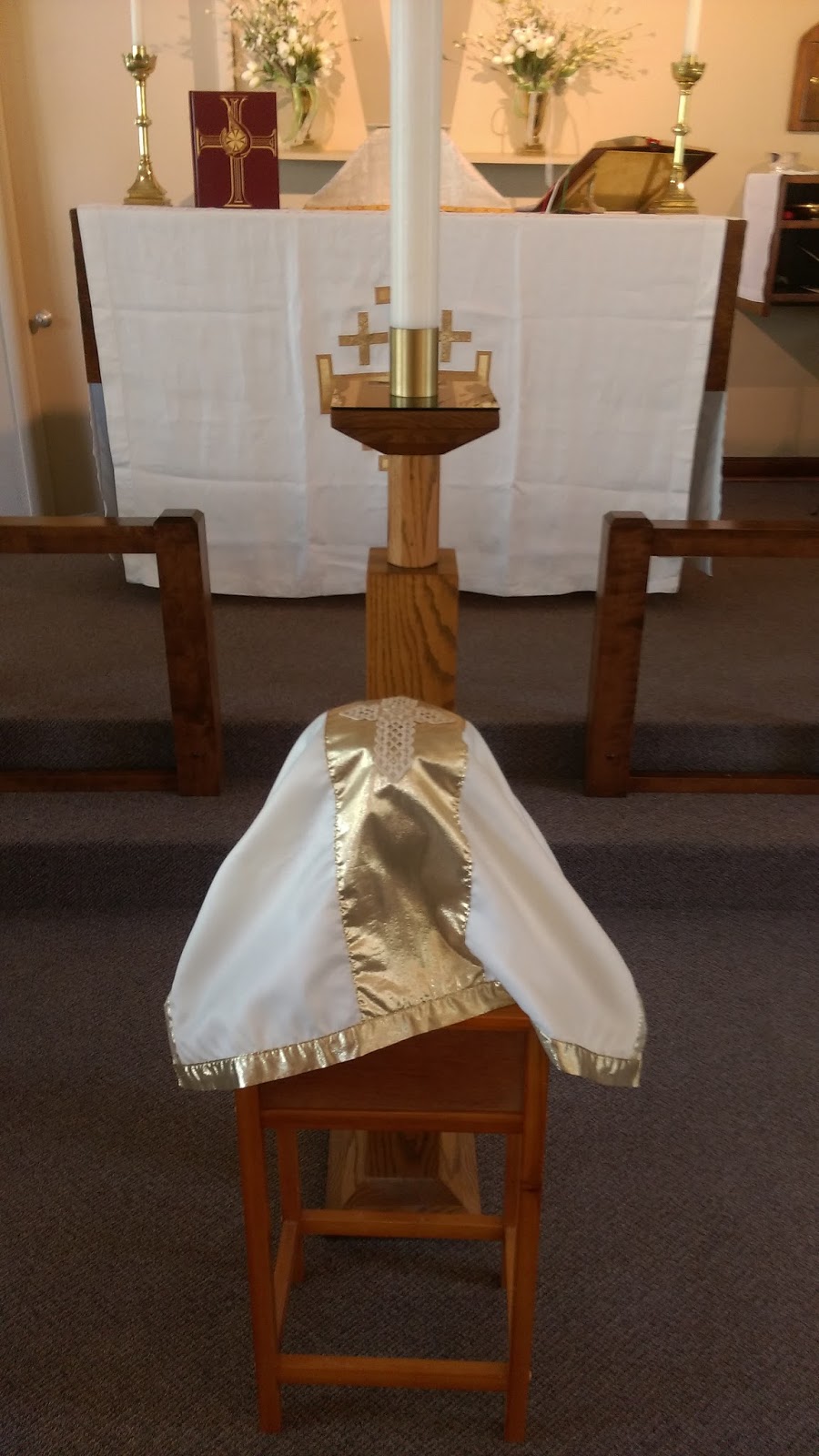 equal. If you ever notice, at our funerals here at St. Stephen’s, the urn of ashes or the coffin is always covered with a white pall. The use of the pall is not just one of those quant things we Episcopalians do. It is not simply some fancy cloth we place over our mortal remains to add a touch of class to the service (though it does do that). There is a very practical reason for placing the pall on the urn or coffin. We put the cloth on because, no matter how fancy and expensive or cheap and inexpensive an urn or casket may be, before the altar, at the funeral, no distinction is made, just as, in God, there is no distinction between any of us.
We are all equally loved children of God. We are essentially on equal ground under that pall. We are all the same.
And, in so many ways, that pall represents baptism as well. Just as the pall is the great equalizer at funerals, baptism is the truly great equalizer in our Christian lives. Our baptism—that singular event that made us Christians—is the starting out point of our lives as Christians and the common factor in those lives. And just as importantly, that holy moment in our lives was the first moment when we were all compelled to preach the Kingdom of God. Without fear.
Yes, many of us are living in fear. But, our fears died in those waters in which we were washed. Our baptismal call is to stand up—strongly, surely, and without fear—to proclaim our equality before God. Without fear. To a large extent, what happened at our baptisms was the first major step in our direction of being followers of Jesus. It was the day in which we essentially were called by Jesus , as Jesus called the disciples in today’s Gospel, to be fishers of people.
Baptism is the first of many steps in following Jesus. And when we see that—when we see our following of Jesus beginning at that very moment in our lives in which we were baptized—we realize how following Jesus is truly a life-long experience.
In our collect for today, we prayed
Give us grace, O Lord, to answer readily the call of our Savior Jesus Christ and proclaim to all people the Good News of his salvation, that we and the whole world may perceive the glory of his marvelous works…
That is what Baptism does. It compels us to answer the call of Jesus and to proclaim to all people the Good News of the Kingdom of God. And the first volley of that proclamation began at our baptism.
In today’s Gospel, when we find Jesus and his first followers going through Galilee, “proclaiming the good news of the kingdom,” we realize that call to us to be “fishers of people” is not necessarily a call to holier-than-thou. It is not a call to be exactly like everyone else in our proclamation. Proclaiming the good news and being fishers of people might simply involve us communicating the truth of that reality in our own unique way It means proclaiming Christ through our demeanor, through the choices we make in our lives and the very way we live our lives. It means standing up for what is right in our way. And it means doing so without fear.
If we do so in such a way, our whole life then becomes a kind of walking sermon, even if we personally don’t say a word. And to a large extent this unique personhood that we received from God was formed in the waters of baptism.
“Follow me and I will make you fishers for people,” Jesus said to those first followers. And he continues to say that to each of us this morning.
So, let us follow him. Let us follow him from the waters in which we were washed to whatever place he leads us in our lives. Let us stand up for truth. Without fear. Let us not let fear win out in our lives and in this world.
We are the ones who can stand up and fight against fear and injustice and inequality by simply being who we are. We have nothing to fear. We have been formed and blessed in those waters of baptism. As baptized followers of Jesus we are protected in a unique and holy way. Let us go out and proclaim this amazing message in our own unique and eclectic way. Let us fish for people and let us bring in a hearty harvest. This is what it is all about. This is how we truly follow Jesus where he leads. And knowing this—truly knowing that—we can follow him with joy and gladness singing in our hearts.



![[image error]](https://3.bp.blogspot.com/-4vQMo9eLXcE/WJeDYHjdzEI/AAAAAAABUGY/rwdH8GlDHsQ7LckmP2nomViiMet_CWWeQCLcB/s1600/salt2.jpg)