Jamie Parsley's Blog, page 32
July 18, 2020
The funeral for Jennifer Johnson
 The Funerals forJennifer Johnson(July 1, 1971-July 11, 2020)
10:00 a.m. - The Fargo Dome, Fargo 2:00 p.m. – Karvonen’s Funeral Home, Wadena, MN
July 18, 2020
Revelation 7.9-17+ As I said at the beginning of our service, it is real honor for me to officiate at this service for Jennifer.
I am especially happy to say that I was Jennifer’s priest.
My role in her life was actually a short one.
I was only her priest for a little over a month.
But in that time, Jennifer and I definitely bonded.
We became close in that time.
And it is a friendship and a bond that I will always cherish.
As we all know Jennifer really fought hard with this battle with cancer.
And she was able to show us all real courage in the face of the hard things of this life.
And as grateful as I am today that Jennifer is not suffering, as grateful as I am that she not in pain anymore, that she is not having to fight anymore, I have something to admit.
I am also angry today.
There should’ve been more time.
Her life was cut short entirely too soon.
She had so much life, so much living ahead of her.
There should’ve been another 30 or 40 years to her life.
She should’ve grown old with Mark.
There should’ve have been more time at the lake, more time to travel, more time to just live and enjoy life.
There was so much life ahead of her.
And I can say that there was maybe a moment or two over these last weeks when my most common prayer for Jennifer was a fist shaken at the sky.
Now, mind you I love God.
I love being a priest, even when I have accompany wonderful young people like Jennifer on their last journey.
Anyone who knows me knows I love God.
I really do.
But sometimes I get angry at God.
And that’s all right.
(We know we can be angry at someone we love).
And it’s all right to be angry about this.
Now, maybe I’m not really angry at God.
But I really am angry at death, and I’m angry at cancer, and I am angry at the unfairness of this all.
It is unfair.
This should not have happened to someone like Jennifer.
This should not have happened to Mark or to Jennifer’s parents Ann or Jerry or to her siblings or to her nieces and nephews or any of the family.
Or to us, who loved her and knew her and cared for her.
Jennifer did not deserve this.
And that makes me very angry!
I’m really angry that there wasn’t more time.
But, for those of us who have faith—faith like Jennifer—and let me tell you, Jennifer had faith—a fierce, strong faith in God—for us, even in the face of this gut-wrenching pain we feel today, even in the face of our frustration and anger and sadness, we know…
We know that the God of love in which Jennifer believed so strongly, really was with her.
I saw it with my own eyes.
Early last Saturday morning, Mark texted me and told me that Jennifer was nearing the end.
I went over to the house, as we gathered around her bed, we prayed, I laid hands on her. And just as we finished the prayers, she went.
It was a holy moment.
It was truly one of those “God moments.”
Even the Hospice nurse was amazed by it all.
There was a palpable, holy energy in that room.
She left this world surrounded by those who loved her.
She left here knowing she was loved and cherished.
She left here hearing all those wonderful, amazing comments from people were calling and texting and leaving messages on social media for her.
She heard them.
And, for those of us who have faith, we know:
This is not the end.
In that beautiful reading we just heard from Revelation, we heard:
"These are they who have come out of the great ordeal…
They will hunger no more, and thirst no more;
the sun will not strike them,
nor any scorching heat;
for the Lamb at the centre of the throne will be their shepherd,
and he will guide them to springs of the water of life,
and God will wipe away every tear from their eyes."
For Jennifer, her great ordeal is over.
She never hungry or thirst again.
And God has wiped away every tear from Jennifer’s eyes.
She will never cry another tear.
We…well, we are not so lucky.
At least right now.
We have not yet emerged from our great ordeal.
But we know that, one day, our tears too will be wiped away for good.
These tears we cry today will be wiped away.
And, when that day comes, it will be a great day.
All this reminds us that our goodbye today is only a temporary goodbye.
All that we knew and loved about Jennifer is not gone for good.
It is not lost forever from us.
All we loved, all that was good and gracious and beautiful in Jennifer—all that was fierce and strong and amazing in her—all of that dwells now in a place of light and beauty and life unending.
And we will see that smiling face again.
We will see her again.
And it will be beautiful.
Jennifer showed us all true courage, true strength, true determination.
She showed us what real courage was in the face of death.
And we should be grateful for that.
We will all miss her so much.
But I can tell you we will not forget her.
Jennifer Johnson is not someone who will be easily forgotten.
She is not someone who passes quietly into the mists.
Her strength, her dignity, her love lives on in all of us who knew her and loved her.
Today, we are sad, yes.
But for those of us who have faith today, we are also confident.
The Alleuia that say today is a defiant word.
That alleluia in the face of death is a defiant alleluia.
It is fist shaken not at God, but it is a fist shaken at death.
It is the fist Jennifer shook at death.
Jennifer, whose faith was so strong, was able to say, Not even you, death, not even you will defeat me.
I will not fear you. (and she did not fear death!)
And I will not let you win.
And, let me tell you, death has not defeated Jennifer Johnson.
So let us be defiant.
Let us shake our fists at death today.
Let face this day and the days to come with gratitude for this incredible person God let us know.
Let us be grateful.
Let us be sad, yes.
But let’s remind ourselves: death has not defeated her.
Or us.
Let us, like Jennifer, be defiant to death.
Let us sing loudly.
Let us live boldly.
Let us stand up defiantly.
Let us live fully and completely.
That is what Jennifer would want us to do today, and in the future.
Into paradise may the angels lead you, Jennifer. At your coming may the martyrs receive you.And may they bring you with joy and gladness into the holy city Jerusalem. Amen.


July 12, 2020
6 Pentecost
 July 12, 2020
Matthew 13.1-9, 18-23
+ Well, today is of course, our first public in-house Mass since March 15.
March 15! Four months!
And it feels good.
It’s so good to see people in the pews
Very good.
But, I do want to stress—and I know this easy to forget:
Worship here at St. Stephen’s was not “on pause” during these four months.
We still continued to celebrate two masses a week, every week during that time.
We still worshipped together.
And I would like to thank all those who worked hard to make sure that worship continued here at St. Stephen’s during the worst days of this pandemic.
Our wardens, Jean and Jessica, our new deacon John, James and the music he faithfully provided for us. Michelle and the cantoring she did for us and Matt Patnode, who provided such beautiful pieces by Bach each Wednesday night (and which he continues to do).
It is important to remember that just because we didn’t meet together as we did before, the Church was not closed.
St. Stephen’s was never closed.
We still were together, at least virtually.
And, in fact, through that little camera in the middle of the nave, we had people join us for worship at St. Stephen’s who would not normally worship with us.
People from all over the country and the world.
We even had a person join us for worship all the way from Kenya.
And because of that, we will continue to livestream these masses.
Look at that tripod in the middle of aisle as about 75 people attending our service.
But, I gotta say, it feels good to have the people who are here in the pews, even though this is so different than before.
But baby steps.
Baby steps in the right direction.
During these last four months, those of us who were in the church building for Mass did the best we could.
The fact is, we were all travelling in uncharted territory during this time.
And for those of us who kept things going, who kept things together, who kept everything “here” on task, we did the best we could under the circumstances.
And, dare I say, we did a pretty darn good job.
I certainly didn’t know anything about livestreaming anything before this.
Now I have an extra hour and ½ in my schedule each week to download and upload videos to various social media.
And there were many time when we first tried to do it when I felt like we were being those Holy Fools of Jesus that I preach about on a regular basis.
You know, those “Holy Fools” in the Eastern Orthodox tradition who just kind of goof things up just to keep all the “proper” Christians on their toes.
And many times, especially during the absurd moments of the pandemic, I thought of those Holy Fools for Christ.
Just as a reminder: for the Holy Fools, our job as Christians is not to be perfect Christians or even “successful” Christians.
Our job as followers of Jesus is to follow—to follow in our imperfection, as fractured, imperfect human beings. Not the best, but the least.
And let me tell you, nothing shows our imperfect nature better than trying to navigate social media.
Thank God none of you saw me trying to download and then upload videos for the first time onto our Youtube Channel.
That was not a pleasant day!
Or when our livestream feeds cut out on us in the middle of Mass.
This pandemic, like the Holy Fools for Christ, has taught us some important lessons.
The pandemic has challenged us on how to be the Church in the hard times.
Remember all those sermons I preached over the years from this pulpit about how the Church was changing and we should be ready for that change.
Remember how I preached about how we should think about “doing church” in a new way.
Well, this is it!
Call me the prophet! (Actually don’t!)
The reality is that, we were prepared in many ways.
Despite the flub-ups, despite the frustrations an the extra work, we really prepared for the most part for this change in the way of doing church.
And we went with the flow.
We adapted.
And the Masses went on.
Holy Week went on.
Two masses a week went on.
I don’t know how successful we were during this time.
But then, the fact is, nowhere does Jesus expect us to be successful in our faith, or perfect.
Now, today’s Gospel, at first glance you would think would not be a reminder to us of this fact.
But…but…it actually is.
If you notice at the beginning of our Gospel reading, as Jesus sits in the boat from which he preaches sort of like from a pulpit, we are told that there is a large crowd coming forward to listen to him.
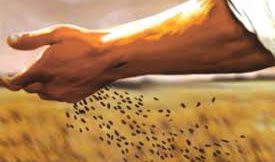
To this large crowd, Jesus then proceeds to preach about seed that fails and seed that flourishes.
And for this moment, it seems as though the seed of the Gospel as it comes from Jesus’ mouth is truly falling on the good soil.
But…. when we look at it from the wider perspective of the story of Jesus, what we realize is that what he is preaching is, in fact, falling on rocky ground and among thorns.
Let’s face it: on the surface, from a completely objective viewpoint, Jesus’ ministry is ultimately a failure (or seems to be anyway).
Let’s look very hard at just this instant in Jesus’ ministry.
On this particular day, he is surrounded by twelve men—people he himself chose—who just, let’s face it, just don’t get what he’s saying.
And they won’t for a very long time.
In fact, they won’t get it until after he’s dead.
These men will, eventually, turn away from him and abandon him when he needed them the most.
One of them, will betray him in a particularly cruel way: one of them will betray him to people he knows will murder Jesus.
By the time Jesus is nailed to the cross, it’s as though everything Jesus said or did up to that point had been for nothing.
Not one of the people Jesus helped, not one of the people he gave sight to, helped to walk, healed of illness, came forward to defend him.
Not even one person he raised from the dead came forward to help him in his time of need.
And certainly, not one person from this large crowd of people that we encounter in today’s Gospel, comes forth to defend him, to vouch for him or even to comfort him as he is tortured and murdered.
Everyone left him except his dear mother and a few of his female friends.
And maybe his beloved apostle John.
As far as his life of ministry was concerned, it seemed very much like a total failure.
It seems, in that moment, as though the seed he sowed had all been sown on rocky ground and among thorns.
It seemed as though the seed he sowed had died.
For any of us, frustration would be an understatement for what we would be feeling at that moment.
We would be feeling that not only our friends have abandoned us, but God too.
And if this was the end of the story, if it ended there, on that cross, on that Friday afternoon, then it would be truly one of the greatest failures.
But this is one of the cunning, remarkable things about Christianity—one of the things that has baffled people for thousands of years.
In the midst of failure, in the midst of frustration, even in the midst of a pandemic, God somehow works.
In that place of broken dreams, of shattered ambitions, (and we experienced broken dreams and shattered ambitions several times during he pandemic) God somehow uses them and turns them toward good.
Somehow, in a moment of abject loneliness and isolation, of excruciating physical pain, of an agonizing murder upon a cross, God somehow brings forth hope and joy and life unending.
And what seems to be sown on rocky ground and among thorns does, in fact, flourish and produces a crop that we are still reaping this morning.
God truly can use our flawed and fractured selves for good and turn our failures and our frustrations into something meaningful.
Look at all those people who are worshipping with us by our various social media this morning (or who will be watching this later during this next week), many of whom have never stepped inside this church building!
We wouldn’t have had the opportunity to reach to any of them if the pandemic hadn’t happened.
See, even in the midst of something awful, can come much good.
What we can take away from our Gospel reading today is that our job is not always to worry about where or how we are sowing the seed.
Our job is to simply do the sowing.
And God will produce the crop.
It is not our job to produce the crop.
What I have realized in my many years of ordained ministry is that I simply need to let God do what God is going to do.
Our job, as Christians, is simply to sow.
And God will bring forth the yield.
And when God does, then we will find crops flourishing even in rocky soil and amidst thorns.
So, all you who have ears, listen.
The pandemic is not over.
We still have a long way to go before it is.
There is still going to be frustration ahead for us.
There is still rocky ground and thorns ahead of us.
But for those of us who hope in God and who sow the seed of God’s Word in this world simply cannot allow frustration to triumph.
Frustration and despair are the thorns and rocky soil of our lives.
Rather, let us heed the message of the Holy Fools for Christ.
Let us be Holy Fools for Christ.
God loves us our weirdness, our eccentricity.
God loves us when we are the misfits, the fools.
God uses and works through our imperfections.
God blesses us even when we’re bumbling along in the middle of pandemic, trying to do church in a new and unique way.
And in our weirdness, in our imperfection, even in a pandemic, we become the rich soil in which that seed flourishes.
When we do that, the crops God brings forth in us and through us will truly be one hundred times more than whatever we sowed.
Let us pray.
Lord, God, in your goodness, you somehow are able to bring abundant fruit even in the midst of thorns; help us to sow the seeds of your Kingdom so that your Word may flourish and you may triumph. We ask this in the Name of Jesus. Amen.
Amen.
July 5, 2020
5 Pentecost
 July 5, 2020
Matthew 11.16-19, 25-30
+ A lot of people seem to think there are secrets to the Priesthood.
I think people think it’s a secret society, like the Masons or something.
They think there are secrets prayers and rituals, etc.
I am asked on a regular basis what those secrets are.
And I guess I don’t help the situation, because my usual response is: “they’re between Jesus and me.”
Actually, there aren’t many secrets to a priests’ life.
But there are things you might not know about.
For example, what most of you might not know is that all these vestments…well, each one is put on with a prayer.
Each of these vestments a priest wears has a prayer that goes along with it.
As the priest puts on each articles of clothing, he or she can say a prayer to remind them that each article of clothing has symbolic meaning.
If you go into the undercroft, you’ll see on the wall there by the vestments the vesting prayers on the wall.
And I know that Deacon John prays some of these prayers when he’s vesting as well when he vests in his Deacon’s vestements.
The prayers are actually good things for someone like me.
I need such things in my life to help me get centered.
I like the fact that I am essentially being clothed in prayer when I pray those prayers while vesting.
And I really do love the symbolism of them.
The prayers are interesting in and of themselves.
For example, when I put on the alb, which is the white robe under these vestments, I pray,
“Make me clean as snow, O Lord, and cleanse my heart; that being made clean in the blood of the Lamb I may deserve an eternal reward.”
When I put on the stole, the scarf-like vestment I wear around my neck, I pray:
“Restore unto me, O Lord, the stole of immortality which I lost through the sins of my first parents and, although, unworthy to approach Thy sacred Mystery, may I nevertheless attain to joy eternal.”
And when I put on this chasuble, this green vestment I wear over it all, I pray a prayer that directly quotes our Gospel reading for today.
The prayer I pray when I put on the chasuble is,
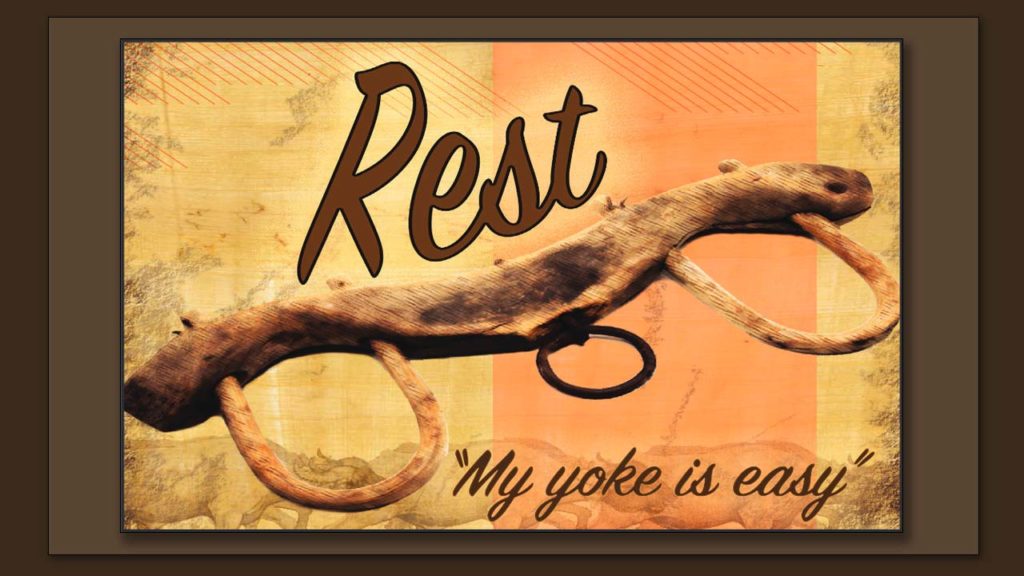
“O Lord, who hast said, ‘My yoke is sweet and my burden light,’ grant that I may carry it to merit Thy grace.”
The chasuble, in this sense, really is symbolic of the yoke.
Now the word of the day today is a strange one.
Yoke
It’s one we really don’t want to have to ponder, because, let’s face it, no one wants a yoke.
When we think of a yoke, we no doubt think of something that weighs heavily upon us.
We think of something a beast of burden carries on their backs.
We can’t imagine anything worse for us.
Why would we want an extra burden in our lives?
We have enough burdens as it is.
We’re still bearing the yoke of the pandemic.
And for some, they seem think wearing a mask or being asked to follow safety protocols is a yoke for them.
We are all truly “weary and carrying heavy burdens.”
And sometimes these heavy burdens truly affect our bodies.
As some of you know, I have very terrible back issues.
These came from fractured bones I received in car accidents over the years.
I can’t stand for long periods.
Or sit on a hard surface for prolonged periods.
Every time I go to my chiropractor about these issues, they say things to me like, “Father, you’ve been carrying some heavy burdens on your back, haven’t you?”
Well, we all do, don’t we?
We are all carrying around things we probably should have allowed ourselves to get rid of some time ago.
So, the last thing we want at this time in our lives is to take on another burden.
And not just a burden.
But a burden that is put on us to essentially control us.
Jesus shouldn’t be a burden in our lives.
Isn’t Jesus supposed to take some of the burdens from us?
The reality is: taking on Christ is equivalent to taking on a very heavy burden.
The cross of Jesus is our yoke as Christians.
Being Christians means living with a burden.
It means we have a structure, a framework that directs our lives.
And sometimes it’s hard to live in such a way.
It’s hard to live by a set of standards that are different from the rest of the world.
Let me tell you as someone who lives with standards different than the rest of the world (vegan, celibate, teetotaler that I am).
Still, I think, most of us, even us Christians, still bristle when we describe our faith and many of those standards that go along with our faith as a yoke.
A yoke on our backs confines us.
It does not allow us freedom.
And we, as humans, and especially as Americans, love our freedom.
We love “elbow room.”
We don’t like anyone telling us what to do and forcing us to go places we don’t want to go.
But the fact is, when we take Christ as our yoke, we find all our notions of personal freedom and independence gone from us.
No longer do we have our own personal freedom
No longer do we have our own personal independence.
What we have is Christ’s independence.
What we have is Christ’s freedom.
Our lives are not our own.
As Christians, we don’t get to claim complete personal independence over our own lives.
Our lives are guided and directed by Christ.
Our lives are ruled over by Christ.
The yoke of Christ means that it is Christ who directs our yoke.
It Christ who directs us, if we need to, to go the places Christ wants us to go and do the things Christ wants us to do and live in certain ways that Christ wants us to live.
It is our duty to be a “beast of burden” for Christ and for what Christ teaches.
The great thing about that is that if we let Christ direct us, nothing wrong will happen to us.
Christ will always lead us along the right path.
Christ will direct us where we need to go.
Now I say all of this to you as though I am fine with all of this.
I say this to you as though I have completely surrendered myself to Christ as his beast of burden.
But, I’ll be brutally honest with you.
I find much of this very difficult to bear as well.
I have always been one of those independently-minded people myself. I know that’s not a surprise to any of you.
I have never liked being told what to do or what to say by anyone.
I have always preferred doing things on my own.
And for years I struggled with this scripture in my own life.
I did not want to surrender my personal independence and my personal sense of freedom.
Which is why that prayer I pray when I put on my chasuble is not always a prayer I want to pray.
Certainly, in many ways this prayer defines for me what ministry is all about.
When I put on this garment, symbolic of my ministry as a priest, I am reminded of the yoke, of the burden, I carry every day.
In a sense, as a priest, my life is not my own.
I’m not complaining about that.
I knew the rules of the game when I entered the priesthood.
But the reality is that my life is fully and completely Christ’s.
As a priest, I don’t always get to do what I want, or go where I always want to go.
There are standards.
There are boundaries.
It’s not a free-for-all.
And for those clergy who think it is—well, they’re the ones, we all know, who get in trouble.
I strive to do what Christ wants and I strive to go where Christ leads me.
The key word there is “strive.”
I try to do what Christ wants and try to go where Christ leads.
More often than not, my own arrogance gets in the way, my own fears and anxieties cause me to shrug off the yoke of Christ, and my own selfishness leads me to do only what I want to do.
All ministry is a yoke.
And ministry, as we all know, doesn’t just happen out of the blue.
Our ministry that we do stems directly from our baptism.
It is a response to the promises that were made for us when we were baptized and which we re-affirm on a regular basis.
So, when I talk about my life not being my own, it is not confined to just me as an ordained priest in the Church.
Rather, through baptism, we are all called to ministry, to a priesthood of all believers.
We have all, through our baptism, taken on the yoke of Christ.
Because, through baptism, we have been marked as Christ’s own forever and we have been given a yoke that we cannot shrug off.
Our lives are not our own.
Through baptism, we are Christ’s—and our lives belong completely and fully to Christ.
Now all of this might seem confined and difficult to accept, but Jesus says, in no uncertain terms, that his yoke is not quite like the yoke put on a beast.
While that yoke is heavy and unwieldy—it is a tedious weight to bear for the animal—for us, he tells us, his yoke is light and the burden easy.
It is a burden that we should gladly take on because it leads us to a place of joy and gladness.
It is a yoke that directs us to a place to which we, without it, would not be able to find on our own.
We, in our arrogance, in our self-centeredness, in our selfishness, cannot find the Kingdom of God on our own.
Only through Christ’s direction can be we be truly led there.
The yoke of Christ is, in an outward sense, a simple one to bear.
The yoke of Christ consists of loving God and loving our neighbor as our selves.
It is these two commandments that have been laid on our backs and by allowing ourselves to be led by them, they are what will bring us and those whom we encounter in this life to that place of joy.
So, let us gladly embrace the yoke Jesus laid upon us at baptism.
For taking on the burdens of Christ will not be just another burden to bear.
It won’t cause us any real pain.
It won’t give us aches and pains that will settle in our backs and necks, like the others burdens we carry around with us in this life.
But rather, the yoke of Christ is what frees us in a way we cannot even begin to understand.
It is a freedom that we find in Christ.
“Take my yoke upon you,” Jesus says to us, “and you will find rest for your souls.”
Let us take the yoke of Christ upon ourselves with graciousness, and, when we do, we too will find that rest for our souls as well.
Let us pray.
Holy and loving God, give us strength to bear what we must bear, and to go where we must go, so that in doing so, we may follow your Son, Jesus; in whose name we pray. Amen.
June 27, 2020
The memorial service for Jim Coffey
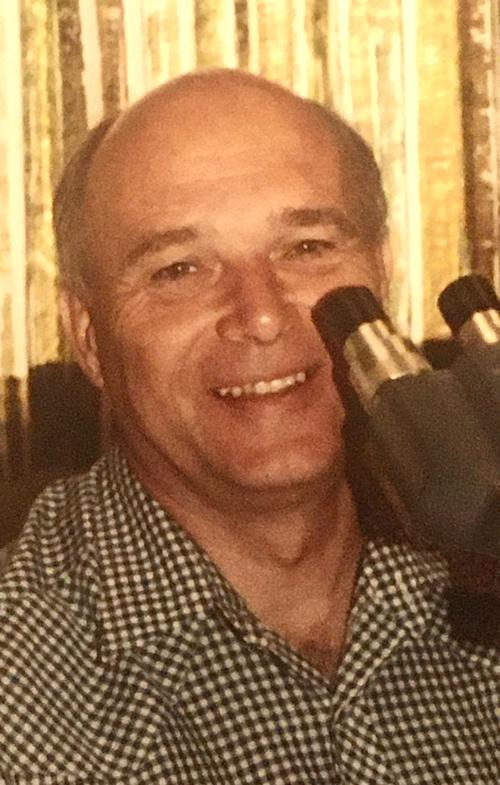 Jim Coffey1929- 2020
June 27, 2020
+ Well, we gather today not really wanting to be here.
Yes, we knew this day was inevitably on the horizon somewhere.
But it still seems a bit too soon.
It was supposed to be different.
I guess imagined a time in which we could all say our goodbyes in person.
But, again, as Jim would tell us, this is the way it sometime happens.
And, in many ways, this might be better.
Whatever the case, all I do know for certain today is that I am very grateful.
I am grateful for Jim and for all he was.
I am grateful for the incredible and amazing life he lived.
I am grateful for the love he had for Joy (and the love she had for him).
I am grateful for all of you—his legacy in this world.
And you are all an amazing legacy to an amazing man!
And yes, as sad as today is, we are also able to rejoice.
We rejoice in Jim.
We rejoice in all that wonderful and beautiful and brilliant in Jim.
I am very honored to have been his priest.
I am very grateful to help commemorate him today and give thanks for his life today and to commend this truly wonderful man to God.
I say I am his priest, but I would say I was his friend.
And I am grateful for that too.
Today, is not the end of anything.
Yes, we are saying goodbye.
But we are not going to stop loving him, or remembering him, or sharing all these wonderful stories about him.
And as you all know, there will be many, many stories told about Jim Coffey in the years to come.
Many wonderful stories.
And his presence will certainly stay with us as long as we share those stories.
I have no doubt that Jim is with us here this afternoon, celebrating this long and wonderful life with us.
I am of the firm belief that what separates us who are alive and breathing here on earth from those who are now in the so-called “nearer presence of God” is actually a very thin division.
So, yes, right now, I think we can feel that that separation between us here and those who have passed on is, in this moment, a very thin one.
And because of that belief, I take a certain comfort in the fact Jim is close to us this morning.
He is here, in our midst, celebrating his life with us.
And we should truly celebrate his life.
It was a good life.
It was a life full of meaning and purpose.
He made a real difference in this world.
And I’m not just meaning in the life of you, his wife, and children and grandchildren and great-grandchildren.
He made a difference in the lives of so many others.
Those he touched and affected as a doctor.
Those he knew and cared for.
Those many people who called him a dear friend.
He was remarkable in so many ways.
He was a man of science.
But he was also a man of deep faith.
And I got to see that side of him on more than one occasion.
Now saying that, I’m not saying he was some deeply over-pious person.
He was not that.
And even with his faith, he could still caste a critical doctor’s eye.
I remember very clearly one Christmas Eve, after Mass, we were talking and he said, “A virgin birth? Impossible!”
But he did have a deep and abiding faith in God.
I saw it again and again in his life.
And, toward the end of his life, whenever I would come to visit him, he would mouth the prayers he knew so well and, when he was able, he would always faithful receive Holy Communion.
That faithful life made itself known in so many ways.
All of us were touched by all the kindness he showed to us.
I will never forget that strong and gentle presence.
I will never forget that that kindness and that goodness that he embodied.
I will always remember his care and his concern for others.
Of course, St. Stephen’s was an important place in his life.
This was his church home.
Beginning in 1964 Jim served as Senior Warden here seven times, and as Junior Warden four times.
I am so very happy that his ashes will rest here in our memorial garden.
This was a person who truly lived out in his life the great commandments to Love God and to love others as you love yourself.
It was that love—love of God, love of others, love of his family and friends—that truly defined Jim Coffey.
As Jesus said in our Gospel reading for reading.
“Abide in my love. If you keep my commandments, you will abide in my love…”
That is the perfect summary of Jim’s faith and life.
He kept those commands of love of God and love of others in the best we he knew how.
And we—all of us here today—are better for that love.
We all felt it.
We all were embraced in it.
We all knew how wonderful that love of Jim’s was.
As a faithful Episcopalian, Jim know that is that sometimes we can’t clearly define what it is we believe.
Nor should we.
We can’t pin it down and examine it too closely.
When we do, we find it loses its meaning.
But when I am asked, “what do Episcopalians believe?” I say, “we believe what we pray.”
I think Jim would’ve appreciated that definition of our beliefs.
We’re not big on dogma and rules.
We’re not caught up in the letter of the law or preaching a literal interpretation of the Bible.
But we are big on liturgy—on the our worship services.
Our Book of Common Prayer in many ways defines what we believe.
And so when I’m asked “What do Episcopalians believe about life after death?” I say, “look at our Book of Common Prayer.”
Look at what it says.
And that is what we believe.
This service is a testament to what we Episcopalians believe about what happens—this service of Resurrection, of life unending, of the fact that today is not ending, but is, in fact, a great and wonderful beginning.
This service is a testimony to what Jim himself believed.
Later in this service, as we commend Jim to God’s loving and merciful arms, we will pray,
You only are immortal, the creator and maker of mankind; and we are mortal, formed of the earth, and to earth shall we return. For so did you ordain when you created me, saying, "You are dust, and to dust you shall return." All of us go down to the dust; yet even at the grave we make our song: Alleluia, alleluia, alleluia.
Jim the poet would get those words.
Jim—who could recite “The Cremation of Sam McGee” by Robert Service from memory (that always amazed me—and I’m a poet!)—would have “gotten” the poetry of that passage.
Jim—whose amazing and incredible photography reflected his keen poetic eye—would really “get” what was being said in those words.
He would understand that, yes, even now, even here, at the grave, what do we do?
We rejoice.
We sing our alleluias today.
Because we know.
We know that what we are rejoicing in today is Jim’s new life, his new beginning.
Where Jim is right now—in those loving, caring and able hands of his God—there is no pain or sorrow.
There is only life there. Eternal life.
At this time of new beginning, even here at the grave, we—who are left behind—can make our song of alleluia.
Because we know that Jim and all our loved ones have been received into God’s arms of mercy, into the “blessed rest of everlasting peace.”
This is what we cling to on a day like today.
This is where we find our strength.
This what gets us through this temporary—and I do stress that it is temporary—this temporary separation from Jim.
We know that—despite the pain and the frustration, despite the sorrow we all feel—somehow, in the end, God is with us and Jim is with God and that makes all the difference.
For Jim, sorrow and pain are no more.
In those 91 years, Jim knew much love and wonder and beauty.
In those 91 years, he also gave much love and wonder and beauty.
All of that is not gone.
It still goes on.
Jim, in this holy moment, has gained life eternal.
And that is what awaits us as well.
We might not be able to say “Alleluia” with any real enthusiasm today.
But we can find a glimmer of light in the darkness of this day.
It is a glorious Light we find here.
Even if it is just a glimmer, it is a bright and wonderful Light.
And for that we can rejoice and be grateful. And we can celebrate. May angels welcome you, Jim.May all the saints come forward to greet you.And may your rest today and always be one of unending joy.
June 26, 2020
The Memorial Service for Jason Gould
 June 26, 2020Hanson-Runsvold Funeral Home
I really want to keep this very informal.
Jason would want this to be very simple.
And I don’t think he’d be too happy to know we’re all talking about him.
But, it’s good to talk about him, to share memories of him, to remember the good things, and try to forget the bad things.
I say that, but forgetting the bad things is hard to do.
But, what I realized is that I can’t blame him really for the bad things any more than I can blame myself.
For Jason, he had a tough life, from the very beginning.
When he was born in September of 1959, he was born into a bad time in his family.
His grandmother Laverne was dying of Leukemia.
She was able to see him shortly after he was born on September before she died on Sept. 23, 1959.
The other issue going on was that, according Mom anyway, the marriage between her and Roger was pretty much over by that time.
They were both unhappy.
Mom talked about how there was a kind of pall over Jason’s pregnancy.
And she said she didn’t even set up his nursery until just few weeks before he was born.
Of course, as we know, he was born with scarring on his brain.
Mom had no idea how that happened.
This was the time of Thalidomide babies, but she always said she didn’t take any type of drugs during that time except for vitamins.
In 1961 and again in 1962, he almost died.
Michelle remembers the seizures.
He was hospitalized for long periods of time.
It was a terrible time.
Then, Dr. Lee Kristoferson was able to figure out what the issue was and prescribed a very powerful anti-seizure medication.
As much of a miracle as the medication was, it also wreaked havoc on Jason.And for the rest of his life he struggled.
His parents’ divorce was particularly hard on him, especially being the youngest.
Michelle and I talked the other day about how he would sit at the picture window in our old house waiting for his father to come home from work.
I also remember Mom talked about how the medication made him hyper.
So she would hand him pots and pans and a wooden spoon and he would drum to the music on the radio.
She especially how he became really good at drumming along to “Love Me Do” by the Beatles.
When Mom married Dad, Jason has a hard time with it I know.
And when I came along—man, that was not good.
Or 10 years Jason had been the baby. Of the family.
And now suddenly there was me.
I don’t think he ever got over that.
His teenage years were really rough.
He dropped out of high school.
He went into the Job Corps.
I remember when he boarded the plane for South Dakota.
He was scared, Mom was crying. We took a trip down to Rapid City the following spring. It was there he learned how to weld.
He came back and worked O’Day Equipment, then at Skarphol.
He continued to have really bad seizures.
As I say, it was not an easy life.
But he was a good guy.
Everyone who knew him said, he was a good guy.
He loved hockey.
That was his favorite thing in the whole world.
Even as a little boy, he loved playing hockey.
And for a guy his size, he could skate better than most people.
He also loved kites, and flying kites.
He would spend hours and hours just flying kites.
I think he just loved how it was a way to kind of escape life.
And he was funny.
He was a true clown.
He could make anyone laugh—well, except for Nana.
His jokes drove her crazy!
I am happy that all the hard times are behind him now.
I am happy that there no more seizures, no more epilepsy, no more pain, no more frustration in this life and all that life threw at him.
I hope more than anything else, that he is finally happy now.
I hope he is whole and healthy and fully himself.
I’m happy Mom never had to live to see this day.
She feared this day all those years.
And I am grateful that they are together again.
They loved each other.
And it’s good to know they’re back together.
I hope for the rest of us we can remember him for all the good that was in him.And there was a lot of good in him.
I hope we remember his laughter and his joy and his ability to goof around, even if it went a little too far sometimes.
I hope we will always remember him.
Because he deserves our remembrance.
When Jason was baptized on October 18, 1959 at St. Mark’s Lutheran Church in Fargo, he was of course baptized in the Name of the Father, the Son and the Holy Spirit.
But, at the beginning of that service there was a short formula that was used (it was used at my baptism 10 years later as well when Iw as baptized at Bethlheme Lutheran Church in Fargo).
During the baptism service, the Pastor Lloyd Zaudtke made the sign of the cross on Jason’s forehead and said, “Receive the sign of the holy Cross, in token that henceforth thou shalt know the Lord, and the power of the resurrection, and the fellowship of his sufferings.”
In many ways, that summarizes Jason’s life, I hope.
He wasn’t, by any sense of the word, religious.
But he was loved by God.
I know that.
And throughout all of his sufferings, throughout all of the many hardships of his life, he was still marked by that cross.
He lived, whether he was aware of it or not, in the fellowship of Jesus’ sufferings.And now, we can believe, he lives right now in the power of Jesus’ resurrection.
That is my hope, and my consolation in this moment.
May angels welcome you, Jason.
May all the saints come to greet you.
And may your rest today and always be one of unending joy.
June 21, 2020
3 Pentecost
 June 21, 2020
Matthew 10.24-39
+ Even during a pandemic, pastoral care still goes on.
And probably the biggest pastoral duty I have had during these last few months has just been listening.
Listening to people who have called me or reached out to me.
And I would say that the majority of people who are reaching are dealing with issues of deep and abiding fear.
Let’s face it, it’s a frightening time right now.
Covid is still raging through our country.
The political differences between people are leaving us divided and frustrated and angry
And the protests against police violence toward black people, the fact that black people are being killed in disproportionate numbers, is definitely frightening.
Add to that a HUGE spike in homophobic and anti-Semitic attacks in these last two or so years has been sobering.
It is a truly strange and uncertain time we are living in.
This year of 2020 has been a particularly hard one.
And it’s only June!
And there’s still an election coming!
Sigh.
All of this reminds me very much of some of the petitions we find in a service in our Prayer Book we use only two time a year.
In our Prayer Book, beginning on page 148, we have something called “The Great Litany.”
I love the Great Litany!
The Great Litany, and especially the Supplication, which can be found on page 152 is a special prayer service which is often used “in times of war, or of national anxiety, or of disaster.”
It’s not a liturgy we, thankfully, use very often.
We use on the first Sunday of Advent and the First Sunday of Lent here at St. Stephen’s.
And although some people find it ponderous or even theologically uncomfortable, it is meaningful, and let me tell you, it speaks volumes to us in these current times.
In this time of national anxiety, I have occasionally prayed the Great Litany privately here in church on an occasion or two in the past.
I actually have prayed it a couple of times here in church during the pandemic.
Fear like that can be very crippling.
And, as you’ve heard me say many times, fear in this sense is not from God.
Fear is a reality and there’s no way around at it times, but it is not something we should allow to dominate our lives.
In a sense, that fear is possibly what Jesus is hinting at in our Gospel reading.
Well, there’s actually a lot going on in our Gospel reading for today.
There are layers and layers in our Gospel reading.
And some really fairly unpleasant things.
But essentially it is about our fear of doing the work of God—doing the ministry of Christ—and…about taking up our cross.
Certainly it seems all this is bound together.
Essentially, probably our greatest cross to bear is our fear.
A fear like I referred to at the beginning of my sermon.
A strange, overpowering fear that is hard to pinpoint.
A fear of the unknown.
A fear of the future.
A fear of all those things we can’t control in our lives.
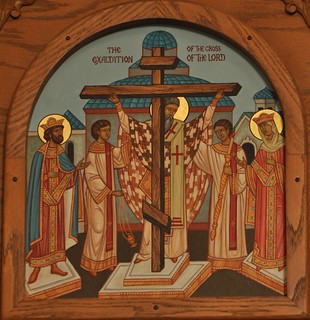
Let’s take a moment this morning to actually think about the symbol of our fears—this thing to which Jesus refers today—the Cross.
And I say that because the Cross is a symbol of fear.
It certainly was to people of Jesus’ day.
It was an instrument of torture and pain and death.
It was the equivalent of a noose or a guillotine
There was nothing hopeful or life-affirming in it to them.
And yet, look at how deceptively simple it is.
It’s simply two pieces, bound together.
Or, as the our crucifix in the corner shows, it is a cross on which a man actually died.
I love the symbol of the crucifix, especially.
In it, gazing on the figure of Jesus who hangs there, we cannot deny what the cross is or what it represents to us.
For someone who knows nothing about Christianity, for someone who knows nothing about the story, it’s a symbol they might not think much about.
And yet, for us, on this side of Jesus’ crucifixion, the Cross is more than just another symbol in our lives.
It is a perfect example of how something that is a true symbol of death, destruction and fear can be transformed.
The story of the Cross is amazing in the sense that is as symbol of absolute terror and darkness transformed into a symbol of unending life, of victory of fear and death and despair.
Jesus knew full well what the cross was all about, even before he was even nailed to it.
In our Gospel reading, he says, “anyone who does not take up his cross and follow me is not worthy of me.”
He knew it was a terrible dark thing.
He knew what is represented.
And by saying those words, he knew the people of his day did not want to hear those words either.
Taking up a cross? Are you serious? Why would anyone do that?
Taking up the Cross is frightening after all.
To take up a cross means to take up a burden—that thing we maybe fear the most in our lives.
To take it up—to face our greatest fear—is absolutely torturous.
It hurts.
When we think of that last journey Jesus took to the place of his crucifixion, carrying that heavy tree on which he is going to be murdered, it must’ve been more horrible than we can even begin to imagine.
But the fact is, what Jesus is saying to us is: carry your cross now.
Carry it with dignity and inner strength.
But carry it without fear.
And this is the most important aspect of today’s Gospel reading.
Jesus commands us not once, but twice,
“Do not be afraid.”
“Do not be afraid.”
He isn’t saying that in some nonchalant way.
He isn’t just saying it flippantly.
He is being blunt.
Do not be afraid.
Do not be afraid of what the world can throw at you.
Do not be afraid of what can be done to the body and the flesh.
Do not be afraid of pandemics or racism or violence
Taking our cross and bearing it bravely is a sure and certain way of not fearing.
It is a defiant act.
If we take the crosses we’ve been given to bear and embrace them, rather than running away from them, we find that fear has no control over us.
The Cross destroys fear.
The Cross shatters fear into a million pieces.
And when we do fear, because we will experience fear in our lives, we know we have a place to go to for shelter in moments of real fear.
When fear encroaches on our lives—when fear comes riding roughshod through our lives—all we have to do is face it head-on.
And there, we will find our fears destroyed.
Because of the Cross, we are taken care of.
There is no reason to fear.
I know that sounds complacent.
But there is no reason to fear.
Yes, there will be moments of collective, spiritual fear we are going through right now.
Yes, there will be a palpable fear we can almost touch.
Yes, we will be confronted at times with real and horrible fear.
But, there is no reason to despair over it because we are not in control.
God is in control.
“Even the hairs of your head are counted” by the God who loves us and cares for us.
This God knows us intimately.
So intimately than this God even knows how many hairs are on our head.
Why should we be afraid then?
Because each of us is so valuable to God.
We are valuable to God, who loves us.
When we stop fearing whatever crosses we must bear in our lives, the cross will stop being something terrible.
Like that cross on which Jesus died, it will be an ugly thing of death and pain and fear turned into a symbol of strength and joy and unending eternal life.
Through it, we know, we must pass to find true and unending life.
Through the Cross, we must pass to find ourselves, once and for all time, face-to-face with our God.
So, I invite you: take notice of the crosses around you.
As you drive along, notice the crosses on the churches you pass.
Notice the crosses that surround you.
When you see the Cross, remember what it means to you.
Look to it for what it is: a triumph over every single fear in our lives.
When we see the crosses in our lives, we can look at it and realize it is destroying fear in our own lives.
Let us truly look at those crucifixes and see the One who hangs nailed to the cross.
Let us bear those crosses of our lives patiently and, most importantly, without fear.
We are loved by our God.
Each of us is precious to our God.
Knowing that, rejoicing in that, how can we ever fear again?
Let us pray.Holy God, we do live in fear. We do avoid taking up the cross Jesus tells us we must bear in our following of him. Dispel from our lives these crippling fears, these fears that prevents us from living into our own full potential, from the fears that separate us from you, and help us to live fully into this world without fear. We ask this in Jesus’ holy Name. Amen.
June 14, 2020
2 Pentecost
 June 14, 2020
Exodus 19.2-8a; Matthew 9.35-38
+ Well, I don’t need to tell anyone what a very special day today is.
This afternoon, when John Anderson is ordained a deacon at All Saints Church in Valley City, St. Stephen’s will have its first vocational deacon (hopefully not its last).
I am going to say to John what was said to me at my ordination to the Diaconate 17 years ago next month.
Today is not about John. It really isn’t
It is not even about St. Stephen’s.
It about the Church—about all of us.
John is being ordained not for St. Stephen’s, but for all of us—for the whole Church.
And what we celebrate today is that ministry.
But, we also get to celebrate John too today.
And we also get to celebrate what this ordination means to us here at St. Stephen’s.
As I mention in the notice I wrote for today’s bulletin (which I posted on Facebook and our blog this morning), John first asked me about being a Deacon way back in 2014.
I remember that evening at Mezzaluna and that conversation we had that night well.
John, after years of ministry in the United Methodist Church, truly felt that God was calling him toward this change in ministry.
I don’t think we knew on that night in 2014 that the road ahead would be a long, circuitous, often frustrating one.
Actually, I think we find of knew it wouldn’t be easy.
Certainly there have been great joys and very deep disappointments as he sought to heed his calling.
And, if he hadn’t seen the ugly side of Church politics before that, he certainly did during his process as well as blatant discrimination.
But, as I reminded him and all of you many times over those years, our path in following Jesus is so often filled with great joys and deep disappointments.
But, we’re not going to talk about the disappointments today.
And today is one of those days of great joy.
After today, there will be some noticeable changes.
John will now be vested as a deacon, wearing a stole and, at times, a dalmatic, at our liturgies.
He will now be wearing a clerical collar.
He will be proclaiming the Gospel at mass.
He will be assisting at the altar.
We will be referring to him from now on as “Deacon John.”
But outside those visible changes, all remains as it has been.
The fact of that matter is that John has already been serving faithfully in a diaconal ministry for several years., as we all know and have seen.
We at St. Stephen’s are not only blessed today, we are very grateful as well.
We have longed for diaconal ministry for many years.
He have been in need of a deacon for at least 10 years.
It is especially appropriate that our congregation, named after the first deacon of the Church, finally has a deacon to serve our growing and expanding needs.
It’s also appropriate on this wonderful day that we get this reading from the Gospel.
This was the same Gospel that was read at my ordination to the Priesthood 16 years ago last Thursday.
Now, I didn’t pick to for this morning.
But the words of that Gospel, which we just heard, were words that have been very prophetic in my own life as an ordained minister.
In that Gospel reading, we hear Jesus say, “I am sending you as sheep into the midst of wolves; so be wise as serpents and innocent as doves.”
Well, John.
I don’t think I need to tell you this this morning, but, as you very well know after all your years of ministry, that’s often what it feels like being a minister of God, whether as an ordained person or not.
Actually, that’s what it’s like just to be a Christian at times.
Most of us, in whatever ministries we might be doing in our lives, know this to be very true.
We’ve all been there, in the midst of those wolves.
We have known those wolves very well.
And yes, some of them really are wolves in sheep’s clothing, let me tell you!
I could name a few…
I won’t.
But I could.
It’s important in all the ministries we do to be as wise as a serpents and innocent as a doves.
Well, I don’t know how “innocent” I personally have been.
Or, for that matter, “wise” either.
But I’ve tried really hard to be both wise and innocent, as a priest, as a deacon, as a follower of Jesus, a lover of God and a lover of others.
And I know John has too.
And I know that we all, who are doing ministry together here at St. Stephen’s are striving for that as well.
There is something so profoundly true in this Gospel reading for today.
Of course, there’s a lot here.
But, it’s all good.
And it is a message to all of us.
All of us who are called to ministry.
All of us who serve.
All of us who strive to follow Jesus and love God and love one another.
For those of who do those things, who follow Jesus, who love God and one another, in any way in our lives, we are, as we heard in our reading form Exodus today, “a priestly kingdom and a holy nation.”
Doing any one of these things—following Jesus, loving God, loving others—is not easy.
Because doing these things isn’t some insular thing we do.
It isn’t just about “me and Jesus,” so to speak.
It’s about all of us.
Together.
It is not easy being wise as serpents and innocent as doves.
Ministry is hard.
Following Jesus is hard.
Loving God is hard.
Loving one another—let me tell you, that’s very hard sometimes.
Being a laborer when the harvest plentiful and the laborers are few is hard.
All of us who do it know that we all have to be wise as serpents and innocent as doves at times in our lives and in the work we do.
Each of us has been called, by our very baptism, to be those laborers of the harvest.
We have been called to serve.
We have been called to shed our egos to a large extent.
And that might be the hardest thing of all.
I know that it is for me.
Ministry is certainly not some ego trip.
If one goes into ordained ministry for an ego trip, let me tell you, there will be a rude awakening.
I hate to break this news to you, John, but it’s not always going to blue skies and flowers every day after today.
Because, ministry, any kind of ministry, is not about any one of us as an individual.
It is not about us as individuals.
It is not about the cult of personality.
When we make it such, it is doomed to fail
Trust me.
I have seen it.
Ministry is, in fact, humbling.
Or, sometimes, downright humiliating.
And, sometimes, it can be a burden.
Partly it can be burden because, none of us, not one of us, is perfect.
And realizing our limitations can be sobering.
It can be frightening.
And it can be humbling.
Of course, we must remember that no one is expecting any of us to be perfect.
But the message I think we all—ordained or not—can take away from this is that God uses our imperfections.
God uses us as we are.
God loves us for who are.
And this is our model in turn.
We must love each other, as we are, for who we are.
And when we realize that we don’t have to be perfect, that we don’t all have to ordained priests or deacons to do what God calls us to do, it can be a relief.
Because, the fact is, imperfect as we are, we are all a priestly kingdom
God calls each of us in our own ways—in our own fracturedways—to serve as we need to serve—to do as much good as we can here and now.
That is all we can do sometimes.
We must strive hard just to do good, even in some small way, every day, in whatever way we can.
In so many ways, our lives and ministries are very much like those Israelites, who we encounter today in our reading from Exodus wandering about in the desert.
It does feel like that on occasion.
That we are wandering about in the desert.
That we are uncertain of what we are doing or where we are going.
But, once we start trusting, once we stop relying only ourselves and our egos, once we stop trying to be perfect all the time, and just trust God, and love others, and just follow Jesus where he is going, we do find our way.
So, let us not try to hide our imperfections.
Instead, let us live out our ministry as we are, striving to have compassion on the harassed and the helpless, on those who are sick and those who might not even know they’re sick, on the marginalized and on those who have little or no voice.
Even if we fail, making the effort helps us to live out our ministry and, if nothing else, it just makes the world a little better place than it was before.
Let us truly be a priestly nation, loving God, loving each other.
And in all that may come upon—good or bad—let us be wise as serpents and innocent as doves.
By doing so, we live in integrity.
By doing so, we will make a difference in this world, even in some small way.
By doing so, we will bringing the Kingdom of God even closer.
“The Kingdom of God is near,” we hear Jesus say to us today in our Gospel reading.
It is near because we are working and striving to make it near.
We are making it present when we do what we do in love.
Let us pray.
Lord of the Harvest, send us out. Help as we bring your Kingdom nearer. Let us strive, in our love of you and of one another, to do the work you have called us to do. There is much work to do. Let us do what we must do. We ask this in the holy Name of Jesus. Amen.
June 7, 2020
Holy Trinity Sunday
June 7, 2020
Matthew 28.16-20
+ I saw this cartoon the other day on Facebook.
It shows a coffee place.
There is a sign at the check out that says
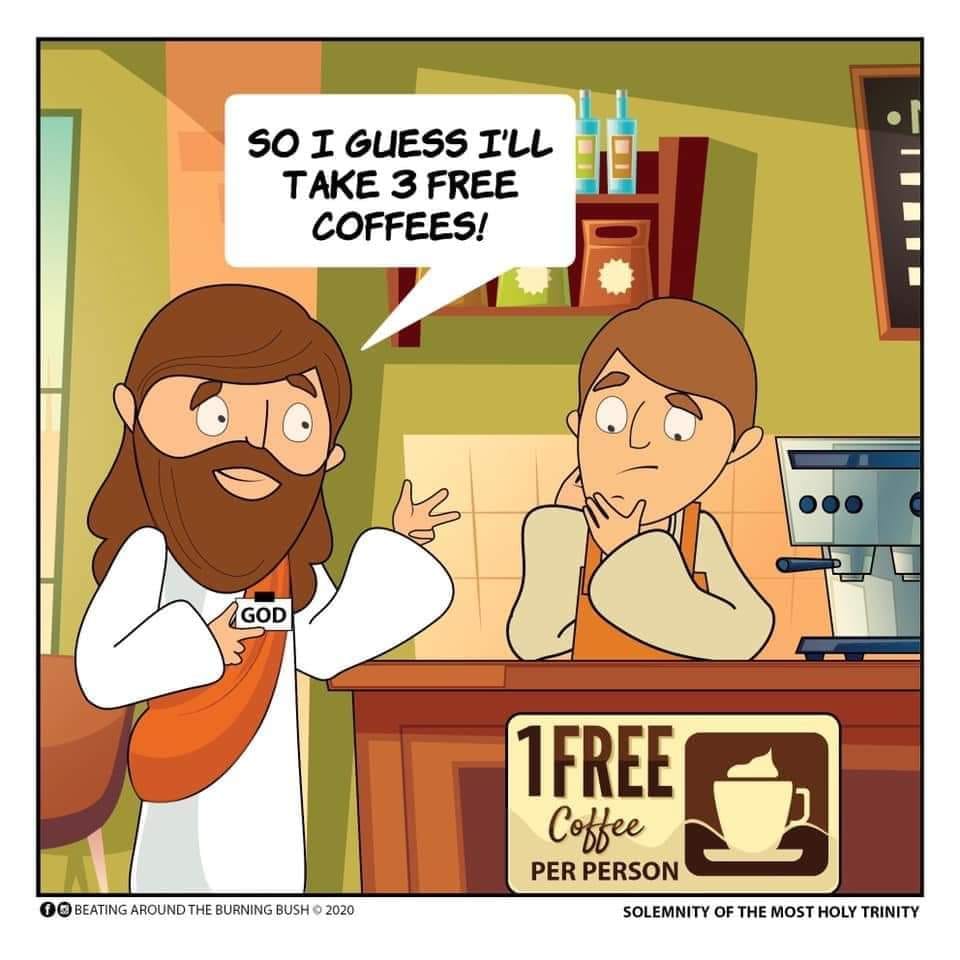
Now, if you get that cartoon, you sort of get the Trinity.
And if you don’t get it, that’s alright.
Because the Trinity is a difficult thing to wrap our minds around.
Now, I don’t quote Martin Luther very often from this pulpit.
And I really wish Thom Marubbio were here in church to hear me do this, because it would make him very happy.
But I am going to quote Luther because this is by far the best way to establish how to talk about the Trinity on this Trinity Sunday.
Luther wrote,
“To deny the Trinity is to risk our salvation; to try to explain the Trinity is to risk our sanity.”
I love that quote!
And it speaks very loudly to me today.
Because, let’s face it, it’s true.
There are, no doubt, a few anxious preachers out there in the world.
There is probably more than one who is going into the pulpits of churches quaking a bit over the sermon they have to preach today.
For some reason—a reason I never understood—there are a lot of preachers who just don’t even want to wrestle with the subject of the Trinity.
Not me.
I LOVE to preach about the Trinity.
Now, I don’t claim to know anything more about the Trinity than any other preacher.
I am no more profound than anyone else on trying to describe what the Trinity is or how it works.
For me, as for everyone here this morning, it is a mystery.
In fact, God as Trinity is the ultimate mystery of mysteries.
Of course, I see it as the paramount belief we Christians have.
The Trinity.
God as Three-in-One—God as Father or Parent or Creator, God as Son or Redeemer and God as Spirit or Sanctifier.
When we really think about it, it isdifficult to wrap our minds around this concept of God.
The questions I regularly get is: how can God be three and yet one?
How can we, in all honesty, say that we believe in one God when we worship God as three?
Aren’t we simply talking about three gods? (No, we are not talking about three Gods)
Whole Church councils have debated the issue of the Trinity throughout history.
The Church actually has split at times over its interpretation of what exactly this Trinity is.
For me, none of these are deal breakers.
The Trinity is not a stumbling block.
Yes, I know the word “Trinity” never appears in scripture.
But I do enjoy exploring the different aspects of how God as Trinity is made known to us.
And…I very unashamedly believe that God does manifest God’s self in Trinitarian terms.
But that doesn’t mean I am not confused by this mystery some times.
And it doesn’t mean that I don’t occasionally doubt it all sometimes.
In our Gospel reading for today, we find that some worshipped Jesus when they saw him resurrected.
And we find that “some doubted.”
I think that was a normal reaction for those people, who were still struggling to understand who Jesus was, especially this resurrected Jesus—this second person of the Trinity
And the fact that we too doubt things like the Trinity is normal as well.
It IS difficult to wrap our minds around such a thing.
It’s complicated and it’s complex.
And, speaking for myself, and to echo Luther, sometimes the more I think about it, the more complicated it seems to get.
Especially when we try to think in the so-called correct (or orthodox) way about it all.
But the doubts, the complications and intricacies of the concept of the Trinity are all part of belief.
Belief is not meant to be easy.
It is meant to be something we struggle with and carry around with us.
And doubt isn’t always a bad thing.
We all doubt at times.
Without doubt we would be nothing but mindless robots of God.
There are moments when the Trinity does confuse me and I am filled with doubts.
Sometimes my most common prayer is, “Seriously, Lord? Really?”
I am one of those people who occasionally just wants something simple in my faith life.
I just want to believe in God—the mystery of God, the fact that God is God and any complexity about God is more than I can fathom.
I sometimes don’t want to solve the mystery of God.
I don’t want God defined for me.
I sometimes don’t want theology.
I sometimes just want spirituality.
I sometimes just want God.
But, as a Christian, I can’t get around the Trinity.
And none of us can either.
And so I struggle on, just like the rest of us.
Yes, I have my doubts.
Yes, my rational, intellectual mind prevents me from fully understanding what this Trinity could possibly be and, as a result, doubts creep in.
Every year, on Holy Trinity Sunday, I place the Andrei Rubelev’s famous icon of the Trinity in the Narthex.
I will post this icon on Facebook and on my blog.
Be sure to take a look at it and see how truly beautiful it is.
In it you’ll find three angels seated at a table.
According to some theological interpretations, these three Angels represent the three Persons of the Trinity.
In the icon we can see that all three Angels are shown as equals to each other.
In a sense, this icon is able to show in a very clear and straightforward way what all our weighty, intellectual theologies do not.
What I especially love about the image is that, in showing the three angels seated around the table, you’ll notice that there is one space at the table left open.
That is the space for you.
In a sense, we are, in this icon, being invited to the table to join with the Trinity.
We are being invited to join into the work of the Trinity.
And I think that icon speaks very loudly to all of us on this Sunday in which out country is so divided—divided by racism, divided by civil unrest, divided by one side versus the other side.
This icon is saying to us: no matter who you, now what your divisions, come, sit with here.
Sit here in the present of the One in whom there are no divisions.
Sit here in the presence fo the One in whom those dark and terrible things that divide us have no place.
Sit here at this table and become one with the One who invites us there.
And I think that is why this icon is so important to me.
It simply allows me to come to the table and BE with God as Trinity.
It allows me to sit there with them and be one with them.
No need to wrestle with them, or debate them, or doubt them.
And we realize, certainly in our own life here at St. Stephen’s, that God as Trinity is still calling to us to be at the table with God.
Here, at this altar, we find the Trinity, inviting us forward.
And from this table, at which we feast with God as Trinity, we go out to do the ministries we are all called to do.
We go out to do the work of God as Trinity.
We don’t need to rationalize everything out about our faith in God.
We don’t need to sit around and despair over it.
We don’t need to risk our sanity.
Or our salvation.
No matter how much we might doubt the Trinity, the fact is: the Trinity exists.
God as Trinity goes on, in that eternal, wonderful relationship.
And no matter how much we might doubt in our rational minds, we are still being called to the table to sit and to serve with the Trinity.
So, let us do just that.
Let us sit down at that table.
Let us bring our doubts and uncertainties with us.
And let us leave them there at the table.
Let us let God be God.
And let us go out from this table to do the work each of us has been called by God to do.
Jesus today, in our Gospel reading, commands us to go and make disciples of all the nations.
By doing so, we are joining in that communion of the Trinity.
And by doing so, we know, despite our doubts, despite our uncertainties, that the Trinity will be with us always.
Always.
Even to the end of the age.
Let us pray.
Holy God, you are a mystery even to those of who long to know you; help us to live within the bonds of the mysteries of our faith that in seeking you, we may truly find you; we ask this in Jesus’ holy Name. amen.
May 31, 2020
Pentecost
 May 31, 2020
Acts 2.1-21
+ Well, I had a whole other sermon prepared for today.
Originally, I had planned to say that, on this Pentecost Sunday, we have so much to celebrate.
On Friday, we learned that John Anderson will be ordained to diaconate on June 14—just two weeks from today.
And that is very exciting.
But then, last night, as we all know by now, downtown Fargo erupted in protests.
I could hear the booms from my porch.
Some of you could probably smell the tear gas.
And all of this after peaceful protests earlier in the day that seemed to go well.
And this is where we are this morning.
We are in this strange place.
And we are seeing clearly that what we are now is what we have been for the last few years.
Truly a divided nation.
A nation that is divided and angry and frustrated.
A nation that is struggling.
A nation that is on the verge, at times, of violence.
Even here.
Even in Fargo-Moorhead.
We don’t get to be complacent anymore here.
We don’t get to use our old excuses.
We don’t get to say:
“That stuff is stuff happens elsewhere.”
“That stuff happens in the big city, in Minneapolis, in Chicago, in Atlanta or Los Angeles or New York.”
Not anymore.
It happens here too.
And what do we do when the violence and the anger “out there” start making themselves known “right here?”
We wring our hands.
We gave in to shock and amazement at what is happening in streets that are so familiar to us.
The fact is, on this Pentecost Sunday, in this tumultuous, frightening time, we know what we have to do as followers of Jesus.
We are not to fear.
We are to love.
Love our neighbors, love our sisters and brothers, love those who hurt and who are in pain, who are frustrated and angry.
And we are to be righteously angry.
Angry at the society that has allowed the violence that killed George Lloyd.
Anger at inequality and racism and white supremacy and complacency.
Angry at an unjust system that continues to allow violence.
Angry at instigators and outside forces and other violent people who come into our community to perpetuate violence.
Angry that we can’t even peacefully protest without outside forces coming in and disrupting our efforts at peace.
Today, on this Pentecost Sunday, in which we hope and long for the Spirit of our loving God to come to us, to fill us with peace and love, we know that that is now what is filling us today.
But that same Spirit is also the Spirit of a God who hates injustice, who hates violence, who hates racism, who hates when the least of us is struck down and murdered.
That Spirit is also dwelling with us today.
That Spirit has also descened upon today.
And so, what do we do on this Pentecost Sunday?
How do we respond?
We respond the only we know how to respond as followers of Jesus.
We respond with love.
We respond with love in a world that seems to be dominated by hatred and violence.
We respond as the compassionate, loving, peaceful people are as followers of loving, compassionate, peaceful Christ.
We respond by working, in whatever small way we can, to change this world for the better.
We respond by not feeding the flames of anger and violence.
We respond by not perpetuating stereotypes and prejudices.
We respond by recognizing our own prejudices and striving to destroy them form ourselves.
And while the world around us rages, we, commanded by our God to love and to seek peace in this world, do so even as chaos reigns.
We respond by not only speaking out against injustice and violence, but by doing whatever we can in our world.
That is what we do on this Pentecost Sunday, in this divided America, in this city in which violence and fear and anger have touched us.
We, the lovers of justice, the strivers for peace, the workers for inclusion, have much work ahead of us.
And so, let us love and love fully.
Let peace reign within us, even while violence rages about us.
And let us strive, even in a world that seems so out-of-control, for peace, for equality, for those who have no voice, for those who are abused and neglected and discarded.
Let us love—and love fully.
And when we do, that is when the Spirit of our Loving God is truly present within us.
Let us pray.
Come, O Holy Spirit, come!Come as the fire and burn.Come as the wind and cleanse,Come as the light and lead,Increase in us your gifts of grace.Convict, convert, and consecrate us, until we are wholly yours.
Amen.
May 24, 2020
7 Easter/The Sunday after the Ascension
 May 24, 2020
Acts 1.6-14; John 17.1-17
+ This time of quarantine and self-isolation during this pandemic seems to be going on and on without end.
Yes, some businesses are open.
Yes, some churches are allowing public worship in their buildings again.
But not us.
And, as he said in my letter this past week, and at my announcement at Wednesday night Mass, we will not.
I had hoped that we could all get together again next Sunday, for the Feast of Pentecost.
Yes, we will still dedicate and bless the plaque of St. Stephen’s next week as planned.
But we will do so virtually.
In fact, I don’t know when we will meet together again in this building.
And I’m not going to guess yet.
As I have said throughout the entire situation: I do not want Sty. Stephen’s the be responsible for anyone getting sick.
I do not want anyone being exposed to anything here.
I have tried to walk a “middle road” through this very difficult situation.
I have tried to walk between the two extremes of this pandemics—those who say it’s all a hoax, that we don’t need masks, that we must open the doors of the church building, and those who say we should not even do what we are doing now—who think we should be essentially wearing Hazmat suits.
I will continue to follow the CDC guidelines, and the Diocesan regulations and consulting people like our very own Dr. John Baird.
So, for now, we wait.
And we continue to do what we have been doing.
We continue to gather virtually.
We continue to worship together at mass twice a week, virtually.
And we continue to do what we are called to do as followers of Jesus.
We continue to love and worship God.
And we continue to love and serve others.
And we know that despite the fact that this pandemic continues, Christ is still present with us.
Certainly, from our Gospel reading last week and this week, we find that his Presence has not left us.
He is still present, though just in a different form.
Last week in our Gospel reading we heard that he will be present in the Advocate, the Spirit of God, and this week we hear that he will be present in us, in his disciples who keep his word and continue to do his ministry and be his presence in this world.
We celebrated the eve or Vigil of the Feast of the Ascension here at St. Stephen’s on Wednesday night, as we always do.
(Thursday was the Feast of the Ascension)
And as I said then, I repeat this morning:
I really love the Feast of the Ascension.
I love all that it represents.
I love that sense of going up.
Of rising.
Of moving upward.
Ascension is, of course, all about rising.
This week, we move slowly away from the Easter season toward Pentecost.
You can almost feel the shift.
For the last several weeks, we have been basking in the afterglow of the resurrected Jesus.
In our Gospel readings, this resurrected Jesus has walked with us, has talked with us, has eaten with us and has led the way for us.
Now, as we hear in our reading from Acts this morning, he has been taken up.
We find a transformation of sorts happening in our relationship with Jesus through these scripture readings.
Our perception of Jesus has changed.
For a moment, we feel his absence.
He is not present with us as he was before—walking and talking and eating with his disciples as he was before his ascension.
But, we realize, we will be given something that will not leave us.
We will be given God’s Spirit, right here with us.
We find that truly this Spirit of God is, in our midst.
Us, right here. Right now.
At Pentecost next week, we will acutely see the fact that God has truly come among us.
God is here, right now, with us. Even in a pandemic.
No, God is not speaking to us not from a pillar of cloud or fire, not on some shroud-covered mountain, not in visions.
Now God is here, with us, speaking to us as we speak to each other.
At the Ascension, the puzzle pieces really start falling into place.
What seemed so confusing and unreal before is starting to come together.
God is with us and truly loves us.
God dwells in us and through us.
And next week, one more puzzle piece falls into place when Jesus, in a sense, returns.
Next week, we will celebrate God’s Spirit descending upon and staying with us.
For the moment, though, we are caught in between those two events, trying to make sense of what has happened and trying to prepare ourselves for what is about to happen.
We are caught between Jesus’ ascent into heaven and the Spirit’s descent to us.
It is a time for us to pause, to ponder who we are and where are in this place—in this time in which everything seems so spiritually topsy-turvy.
I’m not certain there is a way we can make sense of the Ascension, but what we are faced with is the fact that this in this ascended Jesus, the God of Jesus still acts in our lives.
God acts in us and through us.
I can’t repeat that enough.
The commission that the ascended Jesus gave to the apostles, is still very much our commission as well.
We must love—fully and completely.
Because in loving, we are living.
In loving, we are living fully and completely.
In loving, we are bringing the ascended Christ to others.
And we must go out and live out this commission in the world.
When we do, the ascended Christ is very much acting in the world.
For those first followers of Jesus, it seems like they didn’t have much of a chance to ponder their life-altering experiences.
As soon as one life-altering experience happened, another one came along.
Just when they had experiences Jesus’ death, resurrection and ascension, they encountered this outpouring of God’ Spirit in their lives.
The waters, it seemed, were kept perpetually stirred.
Nothing was allowed to settle.
That is what ministry is often like.
One day, very early in my career, much earlier than I was ever ordained, I came to realize that Ministry is perpetually on-going.
There is never an ending to it.
Even in a pandemic.
It doesn’t matter if my life is falling apart around me, or that I am tired.
It’s always something.
This past week was a perfect example of that.
One week brings another set of opportunities, set-backs, trip-ups, tediums, frustrations, joys, celebrations.
Ministry truly is a never-ending roller-coaster ride of emotions and feelings.
These are things those first followers of Jesus no doubt struggled with.
Yet we, like them, are sustained.
We, like them, are upheld.
We, like them, are supported by the God Jesus ascended to, whose work we are doing in this world.
In those moments when our works seems useless, when it seems like we have done no good work, the ascended Jesus still triumphs.
Our job, in this time between Jesus’ departure from us and his return to us, is to simply let him do what he needs to do in this interim.
We need to let the ascended Jesus work in us and through us.
We need to let the God of this ascended Jesus be the end result of our work.
When we wipe our hands as we walk from the grave, lamenting the fact that it seems no one was saved (as the old Beatles song “Eleanor Rigby” goes) we need to realize that, of course, it seems that way as we gaze downward at our hands.
But above us, the Ascension is happening.
Above us, Jesus has risen.
And we are rising with him, even when it seems like we are bogged down in this very earth.
Above us, Jesus has been seated at the right hand of God.
Above us, that place, that God to whom we are ascending, is there.
All we have to do sometimes is look up.
All we have to do is stop gazing at our dirty, callused, over-worked hands—all we have to do is turn from our self-centeredness—and look up.
And there we will see the triumph.
And as we do, we will realize that more were saved than we initially thought.
Someone was saved.
We were saved.
Jesus has ascended.
But he isn’t gone.
He is with us, now even more so than before his ascension.
He is with us in an even more intimate way.
The joy we feel today comes when we let the ascended Jesus do what he needs to do through us.
We are, as Jesus says in today’s Gospel, “in the world.”
And because we are, we must do the work we are called to do in this world.
So, let us stop gazing upward at that empty sky into which he has ascended.
There is work to do.
Right here.
Right now.
Even in the midst of a pandemic.
Let’s wipe the sun-blindness from our eyes.
Let us turn toward those around us in need.
And let us be Jesus to those who need Jesus.
And there are people who need us to be Jesus for them.
Even in a pandemic.
There are people who need us to be kind and compassionate and full of love.
There are people who need our acceptance and hospitality.
When we love others, when we are Christ to others, when we bring a God of love and acceptance to others, we allow others to rise as well.
We embody and allow the Ascension to continue in this world.
So, let the joy of the ascension live in us and through us and be reflected to others by us.
We will be sanctified in the truth of knowing and living out our lives in the light of the Ascension.
We will rise.
This morning, we have looked up and we have seen it.
We have seen that rising—his rising and our rising—happening above us in beauty and light and joy .
Let us pray.Holy God, as we proceed through these last days of the Easter season toward the Feast of Pentecost, prepare us for the Holy Spirit. Open our hearts and our minds to an outpouring of your living and life-giving Spirit. We ask this in the holy Name of Jesus. Amen.