Jamie Parsley's Blog, page 34
March 29, 2020
5 Lent
 March 29, 2020
Ezekiel 37.1-14; John 11.1-45
+ Sometimes the lectionary—those assigned Bible readings we have each Sunday—are weirdly prophetic. They sometimes speak exactly to the situation at hand. They sometimes perfectly mirror a situation in which we are all living.
Well, today is one of those days.
Today, our reading from Hebrew Scriptures and our Gospel reading reflect our own strange time perfectly.
The first reading, of course, is Ezekiel’s vision of the dry bones. It’s a great story in and of itself. Ezekiel is brought by God to a valley full of dry bones and told to prophesy to them. As he does, they take on flesh and come alive.
It’s a great story for any Lenten season. But man! Does it speak loudly to us in this Lenten season!
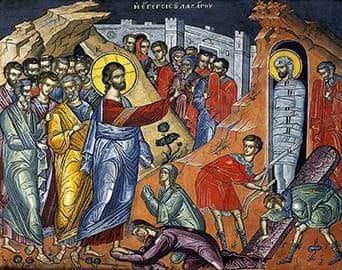
And our reading from the Gospel today is the raising of Lazarus. This story of Lazarus takes on much deeper meaning when we examine it closely and place it within the context of its time. And it’s a story I LOVE to examine and wrestle with.
One of our first clues that the something is different in this story is that, when Jesus arrives at the tomb of his friend Lazarus, he is told that Lazarus has been dead four days. This clue of “four days” is important.
First of all, from simply a practical point, we can all imagine what condition Lazarus’s body would be in after four days. This body would not have been embalmed like we understand embalming today in the United States. There was no refrigeration, no sealed metal caskets, no reconstructive cosmetics for the body of Lazarus. In the heat of that country, his body would, by the fourth day, be well into the beginning stages of decomposition. There would be some major physical destruction occurring.
Second, according to Jewish understanding, when the spirit left the body, a connection would still be maintained with that body for a period of three days by a kind of thread. According to Jewish thinking of this time, the belief was the spirit might be reunited with the body up to three days, but after that, because the body would not be recognizable to the departed spirit because of decomposition, any reuniting would be impossible. After those three days, the final separation from the body by the spirit—a kind of breaking of the thread—would have been complete. The spirit then would truly be gone. The body would truly be dead.
So, when Jesus came upon the tomb of Lazarus and tells them to roll the stone away, Martha says to him that there will be stench. That’s an important part of the story as well. He was truly dead—dead physically and dead from the perspective of his soul being truly separated from his body.
So, when the tomb was opened for Jesus, he would be encountering what most of us would think was impossible. Not only was Lazarus’ spirit reunited with his body, but he also healed the physical destruction done to his body by decomposition. It would have been truly amazing.
And Jesus would truly have been proven to be more than just some magician, playing tricks on the people. He wasn’t simply awakening someone who appeared to be dead, someone who might have actually been in a deep coma. There was no doubt that Lazarus was truly dead and now, he was, once again alive.
Now, at first glance, both our reading from the Hebrew scriptures and our Gospel readings seem a bit morbid.
These are things we don’t want to think about. Certainly not right now. Not now when we are surrounded by a deadly pandemic. Not now when people are dying in droves of this terrible illness.
But, let’s face it. They do speak loudly to us. We are living in a valley dry bones right now. Or it does feel like it right now.
We are sequestered.
We are isolated physically from each other.
We are in quarantine.
And it feels as though there is nothing but bones and uncertainly around us.
It feels like a very desolate time.
And to top off that desolation, we are rapidly heading toward Holy Week. Next week at this time, we will be celebrating the triumphant entry of Jesus into Jerusalem. We will be hearing the joyful cries of the crowd as he rides forth. Within 11 days from now, we will hear those cries of joy turn into cries of jeering and accusation.
For us, Holy Week this year will feel doubly desolate. We will not being gathering here in this building to commemorate these events. There will be no washing of the feet on Maundy Thursday. We will be sharing the Eucharist spiritually, yes, but not physically.
To just add even more to it all, we will be hearing about betrayal, torture, murder and death as Jesus journeys away from us into the cold dark shadow of death. These images of death we encounter in today’s readings—as unpleasant as they are—simply nudge us in the direction of the events toward which we are racing, liturgically.
During Holy Week, we too will be faced with images we might find disturbing. Jesus will be betrayed and abandoned by his friends and loved ones. He will be tortured, mocked and whipped. He will be forced to carry the very instrument of his death to the place of his execution. And there he will be murdered in a very gruesome way. Following that death, he will be buried in a tomb, much the same way his friend Lazarus was. But unlike Lazarus, what happens to Jesus will take place within the three days at that time required for a soul to make a final break from his body.
And this brings us back to the story of Lazarus. We often make the mistake, when think about the story of Lazarus, that Lazarus was resurrected.
The fact is, he was not resurrected.
It was not resurrection because Lazarus would eventually die again. He was simply brought back to life. He was resuscitated, shall we say.
So, Lazarus truly did rise from the tomb in Bethany, but he was not resurrected
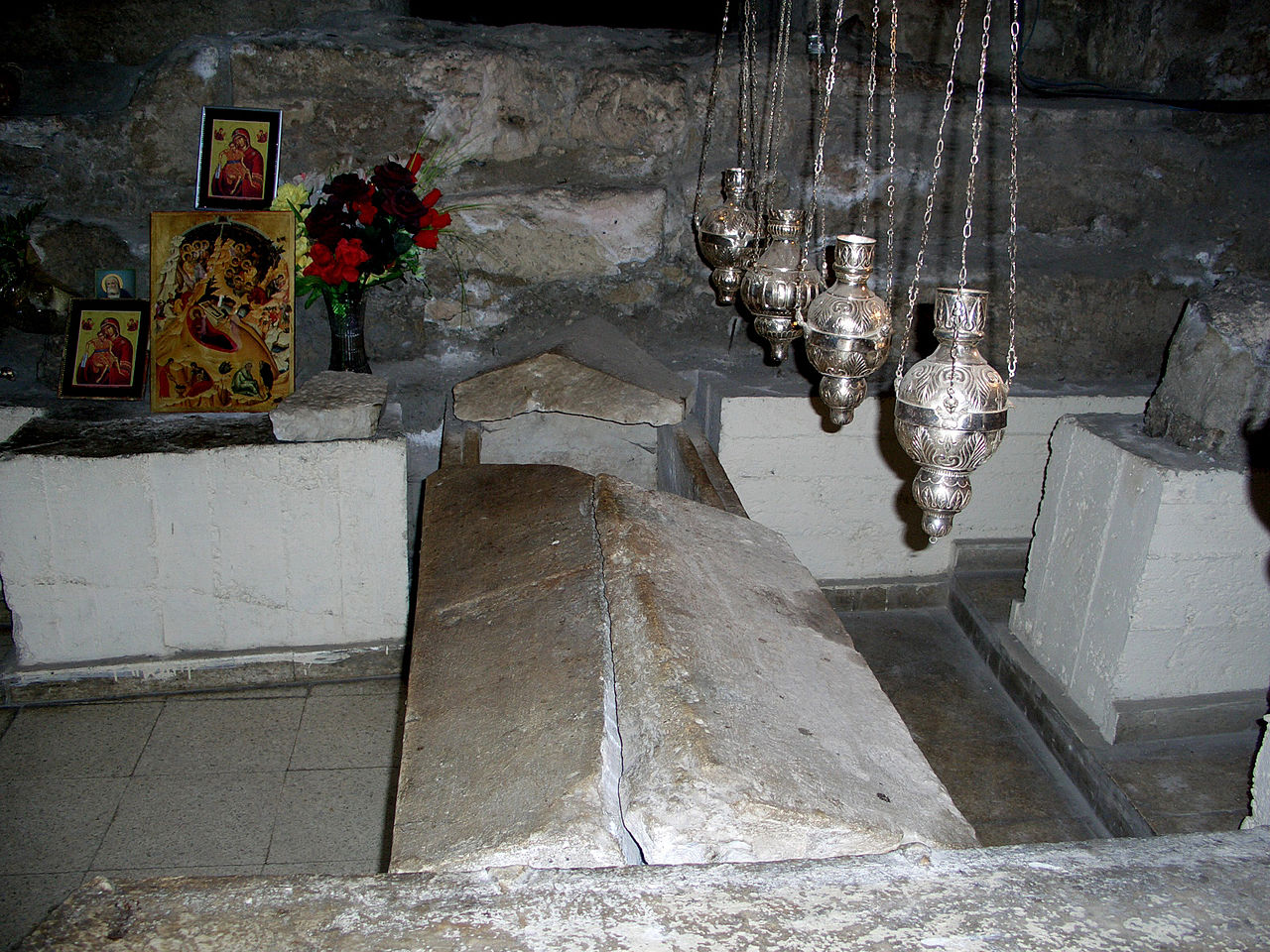 Lazarus' purported tomb on Cyprusthere. He went on to live a life somewhat similar to the life he lived before. And eventually, he died again. There’s actually a tomb purported to be Lazarus’ on Cyprus (though his actual bones, it is believed, have been lost).
 But Resurrection is, as we no doubt know, different.
Resurrection is rising from death into a life that does not end.
Resurrection is rising from all the things we encountering right now in our lives—Covid, pandemics, sickness, death, anxiety and fear.
Resurrection is rising from our own broken selves into a wholeness that will never be taken away from us.
Resurrection is new bodies, a new understanding of everything, a new and unending life.
Resurrection, when it happens, cannot be undone.
It cannot be taken away.
Resurrection destroys the hold of death.
Resurrection destroys death.
And the first person to be resurrected was not Lazarus. The first person to be resurrected was, of course, Jesus. His resurrection is important not simply because he was the first. His resurrection is important because it, in a real sense, destroys death once and for all.
The resurrection of Jesus casts new light not just on our deaths at the end of our lives.
The resurrection of Jesus casts light on where we are now.
God’s raising Jesus from the death shows us that we will rise from this dark time, this time of pandemic, this time of coronavirus, this valley of dry bones in which we now live.
All of this fear and uncertainty and sickness and foreboding is only temporary. But the resurrection of Jesus and the life he promises-that unending life—is eternal.
The end is not a cross or a tomb.
The end is not a valley of dry bones.
The end is not pandemics or anxiety or fear.
The end is that Easter light.
The end is that life in which we will be raised like Jesus into a new and unending life.
We will be raised into a life that never ends, a life in which “sorrow and pain are no more, neither sighing, but life eternal,” as we celebrate in the Burial Office of the Book of Common Prayer. Because Jesus died and then trampled death, he took away eternal death.
So, as we continue our journey through this valley of dry bones, as we journey through this time of uncertainty and anxiety, as we move through these last days of Lent toward that long, painful week of Holy Week, we go forward knowing full well what await us on the other side of the Cross of Good Friday. We go forward knowing that the glorious dawn of Easter awaits us. And with it, the glory of resurrection and life everlasting awaits us as well. We go forward knowing all of this in only temporary. But what awaits is eternal.
So, let go forward. Let us move toward Holy Week, rejoicing with the crowd. And as the days may seem dark and we may feel weary, let us keep focused on the Easter light that is just about to dawn on all of us.


March 23, 2020
From the Rector, March 23, 2020
As we enter into another week of quarantine, worship from a distance, and an uncertain future, we do so as a community. We do so with the knowledge that God is with us, and that all will be well.
I ask your prayers for our St. Stephen’s community. The effects of this crisis are already hitting very close to home. Although, thankfully, none of our community had been diagnosed with the virus, we are starting to see members affected by reduced work hours, financial shortfall due to the looming recession and, of course, our regular day-to-day pastoral issues.
As you know, one of our own continues to near the end of his earthly journey. I ask that you continue to keep Larry Kindseth in your prayers, as well as his wife, Anna and his daughters, including our own Janie Breth, and her family.
Another parishioner is with her ailing father in California and is thus further separated from our community. Please pray for Amy Phillips, her father, Sam, as well as Dan and their family during this time.
We still gather to worship. Our live streaming Mass is a huge success, with almost 200 people viewing each liturgy and participating from home. We also have people joining us from around the country and the world. The feedback to our live streaming has been phenomenal! Please keep posting those comments! (I will publish a few of them in our newsletter next week)
I am also aware that some of us are not members of Facebook for various reasons. With that in mind, and with the goal of widest outreach to our members, as well as non-members, we have now formed our very St. Stephen’s Channel on YouTube and have been uploading the videos of our Sunday and Wednesday masses there. Our St. Stephen’s YouTube channel can be found at: https://www.youtube.com/channel/UCcdWKCnCHmviajkFX5p-xGg
The link can also be found on our website and blog. Or simply go to YouTube.com and search for “St. Stephen’s Fargo.” Please be sure to subscribe to our YouTube Channel.
We are all brand new to this unique way of communicating and new ways of worship. There are, of course, going to mistakes as we proceed. Please be patient with us as navigate this strange new world together.
Both John Anderson and I have been slowly but surely making phone calls, emailing and texting parishioners to check on their well-being. Communication though is a two-way street of course, so please do check in on a regular basis with me so that we can be in regular communication during this time.
The work of the Church continues. We celebrated Laetare Sunday this past Sunday, though our rejoicing on this Rose Sunday was a bit subdued. We also blessed John Anderson’s new Deacon’s stole (made by Jean Sando) and his brand-new Dalmatic.
In addition to our weekly Masses, our Vestry also met on Sunday by Zoom. It was a productive meeting but one in which we all realized how difficult it is to meet everyone’s needs at this time.
Our wardens, Jean and Jessica, communicate on a daily basis (oftentimes many times a day). Please keep your wardens and Vestry in your prayers as well.
The big questions for the near future, of course, concern John Anderson’s ordination and Holy Week.
John Anderson’s ordination: I have been in contact with Bishop Keith Whitmore about whether the April 4thdate for ordination is still feasible. As we all know, this situation changes day by day. Earlier last week, we were weighing the option of a small ordination service on April 4th, which could then be live streamed. Since then, the situation has become more dire and it has become abundantly clear that the quarantine will continue into at least the first week of April. The concern on our part and for Bishop Keith is the matter of travel. Bishop Keith is 74 and squarely within the range of vulnerability for this virus. With that in mind, we must simply prepare ourselves for a postponement the ordination. John is fully aware of this and is willing to do what needs to be done. Please do keep John, Jessica and their family in your prayers at this time. This is just one more unavoidable disappointment for him in an already frustrating process.
Holy Week: it is becoming more obvious that the quarantine will remain in effect past the originally planned deadline of April 1. That means that it is becoming starkly clear that our Holy Week liturgies will be closed to public worship. However, we will continue to do those liturgies, though we will reduce them greatly, and will pare down the liturgies themselves.
The revised schedule for Holy Week is as follows:
Maundy Thursday Mass will be on April 9 at 7:00 p.m. as planned. There will be no foot washing.
There will only be one Good Friday liturgy on April 10 (no Stations of the Cross). The liturgy will be at 12:00 p.m.
I debated about whether we will do the Holy Saturday liturgy, but it is one of the most meaningful liturgies of Holy Week, and one that speaks loudly to us at this time. The Holy Saturday liturgy will be at 10:00 a.m. on April 11.
There will be NO Easter Vigil Mass on April 11.
We will celebrate Easter on April 12 at our regular time of 11:00 a.m. The baptism planned for Easter Day is rescheduled for another time.
All the Masses will be live streamed, as well posted to the YouTube Channel.
This is where are as we enter another week of this strange, new reality. I reiterate the message that I have continued to preach throughout this time: do not fear. Do not let anxiety and despair win out in this situation. Our God of love is close to us through all of this.
In my sermon last Sunday, I shared this:
We will get through this.
We will gather again in our church building.
We will again shake hands and hug at the Peace.
We will again share the Body and the Blood of Jesus at Holy Communion at the altar again.
We will all sit down at our post-Mass luncheon and eat our fill again.
We will all go out and do the ministries we have all been called to do again.
And this time we are going through right now will seem like a strange and truly bizarre dream.
Please hold this truth close to you as we make our way through this desert-time.
Continue to stay put, wash your hands, be safe, and pray. Pray for St. Stephen’s, for the Church, for our Nation and for the world. Please pray for me too. Know that all you continue to be included in my daily prayers. I miss those of you whom I cannot see in person. But we will see each other soon.
-peace,Fr. Jamie+
March 22, 2020
4 Lent
 Lataere SundayMarch 22, 2020
1 Samuel 16.1-13; Ephesians 5.8-14; John 9.1-14
+ Well, today is Laetare Sunday. This is usually a joyful Sunday in the midst of Lent. After all “Laetare” means “rejoice” in Latin. And normally that is what we do on this Sunday.
In normal times, we find ourselves rejoicing because we are now at the midpoint of Lent. We usually, at this point, get a little break from Lent on this Sunday. It’s not all purple and switches and ashes around us.
But today, our rejoicing on this Laetare Sunday is muted.
Usually, this Sunday is a Sunday in which our church building is usually full.
We also usually have our traditional simnel cake at coffee hour after Mass.
But not today.
Most of our Church is dispersed today.
They are quarantined in their homes. They are safe. They are sound. And we are thankful for that.
And around us, there is a sense of unease. We are uncertain of what is about to happen.
We are living in a time of anxiety and uncertainty as most of us have never known before. We’ve never done this before. Few of us have ever lived through anything like this.
It’s hard this morning to rejoice with any real feeling. But it is good for us just to pause for a moment. It’s good to take this time and just…breathe. It’s good to reorient ourselves.
When we look back at where we’ve been, it seems like a long journey so far this season of Lent. Way back on Ash Wednesday, on February 26 (doesn’t that feel like a long time ago), we began this season. And Easter on April 12th seems to be a very distant future.
There is talk now of limited liturgies during Holy Week. The journey so-far seems so long and so exhausting. And the journey ahead seems, at moments, daunting.
This is where we are—right smack dab in the middle of this Lenten season.
But, on this dark and gloomy Laetare Sunday, we get this Gospel reading. I’m happy we have the Gospel reading we have for today. We definitely need it! It’s a long one. But it’s a good one.
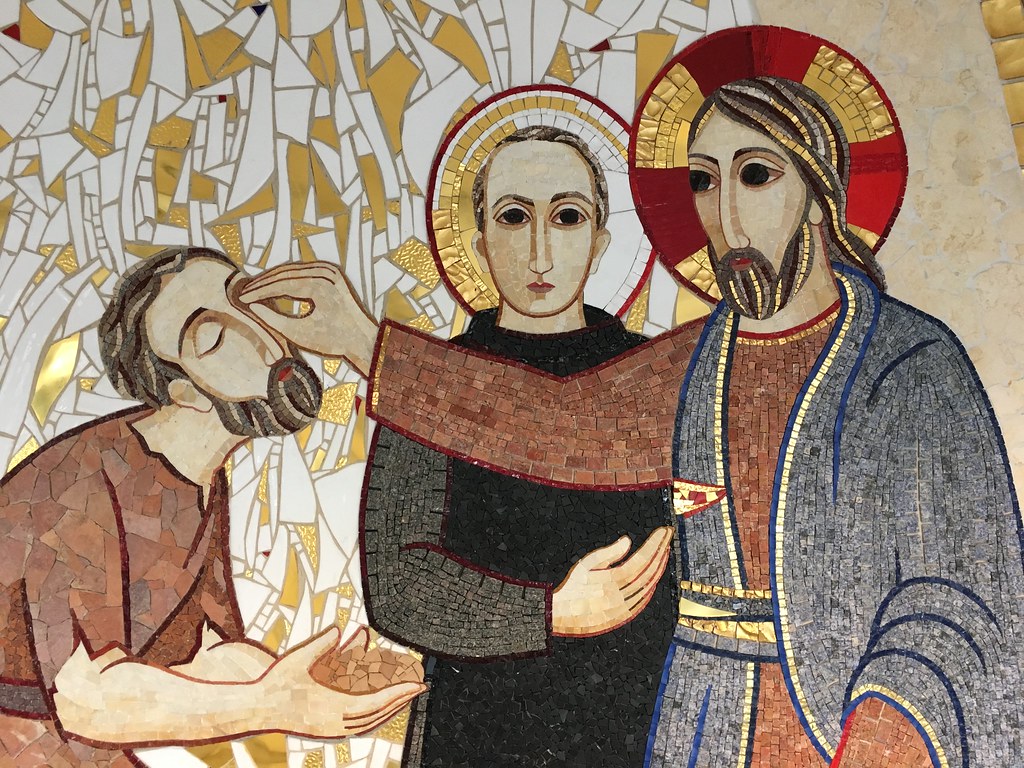
This story of Jesus healing the blind man speaks very loud and very clear to us at this time in our collective history. In a sense today—Lataere Sunday, the half-way mark of Lent—is a time for us to examine this whole sense of blindness. Not just physical blindness, but spiritual blindness, as well. The blindness we are all experiencing not being able to “see” each other right now.
Right now, we feel like blind people—or, at least, like nearsighted people. We grope about. We find ourselves dependent upon those things that we think give us some comfort, some sense of clarity.
The internet helps. Social media helps. We are able to keep tabs on each other. We are able to worship together—kind of—through livestreamed liturgies. We are able to keep in touch through phone calls and regular emails and texts.
But ultimately, nothing really seems to heal this particular nearsightedness. In fact our sight seems to get worse and worse as we go on through this crisis.
In our Gospel reading for today, we find a man blind from birth. The miracle Jesus performs for him is truly a BIG miracle.
Can you imagine what it must’ve been like for this man? Here he is, born without sight, suddenly seeing. It must have been quite a shock. It would, no doubt, involve a complete reeducation of one’s whole self.
By the time he reached the age he was—he was maybe in his twenties or thirties—he no doubt had an idea in his mind of what things may have looked like. And, with the return of his vision, he was, I’m certain, amazed at what things actually looked like. Even things we might take for granted, such as the faces of our mother and father or spouse, would have been new for this man. So, the miracle Jesus performs is truly a far-ranging miracle.
There’s also an interesting analytical post-script to our Gospel reading. (And I’ve shared this story with you, but I always found it interesting)
St Basil the Great and other early Church Fathers believe that this blind man was not only born blind, he was actually born without eyes due to some kind of birth defect This, they say, is why Jesus takes clay and places them upon the empty eye sockets, essentially forming eyes for this man. When he washes them in the waters of Siloam, the eyes of clay became real eyes with perfect sight.
It’s a great story, but the real gist of this story is about us. Yes, this crisis, this quarantine we’re under may feel like a kind of blindness. Yes, we are not really able to “see” each other as we once did. We took for granted that we could see each other before this event.
I know that many of us are feeling despair and fear. But as I have preached again and again, as I will continue to preach again and again:
We, as Christians, cannot despair. And we, as beloved children of a loving God, cannot fear.
We cannot fear.
We cannot live in the darkness of despair and fear.
This is not the place for the loved children of God.
Our reading from Paul’s Letter to the Ephesians shows us that we are not children of darkness. We are not meant to walk around, groping about in our lives. We are meant to walk in light. We are meant to embody light in our lives. And, by that, we are not just meant to hold the light close to us, as though it’s some special gift we are given.
We are not meant to hoard the light. As children of light, we are meant to share it. We are meant to be conduits of that light. To everyone. Even when we might not feel like it.
Even now, when are so separated from others. And yet, with social media, we really aren’t. Kind of.
We are anointed in much the same way David was anointed by the prophet Samuel in our reading from the Hebrew Scriptures today. We, who were anointed at our baptism, are now called to be what David was—a person on whom the Spirit of God comes in great power.
That Spirit brings light.
That Spirit brings spiritual clarity.
That Spirit brings vision.
That Spirit brings us hope and healing and health.
That Spirit sustains us, even in this strange and bizarre time.
You know what the Spirit doesn’t do? That Spirit does not allow us to fear or despair.
That is what we are doing on this day. Lataere Sunday is a time to refocus, to readjust ourselves again, to remind ourselves of our anointing, of the light that dwells within each of us, of the Spirit who lives inside each of us.
Today, even in Lent, even in this midst of this pandemic, you know what? we can be joyful. It is a time for us to realize that this dark time in not eternal.
Darkness is never eternal. But light—light, is eternal.
We will get through this.
We will gather again, here in this building.
We will shake hands and hug at the Peace.
We will share the Body and the Blood of Jesus at Holy Communion at this altar again.
We will all sit down at our post-Mass luncheon and eat our fill again.
We will all go out and do the ministries we have all been called to do again.
And this time we are going through right now will seem like a strange and truly bizarre dream.
No matter how blind or nearsighted it might seem right now, our sight will be returned to us once again.
We, in a sense, find ourselves on this Lataere Sunday—this joyful Sunday in Lent—looking forward.
Lataere Sunday is a great time to remind ourselves that, even in our darkness, it will not be dark forever. All will be made right again. And we will see each other again with clarity and vision—with new eyes. And we will see the darkness lifted from our lives and the dazzling light of Christ breaking through.
So, today, on this Lataere Sunday—on this joyful Sunday in Lent—let us be joyful, even if we don’t really feel like it.
Let’s be joyful, even in this strange exile in which we find ourselves.
Let us be joyful even as we grope about, spiritually half-blind as we may seem right now.
Let us be joyful, because darkness and pandemics are only temporary.
Let us be joyful, and let us not fear.
God loves us.
God loves you.
And all will be well.
Knowing that, how can we not rejoice?
March 15, 2020
3 Lent
 March 15, 2020
John 4.5-42
+ Well, there is no escaping the fact that we are now living in a very unique time. Few of us who are alive today have ever had to endure living though a pandemic.
I remember my grandmother talking about living through the 1918 Spanish Flu epidemic, as well as few other smaller outbreaks of disease earlier in 1914 and later in the 1920s.
The fact that we are here, the fact that we are bracing for this strange common experience, is difficult for all of us.
We are all living with anxiety.
We are living with a certain amount of fear.
We are concerned not only for ourselves, but for our loved ones, for our friends.
I have been concerned for each of you. I have listened to your fears, your concerns, and your anxieties. And I have struggled to figure out what we do and how we deal with this crisis, while at the same time not giving in fear and defeat.
I posted this note on Facebook this week, which garnered a bit of interest:
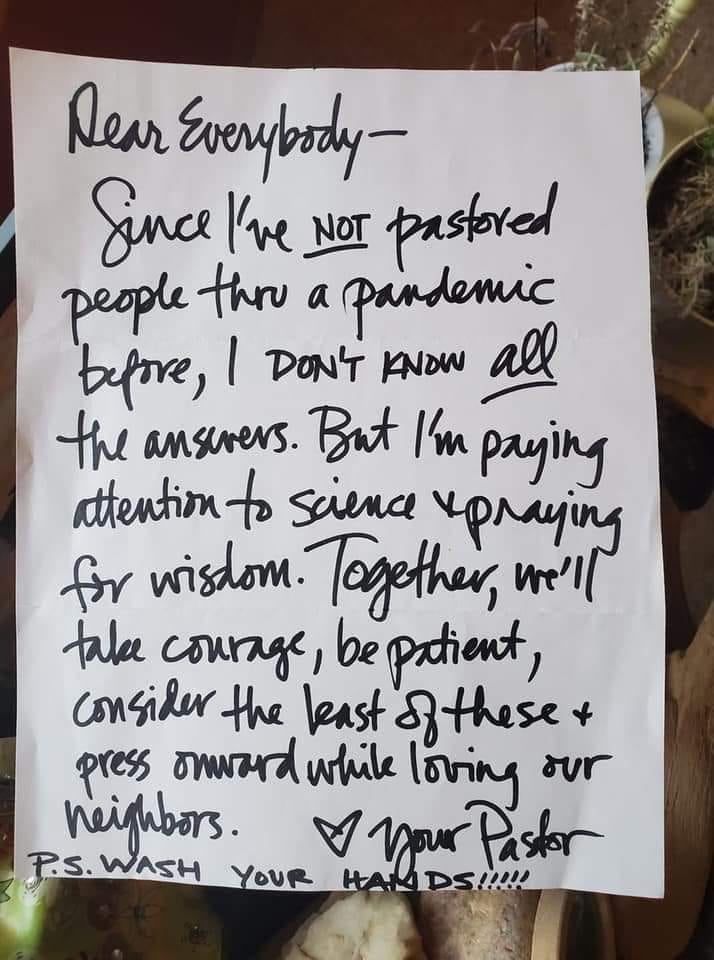
What I have been doing is keep up on the latest, most valid information, while trying to ignore the more sensationalist information.
I have been listening to doctors and scientists.
I have tried to make the best decisions regarding St. Stephen’s, trying to keep everyone safe physically, emotionally and spiritually.
And I will continue to take precautions that protect us, even if those decisions are unpopular. And if you have issues with any decisions I make during this time, I hope you will forgive me and understand that I, along with the Wardens and Vestry, are trying to make the best decisions we can while navigating uncharted waters.
And I have been praying hard. Because, I do believe in the power of prayer. And I have seen, many times in my own life, the positive effects of prayer. I have been praying for a quick resolve to this pandemic. I have been praying for each of you and for protection for you. I have been praying for wisdom in how to proceed. And I have been praying that we can still meet, still worship together, still celebrate the life-living sacrament of Holy Communion, because I think these are important in times like this.
How long we will able to do this, I do not know. Churches are temporarily closing for the safety of its members. And we may have to as well.
And I have been trying hard to calm myself, to rest in the calm, cool Presence of God, to trust in God.
Again and again, as I study scripture and move deeper and deeper into my relationship with God, I realize that God still does speak to us. And one of those most commons things God says to us, over and over again, throughout Scripture and throughout our own lives is,
“Do not fear.”
“Do not be afraid.”
Do not be afraid.
We are loved by our God.
God is close.
God is near.
Even in our reading from Romans this morning, we hear this:
Since we are justified by faith, we have peace with God through our Lord Jesus Christ, through whom we have obtained access to this grace in which we stand
It’s amazing how such a simple Scripture such as that sustains.
“We have peace with God through our Lord Jesus Christ.
This peace is a peace that is stronger than pandemics and the fear and chaos that surrounds pandemics. It is this peace we find ourselves clinging to in times like this. It is this peace in which we dwell while storms rage around us.
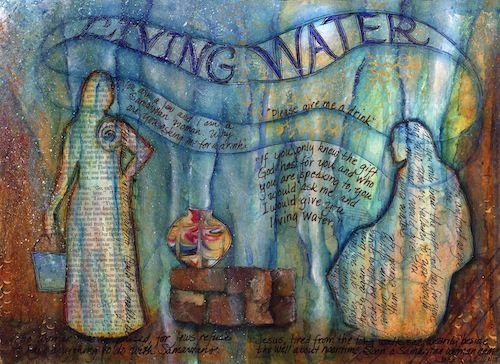
And in our Gospel reading for today, we find this encounter with Jesus and the woman at the well. In this encounter we hear Jesus talk about water and thirst, and the thirst for a water that is more than just physical water.
We understand this. We too find ourselves thirsting. We do thirst for knowledge, we thirst for health, we thirst for peace and calmness of mind in the midst of chaos. And we definitely thirst for spiritual truth. And I think that’s very close to what Jesus is talking about in today’s Gospel.
When Jesus sits with the woman at the well, he offers not only her that water of life—he offers it to us as well. And we, in turn, like her, must “with open hand” give it “to those who thirst.”
To truly understand the meaning of water here, though we have to gently remind ourselves of the land in which this story is taking place. Palestine was and is a dry and arid land. And in Jesus’ day, water was not as accessible as we take for granted these days. It came from wells that sometimes weren’t in close proximity to one’s home. There was certainly no in-door plumbing. The water that came from those wells was not the clean and filtered water we enjoy now, that we drink from fancy bottles. They didn’t have refrigeration, they wouldn’t have understood what an ice cube was—so often the water they drank was lukewarm at best.
And sometimes it was polluted. People got sick and died from drinking it. Jesus understood and lived in a society that really feared illness. They too experienced epidemics and pandemics.
But despite all of that, water was essential. One died without water in that arid land. Water meant life. In that world, people truly understood thirst. They thirsted truly for water.
And so we have this issue of water in a story in which Jesus confronts this woman—who is obviously and truly thirsty. Thirsty for water, yes, but—as we learn—she is obviously thirsty also for more. She is thirsty as well for love, for security, for stability, all of which she does not have.
She is a woman who is dealing with some real anxiety in her life.
Now, we have to be fair to her. For a woman to be without a man in her day would have meant that she would be without security, without a home, without anything. A woman at that time was defined by the men in her life—her husband or father or son. And so, widowed as many times as she was, she was desperate to find some reason and purpose in her life through the men in her life.
She is thirsty. Thirsty for the water she is drawing from the well and thirsty for more than life has given her.
In a sense, we can find much to relate to in this woman. We too are thirsty people. We too are living in fear, especially right now. Or we are living in denial of what is happening around us. We are living with this sense of unknown about what is going to happen. We too really are thirsty.
In this strange, surreal collective moment in which we live, we are longing for peace and health and calmness. We find that we will never be quenched until we drink of that cool, clean water which will fill us where we need to be filled.
That cool, clean Water is of course our knowledge that we are truly loved by our God. That knowledge of God’s love is the Water of which we drink to be truly filled. It is the Water that will become in us “a spring of water gushing up to eternal life.”
What better image to take with us in this strange, uncertain time?
As we journey through the weird, collective desert in which people are reacting with fear and panic, what better image can we cling to? We, collectively, are that woman at the well—we are parched and we feel alone, uncertain of our future.
In many ways, this experience is very much like a big, collective Lent. We are finding ourselves—our fractured, shattered, uncertain, frightened, insecure selves—struggling, coming to this well, expecting something…some quenching to this anxiety.
Last week, I talked about Passive Diminishments. Well, we are right in one, big huge, passive Diminishment. We are in a situation, we cannot avoid, we cannot escape, but that we must simply endure as best we can, while doing everything we can to avoid illness.
In Jesus, we find that calmness we are longing for. At this life-giving Eucharist we celebrate together, we find consolation. Here too our thirst is quenched in the God we find here at this altar. Like the Samaritan woman, we approach the well of this altar, weighed down heavily by our fear.
But, like her, we are able to leave the well of this altar different people. We walk away from this altar transformed people—a person made whole. We walk away no longer thirsty people. We walk away remade into saints.
So, as we journey together through this very bizarre and strange time, through this uncharted territory none of us has walked before, and as we approach Easter and the Living Water that pours forth from the tomb of Easter, let us do so without fear, without anxiety.
Before I close today, I want to make mention of Bishop Barbara Harris, who died yesterday morning.
Bishop Harris was described by my friend Fr. Tim Schenck as a “fierce, prophetic,
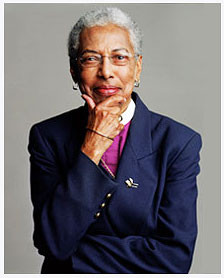 Bishop Barbara Harris
1930-2020chain-smoking, foul-mouthed witness for social justice.”
(I LOVE that description!)
She was also the first woman ordained a Bishop in the Anglican Communion.
I, for one, am deeply grateful for all Bishop Harris did and was. This world is just a bit darker than it was, since her presence left it.
But, Fr. Tim shared a quote from her that speaks loudly to all of today in our particular situation. Bishop Harris once said,
“We are an Easter people living in a Good Friday world.”
Yes, it may seem right now like a prolonged, seemingly unending Good Friday. But we are Easter people. We carry Easter within us, even in these dark times. That bright shining light of Easter is alive within each of us.
So, no matter how dark it may seem, no matter how frightening it feels at times, we have to remind ourselves that that eternal, life-affirming Easter is alive in each of us. And as Easter people, we need to remember again and again what our God tells us:
“do not fear.”
Do not fear.
Our God loves us.
DO NOT FEAR.
God loves you.
Each of you.
Fully and completely and uniquely.
Cling to that love.
Hold that love close to you in this time.
Let that love be your shield against fear and anxiety.
God loves you.
That is our living water right now.
All we have to do is say, “Give me some of that water.”
And it will be given to us.
And those of us who drink of that water will never again be thirsty.
March 8, 2020
2 Lent
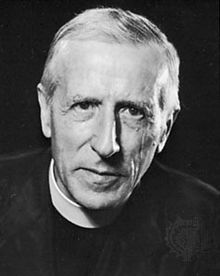 Pierre Teilhard de Chardin, SJ
(1881-1955) March 8, 2020
Genesis 12:1-4a; John 3.1-7
+ Sometimes, as we know, there are moments in which we find ourselves struggling with things—nameless things.
Things that we can’t really define.
Things that don’t seem to have names.
You know what I’m talking about.
The illnesses and limitations that come with growing older.
The fact that we are limited physically by injuries or age or illness.
The fact that we can’t love as fully as we want to due to past broken relationships.
The fact that rifts and brokenness in our families weigh heavily on us.
When we’re dealing with heavy things like this in our lives, we don’t worry about labels and names of things.
But sometimes, when something is given a name, we find it’s easier to confront and deal with.
It’s easier to deal with depression, when we know it as depression.
It’s easier to deal with anxiety, when we know it is known as anxiety.
Most of these situations, we realize, are beyond our control.
There is nothing we can do about it.
It’s just a fact of life.
Or the fact that sometimes we get sick and it has nothing do to with anything we have done.
We can get treatment for our illness.
We can follow that treatment.
But we can’t rush the healing process.
It happens on its own.
So, for the moment, we simply must be sick.
Or, in the case of losing a loved one.
There’s no getting around this loss.
We can’t hide from this loss.
We can’t pretend we haven’t experienced this loss.
We can’t rush the grieving process.
It’s just a reality in our lives.
And we must simply live with it—with all its pain, with all of its heartache, with all its frustrations.
In all of these things, we know they’re realities.
But we don’t really have a good name for all of these things.
But…there actually is.
One of my personal heroes, someone I mention on a very regular basis, is Pierre Teilhard de Chardin.
Chardin was a Roman Catholic Jesuit priest.
He was also a paleontologist.
In fact, he found the Peking Man, an important link in the Evolution of Humanity.
He was also a great philosopher.
And he coined a term to describe these unavoidable, somewhat unpleasant facts of our lives.
He called them “passive diminishments.”
I mentioned these in my Ash Wednesday sermon.
According to Teilhard, these passive diminishments were simply the acceptance of sufferings that we cannot change.
For Teilhard, it wasn’t enough to simply recognize them as diminishments.
He believed that our spiritual character is formed as much by what we endure and what is taken from us as it is by our achievements, and our conscious choices.
So, in essence, it is important for us to accept ill fortunes, whether disease, old age or accident, as part of our journey to holiness.
That doesn’t mean w shouldn’t avoid the avoidable or that we shouldn’t seek healing in our lives when we can.
The great novelist Flannery O’Connor, who I also quote very often and who also was devoted to Teilhard, described passive diminishments as “those afflictions you can’t get rid of and have to bear.”
This coming from a woman who suffered from lupus throughout her adult life.
As we enter this Season of Lent, I think it’s a good thing to understand our own passive diminishments and how we deal with them.
Do we accept these unavoidable moments of suffering in our lives?
Or do we fight them?
Or worse, do we try to pretend they don’t exist?
The fact is passive diminishments are the boundaries of our lives.
They keep us within this human condition in which we live.
And I think acknowledging these diminishments in our lives draws us closer to God.
They bring us into close contact with Jesus.
After all, no one knew more about passive diminishments than Jesus.
He too knew these limits in his very Body.
Being limited is just a reality for us.
But… it is not a time to despair.
Our limitations, especially when we place them alongside the limitations of Christ endured, has more meaning than we can fully fathom at times.
And rather than seeing them only as these burdens we must bear, we must also recognize them as paths of holiness and wholeness.
And, in the process, we realize they help form who we are.
They become important parts of our characters.
One of the most effective means I have found to use my passive diminishments for holiness of goodness has been in my ministry.
And it should be for all us who are ministers.
And all of is here today are ministers.
We are called, each of us, to do ministry.
These passive diminishments of our lives should not be seen as hindrances for ministry.
We shouldn’t be saying, “I can’t do ministry because I’m too old, or too limited physically, or I am too overcome by grief.”
Rather, we can do truly effective ministry by using these limitations of our lives.
We can actually walk alongside someone who is grieving or who is suffering physical limitations or who feels unneeded because they feel they’re too old.
After all, we are all called to do ministry in our own ways, in our own circumstances.
In our reading from the Hebrew scriptures this morning, we find a clear call from God to Abram.
“Go from your country and your kindred and your father’s house to a land that I will show you.”
Essentially this is the call to all of us who are in ministry.
God calls to us wherever we may be and limited by whatever passive diminishments in our live, and when we hear that call, we must heed it.
We must step out, even when we feel limited in our lives, and we must step out into our service to others even if that means going to those people in strange and alien places.
And sometimes when we step into those uncomfortable places, we are made all the more aware of our own limitations—we become even more vulnerable.
But that’s just a simple fact in ministry: when God calls, God calls heedless of our limits.
In fact, God calls us knowing full well our limitations.
And—I hope this isn’t news to anyone here this morning—God uses our passive diminishments.
God can truly work through these broken aspects of our lives and use our fractured selves in reaching out to other fractured people who are also suffering various passive diminishments in their own lives.
For many people our brokenness, our limitations divides us.
They separate us.
They isolate us.
They prevent us from moving forward in our lives and in ministries.
I see this all the time in the world and in the Church.
And when it does, our brokenness and our limitations become a kind of condemnation.
They become open wounds we must carry with us—allowed by us to stink and fester.
But when we can use our brokenness, when we can use our passive diminishments, to reach out in love, when we allow God to use our very brokenness, it is no longer a curse and a condemnation.
Our limitations become fruitful means for ministry.
It becomes a means for renewal and rebirth.
It becomes the basis for ministry—for reaching out and helping those who are also broken, who are also suffering with their limitations, who are in need around us.
Teilhard was a genius in figuring this out!
In our Gospel reading for today we get that all-too-familiar bit of scripture.
“For God so loved the world that he gave his only Son, so that everyone whoever believes in him may not perish but have eternal life.”
We have heard that scripture so often in our lives, w almost don’t realize what it’s really saying.
It is saying to us that God truly does love us.
God loved us so much that God came among us in God’s very Son.
That God’s love became real for us in an actual human, Jesus.
And that when we look to Jesus, we find God’s love there.
We realize that each and every one of us is truly and uniquely loved by God.
Even with our limitations, even with our brokenness.
And that, because we are so loved by God, those of us who are heeding our call—who are following after Jesus, who are loving God and loving the God we find in others—we will be made whole one day.
We will be given eternal life
Each of us is called.
Each of us has been issued a call from God to serve.
It might not have been a dramatic calling—it might not have been an overwhelming sense of the Presence of God in our lives that motivates us to go and follow Jesus.
But each Sunday we receive the invitation.
Each time we gather at this altar to celebrate the Eucharist, we are, essentially, called to then go out, refreshed and renewed in our very limited, broken selves by this broken Body of Jesus, to serve the broken people of God who are all suffering with their own passive diminishments.
We are called to go out and minister, not only by preaching and proclaiming with words, but by who we are, by our very lives and examples.
So, let us heed the call of God.
Let us do as Abram did in our reading from Genesis today.
“Abram went, as the Lord told him…”
Let us, as well, go as God has told us.
Let us go knowing full well that heeding God’s call and doing what God calls us to do may mean embracing those limitations we have feared and fought against.
And doing so will be doubly frightening when we know we go as human beings—as people broken and vulnerable.
But let us also go, sure in our calling from God.
Let us go sure that God has blessed each of us, even in our brokenness.
God has blessed us, even with all our passive diminishments.
Let us go knowing that God loves us, because we too love.
Let us go knowing that God will use the cracks and fractures within us, as always, for good.
And let us go knowing God will make us whole again in our eternal life.
God will make us a blessing to others and God will “bless those who bless us.”
What more can we possibly ask of the ministry God has called us to carry out?
March 1, 2020
1 Lent
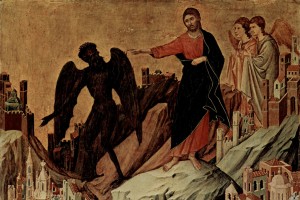 March 1, 2020Gen. 2.15-17; 3.1-7; Matthew 4.1-11
+ As we prepare for the ordination of John Anderson to the Diaconate on April 4, I’ve found myself thinking of my ordination.
16 years ago, when I was ordained to the priesthood, I included a prayer on the booklet for my ordination service, which I adapted from a prayer written by the great Archbishop of Canterbury, Michael Ramsey.
In that prayer, I prayed:
Only one thing I ask: take my heart and break it. Break it not as I would like it to be broken, but as you would.
Some times, I realize, we need to be careful what we pray for.
Because our prayers might be answered in ways we never thought they would.
I can that, in these past 16 years, I have been broken in ways I never could’ve imagined.
I say that not as a complaint.
I say that simply as a fact.
And I can say that, I am, somewhat thankful for the opportunity to be broken in ways that God has seen fit.
Because, in being broken, I have felt a weird connection with Jesus that I might not have had other wise.
After all, he too was broken.
He too knew what brokenness was in his very Body.
That concept of the broken ones of God having a connection with the broken body of Christ that we experience in a very physical way during our celebration of the Eucharist has spoken to me and it is this theme that I am going to return to again and again during this season of Lent.
We have all known brokenness in our lives.
Broken relationships.
Broken health.
Broken love.
Broken families.
Being broken—and we all are broken in various ways—is just a reality for us. But it is not a time to despair.
Our brokenness, especially when we place it alongside the broken Body of Christ that is lifted up and shown at the Eucharist, has more meaning than we can fully fathom at times.
In that moment, we realize we can no longer feel separated from Christ by our brokenness.
It is a moment in which we are, in fact, uniquely and wonderfully joined TO Christ in our shared brokenness.
And what we glimpse today in our scripture readings is, on one hand brokenness, and on the other hand, wholeness.
In our readings from the Hebrew Scriptures and from the Gospel, we get two stories with one common character.
In our reading from Genesis, we find Satan in the form of a serpent, tempting Adam and Eve in the Garden.
In our Gospel, we have Satan yet again doing what he does best—tempting.
But this time he is tempting Jesus.
What we have here is essentially the same story, retold.
We have the tempter.
We have the tempted.
We have the temptations.
But we have two very different results.
In fact, we have exactly opposite results.
But ultimately these stories tell us this:
anytime we find something broken, somehow God fixes it in the end.
When it comes to God, what seems like a failure—the fall of Adam and Eve—eventually becomes the greatest success of all—the refusal of Jesus to be tempted.
And whatever is broken, is somehow always fixed and restored.
Still, we must deal with this issue of temptation.
It is the hinge event in both of the stories we hear this morning from scripture.
Alexander Schmemann, the great Eastern Orthodox theologian, once said that there are two roots to all sin—pride and the flesh.
If we look at what Satan offers both Adam and Jesus in today’s readings, we see that all the temptations can find their root mostly in the sin of pride.
Adam and Eve, as they partake of the fruit, have forgotten about God and have placed themselves first.
The eating of that fruit is all about them.
They have placed themselves before God in their own existence.
And that’s what pride really is.
It is the putting of ourselves before God.
It is the misguided belief that everything is all about us.
The world revolves around us.
The universe exists to serve us.
And the only humility we have is a false one.
When one allows one’s self to think along those lines, the fall that comes after it is a painful one.
When Adam and Eve eat of the forbidden fruit, they are ashamed because they realize they are naked.
They realize it is not all about them, after all.
They have failed themselves and they have failed God in their pride.
But the amazing thing, if you notice, is that Adam and Eve still have not really learned their lesson.
They leave the Garden in shame, but there is still a certain level of pride there.
As they go, we don’t hear them wailing before God.
We don’t see them turning to God in sorrow for what they have done.
We don’t see them presenting themselves before God, broken and humbled, by what they have done.
They never ask God for forgiveness. Instead, they leave in shame, but they leave to continue on in their pride.
From this story, we see that Satan knows perfectly how to appeal to humans.
The doorway for Satan to enter into one’s life is through pride.
Of course, in scripture, we find that Satan’s downfall came through pride as well. Lucifer wanted to be like God.
And when he knew he couldn’t, he rebelled and fell.
We see him trying to use pride again in his temptation of Jesus in the wilderness.
When Satan tempts Jesus in the wilderness, he tries to appeal to Jesus’ pride.
He knows that Jesus knows he is exactly who is.
Satan knows that Jesus truly does have the power to reign and rule, that he has all the power in the world.
And Satan further knows that if he could harness that power for himself—for evil—then he will have that power as well.
Because Jesus was fully human, Satan knew that he could appeal to the pride all humans carry with them.
But Jesus, because he, in addition to being fully human, was also fully the Son of God as well, refused to succumb to the sin of pride.
In fact, because Jesus, the Son of God, the Messiah, came to us and became human like us, the ultimate sign of humility came among us.
So, these two stories speak in many ways to us, who are struggling in our own lives.
As we hear these stories, we no doubt find ourselves relating fully to Adam and Eve.
After all, like Adam and Eve, we find ourselves constantly tempted and constantly failing as they did.
And also like them, we find that when we fail, when we fall, we oftentimes don’t turn again to God, asking God’s forgiveness in our lives.
We almost never are able to be, like Jesus, able to resist the temptations of pride and sin, especially when we are in a vulnerable state.
Jesus, after forty days of fasting, was certainly in a vulnerable place to be tempted.
As we all enter the forty days of fasting in this season of Lent, we too need to be on guard.
We too need to keep our eyes on Jesus—who, in addition to being this divine being, the very Son of God, is also our companion in this earthly adventure we are having.
We need to look to Jesus, the new Adam, the one who shows us that Adam’s fall—Adam’s brokenness—is not the end of the story.
Whatever failings Adam had were made right with Jesus.
And, in the same way, whatever failings we make are ultimately made right in Jesus as well.
Jesus has come among us to show up the right pathway.
Jesus has come to us to lead us through our failings and our brokenness to a place in which we will succeed, in which we will be whole.
So, let us follow Jesus in the path of our lives, allowing him to lead us back to the Garden of Eden that Adam and Eve were forced to abandoned.
Because it is only when we have abandoned pride in our lives—when we have shed concern for ourselves, when we have denied ourselves and disciplined ourselves to the point in which we realize it is not all about us at all—only then will we discover that the temptations that come to us will have no effect on us.
Humility, which we should be cultivating and practicing during this season of Lent, should be what we are cultivating and practicing all the time in our lives.
Humility is the best safeguard against temptation.
Humility is the remedy to help us back on the road to piecing ourselves back together from our shattered brokenness.
So, as we move through the wasteland of Lent and throughout the rest of our lives, let us be firm and faithful in keeping Jesus as the goal of our life.
Let us not let those temptations of pride rule out in our life.
In these days of Lent, let us practice personal humility and spiritual fasting.
Let Jesus set the standard in our lives.
And let him, as he did to Adam and Eve when he died on the cross, raise us up from the places we have fallen in your journey.
And let us let him piece our brokenness back into a glorious wholeness.
February 26, 2020
Ash Wednesday
 February 26, 2020
Joel 2.1-2,12-17; 2 Corinthians 5:20b-6:10; Matthew 6.1-6,16-21
Ê I once had a parishioner tell me that they were not appreciative of me preaching to them about sin during Lent.
That elicited one of those looks I occasionally give—a look of absolute bewilderment at what people sometimes say to me.
Some of you have received that same look.
“I’m sorry, Father,” this person said to me, “but what do you know of about my sins and the kind of sins I have to deal with in my own life?
“You’re a celibate male priest of all things! You don’t know the struggles I go through as a married person, as a parent, as a person who struggles with real temptations and real frustrations and real marital issues, for example.”
Granted, yes, I am that now-very-rare, almost extinct dinosaur of being a celibate Anglo-Catholic priest in the Episcopal Church (there aren’t a lot of us out there, let me tell you). After all, we all know how celibacy has taken a huge beating because of some horribly abusive clergy who hid behind their celibacy to do horrible, very non-celibate abuse. As you know, I also don’t make any apologies about any of that, but to say that, because I’m celibate, I somehow don’t understand others’ struggles, or, worse, that because I’m celibate I somehow seem “removed” from everybody else’s struggles, shocked me.
I responded to this person the only way I knew how to.
I said, “You do know that I am a sinner too, right?”
I understand that this might not be something parishioners want to hear. They don’t want to hear that their priest is a sinner just like them.
But the fact is, we all are sinners. That’s what Ash Wednesday is all about. This is our time to admit God and to one another,
“I am a sinner too.”
We’re all in this boat together. It might be different for you as opposed to someone else who is here tonight.
But each of our dealing with our own sins, in our own ways. That doesn’t mean we say that so we can then whip ourselves, or bash ourselves or be self-deprecating. We say it as a simple acknowledgment of our humanity before God, our imperfection.
That is exactly what we do tonight and for these next 40 days.
During Lent, we will be hearing about sin. We will be hearing about repentance. We will be reminded of the fact that, yes, we have fallen short in our lives.
And tonight especially, we will be reminded that one day, each of here tonight will one day stop breathing and die. We are reminded tonight in very harsh terms that we are, ultimately, dust. And that we will, one day, return to dust.
Yup.
Unpleasant.
But…
…sometimes we need to be reminded of these things.
Because, let’s face it. We spend most of our lives avoiding these things. We spend a good portion of our lives avoiding hearing these things. We go about for the most part with our fingers in our ears. We go about pretending we are going to live forever. We go about thinking we’re not really like everyone else. We think: I’m just a little bit more special than everyone else.
Maybe…maybe…I’m the exception.
Of course we do that.
Because, for each of us, the mighty ME is the center of our universe. We as individuals are the center of our own personal universe.
So, when we are confronted during Lent with the fact that, ultimately, the mighty ME is not the center of the universe, is not even the center of the universe of maybe the person who is closest to me, it can be sobering. And there we go.
Lent is about sobering up. It is about being sober. About looking long and hard at the might ME and being realistic about ME. And my relationship with the God who is, actually, the center of the universe and creation and everything that is.
It’s hard, I know, to come to that realization. It’s hard to hear these things. It’s hard to have hear the words we hear tonight as those ashes are placed on our foreheads,
“You are dust and to dust you shall return.”
You are dust.
I am dust.
We are dust.
We are ashes.
And we are going to return to dust.
Yes.
It’s hard.
But…
Lent is also about moving forward. It is about living our lives fully and completely within the limitations of the fact that are dust.
Our lives are like jazz to some extent. For people who do not know jazz, they think it is just free-form music. There are no limits to it.
But that’s not true. There is a framework for jazz. Very clearly defined boundaries. But, within that framework there is freedom.
Our lives are like jazz as well. Our mortality is the framework of our lives.
We have boundaries.
We have limits.
And I am going to talk about those limits during this season of Lent. I am going to be talking throughout these forty days about a term one of my heroes coined. That hero, Pierre Teilhard de Chardin, the great Jesuit priest and paleontologist, talked about something like passive diminishments.
Passive diminishments, according to Chardin, are simply those sufferings in this life that we cannot avoid. They are the limits in our lives—the hard boundaries of our existence that we cannot avoid.
I’m not going to go into them too deeply tonight. But I will during the Sundays of this season.
Tonight, though I will say this:
Within those limits, within the boundaries of those passive diminishments, we have lots of freedom. And we have the potential to do a lot of good and a lot of bad. Lent is the time for us to stop doing the bad and start doing the good. It is time for us to store up for ourselves treasure in heaven, as we hear Jesus tell us tonight in our Gospel reading. It is time for work on improving ourselves. And sometimes, to do that, we need to shed some things.
It is good to give up things for Lent.
I know this is a dumb thing to admit, but I am giving up sugar again for Lent. And caffeine again too. I actually went back on caffeine while I was on vacation just so I could give it up for Lent. (Stupid). That’s how bad it is when you give up so much in your daily life. I’m vegan. I don’t drink alcohol. I’m celibate. What else can I give up?
The reality however is this:
Yes, we can give up sugar or caffeine or meat or tangible things that might not do us good. But let me just say this about that.
If we give up something for Lent, let it be something that changes us for the better.
Let it be things that improve us. Let us not only give up things in ourselves, but also things around us.
Yes, we can give up nagging, but maybe we should also give up those voices around us that nag. Or maybe confront those voices that nag too much at us.
Yes, we can give up being controlling and trying to change things we can’t. But we maybe also try hard to push back and speak out against those unreasonably controlling forces in our own lives.
Maybe Lent should be a time to give up not only anger in ourselves, but those angry voices around us.
Lent is a time to look at the big picture of our lives and ask: what is my legacy?
How am I going to be remembered?
Are people going to say of our legacies what we heard this evening from the prophet Joel?
“Do not make your heritage a mockery…”
Am I going to be known as the nag? As that angry, bitter person? Am I going to be known as a controlling, manipulative person who always had to get my way? Am I going to be known as a gossip, as a backbiter, as a person who professed my faith in Christ on my lips, but certainly did not live it out in my life?
If so, then there is no better time than Lent to change our legacy. That is our rallying cry during Lent as well.
Let us choose to be a good, compassionate, humble, love-filled follower of Jesus. That is the legacy we should choose during this season, and from now on.
After all, we ARE ashes.
We are dust.
We are temporary.
We are not immortal.
We are bound by our passive diminishments.
But our legacies will outlive us.
In fact, in many ways, they are, outside of our salvation, ultimately, the most important thing about our future.
Let us live in to the legacy that will outlive us. This is probably the best Lenten discipline we can do. Most importantly, let this holy season of Lent be a time of reflection and self-assessment. Let it be a time of growth—both in our self-awareness and in our awareness of God’s presence in the goodness in our life.
As St. Paul says in our reading from this evening: “Now is the acceptable time.”
“Now is the day of salvation.”
It is the acceptable time.
It is the day of salvation.
It is time for us to take full advantage of it.
February 2, 2020
The Feast of the Presentation of Our Lord
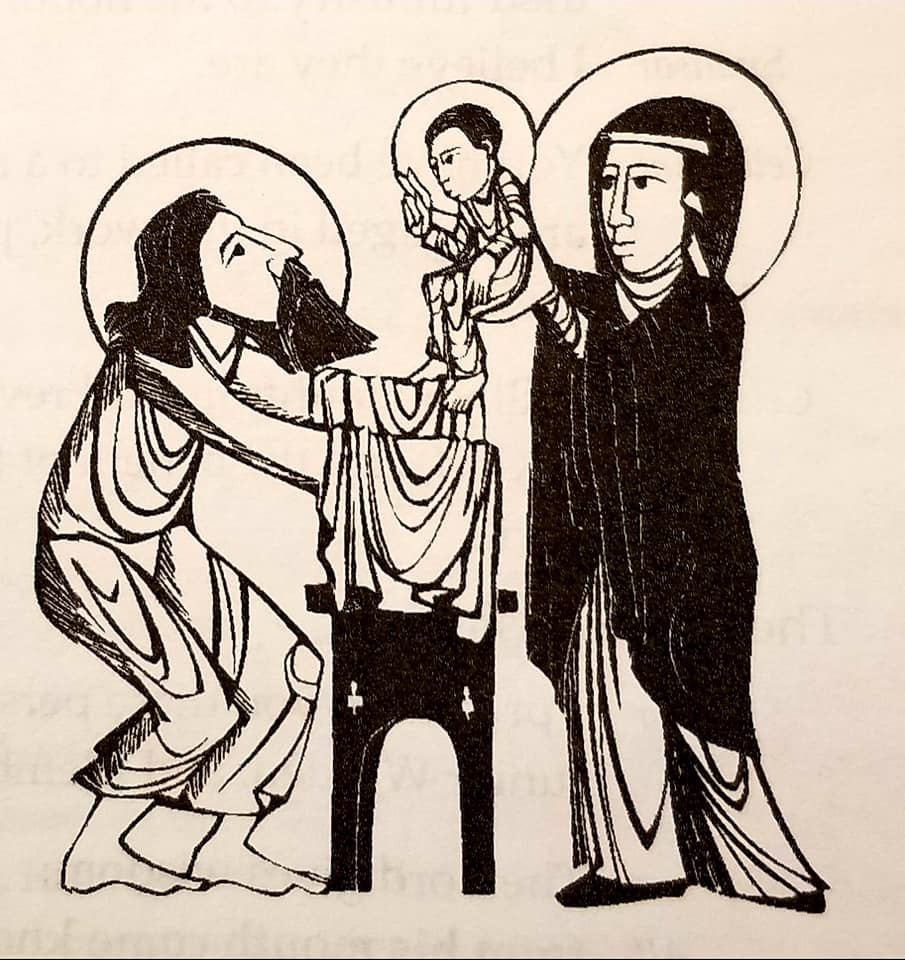 February 2, 2020
Luke 2. 22-40
+ So, let’s see if you can remember this. What happened 40 days ago today?
Yes, Christmas happened 40 days ago today. I know it’s hard to even think of that, now in early February. It feels so long ago already. But, yes 40 days ago we commemorated the birth of Jesus.
Which is why, today, we are commemorating the Presentation of Jesus. Which simply means that, in Jewish tradition, the first born son was to be presented to the Temple on the 40th day after his birth. And on that day, the child was to literally be redeemed.
Reminiscent of the story of Abraham and his son Isaac, an animal sacrifice would’ve made in the place of the life of the son, which in the case of Jesus’ family, who were poor, would have been two doves.
Now why, you might ask? Why 40 days?
Well, until about the Thirteenth century, it was often believed that the soul did not even enter a boy child until the 40thday. (The soul entered a girl child on the 80th day) So essentially, on the 40th day, the boy child becomes human. The child now has an identity—a name. And the child is now God’s own possession.
This has been a very important feast in the Church from the very beginning. Of course the Eastern Church, which celebrates Jesus’ birth on January 6, doesn’t celebrate the Feast of the Presentation until when…
February 14th.
This day is also called Candlemas, and today, of course, we at St. Stephen’s, in keeping with a tradition going back to the very beginning of the Church, will bless candles on this day. In the early Church, all the candles that would be used in the Church Year and in individual people’s lives would be blessed on this day. The candles blessed on this day for personal use were actually considered spiritually powerful. They were often lit during thunderstorms or when one was sick or they would be placed in the hands of one who was dying. Now all of that is wonderful and, I think, is interesting in helping understand this feast day and in its importance in the life of the Church and the world.
But the real message of this day is of course the fact, in presenting Jesus in Temple, the Law in Jesus was being fulfilled.
This morning, in this feast, we find the old and the new meeting. That is what this feast we celebrate today is really all about.
Now, I love this feast. But I have to admit that it has taken on a bittersweet air for my personally. It was on this day, two years, that we celebrated the Requiem Mass for my mother at Gethsemane Cathedral in Fargo. Many of you were there with me that day. And it was a beautiful mass. Fr. Mark Strobel even referenced this Feast day in his sermon for my mother that day.
In many ways, it was appropriate that her Requiem Mass was celebrated on this day. The Feast of the Presentation is all about the Old and the New meeting. In fact, in the Eastern Orthodox Church, this feast is called the Meeting of Christ with Simeon.
In our Gospel reading for today, we find this righteous man Simeon representing the Old Law. He is the symbol of the Old Testament—the old Law of Moses. We have Simeon who is probably a priest in the Temple. He is nearing the end of his life. He knows he is in his last days. But he also knows something new is coming. Something new and wonderful and incredible is about dawn.
As a priest, he performed those Levitical rites that fulfilled the Law. He oversaw the rites of purification. Mary herself would certainly be going through the purification rites all mothers had to go through on this fortieth day after the birth of a child. Simeon would also have presided over the dedication service of the new child to God, which, of course, would have included both his naming and his circumcision. All of this fulfils the Old Law.
Then, of course, there is a figure who we always seem to overlook in this scripture reading. But she is important. And, after I’m done here, you’ll see how really important she is to the story.
The Prophet Anna.
Now, Anna is important to this story. Do you want to hear an interesting story
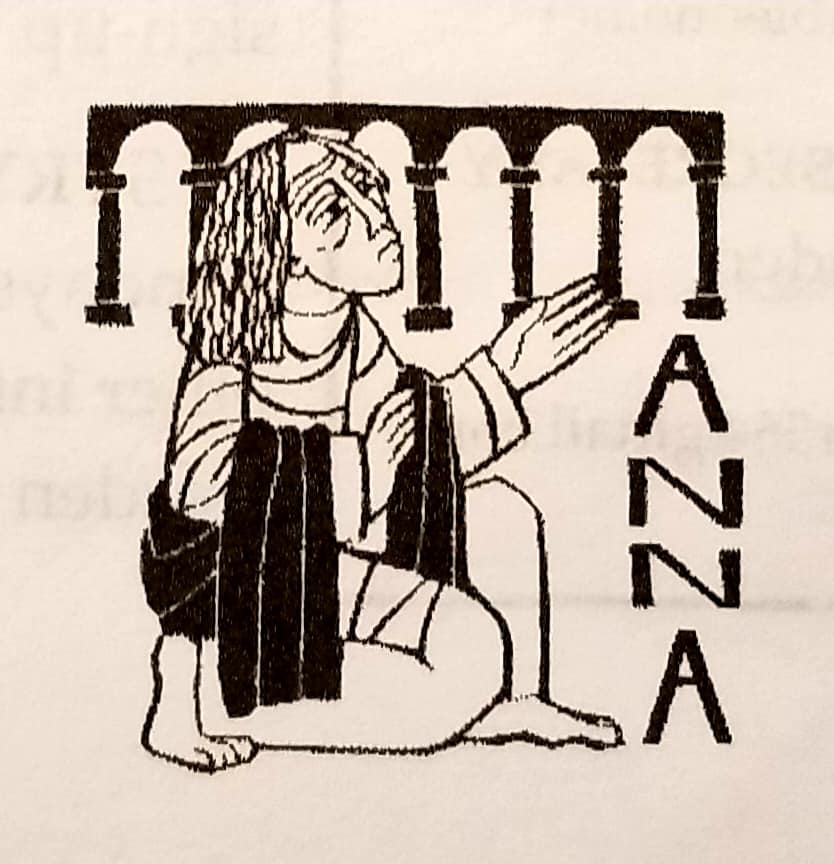 related to Anna? OK. Hold on to your hats. Because my guess is that you’ve never heard this before.
So, from our reading today, we find quite a bit of information about Anna. We know that she is a widow. We know that her father was Phanuel. We know she was a prophet and that she lived in the Temple.
But, here’s where it gets interesting. I recently read about this legend that actually makes some real sense. . According to this belief, Anna’s father, Phanuel, was actually a High Priest of the Temple in the line of Zadok the High Priest, in which the prophets predicted the Messiah would be born. According to the story, Phanuel was killed by Herod the King to prevent the Messiah from being born, since Herod believed that the Messiah would be born in the lineage of Zadok.
Phanuel had three daughters. Anna (or Hanna as she was also known), Elizabeth, and another daughter, Joanna.
And, according this story, Anna is the none other than the mother of Mary, the mother of Jesus.
So, when we encounter Anna in today’s Gospel reading, we are actually, according to this scholarship, encountering the grandmother of Jesus, which makes tremendous sense. Of course, the daughter of the High Priest would be in the Temple at the end of her life. Of course the granddaughter of the High Priest would bring her son and present him there, in the presence of his grandmother.
But we don’t stop there. If the name Elizabeth sounds familiar, it should. She is the mother of John the Baptist. The Gospel of Luke describes her as a “kinswoman” of Mary. She was then Mary’s aunt. Which makes Jesus and John cousins.
But we encounter these women one other place in the Gospel of Luke. Also in the Gospel of Luke, as Jesus is going to the cross, he encounters the “Daughters of Jerusalem.” According Jewish tradition, the “Daughters of Jerusalem,” are actually the daughters of the high priest. It was an actual title that was given to them.
So, essentially Jesus encounters his aunts (we get the impression that Anna, was probably older than her sisters, was long dead by that point).
I love this little microcosm into the story of Jesus and his presentation in the Temple
I just want to add one personal note to this: my mother’s patron saint was none other than St. Ann, the patron saint of mothers. I did not know any of this when I planned her Requiem Mass for this day.
Now, I imagine one or two of you might be a bit skeptical of this. But, the fact remains, in scripture this how we see God work. God doesn’t just randomly do things. There is a building of up of all God does. There is a plan and a structure to the way God works, especially in the life of Jesus.
Each aspect of his life has meaning and purpose, even in those generations before he was born. We see that God was working in preparation in the world, even before Jesus was born. Anna represents God’s unique way of preparation. Anna is an important part of the story we are encountering today. She comes forward out of the background and begins praising God and speaking of the greatness of this Child. What she proclaims is the New. What she praises God for is Jesus—born under the most unusual of circumstances.
In case we forgot what happened 40 days ago, he was conceived and born of a virgin, with angels in attendance, with a bright shining star in the sky and mysterious strangers coming from the East.
In Jesus, we have the Law fulfilled. Eventually, in this baby that comes before Simeon, the old Law would find its fulfillment. The Law is fulfilled in this baby, who will grow up, to proclaim God’s kingdom in a way no else has before or since. This baby will also grow up to die on the Cross.
No longer do we need those animal sacrifices. We don’t need a lamb or two little doves or pigeons to die for us. His death did away with all those sacrifices.
Now, this all sounds wonderful. But no doubt we start asking this important question: why do we even need the Old Testament. If Jesus came to fulfill it, it seems pointless.
But what we need to remember is that this New Law does not overcome or cancel out the old Law. It only solidifies it. It makes it more real. The Old Law will simply change because now there will be no more need of animal sacrifices and atonement offerings.
In Jesus—the ultimate Lamb of God—those offerings are taken away. They were needed then. They are not needed now. But they foreshadowed what was to come. We have one offering—that offering of Jesus on the Cross—and through it we are all purified.
But even more so than that. This Feast of the Presentation is about us as well. We too are being Presented today. We too are presented before God—as redeemed and reborn people. We too are being brought before God in love. From this day forward we know that we are loved and cherished by God. We know that we are all essentially loved children of God, because Jesus, the first born, led the way for us.
The Old Law hasn’t been done away for us. Rather, the Old Law has been fulfilled and made whole by the New . We see that there is a sort of reverse eclipsing taking place. The Old Law is still there. But the New has overtaken it and outshines it.
See, it really is a wonderful day we celebrate today. The Feast of the Presentation speaks loudly to us on many levels. But most profoundly it speaks to us of God’s incredible love for us.
So, this morning, on this Candlemas, let us be a light shining it the darkness. Let that light in us be the light of the Christ Child who was presented in the Temple. We, like Jesus being presented to Simeon, are also be presented before God today and always.
So let us, like the prophet Anna rejoice. Let us, like her, speak to all who are looking for redemption.
And with Simeon, let us sing:
“Now you may dismiss your servant in peace, according to your word;For my eyes have now seen your salvation which you have prepared in the presence of all peoples.
Amen.
January 26, 2020
3 Epiphany
 January 26, 2020
1 Corinthians 1.10-18; Matthew 4.12-23
+ I have a major fault in my life.
I need to confess this, I think.
In our Gospel reading for today, we hear about “following” Jesus.
I have never found this idea of “following” a great one.
I know I preach a lot about following Jesus and how a Christian is a follower.
But, deep down, such talk really grates on me at times.
Being a follower in my understanding has never been something I enjoyed.
I was never a follower.
I’ve always kind of done my own thing.
As many of you know.
And so when we come across this talk of Jesus telling us to follow him, I will do it.
I get it.
I understand it.
And I try hard to do it.
But it has not been easy for me at times.
And I can imagine if I had lived in his time, I would’ve been the one who would have done so a bit reluctantly.
I would have been the disciple standing off to the side, with my arms crossed.
I’d be there.
I’d be listening.
And I would follow.
But I’d do so with a bit of a drag in my feet as I did it.
And you know what?
That’s all right.
The fact is, we don’t all have to follow Jesus in the same way.
Some of us might be enthusiastic.
Some of us might…not.
It doesn’t mean being a stereotype.
It doesn’t mean I have to follow him the same way you follow him.
We can follow in our own particular way.
The key isn’t how we follow him.
The key is that we simply do follow in whatever way we can.
I think it’s appropriate at that we talk about our following of Jesus today.
After all, it is Annual Meeting Sunday.
It is the Sunday in which we gather together to look at where we’ve been this last year and to look forward into the next year.
It is a time for us to stop and to think about the unique and eclectic ways in which we can follow Jesus in this coming year as a congregation and as individuals.
But, as I say that, I want to stress one very important thing:
Following—and this is real point for me in all of this—doesn’t mean conforming.
Which is what makes us, especially here at St. Stephen’s, so…how shall I say it...eclectic.
Notice that I didn’t say eccentric.
Though we are definitely that as well.
And following Jesus in our own unique ways sometimes means that there will be differences of opinions.
There are divisions in our churches and—I guess I don’t have to really say this—there are divisions in our society right now.
If you don’t think so—uh, you haven’t been keeping up with the news, especially this past week.
We are divided.
Even here this morning, there are diverse views in our divisions regarding where we are in this country and society.
And it’s unfortunate that such divisions have to exist.
But, in our following Jesus, although there can variety, although we can be eclectic, we cannot allow ourselves to be divided from each other.
We can have differences of opinions.
We can argue about semantics.
We can debate the fine aspects of how to live our lives as Christians.
But if we are following Jesus, we cannot be divided from each other in our following.
“Has Christ been divided?” Paul asks this morning his letter to the Corinthians.
The answer, of course, is “no.”
Christ cannot be divided.
And that same thinking can be applied to Christ’s Church.
Yes, there may be denominational divisions, or, as we are seeing right now, political divisions or even physical divisions, but the fact remains that the Church continues to be the Church Undivided even in the midst of all the wrangling and fighting and misunderstanding.
Even death does not divide us.
We are also part of the Church that dwells now in the nearer Presence of Gd.
One thing that’s clear, we all deal with our own fears in this life.
I see it again and again in the ministry I do.
There is a lot of fear out there.
And it is a fear that can truly destroy and wreak havoc.
If we as Christians are to face what seems to be overwhelming fear, we need to be united.
We cannot let these fears divide us.
When we gather together—even two or three of us—Christ himself and the whole Church, both here on earth and in the nearer Presence of God is present fully and completely.
And the great reminder to us of this undivided Body of Christ is baptism.
We are sealed against division, against fear, against the forces of darkness that may seem at times to prevail in this world by our baptism.
A few weeks ago I preached about how, in these waters of baptism all of us were made equal.
If you ever notice, at our funerals here at St. Stephen’s, the urn of ashes or the coffin is always covered with a white pall.
The use of the pall is not just one of those quant things we Episcopalians do.
It is not simply some fancy cloth we place over our mortal remains to add a touch of class to the service (though it does do that).
There is a very practical reason for placing the pall on the urn or coffin.
We put the cloth on because, no matter how fancy and expensive or cheap and inexpensive an urn or casket may be, before the altar, at the funeral, no distinction is made, just as, in Christ, there is no distinction between any of us.
We are all equally loved children of God.
We are essentially on equal ground under that pall.
We are all the same.
And, in so many ways, that pall represents baptism as well.
Just as the pall is the great equalizer at funerals, baptism is the truly great equalizer in our Christian lives.
Our baptism—that singular event that made us Christians—is the starting out point of our lives as Christians and the common factor in those lives.
And just as importantly, that holy moment in our lives was the first moment when we were all compelled to preach the Kingdom of God.
Without fear.
Yes, many of us are living in fear.
But, our fears died in those waters in which we were washed.
Our baptismal call is to stand up—strongly, surely, and without fear—to proclaim our equality before God.
Without fear.
To a large extent, what happened at our baptisms was the first major step in our direction of being followers of Jesus.
It was our first step on that path.
It was the day in which we essentially were called by Jesus , as Jesus called the disciples in today’s Gospel, to be fishers of people.
Baptism is the first of many steps in following Jesus.
And when we see that—when we see our following of Jesus beginning at that very moment in our lives in which we were baptized—we realize how following Jesus is truly a life-long experience.
In our collect for today, we prayed
Give us grace, O Lord, to answer readily the call of our Savior Jesus Christ and proclaim to all people the Good News of his salvation, that we and the whole world may perceive the glory of his marvelous works…
That is what Baptism does.
It compels us to answer the call of Jesus and to proclaim to all people the Good News of the Kingdom of God.
And the first volley of that proclamation began at our baptism.
In today’s Gospel, when we find Jesus and his first followers going through Galilee, “proclaiming the good news of the kingdom,” we realize that call to us to be “fishers of people” is not necessarily a call to holier-than-thou.
It is not a call to be exactly like everyone else in our proclamation.
Proclaiming the good news and being fishers of people might simply involve us communicating the truth of that reality in our own unique way
It means proclaiming Christ through our demeanor, through the choices we make in our lives and the very way we live our lives.
It means standing up for what is right in our way.
And it means doing so without fear.
If we do so in such a way, our whole life then becomes a kind of walking sermon, even if we personally don’t say a word.
And to a large extent this unique personhood that we received from God was formed in the waters of baptism.
“Follow me and I will make you fishers for people,” Jesus said to those first followers.
And he continues to say that to each of us this morning, and in our year ahead.
So, today, on this Annual Meeting Sunday, let us follow him.
Let us follow him from the waters in which we were washed to whatever place he leads us in our lives.
Let us stand up for truth.
Without fear.
Let us not let fear win out in our lives and in this world.
We are the ones who can stand up and fight against fear and injustice and inequality by simply being who we are.
We have nothing to fear.
We have been formed and blessed in those waters of baptism.
As baptized followers of Jesus we are protected in a unique and holy way.
Let us go out and proclaim this amazing message in our own unique and eclectic way.
Let us fish for people and let us bring in a hearty harvest.
This is what it is all about.
This is how we truly follow Jesus where he leads.
And knowing this—truly knowing this—we can follow him with joy and gladness singing in our hearts.
January 19, 2020
2 Epiphany
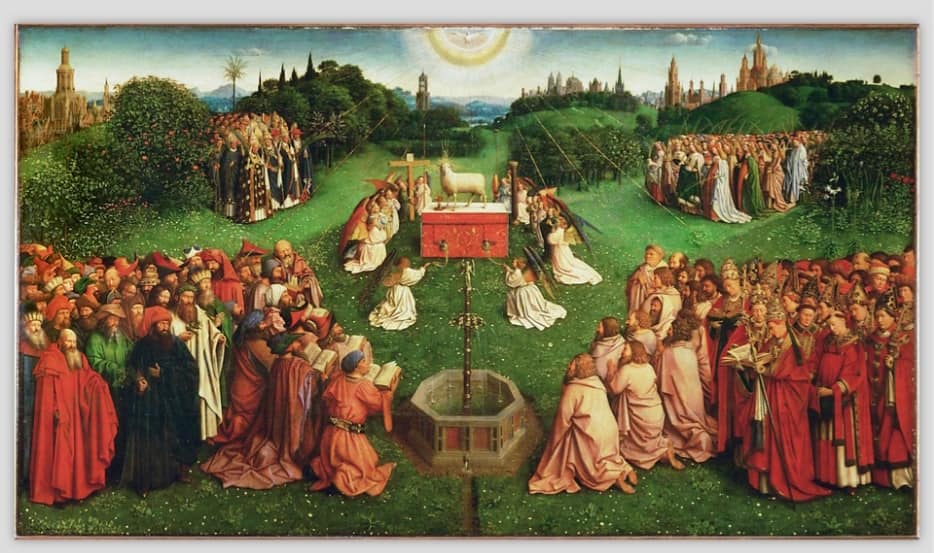 January 12, 2020
John 1.29-42
+ Recently, I was reading about an incredible piece of art that was recently cleaned and restored.
I am talking about the Ghent altarpiece.
This bit of art is one you no doubt know.
If you saw it you would say, “Oh, yes, I know that.”
In it, we find a panel called “The Mystical Adoration of the Lamb” in which Jesus as the Lamb of God is standing on an altar, surrounded by adoring angels and saints.
This altarpiece can be found in St. Bravo’s Cathedral in Ghent, Belgium.
It was painted in 1420s, early 1430s and was believed to have been painted by brothers Hubert and Jan van Eyck.
It’s a stunning piece of art.
But, if you are familiar with it, you may want to check out what was found as they were cleaning and restoring it.
It seems that, at some point, the face of the Lamb was altered.
At some point, the face was painted to look like an actual lamb.
But the original painting showed a very humanized face to the Lamb.
And this was only revealed after the restoration.
The human face on the Lamb is actually quite startling.
It appears to stare out at the observer, to stare them down essentially.
Now some describe this face as “cartoonish.”
But I found the revealed face of the Lamb to be sobering and compelling.
And it hit home to me the fact that the image of Jesus as the Lamb of God is essential in many ways to us.
All of this, of course, hits home to me this week because, of course, our Gospel reading for today deals with Christ as the Lamb of God.
And for some reason, this past week, as I was meditating on our Gospel reading for today, the whole image of Jesus as the Lamb of God really came home to me in a new way.
In today’s Gospel reading we find John the Baptist calling out not once but twice, identifying Jesus as the Lamb of God.
For us, it’s a very nice image.
A nice fluffy, sweet-natured lamb.
But…is that the right image we have of Jesus?
If God chose to be incarnate in the flesh, would God want to be looked upon as a sweet, fluffy lamb?
No, not all.
And that’s not what John is getting at when we calls out the way he does.
Sweet and gentle is not what John saw when he observed Jesus as the Lamb of God.
For John, what he observed when he looked at Jesus and saw the Lamb of God walking past, was truly a thing that would most vegans cringe:
He saw that sacrifice that was seen in the Temple in Jerusalem.
There, the lamb was sacrificed—and quite violently sacrificed—as a sin offering for the people.
He saw before him not Jesus the man, but the sacrificial Lamb, broken and bleeding.
To be fair, in our own images of the Lamb of God, we don’t have just a fluffy little lamb.
 The image we have on our altar here is not a sweet, fluffy lamb.
Look at it.
It is a defiant lamb.
It is a Lamb that stares right at us and confronts us.
And, if you look closely, you will see the Lamb pierced.
We see blood pouring from the side of the Lamb.
We see a sacrificed Lamb.
And that look of strength and defiance can also be seen directed at the one who has done the piercing.
I love this image on our altar, by the way.
We also find other references to the Lamb in our Mass
In our Sunday morning and Wednesday night Masses, we sing the Agnes Dei—the Lamb of God—after I have broken the bread.
I am so happy we do that.
This “fraction anthem” as we call it, carries such meaning.
In it we sing, essentially:
Lamb of God, who takes away the sins of the world, have mercy on us
Lamb of God, who takes away the sins of the world, have mercy on us.
Lamb of God, who takes away the sins of the world, grant us peace.
Then you see me hold up the chalice and that brokenbread and you hear me say,
“This is the Lamb of God. This is the One who takes away the sins of the world. Happy are we who are called to this supper.”
That shed blood.
That broken body.
That sacrifice.
I cannot tell you how many times I have stood at this altar during that anthem and looked down at the broken bread on that paten and looked into that cup and had a moment of spiritual clarity.
So many times I have looked at the broken bread and the cup and thought, this is Jesus.
This is the Lamb of God.
For me, that moment of spiritual clarity is very much like the moment John announces Jesus as the Lamb.
For me, it might as well be the Baptist’s voice in my ear, announcing to me that “This is the One!”
And it should be for all of us.
But more than just some mystical experience is this concept of the Lamb being broken.
Why do we break the bread at the Eucharist?
Why do I, when I hold up that broken bread with the chalice, and say, “This is the Lamb of God. This is the One who takes away the sins of the world…”?
We do it to symbolize the broken body of the Lamb.
The Lamb was broken.
The Lamb was sacrificed.
And it is importance to recognize that.
Trust me, we understand brokenness right now in our world, in our society, and, no doubt, many of us know it in our lives.
Brokenness is part of this imperfect world in which we live.
And it is hard to bear.
When we gaze upon that broken bread, when we gaze upon that broken lamb, we gaze upon our own brokenness as well.
But we gaze upon a God who understands our brokenness.
A God who understands these fractures and these pains each us bear within us and in this world in which we live.
But it also symbolizes something even more practical.
We break bread, so we can share it.
We don’t get the option of just sitting around, wallowing in our brokenness.
We don’t get to just close up and rock back and forth in pain over the unfairness of this world and society and our lives.
We are called to go out and do something about it.
We break this bread and then break it and then break it again until it becomes small pieces that we must share with one another.
By sharing our God who knows brokenness, by sharing of our broken selves, we do something meaningful.
We undo our brokenness.
We become whole by sharing our brokenness.
It means we take what we have eaten here—this Lamb, this Jesus, this God who knew pain and suffering and death—and we share this Jesus with others, through our love, through our actions of love, through our acceptance of all people in love.
It is not enough that we simply recognize the Lamb.
We must recognize the Lamb, broken for us, so that we can share the Lamb with others.
And that is the purpose of our lives as Christians.
Yes, we gather here and are Christians.
But we are also gathered here so we can go out and share this Lamb that has been revealed to us.
And in sharing the Lamb, others too can share the Lamb.
So, let us listen to the voice of the Baptist proclaiming in our ears, “Behold the Lamb of God!”
Let us hear that voice when I hold up the Bread and the Chalice.
Let us hear that voice as we come forward to share that bread and drink from that chalice.
But let us be that voice when we leave here.
Let us proclaim the Lamb of God as we share Christ with others, in all that we do as Christians, in the differences we make in this world around, in all the good we do and say in our lives.
When we do that we will find ourselves, as we heard in the beautiful collect from this morning, “illuminated by [God’s] Word and Sacraments.”
And being illuminated, we will “shine with the radiance of Christ’s glory, that he may be known, worshipped and obeyed to the ends of the earth.”