
Rod Dreher's Blog, page 594
April 13, 2016
They Still Ain’t Gonna Play Sun City
Back during the anti-apartheid era, there arose a boycott movement among performing artists to avoid Sun City, a South African resort. Little Steven (Van Zandt) organized a protest video, “I Ain’t Gonna Play Sun City” to publicize the boycott.
So, now we are to understand that North Carolina and Mississippi are the latter-day equivalents of Sun City. Bruce Springsteen (whose guitarist Little Steven is) started it off by canceling his NC show to protest the new law there, and now Bryan Adams has done the same in Mississippi. Jimmy Buffett is going to keep his NC date, but says he’s seriously reconsidering anything else there. (Side note: Hey Jimmy, I guess you’re going to order your Margaritaville restaurants to implement unisex bathrooms then, or to otherwise make it clear that transgenders can use the bathroom of their choice. Right? If not, why not?)
This is going to become the thing now.
And, of course, that is their right. I think they are making a stupid mistake, but I believe they have a right to withhold their creative labor because to perform under these conditions would violate their consciences. Why do they get to do this, but florists, photographers, and bakers do not? Nobody is saying that florists, photographers, and bakers have the right to refuse all service to gay customers. The protection is to keep whatever minority of Christians in those professions who object to participating in a same-sex wedding from having to do so. I guess that some artists are more equal than others.
Here’s what I don’t get: if you check out the map on the Human Rights Campaign’s website, you’ll see that most of the states in the US have basically the same laws that North Carolina and Mississippi just passed. So why aren’t these artists boycotting the rest of America? It’s bizarre. But then, you are going nowhere if you expect logic and reason to guide this debate.
The fact is, it’s impossible to come up with a clean, perfectly logical, neutral position on public accommodations. I tend to be more libertarian on these matters, and would rather have to live with people discriminating against others, including myself, rather than have the power of the state force them to violate their own conscience, no matter how malformed I judge their conscience to be. I really do believe that a lesbian bar should have the right to refuse male customers, for example. I believe that a gay florist should have the right to refuse to provide flowers for the wedding of a Republican politician who campaigned against gay rights. Me, I would not want to buy a custom-made cake from a baker who was being compelled to sell it to me against her conscience, in part because I would be afraid that she might spit in the thing.
Anyway, I know that if this approach to the law were universal, anybody could claim a conscience exemption from having to provide any goods or services to anybody. That would be unworkable. I don’t believe that a Muslim cab driver, for example, should have the right to refuse to transport a woman, or a passenger carrying an unopened bottle of wine. But is it possible to draft a universally applicable, content-neutral version of this law? I doubt it.
Peter Tatchell, probably the UK’s most famous gay marriage campaigner, published a piece earlier this year saying that he had been wrong to support a Northern Ireland court’s ruling penalizing a Christian baker who refused to bake a gay wedding cake. Tatchell wrote:
However, the court erred by ruling that Lee was discriminated against because of his sexual orientation and political opinions.
His cake request was refused not because he was gay, but because of the message he asked for. There is no evidence that his sexuality was the reason Ashers declined his order. Despite this, Judge Isobel Brownlie said that refusing the pro-gay marriage slogan was unlawful indirect sexual orientation discrimination. On the question of political discrimination, the judge said Ashers had denied Lee service based on his request for a message supporting same-sex marriage. She noted: “If the plaintiff had ordered a cake with the words ‘support marriage’ or ‘support heterosexual marriage’ I have no doubt that such a cake would have been provided.” Brownlie thus concluded that by refusing to provide a cake with a pro-gay marriage wording Ashers had treated him less favourably, contrary to the law.
This finding of political discrimination against Lee sets a worrying precedent. Northern Ireland’s laws against discrimination on the grounds of political opinion were framed in the context of decades of conflict. They were designed to heal the sectarian divide by preventing the denial of jobs, housing and services to people because of their politics. There was never an intention that this law should compel people to promote political ideas with which they disagreed.
The judge concluded that service providers are required to facilitate any “lawful” message, even if they have a conscientious objection. This raises the question: should Muslim printers be obliged to publish cartoons of Mohammed? Or Jewish ones publish the words of a Holocaust denier? Or gay bakers accept orders for cakes with homophobic slurs? If the Ashers verdict stands it could, for example, encourage far-right extremists to demand that bakeries and other service providers facilitate the promotion of anti-migrant and anti-Muslim opinions. It would leave businesses unable to refuse to decorate cakes or print posters with bigoted messages.
In my view, it is an infringement of freedom to require businesses to aid the promotion of ideas to which they conscientiously object. Discrimination against people should be unlawful, but not against ideas.
Question for the room: In 2008, , the toddler child of white supremacists. I think the store should have had that right. I would not have made that cake had I been a baker. What do you think? If you’re going to compel a conservative Christian baker to make a cake for a gay wedding, by what right do you defend the right of anti-Nazi bakers to withhold their creative labor on principle?
UPDATE: St. Louisan nails it:
The North Carolina law is focusing where things stand.
If like the baker in Oregon you don’t want to provide services for a same sex wedding due to your deeply held beliefs, you are breaking the law and morally reprehensible. But if like Bruce Springsteen you don’t want to provide services for people who share a state with legislators whose law you dislike due to your deeply held beliefs, you are merely exercising your rights of conscience and of running your own business.
Four legs good! Two legs baa-aaa-d!


April 12, 2016
Ben Op Book Bleg
Now it can be told: the publisher of The Benedict Option will be Sentinel, the conservative imprint of Penguin Random House. The editor is Bria Sandford. Let joy be unconfined! We’re aiming to hit bookstores in Spring 2017.
I’m trying to think of a good subtitle. Something along the lines of, Keeping The Faith In A Post-Christian Age. But punchier, if possible. Any thoughts?
Hey, NC, No Porn For You!
O Fortuna, you have blessed me with a truly Prytanian piece of news:
XHamster just delivered a serious money shot on the North Carolina legislature.
Users from the Tar Hell State began complaining on Monday that when they tried to access the popular porn site on Monday, they were met with a blank screen.
XHamster spokesman Mike Kulich says that this is no accident, but rather a direct response to the state’s passage of what is seen as an anti-LGBT law.
“We have spent the last 50 years fighting for equality for everyone and these laws are discriminatory which XHamster.com does not tolerate,” Kulich told The Huffington Post. “Judging by the stats of what you North Carolinians watch, we feel this punishment is a severe one. We will not standby and pump revenue into a system that promotes this type of garbage. We respect all sexualities and embrace them.”
Yes, that’s the way to turn socially conservative North Carolinians against the new law: deny their local perverts access to online pornography. I love Charles C.W. Cooke’s suggestion:
One has to wonder which briar patches the bill’s opponents will throw their enemies into next. Perhaps Planned Parenthood will refuse to perform abortions until the measure is nixed?
Let us take a moment to reflect on the comic sublimity of our nation’s nitwit degeneracy: a pornographer is claiming the moral high ground. Pass the popcorn.
Walker Percy Tickets

Hey, if you’re planning to come to the Walker Percy Weekend in St. Francisville on June 3-5, please go ahead and get your tickets now. Don’t know if you saw it, but we’ve just added Father Patrick Samway, SJ, to the speaker line-up. He’s going to be speaking about Percy and Catholicism. He wrote the authorized biography of Walker Percy, and has some terrific personal stories to tell, I am informed.
 I have heard from a number of you that you are planning to come, but haven’t yet bought tickets. Please don’t put it off! When the tickets are gone, they’re gone — and hotel space is limited. Keeping in mind the lodging situation, we sell only a limited number of tickets, but the longer you wait to make your plans, the fewer lodging options you have.
I’ve also kindly received permission to screen “The Seer,” the terrific new Wendell Berry documentary, from filmmakers Laura Dunn and Jef Sewell. They may be here for the festival. They’re both Percy fans, and his fiction played a role in their courtship. I can’t promise for sure that we’ll have it here — I’m going to look into how and where we can pull off the screening — but it’s looking positive. 
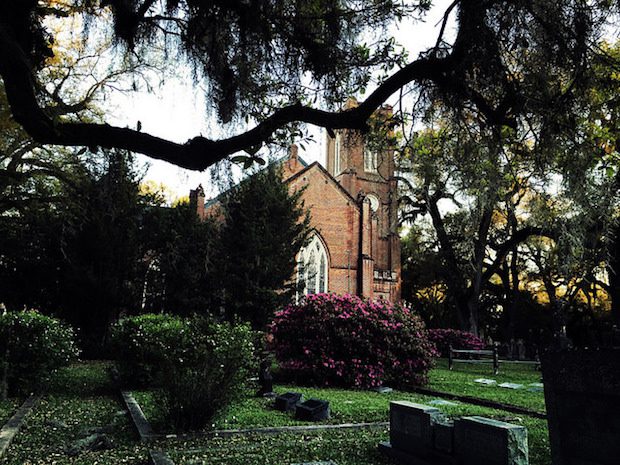
Y’all, come see us. The Walker Percy Weekend is always such fun. Here’s the website, where you can check out the panelists, the parties, and the food — and where you can buy tickets. The good people of Grace Episcopal Church will welcome us to a Friday night cocktail party with heavy hors d’oeuvres under the moss-strewn live oaks, in the church yard. Here’s a glimpse of the site. Hard to get more Old South than this:
The Trumpening & The Chalkening
A group of UC San Diego students said they were deeply disturbed after anti-Mexican/pro-Donald Trump sayings were found on campus in front of a Latino community center.
The messages, some of which said “build the wall,” “deport them all,” and “Mexico will pay,” were written in chalk on a sidewalk close to theRaza Resource Centro.
According to the UCSD College Democrats Facebook page, the sentiments were written by three to five men wearing hooded sweatshirts on Friday, the night before the university’s annual Triton Day, when new students are welcomed to campus.
Hoods! There were hoods! Was it … Sataaaan the Klaaaaaan?
A Latino PhD student writes:
“If it is found that these individuals are students, we request their immediate expulsion for inciting racist hostilities on campus in violation of UCSD “Principles of Community,” wrote Aguilar. “We demand that the mental health of Latin and Black students be prioritized in the wake of persistent racist hostilities on campus.”
Because the mental health of Latin and Black students is so fragile that they cannot endure someone writing chalk messages in support of a political candidate on the sidewalk at a university. Agreed, “Deport them all, Mexico will pay” is provocative, but come on, this is a college campus. A college provost felt compelled to issue a statement that included these lines, making it into a federal case:
Students have every right to protest against this latest attempt to roil the campus, but it is also well to recall that we have learned from similarly repugnant incidents before. ERC therefore urges the campus at large to reframe this incident as an occasion to acknowledge the persistence of gross insensitivity in American society and insist on greater multicultural understanding on campus.
UCSD has long had a problem dealing with speech its student leaders dislike. Late last year, when The Koala, apparently a historically obnoxious student publication, came out with offensive content, the Student Government responded by cutting all funding of campus media rather than risk a lawsuit for targeting that particular publication. Excerpt:
The Foundation for Individual Rights in Education intervened, as it has in other Koala controversies, and funding was restored to all 33 student-funded media organizations by the following month. Greg Lukianoff, president and CEO of FIRE, said the student government’s new attempt to cut funding will likely end in a similar fashion.
“It’s become something of a pattern that has repeated over the years at UCSD,” he said. “And it’s almost certainly unconstitutional. It’s difficult to claim your decision to cut funding was content neutral when it’s really clearly about a particular magazine and its viewpoint. It’s wrong and foolish to cut all media funding, and ironic because by cutting funding to all publications, you’re getting rid of the funding that allows for some of the best counterspeech.”
One of the affected publications is the Muir Quarterly, the Koala’s rival humor publication. Over the years, the Muir Quarterly has used some of its funds to produce issues parodying and critiquing the Koala and its questionable attempts at humor. The publication and its staff received no advance notice about the decision to cut its funding.
Clearly the answer is to ban chalk at UCSD.
Forgotten Chastity
My traditionalist Catholic friend Michael Brendan Dougherty, like several other Catholic friends of mine, really did not like Pope Francis’s letter Amoris Laetitia. From MBD’s column:
Pope Francis’ document justifies people receiving communion in a public state of sin by saying that the Eucharist is “not a prize” for good behavior. That is true. But instead the Church has turned it into a participation trophy, something so perfunctory and ultimately meaningless that it seems just too cruel to deny it to anyone.
Perhaps worse than Pope Francis’ official invitation to sacrilege is the document’s cowardice, cynicism, and pessimism. The Church can no longer even bring itself to condemn respectable sins such as civilly approved adultery. It can barely bring itself to address a man or woman as if they had a moral conscience that could be roused by words like “sin.” Instead, it merely proposes ideals; ideals cannot be wounded by your failure to realize them. And it promises to help you out of your “irregular” situation.
This supposed paean to love is something much sadder. A Church so anxious to include and accept you that it must deny the faith that transforms and renews you. It admits that God’s commands are not just beyond our reach, but possibly destructive to follow.
But a reader of this blog sends in this fascinating take. I’ve read it, and re-read it:
Amoris Laetitia isn’t the lost battle on the grounds of communion for the divorced and remarried. It is a recognition of what we have lost. It truly acknowledges that we have lost the truth in family and marriage and because of this, we have completely seen the meaning of sex and marriage shattered in an entire generation.
I look at this as a 24 year old female who was born into this generation where marriage and sexuality has been so shattered. I can tell you, even in my traditional and conservative state of Nebraska and the Diocese of Lincoln, that I don’t know a single woman or man in a proper relationship in regards to the Christian understanding of marriage and sex. All of the women I know in my circle of friends and my younger family members practice sex before marriage. I’m not saying I have never met or read of anyone who practiced chastity but I am saying that I don’t know anyone intimately who does. The majority of my friends and family, with few exceptions, come from a practicing Christian household. Most of my female friends go to church regularly. This is the same group of women who did not disagree at dinner last week when one friend said, “Not having sex before marriage is unrealistic.”
I now embrace the virtue of chastity but I agree with them that it will be a sin that the majority of people will fail in. The effort to abstain from premarital sex would be Herculean. It is an effort that would be undermined by family, as we see with the case most parents don’t comment on their children’s relationships and have no problem moving them in together. It would be undermined by friends because very few would understand and none would support it. It is undermined by nearly everything in society.
I’m not saying everything Pope Francis wrote in Amoris Laetitia (I prefer the careful thinking of Benedict XVI) is perfect but I think it is needed because it recognizes that many people, especially the people of my generation, have lost the truth in regards to sexuality and God and marriage to the degree that it reduces our culpability in sin. Is it a sin if no one has any idea that it is a sin?
Neither the right or the left should be acting as they do. This exhortation is truly a letter for mourning and renewal. I think, especially for the attitude of the left, there should be no cause for celebration because this exhortation was only necessary because we have so lost the truth that an entire generation have basically become pagans and is now left with no idea or example on how to form a relationship according to Christ. That is a tragedy and we should all mourn it.
But the right is wrong as well. The truth is still the truth and the exhortation is a call for us to renew Christian education and formation in our lives. Even in the darkest night, there is still hope and the Church is Christ’s Church for now and eternity.
It reminds me of something that G.K. Chesterton wrote his book on St. Francis. He spoke of the Dark Ages as a purgation, a necessary expiation for the sins of the pagan world. I would say we are at the gate of another Dark Ages, another necessary purgation for another generation of pagans.
“Chastity” is not total abstinence from sex, as many people wrongly believe. Rather, it is the right use of the sexual instinct. As the young female reader avers, we have lost the idea that sex has meaning, and that marriage has anything to do with the right use of the gift of sexuality.
(By the way, an Eastern Rite Catholic theologian explains here why it’s simply not true that Orthodox Christianity regards second marriages as the equivalent of first marriages. It’s more complicated that you might think.)
The Weakness Of Reason
Jones, a reader of this blog, wrote this in response to the arguments here about pornography:
I’m starting to feel a familiar pattern across a lot of areas, just something I’m realizing personally. The longer you pay attention to these controversies, the more you start to understand history — why civilizations collapse, empires decay, wars get started. Reason is such a pathetically weak force. Our grasp on reality is so thin, and so filtered through ideology, through our own psychological needs . . . that’s all an aside (bound to sound somewhat hysterical, to those who come here to decry hysteria . . .) It doesn’t matter, in history, who has the “right answer,” or even whether anyone does. Our culture produces a lot of hyper-intellectual froth, to very little effect.
I agree. The other day at the Canadian conference where I spoke, a pastor rose during Q&A and said that he thought Peter Leithart and I were giving rational apologetics too little credit today. I responded that it’s simply not possible to reason with people who don’t share a common source of authority. But it’s even worse than that. These days, it’s quite possible to find oneself drawn into arguments with people who will share your premises, but reject your conclusion for no reason other than they don’t wish to accept what follows from those premises. Believe me, I’ve had those arguments.
People aren’t terribly interested in truth, because at worst it frightens them, and at best it makes them feel uncomfortable. Which is about the same thing.
Another reader writes:
If you missed All Things Considered on Friday afternoon because of your travels, then you missed a sterling example of Moralistic Therapeutic Deism-cum-emotivism in relation to the Pope’s new exhortation. Here is a link:
http://www.npr.org/2016/04/08/473557153/u-s-catholics-divided-over-pope-francis-family-life-guidelines
And here is the relevant quote, after a lead-in from Tom Gjelten, from a teacher at a Catholic school:
GJELTEN: Metz says she made clear that church doctrine is not changing, but she highlighted the inclusive tone of the document. She thinks it may help young Catholics consider what relationship they will have with their church.
METZ: Is this something I really want to be a part of? Is this something that resonates with my understanding of what I believe Jesus Christ taught, of what I believe this church is about? They’re asking the question in order to see where they fit in.
“Is this something that resonates with my understanding of what I believe Jesus Christ taught? Of what I believe this church is about?” Here we see MTD-emotivism at its finest: all that matters is my personal interpretation of something and how that something makes me feel, even if I am nominally a part of a religious institution with a millennia-old understanding what what Jesus Christ taught.
So now if we’re not constantly flattered, constantly entertained, constantly reassured, constantly told that our North Star should always and only be our own subjective emotional response to a thing, then we are free to leave it behind. I have no idea how you form a society or culture — much less a religious body — with this kind of attitude. And what’s troubling is how difficult it is so see any other attitude in contemporary American life.
Yes.
April 11, 2016
A Nation Within A Nation
It is hard to resist the symbolism of the Islamic State establishing a base for its murderous designs in the so-called capital of Europe at a time when the European idea is weaker than at any time since the 1950s. A jihadi loves a vacuum, as Syria demonstrates. Belgium as a state, and Belgium as the heart of the European Union are as close to a vacuum as Europe offers these days.
More:
As Julia Lynch noted recently in The Washington Post, Molenbeek’s radicalism is not new. It was “home to one of the attackers in the 2004 commuter train bombings in Madrid and to the Frenchman who shot four people at the Jewish Museum in Brussels in August 2014. The Moroccan shooter on the Brussels-Paris Thalys train in August 2015 stayed with his sister there.”
This is an outrage. Splintered Belgium had lost control of Molenbeek. A heavily Muslim district of Brussels had in effect seceded. If this were the extent of the problem, it would be grave. But Molenbeek is just the most acute manifestation of a European failure.
The former head of Britain’s Equalities and Human Rights Commission (EHRC), Trevor Phillips, has admitted he “got almost everything wrong” regarding immigration in a new report, claiming Muslims are creating “nations within nations” in the West.
Phillips says followers of Islam hold very different values from the rest of society and many want to lead separate lives.
The former head of the U.K.’s equalities watchdog also advocates the monitoring of ethnic minority populations on housing estates to stop them becoming “ghetto villages.”
Phillips was the author of a 1996 report denouncing “Islamophobia” in Britain. Now he’s on the other side, saying that there’s still a lot of Islamophobia, but there’s a lot of concrete reason to be afraid of Islam in Britain. Kind of late for that, innit? There’s a new shock poll out in Britain, in advance of a documentary, reporting in part that:
• One in five Muslims in Britain never enter a non-Muslim house
• 39 per cent of Muslims, male and female, say a woman should always obey her husband
• 31 per cent of British Muslims support the right of a man to have more than one wife
• 52 per cent of Muslims did not believe that homosexuality should be legal
• 23 per cent of Muslims support the introduction of Sharia law rather than the laws laid down by parliament
The documentary will portray the U.K.’s Muslims as a “nation within a nation” that has its own geography and values.
In a piece for the Daily Mail, Phillips (who, by the way, is black) says:
Four per cent – the equivalent of more than 100,000 British Muslims – told the researchers that they had sympathy for people who take part in suicide bombing to fight injustice.
Asked if they knew that someone was involved with supporting terrorism in Syria, just one in three would report it to the police.
There is one truly terrifying finding. Muslims who have separatist views about how they want to live in Britain are far more likely to support terrorism than those who do not.
And there are far too many of the former for us to feel that we can gradually defeat the threat.
Liberal-minded Muslims have been saying for some time that our live-and-let-live attitudes have allowed a climate to grow in which extremist ideas have flourished within Britain’s Muslim communities.
Our politicians have tried to reassure us that only a tiny minority hold dangerous views.
All the while, girls are shipped off to have their genitals mutilated, young women and men are being pressured into marriages they do not want, and teenagers are being seduced into donning suicide vests or becoming jihadi brides.
We have ‘understood’ too much, and challenged too little – and in doing so are in danger of sacrificing a generation of young British people to values that are antithetical to the beliefs of most of us, including many Muslims.
How strange it is for me to read this as an American who feels like a religious minority in my own country, and who is advocating more of a separatist mentality, for the sake of our own religion. Then again, not all religions are the same. This piece brings to mind the story I’ve told in this space several times before: about an Egyptian Muslim, an immigrant to Britain, who told me a decade ago that she and her husband worried a lot about their daughters. The decadence of secular Britain, especially the pornification of the morality of young people there, appalled them, but just about every religiously observant school they turned to was run by Islamists who pushed a hardcore religious ideology they, as practicing Muslims, rejected.
It is hugely significant that Trevor Phillips, given his prominent role in denouncing “Islamophobia” and promoting multiculturalism, is now saying that his side got it almost entirely wrong. But what does that mean going forward, both for Britain and for Europe? How are they supposed to prevent Molenbeek when they keep taking in more Islamic immigrants?
Catechism By Gramsci
Here’s a bit from Catholic theologian Tracey Rowland:
Thus, in order to destroy their power [i.e., the power of the ruling classes in Christian countries], it followed that one had to undermine the so-called cultural hegemony of Christianity itself.
Different Marxist factions had different ideas about how best to go about this. The Italian Communist Antonio Gramsci drew a distinction between what he called a “war of manoeuvre” and a “war of position.” The war of manoeuvre was the Stalinist model. One simply used political violence to achieve one’s ends. But Gramsci thought this would not work in the more highly developed Western countries. For these countries, he recommended a war of position. A war of position is one in which one first identifies “switch-points of social power” and then one seeks to peacefully take control of those switch-points. The switch-points all relate to the field of cultural values – in particular, the arts and education. The most important switch-points of power are positions like school principal, university professor, government policy maker, education department bureaucrat and journalist.
In 1967, Rudi Dutschke, a German student leader, reformulated Antonio Gramsci’s philosophy of cultural hegemony with the phrase, “The long march through the institutions.” Instead of a long military march, such as the one undertaken by the Chinese Marxist Maoist Tse-Tung, in the highly developed western countries the long march would be through the most culturally significant of our social institutions – that is, through schools, universities, courts, parliaments and through the media, through newspapers and television.
Here, from Villanova theologian Katie Grimes, is an example of this long march. She’s teaching this course in the fall:
22481 THL 4490-002 RACISM and the CATHOLIC CHURCH TR 4:00-5:15 Grimes
Although the Catholic church understands itself as the Body of Christ, the lived history of the church in the United States shows that the church has not been able to bring blacks and whites together as members of one body. This course will explore the way in which the church has operated as an instrument of not racial unity and justice but racial segregation and white supremacy. This course seeks to empower students to draw upon the vast resources of the Catholic theological tradition in order to supply solutions to the theological problem of white supremacy.
Now, it would be really interesting to take a course on how Roman Catholic Christianity has historically dealt — and failed to deal — with issues of race and racism. Just not one taught by über-SWPL Prof. Grimes — we have noted her rich theological and social views here, here, here, and here — whose scholarship includes advocacy for the street theology of gangsta rapper Tupac “A smokin ass nigga robbed me blind/I got a tech nine now his smokin ass is mine” Shakur. A glimpse of her views on Catholicism and racism:
Since the racially segregated space of the United States operates as a habitat of white supremacy, the vice of white supremacy pervades the church’s corporate body and thereby permeates all of its practices, including those of baptism and the Eucharist. Rather than turning to the church’s sacraments as an antidote to the vices of a presumed external culture, this paper chronicles the way in which these very practices have been corrupted by it. The church cannot reform itself from within. In order to enable these sacraments to build the body of Christ, the church must work to dismantle regnant patterns of white supremacist racial segregation in the world.
In other words, the hopelessly corrupt, in Grimes’s view, Catholic Church did not betray itself by supporting white supremacy. The Catholic Church, rather, was being what it is:
Indeed, the vice of white supremacy entered the church’s corporate body not just when the church was acting in un-Catholic ways; the church acquired this vice even by being itself.
She goes on to say that white people (such as herself) must not be persuaded to do what she considers to be the right thing, they must be compelled to act on behalf of “Black Power,” which, she says, puts the interests of black people first:
Theologians need to learn to care less about how to persuade whites to do the right thing and more on what they need to be made to do. Rather than intensifying projects of moral suasion, the church ought to begin devising strategies of white corporate coercion. At stake is not just the justice of the church but its very identity as the body of Christ.
Just so you know, the “Racism And The Catholic Church” course at Villanova, a Catholic university, will be taught by a theologian who believes that the Catholic Church is, in its very essence, a racist institution, and that its theologians ought to be trained not to make better arguments to convert people away from racist views and practices, but to coerce whites against their will.
It seems to me that we can explain Katie Grimes’s employment one of two ways:
1. The theology department at Villanova is so politically correct that it foolishly hired a racist white theologian who wants to destroy the Catholic Church; or
2. The theology department at Villanova knows exactly what it’s doing
UPDATE: Comes the complaint that Women In Theology, the collective blog for culturally leftist female theology professors, does not explicitly invite transgendered women to participate. To which Villanova Catholic theologian Grimes responds:
Katie from Women In Theology here. Thanks for calling this to our attention. We are currently discussing ways to better avoid any form of transphobia or gender policing, and we particularly welcome advice from those who identify as genderqueer or transgender on how to do this.
For myself personally, I would consider trans women to be women full stop. I sincerely regret not realizing the exclusionary character of the language we chose and take full responsibility for it.
Oh. OK.
Porn: A Civilizational Crisis
Conor Friedersdorf makes a familiar point: that if porn is so bad for you, why is there less rape and greater support for gender equality?:
None of that answers whether pornography is medically healthy or morally permissible. But given that the rise of ubiquitous porn has coincided with significant declines in rape and spousal abuse, and with increasing support among men for gender equality, how can anyone be confident that it makes men disrespect women, let alone that it causes harm so dramatic that it represents a civilizational threat?
The same logic applies abroad.
Lots of countries with ubiquitous pornography seem to be much more successful, and to treat women much better––to grant them more rights, dignity, and status as equal persons––than countries where porn is more restricted or unavailable. Again, that doesn’t prove that the new era of hi-definition, streaming video porn doesn’t represent a public health threat, or that it isn’t morally objectionable, but it does suggest that Burk and those who hold his particular views about pornography have a lot of explaining to do about how porn functions in the real world.
Conor is referring to this earlier column by Denny Burk, in which Burk calls the pornography epidemic a “civilizational calamity.” Burk writes:
The sexual revolution promised us more sex and more pleasure. It has actually delivered to us a generation of men who think of women as objects to be used and abused for their sexual pleasure. It has not given us men who know what virtue and honor are. It doesn’t teach men to pursue their joy in self-sacrificially loving and being sexually faithful to one woman for life. It teaches young men to use women for sex and then to discard them when they become unwilling or uninteresting. This means that it has given us a generation of young men completely unprepared for marriage and for fatherhood.
I’ve read the Time magazine cover story on which Burk’s column is based, though the piece is not available online to non-subscribers. The lengthy Time story presents some neuroscientific evidence, as well as a great deal of anecdotal evidence, that prolonged exposure to pornography affects your brain and renders you sexually dysfunctional. Sociologist Gail Dines, writing in the WaPo, says the evidence that porn is a “public health crisis” is undeniable:
The thing is, no matter what you think of pornography (whether it’s harmful or harmless fantasy), the science is there. After 40 years of peer-reviewed research, scholars can say with confidence that porn is an industrial product that shapes how we think about gender, sexuality, relationships, intimacy, sexual violence and gender equality — for the worse. By taking a health-focused view of porn and recognizing its radiating impact not only on consumers but also on society at large, Utah’s resolution simply reflects the latest research.
The statistics on today’s porn use are staggering. A Huffington Post headlineannounced in 2013 that “Porn Sites Get More Visitors Each Month Than Netflix, Amazon and Twitter Combined,” and one of the largest free porn sites in the world, YouPorn, streamed six times the bandwidth of Hulu in 2013. Pornhub, another major free porn site, boasted that in 2015 it received 21.2 billion visits and “streamed 75GB of data a second, which translates to enough porn to fill the storage in around 175 million 16GB iPhones.”
Extensive scientific research reveals that exposure to and consumption of porn threaten the social, emotional and physical health of individuals, families and communities, and highlights the degree to which porn is a public health crisis rather than a private matter. But just as the tobacco industry argued for decades that there was no proof of a connection between smoking and lung cancer, so, too, has the porn industry, with the help of a well-oiledpublic relations machine, denied the existence of empirical research on the impact of its products.
Samuel D. James, a former student of Denny Burk’s and a Friedersdorf fan, writes:
I think Friedersdorf misses the crucial point. The reason that Time, and many other publications, are covering the pornification of American culture is not a sexual violence epidemic, but it’s an epidemic nonetheless. It’s an epidemic of sexual and spiritual dysfunction. Psychologists and social scientists are literally just beginning to uncover porn’s terrifying neural imprint. As Aaron Kheriarty has noted in an excellent essay for The Public Discourse, the mental and emotional stakes of sexual habits are high, and where those habits involve isolation, fantasy, and authoritarian control of the sexual ritual, the human brain quite literally begins “fusing” reality with unreality.
This psychological phenomenon has consequences. As Time and others have noted, those addicted to porn tend to struggle with even the basic elements of interpersonal relationships. But the consequences also go far beyond social skills. Pornography doesn’t just absorb libido, it replaces it with something completely different. This is why, for example, Kevin Williamson saw scores of men paying for access to an adult entertainment convention when cheaper and legal prostitution was nearby. What these men want, by definition, isn’t a sexual experience but a pornographic one. They aren’t getting bootleg copies; they’re going into another business altogether.
This gets at the heart of what I think professor Burk meant when he said “civilizational calamity.” Porn doesn’t supplement sex. It replaces it. And what many in our culture are beginning to understand is that whatever it replaces it with is an acid to healthy sexual psychology. Lest we pat ourselves on the back for ending the kind of patriarchy that Friedersdorf mentions, let’s remember that in the porn-saturated world of the internet, women are still subjugated to the language, attitudes, and behavior that exemplifies a culture where they are in real physical danger.
Rod Dreher's Blog

- Rod Dreher's profile
- 509 followers

