
Rod Dreher's Blog, page 670
September 13, 2015
‘Don’t Underestimate Corbyn’
The conservative British pundit Peter Hitchens disagrees with nearly everything the new Labour leader Jeremy Corbyn stands for, but he’s delighted by Corbyn’s winning leadership of the party. Excerpt:
If (like me) you have attended any of Mr Corbyn’s overflowing campaign meetings, you will have seen the hunger – among the under-30s and the over-50s especially – for principled, grown-up politics instead of public relations pap.
Mr Corbyn reminds mature people of the days when the big parties really differed. He impresses the young because he doesn’t patronise them, and obviously believes what he says. This desire for real politics isn’t just confined to the Left. Ken Livingstone is right to call Mr Corbyn Labour’s Nigel Farage. Ukip appeals to a similar impulse.
Millions are weary of being smarmed and lied to by people who actually are not that competent or impressive, and who have been picked because they look good on TV rather than because they have ideas or character.
Indeed, ideas or character are a disadvantage. Anything resembling a clear opinion is seized upon by the media’s inquisitors, and turned in to a ‘gaffe’ or an outrage.
Hitchens goes on to say that all thoughtful Brits ought to be at least a little bit happy that the professional image makers of UK politics were knocked on their butts by “a bearded old bicyclist.” I can agree with him there! Read the whole thing.
There is no one on the American Right to compare to the rumpled Corbyn, a veteran legislator from his party’s hard-left fringe. But in a way, the Summer of Trump is a form of sticking it to the GOP elites. I think Trump is a highly unprincipled demagogue (vs. Corbyn, who has strong principles, but the wrong ones, and is the opposite of a demagogue), and a disaster for the Republicans, and I will be very happy when his campaign flames out. But I can’t help taking a bit of Schadenfreudian pleasure in the way he’s vexing the campaigns of all the professional Republicans, and I have a grudging admiration for the way he makes “gaffes” all the time, but nothing sticks to him. Even though I’m usually appalled by this or that gaffe of his, it is at times weirdly pleasant to see a politician say something that freaks out the tut-tutters (like me!), and get away with it.
And by the way, Bernie Sanders is the US left’s version of Jeremy Corbyn, and I’m very pleased to see him sticking it to the Clinton machine.


September 12, 2015
Labour Throws Self Off Cliff
The Labour Party’s grassroots have rebelled against its establishment and elected far-left MP Jeremy Corbyn as its new leader. To get a sense of the magnitude of the upset, imagine how it would feel if Bernie Sanders toppled Hillary Clinton and won the Democratic Party’s nomination for president.
Now, imagine how the Republicans would feel if that happened, and you’ll get a sense of how good it feels to be a Tory this morning. From the Guardian‘s report:
Corbyn’s victory is all the more remarkable because he started as the rank outsider, behind rivals Burnham, Cooper and Kendall, and only scraped on to the ballot paper when about 15 Labour MPs lent him their votes in order to widen the debate.
Initially, the odds of him winning were around 100-1, but his campaign was boosted when he won the support of two of the biggest unions, Unite and Unison, and became the only candidate to vote against the Conservatives’ welfare bill while the others abstained.
Corbyn’s campaign has also been helped by a surge in new members and supporters who paid £3 to take part in the vote, leading to a near-tripling of those eligible to about 550,000 people. Throughout the campaign, he addressed packed rallies and halls, where he had to give speeches outside the buildings to crowds gathered in the street.
While his supporters will be jubilant about Labour taking a turn to the left, his triumph will be deeply disappointing to the parliamentary party, which overwhelmingly backed other candidates by 210 to 20.
More:
During his three decades in parliament, Corbyn has spent much of his time championing causes such as the Stop the War coalition, campaigning against the private finance initiative and supporting peace efforts in the Middle East.
In the campaign, he promised to give Labour members a much greater say in the party’s policymaking process, in a move that could sideline MPs. His key proposals include renationalisation of the railways, apologising for Labour’s role in the Iraq war, quantitative easing to fund infrastructure, opposing austerity, controlling rents and creating a national education service.
The NYT’s report says, in part:
Mr. Fielding sees Mr. Corbyn’s success as a “sign of alienation from the system as it exists,” adding that his three opponents are viewed by many within the party as “Tory-lite,” a reference to Mr. Cameron’s Conservatives.
The view among many supporters, Mr. Fielding added, was that “voting for Jeremy Corbyn might not work, but at least it is something that we believe in — and maybe it will work.”
That chimes with the experience of the former Labour minister Chris Mullin, when he explained his reservations about Mr. Corbyn to party supporters.
“Gently I pointed out,” Mr. Mullin wrote in The Guardian, “that a party led by Corbyn, saintly and decent man that he is, was likely to be unelectable. Which only met with the riposte that since the other three candidates appear to be unelectable too, why not go for the real thing?”
It’s a fantastic political story. In every interview I’ve seen with Corbyn, he comes off as yes, decent and saintly, as well as gentle, normal, and attractive because he’s the complete opposite of the groomed and programmed Blairite type, as exemplified by this infamous clip of Ed Miliband, the party’s last leader:
UPDATE: Good comment from a reader:
If I were an establishment Tory I wouldn’t be celebrating. I’d be concerned. A left/right condominium, such as existed in Britain until the last election, or that exists in the US today, insures elite control of political discourse. Certain issues, words and debates are always safely out of bounds.
Once that breaks down, as may be happening in Britain, elite control breaks down with it. To the extent that Corbyn is willing to publically attack and offer distinct alternatives to the regnant elite consensus, it will be dangerous for the Tories, who will be left holding the bag for the whole discredited British establishment, from John Major and Tony Blair to Gordon Brown and Cameron himself. Big changes in Labor portend big changes for the Tories, and Tory incumbents should be nervous.
In fat, Corbyn’s rise will probably benefit UKIP more than the Tories. UKIP has been poaching Labor voters alienated by New Labor’s immigration policies – Corbyn approves the migrant flood into British communities, arguing it is a net good. He seems to really believe that, in a vague, decent-chappish way, and he is dead wrong.
Like you, across a gaping political divide I salute Corbyn as an apparently honorable, decent man. The last of the Blairs, Clintons, G. W. Bushes, Camerons, and Obamas of this world can’t come soon enough for me.
September 11, 2015
Hungary’s Refugee Problem
Screaming “Allahu akbar!”, a mob of “refugees” — almost all of them men — attacks a train in Hungary with stones.
On the same day, September 7, a Roman Catholic bishop of Hungary spoke out:
Pope Francis’s message Sunday couldn’t have been clearer: With hundreds of thousands of refugees flowing into Europe, Catholics across the continent had a moral duty to help by opening their churches, monasteries and homes as sanctuaries.
On Monday, the church’s spiritual leader for southern Hungary — scene of some of the heaviest migrant flows anywhere in Europe — had a message just as clear: His Holiness is wrong.
“They’re not refugees. This is an invasion,” said Bishop Laszlo Kiss-Rigo, whose dominion stretches across the southern reaches of this predominantly Catholic nation. “They come here with cries of ‘Allahu Akbar.’ They want to take over.”
Yeah, that’s exactly who you want in your country.
Kim Davis Case A Religious Liberty Loser
On TAC today, Pat Buchanan says the Kim Davis case represents rebellion brewing in the heartland. Excerpts:
Some conservatives say that Kim Davis as a public official has to carry out court orders, even those she believes to be immoral, or quit. Yet the course she took has undeniably advanced her cause in our unending culture war.
For she rallied and inspired many with her witness, defiance, and willingness to go to jail. She set an example of nonviolent resistance. She treated same-sex marriage not as some great social leap forward, but as a moral abomination. Many among the silent majority were surely nodding in approval.
She has also exposed the breadth and depth of the division in the country between an older Christian America and new Secular America.
And:
Indeed, from the raw politics of the Summer of Trump, it seems clear that Middle America has come to believe it has been had, and that the state that rules the nation is hostile to the country they love, and needs to be resisted and defied.
This is wishful thinking on Buchanan’s part. Take a look at the YouGov poll results on the Davis affair, taken September 4-7. They’re fascinating. The main takeaways:
62 percent of those polled support jailing people for contempt of court; only 15 percent said they opposed it
Of Republicans polled, 64 percent said they supported jailing people for contempt of court
Strong majorities in every demographic category (except for African-Americans) supported jailing people for contempt of court The region where support for jailing them was strongest? The South, Kim Davis’s home region
An overall majority of people (53 percent) believe religious liberty is under threat in America. Four out of five Republicans believe that, and 55 percent of Independents do. The only demographics that didn’t believe that? Democrats, those making over $100K per year, and those living in the Midwest (though in the Midwestern case, it was a plurality).
A slight overall majority (52 percent) believes that elected officials should not be given a religious exemption from doing their job, though the numbers break down along partisan and regional lines. Republicans alone among the political orientations are divided equally.
Majorities in all regions except the South believe elected officials should be required do their jobs regardless of their conscience — and in the South, the “do your job” faction polled a 47 percent plurality, versus 38 percent of Southerners who believe in the conscience deferment, and 16 percent who aren’t sure.
An overall majority said Kim Davis, in particular, ought to have gone to jail for contempt of court. Interestingly, Republicans, who answered generically that someone in Davis’s position should go to jail, were evenly split when Davis’s name came up.
Big majorities across every demographic category say that Kim Davis ought to resign as a matter of principle. It’s not even close. Only 22 percent of people say she should keep her job and remain defiant
HuffPo’s summary report, with helpful graphics, is here.
To summarize: most Americans believe religious liberty is at risk in America today, but they do not believe that as an elected official, Kim Davis has a plausible religious liberty claim in this case. They believe the judge was right to send her to jail, and believe that she ought to resign.
There is no Buchananite “silent majority.” Buchanan says that Davis “undeniably advanced her cause” in the culture war, and I can agree with that, as long as the emphasis is on the word “her.” She has also advanced Mike Huckabee’s bid to become the Jesse Jackson of white conservative Evangelicals. But she has in no way advanced the cause of protecting religious liberty — a cause that for now, according to the poll results, remains popular.
Think of it: most people in this country are (rightly) worried about the future of religious liberty. But if “religious liberty” comes to mean in the public’s mind “the right of elected officials to refuse to obey the law when their conscience tells them not to,” we Christians are going to lose down the road, and we are going to lose big.
Like I said before, Kim Davis is a shipwreck for religious liberty.
View From Your Table
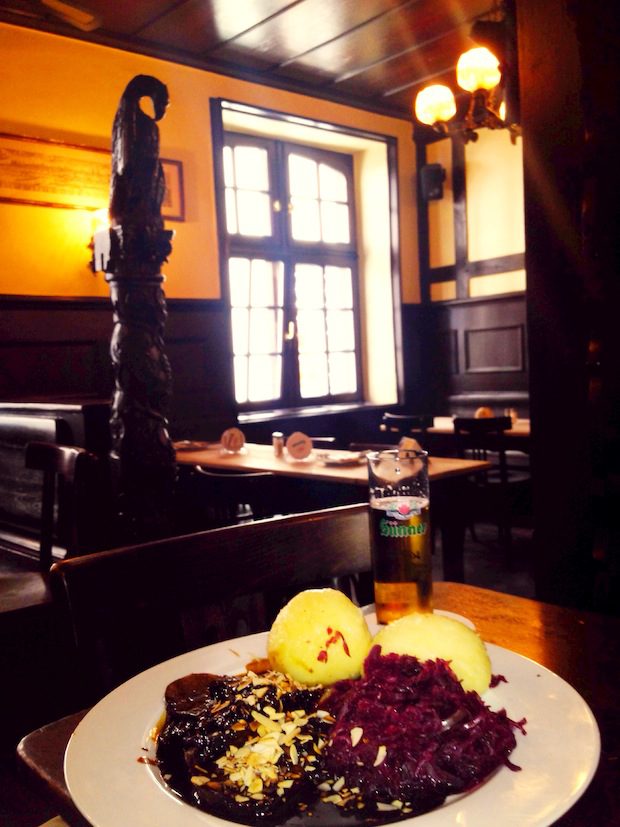
Köln, Germany
I haven’t done a VFYT in a while. Not quite sure why I drifted away from them. But James C. sends the one above this morning, with this note, and I just had to post it:
That’s Rhineland sauerbraten with delicious sauerkraut and potato dumplings. I’m at a traditional brauhaus. Notice how, unlike in Bavaria, the beers don’t come in giant litres. Here the local kölsch is brought out one after another in small glasses, with the waitress counting them on the coaster with a pen. Another difference is the sauerbraten. I grew up with the Bavarian version from my father’s mother (of Bavarian heritage). This kind has berries and nuts in the delicious gravy. One of my favourite things to eat!
Coming in to Germany last night, I got to thinking about your blog post about European civilisation no longer believing in itself. I wholeheartedly agree with that diagnosis of malaise. But paradoxically, could there also be too much confidence? Last night (as I always do when coming to Germany (or Sweden, Switzerland et al.), I told myself: “My God what a civilised country.” From the sparkling, smooth, whisper-quiet train from the gleaming airport to the clean, peaceful streets and startlingly well-organised and immaculately maintained infrastructure, this place is a marvel of good order that puts our country to shame.
Perhaps many contemporary Germans don’t realise how difficult this achievement is, and how fragile it is and precarious to maintain. Perhaps they think this state of things is inevitable for any culture or people, with enough discipline. Perhaps they tell themselves that Syrians only need to be exposed to German culture and education to become good Germans. Perhaps they have convinced themselves that these newcomers are sponges who will easily release their Arab oil when they soak up good German vinegar.
I’m not convinced. But in any case, Germany is still Germany, for now. And it’s a lovely place to be.
An Anglican Benedict Option
An Episcopal friend passes along to me the cover story from the August 21 issue of The Living Church magazine, titled, “Lambeth’s Benedict Option.” It’s an interview with the Rev. Anders Litzell, prior of the new Community of St. Anselm, living at Lambeth Palace, the headquarters of the Anglican Communion. The community consists of an ecumenical group of 16 residents and 20 other members who are committed to living in prayer, community, and service for one year. Excerpts:
In your doctoral work you have focused on the leadership of St. Benedict. Because of his creation of an intentional Christian community in a time of cultural change and political chaos, Benedict is considered a timely example for the church in a post-Christian culture (e.g., Rod Dreher’s “Benedict Option”). How has St. Benedict’s example guided you so far in creating the Community of St. Anselm?
St. Benedict is a great influence on me and Archbishop Justin alike (who is a Benedictine Oblate) and the flavour of our Rule is much inspired by St. Benedict, both in particular emphases (restating in our context St. Benedict’s exhortation to his monks to “prefer nothing whatever to Christ”) as well as the basic balance between work, study, prayer, rest — and the importance of silence in our daily schedule. Also St. Benedict’s wisdom in shaping and facilitating deep human relationships is a wealth of riches that continues to inspire and challenge me as we make the smaller, but ever so important, decisions that will guide our day-to-day life.
More:
Much has been said in recent months about millennials and their relationship (or lack thereof) to the church. The Community will be made up of people who are 20 to 35. You have received hundreds of applications for only a few spots, demonstrating a great interest among young people in such a community. What is it about this venture that appeals to millennials?
Just under 500 people from all over the world, and from a very great range of denominations, started the application process, applying for 16 resident and up to 40 non-resident places (the latter for people living and working in London). By any standard, that’s a phenomenal response.
Yet on one level there is nothing special about the millennials’ response to this at all; it is the call of the Holy Spirit to be shaped into the likeness of Christ. That call is the same and equally attractive in every generation, which is why we are able to draw on treasures from throughout the life of the Church in this formational year. Jesus Christ is the same, yesterday, today, and forever, and he calls a people to his name today as before, and it is not only attracting millennials. But for this to be a gift to future generations, we are inviting people in the earlier stages of their lives.
On another level, this year of community life is addressing a series of needs and wants in society, which the Holy Spirit is even today equipping the Church to respond to. The word community is being used widely by both Church and increasingly in secular society today (and it is even bent out of shape from time to time). It is a banner waved around by politicians, banks, even the police, at least in the U.K. There is a distinct need for a different way of relating to one another in life than transactional connections, than isolating individualism and self-identification, and I think that need and desire is what secular society is reflecting.
In that sense it is not about millennials per se, but about the signs of the times, perhaps most visibly embodied by the millennials. Community life in the name of Christ; a life shared in increasing transparency to one another, self-giving to each other, and to those most in need in society. A life shared in sacrifice, prayer, discipline, study: this kind of community life is not another add-on to be slapped onto Western individualism/consumerism. It is a different paradigm of social existence, and I am delighted that we can model that in such a visible place, and annually send more young people out into the world with a deep experience of that way of life.
Read the whole thing. The Community of St. Anselm is a project launched by Justin Welby, the Archbishop of Canterbury. Here’s the community’s website; they’re taking applications now for 2016-17. Here’s how the community describes its project:
We all know there’s a real need for integrity in our world today. In finance, business, politics and every other sphere, we need people whose actions are rooted in a deep commitment to the common good.
The non-residential programme of the Community of St Anselm is a year-long challenge to combine your job with a demanding Rule of Life that the ancient Christian monastics would have recognised. The idea is that you commit to one evening a week and regular weekends – plus several group retreats over the year – while maintaining your work commitments.
We like to think of it as a kind of ethical bootcamp – aimed at putting Jesus at the centre of your life.
With a group of young Christians from many different backgrounds, you’ll follow a pattern of prayer, study, deep self-reflection and service. Put simply it’s about doing whatever it takes to become more like Jesus – and living out that discipleship in your workplace and everywhere else.
You’ll swear off all kinds of habits and comforts to make space for the priorities of God – and make prayer your new bottom line. It’ll be really tough. But it will also be rewarding, fun and life-changing.
That’s fantastic! Here’s a video describing the vision:
This is really exciting. Congratulations to the Anglicans for trying this out. I’m grateful to Abp Justin for his vision. When I start researching the Benedict Option book, I hope to come visit the Community and find out what they’ve learned, and how it can help the rest of us.
The Benedict Option at Lambeth Palace. Whoever could have imagined such a thing? It makes me think at once of how helpful it would be to Christians students at college campuses if churches or ministries would buy a large house, or a series of apartments, and set up Benedict Option living arrangements, where Christian students can live together, pray together, study together, and serve together.
The Lord’s Trump
Louisiana Gov. Bobby Jindal laid into Donald Trump in a speech at the National Press Club. He got in this zinger:
You may have recently seen that after Trump said the Bible is his favorite book, he couldn’t name a single Bible verse or passage that meant something to him. And we all know why, because it’s all just a show, and he hasn’t ever read the Bible. But you know why he hasn’t read the Bible? Because he’s not in it.
Good one! But a reader who is also a bishop of the church writes to say, drily:
This shows the Governor’s limited knowledge, for Trump is all over the Bible in the Coverdale and King James editions. My favorite, from the Coverdale, is Psalm 47:5: “God is gone up with a merry noise, and the Lord with the sound of the trump.”
Hey-yooooo! I bet the Donald uses the Bishop’s line on the stump.
The Transgender Revolution
What does an almost forty-year-old, out and proud lesbian do when her partner comes out as a transgender male? I don’t really know. I can only tell you what this lesbian chose to do: I chose to stay. I chose to stay because, when I really got honest, if Simon was a boy, he’d always been a boy, whether I’d acknowledged it or not.
I chose to stay because Simon is brave, kind, honest and loving ways in ways that Amy could never quite muster up the openness, the transparency, to be. I chose to stay to honor the family that we created together. I chose to stay because I can’t imagine my life without him.
When I begin to overanalyze what staying with Simon means for my lesbian identity, I get a little panicked. Losing the lesbian label feels a bit like losing part of myself.
But then I look at the person I committed my life to almost ten years ago, I look at our child who adores us both, and I know that with Simon is where I want, where I need, to be. I love him. And he still gets me like no one else does. These things transcend labels.
Modern solutions to modern problems:
Cid Isbell hadn’t been nervous about the seven-hour operation until the day before he went into the hospital. But once he made it to his San Francisco hotel room, he began burning sage for good vibes.
“Advanced surgery for female-to-males has been way behind male-to-female until now,” Isbell said. “The surgeons always told me, ‘it’s easier to make a hole than a pole’ but now we’re catching up.” And catch up he did.
Inside the operating room, a surgeon lifted up a six-inch length of flesh that looked exactly like a penis but had been crafted out of a chunk of Cid’s arm. He handed it, almost ceremonially, to the lead surgeon, who began sewing it between Cid’s legs, just above where his vagina used to be.
The whole procedure took most of the day, and when Cid finally woke up and glanced down, he said: “Wow, I have a penis! That looks freakin’ amazing.”
A whole new world opens up for Cid, née Diana:
The day after his surgery, Cid is groggy but in high spirits.
Never shy, he pulls back the covers to show off his penis. It doesn’t have a dressing, so that it can be checked every hour to make sure the blood supply is working.
“I called the nurse to say a tube was stuck to my scrotum and then I thought, wait, I have a scrotum? Cool!” he said.
Laughing hurts, but Cid is joshing anyway. “I’ve decided I’m a virgin again. I have a few woman friends who are arguing about deflowering me. Then I had some gay men who are, like, I want to be the first. I might just auction myself on eBay.”
Okay. It’s easy to laugh at this insanity, but for political economist Dale Kuehne, this kind of thing is neither funny nor trivial:
While today’s conversations push the boundaries of how we understand gender, they don’t understand that this brave new world of identity is about more than gender.
The students with whom I associate—from middle school to college students—have understood for several years that we now reside in a world beyond gender. The youngest of them probably don’t realize that TIME’s article announced anything “new.”
For many of them, gender discussions, even of the transgender variation, are just so yesterday. When we talk about personal identity, we don’t include the mundane questions about being male and/or female. A person can certainly identify as male or female if they wish, but there is little expectation that one would do so.
After all, today Facebook gives us over 50 “gender” identities to choose from. (Conversations about this can involve questions about why there are so few options.) And rather than looking to gender or variations on a gender, more and more young people are seeking to discover their identity by widening the options to include “otherkins” (people who consider themselves to have a non-human identity, such as various animals, spirits, mediums, and so on).
Young people today are much less binary when it comes to understanding identity because “male” and “female” as categories don’t express a unique or comprehensive identity.
When I tell this to many adult audiences, they laugh, believing that young people will grow out of this “stage.” They’re surprised that I don’t share their sense of the immaturity of our youth.
That’s because the young people with whom I interact are extraordinarily perceptive, compared to adults. As one high school student recently asked me, “Why does our school demand that we figure out if we are male or female or some variation? How could we figure it out even if we cared about gender? Can you tell me what it feels like to be woman? Can you tell me what it feels like to be a man? Of course not. No one knows.”
Precisely.
If everything is reduced to gender—even liquid gender—then how can anyone know by a solely internal exploration if they feel male or female?
What does it feel like to be a man? It can’t just mean that I am attracted to women, because it is okay to be attracted to men. It can’t just mean I feel like a lumberjack—because what does it mean to feel like a lumberjack? It can’t simply mean to be drawn to women’s clothes because what makes some garments women’s clothes?
In short, if the ultimate source of reference is the self, and if no other self than the individual is a reference point, how can you know who or what you are?
Indeed. The kids are right.
We don’t live at a tipping point; we already live beyond the tipping point. Whether adults realize it or not, the most important conversation today is not about gender, but about identity, as released from the confines of gender.
Kuehne, I should say, thinks this is a very bad thing, because it is part — indeed, perhaps the end point — of the total deconstruction of the relational bases of society and its refashioning to serve the needs of the sovereign Self. (His book about the Sexual Revolution and identity is here.) Not long ago, a high school girl visiting from out of town was telling me how difficult it is to know how to address a girl at her school who insists that she is a boy, but who also plays on the female athletic teams — and demands that her female teammates call her “he”. The school authorities support all this.
It’s face-planting stuff, but it’s also a frontal challenge to the natural order, and beyond that, it’s a metaphysical challenge. Is reality nothing more than what we choose to call it? Does the Self have the power to re-order reality to suit its desires — and, in our deracinated culture, does it have the power to compel others to live by its illusions at the risk of being denounced as bigots, or even sued?
I notice this morning that TAC publishes a rave review of The Crisis of Modernity by the late Italian philosopher Augusto Del Noce, translated by our own Carlo Lancellotti. In the book, Del Noce recognizes the Sexual Revolution as primarily a metaphysical one intended to destroy the basis for traditional morality. In an essay first published in 1970, Del Noce wrote:
Indeed, [Wilhelm] Reich’s thought is based on the premise, which of course is taken as unquestionably true without even a hint of a proof, that there is no order of ends, no meta-empirical authority of values. Any trace not just of Christianity but of “idealism” in the broadest sense, or of a foundation of values in some objective reality, like history according to Marx, is eliminated. What is man reduced to, then, if not to a bundle of physical needs? …
Having taken away every order of ends and eliminated every authority of values, all that is left is vital energy, which can be identified with sexuality, as was already claimed in ancient times and it actually difficult to refute. Hence, the core element of life will be sexual happiness. And since full sexual satisfaction is possible, happiness is within reach.
More Del Noce:
The idea of indissoluble monogamous marriage and other ideas related to it (modesty, purity, continence) are linked to the idea of tradition, which in turn presupposes (since tradere means to hand down) the idea of an objective order or unchangeable and permanent truths (the Platonic True in itself and Good in itself). On top of everything else, the affirmation of these themes is one of the glories of Italian thought, because what else is Dante’s Comedy if not the poem of order viewed as the immanent form of the universe? …
Interesting. In the Commedia, the Inferno is where individual souls are trapped for eternity, isolated from communion with each other, in worlds they fashioned for themselves, because they preferred their own “truth” to the objective truth of the divine order. Del Noce:
But if we separate the idea of tradition from that of an objective order, it must necessarily appear to be “the past,” what has been “surpassed,” “the dead trying to suffocate the living,” what must be negated in order to find psychological balance. The idea of indissoluble marriage must be replaced by that of free union, renewable of breakable at any time. It does not make sense to speak of sexual perversions; on the contrary, homosexual expressions, either masculine or feminine, should be regarded as the purest form of love. …
Sexual liberation, as Del Noce saw, is based on the denial of metaphysics — that is, the denial of the claim that there is an immanent order in the world. Del Noce said traditionalists can’t even have a dialogue with the sexual liberationists because they deny the very foundation of tradition: belief in an unseen order.
The normalization of transgenderism requires the denial that gender and gender difference have essential meaning. It requires us to believe that truth is whatever the willing individual wishes it to be. And it greases the slippery slope to the loss of our very humanity. Ever heard of species dysphoria? You will.
It’s anarchy, and it can’t last. There will be an immense amount of destruction before this passes, and the natural order reasserts itself. Point is, the craziness in these two stories I posted at the top of this blog are hilarious, in a way, but deep down, not funny at all. The profound disorder within those people is, and is becoming, valorized by our culture, a political act that is undermining the basis of political and social life.
September 10, 2015
‘What’s Theirs is Yours’

Ray and Dorothy Dreher, Spring 2012
A couple of years ago, at the first Walker Percy Weekend, Tracie Barnard and her husband came down from Tennessee for the event. They were fans of The Little Way of Ruthie Leming. I invited them to come over for a gumbo lunch at my house on that Saturday. They sat on the same front porch on the book’s cover with my folks, Mam and Paw, and talked. Tracie recalls that day in a very moving blog post paying tribute to my dad, who died last month. (See the post I wrote about the day of his death here). Excerpt from Tracie’s entry:
Paw was especially proud of Hannah, Ruthie and Mike’s eldest daughter, who was then backpacking through Europe. He told me I should look up her blog! He relaxed in his easy chair, reclined back. You could tell he had once been an invincible man of the land. Ruthie’s journey had taken its toll on him. His eyes were bright–but you could see his broken heart in them. He spoke sweetly, gently, of his girl. He said that he had read the book–Mam hadn’t made her way through as yet. What struck me is that some of the stories she told of Ruthie–her fishing excursion after her diagnosis, “the halo picture” (those of you have read the book know precisely of what I speak), Rod had shared in “The Little Way”. I listened, often laughing through teary-eyes. Mam, my friends, is a vibrant woman, full of fun and mischief. My kind of woman.
We shared bowls of gumbo, styrofoam cups of hospitality, and a heap of gratitude. We found the chance to tell them just how much this book had meant to us, to the cadre of friends with whom we had shared it (some of whom received it as a graduation gift!), and the impact of Ruthie’s life, her Way, had made on folks she never met. I could barely get the words out–and my dearest Philosopher paused, gathering himself, as he expressed his appreciation. As Rod helped his daddy out to the front porch (for his “smokes”), Mam said quietly, “Ray isn’t meant for this world much longer. A part of him died with Ruthie. I just pray that the Lord takes him quickly.”
We decided to take our leave, thanking our gracious hosts along the way. Rod hugged us and thanked us for spending time with his folks. Absolutely no thanks were necessary. My goodness. I was full–of nourishment undefinable. I asked Mam if we could take a picture on the rocking chair. And, she said, “Of course, Honey.” She sat, I knelt down beside her, both of us smiling–and “glistening” in the heat of the day. We hugged, I planted a little smooch on Paw’s rugged cheek, squeezed his hand, and thanked him quietly. So much like my Pop-Pop, ever the gentleman, he thanked us again for coming. And waved from his spot on the porch.
Oh my heart.
Read the whole thing. It got to me, I’ll tell you that. Thank you, Tracie. See you next week in Tennessee.
Benedict, Beer, Douthat, Decline
I’ve written a lot in this space about how much I love the Benedictine monks of Norcia, who have created a fastness of light, beauty, and grace in the Umbrian mountains, over the childhood home of Saints Benedict and Scholastica. What they are doing in their monastery is spiritual and cultural work that is vital to all of us. I’m sure of it. Making a pilgrimage last fall to Norcia to pray where St. Benedict lives, and where the traditional Latin liturgy is chanted, was one of the highlights of my life. Here is the monastery website, where you can learn more about them, including their first-ever album of chant. They also do something there that’s unusual for Benedictines in Italy: they brew beer!
Well, I’ve learned that next month, on October 7, there will be an event in New York City to raise funds for the Norcia monastery. The speaker will be Ross Douthat, whose talk is titled, Religion and the Fate of the West: Being Catholic in a Secular Age. Father Cassian Folsom, the prior of the Norcia monastery, will also be there; he’ll be talking about the work of the monastery and its role in restoring Christianity. Fr. Cassian is bringing with him some of the delicious beer he and his men brew.
I wish it were possible for me to be there. I know, like, and respect both men very much. I am not overstating things when I say that I think of them and their work as important to the future of Christianity in the West. The idea of Ross and Fr. Cassian meeting delights me. The idea of both of them speaking at the same venue about the faith, culture, and living it out in the post-Christian West is really about as good and evening of thinking and fellowship as this Benedict Opter can imagine.

Fr. Martin, brewmaster
And I don’t overstate things when I say that Birra Nursia is very good stuff. The commercial clip at the top of this post gives you a brief view of what life is like in the monastery, and also at its tiny brewery. I’ve been to both places, and let me tell you, it’s graced, all of it.
If you are a Christian who lives in or around New York City, I exhort you to buy an advance ticket and go hear Fr. Cassian and Ross talk. Tickets aren’t cheap, but the money is for a good cause — that precious monastery — and I can all but guarantee it will be worth it. I especially urge any young Catholic men who think they might have a vocation to the monastic life to go listen to and meet Fr. Cassian. It could change your life.
More info and ticket purchases here.

Interior of monastery refectory, Norcia
Rod Dreher's Blog

- Rod Dreher's profile
- 508 followers

