
Rod Dreher's Blog, page 665
September 27, 2015
#LouisianaForTheWin
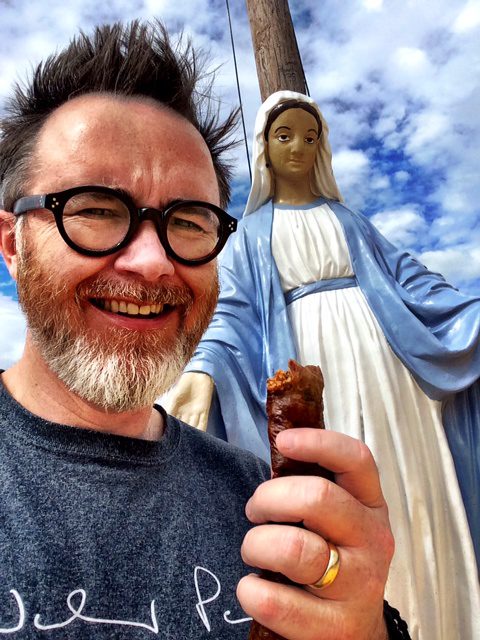
Part of my weekend travel: in the parking lot of the Best Stop in Scott, La., in the bright sunshine eating smoked boudin I just bought there. Love the look on the BVM’s face; she’s presiding over the parking lot. South Louisiana, man!


A Benedictine’s Life
READING Between liturgical prayer, Scripture reading, daily work and community activities, my time is very limited. The last time I read a novel was when I had to have a stem cell transplant in 2012 for multiple myeloma and had to be in isolation for four weeks. It’s too bad that it takes that much to get me to read a novel, but I read “The Red Horse,” by Eugenio Conti, a wonderful and moving story about Italian involvement in World War II told through the lives of people living in a small town in northern Italy.
LISTENING As monks, we live in the silence like fish live in water. But our liturgical prayer is all song, mostly chanting together. It’s usually alternating from one side of the choir to the other, so it’s kind of a dialogue. It’s for the glory of God, so you feel it’s something larger than yourself that you are caught up into. It’s a quite remarkable experience, in fact.
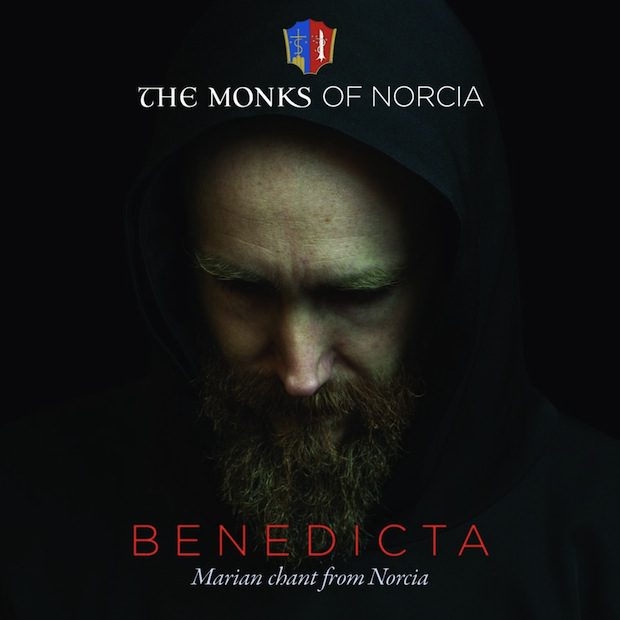
If you take a look at the article, you’ll see that they photographed him at the crypt altar that was part of St. Benedict’s fifth-century house. I’ve prayed in that very spot. It was incredibly moving. It really is hard for me to find enough superlatives to describe that monastery and its joyful, young, light-filled monks, who earlier this year released their first album of chant. Father Cassian is in his 60s, and he is much the oldest member of the community; he says in the NYT piece that the average age among them is 33. The Spirit is working powerfully among those men. Again and again I say unto you: if you are an unmarried Catholic man who sense a possible calling to the monastic life, get to Norcia as fast as you can and see if it’s for you. That’s a Benedict Option that some of you should consider.
Say, New Yorkers, on October 7, Ross Douthat will be speaking at a Manhattan event to benefit the monks of Norcia. Information here. They will also be serving beer brewed by the Norcia monks. You don’t want to miss this. Father Cassian will also be there to talk about the work they’re doing in the monastery. If you want to see the face of hope for the future, go meet Father Cassian and any of the brothers he will have brought with him.
The Sexy Pope Francis
Ross Douthat observes that Pope Francis has had a great trip to the US, and says it’s not an altogether bad thing if Francis revives the Religious Left:
A revitalized religious left, a Christianity that doesn’t feel like the province of a single political faction, would be a sign of religious vitality writ large. And I would far rather debate politics with Cornel West or the editors of Commonweal than with a liberalism that thinks it can impose meaning on a cosmos whose sound and fury signifies nothing on its own.
Me too. But Douthat says that religious liberalism is flagging in this country for serious reasons, among them its discomfort with supernaturalism, and the other “is religious liberalism’s urge to follow secular liberalism in embracing the sexual revolution and all its works — a move that promises renewal but rarely delivers, because it sells out far too much of scripture and tradition along the way.”
More:
The second tendency, though, is one that Francis has tacitly encouraged, by empowering clerics and theologians who seem to believe that Rome’s future lies in imitating the moribund Episcopal Church’s approach to sex, marriage and divorce.
How far to go with them is the question that awaits the pope in Rome this fall, and that hangs over the springtime for liberal Christianity his pontificate has nurtured.
How it’s answered, and what follows, will determine whether we’re watching something genuinely new and fresh emerge — or whether, after the cheering ends, the same winter that enveloped liberal Protestantism after the 1960s will claim Franciscan Catholicism as well.
Read the whole thing. That last paragraph brings to lines a few lines from the diary of the Orthodox priest Alexander Schmemann. A reader sent me this bit in which Fr. Schmemann mused on Pope John Paul II’s visit to NYC in 1979:
The Pope’s days in New York are accompanied by extreme excitement and rapture. What remains is that one can see something quite genuine (man’s longing for goodness) and something obviously connected with our civilization: television, “media,” etc. What worries me is this: this popularity will recede as soon as the pope concretely expresses his faith. Then the euphoria will end… And then will begin: “crucify him” and “we have no King, but Caesar…” — i.e., a return to the present. (Mark 15:13-14, John 19:15)
We’ll see what happens with Francis. Have to say I think his big Philadelphia speech about religious liberty was disappointing. Religious liberty is at serious risk in the emerging American order, but his speech was bland and safe. It was like, “America is a land of religious liberty. Religious liberty is important. You Americans should treasure it. Don’t forget the immigrants! Adios.” He didn’t say anything wrong, but he didn’t say much of anything at all. The religious liberty cause could have used a more forceful, direct, and specific speech from this popular Pope.
Anyway, back to Douthat’s point. Michael Pakaluk, a philosopher at Ave Maria University, has a piece up at First Things condemning what he calls “lifestyle ecumenism,” which he defines as “the view that Catholics should practice today a kind of ‘ecumenism’ towards persons in living arrangements other than marriage, such as cohabitation, common law marriage, and same-sex relationships.” This approach, which has been advocated by cardinals close to Francis, and which will be at issue in the October Synod, violates Catholic teaching, says Pakaluk. He makes his case, then concludes:
As a father of a large family, raising children in the difficult circumstances of the present culture in the US and Europe, I find the Cardinal’s [Christoph Schönborn’s] approach particularly dismaying. I want clear teaching from bishops, to back up my efforts with young persons; I want an unfashionable but needed reminder, in our time, of the imperilment of the soul and the reality of sin. In contrast, Lifestyle Evangelism looks like the rationalization of a bad outcome. The main task of the bishops, I conceive, is to teach the faith clearly and protect the flock from the trepidations of the Evil One. Our bishops in the 50 years since Humanae vitae have generally failed at these tasks in the area of sexual morality. Cohabitation and the hook-up culture do not “just happen.” Two generations of Catholic children who might have grown up living chastity and modesty have been lost, taken away by faulty Catholic school systems, inadequate catechesis, cowardly preaching, and an absence of a protective spirit by our pastors. The True Pastor goes so far to keep out the wolves that he lays down his life if necessary. Lifestyle Ecumenism strikes me as a shrug of the shoulders which says it’s a fact of life that wolves take the sheep.
Nobody can doubt that Pope Francis has had a spectacular trip here to the US. Even my Catholic friends who tend to be skeptical of his papacy and its priorities have been inspired by this papal pilgrimage. And why not? Francis is a rock star. But so was John Paul II, and that fact did not bring his flock back to the traditionalist Catholic teaching on sex and the family, which he never hesitated to preach. Now Francis is trying something different. We’ll see what happens. The experience of the Episcopalians and other Mainline Protestants doesn’t give much reason to hope.
September 26, 2015
The 2015 Mustard Greens Queen
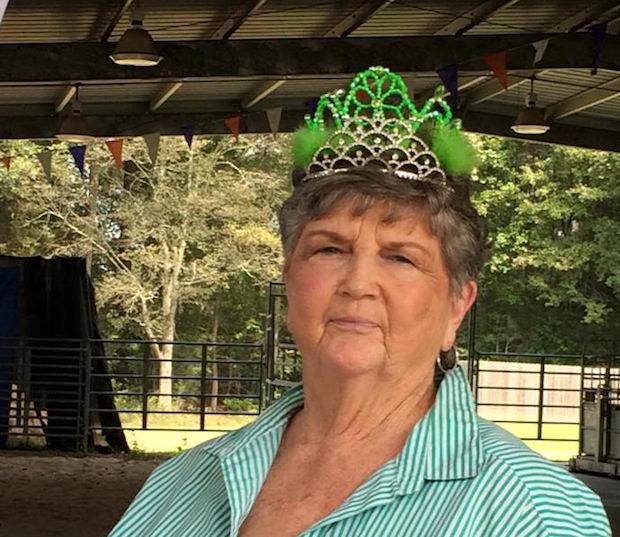
Mrs. Sue Powell cooks better than you
I am genuinely thrilled to say that Mrs. Sue Powell is the Mustard Greens Queen of West Feliciana Parish for the fourth year in a row. I just learned this at midnight, and now I’m dying for a mess of mustards. Congratulations to Miss Sue!
I wonder if you have to come from the South to like greens. You have to soak cornbread in the pot liquor to get the full effect. I’m making myself really, really hungry right now…

UPDATE: Well, I couldn’t stand it. Midnight snack below: thawed-out jambalaya with habanero sauce and Tony Chachere’s. #LouisianaWinsAgain

Baby Irene’s Baptism
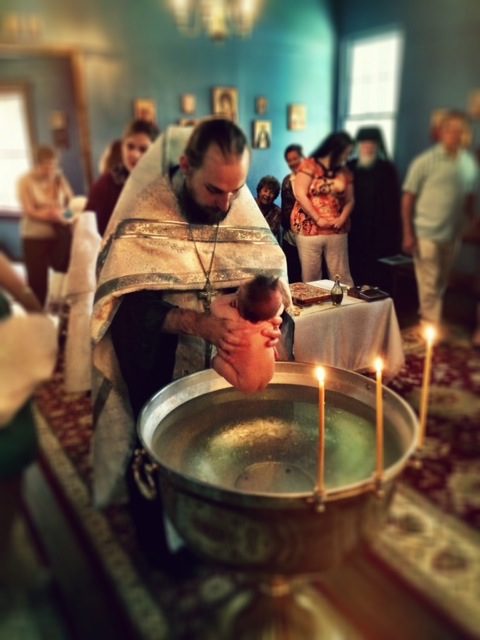
You readers who have followed the story of Baby Irene Harrington and her family will be pleased to learn that she became a Christian this morning. Her father baptized her. Many of you contributed to the GoFundMe account for the Harrington family, for which I once again thank you. Thanksgiving for generous contributions also goes to the congregation of Our Lady of Mount Carmel Catholic Church in St. Francisville, as well as to Father Frank Bass and his parishioners at St. Isidore Catholic parish and St. Pius X parish. No doubt many more people gave quietly, and their names are known only to the Harringtons, or to God alone. Whatever the case: thank you.
Irene was born with severe birth defects, and will require many surgeries and constant care. Her mother nearly died giving birth, requiring 31 units of blood during surgery. The hardships that this family are facing and will face are severe, but there was nothing today among us but joy and gratitude for new life. That, and Chantilly cake. Glory to God for all things!

‘A Traveler Unstuck From Place And Time’
This is so good, so good. But you have to know Herzog’s documentaries and his narration style to fully get the joke, but it’s enough to know that he is an angsty Teuton full of maximum existential heaviosity.
September 25, 2015
The Anti-Benedict Conspiracy
Catholic journalist Edward Pentin got his hands on a copy of the authorized — repeat, authorized — biography of retired Belgian cardinal Godfried Danneels. Blockbuster stuff in it, according to Pentin’s report. Excerpts:
At the launch of the book in Brussels this week, the cardinal said he was part of a secret club of cardinals opposed to Pope Benedict XVI.
He called it a “mafia” club that bore the name of St. Gallen. The group wanted a drastic reform of the Church, to make it “much more modern”, and for Cardinal Jorge Bergoglio to head it. The group, which also comprised Cardinal Walter Kasper and the late Jesuit Cardinal Carlo Maria Martini, has been documented in Austen Ivereigh’s biography of Pope Francis, The Great Reformer.
Danneels has been bad news for a long time. Pentin again:
It was also revealed this week that he once wrote a letter to the Belgium government favoring same-sex “marriage” legislation because it ended discrimination against LGBT groups.
The cardinal is already known for having once advised the king of Belgium to sign an abortion law in 1990, for telling a victim of clerical sex abuse to keep quiet, and for refusing to forbid pornographic, “educational” materials being used in Belgian Catholic schools.
He also once said same-sex “marriage” was a “positive development,” although he has sought to distinguish such a union from the Church’s understanding of marriage.
The Italian Vaticanist Marco Tosatti writes (in Italian; I’ve modified the Google translation:
The election of Jorge Bergoglio was the result of secret meetings that cardinals and bishops, organized by Carlo Maria Martini, held for years in St. Gallen, Switzerland. This, according to Jürgen Mettepenningen et Karim Schelkens, authors of a newly published biography of the Belgian Cardinal Godfried Danneels, who calls the group of cardinals and bishops a “Mafia club”.
Danneels according to the authors, worked for years to prepare for the election of Pope Francis, which took place in 2013. Danneels, moreover, in a video recorded during the presentation of the book in Brussels, admits that he was part of a secret club of cardinals who opposed Joseph Ratzinger. Laughing, he calls it “a Mafia club that bore the name of St. Gallen”.
The group wanted a drastic reform of the Church, much more modern and current, with Jorge Bergoglio, Pope Francis, as its head. They got what they wanted. Besides Danneels and Martini, the group according to the book were part of the Dutch bishop Adriaan Van Luyn, the German cardinal Walter Kasper and Karl Lehman, the Italian Cardinal Achille Silvestrini and British Basil Hume, among others.
I underscore that this is not some secretly sourced claim, but it’s from an advance copy of Cardinal Danneels’ official biography, approved by himself.
This is the first confirmation of rumors that had been going around for years about Benedict being thwarted by a liberal conspiracy, one that eventually forced him out. These men — Danneels, Van Luyn, Kasper, Lehman, and Hume, at least — all preside over dying churches. And they killed the Benedict papacy. Danneels, you will note, was given by Francis a prominent place at next month’s Synod on the Family.
I am glad this came out now. The orthodox bishops and others going to the Synod now know what a nest of snakes they are working with, and how high up the corruption goes. Poor Pope Benedict. My heart breaks for that good man.
UPDATE: Apparently there has been a lot of talk i some circles about the “Team Bergoglio” affair since Austen Ivereigh’s book about Francis, The Great Reformer, came out late last year. Br. Alexis Bugnolo writes about it here, and again here.
Moralistic Therapeutic Papism?
Denny Burk, a Southern Baptist, was disappointed by Pope Francis’s speech to Congress. Excerpt:
The Pope didn’t speak prophetically but politically. The Pope spoke clearly and at length in support of liberal political priorities—climate change, immigration, abolishing the death penalty. He spoke vaguely and briefly (if at all) about the most contested social issues of our time—abortion, marriage, and religious liberty.
Well, I don’t see climate change or the death penalty as liberal theological priorities, certainly not within Catholicism. Immigration is also an important priority to Catholics, though I am less convinced than many Catholics are that there is a clearly Catholic theological mandate in favor of mass immigration. I am neither surprised nor bothered that the Pope spoke on these things. But I agree with Burk that it is shocking that the Pope barely talked about these other things.
On abortion, given the Planned Parenthood undercover videos, and given that defunding Planned Parenthood is about to come up in front of the Congress, and especially given that there are many Catholic Democrats who are planning to vote against removing government funding from the very organization that slaughters these children and sells their body parts, it is bizarre that Francis didn’t speak more explicitly about abortion.
Burk also notes that Francis didn’t get into the same-sex marriage issue explicitly, or religious liberty, beyond vague statements. This too is mystifying, given the recent changes in US culture, and given how the freedom of the Church he leads to run its own institutions according to what Catholics believe to be the truth is very much at issue in our country. There he was speaking before the United States Congress, and barely mentioned this. Again, it’s inexplicable, given the forum, and given the very real attacks, current and future, on Catholic teaching and religious liberty coming from US courts and political liberals.
The conservative Catholic Robert Royal is much happier with what Francis said than the Southern Baptist Burk is, but there is this:
Inexplicably, at the same time, the Holy Father – in his address to the bishops – warned them about being harsh, about failing to offer the people of God that attractive light that is the Gospel of Jesus Himself. Situations around the world differ, to be sure, and the pope may have some concrete experience of his own in mind. But those of us who consider ourselves unshakeable friends, and supporters, of the papacy – and who have knocked about in various corners of the world – have a fair bit of difficulty in identifying who, exactly, the Holy Father thinks he is speaking to, when he frets about harshness and rigidity, especially when Catholicism is under assault, even in the developed nations of the world.
Far more people, in our experience anno Domini 2015, in many parts of the world, are less troubled about a Church that is too judgmental than a Church that has lost its way – and has nothing distinctive to say to the secular world. If the pope wants to say something truly revolutionary in America, he might propose to us that Christianity might be something more than openness, tolerance, kindness. The secular world doesn’t need Christianity to appreciate that. So exactly who do we think we are speaking to?
I love how Francis confounds both the American left and the American right. In that he is being Catholic, given that Catholicism does not line up squarely with either political ideology. And unlike my Evangelical friend Denny Burk, I don’t mind that the Pope gave a political speech in a political forum. What I find hard to explain is why the Pope barely paid attention to the most important political issue facing his American flock: the way the Sexual Revolution is beginning to impact religious liberty for those individuals and institutions which, like the Catholic Church (at least officially), oppose it.
If one draws the impression that Pope Francis doesn’t really care about these things, one could hardly be blamed. I am thinking right now about the Catholic high school religion teacher who wrote to me after Francis’s famous “Who am I to judge?” remark regarding homosexuality. He said that even though the pope wasn’t turning away from Catholic teaching, that’s how it was received by his students, who said, “Hey, the Pope has no problem with it.” So there’s that.
Is America Post-Christian?
In a truly post-Christian society, would so many people find an imitatio Christi thrilling and fascinating and inspiring? Would so many people be moved, on a deep level, by an image like this one? (Wouldn’t a truly post-Christian society, of the sort that certain 20th century totalitarians aspired to build, be repulsed instead by images of weakness and deformity?) And then further, in a fully secularized society, would so many people who have drifted from the practice of religion – I have many of my fellow journalists particularly in mind – care so much whether an antique religious organization and its aged, celibate leader are in touch with their experiences? Would you really have the palpable excitement at his mere presence that has coursed through most of the coverage the last two days?
A cynical religious conservative might respond that the secular media only cares, only feels the pulse of excitement, because this pontificate has given them the sense that the Catholic church might be changing to fit their pre-existing prejudices, that the Whig vision of history that substitutes for its Christian antecedent might be being vindicated in the Vatican of all places. And this is surely part of it, which is one reason among many why Christian leaders should be wary of mistaking an enthusiastic reaction for a sign of evangelistic success or incipient conversion; sometimes the enthusiasm is just a sign that the world thinks that it’s about to succeed in converting you.
But mixed in with this Whiggish, raze-the-last-bastions spirit is something else: Probably not the sudden, “Francis Effect” openness to #fullChristianity that some of the pope’s admirers see him winning, but at the very least a much stronger desire to feel in harmony with the leader of the West’s historic faith than you might expect from a society allegedly leaving that faith far behind.
Oh, I dunno. I doubt it. I wish it were so, but I just can’t see it.
Believe me, I’m quite pleased to see so much excitement among my Catholic friends — and I’ve been among them this week at Villanova — over Francis’s visit. Even pals who are not theologically inclined to be Francis fans are feeling great this week. As regular readers know, I’m much more of a Benedict XVI man, but Francis sometimes says things that challenge me in a good way.
That said, I’m not convinced that public enthusiasm for Pope Francis is a sign that we are not (yet) post-Christian. Let me explain why.
What does it mean to say we are in post-Christian times? Does it mean that there are no Christians left? Of course not, that would be ridiculous. It means that we have left the historical period in which the Christian religion and its precepts were at the core of the moral imagination of the West. It doesn’t mean that Christianity has disappeared. It only means that Christianity as an ideal and a cultural force is no longer dominant.
The most recent Pew survey found that Christianity is declining sharply in America. Catholics and Mainline Protestants are taking very serious hits, but Evangelicals are holding their own. But Christians are still by far the most populous religious group in the US. What does that mean, though? Earlier this month, Pew surveyed American Catholics in advance of Francis’s visit. They found that on key Catholic teachings about the family and sexuality, Catholics reject the teaching of their own church:
Nine-in-ten U.S. Catholics say, when it comes to parenting, a married mother and father are ideal – as good as, or better than, any other arrangement for bringing up kids. But large majorities of Catholics think other family configurations generally are acceptable, too.
For example, 84% of Catholics say it is acceptable for unmarried parents who live together to bring up children, including 48% who call this as good as any other arrangement for raising children. And fully two-thirds of American Catholics think it is acceptable for same-sex couples to raise children, including 43% who say a gay or lesbian couple with children is just as good as any other kind of family.
Leaving children aside, Catholics also condone a variety of adult living arrangements that the church traditionally has frowned upon. A sizable majority (85%) think it is acceptable for a man and woman to live together as a couple outside of marriage, including more than half (55%) who say cohabitation is as good as any other living arrangement for adults. And seven-in-ten Catholics say married couples who opt not to have children have chosen a lifestyle that is as good as any other.
The numbers are more in line with Catholic orthodoxy when they filter out people who go to mass regularly, but still far from ideal. In 2013, Pew’s analysis of data from the General Social Survey found that Americans who considered themselves to be “strong Catholics” was at a four-decade low, while Evangelicals and black Protestants were doing well by that measure. Mind you, that’s self-reporting, and it doesn’t tell us about the content of the faith the respondents practice.
In 2013, the Barna Group, an Evangelical polling firm, looked at a number of factors having to do with belief and practice to determine how post-Christian America is. The good news is that Barna found that a majority still qualify as meaningfully Christian. But a majority of Millennials are post-Christian by Barna’s metric (which is a bit eccentric, but still useful), and the most post-Christian regions are, of course, the East and West coasts — which are much more culturally influential than the South and the heartland. As sociologist James Davison Hunter has pointed out, cultural change in a society is usually determined by its elites.
Let me quote once again this highly relevant passage from sociologist Philip Rieff’s prophetic 1960s book The Triumph of the Therapeutic. Emphases below are mine:
The death of a culture begins when its normative institutions fail to communicate ideals in ways that remain inwardly compelling, first of all to the cultural elites themselves. Many spokesmen for our established normative institutions are aware of their failure and yet remain powerless to generate in themselves the necessary unwitting part of their culture that merits the name of faith. “Is not the very fact that so wretchedly little binding address is heard in the church,” asked Karl Barth, rhetorically, in 1939, “accountable for a goodly share of her misery—is it not perhaps the misery?” The misery of this culture is acutely stated by the special misery of its normative institutions. Our more general misery is that, having broken with those institutionalized credibilities from which its moral energy derived, new credibilities are not yet operationally effective and, perhaps, cannot become so in a culture constantly probing its own unwitting part.
It may be argued against this position that Western culture was never deeply believing—at least not in the Christian manner which, in a number of its most persuasive varieties, encouraged the seeking after individual salvations at the expense of a collective one. Even so, Christian culture survived because it superintended the organization of Western personality in ways that produced the necessary corporate identities, serving a larger communal purpose institutionalized in the churches themselves. Ernst Troeltsch was correct in his institutional title for the moral demand system preceding the one now emerging out of its complete ruin: a “church civilization,” an “authoritarian and coercive culture.” What binding address now describes our successor culture? In what does the self now try to find salvation, if not in the breaking of corporate identities and in an acute suspicion of all normative institutions?
We must grant that there has never been a utopia in which everyone believed with perfect or near-perfect orthodoxy. Christians are always in need of repentance. The Church always needs to be reformed. Nobody can dispute this. Nor can the Christian faith be reduced to a moral and ethical code. That said, the Christian faith cannot be divorced from certain moral norms and the obligation for people who call themselves Christians to abide by them. For very many contemporary Americans, the historic Christian faith does not make much difference in their personal beliefs and practices. The whole point of Moralistic Therapeutic Deism is to be parasitic on the concepts of Christianity, but turn them inside out to make Christianity a strategy for psychological and emotional comfort as an add-on to our modern American lives. It is exactly the kind of pseudo-Christianity that Rieff predicted would become the major religious form in America. Sociologists Christian Smith and Melinda Lundquist Denton, who coined the MTD phrase, said that Christianity in America is either degenerating into a pathetic version of itself, or is being actively colonized by MTD.
To conclude, it’s clear that America (and certainly Europe) is post-Christian, but that does not mean that we don’t still have some attachment to the faith and its ideals, only that it has faded, and continues to fade. We are in a time of transition, and have been for decades, even centuries (think of Matthew Arnold’s poem Dover Beach). There are many opportunities for deepening our faith, even in this post-Christian culture. I do believe, though, that Christians cannot afford to deceive ourselves about the present state of things, and what it portends for our future.
Has there been a “Francis effect,” in which lapsed Catholics have been energized to return to their faith because of this celebrated new pope? No. According to Pew’s findings, Catholic Americans are certainly excited by Pope Francis, and view him favorably. Alas, those most enthusiastic for the Pope are those who already go to church regularly. More:
But despite the pope’s popularity and the widespread perception that he is a change for the better, it is less clear whether there has been a so-called “Francis effect,” a discernible change in the way American Catholics approach their faith. There has been no measurable rise in the percentage of Americans who identify as Catholic. Nor has there been a statistically significant change in how often Catholics say they go to Mass. And the survey finds no evidence that large numbers of Catholics are going to confession or volunteering in their churches or communities more often.
So, look, I don’t mean to rob anybody of the joy and good feeling they get from having the Pope here. I expect that it will be an occasion of serious conversion and renewal for many individuals, and for that, Deo gratias. I don’t see it as halting the deeper long-term trends in this culture. I suspect Ross and I agree on the data, but he sees the glass half-full, and I see it half-empty. The numbers and the trends are gloomy, but I am working my way towards a Russell Moore-ish view of the situation facing the church, which is this (from the Christianity Today cover story out now):
“We are a prophetic minority who must speak into a world that is . . . exactly what Jesus promised us the world must be,” he said.
…
“Moore has an important message: How do you live when you’re in exile?” says Fox News commentator Kirsten Powers. “Let’s stop the pity party and instead say, ‘We’re in exile, and this is not the first time God’s people have been in exile.’ ”
So, when Ross finds good news in what he sees this week as “at the very least a much stronger desire to feel in harmony with the leader of the West’s historic faith than you might expect from a society allegedly leaving that faith far behind,” I say that most people want to feel in harmony, but they don’t want to do anything to bring themselves in harmony, and — this is crucial — they don’t believe that they have to do anything more than feel to be in harmony with him. Because America is post-Christian.
UPDATE: Mollie Hemingway nails it:
Right after the terrorism attacks of September 11, 2001, newspapers and broadcasts were filled with stories about Americans returning to their houses of worship in droves. Evangelical leaders and others claimed that a religious awakening was happening, seen as one positive result of the day of carnage. Maybe there was a tick upward for a week or two, but not only did the terrorism attacks not presage some kind of general spiritual awakening in the United States (at least for Christianity), the trend is actually toward more religious apathy, not less.
We’re now living in something that the media like to refer to as the “Francis Effect.” Like the September 11 Effect, this is about, supposedly, a reinvigoration of church life, particularly for Roman Catholics. Francis has only been in that office for two-and-a-half years but we’re told that he is such a stark contrast to his predecessor Pope Benedict, the media-opposed theologian who led the church for several years, that Roman Catholics are rushing back or finding new enthusiasm for their religious practices. He was supposed to “rescue the church.” What’s intriguing those who study these things, though, is that for all the good feelings reported by Roman Catholics, attendance at Mass is doing anything but rising.
More:
In the same vein, think of the Francis Effect. Many Roman Catholics on left and right keep waiting for it to result in numerical or percentage increases in actual reception of the sacraments. It’s only been two-and-a-half years, certainly. But also, it’s been two-and-a-half years! A life of sanctification is not something gained by battling traffic once in your lifetime to see a pope give a few minutes of remarks.
It’s wonderful that some people say that Francis makes them feel the church is more welcoming to them. But if it’s just making people feel more comfortable in their politics, instead of making them feel the comfort of absolution, communion and strengthening of faith, that’s not much to get excited about.
September 24, 2015
The Ghosts of Murder Mansion
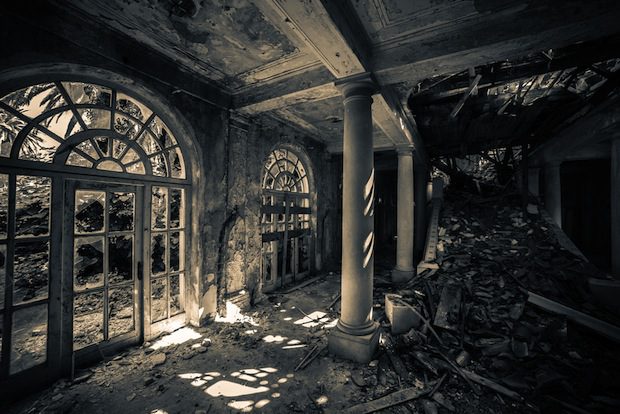
Inside her bedroom, Judye somehow escaped her father, whose hands were covered in blood, as was his shoulder. Judye ran into her parent’s bedroom. There she saw the full horror of her father’s work. Judye sprinted down the hallway and found the spiral staircase. She ran out the front door, taking deep breaths of cold night air. The smiling gargoyle in the fountain watched on as she flew down the concrete steps. She banged desperately on the door of the Lewis house. Getting no answer, she began hammering on the French windows next to the front door, smearing them with blood. Upstairs, Cheri and Shelley were frozen in fear. Judye tried another neighbor, Marshall Ross, who finally opened his door. Together, they called the police.
Back in the Perelson house, the two younger children had woken up to the sound of their sister’s screams. “Go back to bed. This is a nightmare,” Harold told 11-
year-old Debbie. Then he strode away, dripping blood onto the floor. Meanwhile, Marshall Ross was climbing the steps to the Perelson house. He found Debbie and 13-year-old Joel waiting on the first floor. Then he climbed the stairs and came face-to-face with the doctor.
“Go on home,” Harold told him, according to the Coroner’s report.
“Don’t bother me.”
More:
By the time they found the doctor, he was on the floor. His head lay on a pillow covered in his daughter’s blood, the hammer in his hand. He was only just breathing, and would be dead before the ambulance arrived. The police gathered the rest of the pills and laid them on a dresser in his room. There they discovered on a nightstand next to Perelson’s bed, a copy of Dante’s “The Divine Comedy.” It was opened to Canto 1: Midway upon the journey of our life I found myself within a forest dark, for the straightforward pathway had been lost.
Ha! If only he had read Dante, the lives saved would likely have been two. One more bit, from the present day, a trespasser to the Murder House:
And there in the living room, she saw the fabled Christmas presents. As promised by visitors before her, their ribbons were still tied. Just then, Jennifer felt “something ominous.”
Maybe it was the same feeling that drove away the homeless, who once tried to shelter there many years ago, but fled citing unsettling chills, mystery footsteps, unholy noises at night. Maybe it was the feeling described by neighbors in a newspaper that they were being “followed.” Adrenaline squirted in her veins now.
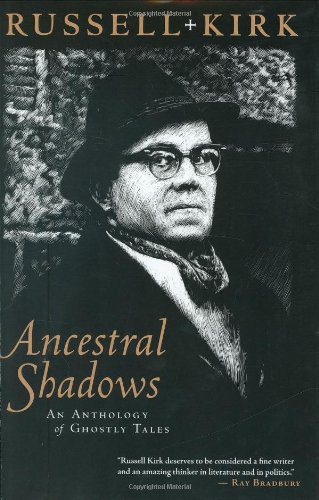
The traditionalist conservative thinker Russell Kirk was an avid collector of ghost stories, and writer of them too. Tonight, on my last night at Villanova, I’m having dinner with the university’s Russell Kirk Society. I promise you there will be ghost stories. I’m going to make sure of that.
Rod Dreher's Blog

- Rod Dreher's profile
- 508 followers

