
Rod Dreher's Blog, page 666
September 24, 2015
TAC Told You So
As most readers know, my bailiwick at The American Conservative is writing about cultural conservatism, an area I visit far more than foreign policy. Nevertheless, I am grateful to work for a magazine that fights so hard from the Right for realism and restraint.
Earlier this month, when it emerged in Congressional testimony that the Obama administration had spent $500 million to train what amounted to four or five “moderate” Syrian rebels, I thought of Daniel Larison’s blog post from August 12, 2014, warning that Obama had just set aside half a billion dollars to drop down the Mideast rathole. Larison wrote at the time:
One would think that events in Iraq over the last few months would dispel the illusion that U.S. arms and training guarantee that things will develop in a certain way. The U.S. spent years and enormous sums of money to train and equip the Iraqi army, and it was useless in preventing ISIS from seizing large parts of Iraq.
And on June 30, 2014, Larison also wrote to criticize the president’s $500 million plan as a boondoggle in the making:
All of the calls to arm the opposition in Syria are based on the false belief that the U.S. has the ability to manipulate and direct the course of a foreign civil war, and that it is only because Washington has “failed” to insert itself aggressively enough that the war has turned out the way it has. Obama’s decision has the distinction of being guaranteed not to “work” on its own terms while also being harmful. Adding in a few more weapons into the Syrian civil war isn’t going to achieve anything except to help prolong the war and put off the day when a negotiated settlement can be reached. The more support that the U.S. and other outside governments provide to the opposition, the less inclined they will be to negotiate. Arming insurgents doesn’t give the U.S. much in the way of control or influence over them, but it does implicate the U.S. in whatever they do with the weapons and training provided to them.
More Larison:
The developments of the last six months ought to have put an end to the idea of arming the Syrian opposition once and for all, but the administration has outdone itself in finding a Syria policy option that makes no sense, satisfies no one, and slowly pulls the U.S. into a conflict where Americans still have little or nothing at stake.
And now, a year later, the verdict is in: Larison was entirely right. Half a billion taxpayer dollars, thrown to the wind in a bipartisan donnybrook.
TAC told you so! This magazine was founded in foreign policy realism — specifically, to oppose from the right the Bush administration’s foreign-policy adventurism in Iraq. TAC was right in 2002, and it is still right to oppose U.S. meddling in places where we have no business. After the 2016 elections, a new administration will take the reins in Washington, and you can be certain that whether the White House is occupied by a Republican or a Democrat, the War Party will still be in power, devising new ways to spend money spreading mayhem and undermining global stability and America’s national security in the process.
Please consider adding your financial support to The American Conservative‘s mission. There’s no one else like us. We work hard to be David to the foreign policy and defense establishment’s Goliath, motivated by the belief that keeping America strong means avoiding unnecessary foreign entanglements. If you share that view, then we need your help.
I also want to make an appeal from the social and religious conservative corner. Lately I’ve been working on a story about the religious liberty fight. Concluding an interview with one prominent source in the Christian legal community, the source thanked me for the things he’s been reading on this blog about the political and legal complexities of the religious liberty fight — and how the Kim Davis circus is actually hurting the cause. “You may not know this, but so many of us working in this field are reading you every day,” the source said. “You’re saying what we think.”
It’s not the motivational message going out from the Christian-Industrial Complex inside the Beltway, but it happens to be what’s really happening. I’ve tried to bring the same realism to covering religious liberty and social conservatism as my TAC colleagues bring to analyzing foreign policy. My writing in this space about the Benedict Option was seen some time ago as pessimistic and dystopian by many conservatives, but after the Indiana RFRA shocker and the Obergefell decision, the Benedict Option is one of the hottest topics among social and religious conservatives. And it all started here.
If it’s important for you to have TAC as an incubator of creative-minority conservatism over and against the party line, understand that we cannot do what we do without the financial help of you readers. Please make your tax-deductible gift to The American Conservative today.


Benedict Option & the Church in Modernity
I’m still at Villanova, attending classes in the Humanities department. Yesterday, in a class about Society, I listened as the students talked about a book of ethics written by Herbert McCabe, OP, a Dominican philosopher. A line from McCabe’s book jumped out at me:
Community is not founded upon law; rather, law is founded upon community.
Ponder that line for a minute with reference to contemporary America, and you’ll be well into the MacIntyrean weeds. The shared beliefs that are necessary for a real community scarcely exist. “Community” as most of us experience it today is little more than a collection of atomized individuals who live in the same geographical location. This has consequences for lawmaking, and for respect for authority.
Consider, then, this passage from MacIntyre’s After Virtue, posted to Addenda, the Mars Hill Audio Journal blog. Excerpt:
[M]odern politics cannot be a matter of genuine moral consensus. And it is not. Modern politics is civil war carried on by other means. . . .
[P]atriotism cannot be what it was because we lack in the fullest sense a patria . . . . [T]he practice of patriotism as a virtue is in advanced societies no longer possible in the way that it once was. In any society where government does not express or represent the moral community of the citizens, but is instead a set of institutional arrangements for imposing a bureaucratized unity on a society which lacks genuine moral consensus, the nature of political obligation becomes systematically unclear. Patriotism is or was a virtue founded on attachment primarily to a political and moral community and only secondarily to the government of that community; but it is characteristically exercised in discharging responsibility to and in such government. When however the relationship of government to the moral community is put in question both by the changed nature of government and the lack of moral consensus in the society, it becomes difficult any longer to have any clear, simple and teachable conception of patriotism. Loyalty to my country, to my community—which remains unalterably a central virtue — becomes detached from obedience to the government which happens to rule me.
As long as we’re in MacIntopia, take a look at this post also on Addenda. It’s an excerpt from a 2014 book by Francisco Javier Martínez Fernández, in which he argues that the Church (= all Christians) in secular modernity:
[A] Church that understands itself and reality through the prevailing categories of secular modernity (whether in their postmodern or Enlightenment form, or merely constituted as reactions to either of these) is doomed to disappear. Or at any rate, it will undergo such a metamorphosis that its continuity with ‘historical’ Christianity would be broken (indeed, it has in part already been broken). . . . Moreover, a Church that uses secular categories is incapable of having a productive and sincere encounter with people of other religious and cultural traditions. To the extent that it adapts itself to the categories of secular modernity, it takes on the precise role that modernity assigns to it; insofar as it embraces this role, the Church can only dissolve, or else be an instrument of violence and division. In order to meet every man and every woman in a way that allows all of us—Christians and non-Christians—to grow in our common humanity, the Church must free itself from the categories of modernity and recover its identity from within its own particular tradition.
The Church only exists in concrete cultural forms, on which the encounter with Christ—which from the beginning has always occurred in concrete cultural form—has had varying degrees of impact. This encounter can be the determining factor of the human experience, or it can remain merely a partial or marginal aspect thereof. The task of Christian education consists entirely of helping people pass from the latter condition to the former. For people in the latter situation, the categories determining Christian life continue to be those of the surrounding culture. And those categories will influence and weigh on the thought of individuals and peoples depending on how decisive the encounter with the Risen and Living Christ, Center and Lord of the cosmos and of history, has been in determining their self-awareness and awareness of reality.
The author says that if Christians accept the categories of secular modernity, then “either the Church accepts its role as a cultural leftover from the past, or it must dissolve into the surrounding society.” Read the whole thing.
What is the alternative? I would say the Benedict Option. Years ago on the Journal, host Ken Myers interviewed D.H. Williams, a patristics scholar now at Baylor. Williams said in his interview, about the early Church:
“In the process of teaching, or catechizing new Christians, it was taken with great seriousness that the commitment that they were making was a corporate one, and an exclusive one. And that it entailed a body of meaning that in many ways was inviting them to become members of a counterculture, from the one in which they had converted from. And even the catechetical process itself begins to raise important questions about the church as culture. That you are de facto encouraging the new Christian to learn a new vocabulary, a new sense of what is the highest, the good, and the beautiful; that there really are true things and false things; that there really are certain moral lines to be drawn in the sand, and that you may struggle with these, and part of the struggle is very good.”
We are going to have to do something very much like that with the Benedict Option.
By the way, if this line of critique interests you, you really should subscribe to the Journal, which is the single most helpful guide to understanding the role of faith and culture in secular modernity. Journal founder, editor, and host Ken Myers and I are going to engage together at Georgetown’s October 10 Benedict Option event. Follow @benedictoption on Twitter to keep up with news of the happening.
September 23, 2015
SJWs as Marcusian Monsters
Have you been reading the website Heterodox Academy? Bookmark it; it’s terrific. Here’s an essay from the site by political scientist April Kelly-Woessner, in which she discusses how younger generations of Americans are less tolerant than older ones. She writes:
Political tolerance is generally defined as the willingness to extend civil liberties and basic democratic rights to members of unpopular groups. That is, in order to be tolerant, one must recognize the rights of one’s political enemies to fully participate in the democratic process. Typically, this is measured by asking people whether they will allow members of unpopular groups, or groups they dislike, to exercise political rights, such as giving a public talk, teaching college, or having their books on loan in public libraries.
It turns out that people in their 20s and 30s are measurably less tolerant than people in older generations. Kelly-Woessner pins the blame on Herbert Marcuse, the political theorist known as the “Father of the New Left.” Marcuse is perhaps best known for his idea of “repressive tolerance”, the title of an essay in which he called for “liberating tolerance,” by which he meant suppressing ideas and speech of the Right, because it is evil. Kelly-Woessner writes:
The idea of “liberating tolerance” then is one in which ideas that the left deems to be intolerant are suppressed. It is an Orwellian argument for an “intolerance of intolerance” and it appears to be gaining traction in recent years, reshaping our commitments to free speech, academic freedom, and basic democratic norms. If we look only at people under the age of 40, intolerance is correlated with a “social justice” orientation. That is, I find that people who believe that the government has a responsibility to help poor people and blacks get ahead are also less tolerant. Importantly, this is true even when we look at tolerance towards groups other than blacks. For people over 40, there is no relationship between social justice attitudes and tolerance. I argue that this difference reflects a shift from values of classical liberalism to the New Left. For older generations, support for social justice does not require a rejection of free speech. Thus, this tension between leftist social views and political tolerance is something new.
She goes on to say that intolerance is now being redefined as a social good, e.g., protecting victim groups from speech that makes them feel “unsafe.” Read the whole thing.
Take a look at this example of “liberating tolerance,” also up on the Heterodox Academy site. It’s a clip from a Portland, Oregon, anarchist’s meeting which was disrupted by protesters who accused organizers of creating an “unsafe” space by questioning rape claims. It’s bizarre — but if you watch it, be aware that there’s profanity in it, so it’s NSFW:
George Yancey says this appalling episode is an example of “education dogma,” which he says are “not the result of gaining more facts but instead are the dogmatic adaptation of certain social values provided to [those who hold them] by [the higher education] subculture. We see evidence of this in that it is clear that students like the ones in the video are not looking for more information to make accurate assessments, but simply look to affirm previously accepted beliefs.”
What are some of the Education Dogmas, according to Yancey? Here’s his list:
1. There is a campus rape culture that encourages the sexual assault of women.
2. A woman accusing a man of rape has vastly more credibility than a man who claims his innocence.
3. The earth is getting dramatically warmer due to human activity and altering that activity can stop or slow this trend.
4. Israelites settlers and the Israel government are as bad as or worse than Palestinian terrorists.
5. Fundamentalist Christians are morally the same as Muslim terrorists.
6. Military action in the Middle East creates more problems than it solves.
7. Criticism of Islam as a religion of terrorism is an example of Islamophobia.
8. Religious freedom is not as important as acceptance of sexual minorities.
9. Society would generally be better if traditional religion disappeared.
10. Marriage between those of the same sex should be seen as the same as marriage between those of different sexes.
11. Trans women should be allowed to use the same facilities as biological women.
12. The physical differences between men and women play no role in economic disparities between the sexes.
13. A woman has a right to an abortion for whatever reason she chooses.
14. Black men are targeted by the police.
15. Anti-Hispanic racism is an important part of what motivates those who oppose immigration reform.
16. President Obama is criticized more than previous presidents because of his race.
17. Raising taxes on the wealthy will improve our economy.
18. Political conservatives are either greedy manipulators exploiting the marginalized or sincere dupes voting against their own economic interests.
19. There is little, if any, correlation between hard work and economic success.
20. The United States is more damaging to the world than other western industrialized nations.
Yancey continues:
Let me be clear that I am not arguing that these statements are either right or wrong. For the record I agree with some statements and disagree with others. I am not arguing it is problematic that students on college campuses have these beliefs. I argue that it is problematic that they hold onto these positions with a dogmatic attitude where they are unable to entertain alternative perspectives. There are arguments opposing these statements that are not tied to evil motivations but consist of perspectives that differ from the tenets of education dogma. Yet those who hold alternative perspectives are not just wrong but they are– put in the proper term – racist, homophobic, Islamophobic, denier, sexist, cisgenderist, pro-rape, etc. They are heretics in a binary worldview where creative compromises and third ways, which require the critical thinking skills which we should be teaching our students, are ignored and only stigmatizing and silencing the heretic is allowed.
To underscore his position, Yancey, an African-American sociologist, says he has no problem with people who believe any of these things; his problem is with those who seek to silence those who disagree. Read his entire piece here.
The Pedophile’s Orientation
Todd Nickerson is a self-confessed pedophile. He says he does not act on his desires, but he wants you to understand that he’s a human being. Excerpts from his essay in, where else, Salon.com:
I’ve been stuck with the most unfortunate of sexual orientations, a preference for a group of people who are legally, morally and psychologically unable to reciprocate my feelings and desires. It’s a curse of the first order, a completely unworkable sexuality, and it’s mine. Who am I? Nice to meet you. My name is Todd Nickerson, and I’m a pedophile. Does that surprise you? Yeah, not many of us are willing to share our story, for good reason. To confess a sexual attraction to children is to lay claim to the most reviled status on the planet, one that effectively ends any chance you have of living a normal life. Yet, I’m not the monster you think me to be. I’ve never touched a child sexually in my life and never will, nor do I use child pornography.
But isn’t that the definition of a pedophile, you may ask, someone who molests kids? Not really. Although “pedophile” and “child molester” have often been used interchangeably in the media, and there is some overlap, at base, a pedophile is someone who’s sexually attracted to children. That’s it. There’s no inherent reason he must act on those desires with real children. Some pedophiles certainly do, but many of us don’t. Because the powerful taboo keeps us in hiding, it’s impossible to know how many non-offending pedophiles are out there, but signs indicate there are a lot of us, and too often we suffer in silence. That’s why I decided to speak up.
It turns out he was born with a deformity, which made him feel inadequate and set apart, and he was also molested as a small child by a visitor to his grandmother’s house.
He says he found hope in a group called Virtuous Pedophiles, who support each other and encourage each other not to act on their desires. More:
For better or worse—mostly worse—we have this sexuality, and unlike with most sexualities, there is no ethical way we can fully actualize our sexual longings. Our desires and feelings, if we are to remain upright, are doomed from the outset. Indeed, whereas the majority of crimes can be bounced back from, society doesn’t extend a mulligan to molesters. I understand why, but that doesn’t make the burden any lighter to bear, particularly for those of us who have minimal or no attraction to adults. And for the pedos who are lucky enough to be able to form working relationships with adults, there are a new set of concerns: What if we have children? Will I be a threat to them? Can I ever share this fact with my spouse? Can I ever love and want her as much as I do a child?
So, please, be understanding and supportive. It’s really all we ask of you. Treat us like people with a massive handicap we must overcome, not as a monster. If we are going to make it in the world without offending, we need your help. Listening to me was a start.
This is fascinating stuff. Repulsive, at first, but I think about what it must be like to live with this tormenting desire, but not be able to act on it, and I pity the man. We are more than our desires. This man needs people to help him bear his cross.
That said, it is worth considering how the way we think and talk about sexuality, desire, and identity in our culture blurs the lines for this man. He says he cannot help desiring who he does, and I believe him. He recognizes that his desire is disordered, and he needs help refraining from indulging it. This VirPed (his word) group is all about helping him live a moral life despite this hated disorder.
If Todd Nickerson’s desire was for people of the same sex, this piece would never have been published, obviously. There is a Catholic group called Courage, for gay men and women who want to live celibately, in obedience to Catholic teaching — and they are often criticized, even within the Church. In our contemporary culture, most people do not believe sexual desire towards someone of one’s own sex is disordered. Almost everybody believes sexual desire towards a child is disordered. Similarly, almost everyone believes sexual desire towards an animal is disordered.
How do we determine which sexual desires are disordered, and which aren’t? Consent? Isn’t that a very thin line? Todd Nickerson describes being fondled by the older man when he was seven, and it was not traumatic for him, in his memory.
Nickerson describes pedophilia as an “orientation.” No, I’m not saying that homosexuality is the same thing as pedophilia. It is not. What concerns me, though, is that the language and concepts we have accepted to sweep away the old Christian objections to homosexuality — in particular, the sacrosanct way we see sexual desire as at the core of identity and personhood — can easily be manipulated to legitimize pedophiles. The only reason Nickerson sees his sexual desire for children as illegitimate is because society tells him he cannot act ethically on it. Nickerson writes:
With sexuality … there’s a physiological component, a drive every bit as powerful as belief. In essence, your brain knows what it likes and isn’t going to take no for an answer. For that reason, the nature or nurture question with respect to sexual preference is ultimately irrelevant—it becomes all but hardwired soon enough, until it’s all you know. And it’s self-reinforcing, no matter how much you wish to dig it out. Eventually it all tangles together with the rest of who you are.
… with the rest of who you are.
Are there any grounds — other than consent — on which we can take a firm stand against Todd Nickerson’s sexual desires, and tell him to deny what he desires in the deepest recesses of his brain, and that he considers to be an inextricable part of himself? We have made liberating the sexual self a virtue in the LGBT movement, and before that, in the Sexual Revolution. So where does that leave Todd Nickerson in terms of finding resources with which to deny his sexual desire? If we simply say by fiat “children cannot consent to sex, therefore pedophilia is wrong, does that really take care of the problem?
An Ex-Catholic’s Gratitude
Mark Edmundson writes about his Catholic childhood and deep disillusionment with the Roman Catholic Church, which he left. There’s a lot in the essay about the abuse scandal, so much that I thought about not posting the essay on a day when Francis is in the country. But this ending makes the whole thing worthwhile. He’s talking about why the Catholic laity did not abandon the Church after the worst of the scandal became known:
I suspect that people stuck with the Church in part because of its commitment to forgiveness. They also stuck with it because it is one of the few powerful bodies that tries to say a resolute No to what is most distressing about worldliness.
The Church is in favor of life. It rejects capital punishment. In a time when virtually no one challenges the rich and no one fights for the poor, the Church, as Pope Francis has dramatically shown, is on their side. Sell what you have and give the money to the poor, the Savior says, and then come and follow me. No other major Western institution says this. No one else has contempt for getting and spending. No one else will befriend the condemned man, or the rapist, or the thief. As long as you are alive and in this world, the Church has hope for you. When everyone else has given up on you, the Church remains open. How many times do you forgive your brother or sister? Jesus suggests that we do this no end of times. For the Church, there is no such thing as human refuse. Everyone matters. Everyone is equal. What you do to the least of mine, you do to me, Jesus says, and sometimes the Church tries to bear him out.
Does the Church fail? Of course it does. The Vatican flows with gold; the bishop knows fine wines; the priest is still ogling your son. But the Church carries within it the answers to its own excesses. You need to examine your conscience, you need to confess your sins, you need to be sorry, you need to vow to sin no more. But if you do, the door is open. The Church may at times outrage its own highest values—blindness, denial, lies. But it will try to right itself in its own way, and it will never give those values up, no matter how large the gap between what it professes and what it achieves.
Looking back, I’m grateful for the education the Church gave me. I walked out, I dare say, with its best principles in my heart, and maybe I left its worst behind. The Church stands yet and probably always will. It tells us that our lives mean something. It tells us that an individual existence has a shape, beginning with baptism and passing to confession, communion, confirmation, and marriage all the way to extreme unction and the grave. Without that inner structure, without some moral code, without forgiveness, what is life? Something closer to the experience of animals that merely eat, couple, and sleep. That the very best wisdom in the world is wrapped up with some of the worst crime is not easy for one to reconcile. But the Church now, even under the guidance of a new and invigorating pope, is a spiritual treasure guarded by a murderous dragon—and it is no less the treasure than it is the dragon.
For a major human riddle—maybe the major human riddle—is this: the worst kind of corruption is the corruption of the highest ideals. Where there are high ideals, there will often be corruption and often of the vilest sort. But without ideals, where—and what—would we be?
Read the whole thing. It’s worth it.
The question is, though, without a living relationship to the living God through the Church, how long can an individual or a society hold on to those ideals? The Elder Zosima, in The Brothers Karamazov, says:
Much on earth is concealed from us, but in place of it we have been granted a secret, mysterious sense of our living bond with the other world, with the higher heavenly world, and the roots of our thoughts and feelings are not here but in other worlds. That is why philosophers say it is impossible on earth to conceive the essence of things. God took seeds from other worlds and sowed them on this earth, and raised up his garden; and everything that could sprout sprouted, but it lives and grows only through its sense of being in touch with other mysterious worlds; if this sense is weakened or destroyed in you, that which has grown up in you dies. Then you become indifferent to life, and even come to hate it. So I think.
How do we stay connected to the mystery, and make it accessible across the generations, if not for the visible structure of the Church? Without the physical embodiment of those ideals, and without believing in the authority of the Church, how are we to know that these ideals are good?
I really appreciate what Mark Edmundson says at the end of his essay, but I’m left wondering how he would expect his children (if he had ever had them) and his children’s children to believe in these ideals if they were not given as their birthright this connection to the Church.
Run! Commie Devil Pope!
A reader sends in this delicious montage of right-wing TV and radio talkers losing their caca over Pope Francis.
September 22, 2015
Francis in the US
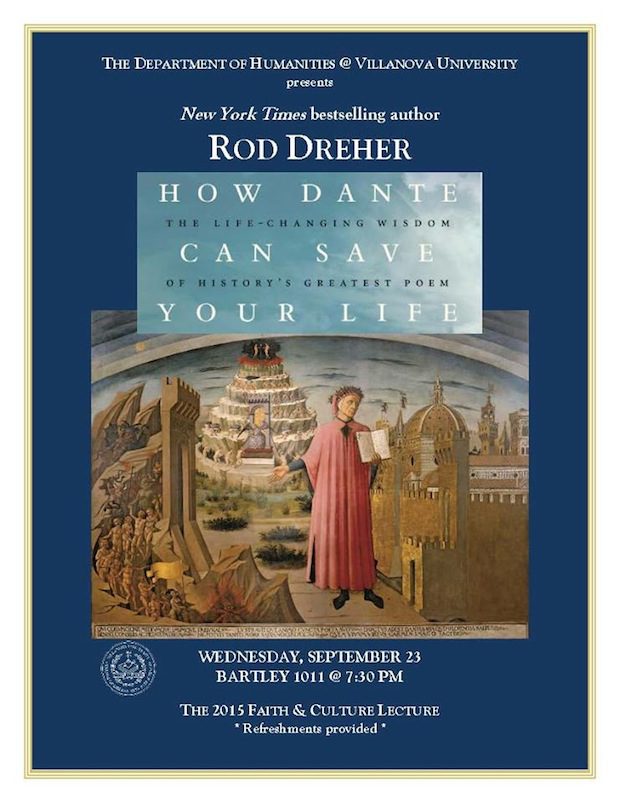
Hey, I’m at Villanova University in suburban Philadelphia tonight, spending Wednesday at the college and giving a Dante lecture that night. The city is all wound up, waiting for Pope Francis to arrive. Open thread for readers in Washington, Philly, NYC, and all those coming into one of these cities on the Pope’s tour to see him: What are you thinking and feeling right now? What are your hopes? Your fears? Not interested in arguing about anything here; just want to know what’s on your mind right now.
We Are Not Going to the Hills, OK?
Catholic writer T. Renee Kozinski sees some things she likes in the Benedict Option:
This time round, though, it is less like Benedict and more like the Maccabees: lay people, not monks, who aspire to build walls around what is true, good, and beautiful in order to preserve these transcendentals along with themselves and their children. You see this in the micro-educational institutions that create a community of learning and faith, without hope of any largesse or approval-stamp from the culture at large; you see this in small church communities centered around a liturgy that “brings beauty flowing into the realm of the senses.”
In fact, many of these marginalized communities have existed already for more than thirty or forty years. What seems new now is that instead of talk about “the new evangelization” or a movement out to “re-claim the culture,” the discussion in some of these communities seems to be also about “withdrawization,” or an intensified focus on the elements of the monastic life—prayer, contemplation, beautiful liturgy, hierarchical authority, an ordered way of life that has retreated away from a disordered world.
This, to me, is an attractive option. I am a watcher, an observer, I’ve begun to feel as if I am watching the world, our culture, turn into a hallucinogenic baby of the perverse marriage of 1984 and Brave New World, but instead of straightforward flip-flops (“war is peace”) as a means to political control, it is clownish, celebratory warpings of natural law and nature as a means to soul-control. Creating fortresses sounds attractive, because I am frightened—the mask of sanitary individualism and creative moral license is coming off, and the maggot-ridden face of each is becoming clearer and clearer.
We live not in a culture oppressed by one party’s lies; we live in a culture in love with the ability to lie to itself. “Abortion is about me and my body” is just one. “Happiness is what makes me feel satiated” is another. “Tolerance is supporting whatever you want, Caitlyn.” Joseph Pieper could say, “I told you so” because indeed we are seeing abuse of language as abuse of power, but now at a level and ubiquity that is unprecedented, much more fundamental than anything I’ve experienced in reading history or culture-watching prior.
… but she’s opting out of the Benedict Option, because she believes it amounts to a refusal to be “salt and light” in the world:
Should the salt refuse to be shaken out on it? Should the light retreat? This is one possibility, and God may want this, and I may be wrong. But Jesus never congratulated the disciples for hiding out in Jerusalem; He came to them, pitied them, and gave them power to sacrifice themselves, to rise above fear. Most of them died at the hands of a culture, out in that culture that “kept truth imprisoned in its own wickedness.”
I remember a bishop who in 1999 said to a group of middle school students, “Your generation will be martyrs.” Those students are now in their twenties. Another bishop, Francis Eugene George, said, “I will die in my bed. My successor will die in jail. His successor will die a martyr’s death.” In those years I kept those words, but could not see the form this would take. Now I can see the form, the context laid, in just fifteen years.
I want my children to learn courage and how to hang on to the faith in the face of darkness. I want them to be soldiers because I think they will need this. A monastic-retreat or a fortress-community in its best form can give an important, essential element, an embodiment of the faith itself, but that is not enough. That alone can create people who see the world like a jumping fish sees the far-distant shore. We also need to teach our children what they will face, how to live with courage, how to die, and most importantly, how to love those lost in the culture. They need to know that to live in this world means a kind of death, and they need to believe that truth, goodness, and beauty are transcendentals found outside themselves, but also be motivated to walk alongside “those people,” to be challenged by them to love better with more personal understanding. I don’t want my children to become hot-house creatures who cannot survive in the desert of this world, who have nothing to offer, who have taken the life-boats off the Titanic and are rowing away, insensitive to those crying out in the frozen water.
Well, Ms. Kozinski, have I got good news for you: I’m not asking you or anybody else to run off to the woods and build a compound to keep the world out. I think that is neither possible nor desirable for lay Christians. What the Benedict Option asks you to think seriously about is the extent to which all of us need to withdraw strategically, in a limited fashion, into our own communities — churches, schools, and so forth — not to keep ourselves untainted by the world, but so we can deepen our knowledge, practice, and commitment to the faith, and our bonds with each other, precisely so we can be the salt and light that Christ commanded us to be.
I ask you to read this 2004 First Things essay by Robert Louis Wilken, a leading historian of the early church and a Catholic convert. Especially these parts:
In my lifetime we have witnessed the collapse of Christian civilization. At first the process of disintegration was slow, a gradual and persistent attrition, but today it has moved into overdrive, and what is more troubling, it has become deliberate and intentional, not only promoted by the cultured despisers of Christianity but often aided and abetted by Christians themselves.
More:
Material culture and with it art, calendar and with it ritual, grammar and with it language, particularly the language of the Bible—these are only three of many examples (monasticism would be another) that could be brought forth to exemplify the thick texture of Christian culture, the fullness of life in the community that is Christ’s form in the world.
Nothing is more needful today than the survival of Christian culture, because in recent generations this culture has become dangerously thin. At this moment in the Church’s history in this country (and in the West more generally) it is less urgent to convince the alternative culture in which we live of the truth of Christ than it is for the Church to tell itself its own story and to nurture its own life, the culture of the city of God, the Christian republic. This is not going to happen without a rebirth of moral and spiritual discipline and a resolute effort on the part of Christians to comprehend and to defend the remnants of Christian culture. The unhappy fact is that the society in which we live is no longer neutral about Christianity. The United States would be a much less hospitable environment for the practice of the faith if all the marks of Christian culture were stripped from our public life and Christian behavior were tolerated only in restricted situations.
If Christian culture is to be renewed, habits are more vital than revivals, rituals more edifying than spiritual highs, the creed more penetrating than theological insight, and the celebration of saints’ days more uplifting than the observance of Mother’s Day. There is great wisdom in the maligned phrase ex opere operato, the effect is in the doing.
Or, to put it in the words of my priest in this past Sunday’s sermon, with regard to evangelizing the world, “You can’t give away what you don’t possess.” The Benedict Option is about finding ways to thicken our Christianity and Christian culture, so it doesn’t get blown away by the increasingly hostile post-Christian culture in which we live.
Think of it like this: if it’s raining so much that the whole world appears to be on the verge of flooding, and you worry about saving yourself and your neighbors, do you stand there while the water rises, because you want to share the experience with the others, or do you build a boat so you can climb aboard it and pull into it the others who, seeing that the alternative is death, clamber aboard?
Among the Ahmed Truthers
A geek reverse-engineers Ahmed’s clock, and concludes that he didn’t even build the thing, but rather took the guts out of a ’70s or ’80s era digital clock, put them in a pencil box, and tried to pass it off as his own. Excerpt:
I found the highest resolution photograph of the clock I could. Instantly, I was disappointed. Somewhere in all of this – there has indeed been a hoax. Ahmed Mohamed didn’t invent his own alarm clock. He didn’t even build a clock. Now, before I go on and get accused of attacking a 14 year old kid who’s already been through enough, let me explain my purpose. I don’t want to just dissect the clock. I want to dissect our reaction as a society to the situation. Part of that is the knee-jerk responses we’re all so quick to make without facts. So, before you scroll down and leave me angry comments, please continue to the end (or not – prove my point, and miss the point, entirely!)
For starters, one glance at the printed circuit board in the photo, and I knew we were looking at mid-to-late 1970s vintage electronics. Surely you’ve seen a modern circuit board, with metallic traces leading all over to the various components like an electronic spider’s web. You’ll notice right away the highly accurate spacing, straightness of the lines, consistency of the patterns. That’s because we design things on computers nowadays, and computers assist in routing these lines. Take a look at the board in Ahmed’s clock. It almost looks hand-drawn, right? That’s because it probably was. Computer aided design was in its infancy in the 70s. This is how simple, low cost items (like an alarm clock) were designed. Today, even a budding beginner is going to get some computer aided assistance – in fact they’ll probably start there, learning by simulating designs before building them. You can even simulate or lay out a board with free apps on your phone or tablet. A modern hobbyist usually wouldn’t be bothered with the outdated design techniques. There’s also silk screening on the board. An “M” logo, “C-94” (probably, a part number – C might even stand for “clock”), and what looks like an American flag. More about that in a minute. Point for now being, a hobbyist wouldn’t silk screen logos and part numbers on their home made creation. It’s pretty safe to say already we’re looking at ’70s tech, mass produced in a factory.
So I turned to eBay, searching for vintage alarm clocks. It only took a minute to locate Ahmed’s clock. See this eBay listing, up at the time of this writing. Amhed’s clock was invented, and built, by Micronta, a Radio Shack subsidary. Catalog number 63 765.
Here’s a video purporting to show how you can make a clock exactly like Ahmed’s in about 20 seconds:
Here’s a second video, this one by scientist Thomas Talbot, who cries foul on Ahmed:
Says the Daily Beast, in its story about “nerd rage” against a clock they think is fake:
Thomas Talbot, an electronics author and prominent medical virtual reality scientist, said the clock’s printed circuit boards and ribbon cables, along with the 9-volt battery backup, are signs of a commercial product.
In his video, Talbot displays a photo of Mohamed’s clock and on screen, flashes an arrow over a tangle of cords jutting from the case. “This was put in here to look like a device, with these cables and these… to look like a device that would be suspicious, and I think intentionally so,” he says of the design.
“This is simply taking a clock out of its case, and I think probably for provocative reasons, intentionally,” he said in his video. He did not elaborate further.
“When I saw this, I thought, ‘We’re getting duped here,’” Talbot told The Daily Beast, adding, “Anybody who knows electronics really well needs less than five seconds to know that was a clock taken out of the box.”
The researcher, who has run contests for young inventors Mohamed’s age, said he doesn’t intend to pick on Mohamed but rather the media’s failure to capture more of the story. Over the weekend, social media activists embarked on a campaign to downvote his YouTube video, which had more than 380,000 views Sunday night.
“Whether it fits your narrative or whatever you want to believe… this particular child down in Texas did not make anything,” Talbot said in the video, adding, “People should not recognize this as an invention and recognize this child as an inventor for this particular creation.”
More from the Beast:
For some electronics experts, Mohamed’s windfall is unfair to students that actually invent things. Bryan Bergeron, an author of electronics books and editor in chief of the magazine Nuts & Volts, said that Mohamed’s project “would be ‘cute’ for someone age 7. But even then, not ‘inventive.’”
“The problem with giving this 14-year-old—whom I have nothing against; I really know very little of him—kudos for being inventive, is that there are tens of thousands of 11-year-olds out there actually designing circuits, building them from scratch and ‘innovating,’” Bergeron told The Daily Beast.
One of those teenagers is my electronics geek son, who was initially furious over what happened to Ahmed, but now thinks Ahmed is a plagiarizing little punk. My son said to me last night, wearing his MIT t-shirt, “I’m actually inventing things, but this kid is getting all the intention for something he didn’t even invent. This is really disappointing.”
You know what’s interesting about the Talbot part of that story? That here’s a scientist offering an analysis that debunks what might be a tall tale, but the Social Justice Warriors want to shut him up because his analysis might disprove the initial narrative.
I jumped to conclusions about Ahmed’s clock the first time, so I’m not going to do it now. But what these geeks show us makes the entire episode look very fishy. The early Ahmed Truthers on this blog who suspected the kid was put up to this stunt by his attention-seeking gadfly of a father might have been on to something. Whatever the truth is, it seems at least likely that Ahmed did not “invent” anything. That may not justify the overreaction of school officials and the Irving police, but it’s worth seriously considering, if Ahmed did, in fact, plagiarize this device, whether or not he was trying to provoke exactly this kind of overreaction. Somebody needs to get to the bottom of this — or has the story become too useful for the White House and others who rushed to Ahmed’s defense to discredit?
Rod Dreher's Blog

- Rod Dreher's profile
- 508 followers

