
Rod Dreher's Blog, page 593
April 15, 2016
TAC Talks Foreign Policy In Dallas
If I were you, I would strongly consider going to this event:
The American Conservative presents “What Impact Will the 2016 Campaign Have on U.S. Foreign Policy?” — a discussion with some of the magazine’s most prominent contributors.
You won’t want to miss this opportunity to hear from:
Daniel Larison, senior editor, The American Conservative
Scott McConnell, founding editor, The American Conservative
Robert Merry, contributing editor, The National Interest
Benjamin Schwarz, national editor, The American ConservativeA reception will follow with other TAC editors, board members, and supporters.
Space is limited, so please RSVP to guarantee your seat by clicking “Get Tickets” above.
(Any additional questions may be directed to letters@theamericanconservative.com, subject line “Dallas event.”)
WHEN
Wednesday, April 27, 2016 from 5:30 PM to 7:30 PM (CDT) –
WHERE
D Magazine – 750 North St. Paul Street Suite 2100, Dallas, TX 75201
Click here to reserve your spot. I trust that I don’t have to introduce you to Larison, McConnell, and Schwartz. Robert Merry is a realist foreign policy commenter whose extraordinary book Sands Of Empire is one of the best things I’ve ever read about US foreign policy, post-Iraq. Here’s a link to an archive of his most recent articles for the National Interest. Check out this lengthy, fascinating, even iconoclastic take on Donald Trump and Vladimir Putin, from last December. Excerpt:
The result of all this has been the widespread demonization of Vladimir Putin throughout America, expressed in harsh, dismissive language by journalists, academics and politicians of all stripes and both parties. He’s a killer, they say, a tyrant, a gangster.
And then along comes Donald Trump, a brash, undisciplined developer with no political background or foreign policy sophistication. But somehow he sees what the vast majority of establishment denizens can’t seem to perceive. He says, essentially: There’s something wrong here. Putin seems to be doing what any effective leader would do in the same circumstances. He could easily take Ukraine’s eastern regions militarily and nobody could stop him, but he hasn’t. His proposals for a negotiated settlement have been summarily rejected by the West. He’s true to his allies in the Middle East, such as Syrian leader Bashar al-Assad, in sharp contrast to President Obama, who threw over Egyptian President Hosni Mubarak for no particular reason. He could become a significant geopolitical counterweight to a rising China, which is emerging as a major U.S. adversary. So, I think I could get along with the guy, and I certainly think it’s worth a try.
It’s unfortunate that Trump doesn’t know how to press his case with finesse. But his instincts merit some respect, as does his fortitude in taking on a foreign policy outlook that is so thoroughly embedded in elite thinking throughout the country. But then, one reason Trump seems to beguile so many Americans, as reflected in the polls, has been his willingness to slam the elites that have left the nation mired in such a civic mess.
Of course the West must always fortify itself against any possible encroachment by the Russian bear, as it has had to do for centuries. But that doesn’t mean America and Europe need to pursue their own policies of encroachment or employ the kind of bellicose diplomatic language that destroys prospects for finding common ground on matters of mutual interest. The country is on the wrong course on this powerful diplomatic matter. Nobody in politics seems to see it or care about it—except Donald Trump. Kudos to him.
So: Merry, Larison, McConnell, and Schwarz. That’s going to be a fantastically interesting evening.
If I were going to be there, I’d say we ought to all retire after it to the Old Monk, get sloshy on great beer, and try to talk Larison into teepeeing the nearby Bush Institute. But see, that’s why they like me idling on the bayou, a threat to no one’s dignity but my own. Such as it is.


Walker Percy Weekend Update
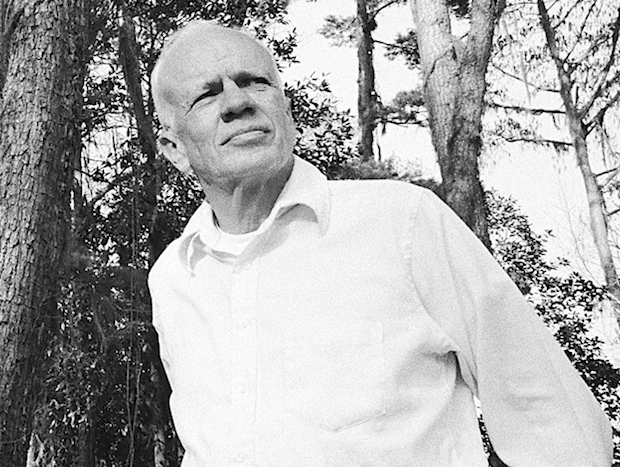
Photo courtesy of and copyright Christopher R. Harris
Good news! We have confirmed that we will be screening The Seer, Laura Dunn and Jef Sewell’s amazing new documentary about the life and work of Wendell Berry. The screening is tentatively set for Friday afternoon, on the first day of Walker Percy Weekend. If you’re getting to town early, you’re in for a treat. More details on the screening as they become available.
I’ve also heard from Nicole Rizkallah, from Phoenix, who is coming back for her second festival, and bringing lots of friends. She’s put together a Percy seminar for anybody who’s interested in joining (they have seven people signed up at the present moment, I think). This is not an official festival event, but free event organized by festival attendees, which I think is cool. Here’s the schedule:
FRIDAY, JUNE 3
10:30 AM
Rosedown Plantation Visit, St. Francisville
2:00 – 4:00 PM
DYSTOPIA AND THE ACIDS OF MODERNITY SEMINAR
“[We] live in a deranged age, more deranged than usual, because in spite of great scientific and technological advances, man has not the faintest idea of who he is or what he is doing.” – Walker Percy
Location: TBD (around St. Francisville)
Seminar Readings
The Last Gentlemen, Walker Percy
Health is Membership, Wendell Berry
A Statement of Principles, John Crowe Ransom
Suggested Readings
Benedict Option FAQ, Rod Dreher
Sex, Economy, Freedom, and Community, Wendell Berry
FUN Suggested Readings
Bourbon Neat, Walker Percy
Questions They Never Asked Me So He Asked Them Himself, Walker Percy
SUNDAY, JUNE 5
10:30 AM – Mass, Our Lady of Mount Carmel
Early Afternoon – New Urbanism Field Study at Chappapeela, Ken Bickford
You interested in participating? E-mail Nicole at xavierfellowsprogram — at — gmail — dot — com.
Don’t forget to buy your tickets for the festival! There are plenty still available, but they sold out long in advance of the 2014 and 2015 festivals. If things go this year as they have in the past, there will be a huge rush as we get closer to the date. We had people who waited too long begging us to sell them tickets, but we couldn’t. Don’t be one of those people.
New WPW t-shirts just in, and on sale at The Conundrum bookstore in town (since last year’s festival, we now have a bookstore!).
UPDATE: You can order Walker Percy Weekend t-shirts online, through the festival website!

Holding On To Your Religion
Here are a couple of really intriguing responses to the “Ben Op As Bondage” post from yesterday. I took them out of the comments thread because they deserve greater attention.
Reader Simeon T. writes:
I am yet another young Christian shaped by the “fundagelical” movement. I was homeschooled, my family attended conservative churches (including leaving one that started to introduce too much of the “cool” factor), and we generally moved in circles that sound similar to those against which Libby Anne reacts.
Despite that, my faith (and thus far that of my siblings) is firm and vibrant. Praise God. I’ve been mulling over this piece for the last 2.5hrs (thanks for providing much better in-flight entertainment than whatever American was showing from CNBC) wondering how that happened. I think the answer may lie in history.
Often, fundamentalist Christianity isolates itself not only from present evil but also from much of the past, good and bad alike. Christian history is especially lacking. If the true church didn’t start with the 12 and jump from Acts to American Baptist circuit-riding preachers, it certainly did no more than begin with John the Baptist and jump from the Apostle John to Martin Luther. Many times Christian history is reduced to something like Jesus-Luther-Anabaptists-Wesley-Bryan (William Jennings)-Graham-us. Probably a couple 19th-century foreign missionaries are thrown in for good inspirational measure. Practically ignored as matters of church history are the Roman persecutions and Constantine’s conversion; the growth of the church amidst political chaos (including the original St. Benedict’s deeds); the heresies, schisms, councils, etc. that shaped the church in its unity and in its factions, and much more. In short, practically everything that points to the catholic church as one continuous body through time is left untaught or taught only as a footnote to World History. Perhaps it is because the American church has forgotten there was a true church before itself. Perhaps it is because that history smells too strongly of papism. Perhaps it is because of sheer intellectual laziness.
Compounding the lack of church is history is a lack of family histories. I’m afraid that many of my peers’ parents have failed to communicate their own histories to their children. Maybe it was to preserve their purity, like censoring a movie featuring “d*mn.” Maybe it was an attempt to preserve their kids’ respect. If the latter, the attempt failed all too often.
My own parents were raised in the faith and wandered for years before the Lord drew them back. They have told even these chapters of their histories to their children, not to boast of their depths of depravity, but as a testimony and a caution. In a sense, I don’t need to wander. I’ve done so through my parents. (“As in Adam all sinned,” but writ small and more personally.) As for church history, Eusebius and the Benedictine Rule were required reading.
In the end, here is the problem with what I call frantic fundamentalism. Without family and church histories from which to draw, each new generation has to start over in a mad rush to define itself: dedicate themselves to God “in a special way,” learn all conceivable apologetic arguments, hash out very old theological debates while thinking them novel, reinvent church music, be surprised by persecution or its portents. The burden is too great, and many individuals collapse under the weight.
My final point is this: the Benedict Option ought not focus so much on avoiding the evil present as on remembering the community’s own past. That is its difference from fundagelicalism and its great hope. Thanks to my parents for (unconsciously?) realizing and practicing that.
What a great comment. I have written here before, and have said in the manuscript I’m working on, that the Benedict Option is in large part a strategy for remembering in an age of forced forgetting.
In a very different comment, reader Kanitach writes:
It feels odd to write “I grew up,” because I’m still growing up, but. I grew up in an Orthodox Jewish family (and not Modern Orthodox, either), attending Orthodox Jewish institutions from preschool to summer camp to high school to first jobs, praying every day and going to shul every week. I follow a strict dress code and to this day have never so much as shaken hands with the opposite gender. Sex ed was nonexistent, and I’m blushing as I type the word. Until recently, my family had no home Internet, video games, or, for the kids, cell phones. I got an email address in eleventh grade, but I could only access it in school, and only when my teacher entered the Internet password.
We don’t live in Kiryas Yoel, but we don’t need to. Of the people in my life on any closer terms than acquaintanceship, exactly zero are not Orthodox Jews. When I first read about the necessity of a Benedict Option, I laughed out loud and wonder what took other religions so long to reach that conclusion.
Last year I started college, entering a non-Jewish educational environment for the first time. To say I was terrified would be an understatement. With my exposure to mainstream America hazy at best, I was convinced that college would be a hotbed of promiscuity and militant atheism. Spoiler: it was not. It took me over a year to get used to having the opposite gender in my class, but nobody cared that I was religious. After years of inculcation with a persecution complex, it was kind of insulting.
Living in a parallel universe, one that occupies the same space as the surrounding culture but never intersects it, I can say that the tight-knit wraparound of the community is both a curse and a blessing. On the one hand, there was utter consonance between school and home. My teachers and classmates, every lesson I learned, was reflected seamlessly in my life. My social life, my corner grocery, even my doctor is Orthodox.
On the other hand, communal standards are often elevated to religious precepts, your life comes prefabricated by the manufacturer, and any form of “rumspringa” can burn all your bridges behind you. My close friend, an artsy nonconformist wildcard totally unsuited to the path they were expected to follow, left Orthodoxy slowly, over a period of years: it started with experimentation in dress, interests that were harmless but unusual, and soon they were locked into the “problem child” track.
I’m an inquisitive person, an insatiable reader and questioner of everything. In another family in my community, my parents could have forbade half the things I read and told me I was a heretic, but they didn’t. Over the course of my life I can remember only three library books I brought home that they wouldn’t let me read. They respected my curiosity, allowing me to suck up information instead of cracking down on the danger sign it wasn’t.
But the Internet, that’s a big deal. Because my family didn’t have it, I assumed the whole fuss was just typical communal overreaction. I had virtually no unsupervised Internet access until the age of 17, and by then I was mostly mature enough to filter myself.
Mostly. If I could go back and do it all over again, I would delay my Internet awakening another few years. The ability to compare my lifestyle with the world, to view it from an outsider’s perspective, to read about some not-so-pretty internal affairs from an objective perspective, triggered a crisis of faith I’m still quietly working on.
There’s been an obvious generational shift of late; my younger siblings have been allowed unrestricted (albeit filtered) access to the Internet and occasional rentals of a movie, something that would have been unthinkable in my childhood (and boy does it feel weird to write “my childhood”). They make references to pop culture that I barely understand, mouth off to my parents, and break the dress code in ways barely noticeable to an outsider but that would have landed me in hot water. Nobody appears to be going anywhere ideologically, but the external standards have certainly been lowered.
Despite my crisis of faith, I’m 90% committed to Orthodoxy at this point. (I might make the jump from haredi to Modern Orthodox if the opportunity presented itself.) But I don’t think it’s been a very fair crisis of faith, because I haven’t actually tried any other way of life for fear of burning my bridges.
TL;DR I’m not sure where this rambling dissertation was supposed to go, but if you want to know if my community’s BenOp has been successful, it depends on your definition of success, I guess.
Good Job, Grown-Ups!
Lord have mercy, there actually is adult supervision on an American college campus. Several of you readers have sent me this clip showing how Ohio State handled student SJW crybabies:
Here’s the report from the Columbus Dispatch on the brief occupation of Bricker Hall, the OSU administration building, by a coalition of left-wing malcontents. Excerpts:
“#NoEndsNOW” and “#ReclaimOSU” were among the social-media tags used by those supporting The Real Food Challenge, United Students Against Sweatshops, Committee for Justice in Palestine, OSU Coalition for Black Lives and others. A group called the Afrikan Black Coalition declared on its blog that university officials were “starving” protesters because they would not allow them to have food brought in the building.
The Real Food group wants Drake to sign a pledge promising that, by 2020, 20 percent of dining-hall food will come from non-corporate sources; officials say university-wide responsible-food efforts already equate to more than that.
Et cetera. Demands, demands, demands. That’s when Jay Kasey, a senior university administrator, came in and calmly told the children that their game was over, that the university would not negotiate with them, and that anybody who refused to take their self-righteousness and go home would face consequences. From the transcript of the video above:
If you are students, and I think the vast majority of you are, I want you to understand that you are violating the student code of conduct. As dictated to me by [university president] Dr. Drake 15 minutes ago to me on the phone, we have chosen to try to work with you this evening because we respect you. This is your university.
And we want to have dialogue. We want the dialogue to extend beyond tonight. But if you refuse to leave, then you will be charged with a student code of conduct violation.And I’m telling you this now because I want you to have good thought and careful consideration. If you’re here at 5 a.m. we will clear the building and you will be arrested. And we will give you the opportunity to go to jail for your beliefs. Our police officers will physically pick you up, take you to a paddywagon, and take you to be jail.
He also said they would be expelled from the university. No drama, just facts.
They left after midnight.
And that is how you run a university.
David French, a fellow Southerner, says:
I never thought I’d say this, but I’m proud of the Big 10 and ashamed of the SEC. Cowardly Missouri continues to pay the price for last year’s craven capitulation. The university has actually closed two dormitories because of enrollment declines and is battling through a $32 million budget shortfall.
April 14, 2016
LSD And Genesis
And now for something completely different!
I’ve been thinking for the past few days about that new study from British scientists comparing the brain in a normal state to one under the influence of LSD. Take a look at the Guardian‘s report, especially the neural images, which are, well, mind-blowing. Excerpts:
The profound impact of LSD on the brain has been laid bare by the first modern scans of people high on the drug.
The images, taken from volunteers who agreed to take a trip in the name of science, have given researchers an unprecedented insight into the neural basis for effects produced by one of the most powerful drugs ever created.
A dose of the psychedelic substance – injected rather than dropped – unleashed a wave of changes that altered activity and connectivity across the brain. This has led scientists to new theories of visual hallucinations and the sense of oneness with the universe some users report.
The brain scans revealed that trippers experienced images through information drawn from many parts of their brains, and not just the visual cortex at the back of the head that normally processes visual information. Under the drug, regions once segregated spoke to one another.
Further images showed that other brain regions that usually form a network became more separated in a change that accompanied users’ feelings of oneness with the world, a loss of personal identity called “ego dissolution”.
More:
Under the influence, brain networks that deal with vision, attention, movement and hearing became far more connected, leading to what looked like a “more unified brain”, he said. But at the same time, other networks broke down. Scans revealed a loss of connections between part of the brain called the parahippocampus and another region known as the retrosplenial cortex.
The effect could underpin the altered state of consciousness long linked to LSD, and the sense of the self-disintegrating and being replaced with a sense of oneness with others and nature. “This experience is sometimes framed in a religious or spiritual way, and seems to be associated with improvements in wellbeing after the drug’s effects have subsided,” Carhart-Harris said.
The drug can be seen as reversing the more restricted thinking we develop from infancy to adulthood, said Nutt, whose study appears in the journal Proceedings of the National Academy of Sciences.
Here’s a bit from the Reuters account of the study:
Scientists have for the first time scanned the brains of people using LSD and found the psychedelic drug frees the brain to become less compartmentalized and more like the mind of a baby.
A research team led by scientists at Imperial College London said that while normally the brain works on independent networks performing separate functions such as vision, movement and hearing, under LSD the separateness of these networks breaks down, leading to a more unified system.
“In many ways, the brain in the LSD state resembles the state our brains were in when we were infants: free and unconstrained,” said Robin Cahart-Harris, who led the study. “This also makes sense when we consider the hyper-emotional and imaginative nature of an infant’s mind.”
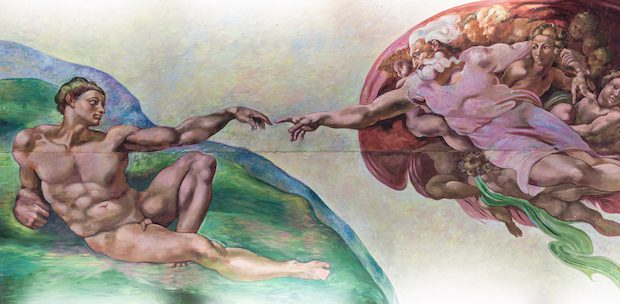
Now, what does this have to do with the Book of Genesis? I’ve been thinking of how the experiences reported by LSD users closely resemble rare mystical experiences a relatively small number of religious practitioners report — particularly the sense of the ego dissolving into a general oneness with Creation, and a sense that Creation itself is alive, and mystically unified, harmonious.
This is the portrait of the prelapsarian world of Genesis. Adam and Eve live in harmony with God and with Creation. The Fall occurred when the two individuated themselves — that is, became aware of themselves as discrete individuals with the power to turn away from God. They lost that intimate fellowship with him, and with Creation, that they had once had.
Is this not analogical to the experience of maturing from infanthood toward adulthood? Though I don’t believe in a literal Adam and Eve — I believe Genesis is a “true myth,” in the sense that it is a parable that explains profound truths to us — I believe there was a metaphysical catastrophe of some sort that caused our loss of union with God. Could it be that in order for human consciousness to arise within us, we had to experience the Fall — which, in biological terms, might have meant that the surviving hominids were those whose brains turned the experience of God off, in some sense. Note that in the brain scans, people under the influence of LSD have all parts of the brain communicating with each other, not just tiny parts.
If true, then it gives a new dimension to Jesus Christ’s statement that we must be like little children if we wish to return to the Father.
I’ve hesitated to write this because I don’t want to give the impression that I disbelieve in the Fall as a spiritual reality. But it’s interesting to contemplate what LSD might reveal to us about the nature of how our bodies mediate the spirit incarnated in them. Put another way, does the experience of LSD and other psychoactive drugs reveal the world to us as it really is (“open cleansing the door of perception,” as Huxley put it), but that we cannot normally endure and function? Or is it purely illusory? Or both?
Again, I’m simply speculating. What do you think? I’m really interested in what psychoactive drugs can tell us about mystical experience. Two summers ago, when I visited my dying friend Miriam in Amsterdam, she told me about how she had undergone recently an experience with ayahuasca, the psychoactive drug derived from an Amazon plant. It sounded terrifying to me, something I would never want to do. But something extremely profound had happened to her, revealing her hidden terror, and helping her to conquer it. She was now ready to die (from her cancer) in peace. As a Christian, much of what she had to say triggered a defensive response within myself, but I could not deny the profound effect that experience had on my friend (and when she disclosed the content of it to me, I understood).
Naked Lady In The Desert
In the Orthodox Church, we are preparing to commemorate the life of St. Mary of Egypt. Last night in our parish, we did as Orthodox parishes always do during matins of the Fourth Thursday of Lent: read aloud during evening services her biography, as written down by St. Sophronius, the Patriarch of Jerusalem, who lived from 560 to 638. St. Mary of Egypt died in the year 522. When Sophronius heard her story, passed down in oral tradition by the monks in the nearby monastery, he was so impressed that he wrote it down to preserve it. The story is told in Orthodox churches on the
I urge you to read the entire story, which is just bizarre and marvelous. Here’s a short version.
The Elder Zosimas was a monk living in a monastery in the desert outside of Jerusalem. One day he was out in the desert during Lent, praying, when this happened (remember, this was written down by the Patriarch of Jerusalem in the 7th century):
And as he sang thus without turning his eyes from the heavens, he suddenly saw to the right of the hillock on which he stood the semblance of a human body. At first he was confused thinking he beheld a vision of the devil, and even started with fear. But, having guarded himself with he sign of the Cross and banished all fear, he turned his gaze in that direction and in truth saw some form gliding southwards. It was naked, the skin dark as if burned up by the heat of the sun; the hair on its head was white as a fleece, and not long, falling just below its neck. Zosimas was so overjoyed at beholding a human form that he ran after it in pursuit, but re form fled from him. He followed. At length, when he was near enough to be heard, he shouted:
“Why do you run from an old man and a sinner? Slave of the True God, wait for me, whoever you are, in God’s name I tell you, for the love of God for Whose sake you are living in the desert.”
“Forgive me for God’s sake, but I cannot turn towards you and show you my face, Abba Zosimas. For I am a woman and naked as you see with the uncovered shame of my body. But if you would like to fulfil one wish of a sinful woman, throw me your cloak so that I can cover my body and can turn to you and ask for your blessing.”
Here terror seized Zosimas, for he heard that she called him by name. But he realized that she could not have done so without knowing anything of him if she had not had the power of spiritual insight.
Mary was born in Egypt and left home for the city of Alexandria at the age of 12, a runaway. There she gave herself over to a life of prostitution, which she enjoyed so much that she didn’t always ask for compensation:
Often when they wished to pay me, I refused the money. I acted in this way so as to make as many men as possible to try to obtain me, doing free of charge what gave me pleasure. do not think that I was rich and that was the reason why I did not take money. I lived by begging, often by spinning flax, but I had an insatiable desire and an irrepressible passion for lying in filth. This was life to me. Every kind of abuse of nature I regarded as life.
Plainly this version of Mary of Egypt would be considered a saint by many in our debased culture. Anyway, she set out on a pilgrimage to Jerusalem on a boat full of men, some of whom she pleasured to pay for her journey. She was just going out of curiosity. When she arrived in the holy city, she tried to enter into the Church of the Holy Sepulchre, but found that an invisible force would not let her cross the threshold.
She looked up and saw an icon of the Virgin Mary. She asked the Holy Virgin to have mercy on her and pray for her to be able to enter into the church and see the Cross of Christ. She said in her prayer that if she was allowed to see the Holy Cross, she would spend the rest of her life in repentance.
After that, she was able to enter the church and fulfill her desire. She then went into the desert on the other side of the River Jordan to live as an extreme ascetic and hermit. For almost half a century she lived alone without seeing another human being, until the monk Zosimas happened across her. She was a withered old woman, whose very clothes had wasted away to nothing and fallen off of her. But she was so repentant and changed by the power of God that she was a miracle worker.
Read the whole account of her marvelous life. There is reason to doubt the historicity of this particular story, as there were similar but substantially different ones going around Palestine at the time (see here for more). But this story, and the saint it glorifies, were enormously popular in the first millennium of the Church. This wild desert woman is very far from our own time in every way, but perhaps paradoxically, that makes her very much a saint for us.
Ben Op As Bondage
Well, as a homeschooled child, I grew up with this greater degree of separation, and it didn’t work. Let me explain why it didn’t work.
On the surface, it probably looked like it worked. As a child, my life revolved around church, Bible study, Bible club, homeschool co-op (you had to sign a statement of faith), homeschool debate club (another statement of faith), and children’s choir at our church. We had a large number of families in our social circle, and all were evangelical or fundamentalist Christians like us. All of the other children I was friends with were homeschooled, and all integrated religion into their curricula. My mother read the Bible aloud to us every morning after breakfast, and we were required to read the Bible to ourselves before breakfast as well. My father prayed with us before bed, and we memorized hundreds of Bible verses and studied theology and apologetics. All of our subjects were taught from a Christian perspective.
Growing up, we each made a profession of faith and we were each baptized. We were isolated from the influences we might have received had we attended public school. We didn’t date, we didn’t party, we never tried smoking or drugs. By all appearances, we were good Christian kids. In fact, at our evangelical megachurch—where we eschewed youth group as too worldly, because there were public school kids there—we were seen by many as the quintessential example of a godly Christian family. Our faith was woven seamlessly through our lives.
Despite all that, Libby Anne left the church anyway. When she went off to college, she was totally unprepared to engage people who didn’t see the world as she did. For another:
There’s another problem, too. Growing up within Christian community, I only ever heard the other side’s arguments through a sort of filter. For example, I studied evolution out of creationist textbooks which explained evolution in an incomplete way and was full of straw men of evolutionary scientists’ positions. The same was true with basically everything. I didn’t hear the other side’s argument from the horse’s mouth, as it were, until I was in college, and when I did I was surprised, because what the other side actually said didn’t line up with what I’d been taught it said. This created a crisis of faith, because I no longer felt I could trust what my parents had taught me.
Because what I call the Christian bubble filter is so common across congregations and communities, raising children under a more separate Benedict Option could potentially mean that all of their information about the world outside the bubble would be filtered and thus distorted. This is a problem because when they eventually hear something from someone outside of the bubble, unfiltered—the moment they meet an ordinary gay couple happily raising children, or learn that using entropy to argue against evolution fails on the most basic level—-it won’t line up with what they’d been told inside the bubble. And frankly, postponing this moment until adulthood spells trouble.
There’s a lot more, but I don’t want to overquote her here. Let me just say, read the whole thing.
I appreciate her very challenging comment. As I’ve said here before, I grew up in a family where the approach to Christianity was undemanding. Believe it or not, even though I was raised in the Deep South, fundamentalists were thin on the ground in my town. I don’t think I met an actual fundamentalist who behaved in the way Libby Anne describes until I was an adult. Given my background, I longed for a Christianity that was deeper and more rigorous. Had I been raised like Libby Anne, I suspect that I would have similar misgivings about Christianity. It’s impossible to say.
And, I don’t want to push back as hard as I might, simply because as I’m writing the Benedict Option book, I want to learn from the experiences of people like her, for the sake of avoiding, and teaching readers to avoid, the mistakes that led her to lose her faith.
That said, I do want to push back against the idea that the only options on the table are life in a fundagelical bubble, or no separation at all from the world. Insofar as I’m raising my children in a Benedict Option, their childhood looks nothing like Libby Anne’s. I don’t personally know too many people who would say that they are Ben Opping in their families, but of those I do, their lives don’t look like Libby Anne’s family in childhood. At this point in my research, it’s hard to say with any precision what the difference is, but one thing that stands out is that none of us approach the world as a terrifying place from which the kids have to be protected like diamonds in a vault.
For example, all my kids know that gays exists, and that they are people like everybody else. Our kids know what sex is, and that people have sex outside of marriage. Et cetera. Our kids know what we believe to be morally right, and they know that our family’s beliefs in this regard mark us as outsiders in this culture. But they are still true anyway, and as is age-appropriate, we explain why we believe what we believe.
They’re getting normal biological science in homeschooling, but we explain to them how to reconcile what we know from science with what we know from Scripture and Tradition. And again, as age-appropriate, we explain the difference between Science and Scientism. And so on.
This is our general approach to the world outside the home. Is it going to produce resilient Christian adults who hold on to their faith once they leave the nest? We hope so, but we also know that there is no foolproof formula. Weirdly enough, my late sister and I both turned out to be more religiously observant than our parents, but I have had a number of friends over the years who were raised more or less like I was, and who no longer go to church because they believe there’s nothing much to it. On the other hand, I have a friend whose adult children were raised in the best of all conceivable Christian homes, yet one of her three left the faith in a big, bold way. You never know.
But I believe that there are some environments that grow more resilient kids, and some that do not. It would be interesting to me to know what happened to most of the other kids that Libby Anne was raised with. Are they still practicing the faith? Did they stick with fundagelicalism, or did they find a less rigid form of Christianity? Again, the kind of childhood Libby Anne had, I find strongly unappealing. But maybe that says more about Libby Anne and me than it does about that kind of Christianity. More important, I want to highlight that this fundamentalist-or-nothing model that she posits is a false choice. I don’t believe, as a matter of principle, that all Benedict Options are created equal. Again, though, I’m trying, in my research, to discover which practices work better than others. That’s why I don’t want to get too defensive towards the Libby Annes.
I’ve heard a lot before from people who were raised in Ben Op-type situations that went bad. I’d like to hear from those who were raised in these situations that succeeded. What did your parents and community do right?
Raising kids is hard. Always has been. It’s especially so when you’re having to raise them against the grain of the broader culture. Unfortunately, you only get one shot at it, and it’s easy to screw up. But you don’t see what you did wrong, except in retrospect — after it’s too late.
UPDATE: Fantastic comment by Jones, who is a believing Muslim:
No, isolation doesn’t work. I think that’s the message the woman’s post conveys. If this is going to work, it’s not because we’ve managed to successfully hide from the modern world. And if that were what it would take, that would not be a great endorsement of our worldview in the first place. A great worldview is one that can not only survive encounters with opposing views, but rout them in a square fight.
I grew up in a pretty sheltered environment — some of it on purpose, some of it not. And, yes, my world came crashing down when I left that environment, with massive, multi-year consequences that forever changed my life. These were long, brutally hard years. And I have been exposed to, indeed immersed in, the farthest extremes of irreligious modern life. Not only have I long been in company with radical leftist, feminist, postmodernist, Marxist, multiculturalists; I have been one of them.
And yet I came back. And I firmly believe in, and sometimes fiercely advocate for, a nearly opposite set of views (when it’s not blatantly imprudent to do so, which is almost never . . .).
Why?
Because the views I hold now are better. But how did I come to know that? Because I never forgot my youth; I never forgot my parents, and my community; and I never stopped loving my parents. I think for me that last one has been most important of all. It has always seemed immediately and intuitively obvious to me that they were better — morally superior — to most of the people around me in my “liberal” phase. It was just a matter of staying true to that, to their integrity, their piety, their humility. I never stopped believing in my parents and in their way of life. And I am committed to seeing it forward, even more so in a world that frustrates that way of life from the get-go.
The truth is that a lot of this might be very particular to me. Maybe not everyone can so directly compare the probity, the integrity of their parents’ way of life with the profligate degeneracy and licentiousness of modern life. Maybe not everyone can see the manifest superiority of one to the other with the blazing clarity of self-evident Truth.
There is a cost. My parents lived lives of breathtaking sacrifice. In that sense their lives could not have been more “un-American.” Selflessness was so built in so deeply to their way of life, I can’t imagine how it could be taken out. Even now I struggle to get them to enjoy the things I enjoy, to have the things I have — and even what I have is pathetic in comparison to what most Americans around me have.
Maybe my ability to see the light even in the times of greatest darkness is a gift from them to me–an unspeakably precious gift, bought at an incredibly high price. That price was the unstinting integrity with which they lived their lives. I’ve spent my whole life trying to find ways to repay them — and I have come up with nothing.
Maybe the lesson is this: you cannot hide your children from the world, and you cannot guarantee that they will become good Christians. I should add that I think my parents have been disappointed, sometimes even devastated, at what me and my siblings have become in this country. I don’t think they ever imagined it. But if you live your life in a way that exemplifies the virtues you want to pass on to them, they will surely remember and learn from your example.
Two other points to make sure what I said here is interpreted correctly:
My parents were not saints. They were not people who never did anything wrong. Nor was our house some sort of paradise. It was often filled with rancor, conflict, and misery. So don’t get the mistaken impression that that’s what I’m talking about; some poster image of a good happy family. To the contrary. That only enhances their virtue in my eyes. They worked so hard, for so little reward, and with no purpose except the love of their children.
My parents could not have done what they did alone; they belonged to a community that all held the same norms. And they relied on that community constantly. We enjoyed the benefits of a culture not of our own making.
UPDATE.2: Check out this great response from Will Dole:
I’m not sure that what I’m about to say is entirely different than what a couple of other commenters have posted.
I grew up in a home with many similarities to what Libby Anne describes. I’m the oldest of 11 children (from 25 down to 3), was homeschooled after the second grade, most of my friends growing up were homeschooled, we lived in the country, attended homeschool conventions, eschewed youth group (because of the “bad influences”), and my parents had a conniption fit when I began dating (the pastor’s daughter) at age 17. Fundagelical,indeed.
I also knew a lot of kids in the same degree of sheltering, or greater. The results, like those of any parenting style, are wildly varied. I know folks who, like me, rebelled in various fashions; anything from pornography use to having children out of wedlock, partying, and divorce. Some left the faith. But there is the flipside, namely, that some of the most godly people I have ever met have come out of such a background.
Let me tell you, as someone who has said “never” to sheltering my kids in the way that my parents (attempted) to shelter me, why I am so drawn to the benedict option:
There is something very true in what the fundies see or feel. The world is not their friend in raising godly children. And that non-friend, that enemy, becomes more invasive with each advance in technology. But they miss something even more important, namely that the primary problem of each human is not one which lies outside. Rather, it is one which lies within our chests. Original sin, and the volitional sins which flow from it, are a much bigger problem than the temptations to that sin which the world provides. And here is where I understand your articulation of the Benedict Option, as I understand it, to be so helpful. If we form intentional communicates where we ourselves are formed by our faith, and we can then in turn raise our children in this formation, we are doing this not only as a means of [i]preservation[/i] in the midst of the world, but, perhaps more importantly, an act of [i]preparation[/i] for engagement with the world. So, to take an example, I don’t want to hide from my children the fact that such a thing as pornography exists. I very much do desire them to have minimal or zero access to such materials until they have reached an age, maturity level, and level of spiritual formation that I can reasonably hope that they will respond to the temptation in a wise and godly manner. I don’t want them to just know that “dad said no” or “dad said God said no.” I want them to understand that viewing pornography would be to view a human being as an object for their personal pleasure, rather than an image bearer of God. It would be an affront to that person, to themselves, and to God. Not surprisingly, I don’t think handing a 7 year old a smartphone comports with this. Nor does sending them to a school which is full of children whose parents don’t share my commitments and values.
Is this really rocket science? So much more could be said. But in sum, I see the problem with Fundie sheltering, an essentially think it’s imply the opposite of modern unParenting. And BenOp is totally different.
April 13, 2016
SJW Vandalism At Tulane
Members of the Kappa Alpha fraternity at Tulane University erected a sandbag wall on their own property, and spray painted TRUMP and MAKE AMERICA GREAT AGAIN on it. A group of black men — allegedly members of the Tulane football team — tore it down. Look:
And a group of Latino students, according to the Times-Picayune, backs them:
To support the dismantlers, Tulane’s Latino student group GENTE petitioned the university. It called the Kappa Alpha tradition “a source of aggression towards students of colour on this campus.”
However, students like freshman Khristyan Trejo, a member of student Latino organization GENTE, say it was offensive.
“This really pushed it overboard for students of color on campus,” says Trejo. “It’s one thing to see an endorsement of Trump on campus — that’s freedom of speech — but it’s another to see the wall when it’s a symbol of racism and oppression. As someone with family across the (Mexico-United States) border and knowing people are murdered at the border every day, for (KA) to treat it as a joke and try to justify their actions with satire — well, it’s not a joke to students of color.”
“It’s all just plain disgusting to see this happening in the U.S., the ‘melting pot’ of the world,” Tulane freshman Claire Cruz tells USA TODAY College. “As a Latina on a mostly all-white campus, I am constantly seeing little acts of racism and white privilege, but this huge act was a slap in my face. Not only do I feel as if my safety has been threatened, but also my humanity is being completely written off.”
So fragile is Claire Cruz’s sense of safety and humanity that the word TRUMP spray-painted on sandbags in front of a fraternity house sends her into the fetal position.
Naturally the Tulane administration condemned this act of trespassing and silencing of free speech — particularly insofar as the speech that was silenced was expressing nothing more than support for a Republican presidential candidate.
Haha! Wrong! Actually, the Tulane administration faulted the fraternity for provoking everyone else via they’re intolerable expression of support for the Republican GOP candidate who actually won the Louisiana primary:
Dear Tulane Community,
Many members of the university community have expressed concern over the words “Trump” and “Make America Great Again” that appeared on a wall of sandbags at the off campus chapter house of the Tulane Kappa Alpha Order (KA) on Thursday, April 7.
Tulane encourages and supports the free exchange of ideas and opinions including any expression of support for or opposition to political candidates. We also understand that while members of KA said they intended the words as satire, it sparked a visceral reaction in the context of a very heated and divisive political season.
The Division of Student affairs is working with students and community members in a comprehensive approach to addressing these issues. The Office of Fraternity and Sorority programs is working with the KA chapter leadership, members and national headquarters. The Office of Multicultural Affairs is working with various multicultural groups and students who feel impacted by this incident.
Furthermore, the Office of Student conduct is reviewing the various reports submitted through the http://tulane.edu/concerns website and are gathering additional information in order to follow up on these reports.
As an institution of higher education and learning, we are committed to exploring ways to facilitate learning opportunities from this incident. We remain committed to our values of free speech and inclusion in a learning environment that thrives on the expression of multiple perspectives and viewpoints. Simultaneously we remain committed to supporting all our students in alleviating anything that detracts from the educational environment.
Dr. Dusty Porter
Vice President of Student Affairs
What a steaming pile of dreck. Dr. Dusty Porter and those he represents are mewling cowards. They in no way support free speech impartially on campus. Whether or not the KA members intended Trump support as satire or not does not matter. If the administration of Tulane University cannot unambiguously support the right of its own students to express political speech on their own, off-campus property without it being attacked and destroyed, reportedly by other Tulane students, they ought to resign, because they have no business running an actual university.
I am not a big fan of either fraternities or Donald Trump, but I am a huge fan of free speech. If those men filmed trespassing on private property and tearing down that sandbag wall are identified, I hope the fraternity files charges against them. And if they are identified as Tulane students, I hope the university finds a spine and comes down clearly and forcefully on the side of protecting free speech — and teaching its lawless Social Justice Warrior contingent what it means to live in a free country.
I wish Donald Trump would go to New Orleans and hold a rally on the steps of that fraternity house, just to remind people that this is America, a country where people have free speech and property rights, even if some of the students and the administration at Tulane University have forgotten.
(Oh, and by the way, if those trespassing thugs were members of the Tulane football squad, shouldn’t they have been practicing, given, you know...)
Catholicism, Permissiveness, & Mercy
My pal and sometime intellectual sparring partner Damon Linker makes some good points in his latest piece, which expresses frustration with conservative Catholics (and, I would suppose, fellow travelers like me). The title of the column — “The Retrograde Intransigence Of Conservative Catholics” — tells you where he’s coming from. Excerpts:
A straightforward reformer of the church seeks to change its doctrines. A stealth reformer like Francis, on the other hand, keeps the doctrines intact but invokes such concepts as mercy, conscience, and pastoral discernment to show priests that it’s perfectly acceptable to circumvent and disregard those doctrines in specific cases. A doctrine officially unenforced will soon lose its authority as a doctrine. Where once it was a commandment sanctioned by God, now it becomes an “ideal” from which we’re expected to fall short. Before long it may be treated as a suggestion. Eventually, repealing it is no longer controversial — or perhaps even necessary.
Stealth reform ultimately achieves the same reformist goal, but without inspiring the intense opposition that would follow from attempting to change the doctrine outright.
That describes precisely what Pope Francis has done on the issue of permitting divorced and remarried Catholics whose first marriages haven’t been annulled to take part in the sacrament of communion.
Damon talks about how he was attracted to Catholicism (from secular Judaism) 16 years ago, when in the midst of a profound personal crisis. It was the Catholic Church’s solidity that made it seem like an oasis to him:
For someone who feels troubled by a culture in a constant state of instability and change, the Catholic Church can feel like a rock in a stormy, windswept sea. Finally, something is steady, permanent, unchangeable, fixed, immobile. The church’s very stability can end up looking like the strongest sign and confirmation of its divinity. Everything changes! But not God and his church.
For someone drawn to Catholicism by the promise of order and stability, any sign of change in the church will be unwelcome, threatening. The fact that social and cultural mores shift and develop around it is an argument for retrenchment and improved outreach to a world tempted by sin in new ways. It certainly isn’t a sign that the church should adjust its teachings on faith and morals, accommodating them to the latest trends. Any such adjustment would risk diluting the Truth, and (perhaps just as bad) serve as a potentially fatal concession that the church’s teachings can be fallible. Once that door has been opened, there may be no way to close it. Remove even a single brick from the foundation, and the whole edifice could come crashing down.
Damon talks at some length about conservative Catholics he respects — people like Ross Douthat and Michael Brendan Dougherty — who hold to a firmly orthodox position on marriage, re-marriage, and communion.
But I can’t do it anymore. In my own case, at least, it’s come to feel more like an expression of a personal (and unhealthy) psychological need than a genuine response to and requirement of divinely revealed Truth.
A reader writes:
In some respects, I would say that he makes a fair point. I just wish he would have had the intellectual honesty to say that people who agree with him ought to do like he did and leave the Catholic Church. Framing it as an issue with “conservative Catholics” is unfair and wrong, because it’s really just an issue with “Catholics.” Which is fine — I am Catholic, but I am not going to demand that Damon Linker or anyone else be Catholic — but if you’re going to be Catholic, be Catholic.
That’s pretty much my view — or, if not leave the Church, then at least quit demanding that the Church change her teaching to accommodate their personal psychological needs.
This requires some explanation on my part.
In my case, one big reason I was attracted to Catholicism myself had to do with its being a solid rock in a tumultuous sea of relativism. In particular, it was Rome’s teachings on the meaning of sex and marriage that appealed to me, precisely because I was convicted of the disorder in my own pre-conversion life. Rome offered a deep and comprehensive way to understand sex and sexuality, one that was uncompromising, Biblically sound, and because of that, merciful. Chastity was the hard teaching that I did not want to accept, but I had enough intellectual honesty back then to know that it was not an option, not for Christians who were serious about faith. The Bible, and the continuous witness of the historic Christian church, was uncontestable on this point. The world does not want to hear this, and neither did I. But the Catholic Church — particularly in the person of Pope John Paul II — proclaimed this truth.
When I finally wanted God more than I wanted myself and my own will, I submitted. It was a miserable time, dying to myself in that way. There is nothing in our popular culture to support doing what I had undertaken; in fact, exactly the opposite. The thing I did not really understand until I became Catholic is that there is very little within the culture of ordinary American Catholicism to support it either.
Now, if that’s not been your experience, count yourself lucky. It was my experience in a number of parishes and places. For example, my bride-to-be and I were committed to being faithful Catholics and observing Natural Family Planning. She found a teacher in Austin, Texas, where she was finishing her degree, and I looked for one in the Archdiocese of Miami, where I was then living. I had trouble finding one, and when I finally did locate a teaching couple, they told me that they had been forbidden from teaching NFP in a number of area parishes. The parishes simply did not want to deal with presenting an unpopular teaching.
On two different occasions I got into an argument in the confessional with the priest on the other side of the screen over what’s a sin regarding sexual morality. In one case, the priest and I agreed to drop it, he said the absolution, and let me go. But it wasn’t even close to being an honest dispute. The priest flat-out rejected authoritative, binding Roman Catholic teaching. In the other case, a priest in the confessional at St. Patrick’s Cathedral in NYC advised me to use contraception in my marriage. I challenged him, and he gave a sigh that said oh, one of those, absolved me, and sent me on my way.
Those are some brief examples, fairly outrageous ones, from an orthodox Catholic point of view. Mostly, Catholic priests and parishes don’t even talk about this at all. Their silence says everything. What it says to Catholics like I once was, both as a single man and as a married man, struggling with chastity (= rightly ordering the gift of sexuality): You’re on your own, pal.
Speaking only for myself here, that was enough. I knew the Egypt that had once been my dwelling place, and I preferred the desert to returning there. Still, the desert was a dry and difficult land, a place to wander all alone. In my case, I never felt all that inclined to judge fellow sinners who attempted to live by the Church’s teachings and failed. So did I! Thank God for the sacrament of confession, which was a great mercy to me. What made me really angry — really angry — was the way so many priests and lay leaders within the Church either explicitly or implicitly denied the Church’s teachings. It was one thing to deny Catholics like me the help we needed to live out the Church’s teaching. It was another to spit in our faces and call us fools for trying to do the right thing.
I have been an Orthodox Christian for ten years, and I have come to appreciate better the Orthodox approach to matters like contraception and divorce. In fact, I think Orthodoxy has a more realistic and merciful approach — and in the case of communion after divorce, Pope Francis’s recent teaching is closer to the Orthodox understanding. So why does Pope Francis’s teaching worry me on behalf of my Catholic friends?
A couple of reasons come to mind. First, Orthodoxy and Catholicism have fundamentally different approaches to understanding how marriage is understood in the sacramental economy. An Orthodox priest explains it briefly like this:
For Roman Catholics, Holy Matrimony is a binding, ostensibly an unbreakable, contract. The man and the woman marry each other with the “church” (bishop or priest) standing as a witness to it. Hence, no divorce under any conditions – no divorce but annulment of the marriage contract if some canonical defect in it may be found which renders it null and void (as if it never took place).
In Orthodoxy, Holy Matrimony is not a contract; it is the mysterious or mystical union of a man and woman – in imitation of Christ and the Church – in the presence of “the whole People of God” through her bishop or his presbyter. Divorce is likewise forbidden, but, as a concession to human weakness, it is allowed for adultery. Second and third marriages are permitted – not as a legal matter – out of mercy, a further concession to human weakness (e.g., after the death of a spouse). This Sacrament, as all Sacraments or Mysteries, is completed by the Eucharist, as St. Dionysius the Areopagite says.
There’s a lot more to it than that, obviously, but the relevant point is that within the Roman Catholic sacramental system, pastors have less room to maneuver and still stay faithful to the teaching. People say to me, “But the Catholics are becoming more like the Orthodox; why doesn’t this make you happy, as an Orthodox?” The answer is because I don’t believe in consequentialism. If the Catholics are becoming more like us for reasons that violate their self-understanding and weakens their overall strength and witness, then this is at best an ambiguous outcome.
More important, at least to me, is that the Pope is loosening a teaching that is rarely proclaimed in the first place. I can see that I was too legalistic as a Catholic, and certainly the experience of suffering helped me to understand more fully that the law was made for man, not man for the law. This is why I sympathize with Francis’s pastoral instincts in Amoris Laetitia. That said, I know perfectly well how most American Catholic parishes are going to interpret and implement this teaching: as an excuse to ignore the teaching in the first place (as if most of them needed an excuse).
(To be fair, I don’t know how this is handled in most US Orthodox churches. I have been in only a handful of parishes over the last 10 years, all of them primarily convert parishes. It may well be the case that most Orthodox parishes are just as negligent as RC ones.)
Remember what Damon Linker said:
A doctrine officially unenforced will soon lose its authority as a doctrine. Where once it was a commandment sanctioned by God, now it becomes an “ideal” from which we’re expected to fall short. Before long it may be treated as a suggestion. Eventually, repealing it is no longer controversial — or perhaps even necessary.
You can teach a lie just as effectively by declining to teach the truth. That’s what I fear is going to happen in the Roman Catholic Church in the wake of Amoris Laetitia, however well-intentioned Francis is. I don’t believe that the Roman Catholic Church has never, ever changed its doctrine, and I know, it’s no longer my church, so not really my concern. But I live in this post-Christian culture too, and it bothers me a great deal to see any Christian church weaken its standards, precisely in the area of morality where the historic Christian teaching is the greatest sign of contradiction to the age.
What is the difference between mercy and permissiveness? There is one, I’m sure. Which one is Francis preaching, in effect? I’m not sure.
All Of Us, Church Going
I have been away at a funeral for the past few hours. Mike Hughes, a lawyer who was one of the pillars of our local community, died suddenly over the weekend. It was a real shock. His son Stewart, who shared a law practice with him, is our family’s lawyer; I spoke with Mike not long ago, the last time I was in their office. He was a familiar face around town. Then again, everybody’s a familiar face in a town as small as ours.
The funeral, at Grace Episcopal Church, was rich and beautiful. The Rev. Roman Roldan preached a powerful sermon, and reminded us all that life is too short to hold on to resentments. This was no commentary on the deceased, who was widely liked and admired, but a memento mori; Mike was about to retire, and he and his wife Arlene were going to be able to enjoy being together all the time. No more. You never know.
It was standing room only in the church. Watching from the back as nearly everybody went up for communion, it was amazing to me to see how much we all have aged. It’s strange how I can understand myself getting older, but I want everybody I grew up with, and their parents, to remain the same age. But we’re all sadder, saggier, more weary than we were just yesterday. Death — which is to say, Time — is the great leveler. Father Roldan’s words struck me with particular force when looking at the faces of so many people of our town who were more real to me as young adults, younger than I am now, as a matter of fact, but who are now old people. Me and my generation, we’re now middle-aged, and starting to go to each other’s parents’ funerals.
But you know what? I will be back in Grace Episcopal Church this weekend for a friend’s wedding. A couple of years ago, I was there for her father’s funeral. The wheel turns.
I know. This is a commonplace. But the passage of time, and the entrance into eternity of which death is the demarcation, never becomes a commonplace. I was thinking as we left the church singing “Onward, Christian Soldiers,” how brave it is just to keep living in the face of dying. And I thought: look at all of us, here. Our town.
From Philip Larkin’s great poem “Church Going”:
A serious house on serious earth it is,
In whose blent air all our compulsions meet,
Are recognized, and robed as destinies.
And that much never can be obsolete,
Since someone will forever be surprising
A hunger in himself to be more serious,
And gravitating with it to this ground,
Which, he once heard, was proper to grow wise in,
If only that so many dead lie round.
Rod Dreher's Blog

- Rod Dreher's profile
- 509 followers

