Rob Kitchin's Blog, page 206
July 17, 2012
The lonely men


 There are two themes running through the books that Amazon is presently recommending to me. Here are eight of the top ten books that the site recently suggested I might like to read. I clearly have a taste for fiction involving lonely, siloletted men! For some reason, I also want to read spy thrillers, with a dash of crime. I'm not going to deny they are right, I'd quite happily read all the books below. What is it about the siloletted man, though? He seems to be appearing everywhere these days.
.
.
.
.
.
.
.
.
.
 .
. .
..
.
.
.
.
.
.
.
.

 .
..
.


July 16, 2012
Third birthday
 The View from the Blue House was three years old as of last Thursday. Somehow it feels longer! In that time I've posted 987 posts, including 314 book reviews, 26 short stories and 49 drabbles. The site gets a steady trickle of traffic and hopefully those that pass by get something useful from it. Many thanks to everyone who has visited and commented.
July 15, 2012
Lazy Sunday Service
 It's relatively rare that I'll read two books at the same time, even rarer that I would manage to misplace both of them. Yet that's precisely what I've done with Bad Traffic by Simon Lewis and The Barbed Wire University by Midge Gillies. I know where I've left them, so it's just a matter of collecting them on Tuesday and picking up where I left off. In the meantime, I've made a start on Shaman's Pass by Stan Jones, catching up with Trooper Nathan Active in a very chilly Alaska (much like Irish summers, well almost).
On other news, I'm into the home stretch of completing my share of the Oxford Dictionary of Human Geography. I'm down to the final twenty entries of my 685 allocation. Unfortunately, the remainder are all longer, 750 word pieces. Still, two more weeks and I should have a complete set of first drafts. Then onto editing my own and my co-author's entries. The end is almost in sight. Thankfully.
My posts this week:
Review of Silesian Station by David Downing
Can vacant housing solve the social housing waiting list?
Review of Black Skies by Arnaldur Indridason
Review of The Envoy by Edward Wilson
Desperately seeking ...

July 14, 2012
Desperately seeking ...
She read the ad out loud. ‘Late forties, divorced, overweight, fashion illiterate, employed, solvent, honest man seeks relationship.’
‘Jesus, Dad, is that the best you can do?’
‘What’s wrong with it?’
‘The idea is to attract a date! How about: handsome, young-at-heart, GSOH, caring, generous man seeks fun with soul mate?’
‘It would fail the Trade Descriptions Act.’
‘Who’s going to sue, the date who shows up looking like a cubist painting?’
‘Assuming she turns up.’
‘There’re people out there as desperate as you, Dad.’
‘Thanks.’
‘Probably just as fat, as well.’
‘Don’t push your luck.’
‘Like you, you mean?’
A drabble is a story of exactly 100 words
‘Jesus, Dad, is that the best you can do?’
‘What’s wrong with it?’
‘The idea is to attract a date! How about: handsome, young-at-heart, GSOH, caring, generous man seeks fun with soul mate?’
‘It would fail the Trade Descriptions Act.’
‘Who’s going to sue, the date who shows up looking like a cubist painting?’
‘Assuming she turns up.’
‘There’re people out there as desperate as you, Dad.’
‘Thanks.’
‘Probably just as fat, as well.’
‘Don’t push your luck.’
‘Like you, you mean?’
A drabble is a story of exactly 100 words
July 13, 2012
Review of The Envoy by Edward Wilson (Arcadia, 2008)
 In 1950s Britain Kit Fournier is a career diplomat and spy, notionally the Counselor for Political Affairs at the US embassy on Grosvenor Square, but also the CIA Head of Station. His family have a foreign service pedigree and Fournier is well travelled, schooled and networked. The Cold War is well underway, both the US and Russia have the hydrogen bomb, and Britain is struggling to remain a world power and hold on to its empire. Fournier’s primary job is to spy on and undermine his supposed ally, bringing them evermore under US influence and control. To that end he seeks to disrupt British-Soviet relations and to keep an eye on Britain’s attempts to become an atomic power, running covert operations and a network of agents. Through his cousin, the beautiful and alluring Jennie, married to a British nuclear scientist, he hears about developments at Orford Ness, an island off the Suffolk coast. Determined to find out what is happening and to disrupt its progress he plays a dangerous game with MI5/6, the KGB, and his own spymasters, being drawn into a position that’ll take all his guile and skill to handle.
 The Envoy is a superior spy story that blends real world events and people with a fictional tale. It is complex, multi-layered, atmospheric, full of historical and political insight, and reveals deep insight into human relations. Wilson constructs a compelling and plausible plot that cleverly uses real events, such as the Ordzhonikidze incident in Portsmouth harbour, Britain’s hydrogen bomb program, and the Suez crisis, and real personalities such as Allen Dulles, Jack Kennedy and Dick White. He recreates the social landscape of Britain and the wider political atmosphere and diplomatic games being played in the 1950s, providing a deep sense of historical realism (indeed, the bibliography at the end of the book shows that Wilson did a fair bit of research in plotting the book). In particular, Wilson captures the spy’s world of deception, lies, betrayals, coercion, blackmail, state-sanctioned murder, paranoia, danger and constant worry, and that half the battle is the games within and between one’s own organisations. His characterization is excellent, especially his portrayal of Kit Fournier as a self-reflexive spy racked with self-loathing, yet compelled out of duty and honour to play his role, and he does a good job at exploring the human condition and what drives and shapes people in particular circumstances. Overall, a very well told story, with a couple of nice twists and turns, and an excellent resolution that proves that nothing is as it seems, even to those that think they can see the hand that each party is holding.


July 11, 2012
Review of Black Skies by Arnaldur Indridason (Harvill Secker, 2012)
 Sigurdur Oli has found himself at a crossroads. His long-term relationship has recently come to an end and his life has not turned out as he hoped. He’s even questioning whether he wants to continue being a police officer. When a friend who is being blackmailed asks for unofficial help, he agrees to try and resolve the issue. He arrives at the blackmailer’s house to find her badly injured and her attacker fleeing. He calls for backup and an ambulance, but is unwilling to tell his colleagues what he was doing there in the first place. He should withdraw from the investigation, but instead he sets off trying to solve the case by himself. Slowly he starts to piece things together, whilst also trying to come to terms with his own social situation and his father’s illness, and dealing with a tramp who keeps trying to tell him something important but never quite imparts his tale.
Having read all seven, translated police procedural novels by Arnaldur Indridason featuring Erlandur and his team, I was looking forward to reading Black Skies. It was, however, a book I struggled to get into and I might have put it to one side to pick up again later except for the fact that it was the only reading material I had on a flight. The first hundred pages or so seemed ponderous and lifeless, the writing, especially the dialogue, flat. Sigurdur Oli is out of sorts and so is the tale. Indridason’s writing is always a little ponderous, building up in layers, gently engulfing the reader in an atmospheric fog, but it didn’t quite work in the first half of Black Skies. However, by the second half of the book the story took on more shape, purpose and pace, with the various strands being woven together to create a nice tapestry. It was almost if Indridason started off without really knowing Sigurdur or the plot and developed each as the story unfolded, slowly putting a form on each. The tale itself, with its three interconnected storylines - the murder investigation, Sigurdur’s private life, and Andreas’ disassembly - eventually work themselves out nicely. Moreover, given that the story is set just prior to the Icelandic financial meltdown it provides a nice insight into the national psyche concerning its new found wealth and its trappings. Overall, a book that takes a while to get going, but rounds out into a satisfactory police procedural.


July 9, 2012
Review of Silesian Station by David Downing (Old Street Publishing, 2008)
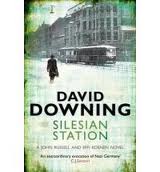 July 1939 and British-born John Russell returns from a trip to the United States with his son to re-enter ‘The Cage’ of Nazi Germany. As a foreign correspondent, Russell is aware that war is coming and the trip has provided him with an American passport that will enable him to stay living near to his son and close to his lover, the movie actress Effi Koenen, and a new job working for the San Francisco Tribune. The passport came for the price of spying on behalf of the United States, the job on condition that he exposes the plight of Jews in German controlled Europe. He arrives back in Berlin to find Effi in a basement cell of the Gestapo headquarters. The price for her release is Russell working for the Nazis, offering his services to the Russians, to whom he’ll pass on disinformation. Russell has communist leanings and on contacting the Russians offers to be a double agent. As tension rises along the Polish border, Russell plays a dangerous game of trying to keep his three controllers, plus his employer, content without revealing his duplicity, travelling to Prague, Breslau, Warsaw, Bratislava, and Moscow, notionally to cover unfolding events. To make life even more difficult, he has agreed to help a friend track down the Jewish niece of one of his employees that disappeared on arrival in Berlin, and Effi wants to find ways to resist and undermine the Nazi regime.
 There’s a lot to like about Silesian Station and it’s a step up from the first book in the series, Zoo Station. The characterization is richer and more keenly observed, and the plotting is excellent, interweaving a number of strands that collectively keep the dramatic tension high throughout the story. The historical context is well realised, both in relation to the larger macro-politics across the continent in the lead up to the start of hostilities, but also the everyday realities with respect to the diverse circumstances and views of people within communities, and how politics and communal relations played out in different locales (Berlin, the Polish border, Moscow, Prague and so on). Whilst the prose is quite workman-like, Downing nevertheless captures the sights and sounds, the cinema and cafes, the streets and apartment living, the fashions and pastimes, and the hopes and fears of people in difficult situations. The result is a rich, rewarding and entertaining read that steadily builds in tension and is satisfyingly resolved.


July 8, 2012
Lazy Sunday Service
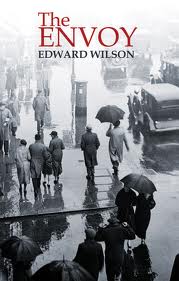 It's quite a long time since I read a book in a single day. Yesterday I worked my way through Edward Wilson's superb, The Envoy, a Cold War spy story set in 1950s Britain that skillfully blends real world events and people with a fictional tale. It's complex, multi-layered, atmospheric, full of historical and political insight, and reveals deep insight into human relations. Full review in due course. I also hope to post reviews of David Downey's excellent, Silesian Station, and Arnaldur Indridason's, Black Skies, this week.
My posts this week
June reviews
Review of The Trinity Six by Charles Cumming
A limited haul from Edinburgh
'Resolved' is a relative term if you live on an unfinished estate
It is was it is

July 7, 2012
It is what it is
‘Well?’ She asked, rising to her feet.
‘The usual.’ He draped his coat over the back of a kitchen chair. ‘Cut back on the sugar and salt. Get some exercise, lose some weight.’
‘And what about ...?’
‘He’s sending me for some tests. A specialist he recommends.’
‘When?’
‘Wednesday afternoon.’
‘Wednesday. So it’s ... you know?’
‘That’s what the tests are for. Probably. Don’t worry, it’ll be fine.’
‘That’s what my father said and ...’
‘Look, health care’s improved since then; they can treat almost anything these days.’
‘But ...’
‘But nothing. It is what it is. Life goes on.’
A drabble is a story of exactly 100 words
‘The usual.’ He draped his coat over the back of a kitchen chair. ‘Cut back on the sugar and salt. Get some exercise, lose some weight.’
‘And what about ...?’
‘He’s sending me for some tests. A specialist he recommends.’
‘When?’
‘Wednesday afternoon.’
‘Wednesday. So it’s ... you know?’
‘That’s what the tests are for. Probably. Don’t worry, it’ll be fine.’
‘That’s what my father said and ...’
‘Look, health care’s improved since then; they can treat almost anything these days.’
‘But ...’
‘But nothing. It is what it is. Life goes on.’
A drabble is a story of exactly 100 words
July 6, 2012
A limited haul from Edinburgh
 I was going to post a review of David Downey's Silesian Station today. Unfortunately, I haven't yet got round to writing it yet; a task for the weekend. I was busy in Edinburgh and I'm now at another conference. I also didn't manage to get myself to a bookshop in the city, but I did manage to pick up The Barbed Wire University: The Real Lives of POWs in the Second World War in the airport. It's author is Midge Gillies, married to crime author Jim Kelly. Looking forward to reading this one in due course.