Rob Kitchin's Blog, page 209
June 9, 2012
Nothing under the mattress
The chair toppled backwards, the old man’s head bouncing off the ground with a sickening thump.
A gloved hand grabbed his brother’s throat.
‘Where’s the money?’
‘What money?’ His voice was weak, his body shaking uncontrollably.
‘Your savings! Your stash of cash.’ The robber’s face was hot beneath the balaclava. ‘Tell me where
the money is or I swear to god I’ll kill you both!’
‘The bank. I told you before, our money’s in the bank.’
A second man, holding a knife, entered the room. ‘Nothing.’
‘He’s lying.’ A vicious punch snapped the man’s head back. ‘Where’s the fucking cash!’
A drabble is a story of exactly 100 words.

A gloved hand grabbed his brother’s throat.
‘Where’s the money?’
‘What money?’ His voice was weak, his body shaking uncontrollably.
‘Your savings! Your stash of cash.’ The robber’s face was hot beneath the balaclava. ‘Tell me where
the money is or I swear to god I’ll kill you both!’
‘The bank. I told you before, our money’s in the bank.’
A second man, holding a knife, entered the room. ‘Nothing.’
‘He’s lying.’ A vicious punch snapped the man’s head back. ‘Where’s the fucking cash!’
A drabble is a story of exactly 100 words.


June 8, 2012
Review of Kingdom of Shadows by Alan Furst (Victor Gollancz, 2000)

March 1938 and former Hungarian cavalry officer, Nicholas Morath, travels Europe from his Paris base performing duties for his uncle, the diplomat, Count Polanyi. Polanyi trades information, favours and conspiracy with the intelligence agencies and rogue agents of various countries as he tries to steer Hungary away from the clutches of the fascist Arrow Cross party and Nazi influence. Morath drifts through the shadows, carrying information, aiding people cross borders, funding political activity, encouraging and cajoling reluctant patriots, and trading intelligence, traipsing between Paris, Antwerp, Vienna, Budapest, Romania, Ruthenia, Slovakia and Sudeten mountains for clandestine meetings. It is clear the war is coming and the pressure is starting to build as Morath tries to ease political tensions, persuade his mother and sister to leave Hungary, maintain his relationship with Argentinian mistress, Cara, and keep his advertising business ticking over.
Furst’s novels are multi-layered, atmospheric affairs, full of crafted prose and understated plotlines. Kingdom of Shadows is no different. An awful lot happens in what is a normal length novel, as Morath criss-crosses Europe sliding in and out of various scrapes, and yet the pace seems leisurely and evocative. Furst is very good at setting a scene, placing the reader into a landscape, and in providing in an economical fashion the contextual politics both locally and at a European scale. In this sense, the reader comes to understand the fully geopolitical complexity of what was going on, without it swamping the narrative. That takes some skill and yet Furst makes it look effortless. As with his other novels, various strands are left somewhat ambiguous, a snapshot of one set of social relations at a particular place and time. My only critique is sometimes the storytelling is a little too understated, especially when something truly dramatic is taking place (being shot at and chased has the same tone and feel as meeting a girlfriend), and there is a little too much ambiguity at times. But when all said and done, Furst has a distinctive voice and its always a pleasure to read one of his books.


June 6, 2012
Review of Resistance: The French Fight Against the Nazis by Matthew Cobb (Pocket Books, 2009)
 In Resistance, Matthew Cobb provides a broad social and political history of the French resistance movement in France during the Second World War, drawing on extensive archival and interview research. What his analysis demonstrates is that the Resistance was, in fact, many resistances, made up of hundreds of groups and cells working in broad alliances, cross-cut with deep political schisms, clashes of personalities, differences in opinion, tactics and strategies, and answering to different masters. A real strength of the book is that Cobb manages to, on the one hand, contextualise resistance within wider European and global politics and the war, and within what was happening in France with respect to the Vichy regime and the apparatus of Nazi oppression, and on the other, to provide in-depth discussion of particular individuals and groups, and their motivations, aspirations, actions and fate. As such, he provides by both breadth and depth, dispassionate contextualisation and poignant intimacy. It’s a powerful combination that leads to a huge amount of information being crammed into a relatively short book without it ever feeling rushed or truncated. In addition, rather than simply describing events as with many historical texts, Cobb provides an explanatory framework, seeking to interpret why certain decisions were undertaken, and he does so from a relatively neutral position, detailing how others have interpreted the same events and why his view concurs or differs. In my view, it’s an excellent piece of work, covering a huge amount of ground in a lively, engaging and informative voice. If you want a rounded, synoptic introduction to the various Resistance movements in France, this is a great place to start.

June 5, 2012
A couple of interviews
 I've two book reviews to put up in the next couple of days. I'm still working on drafting them, so in the meantime here are links to two interviews that were published in the last couple of days concerning Killer Reels.
An origins piece on Crime Always Pays
A short, sharp interview on You Would Say That, Wouldn't You

June 4, 2012
May reviews
 A fairly varied month of reading, in terms of the styles, places and how I rated the books. My book of the month is Joe Lansdale's Edge of Dark Water, a porch-told, coming of age yarn set in East Texas in the 1930s. Edge of your seat stuff.
 Ghost Town by Michael Clifford ****.5
The Shark Infested Custard by Charles Willeford ***
Edge of Dark Water by Joe R Lansdale *****
Killed at the Whim of a Hat by Colin Cotterill **
Buried Strangers by Leighton Gage ***
Lumen by Ben Pastor ***.5
Snapshots by Paul Brazill ****
The Cold Dish by Craig Johnson ****.5
Dead Harvest by Chris F Holm ****

June 3, 2012
Lazy Sunday Service
I was asked this week whether I could write a character drive story about a monster with whom the reader can sympathise. The two main ways to do this, I think, is to make the story about redemption or vengeance. Weighing up which way to go, or maybe there's a third way ...?
My posts this week:
Census 2011: Age profiles
This book was written by someone else, wasn't it
1991-2011: One and a half housing units built for each new household
Review of Ghost Town by Michael Clifford
Spinetingler piece
Review of The Shark Infested Custard by Charles Willeford
Can you smell smoke?
According to the CIF we need to add supply to our oversupply (do we really need more houses?)
My posts this week:
Census 2011: Age profiles
This book was written by someone else, wasn't it
1991-2011: One and a half housing units built for each new household
Review of Ghost Town by Michael Clifford
Spinetingler piece
Review of The Shark Infested Custard by Charles Willeford
Can you smell smoke?
According to the CIF we need to add supply to our oversupply (do we really need more houses?)
June 2, 2012
Can you smell smoke?
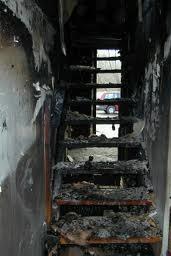 Sniff.
 ‘Can you smell that?’
‘What?’
‘Smoke.’ Sniff.
‘Probably next door burning rubbish again.’
‘Oh, god! I’ve got washing out.’ She dashes from the room. ‘Pete!’
‘What?’
‘Pete! The kids!’
He bolts for the door, black smoke twisting along the ceiling.
Flames are dancing in the kitchen, stretching out into the hall and up the stairs.
He hurtles past her, disappearing into the charcoal fog.
‘Pete! Sarah! Liam!’
The banister catches fire.
‘Mummy!’
‘Liam!’
Pete re-emerges, coughing, carrying a small boy. ‘Get out!’
He turns back to the stairs.
‘Daddy!’
He takes a deep breath, then dashes into the flames.
A drabble is a story of exactly 100 words.

June 1, 2012
Review of The Shark Infested Custard by Charles Willeford
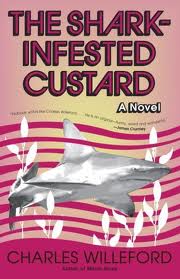 Four guys in their late twenties/early thirties live in a singles apartment block in Miami. Larry ‘Fuzz-O’ Dolman is an ex-cop who now works for a private security company. Eddie Miller is an airline pilot who’s studying for a real estate license. Don Luchessi is a salesman, separated from his wife, but pining for the company of his ten year old daughter. Hank Norton is a smooth talking drug company rep who claims to be able to pick up a woman in any locale. They spend their free time hanging by the pool, playing cards, going to the movies and trying to chat up women. When Hank bets the others that he can pick up a woman from what they agree is an impossible scoring location - a drive-in movie theatre - he sets in train a whole series of events, starting with trying to dispose of two bodies. All four guys love Miami, but can they take the heat?
The Shark Infested Custard is told in four parts, each part told in the first person from the perspective of one of the four lead characters. Willeford manages to produce four different voices and to provide a nice depth of characterization. The dialogue is spot-on, and the scenes are well penned, some of them very well so. There are some very nice observational touches throughout, especially Hank’s amateur psychology readings of other people, although this is tempered by some fairly explicit sexism and some political incorrectness around race. For me, it was the plot that was the weakest element of the book. Each part is an extended short story, with each intersecting with the others. In some places, the story didn’t really seem to be moving anywhere other than building the character. There just seemed to be little forward momentum and if I’d lost the book, I wouldn’t have felt compelled to buy another to find out how the book ended. And collectively the four parts didn’t seem to be adding up to more than the sum of the parts. That is, until the last few pages. Often novels seem to tail off at the end, whereas this one finished with a flurry that had the effect of lifting the whole book. Indeed, it is interesting that a day or so after finishing it, my opinion of its merits is much higher than when I was actually reading it. Overall, an uneven story that has some flashes of brilliance.


May 31, 2012
Spinetingler piece
 There's a short piece up on Spinetingler Magazine's website about Killer Reels. It provides a little bit of background to the book. Many thanks to Brian Lindenmuth who offered me a slot. Check it out ...
May 29, 2012
Review of Ghost Town by Michael Clifford (Hachette, 2012)
 Joshua ‘The Dancer’ Molloy could have been a professional footballer. Instead, he turned to drink and became a member of a drug’s gang. Having just got out of prison for drug smuggling, as part of his AA programme he has returned to Ireland to confront his past and to see his young son. Only his past mugs him, implicating him in the shooting of a gang leader, Junior Corbett. The hit unleashes a fresh wave of tit-for-tat killings amongst Dublin’s gangs and a contract being served for Molloy's life. The Dancer tries to go to ground, at the same time using the services of Noelle Higgins, a solicitor, to seek access to his child. Noelle has problems of her own. She’s married to Donal Higgins, a property developer whose empire is falling around his ears and who has fled the country leaving her to face disgruntled investors, the courts and the media. Alan Slate, a crime reporter trying to rebuild his career and working for a small start-up magazine, has been assigned to investigate both the attempt on Corbett’s life and Noelle’s husband. Well connected with the police, Slate excels at putting his nose where it’s not wanted. In a twist of fate, Corbett has invested in one of Higgins’ schemes and wants his money back. The scene is thus set for a complex game of cat and mouse, Molloy and Noelle trying to survive as various forces are ranged against them.
 Ghost Town is a very well written and entertaining debut novel. Michael Clifford is an Irish journalist and columnist and brings all his skills as a seasoned writer to the book. The real strengths of the novel are its plotting, the characterization, the sense of place, and the contextualization. The story is told through a series of short, tight scenes, shorn of any flab. This works to drive the plot along and to create a high tempo and good tension. And although the plotline is relatively complex, told from multiple perspectives, Clifford makes sure that the reader never loses the thread of the narrative. All of the characters are well penned with sufficient back story to give them depth and make them interesting despite there being a number of central cast members. A real plus for me was that Ghost Town is very much a book about modern Ireland, clearly set in Dublin and Kerry, and detailing elements of the property crash and how it has affected the lives of many. One touch I particularly liked was the symmetry between the professional footballer turned media mogul slowly disintegrating (Slate’s boss), with the failed footballer putting his life back together (Molloy). Clifford does an excellent job of bringing the story to a climax; though a couple of aspects of the resolution were a little clunky though just about credible. Overall, this is a very solid and enjoyable book and a very good complement to Alan Glynn’s Winterland and Gene Kerrigan’s The Rage.