Dan Jorgensen's Blog, page 494
December 21, 2015
That 'high tech' feeling
“Print-on-demand publishing is the new farm system for new voices in fiction. Authors who have compelling things to say, who can market their stories in compelling ways, will succeed.” - Daniel Suarez
More and more publishing houses are going to the new print on demand technology and no one can speak more to how successful the technique is than Suarez, whose novels started in that fashion before being “mainstreamed” by Dutton, one of the Big Five publishers.
Suarez, who was born on this day in 1964, is an IT specialist whose career as an author began with a pair of techno-thriller novels, Daemon, originally self-published under his own company Verdugo Press, and then Freedom, picked up by Dutton along with a re-release of the first one, which also has been optioned for a movie. His latest book, Influx, won the 2015 Prometheus Award.
 A former systems consultant to Fortune 1000 companies, Suarez loves writing, but also stays involved with technology, designing and developing mission-critical software for the defense, finance, and entertainment industries. He said he loves writing but sometimes pushes the wrong buttons with his topics.
 “When you write a high-tech thriller and then people in the defense establishment start calling you - people I can't name - you feel maybe you've hit a nerve. Oh well.”
Share A Writer’s Moment with a friend by clicking g+1 below.


December 20, 2015
'I could tell their stories'
“I always tell people that I became a writer not because I went to school but because my mother took me to the library. I wanted to become a writer so I could see my name in the card catalog.”– Sandra Cisneros
Cisneros (born on this date in 1954) is an American writer best known for her acclaimed first novel The House on Mango Street and her subsequent short story collection Woman Hollering Creek and Other Stories. She is the recipient of numerous awards including a National Endowment for the Arts Fellowship, and is
 regarded as a key figure in Chicana literature.
A native of Chicago who now lives in San Antonio, TX, Cisneros worked as a teacher, a counselor, a college recruiter, a poet-in-the-schools, and an arts administrator before her writing successes. Since then, she has maintained a strong commitment to community and literary causes. In 1998 she established the Macondo Foundation, which provides socially conscious workshops for writers.
It was gaining an understanding of her own social and cultural background that gave her the insight and courage to write from those perspectives. “Cultural environment became a source of inspiration. I could write of neighbors, the people I saw, the poverty that the women had gone through. I could tell their stories.
“One press account said I was an overnight success,” Sandra said. “I thought 'that was the longest night I've ever spent'.”
Share A Writer’s Moment with a friend by clicking g+1 below.
December 19, 2015
Sharing smiles like roses
“As individuals, we are shaped by story from the time of birth; we are formed by what we are told by our parents, our teachers, our intimates.”– Helen Dunmore
My choice for "Saturday's poet" is British writer Helen Dunmore, who said growing up in a large family (her parents also came from large families) was a great influence on her writing because, "In a large family you hear and observe a great many stories." The writer of award-winning poetry and a couple dozen books (mostly for children), she said writing books for kids has given her a special grounding in her craft.
“Writing children's books gives a writer a very strong sense of narrative drive. Children will not pretend to be enjoying books, and they will not read books because they have been told that these books are good. They are looking for delight.”
Among her clever children’s books are Aliens Don’t Eat Bacon Sandwichesand Go Fox, two of her several of her works taught in British elementary schools. Here’s "Saturday's Poem" by Dunmore.
Smiles Like Roses
All down my street
smiles opened like roses
sun licked me and tickled me
sun said, Didn’t you believe me
when I said I’d be back?
I blinked my eyes, I said,
Sun, you are too strong for me
where’d you get those muscles?
Sun said, Come and dance.
All over the park
smiles opened like roses
babies kicked off their shoes
and sun kissed their toes.
All those new babies
all that new sun
everybody dancing
walking but dancing.
All over the world
sun kicked off his shoes
and came home dancing
licking and tickling
kissing crossing-ladies and fat babies
saying to everyone
Hey you are the most beautiful
dancing people I’ve ever seen
with those smiles like roses!
Share A Writer’s Moment with a friend by clicking g+1 below.
December 18, 2015
Getting some 'satisfaction'
“Songwriting's a weird game. I never intended to become one - I fell into this by mistake, and I can't get out of it. It fascinates me. I like to point out the rawer points of life.” – Keith Richards
Born on this date in1943, in the London suburb of Dartford, Kent, Richards started life on the go as his family was temporarily evacuated from their home during the Nazi bombing and rocket campaign of 1944. In 1951, while attending primary school, Richards first met and befriended Mick Jagger in what would not only become a lifetime friendship but also the start of a musical dynasty, leading ultimately to their being enshrined in the Rock and Roll Hall of Fame.
The pair founded the Rolling Stones as a rhythm and blues and jazz group when they were still in their teens and never looked back, although it wasn’t until they changed their style to straight rock in 1964 that they really hit their stride, mostly on songs written by Richards, the biggest (and longest-lasting) hit being I Can’t Get No Satisfaction.
Despite their image as the “anti-Beatles” – a counter to that other wildly popular British boy band of the day – “It was a very, very fruitful and great relationship between the Stones and The Beatles. It was very, very friendly,” Richards said.
While writing music is his forte’, Richards also wrote his autobiography and memoir Life, which was a worldwide bestseller and showed remarkable command of writing style. But, like some of his songs, it was jabbed at by some critics as being a bit ambiguous, to which Richards replied, “I look for ambiguity when I'm writing, because life is ambiguous.”
To hear a great recent interview with Richards, done on NPR’s show “Fresh Air,” go to this link. I promise that you WILL “get some satisfaction.” http://www.wbur.org/npr/441412552/keith-richards-the-fresh-air-interview
Share A Writer’s Moment with a friend by clicking g+1 below.
December 17, 2015
The 'right word at the right time'
“When I need to know the meaning of a word, I look it up in a dictionary.” – William Safire
Born on this date in 1929, just days after the Great Stockmarket Crash, Safire grew up in the turmoil of the 1930s to become one of America’s best-known authors, columnists and journalists. He also was an off-and-on speechwriter for President Nixon and Vice President Agnew, including penning the famous Agnew line describing those opposing their policies as “Nattering Nabobs of Negativism.”
A stickler for language uses and demands, he was perhaps best known as a long-time syndicated political columnist for the New York Times and the author of "On Language" in the Sunday New York Times Magazine, a column on new or unusual usages, and other language-related topics that he wrote right up until his death in 2009. He also is the author of The Right Word in the Right Place at the Right Time.
A two-time Pulitzer Prize winner, he disdained fellow journalists and writers who used what he termed “insiderisms” to try to attract or dazzle readers. “Do not be taken in by 'insiderisms,’” he once noted. “Fledgling columnists, eager to impress readers with their grasp of journalistic jargon, are drawn to such arcane spellings as 'lede.' I say, ‘Where they lede, do not follow.’”
Lede, by the way, is the longtime journalistic term for the “opening” of a story, supposedly containing all the key or important information needed. Safire always delighted in adding a key “nugget” of info. later in his stories – “just to keep the readers on their toes.”
 Safire on “Meet The Press” As a native New Yorker who revered the artistic scene of the Big Apple, he also was a longtime supporter for and writer about the arts both by and for the public. “One challenge to the arts in America,” he encouraged, “is the need to make the arts, especially the classic masterpieces, accessible and relevant to today's audience.”
Share A Writer’s Moment with a friend by clicking g+1 below.
December 16, 2015
Seeking out the answers
“I don't pretend we have all the answers. But the questions are certainly worth thinking about.” – Arthur C. Clarke
Clarke, a native of Great Britain who lived 60 years in Sri Lanka, was born on this date in 1917. He is perhaps most famous for co-writing the screenplay for the movie 2001: A Space Odyssey, widely considered one of the most influential films of all time. His other science fiction writings earned him a number of Hugo and Nebula awards, which along with a large readership made him one of the towering figures of science fiction.
Clarke started writing as a journalist, focusing on science writing. He was a lifelong proponent of space travel and a futurist of uncanny ability. He also was one of the early “pushers” for nations to “get into that business.” In 1934, while still a teenager, he joined the British Interplanetary Society, and as early as1945, he proposed a satellite communication system remarkably similar to the one we all use today.
He wrote over a dozen books about space and space travel proposing ideas that have become reality in today’s scientific world. Those books along with his myriad essays in popular and scientific journals and magazines earned him the moniker “Prophet of the Space Age.” “Politicians should read science fiction, not westerns and detective stories,” he once said. “Then maybe we’d get some things done.”
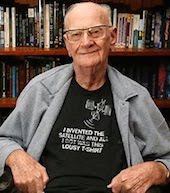 Arthur C. Clarke was 90 when he died in 2008. His shirt reads: "I invented the satellite and all I got was this lousy t-shirt"
 In the 1980s Clarke became well known to many for his television programs Arthur C. Clarke's Mysterious World, Arthur C. Clarke's World of Strange Powers, and Arthur C. Clarke's Mysterious Universe. The popularity of those shows was influential on both writers and scientists around the world as he urged both to “look at the impossible and then find ways to make it possible. The limits of the possible can only be defined by going beyond them into the impossible.”
Share A Writer’s Moment with a friend by clicking g+1 below.
December 15, 2015
'Breathe-in' experiences
“A work of art is one through which the consciousness of the artist is able to give its emotions to anyone who is prepared to receive them. There is no such thing as bad art.” – Muriel Rukeyser
Born on this date in 1913, Rukeyser was an American poet and political activist, best known for her poems about equality, feminism, social justice, and Judaism. Critic and fellow writer Kenneth Rexroth said that she was the greatest poet of her "exact generation."
One of her most powerful pieces was a group of poems entitled The Book of the Dead (1938), documenting the details of the Hawk's Nest incident in West Virginia, an industrial disaster in which hundreds of miners died of silicosis. That followed closely on the heels of her coverage of the Scottsboro Boys case in Alabama (as a journalist), and her work for the International Labor Defense,
 which handled the defendants' appeals. Her writings on the case were among those used in the creation of the award-winning Broadway show by the same name.
Throughout her life (she died in 1980) she traveled to all the world’s hot spots, including the Spanish Civil War in the ‘30s, the war fronts during World War II and Korea, and to Vietnam, primarily using her powerful poetic style to speak out on behalf of what she considered to be injustice or mistreatment. A play about her life with a working title of Throat of These Hours is being developed from her poem Speed of Darkness.
The key to powerful and expressive writing, she said, was experience. “Breathe-in experience. Breathe-out poetry.”
Share A Writer’s Moment with a friend by clicking g+1 below.
December 14, 2015
Writing right -- no wrong ways
“Most important of all, there is no right or wrong way to write - there's only what works for you. I was taught to write every day, but I know a writer (a bestseller at that!) who only writes on weekends.” – Tamora Pierce A native of Pennsylvania, Tamora Pierce, born on this date in 1954, is a writer of fantasy fiction for teens, and best known for stories featuring young heroines. She made a name for herself with her first book series, The Song of the Lioness (1983–1988), which followed the main character Alanna through the trials and triumphs of training as a knight. Since then she’s written a dozen more books and several series, and in 2013 she was the recipient of the American Library Association’s “Margaret A. Edwards Award” for her significant
 and lasting contributions to young adult literature.
Pierce draws on elements of people and animals around her for inspiration. She said she gets most ideas from things she stumbles upon and then “adapts.” Her concept of magic as a tapestry of threads comes from her experiences in crocheting, and in her world all images are somehow based on British naturalist David Attenborough after watching his nature documentaries. “What people tell me they take away from my books is that they can shape their lives, they can achieve their own dreams,” she said. “And certainly that's what I want them to take away.”
Share A Writer’s Moment with a friend by clicking g+1 below.
December 13, 2015
Catching those 'everyday reflections'
“What interests me is trying to catch the reflection of the human being on the page. I'm interested in how ordinary people live their lives.” – Tracy Kidder
John “Tracy” Kidder, who just turned 70, is a Pulitzer Prize-winning writer of nonfiction focusing on – as he says – the lives of “everyday people.” He has explored a wide range of topics through his books, ranging from his award winner, The Soul of a New Machine (about a breakthrough development of a computer) to House, a "biography" of a couple having their first house built, to Among Schoolchildren, reflecting on U.S. education through the lives of 20 children and their teacher. His Old Friends was a poignant study of a pair of elderly men in a nursing home.
Considered a literary journalist because of the strong story line and
 personal voice in his writing, he wrote in a 1994 essay for The Atlanticthat "In fiction, believability may have nothing to do with reality or even plausibility. It has everything to do with those things in nonfiction. I think that the nonfiction writer's fundamental job is to make what is true believable."
A native of New York City, Kidder served two years in Vietnam, but said that unlike other veterans who became writers he didn’t think that had much influence on him. “I know that to write you have to have stories you want to tell,” he said. “You just have to keep your mind alive, and you have to work hard. Things were here before you and will be here after you're gone. The geographic features, especially, give you a sense of your own place in the world and in time.”
Share A Writer’s Moment with a friend by clicking g+1 below.
December 12, 2015
And miles to go
On a snowy early winter morning here in Colorado (and across much of the nation, it seems), this Robert Frost poem seems like an apropos selection for today’s blog entry. Frost actually wrote the poem on an early June morning after staying up working all night on his long poem New Hampshire, the foundation poem for his 1923 book by the same name – and a book that would win the 1924 Pulitzer Prize for Poetry.
After the long night at his desk, he went outdoors to view the sunrise and instead, clearly saw (in his mind) the scene that became this poem.
 He quickly went back indoors and wrote it down in just a few minutes. Stopping by Woods on a Snowy Evening Whose woods these are I think I know.His house is in the village though.He will not see me stopping hereTo watch his woods fill up with snow.
My little horse must think it queerTo stop without a farmhouse nearBetween the woods and frozen lakeThe darkest evening of the year.
He gives his harness bells a shakeTo ask if there is some mistake.The only other sound’s the sweepOf easy wind and downy flake. The woods are lovely, dark and deep.But I have promises to keep.And miles to go before I sleep,And miles to go before I sleep.
Share A Writer’s Moment with a friend by clicking g+1 below.