Dan Jorgensen's Blog, page 422
November 19, 2017
A 'tireless' writing theme
“In order to truly ‘be’ a writer, you have to write every day. I get up at 6 a.m., read the papers, and then write from 8 until noon.” - John Waters
The 71-year-old Waters is a noted American film director (Hairspray is just one of his many hits), screenwriter, actor, stand-up comedian, journalist, visual artist and art collector, and creative writer. Also, somewhat of a bibliophile, he has a personal library of more than 8,000 books, and says the one that most affected his own work was L. Frank Baum’s The Wonderful Wizard of Oz, which also resonated with him in the movie version because of “Great dialogue,” one of the things he prides himself on when he’s writing movie scripts.
With the motif "My life is so over-scheduled, what will happen if I give up control?”, Waters completed a hitchhiking journey across the United States from Baltimore to San Francisco and then turned his adventures into the 2014 bestselling book Carsick.
 A native of Baltimore the seemingly tireless Waters has a new book, Make Trouble, moving up several bestseller lists. He is also both doing live acting and “voice” acting in animated movies. And, he is working on more books, screenplays and short stories. But when December arrives, he said he will be devoted to writing Christmas cards. “I send out about 2,000 cards.” Definitely helps fill his requirement of “writing every day” and probably makes him the U.S. Postal Service's poster boy in the process.
 Share A Writer’s Moment with a friend by clicking the g+1 button below.


November 18, 2017
Helping the truth 'burst forth'
“I was not out to paint beautiful pictures; even painting good pictures was not important to me. I wanted only to help the truth burst forth.”– Alice Duer Miller Born in 1874, Duer Miller was an American writer whose poetry actively influenced political opinion. Her feminist verses impacted on the suffrage issue, while her verse-play The White Cliffs about an American girl coming to London encouraged U.S. entry into World War II. A spectacular success on both sides of the Atlantic, the poem sold over 1 million copies.
 She also wrote many successful novels, short stories and screenplays and was on the very first advisory board for The New Yorker. Here, for Saturday’s poem, is her poem about an encounter on a train.
 To An Old Lady In A Train
Her hair was beautifully white
Beneath her bonnet, black as night,
Which, plainly of New England kin,
Was tied with strings beneath her chin.
And when she spoke I had no choice
But listened to that soft crisp voice;
And when she smiled, I saw the truth,
She had been lovely in her youth,
And with those quick, observing eyes,
Was charming still to all the wise.
And still, in spite of bonnet strings,
She thought keen, quaint, amusing things,
With gaiety that many hold
Remarkable in one so old.
We talked ten minutes in a train,
And when we came to part again,
‘Good-bye, enjoy yourself,’ said she.
I told her that ahead of me
No pleasure beckoned, no, I said,
Stern duty only lay ahead!
‘Oh, well,’ her parting answer ran,
‘Enjoy yourself the best you can.’
And so unconquerably gay,
She went upon her darkening way.
Share A Writer’s Moment with a friend by clicking the g+1 button below.
November 16, 2017
Finding 'balance' for characters and themes
I want readers turning pages until three o'clock in the morning. I want the themes of books to stick around for a reader. I'm always trying to find a way to balance characters and theme.” – Guy Gavriel Kay
Canadian writer Guy Gavriel Kay, born in November 1954, has had a knack for creating what is commonly known as “page turner” books, writing historical fantasy fiction with a flair that has distinguished his writing over several decades. He cut his teeth on fantasy writing by traveling to Oxford to assist Christopher Tolkien, son of J.R.R. Tolkien, editing J.R.R.’s unpublished work The Silmarillion. With that experience as inspiration he began his own career with the 1984 book The Summer Tree.
Many of his novels are set in fictional realms that resemble real places during real historical periods, such as Constantinople during the reign of Justinian I, or Spain during the time of El Cid.
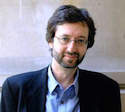 He has authored a dozen best-selling novels, now translated into some 25 languages, most recently focused on Middle Ages China, although his settings and lead characters have come from almost every era.
Not afraid to mix eras and genres, he has won multiple awards, including The World Fantasy Award for the book Ysabel, set in modern day France but bringing his teenage lead into direct contact with characters from both the distant past and another “parallel” world to ours. “I have always argued,” he said, “(that) in a good novel, interesting things happen to interesting people, no matter who they are or where they are from.”
Share A Writer’s Moment with a friend by clicking the g+1 button below.
November 15, 2017
Always the art of the possible
“Science fiction is any idea that occurs in the head and doesn't exist yet, but soon will, and will change everything for everybody, and nothing will ever be the same again. As soon as you have an idea that changes some small part of the world, you are writing science fiction. It is always the art of the possible, never the impossible.” – Ray Bradbury
One of the most celebrated 20th- and 21st-century American genre writers, Bradbury won numerous awards for his science fiction, including a 2007 Pulitizer. He also wrote and consulted on screenplays and television scripts, including Moby Dick and It Came from Outer Space. Many of his works were adapted to comic book, television and film formats. And, of course, he wrote the dystopian novel Fahrenheit 451 and the series The Martian Chronicles. On his death in 2012, The New York Times called Bradbury "the writer most responsible for bringing modern science fiction into the literary mainstream."
 One of our country’s strongest advocates for the public library system, Bradbury said he spent three days a week for 10 years educating himself in the public library, “And it's better than college. People should educate themselves - you can get a complete education for no money. At the end of 10 years, I had read every book in the library and I'd written a thousand stories.”
Share A Writer’s Moment with a friend by clicking the g+1 button below.
November 14, 2017
The 'Surprising' Act of Writing
“The act of writing surprises me all the time. A miraculous thing happens when you have an idea and you want to convert it into words... and then you start to create a work of art, and that's another miracle, and it remains mysterious to the writer, or to this writer anyway.” – Janette Turner Hospital
Born in November, 1942, Turner Hospital grew up in Australia but has spent most of her adult life in either Canada or the U.S. “All my writing, in a sense, revolves around the mediation of one culture (or subculture) to another,” she said. While she is best known for her novels, she also is an accomplished and productive short story writer and has won numerous awards in both genres. One of Turner Hospital's most accomplished novels is Borderline, simultaneously a narrative thriller and a story of moral speculation and inquiry. Set on the “borderline” of Canada and the U.S., its storyline also focuses on where to draw the "borderline" between intrusion into others' lives and responsibility for them.
 Among her many awards areCanada’s Seal Award, the CDC Literary Prize, and the Australian National Book Council Award. Also a teacher of both literature and creative writing, she has been writer-in-residence at major universities in Australia, Canada, England and the U.S. and recently has been Visiting Writer-in-Residence in the MFA program at Columbia University.
 “The themes of dislocation and connection are constant in my work,” she said. “So are the themes of moral choice and moral courage. I am always putting my characters into situations of acute moral dilemma . . . to find out what they will do.”
Share A Writer’s Moment with a friend by clicking the g+1 button below.
November 12, 2017
Getting the right word in the right place
“There was never yet an uninteresting life. Such a thing is an impossibility. Inside of the dullest exterior there is a drama, a comedy, and a tragedy. (As writers) We recognize that there are no trivial occurrences in life if we get the right focus on them.”– Mark Twain
When I was a kid I found myself mesmerized by Mark Twain’s writing. I clearly could become Tom Sawyer or Huck Finn or any of the other characters he brought to life. I wished not only to be them but to be in the places in which they were living, and when I opened one of his books I was immediately transported from my South Dakota farm to the streets of Hannibal, Missouri or onto the Mississippi River.
Born Samuel Langhorne Clemens on a November day in 1835 just after a visit by Halley’s Comet, he famously predicted he would "go out with it" too. He died one day following the comet's subsequent return in 1910.
 Nobel winner William Faulkner called Twain the father of American literature, and he’s been lauded as one of America's greatest humorists. Our nation's annual lifetime award to those who bring laughter and light to our lives is given in his name. Despite some controversy about things he said or wrote, there’s little doubt that he brought words to life through his vivid writing. In a letter to another author, he once wrote:
 “To get the right word in the right place is a rare achievement. To condense the diffused light of a page of thought into the luminous flash of a single sentence, is worthy to rank as a prize composition just by itself . . . Anybody can have ideas - the difficulty is to express them without squandering a quire of paper on an idea that ought to be reduced to one glittering paragraph.”
Share A Writer’s Moment with a friend by clicking the g+1 button below.
November 11, 2017
'Let Us Have Peace'
On Veterans Day I want to not only salute my fellow Veterans but also share a few thoughts on why we observe this day.
When Nov. 11 became a holiday, it was known as Armistice Day, dedicated to those who fought and to the memory of those who died. Its name recognized the armistice that officially ended World War I. In fact, it was called Armistice Day until 1954, when Congress enacted legislation to change it to the current designation.
Perhaps of greater interest than remembering veterans, though, should be a remembrance of why Armistice Day seemed worthy of a holiday. It was to recognize peace. Some of our World War I allies, including Canada, still adhere to that thought, recognizing Nov. 11 as “Remembrance Day.” They remember that on a cold muddy field on the border of Belgium and France near the dawn of the 20thCentury one great army surrendered to another and began to observe peace instead of war. Peace had broken out and the silencing of the machines of war was just cause for celebration.
Nancy Byrd Turner, in her fine poem about the armistice, “Let Us Have Peace,” wrote: The Earth is weary of our foolish wars. Her hills and shores were shaped for lovely things. Yet, all our years are spent in bickerings beneath the astonished stars.
With life so fair, and all too short a lease
Upon our special star! Nay, love and trust,
Not hate and violence shall redeem our dust.
Let us have peace!
Men and women took up arms in the hope that by doing so they and their children could forever embrace peace. As we observe Veterans Day, let us hope this goal will not be forgotten. To strive for peace is a promise Americans ultimately should be making every year, not only when “observing” Veterans Day, but, indeed, when “celebrating” it.
Share A Writer’s Moment with a friend by clicking the g+1 button below.
November 10, 2017
Making reading a pleasure
“When we talk about good books, we often talk about good sentences, but what we rarely talk about is reader pleasure. Yet it is reader pleasure that is going to make a book break out into the kind of success that makes it into a household name.” – Holly Black
Born on this date in 1971, Black is perhaps best known for The Spiderwick Chronicles, a series of children's fantasy books she created with writer and illustrator Tony DiTerlizzi. But, it’s her 2013 novel Doll Bones that made the biggest splash, earning her a Newbery Medal honor.
A native New Jerseyan, who graduated from the College of New Jersey and started her career as a medical books editor, Black broke onto the creative writing scene in 2002 with a bang with her fantasy book Tithe: A Modern Faerie Tale. The book won a handful of awards and started her down a distinguished writing path. Every one of her books has won some sort of award, led by the resounding success of Doll Bones.
 At least 3 of her books or series have now been optioned or made into movies.
 Black’s advice to new writers is to not let writing overwhelm you. “Can you write 200 words a day? 100? 50? In six months, 50 words a day is 9,000 words,” she said. “That's 2-3 short stories. If you did 200 words every day, in three months that's 36,000 words. That's half a short novel.”
Share A Writer’s Moment with a friend by clicking the g+1 button below.
November 9, 2017
Seeing the story, inside-out
“The thing that makes vivid writing is when the reader is in the body of the story, the body of the character. Things smell like something; there's weather, there's texture, there's light.” –Janet Fitch
Born on this date in 1955, Fitch is the author of the international bestseller White Oleander,also a 2002 film by the same name. A native of Los Angeles (3rd generation), she said she grew up in a family of voracious readers but planned to become a historian, not a writer, when she attended Reed College in Oregon. But on her 21st birthday she said she had a revelation that she should, instead, write fiction. And so she did.
 Now a professor of fiction writing at Southern Cal, where she has taught for 14 years, she also has written numerous short stories, essays, articles, and reviews, contributed to anthologies and regularly teaches at the Squaw Valley Community of Writers. Her most recent book is Paint It Black, also made into a feature film.
 Fitch’s advice for beginning writers is simple: “I always read poetry before I write,” she said, “to sensitize me to the rhythms and music of language.”
Share A Writer’s Moment with a friend by clicking the g+1 button below.
November 8, 2017
The raw material of our craft
“Increase your word power. Words are the raw material of our craft. The greater your vocabulary, the more effective your writing. We who write in English are fortunate to have the richest and most versatile language in the world. Respect it.” – P.D. James
Phyllis Dorothy James had a long and illustrious life as a writer, editor, forensic scientist and leading voice of women’s rights in the mid-20th century. Unofficially known as “The Queen of Crime” for her writings in that genre, she won dozens of major awards, received 7 honorary doctorate degrees and a dozen leading writing fellowships, led the Royal Society of Authors, and was knighted by Queen Elizabeth for her contributions to literature.
Not bad for a high school dropout (who left school to help earn money for her impoverished parents) and who later was the sole breadwinner for her own two daughters when her husband was incapacitated in World War II. It was after the war that she first got interested in what went into solving crimes – the focal point of her writing – by working for the police and then writing about it.
While many writers create a private library of works that they personally enjoy, James had what I would term a "unique" addition to hers – the complete bound volume of Notable British Trials, which she termed “a fascinating read” and went to almost daily for both relaxation and inspiration.
 Her insights from both her work and her reading led to great creations, which to date have sold more than 15 million copies worldwide. James died 3 years ago this month at the age of 94. “I don't think writers choose the genre, the genre chooses us,” she said about the writing that she did. “I wrote out of the wish to create order out of disorder, the liking of a pattern.”
Share A Writer’s Moment with a friend by clicking the g+1 button below.