Dan Jorgensen's Blog, page 426
October 9, 2017
'Listening in' to document life
“The great advantage of being a writer is that you're there, listening to every word, but part of you is observing. Everything is useful to a writer, you see - every scrap, even the longest and most boring of luncheon parties.”– Graham Greene
Greene's quote also is interesting in that he was believed to have worked as a spy for the British government during World War II and beyond while continuing to hone his writing career. Born on this day in 1904, he is regarded as one of the greatest writers of the 20th century, reinforced by author John Irving, who described him as "the most accomplished living novelist in the English language." Shortlisted for the Nobel Prize in Literature, Greene produced 25 novels that mostly explored the ambivalent moral and political issues of the modern world. He also wrote short stories, essays, plays and movie scripts and worked as a journalist during a 67-year career. He was working as an editor on The Times of London when his first novel, The Man Within, was published in 1929 to immediate critical acclaim. In 1941, he won the prestigious Hawthornden Prize for his masterpiece The Power and the Glory.

Considered one of the most “cinematic” of 20th century writers (nearly all of his novels and many of his short stories were made into movies or television shows), his characters are both interesting and controversial, for which Greene had a logical explanation. “(You know) the moment comes when a character does or says something you hadn't thought about. At that moment he's alive and you just have to leave it to him to do whatever he prefers.”
Share A Writer’s Moment with a friend by clicking the g+1 button below.


October 7, 2017
The lore of the Lakota
Traveling today in the land of the Lakota where my novel is set, and am reminded of the legend of White Buffalo Calf Woman – a key figure in the lore of The Lakota, who play an integral role in my story And The Wind Whispered.
White Buffalo Calf Woman tells us to spread our voices on the wind, follow our visions, and never give up on the light within; to shed any darkness in and around our lives, and join together to help one another. And, as the youngest Sister of all the Grandmothers -- of earth, wind and sky -- White Buffalo Calf Woman reminds us to remember and be mentors to the young.
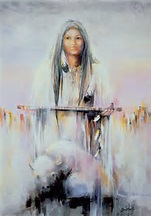 White Buffalo Calf Woman taught the mysteries of the earth and the pathways to follow while living upon it. The earth, she said, is the hoop of the people. For Saturday’s Poem, from the lore of White Buffalo Calf Woman, here is,
 The Hoop of the People“When one sits in the Hoop of The People,
one must be responsible because
all of Creation is related.
The hurt of one is the hurt of all.
The honor of one is the honor of all.
And whatever we do affects everything in the Universe.”
White Buffalo Calf Woman gazed Out upon The People as she spoke.
“If you do it that way - that is,
if you truly join your heart and mind
as One - whatever you ask for,
that's the way it's going to be.”
Then she faded into the night sky,And the wind whispered.
Share A Writer’s Moment with a friend by clicking the g+1 button below.
October 6, 2017
Writing that 'transfers' those images
“Good writing … is especially important in a subject such as economics. It is not enough to explain. The images that are in the mind of the writer must be made to reappear in the mind of the reader, and it is the absence of this ability that causes much economic writing to be condemned, quite properly, as abstract.” – John Kenneth Galbraith
From time-to-time students will ask why they have to take a “writing” class, when they’re planning to go into business, mathematics, computers, or economics. I say to them, make writing the foundation of ANY career choice.
It also was the mantra of Galbraith (born in October, 1908), the economist, public official, and diplomat, who taught economics for decades at Harvard and also served as a U.S. Ambassador to India in the Kennedy administration. His books on economic topics were bestsellers from the 1950s through the 2000s, during which time he also filled the unofficial role of “public intellectual.” A prolific author, he wrote four dozen books, including several novels, and published more than a thousand articles and essays.
 In 1977, he wrote the scripts for the major PBS and BBC Television series on economics – The Age of Uncertainty– a series I highly recommend for its clarity and – as it turned out – prophetic insights. It went on air in 38 countries. “One of the greatest pieces of economic wisdom,” Galbraith once noted, “is to know what you do not know.”
Share A Writer’s Moment with a friend by clicking the g+1 button below
October 1, 2017
Those 'notebooks' on life
“Notebooks allow for all kinds of record-keeping, and I kept one myself as a kid. I was attracted to mixing up words and pictures freely, since that's how I think.”– Marissa Moss
Born in Pennsylvania on Sept. 29, 1959, Moss first submitted a book for publication at the age of 9 and had her first picture book published at age 29. Her mid-1990s book, Ameilia’s Notebook, broke the boundaries of what a “kid’s book” should look like and laid the foundation for many other authors who have since had similarly styled books.
Her first publishing decade was devoted to making picture books, until Amelia's Notebook came out in the format of a journal or diary penned in a black and white composition notebook. Moss (who resides outside San Francisco)
 says that she loves this format because it allows her to explore the world through a child's eyes. “I'd sent it to traditional publishers I'd been working with, but nobody knew what to do with it.” she said. “Tricycle was this small publisher who didn't know any better, and they took a chance.” It not only earned Moss numerous awards but also legions of dedicated readers and a more than 30-book series based on Amelia’s “notebooks.”
She has written several other groups of books in a similar style, including the wildly popular “Mira’s Diary” series about a girl who time-travels to share tales from historical settings. But it was Amelia who made it all a possibility.“ Amelia shows that it's not what happens in life that counts, but rather how you frame it,” Moss said. “(It’s) how you talk about it.”
Blogger’s Note: I’ll be taking the next few days off as I’m traveling by houseboat on the Mississippi River and “mostly” out of reach of an internet connection. I’m hoping to post again on Friday. Until then, may you have your own “writers’ moments.”
Share A Writer’s Moment with a friend by clicking the g+1 button below
September 30, 2017
Reflecting on 'The Truly Great'
“Great poetry is always written by somebody straining to go beyond what he can do.” – Stephen Spender
Spender (born in 1909 and died in 1995) was an English poet, novelist, and essayist who concentrated on themes of social injustice and the class struggle. A frequent lecturer and visiting professor at U.S. colleges and universities, he became the first non-U.S. poet to be appointed Poet Laureate Consultant to the United States Library of Congress (in 1965). He served in that role for 3 years.
 In 1984, on the occasion of the 40thAnniversary of D-Day, Ronald Reagan quoted from the Spender’s poem, The Truly Great, presented here for Saturday’s Poem.
 The Truly GreatI think continually of those who were truly great.
Who, from the womb, remembered the soul's history
Through corridors of light where the hours are suns
Endless and singing. Whose lovely ambition
Was that their lips, still touched with fire,
Should tell of the Spirit clothed from head to foot in song.
And who hoarded from the Spring branches
The desires falling across their bodies like blossoms.
What is precious is never to forget
The essential delight of the blood drawn from ageless springs
Breaking through rocks in worlds before our earth.
Never to deny its pleasure in the morning simple light
Nor its grave evening demand for love.
Never to allow gradually the traffic to smother
With noise and fog the flowering of the spirit.
Near the snow, near the sun, in the highest fields
See how these names are feted by the waving grass
And by the streamers of white cloud
And whispers of wind in the listening sky.
The names of those who in their lives fought for life
Who wore at their hearts the fire's centre.
Born of the sun they travelled a short while towards the sun,
And left the vivid air signed with their honour.
Share A Writer’s Moment with a friend by clicking the g+1 button below.
September 29, 2017
A nice honor
“And the Wind Whispered represents refreshing new ground in Western novel writing.” – Paul F. Murray (Reader’s Favorite Reviews)
Me and The Banner at the Historical Writers of America National Conference in Albequerque, NM.
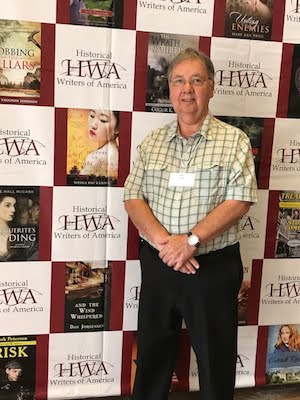
A nice honor and definitely – at least for me – A Writer’s Moment! Happy reading and many happy writers' moments to everyone.
Share A Writer’s Moment with a friend by clicking the g+1 button below.
September 28, 2017
The earth shares its 'music'
“Knowledge is recognition of something absent; it is a salutation, not an embrace.”– George Santayana
Philosopher George Santayana, who died 65 years ago this month, is perhaps best known for his quote, “Those who do not remember the past are condemned to repeat it.”
The Spanish-born Santayana spent almost as much time in America as in his native Spain and often referred to himself as a “dual” citizen. He authored his main philosophical work, The Sense of Beauty, his first book-length monograph, while living in the U.S. It’s often cited as the first major work on aesthetics written in this country.
 Santayana loved the beauty of the world around him and left us with many eloquent notes and quotes on nature, fodder for anyone who aspires to be a writer. One which nicely illustrates the beautiful autumn colors is one of my favorites:
 “The earth,” Santayana said, “has music for those who listen.”
Share A Writer’s Moment with a friend by clicking the g+1 button below.
September 27, 2017
Taking on the 'tough topics'
“Writing is such a good thing to do because you can't really get bored with it. If you're bored with writing, you're bored with life.”– Irvine Welsh
A native of Scotland who was born on this date “sometime in the 1950s,” Welsh burst onto the literary scene with his 1993 bestselling novel Trainspotting, also made into a successful movie. Based on a series of loosely connected short stories, the book tells about a group of characters tied together by decaying friendships, addiction, and efforts to escape the oppressive boredom and brutality of their lives. The award-winning film featured rising stars Ewan McGregor, Kelly MacDonald, Johnny Lee Miller, Ewen Bremner and Kevin McKidd.
Welsh has authored 11 novels and 4 short story collections – most based on the lives of working class Scots. His 2016 book The Blade Artist won wide acclaim, as did his 2017 screenplay for Trainspotting, T2, a sequel to the first movie. Welsh has written a number of successful screenplays, several plays, and one musical.
 Unflinching in writing about tough topics, including addiction, hooliganism, prejudice and class divisions, Welsh offers the following advice to those who might want to give sensitive topics a try.
 “I think the silences we have on some issues are inductive of the fact that we need to write about them more,” he said, “but I think there are some issues you have to write in a sensitive way and in a way that respects the reality of the situation. If you can't do that, you should leave them alone.”
Share A Writer’s Moment with a friend by clicking the g+1 button below.
September 26, 2017
From imagination to infinity
“From a good book, I want to be taken to the very edge. I want a glimpse into that outer darkness.” – Mark Haddon
Born in England on this date in 1962, Haddon is best known for his amazing book and play The Curious Incident of the Dog in the Night-Time – a story of a 15-year-old boy with Asperger’s syndrome – for which he won the Whitbread Award, Guardian Prize, and a Commonwealth Writers Prize.
 The author of more than 20 books, he also has written many short stories and said it was his “late” discovery of the joy of reading that took him off a path toward mathematics and onto one in the writing world. “When I was 13 or 14, I started devouring novels; literature took quite a while to take me over, but it caught up just in time to save me from becoming a mathematician.”
Haddon likes to use a combination of humor, sensitivity and adventure in his writing and advises beginning writers to always employ imagination in developing their works.
“Use your imagination,” he said, “and you'll see that even the most narrow, humdrum lives are infinite in scope if you examine them with enough care.”
Share A Writer’s Moment with a friend by clicking the g+1 button below.
September 25, 2017
Bringing history to life
“When I settled to writing seriously, which would be in my 30s, I did expect to be published eventually, but my aspirations weren't very high. A published book and a few appreciative readers was my idea of heaven.” – Jo Beverley
Mary Josephine "Jo" Beverley, who was born in 1947 and died in 2016, went far beyond those aspirations, publishing 42 novels, dozens of short stories and novellas, and a number of research pieces. Born in England where she grew up and studied history, she moved to Montreal, Canada in her mid-30s and began writing career as a historical, quasi-romance novelist.
Noted for her attention to historical detail, both to the eras and the people who inhabited those time periods, she created communities of interesting interlinked characters with terrific dialogue – traits that won her numerous writing awards. “I've always loved history, from my youngest memories,” she once remarked. “My father enjoyed the great stories of history, like Hereward the Wake, Robin Hood, and Richard the Lionheart, and he shared them with me. I went on to do a degree in history, though I found it rather dry, because it was mostly about politics rather than dashing individuals!”
 So, she kept the history and invented her own “dashing” characters, which won her legions of loyal readers and a “Readers Choice Lifetime Achievement Award.” Shortly before her death from cancer, she said she had one wish unfulfilled.
"What I'd love to do would be to bring a person from the past to me. In that case I'd pick Jane Austen, because I'd like to know what really made her tick. It's my opinion that she was inhibited by her family and a desire to do the right thing. Away from all that, I believe she'd show new facets and enjoy the adventure."
Share A Writer’s Moment with a friend by clicking the g+1 button below.