
SciFi and Fantasy Book Club discussion
Members' Chat
>
Used and Abused: Words and Cliches

 "Trike: "I used the word “skedaddle” the other day and my 15-year-old neighbor looked at me like I’d had a stroke. Her mom knew the word but had never used it, so an explanation ensued..."
You just had to say:
"Skedaddle! Vamoose! Absquatulate! Abscond! Remove yourself! Scram! Hoof it! Leg it! Beat it! Begone! Make tracks! Take a hike! Make yourself scarce! Decamp! Depart! Disappear!
"In other words...get outta here, kid, ya bother me!"
[It helps if you impersonate W. C. Fields while saying it.]
 MrsJoseph wrote: "Also "toboggan" for those knit hats."
Isn't toboggan like a sled?
Micah's list reminds me of how my step dad would annoy me by telling me to "show off" and I'd scream at him "it's shove off you idiot".
 Anna wrote: "MrsJoseph wrote: "Also "toboggan" for those knit hats."
Isn't toboggan like a sled?
Micah's list reminds me of how my step dad would annoy me by telling me to "show off" and I'd scream at him "it..."
I think so - but as we got little to no snow where I'm from...I never met someone who owned a sled. Cardboard boxes, my dear. If you can get the snow to last that long.
ETA: "Etymonline.com lists this shift in the late 20's, probably because it's the type of cap you would wear while tobagganing. I imagine it was probably first called a "toboggan cap", and then eventually the "cap" was just dropped.
"confirmed by the OED, which lists "toboggan-cap" among similar compound formations as "toboggan-bag" and "toboggan-chute".
 Anna wrote: "MrsJoseph wrote: "Also "toboggan" for those knit hats."
Isn't toboggan like a sled?..."
I keep getting into an argument about this with a friend of mine from Texas. (I'm from MA) It's nice to know we're not the only ones confused.
Which makes me wonder. Has anyone come across phrases or slang that would be cliché in one part of the country/world, but an author uses it for the wrong region?
Kristin B. wrote: "I keep getting into an argument about this with a friend of mine from Texas. (I'm from MA) It's nice to know we're not the only ones confused.Which makes me wonder. Has anyone come across phrases or slang that would be cliché in one part of the country/world, but an author uses it for the wrong region? "
lol!
I seriously don't know what else to call it. It's a toboggan, lol. I get weird looks all the time.
Also: "[I] feel some kind of way."
"Kirk Out" <-- More adult regional to the Washington, DC area than my Southern roots. I'd never heard it till I came here.
My cousin answers the phone "How you!?"
"Kicking but not high."
I hate when author try to recreate cultural slang and colloquialisms. The WORST offenders are ALWAYS Romance authors who write "Highland" romances and/or have Irish characters. UGH.The use of one or two words over and over and over again to stand in for a language/accent is so annoying.
 My spouse calls those knit caps touques (like tuuks) silly canadiens. How about cap or hat.
 Probably not directly to our topic, but I admit that when I began reading in English, I struggled with the Scottish? slang often used for dwarves.
 Rachel wrote: "My spouse calls those knit caps touques (like tuuks) silly canadiens. How about cap or hat."
It's a beanie!
Tomas wrote: "Probably not directly to our topic, but I admit that when I began reading in English, I struggled with the Scottish? slang often used for dwarves."Ha. You definitely need to read the Discworld books with the Nac Mac Feegles!
“Nac Mac Feegle! The Wee Free Men! Nae king! Nae quin! Nae laird! Nae master! We willna' be fooled again!”
colleen the convivial curmudgeon wrote: "Tomas wrote: "Probably not directly to our topic, but I admit that when I began reading in English, I struggled with the Scottish? slang often used for dwarves."Ha. You definitely need to read t..."
Oh gawd. (see what I did there?)
 Haha I love that one MrsJ...kicking but not high 😂
I’m with you Colleen....it’s a beanie here in Australia.

 I'm not sure if this one has been mentioned here, but it absolutely drives me up the wall and I see it EVERYWHERE in almost every genre. The offending phrase is "so many.." usually preceded by "like". In context: ".. something others might be able to open up and rifle through, remove things from like so many clipped coupons." (Daughter of Smoke and Bone) WHY??!?! Why not just say "like clipped coupons"? It absolutely does my head in, I don't understand it, and I see it IN EVERY GENRE!!
 I feel better for getting that out of my system!
 Mod
Mod
Hahaha I once commented on the crazy use of similes in books. I feel like sometimes people forget it's supposed to be either poetic or a universality. That gets me, too, Lizzie!
 "with all due respect" is way over used especially on TV programs. I saw an article on the BBC where a similar phrase "With the greatest respect.." is interpreted by Brits as "you're an idiot" and by others as "he is listening to me".
 I can't stand "wake-up call" -- mostly because it almost always means that nothing will change so in fact it is NOT "a wake-up call." If I never hear that idiot phrase again it will be too soon.
 colleen the convivial curmudgeon wrote: "It's a beanie!"
The region I grew up in used the bland-but-accurate "winter hat."
 Did this thread already cover the worn out use of "amazing"?
 This topic! Thank goodness.
Finally I have place to vent (since I stopped shouting it out on my reading process updates before it got weird): the frequency in which the words "bile" and/or "vomit" occur in these SFF books. It'd be easier to pic a book NOT containing said words, it would seem.
*weight gets lifted off chest* That is all. Hopefully I haven't ruined anything for anyone. With some luck the word(s) will now stop bothering me.
...or, since I'm here, though this is nowhere as maddening: also quite common is "calloused hands".
 On my gosh, I agree about "amazing" !! That drives me bonkers.
 Michele wrote: "I can't stand "wake-up call" -- mostly because it almost always means that nothing will change so in fact it is NOT "a wake-up call." If I never hear that idiot phrase again it will be too soon."
Most good writers use it humorously. Most bad writers imitate them without getting the joke.
Properly used:
The Guardians of the Galaxy put the unconscious Thor on their table:
Star-Lord: How is this dude still alive?
Drax: He is not a dude; you’re a dude. This... this is a man. A handsome, muscular man.
Star-Lord: I’m muscular.
Rocket: Who are you kidding, Quill? You’re one sandwich away from being fat.
Drax: It’s true. You have put on weight. [gestures to chin and stomach]
Star-Lord: Gamora? Do you think I’m-
Mantis: He is anxious, angry. He feels tremendous loss and guilt.
Drax: It’s like a pirate had a baby with an angel.
Star-Lord: Okay, this a real wake-up call for me. I’m going to commit, I’m going to get a Bowflex. I’m gonna get some dumbbells.
Rocket: You know you can’t eat dumbbells, right?
— Avengers: Infinity War
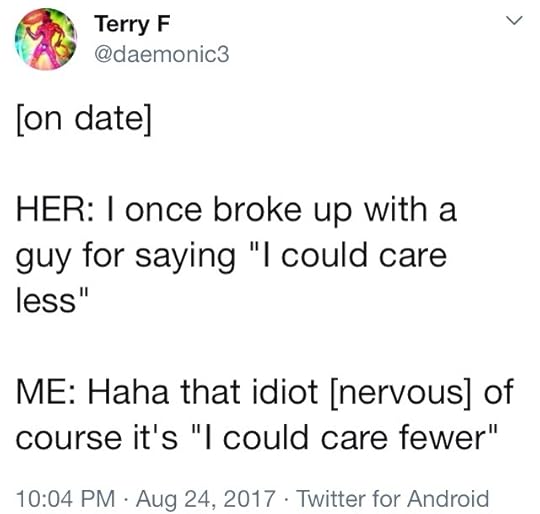
 I get irritated with the use of "couldn't care less" and " could care less"
Both used in the same type of sentence by different authors.
which is correct?
"Couldn't care less" - it's impossible for the speaker to care less about [x] because they don't care about it at all.
 Kateb wrote: "which is correct?"
Not sure if this was rhetorical, but I’ll bite. :)
“Couldn’t care less” says you don’t care about something. In other words, it’s impossible to care less than you already do because you already just plain don’t care. On a scale of 0 to 10, you already care at a 0.
“Could care less” is sometimes used by mistake and makes no sense unless the person really intends to say they care about something. On a scale of 0 to 10, you might care at 1 or 2 or even more, so I guess you could care less…
I always find it half-amusing, half-annoying when people completely misstate clichés. For example, I’ve heard people say “for all intensive purposes” instead of “for all intents and purposes". What?! :) I don’t think I’ve ever seen it in a book though.
Edited to replace “misuse” with “misstate”. They might not be misused, if they were stated correctly…
The misspellings of Voilà bother me a lot. Wa-la or wah-la just jar when I see them and the people that spell the word that way often insist it's an English or American word (maybe in the Urban Dictionary is it?). I often leave the accent off it because I don't have a French keyboard on this laptop, but at lease I use voila.
YouKneeK wrote: "Kateb wrote: "which is correct?"Not sure if this was rhetorical, but I’ll bite. :)
“Couldn’t care less” says you don’t care about something. In other words, it’s impossible to care less than yo..."
I read it the same way as you did, but have read 4 different authors using the "could care less" comment throughout their books. I mentally thought it was an expression from where they lived
they meant it in the same way as the correct saying is used
Thus incorrect as far as I was concerned , I just wondered if this incorrect expression is used elsewhere since the books had to have been edited
 Don't even get me started on this one!
I have some that probably don't bother all of you unless you are old enough to remember when impact was NEVER used as a verb--yes, that's one of my pet peeves dating from the first time I heard it in 1989 or 1990.
Some of my pet peeves have already been covered here :).
Oh, and this is my Canadian upbringing as Americans all seem to do this, and this is using the word good in the place of well.
"How are you?"
"I'm doing good." (doing good means doing good works, etc--WELL is the correct word :) ).
colleen the convivial curmudgeon wrote: "Rachel wrote: "My spouse calls those knit caps touques (like tuuks) silly canadiens. How about cap or hat."It's a beanie!"
In Canada it is a TOUQUE and that is the correct word--even in BC among anglophones :). While it's normal for you, I personally find beanie an irksome term, but then it isn't used much in the part of the States I live in, either.
Elle wrote: "People using (overusing) the word 'Impact" as a verb because they do not know the proper use of "affect" and "effect". And my absolute favorite is when it is used as as an adjective such as "impact..."I just saw this--so we're alike on this one :) I hadn't made to this thread until today, and my notifications took me to page 4.
Micah wrote: "As in: "After these students graduate high school..."NO! Students cannot graduate a high school. High schools graduate students not the other way around. And students graduate FROM high school!"
Yes--agreed!!! You graduate FROM high school!!! I had never heard of this until I moved to New England.
CBRetriever wrote: "they use dotter in Sweden and dottir in Iceland for female offspringlike this book: Kristin Lavransdatter
or
this author whom i really like: Yrsa Sigurðardóttir"
Yes, and as someone who is half-Icleandic I find the distinction very important. To this very day, Iceland uses this system. So, if Snorri has a daughter named Alda and a son named Bjorn they'd go by Alda Snorrisdóttir and Bjorn Snorrison. Also, if it is traditional (so anything historical fiction), Bjorn's eldest son would be named after his father and be Snorri Bjornson. AND, Alda's eldest daughter would be named after her mother That eldest child naming tradtion may have gone by the wayside, though.
Also--in Iceland phone books are listed by given names--you have to know their father's name OR if they have a last name (immigrants) OR use some other moniker that has been given them by common use (that last one might be no longer done, but you'll see it in historical sagas about real people).
And, one other pet peeve win writing is the use blatant anachronistic expressions, philosophies, attitudes, etc.
Karin wrote: "colleen the convivial curmudgeon wrote: "Rachel wrote: "My spouse calls those knit caps touques (like tuuks) silly canadiens. How about cap or hat."It's a beanie!"
In Canada it is a TOUQUE and ..."
A lot of articles say it is either toque or tuque and that touque
http://www.syllabus.ca/en/didyouknow-...
https://www.cbc.ca/news/canada/edmont...
maybe it's regional in Canada? Like Coyote is pronounced two different ways in the US (two or three syllable)
My favorite Canadianism I heard was a campground attendant saying "Tenting, are you?". It took a few seconds to translate.
The thing that’s been bothering me quite a bit over the past few years is the simplifying of words. The two which really grate on my ears and make the speakers sound like bumpkins are “verse” instead of “versus” and “verbage“ instead of “verbiage”.Most words tend to shorten and simplify over time, but this transitional stage is aggravating.
Well, if we're talking about misused words, it annoys me when authors use peaked instead of piqued.
 I hate how "perq" became perk, but then things like mike (similar to perk) are now mic (which follows the perq convention). Make up your mind people!
Karin wrote: "And, one other pet peeve win writing is the use blatant anachronistic expressions, philosophies, attitudes, etc."
I hate how "perq" became perk, but then things like mike (similar to perk) are now mic (which follows the perq convention). Make up your mind people!
Karin wrote: "And, one other pet peeve win writing is the use blatant anachronistic expressions, philosophies, attitudes, etc."The one that gets me every time in fantasy is characters saying "OK."
A lot of these must be the writer having heard a phrase but never read it. Not that that's an excuse. The proofreader should catch those before they escape into the wild.
Phillip wrote: "I hate how "perq" became perk, but then things like mike (similar to perk) are now mic (which follows the perq convention). Make up your mind people!"Mic has always been that. Short for microphone. Similarly, lav is short for lavalier microphone. It was changed to "mike" by people who presumably only heard it spoken, never seeing it written on the side of their electronics.
 No, actually I'd say that "mike" was spelled that way so people would pronounce it right. If I didn't already know better, I'd see the word "mic" and pronounce it "mick". Similarly, OK written as "ok" or "Ok" niggles at me because I see that and want to pronounce it "ock" (as in "Doc Ock"). Hence OK, O.K., or "okay."
 Trike wrote: "Mic has always been that. Short for microphone. Similarly, lav is short for lavalier microphone. It was changed to "mike" by people who presumably only heard it spoken, never seeing it written on the side of their electronics."
If it's in the dictionary, it counts. Therefore, "mike" made the same progression as "ain't" at some point.
 Trike wrote: "The thing that’s been bothering me quite a bit over the past few years is the simplifying of words. The two which really grate on my ears and make the speakers sound like bumpkins are “verse” inste..."
I admit it! Guilty!!!!
Due to internet chats and gaming, I've used verse because I was thinking vs for versus. Verbage instead of verbiage because of making up words. Apparently, a common mashup.
Soo wrote: "Trike wrote: "The thing that’s been bothering me quite a bit over the past few years is the simplifying of words. The two which really grate on my ears and make the speakers sound like bumpkins are..."It started a long time ago with "normalcy."
Incorrect use of oriental. I am surprised when I come across that in a book. I expect the writer to know better.
Soo wrote: "Incorrect use of oriental. I am surprised when I come across that in a book. I expect the writer to know better."depends on when the book was written. When I was a child and a teenager, someone who was asian was oriental. It was very common to use that term prior to either the 60s or 70s
Phillip wrote: "If it's in the dictionary, it counts. Therefore, "mike" made the same progression as "ain't" at some point. "According to this article http://mentalfloss.com/article/66196/..., the mike version actually came first, in the way that abbreviations of words are often spelled as they sound and not just as shortened forms of the words - such as nuke for nuclear.

SciFi and Fantasy Book Club
Books mentioned in this topic
The Reality Dysfunction (other topics)The Reality Dysfunction (other topics)
Kristin Lavransdatter (other topics)
Jade City (other topics)
Kristin Lavransdatter (other topics)
More...
Authors mentioned in this topic
Yrsa Sigurdardottir (other topics)Yrsa Sigurdardottir (other topics)

You know what they say. Everythin..."
Being overly Southern (and loving it), I use words like "skedaddle" all the time. Also "toboggan" for those knit hats. "Gall shirt" for those A-line undershirts. "A Month of Sundays" for a long time.