Chivalry, or the chivalric code, is a code of conduct associated with the medieval institution of knighthood which developed between 1170 and 1220. The ideals of chivalry were popularized in medieval literature, especially the Matter of Britain and Matter of France, the former based on Geoffrey of Monmouth's Historia Regum Britanniae which introduced the legend of King Arthur, written in the 1130s.
The code of chivalry that developed in medieval Europe had its roots in earlier centuries. It arose in the Holy Roman Empire from the idealisation of the cavalryman—involving military bravery, indiviChivalry, or the chivalric code, is a code of conduct associated with the medieval institution of knighthood which developed between 1170 and 1220. The ideals of chivalry were popularized in medieval literature, especially the Matter of Britain and Matter of France, the former based on Geoffrey of Monmouth's Historia Regum Britanniae which introduced the legend of King Arthur, written in the 1130s.
The code of chivalry that developed in medieval Europe had its roots in earlier centuries. It arose in the Holy Roman Empire from the idealisation of the cavalryman—involving military bravery, individual training, and service to others—especially in Francia, among horse soldiers in Charlemagne's cavalry. The term chivalry derives from the Old French term chevalerie, which can be translated to "horse soldiery". Gautier states that knighthood emerged from the Moors as well as the Teutonic forests and was nurtured into civilization and chivalry by the Catholic Church.
Over time, its meaning in Europe has been refined to emphasise social and moral virtues more generally. The Code of Chivalry, as it stood by the Late Middle Ages, was a moral system which combined a warrior ethos, knightly piety, and courtly manners, all conspiring to establish a notion of honour and nobility.
In origin, the term chivalry means "horsemanship", formed in Old French, in the 11th century, from chevalier (horseman, knight), from Medieval Latin caballārius. The French word chevalier originally means "a man of aristocratic standing, and probably of noble ancestry, who is capable, if called upon, of equipping himself with a war horse and the arms of heavy cavalryman and who has been through certain rituals that make him what he is". In English, the term appears from 1292 (note that cavalry is from the Italian form of the same word).
The meaning of the term evolved over time because the word chevalier was used differently in the Middle Ages, from the original concrete military meaning "status or fee associated with military follower owning a war horse" or "a group of mounted knights" to the ideal of the Christian warrior ethos propagated in the Romance genre, which was becoming popular during the 12th century, and the ideal of courtly love propagated in the contemporary Minnesang and related genres. Thus, chivalry has hierarchical meanings from simply a heavily armed horseman to a code of conduct.
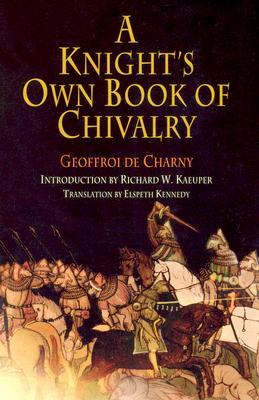
The ideas of chivalry originated in three medieval works: the anonymous poem Ordene de Chevalerie, that tells the story of how Hugh II of Tiberias was captured and released upon his agreement to show Saladin (1138-1193) the ritual of Christian knighthood, the Libre del ordre de cavayleria, written by Ramon Lull (1232-1315), whose subject is knighthood, and the Livre de Chevalerie of Geoffroi de Charny (1300-1356), which examines the qualities of knighthood, emphasizing prowess. Based on the three treatises, initially chivalry was defined as a way of life in which three essential aspects fused together: the military, the nobility, the religion.
The "code of chivalry" is thus a product of the Late Middle Ages, evolving after the end of the crusades partly from an idealisation of the historical knights fighting in the Holy Land, partly from ideals of courtly love....more
“
It is the mission of each true knight...
His duty... nay, his privilege!
To dream the impossible dream,
To fight the unbeatable foe,
To bear with unbearable sorrow
To run where the brave dare not go;
To right the unrightable wrong.
To love, pure and chaste, from afar,
To try, when your arms are too weary,
To reach the unreachable star!
This is my Quest to follow that star,
No matter how hopeless, no matter how far,
To fight for the right
Without question or pause,
To be willing tIt is the mission of each true knight...
His duty... nay, his privilege!
To dream the impossible dream,
To fight the unbeatable foe,
To bear with unbearable sorrow
To run where the brave dare not go;
To right the unrightable wrong.
To love, pure and chaste, from afar,
To try, when your arms are too weary,
To reach the unreachable star!
This is my Quest to follow that star,
No matter how hopeless, no matter how far,
To fight for the right
Without question or pause,
To be willing to march into hell
For a heavenly cause!
And I know, if I'll only be true
To this glorious Quest,
That my heart will lie peaceful and calm
When I'm laid to my rest.
And the world will be better for this,
That one man, scorned and covered with scars,
Still strove, with his last ounce of courage,
To reach the unreachable stars!...more
”
―
Joe Darion,
Man of La Mancha
Kings and queens, princes and princesses, knights and archers, merchants and traders, villager…more
[close]
Kings and queens, princes and princesses, knights and archers, merchants and traders, villagers and farmers. There are so many people to choose from, and they all lived in the middle ages. But it takes work to keep your status in these times. Are you up to the challenge?
Note-
This is an advanced roleplay group that takes place in the Kingdom of Maddenvilla.
Knight & Princess S.p.A. [Massacri Fantasy] è un’azienda gestita da Knight e Princess, due Roman…more
[close]
Knight & Princess S.p.A. [Massacri Fantasy] è un’azienda gestita da Knight e Princess, due Romantici Amanti Platonici appassionati di letteratura fantastica.
Knight & Princess S.p.A. [Massacri Fantasy] ha un’unica e sola Romantica Mission: fornire alla Vostra Persona un intrattenimento ameno e intelligente, schernendo con il suo inconfondibile stile graffiante quella branca oscura e ribalda della letteratura che va contro ad ogni comune pudore, volgarmente nota come fantatrash. La nostra azienda stanerà, stecchirà e sviscererà lancia in resta ogni Orrore Letterario nascosto tra gli scaffali della letteratura fantasy, Science Fiction, fantastica e, perché no, orrorifica - categoria, quest’ultima, che nei fatti comprende tutti i volumi che la ns azienda si propone di recensire.
Knight & Princess S.p.A. [Massacri Fantasy] garantisce analisi accurate di ogni Orrore, in più puntate per le opere particolarmente (s)meritevoli, corredate con l’umorismo pungente di serie che contraddistingue il ns marchio. La ns azienda difende a spada tratta il divertimento senza scrupoli, la libertà di parola e i Romantici Ideali! Inoltre, ogni autore da noi recensito potrà liberamente raccogliere il guanto e ribattere alle nostre recensioni nei commenti - di più, se l’azienda lo valuterà opportuno si premurerà di contattarlo personalmente per invitarlo a dire la sua.
Ma Knight & Princess S.p.A. [Massacri Fantasy] non è solo questo: rubriche speciali saranno dedicate alla segnalazione di volumi meritevoli e/o insoliti, a prontuari per il Vostro fai da te e a molto altro.
This is a group for those that want to read and discuss ancient fiction for fun, whether it be e…more
[close]
This is a group for those that want to read and discuss ancient fiction for fun, whether it be epics, sagas or classics. Anything written and "published" before 1700 goes.
















 Kings and queens, princes and princesses, knights and archers, merchants and traders, villager…more
 Knight & Princess S.p.A. [Massacri Fantasy] è un’azienda gestita da Knight e Princess, due Roman…more
 This is a group for those that want to read and discuss ancient fiction for fun, whether it be e…more
 This is a group where fans of Kirby can play, RP, and talk about Kirby!