The hand of the receiver
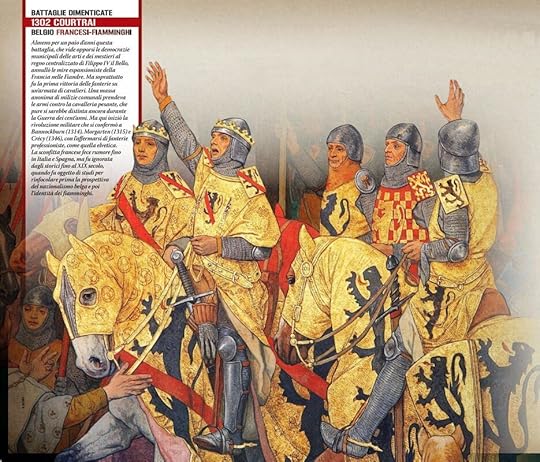 In July 1302 the feudal host of France was smashed by Flemish urban militia at Courtrai in Flanders, remembered as the Battle of the Golden Spurs. Or, to quote Fiona Watson's recent book on Robert de Bruce, 'the most important battle nobody has ever heard of'.
At the time of the battle, Count Guy of Flanders and two of his sons were in French prisons. The regency of Flanders was thus undertaken by another son, Jean, Count of Namur. His regency lasted from the day after the battle until May 1303. During this period, Jean sent envoys to England to try and persuade Edward I to resurrect the Anglo-Flemish alliance, previously agreed between the king and Count Guy. These negotiations were complex. Jean wished to procure English aid not only to protect Flanders, but also his land of Namur, a small county menaced by Holland, Hainault and Zeeland. At the same time a Flemish knight, Jean de Renesse, went to England to gain support for the city of Bruges. His mission lasted between September 1302 and the start of 1303.
Jean de Namur's envoys met with a cold reception. To his request for alliance, the English king and council issued a series of negative responses. First, England and France had been at peace since the truce of 1299; therefore a state of war only existed between France and Flanders. Second, the king had far too many commitments in Scotland and Gascony. Third, Count Guy was in prison and Jean did not have the authority to act in his father's place. Fourth, the pope wished a permanent peace between England and France, which the English dared not put in jeopardy by helping the Flemings.
So the Flemish mission failed. Or at least that was the official line. The separate mission of Jean de Renesse is much more difficult to trace, perhaps for good reason. He went to England to ask military support for the city of Bruges.
Lo and behold, when we sift through surviving Flemish military accounts, what do we find? Between Christmas Day 1302-Candlemas (February) 1303, there was a company of 52 English soldiers in the service of the city of Bruges. They were led by a Flemish officer, Willem de Gand, and paid very good wages of 2 shillings a day per man. Smaller units of English soldiers also turn up in the communal army of Bruges for the following years 1303-04.
These men could have been mercenaries, acting independently of the king. However, the accounts of Jean of Namur for 1302-03 contain a payment of the very large sum of £1320 and 5 shillings. This cash was 'given by hand of the receiver' for the expenses of knights sent to England and Germany. Soon afterwards, we find units of English and German mercenaries in Flemish service.
So, we have what looks like a secret payment, handled by a mysterious 'receiver', who funnelled money to England and Germany to raise soldiers to fight for Bruges against the French. All of this coincided with the trip of Jean de Renesse to England to procure military support for the city of Bruges. His journey coincided with the much more widely publicised mission of the regent of Flanders, Jean de Namur.
The implication is that Edward rejected the Flemish advances in public, but came to a private arrangement with Jean de Renesse. Small units of English soldiers would be sent to Flanders to fight the French. It had to be arranged in secret, because England and France were at peace, and Edward was technically once again a vassal of the French king, Philip the Fair.


No comments have been added yet.