Black Templars and White Templars
 Some further digging on mysterious events in Flanders in the early 14th century.
Many of us will be aware of the tradition of the presence of Knights Templar in the Scottish army at the Battle of Bannockburn. Without delving into that, there were certainly a number of Templars serving in the Flemish armies against the French from 1302-3. This was the immediate aftermath of the Battle of the Golden Spurs at Courtrai, where the army of Philip the Fair went down to a shocking defeat.
Philip's first response was to muster a new army, 16,000 strong, and lead it in person into Flanders. The Flemish town militias, principally Bruges, Ypres and Ghent, quickly mustered troops and dispatched them to repel the invasion.
Surviving documents in the city archives at Bruges provide detailed information of the army that participated in this campaign from September-October 1302. It left the town on 30 August and was composed of guildsmen, crossbowmen and small numbers of mercenaries and professional soldiers.
Among the mercenaries were ten knights of Zeeland and their entourage, a few German crossbowmen, a troop of Dutch soldiers and – most interestingly- a band of seven Englishmen. The latter may have been among the original group of 52 English who had served from Christmas-Candlemas 1302, or a separate unit. I suspect these small groups of English soldiers were dispatched in secret by Edward I, as part of a covert agreement with an important Flemish noble, Jean de Renesse.
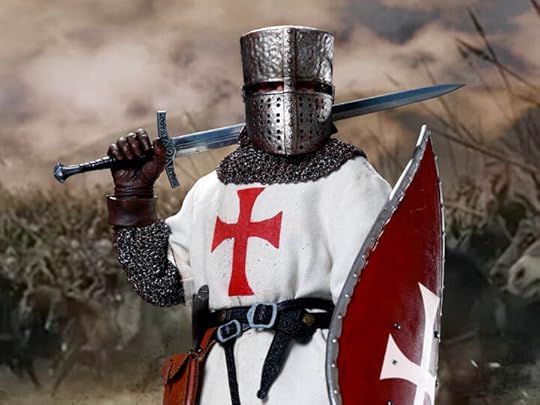
The document also shows that the town of Bruges paid for wagons and four horses used by 'white Templars', who were led by their captain, Woutier die Grote. The white Templars are described wearing white tunics with red crosses. They served alongside Flemish 'Black Templars' i.e. Hospitallers, who wore black tunics with white crosses. The captain of the Hospitallers was one Hannekin vanden Hulbusche. The Templars formed a band of 13 to 20 men, the Hospitallers had 20 to 30.
The expedition itself lasted 41 days. No battle was fought, but the outcome was an embarrassing failure for the French. Since he had lost so many knights at Courtrai, Philip's men were inexperienced, and he dared not risk an open confrontation. When the Flemish army drew near to Douai on 29 September and prepared to attack, the French retreated. The Flemings gave chase, plundered the French camp and killed a number of stragglers: one Flemish chronicler mentions the loss of 200 French knights and 100 French and Genoese infantry.
On 9 October, after some messy skirmishing, the army of Flanders disbanded and went home. Philip's withdrawal was seen as a disgrace by his French subjects, and he was obliged to make a public statement to explain his action: there had been a shortage of supplies (he claimed) and the Flemings had taken up a strong position, which was difficult to attack. However, he promised to launch another invasion very soon.
Philip would eventually have his revenge on the Flemings, but for the moment he had suffered two humiliations in a row. Although the number of Templars in the Flemish army was small, perhaps their mere presence at least partially motivated his calculated destruction of the order.


No comments have been added yet.