Sorrow and suffering?
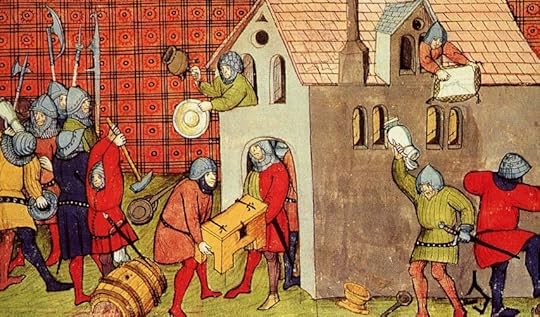 “There was much sorrow and suffering on both sides, as they quarrelled and fought”
 - Lodewijk van Velthem
In February 1298 there was a serious riot at Ghent in Flanders, where the Welsh and English soldiers of Edward I fought a battle in the streets against the Flemish citizenry. The various chronicles report severe damage and loss of life, although as usual it is difficult to untangle facts from distortion.
The king had moved his army to Ghent the previous September. From the start, there were problems. Flanders was divided politically between pro and anti-French elements, and a great number of Flemings had abandoned their ruler, Count Guy, to fight for Philip the Fair. Shortly after Edward's arrival at Ghent, tensions exploded between his men and the citizenry. When he rode through the gates, the king was almost shot dead by a Flemish assassin. The crossbow bolt hit one of his knights instead. In a rage, Edward ordered his Welsh infantry to fire the streets.
A riot blew up, in which the Welsh distinguished themselves: one earned a bounty of £5 from the king for swimming across the river to rescue an English comrade, who was about to be killed by two Flemings. More Welsh got inside Ghent by wading across the streams, climbing the wall and burning the gates from the inside.
The riot was quashed, but resentments simmered. In February, after making a truce with the French, Edward went to Brabant to secure the English wool staple from his son-in-law, the duke. While he was gone, the Welsh and English infantry grew bored and started to abuse the citizens again. Seeing their homes destroyed and wives and daughter raped, the menfolk of Ghent had no choice but to take up arms.
Or at least, that was the version of events in Flemish sources. The major English source, the Chronicle of Bury St Edmunds, claims the people of Ghent had entered into a conspiracy with Philip. On the Feast of Blaise (11 February) they planned to butcher Edward's soldiers, seize the king himself and hand him over to the French. Their plan was foiled when the Welsh lodged in the suburbs outside Ghent burnt through the gates (these were very flammable gates), fell upon the conspirators and slaughtered then. Edward himself joined in and charged the Flemish artillery at the head of his household knights.
Flemish sources claim the Anglo-Welsh suffered terrible casualties and Edward had to beg the citizens to let him and his men leave the city. English sources claim the Flemings suffered terrible casualties and had to beg Edward's mercy. And so on.
Away from the lies and finger-pointing of chroniclers, the surviving accounts paint a less dramatic picture. On 24 February privy seal writs were drawn up in Ghent, sent to England to request safe-conduct for Welsh troops that had already been shipped back to England. On 11 March the chancery issued letters for the men of Glamorgan, with further letters on 15 March for the men of north and west Wales. One final batch of letters, for a group of five stragglers, was issued on 27 March.
Far from suffering casualties, the Welsh appear to have been ferried home, more or less intact. Their officers – Gruffudd Llwyd, Robert Veel and Morgan ap Maredudd – were certainly alive and well. The only named Welsh 'casualty' was one Llywelyn Goly, paid travel expenses by the king to go home on account of 'infirmity' i.e. he had fallen sick.
Not that the riot itself should be dismissed as a myth. In early March 1298, after Edward had moved his headquarters from Ghent to Aardenburg, he gave orders for compensation to be paid to the merchants of Ghent. This was on account of the injuries done to them by the king's soldiers. In addition, a fragment of a wardrobe account records that Welsh troops had stolen grain from mills outside the city. These details suggest a bunch of very drunk medieval squaddies indulging in a spot of looting – not exactly uncommon behaviour, then or now.


No comments have been added yet.