There's been a murr-derrr
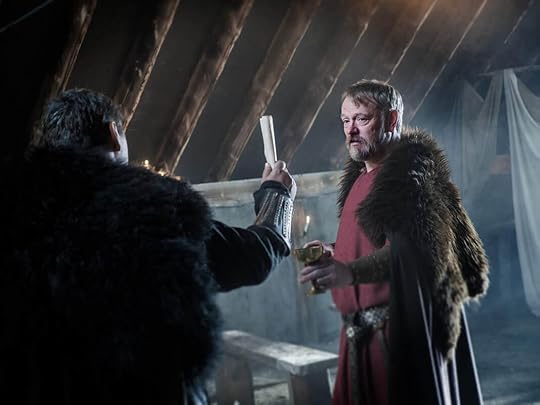 On this day in 1306 Robert de Bruce murdered his rival, John Comyn, at Greyfriars in Dumfries. Comyn's uncle, Robert, was also killed as he tried to defend his nephew. I thought it worth taking a quick look at John 'the red' Comyn, perhaps one of the most unjustly vilified figures in the history of medieval Scotland.
These days John is often presented as a traitor to the cause of Scottish independence. Or at least, that is how he presented in cinema and on some disturbingly popular social media groups. This appears to be the direct result of centuries of Bruce propaganda and the unwillingness of modern generations to question national heroes.
The popular version goes something like this: Bruce was a steadfast, patriotic hero who never bowed the knee to the foul tyrant, Edward Longshanks. Comyn, by contrast, was a cowardly quisling who betrayed William Wallace at the battle of Falkirk and later surrendered to Longshanks on very easy terms. Bruce was right to kill him, even if the circumstances were a bit dodgy.
The reality was this: from the very start of the Scottish wars in 1296, Comyn was consistently opposed to the English. In that year he was among those who invaded England and attacked Carlisle, which the Bruces were defending on King Edward's behalf. A few weeks later Comyn and many others were captured at the battle of Dunbar. In 1297 he was released in exchange for doing military service in Flanders, but deserted the English host when Edward shifted his headquarters from Ghent to Aardenburg, near the Zeeland border.
For the next seven years Comyn was one of the leading lights of the Scottish resistance. His presence at Falkirk in 1298 is uncertain, but it cannot be said that any of the Scottish principals covered themselves in glory: Wallace fled the field and left his men to die, Bruce was conspicuous by his absence, and Simon Fraser fought on the English side.
After Falkirk, Comyn and his fellow Guardians adopted a new strategy, whereby they evaded battle and retook castles and territory when the opportunity arose. Comyn was a supporter of the exiled King of Scots, John Balliol, and for a while it seemed that Balliol's return, backed by a French army, was very much on the cards. That possibility was shaken when Philip the Fair reneged on the Treaty of Asnieres in 1302, and went up in smoke completely when the French suffered a shock defeat at Courtai in Flanders.
The Scottish strategy worked well for as long as Edward was distracted elsewhere. However, when he made a final peace with France in 1303, the English king was able to focus all his resources for one last push in Scotland. Comyn's efforts to repel the onslaught were nothing short of heroic. In February 1303 he won a morale-booting victory at Roslin over Sir John Segrave. More significantly, when the king took his army over the Forth to ravage northern Scotland, Comyn and Wallace attempted a clever counter-strike into northern England. The ploy failed, but it was a near thing. Bruce, meanwhile, was actively fighting for the English.
At last Comyn agreed to open peace talks. This was due to several factors: for the first time since 1296, Edward had managed to hold his army together long enough to maintain an effective presence in Scotland. He could not be shifted, at least in the short term, so it made sense to come to terms. Besides, Edward was old and in poor health, and the Guardians may have gambled on an armistice in the knowledge that their chief enemy was not long for this world.
Finally we come back to 10 February 1306, and a wee dispute in a church. Bruce's motives have been discussed at length elsewhere: among other motives, he was probably alarmed by the rise of the Comyn faction in Scotland, which threatened his own ambitions. So, as Taggart might say, there was a murr-derrr.
(The image is of Jared Harris as John Comyn in the 2019 movie Robert de Bruce)


No comments have been added yet.