Jim Baumer's Blog, page 50
December 19, 2014
Turning 31
Mark is 31-years-old today. It’s sounds clichéd to say it, but it feels like only “yesterday” that I was driving Mary to the hospital like countless other nervous fathers-to-be before. We were living in Indiana at the time, 1,500 miles from family and familiar surroundings. To a then 21-year-old dad-in-waiting, this was terrifying. It was also one of my high-water life experiences
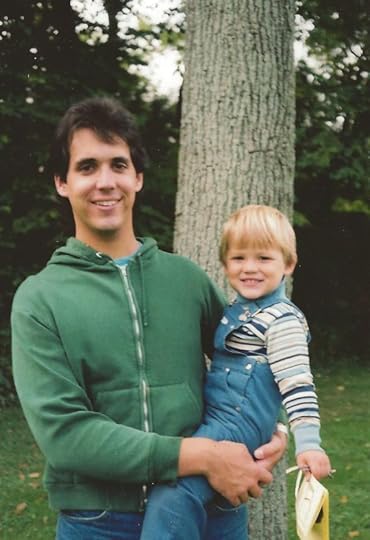
Mark at 18 months (I think).
I enjoyed being his dad. I still do.
Mark was born pre-blogging, pre-Internet, and pre-cell phone. There were no other bloggers out there, writing about their unique parenting ways. Mary and I had three years of Jack Hyles under our belts and his book on child-rearing to guide us. Say what you want about fundamentalist demagogues like Hyles—his book on being a parent was helpful in many aspects—so was Dr. Spock, so go figure.
Indiana became a time for post-Xian guilt and other assorted hang-ups. We managed to move out of a cramped apartment over a pizza parlor in Hobart that had cockroaches, and out to the ‘burbs in Chesterton. For Mark, this meant a neighborhood with kids his own age. We bought him a used tricycle—which I consequently backed over with my car.
We lived 10 minutes away from the Dunes National Lakeshore and while I was working as much overtime as I could garner at Westville Correctional Center, Mary and Mark got to enjoy Lake Michigan’s sandy shores and work on their tans. My schedule afforded me every third weekend off, with a three-day weekend. I loved those times of family bonding, and finding things to do on the cheap—because we had very little money.
Eventually, we saved our dimes and nickels and loaded up the truck, a broken-down U-Haul, and made our way back to Maine. Mark now had grandparents and cousins, and woods to build tree forts in.
Fast forward 25 years. Mary and I still live in Durham, in a house we built not far from Mark’s first residence—living extended-family style with Mary’s parents. Mark just bought a place of his own in Providence. We like having him three hours away, rather than the 3,000 miles away and a six-hour plane trip out to Los Angeles, where he once lived. As an aside—Mark once walked 2,500 of those miles, from Savannah, Georgia, across the southern US, making it to Santa Monica Beach in 81 days. That was Mark’s summer of 2010.

On deck with the Wheaton Lyons. (circa 2005)
Reflecting back on who I was at 31, Mark is so much further along, figuring out how the world works, than I was at a similar age.
Happy Birthday, my son! Glad Momtown and I get to spend some time together with you this weekend, celebrating your special day.


December 16, 2014
Santa’s Helpers
Holiday shoppers took a hit in 2013 when stormy weather right around Christmas resulted in tens of thousands of shoppers not being able to get packages to their intended destinations on time. Not only was it disastrous for shoppers, but retailers took a hit, also.
If shoppers and retailers don’t want a repeat of last year’s Christmas nightmare, package deliverer UPS surely is banking on better delivery results. The company was barraged by criticism last year when the company failed in delivering thousands of packages by Christmas Eve. Brown insists it’s well-prepared to make this a merrier Christmas in 2014, even as increased online shopping is likely to put greater strain on the company and its rivals.

Brown getting it done.
UPS is trumpeting the $1 billion in facility, vehicle and personnel investments it has made worldwide as reason for customers to be confident that Santa will get their gifts to good little boys and girls (along with grown-up goods) on time. UPS officials stress that the upgrades have been made with an eye toward positioning their business beyond this holiday season. The company has also added to its season workforce, upping numbers 12%, to 95,000. Rival FedEx has boosted seasonal hires 25%, to 50,000. And even the U.S. Postal Service has delivery every day of the week through Christmas Day.
Yesterday was considered the busiest mailing day, and UPS indicates that its processing centers will be at their peak of its holiday shipping season, one in which it estimates it will handle about 585 million packages. The following Monday before Christmas will be UPS’ busiest delivery day—the shipping giant will move about 34 million packages worldwide.
I remember last year well. I was working on the phones at a major retailer’s phone center. Customers were cranky and weather woes made it impossible for me to guarantee packages would make it by Christmas day, upon information provided by both UPS and FedEx. Of course, the customers on the other end of the phone expected me, Mr. $12-an-hour-seasonal-phone-rep to play God (or Santa) and tell them that planes would be able to fly through snowstorms and trucks could make it across the frozen tundra of the Midwest. Telling them the truth merely drew their ire.
While I might not be able to afford to put as many packages under our Christmas tree this year, it’s a happier holiday season for this freelancer in 2014, as I’m not pulling any moonlighting duties on the phones for the first time in three years.

Christmas Tree, Oh, Christmas Tree.
December 12, 2014
The Other Direction
Going against the grain is never easy. Swimming upstream is bound to get you talked about, criticized, and maybe even hated. As writers, our job isn’t to make people comfortable—it’s to write what we know to be true (spoken as a writer who writes nonfiction).
Mark Twain was quoted as saying “Whenever you find yourself on the side of the majority, it is time to pause and reflect.” I don’t know if he added, after reflecting—move in the other direction.
What I’ve noticed throughout my life is that the majority is often on the wrong side of history. A mere cursory reading of the subject will tell you that. Yet, many people still hate having you point that out to them.

Literary icon, JD Salinger.
I just finished Salinger, the book that David Shields and Shane Salerno wrote about one of the 20th century’s greatest literary figures, as well as one of the most talked about. Salinger wrote fiction for the New Yorker, when it was edited by William Shawn, who some in Salinger called “an enabler” of the literary giant’s foibles and eccentricities. Shawn himself was an odd duck, so perhaps it was a case of Shawn and Salinger being similar.
Tom Wolfe, of New Journalism fame, wrote a major, two-part takedown of the New Yorker and Shawn for New York, which at the time was a Sunday insert in the now defunct New York Herald Tribune. New York was a small potatoes rival to Shawn’s vaunted publication. Wolfe’s first of two features, “Tiny Mummies! The True Story of the Ruler of 43rd Street’s Land of the Walking Dead!” (Part II was called, “Lost in the Whichy Thicket”), laid low the Shawn-directed ways of one of the major literary publications. These pieces by Wolfe rankled Salinger, too.
Not only did Wolfe’s darts hit a target in Salinger, but E.B. White and Walter Lippmann were critical of the journalist, calling him “an incompetent ass.” There were a host of other lengthy criticisms, and even the White House called to complain to Wolfe’s editor, Clay Felker—not that they had anything else going on in 1965, like a major war, or anything.
This article put Wolfe on the radar as a writer/journalist and he’s gone on to a successful career where he’s now being criticized as being “establishment.” It also got he and Felker invited to all the chic and trendy parties for the literati on New York’s upper east side.
The point is that Wolfe got people’s attention by paying attention, and offering something that others weren’t bothering with at the time. It amazes me how often writers just go along with the status quo, acting as scriveners for those in power. This is never more apparent than when I read Maine’s daily newspapers, or publications that incessantly cheer for Maine’s business community.
Since I’ve been blogging, I’ve tried to offer some contrary ideas and writing. Some of my freelance work continues in that vein.
I hope to do more of it in 2015.
December 9, 2014
Get Writing
I was at a party with holiday overtones over the weekend. The hostess introduced me to another writer. We had an enjoyable discussion about writing, particularly the craft of writing. A recurring theme in our discussion was why some writers move beyond mere procrastination and actually get down to writing.
There continues to be a romanticism attached to “the writing life.” Some of this is the equivalent of what is attributed to Joyce Maynard in Salinger, about the late literary icon, and his hatred about the “artiness in writing and writerliness…tweedy types sucking on cigars on their book jackets or exquisitely sensitive-looking women in black turtlenecks.”
While Salinger became as famous for his obsessiveness and privacy as he was for his literary output, he apparently kept up more closely with the literati than we thought he did at the time, and had “little but contempt for what he sees…” of that world. Writers more famous for the pose they strike, than their writing.
Writing requires work, and sometimes slogging along in near obscurity for some period. Yet, any craft requiring creativity (and ability) must be honed.

Writers write!
Maybe the cigars (and pipes) and black turtlenecks of Salinger’s day that drew his ire have been replaced by incessant tweeting, Facebook trolling, and more about branding than output and quality.
Want to be a writer—how about doing some actual writing?
Here are some of my tips for those willing to put in the work, and cultivate their craft.
Write regularly–
This seems like a given, right? If you’re a writer, you’ll be writing every day, or nearly every day. Surprisingly, for those fixated on the fame part, this doesn’t seem to have occurred to them. Also, there are a host of writers out there without much in the way of output.
It’s a given that all of us start with that very first title. What are you going to do for a second act? What’s next after that? Don’t be a one-trick pony.
Start a blog–
Blogging may not be for everyone, but I can’t imagine being a writer and not having one. A blog grants you a writing platform and carte blanche to say and write what you want. It’s not as tightly curated as writing for publication, which is the point of blogging, really. It’s a place to write about things germane to you and your interests, and from time to time—even about your craft.
When I finally bit the bullet and committed to being a writer in 2002-2003, starting a blog was one of the best decisions I made long before I had a clue about what being a writer meant.
Of course, if you have a blog, think about getting up a fresh post once in awhile.
Self-impose deadlines–
This follows along with the first two suggestions. I have decided that my frequency for blogging is twice weekly. I treat this publication schedule with the same diligence that I do delivering an article on deadline to editors paying me for my writing. What that means is on Tuesday and Friday, it’s not uncommon for me to wake up an hour earlier, or to stay up later the night before, to make sure I have fresh content for this blog.
If you can’t hit self-imposed deadlines like these, it’s unlikely you’ll be able to meet your assignments once you’ve found publications willing to pay you for your writing.
Read regularly and widely–
Read great writing. Whether you prefer fiction or nonfiction, commit to reading a book or two every month. Subscribe to publications with a literary bent. I have a New Yorker subscription. I also am a fan of The Baffler, which satisfies my own interest in cultural criticism, I get to read writers skilled in the art of muckraking, something I’m interested in doing more of.
Don’t have the time to read? Then forget about taking your writing to the next level, whatever that level is for you.
I have a goal to read 30-40 books a year. I’ve kept this up now for the past 10 years. This year I’ll read more than 60 titles. Check the list.
Television is overrated and won’t help you become a better writer. Neither will excessive time on social media.
Interested in developing some of these habits, especially the writing regularly part? I’ll be offering my popular narrative nonfiction class again for Lewiston Adult Education in February, just in time to cure your cabin fever. It works for fiction writers, too, as we’re focused on story and writing each week. Think of it as a buddy system for writers.
December 6, 2014
Picture Talk

Pages & Pints Outline
If a picture is worth a thousand words, then this one might be worth 750, or so.
It’s my talk given at Friday’s Pages & Pints at Lewiston Public Library, in a photo. Well, technically not my talk, since flip charts suck as an audio platform, but an outline of my 30-minute blast on Moxie, beer, and a few thoughts on the craft of writing (and Stephen King’s On Writing: A Memoir of the Craft).
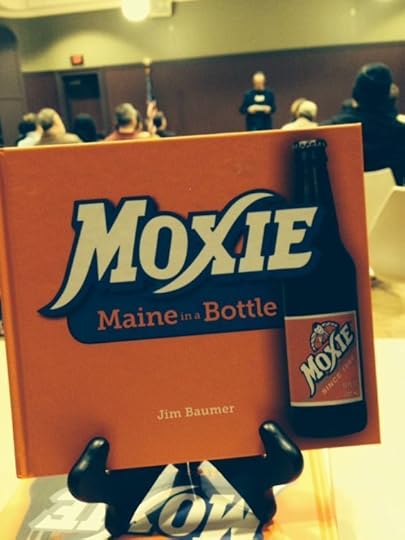
Back of the room with Moxie.
As far as I know, no cans or bottles of Moxie were harmed during the event, but we did some beer afterwards at Baxter Brewing Company.
After that, some of us went up the hill to Middle Street, descending on She Doesn’t Like Guthries. A few more beers, great Guthries’ fare, and music by the excellent Jon Assam, with Danny on the drums. Listening to Jon made me think I was sitting in my living room listening to the late, great Jason Molina.
On Tuesday I wrote about writers writing about “outliers” in Maine, whatever the hell an outlier is in that particular context. Extending the thread slightly, Lewiston could be an outlier (if prone to see Maine that way). If it is, there’s a lot more going on than people from outside give the place credit for.
December 5, 2014
Working Backwards
The path to career success for many follows a time-worn tradition. Often, it’s off to college for a degree. Nowadays, the degree must be “marketable.” And then after that, an advanced degree is almost always expected, if not immediately, then down the road once you are established at the firm. Increasingly, all those initials after your name come with a hefty price tag and mountains of debt.
I’ve never followed convention, or the traditional college track.
My own “education” seems ass backwards according to the ways of the world. The journey of reinvention I’ve been on for more than a decade began later in life. Not that there’s anything wrong with that. In fact, I’m finding that my DIY ways and quirky approach to making a living is more of an advantage than a liability.
The approach I’ve taken to becoming a writer also trod a road less traveled. No MFA, and no English major, either. I didn’t go to J-School to acquire my journalistic skills.
And yet, here I am, 12 years further down the road. I’ve accomplished many things I only dreamed would happen when I walked away from my Moscow Mutual cubicle in January, 2004.
Last October, I knew I needed to update my writing clips as a freelance writer. I landed a gig for a few months writing about consumer goods for the financial website, The Motley Fool. It wasn’t Pulitzer Prize investigative journalism, but these opened doors elsewhere. 2014 has been a really good year, rejoining the freelance writing community.
My son, Mark, reminds me from time to time to, “just keep doing what you’re doing.”
Thanks, Mark. Your advice and admonition continues serving me well.
December 2, 2014
Writing About Maine’s Outliers
I’ve lived in Maine for all but five years of my life. After questing to find spiritual nirvana—in , of all places—our family unit returned to the Pine Tree State in 1987 and I’ve been here ever since. Sometimes I even write a book or two about some aspect of Maine’s history, trying to relate it to the present.
There are times when I don’t even know my native state. The recent influx of flatlanders and people from away now doing all the writing about the state has created a portrait of my home state that I barely recognize. Somehow, this new brand of scrivener has convinced the rest of us that we are more than the feudal serfs we’ve always been.
If you subscribe to one of Maine’s advert-packed glossy mags, like Maine: The Magazine, or a handful of others, or even peruse it in the check-out line if you shop for your groceries at one of Maine’s supermarkets, rather than Whole Foods, you’d think everyone in Maine is a goldarned trust funder with hours to while away dining at one of Portland’s many high-end eateries, or to sit around sipping the latest in trendy cocktails. Apparently these late arrivals don’t have to worry about eking out a living. Even writers from here that I used to think understood our state—a place I recognized in their books and via their writing—have been suckered in and now serve as sycophants for these nouveau trendy types. They now accept the thinking that Portland is the step-sister of hipster-laden Williamsburg. In fact, writers who once resided in Brooklyn and other exotic zip codes are now taking up residence in Maine’s closest thing to a real city, Portland.
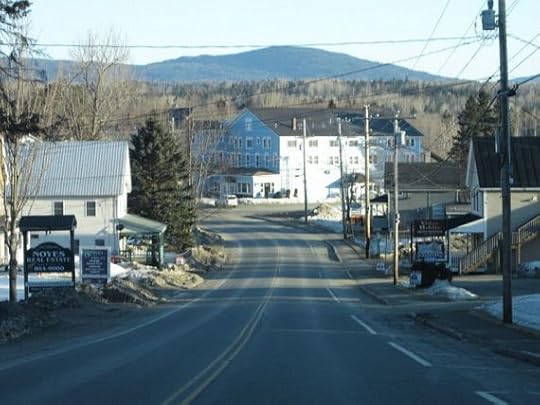
One of Maine’s outlying communities that’s not Falmouth.
After somehow landing an article in one of those glossies, Portland Monthly Magazine, back in June, I opted to go for a discounted subscription via Deal Chicken, or some other wheeler-dealer site, like Groupon. Every month when it arrives, I page through and think, “what the fuck?” I guess this is the state of writing about Maine, which basically means, Portland. Unless you’re slumming.
This month’s feature from their resident foodie, Olivia Gunn, touches down on the subject of “outlier” food establishments. The title itself and my familiarity of her previous features had me wondering how she’d tackle wandering around outside Portland. Apparently for transplants like Gunn, “outliers” and outlying areas are Westbrook, Falmouth, and South Portland. She even got really daring and ventured out to Saco, where there were leather jackets and bandana-wearing hoi polloi—brave girl! God forbid that she’d jump in her car with her beau or clique of high school-similar friends and check out the state’s true outlying towns and territories. Better leave that to the real Mainers, the ones that actually understand the state’s culture dating back 300 years, or so, not the three that you’ve been occupying space in Portland’s West End.
I shouldn’t be so critical. Other than a diminishing handful of cranks, Mainers seem happier than pigs in shit to have sold their souls and birthrights, handing over the state’s cultural chronicling to a handful of 20 and 30-somethings from somewhere else, who care little about the history of the place they’ve landed for a few years before moving on to some other more exciting landmark.
Where’s Joe Ricchio and Food Coma TV, and road-trippin’ off the peninsula? Shoot—they even made it to the Saint John Valley, guns and all.
November 30, 2014
A Cut Above-Bowdoinham (bonus material)
A week ago Saturday, I drove to Bowdoinham to gather information about the town for today’s Explore feature in the Sun-Journal’s b-section. Things went much better than I anticipated.
It’s not as if I thought that Bowdoinham wouldn’t offer up interesting things to write about. No, last Saturday, I was in a pissy (see definition #2) mood, running on fumes after a long week. Actually, when I walked out the door committed to spending a few hours dredging up details for my story, I was dreading leaving the warmth of the wood stove and going out into the bleak, dreary November cold. I also know that this type of writing about local communities demands (if done well) putting boots on the ground in order to connect with the sense of the place.
This is my seventh Explore feature. The town of Wilton was my first one back in May. Seven is a number that comes up in my writing and in my latest book of essays—it is the “perfect number,” after all.
Since beginning these monthly profiles on various Maine communities, I’ve posted bonus content from each of the towns I’ve written about. This additional content serves as a bookend to what is published in the Sunday b-section. I also get to add a few more thoughts in the first-person that the conventions of journalism don’t permit.
The context of these stories about Maine towns requires me to pigeonhole a handful of locals willing to tell me something about their town that someone like me, visiting their town for the very first time, should be sure not to miss. This might be a physical setting, some natural feature, a historical building, etc. While most of the time, local residents have been gracious and accommodating, there have been a few instances when locals offered little more than I was able to dig out myself, doing a little preliminary research. One of my recent visits presented a host of people that were happy to talk about their town, but not willing to be quoted in print. Sorry, that won’t work for me—I have to quote you in the article—that’s the point! That one particular story forced me to go way beyond the usual 2-3 hours in a place.
Perhaps my aversion to going to out to bet my story was colored by that experience. Not to worry—Bowdoinham might be the friendliest little town in Maine!
My very first act of reaching out to the town was by way of a phone call, driving up I-295 out of Topsham. I picked a name off the town’s website—the equivalent of throwing darts, really—and I hit a bulls-eye, or pretty darn close. David Whittlesey knew his town, was enthusiastic about it, and gave me multiple leads of other people to talk to and places to touch down, once I jumped off at interstate exit 37.

Hoop house at Fish Bowl Farm-Bowdoinham
You can read my feature online, or even better, you should turn to the back page of the b-section and see the feature in the format where it looks best—in print. There’s a reason why I attempt to get a few photos for each one of these stories, mainly to add some visuals to my narrative. There’s more to that story too, mainly that I had to go back and re-shoot my photos, because my shots from the week before were so darn gray and bleak. I tweaked my camera settings and tried to find some color on my return visit on Tuesday, which was also overcast. No one balked at having me get a few more photos. They were just as accommodating on Tuesday as they had been on the previous Saturday
If you’ve read my writing before, you probably know of my passion for small towns and that people and place matter. Not all places are created equal, either.
As small towns go, Bowdoinham is a cut above. People care about their community, and it was apparent in talking with people like Kate Cutko, the town’s librarian, and Lynn Spiro, who settled in Bowdoinham more than a decade ago, and runs the Town Landing Restaurant.
Bowdoinham used to build ships, and harvest ice from the Kennebec, Cathance, and the other rivers emptying into Merrymeeting Bay. The railroad once had been a key factor in getting the town above the 2,000 mark for population (it now sits just below 3,000).
Today, the residents of the town have reinvented themselves. Farming, which has always been part of the town’s past, is key element for sustainability and being resilient. But so are the arts, and a host of other factors. Location is something that’s important, also.
Many small towns are struggling. In Maine, we have an aging population, fights over equitable taxation, and a host of other issues, making small town life tenuous in some places.
What I was particularly taken with in Bowdoinham is that it is a place that has a sense of where it’s been, and where it’s headed to. People are genuinely proud of their town and its heritage. Also, they seem to care about one another and have the ability to come together around a number of civic causes. Intentional friendships, mixed with substantial social capital shows that in Bowdoinham, the future looks bright.
November 28, 2014
Powerless
The start of day number two without power.
Being without power and being inconvenienced by a lack of electricity is admittedly a first world problem. However, when you live in the first world, electricity is an expectation. So, being without electricity generally sucks.

5:30 am--Light from our LL Bean lantern.
One option is buying a generator–Mary and I have talked about it–but it would likely change the dynamic, and the appreciation we have of something as amazing as electricity.
I’m guessing that CMP will get our power back on today. Even if it’s later in the day, it won’t be bad–daylight isn’t bad at all–especially if you don’t require gadgetry to make you happy.
The wood stove has been keeping us warm, the sun offers abundant light, and we have leftovers from yesterday’s feast at Aunt Tomato’s.
Mary and I will be fine until darkness descends once again. Then, maintaining an optimistic outlook becomes harder with night fall and no electricity.
November 25, 2014
TLDR Tuesday-Race in America
Until yesterday afternoon, I didn’t know what that four-letter acronym meant. I do now.
It’s amazing that I didn’t know about it. TLDR perfectly sums up my life as a writer/blogger. Most of what I write is too long, or too liberal, or too __________ fill-in an “L-word” here.
While urban dictionary has a host of great descriptions (I liked #1 and #4) in defining the acronym, I also think it could also mean, “Too Lazy Didn’t Read.”
I get it—most people don’t read. That’s not a judgment—it’s a fact! While there are many studies out that detailing American readership, I’ll just go with this one, as they’re all pretty dire to me, a voluminous reader. Well, actually, 12 books a year seemed a bit high (are they counting comic books?), but then again, I’ll read more than 60 for the year.
Joel R. Feagin’s “Racist America.”
It’s fitting that my reading here at the end of 2014 has taken me down the path to race in America. Last night, I was sitting in my living room, watching events unfold in Ferguson, and what I’ve been reading from Joe R. Feagin’s Racist America: Roots, Current Realities, and Future Reparations was playing out on my television screen.
Both Feagin’s book and Todd Beer’s excellent blog, SOCIOLOGYtoolbox, have been helpful in framing my own “big picture” about Ferguson and race in in America. Feagin serves up a buffet-like spread, in volume and depth of topic. Beer provides the context, and the sociological understanding (the lens through which I view most topics) necessary for distance and perspective.
While the media was doing its darned-well-best to frame Ferguson as an island, systematic racism isn’t limited to Ferguson.
What is systematic racism? Feagin frames and defines it early in his introduction.
(quoting Feagin)
In the United States racism is structured into the rhythms of everyday life. It is lived, concrete, advantageous for whites, and painful for those who are not white. Each major part of a black or white person’s life is shaped by racism. Even a person’s birth and parents are shaped by racism, since mate selection is limited by racist pressures against interracial marriage. Where one lives is often determined by the racist practices of landlords, bankers, and others in the real estate profession. (Feagin ticks of a longer list of things determined by racism in America, but I’ve excluded them, due to length.)

Protestors in Ferguson attempt to overturn police car (David Goldman/AP photo)
Feagin goes on from there. This snippet, however, is the key and what I was thinking about last night, as the militarized police moved on angry blacks, who were reacting to yet another failure of the system to punish those who randomly kill black men in America.
(again, quoting Feagin)
One of the great tragedies today is the inability or unwillingness of most white Americans to see and understand racist reality. Among whites, including white elites, there is a commonplace denial of personal, family, and group histories of racism. Most do not see themselves or their families as seriously implicated in white-on-black oppression, either in the distant past or in the present. Referring to themselves, most whites will say fervently, “I am not a racist.” Referring to their ancestors, many will say something like, “my family never benefited from owning slaves,” or “my family never benefited from segregation.” Assuming racial discrimination to be mostly a thing of the past, many whites will assert that African Americans are “paranoid” about racism and will often give them firm advice: Forget the past and move on, because “slavery happened hundreds of years ago.”
The election of Barack Obama as president was supposedly an indication that America was now a “post-racial nation.”
Issues like race and what’s happening in Ferguson (and elsewhere) require sociological imagination—the ability to see the relationship between one’s individual life and the effects of larger social forces.
Beer’s “Racism and the Police: The Shooting of Michael Brown in Ferguson” post is an example of the deployment of sociological imagination to see the bigger picture of race and the other social forces behind what’s happening on the ground. The media rarely do a good job in this area.
So, not only is this likely too long, it’s also too layered, and leans too far left for most.