Greg Ross's Blog, page 632
January 18, 2014
Never the Twain
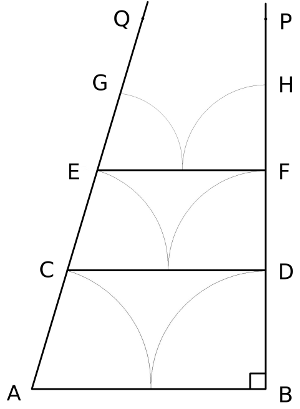
A paradox attributed to Proclus Lycaeus (412-485):
Consider two nonparallel lines, AQ and BP. BP is perpendicular to AB; AQ isn’t. Find the midpoint of AB and mark AC = BD = AB/2. Now if AQ and BP are going to intersect, it can’t happen on AC or BD; if it did, say at a point R, then that would give us a triangle ARB where the sum AR + RB < AB, which is impossible.
But now we can connect CD and follow the same process: CE and DF can't intersect for the same reason. EG and FH are likewise ruled out, and so on up the line forever.
This seems to mean that two nonparallel lines will never intersect. That can’t be right, but where is the error?
(From Alfred Posamentier, Magnificent Mistakes in Mathematics, 2013.)


“Epitaph on an Unfortunate Artist”
He found a formula for drawing comic rabbits:
The formula for drawing comic rabbits paid.
So in the end he could not change the tragic habits
This formula for drawing comic rabbits made.
– Robert Graves

January 17, 2014
Hair Today …
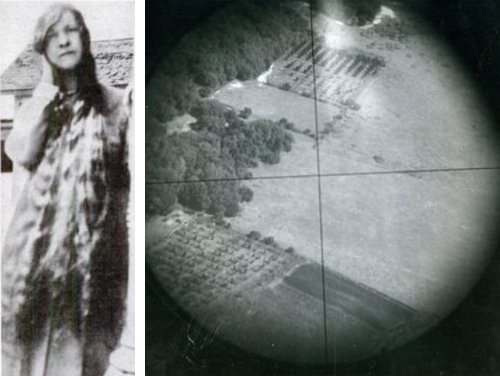
In 1943, Colorado broom factory worker Mary Babnik Brown saw an advertisement in a Pueblo newspaper soliciting blond hair, at least 22 inches long, that had not been treated with chemicals or hot irons. Brown had never cut her hair, which she combed twice a day and washed twice a week with pure soap. When her samples were deemed acceptable, she cut off all 34 inches and sent it in, considering this her contribution to the war effort, though “I cried for two months.”
At the time she was told that her hair would be used in meteorological instruments. It wasn’t until 1987, the year of her 80th birthday, that she learned that it had been used in the Norden bombsight, a top-secret instrument that guided bombs to their targets. Engineers had determined that fine blond human hair worked ideally in crosshairs, but the technology was a closely guarded secret, so the donors weren’t told how their contributions would be used. “I couldn’t believe it when they told me,” Brown said. “All I knew was that they needed virgin hair.”
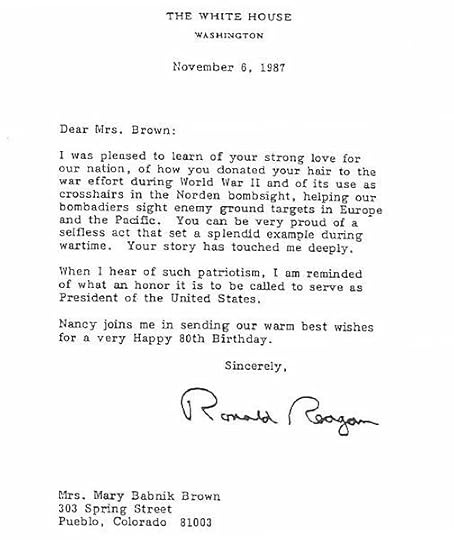
She did get some compensation: Pueblo declared Nov. 22, 1991, “Mary Babnik Brown Day,” she was inducted into the Colorado Aviation Historical Society’s hall of fame, and Ronald Reagan sent her this letter:

Signed Books
Since the Futility Closet book came out, a number of readers have asked whether I could provide signed copies. I think I’ve now worked out a way to to do this for those who are interested. I can send signed copies to U.S. residents for $25 each, and to those elsewhere for a comparable price once we’ve worked out the shipping. If you’re interested, please write to me at gregblog@gmail.com. (And thanks for asking — I hadn’t expected this!)

Nothing Doing
John Cage’s 4’33″ is commonly described as “four and a half minutes of silence,” but in fact it’s the opposite — Cage hoped to lead the audience to hear the ambient sounds of the concert hall as music, to accept as art sounds that they wouldn’t normally consider in that way.
“What they thought was silence, because they didn’t know how to listen, was full of accidental sounds,” he said of the piece’s 1952 premiere. “You could hear the wind stirring outside during the first movement. During the second, raindrops began pattering on the roof, and during the third the people themselves made all kinds of interesting sounds as they talked or walked out.”
In a broad sense 4’33″ was Cage’s most significant work, but the notion of a dedicated piece of art with no substance does introduce some perplexing puzzles. The work debuted as a piano piece with a specified length, but Cage later said that “the work may be performed by any instrumentalist or combination of instrumentalists and last any length of time,” and indeed he produced varying scores in different notations. Can all of these be said to be the same piece?
The “In Futurum” movement for solo piano from Czech composer Erwin Schulhoff’s 1919 Fünf Pittoresken consists entirely of rests, but directs the performer to play “the entire song with as much expression and feeling as you like, always, right to the end!” (French pianist Philippe Bianconi wondered, “Should I just sit there?”) And Alphonse Allais’s 1897 Funeral March for the Obsequies of a Deaf Man, below, consists of 24 blank measures. Could an unwitting audience member distinguish either of these from Cage’s work?
A puzzle by philosopher Patricia Werhane of Loyola University of Chicago: Suppose that a pianist were engaged to perform 4’33″ but had to withdraw at the last moment, and in desperation the stage manager sat in his place. Would this be a performance of Cage’s work? Would it be a musical performance?
Now more than 60 years old, Cage’s idea may still be too novel for a wide public. When BBC Radio 3 broadcast the first U.K. orchestral performance of 4’33″ in 2004, the network had to turn off an emergency backup system that would have interpreted the silence as dead air — and begun playing music.

January 16, 2014

An Epigrammatic Puzzle
Nokes went, he thought, to Styles’s wife to bed,
Nor knew his own was laid there in her stead;
Civilian, is the child then begot
To be allow’d legitimate or not?
– Bon Ton Magazine, July 1794

Diamond Verses
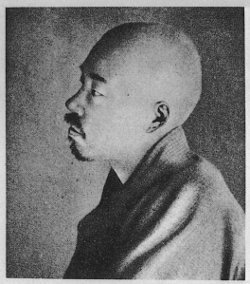
Masaoka Shiki, the fourth of Japan’s great haiku masters, is a member of the Japanese Baseball Hall of Fame. Described as “baseball mad,” Shiki first encountered the game in preparatory school in 1884, only 12 years after American teacher Horace Wilson first introduced it to his students at Tokyo University in 1872. Shiki wrote nine baseball haiku, the first in 1890, making him the first Japanese writer to use the game as a literary subject:
spring breeze
this grassy field makes me
want to play catch
like young cats
still ignorant of love
we play with a ball
the trick
to ball catching
the willow in a breeze
Throughout his career Shiki wrote essays, fiction, and poetry about the game, and he made translations of baseball terms that are still in use today. Eventually he taught the game to Kawahigashi Hekigotō and Takahama Kyoshi, who themselves became famous haiku poets under his tutelage, and today a baseball field near Bunka Kaikan in Ueno bears his name. He wrote:
under a faraway sky
the people of America
began baseball
I can watch it
forever

January 15, 2014
In a Word
oragious
adj. stormy
tenebrific
adj. producing darkness
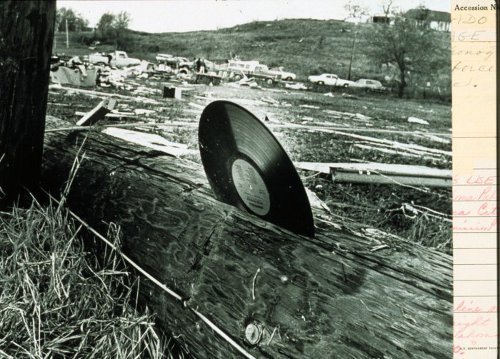
Above: From the NOAA photo library, “The awesome power of a tornado demonstrated — a 33rpm plastic record blown into a telephone pole.” See Freaks of the Storm and Mean Winds.

Thought That Counts
Chris Maslanka devised this brainteaser for the Gathering for Gardner held in Atlanta in April 2004:
A bouquet contains red roses, whites roses, and blue roses. The total number of red roses and white roses is 100; the total number of white roses and blue roses is 53; and the total number of blue roses and red roses is less than that.
How many roses of each color are there?