Greg Ross's Blog, page 631
January 22, 2014
About Face
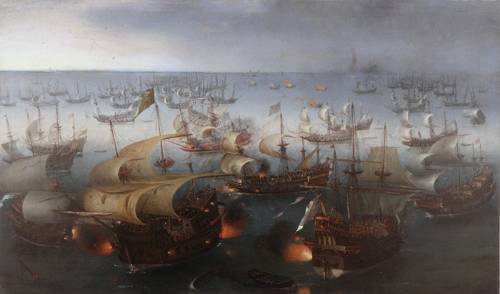
To commemorate the defeat of the Spanish Armada, England struck a medal bearing the device of a fleet flying under full sail.
The inscription read Venit, vidit, fugit — “It came, it saw, it fled.”


January 21, 2014
Planting One’s Feet
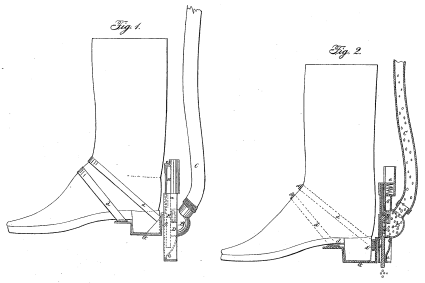
George Meacham invented this convenient planting device in 1856. Strap a seed bag to your waist and a plunger to each boot and you can plant corn effortlessly while strolling in your fields.
And maybe afterward you can dispense popcorn at the campfire.


Constitution

A lump of clay exists on Monday. On Tuesday it’s fashioned into a statue. Are the lump and the statue the same thing? It would appear not: The statue didn’t exist on Monday, and it wouldn’t survive being squashed, but the lump did and would. But if the lump and the statue are two different material objects, how can they coincide? How can two things exist in the same place at the same time?

Fore-Edge Paintings
Some of your old books may contain hidden artworks: Beginning in the 17th century, a book’s binder would sometimes paint a watercolor scene on the edge of the book’s page stack. If the pages were then gilded, the image might remain hidden for years until the pages were fanned.
Sometimes two different images are hidden in the same book, revealed successively when the pages are fanned “up” and “down.” In rare cases paintings are hidden not just on the book’s fore edge but on the top and bottom as well, offering a panoramic view of the painting’s subject.

January 20, 2014
Standoffish
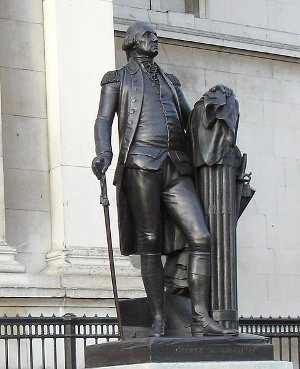
Image: Wikimedia Commons
No British monarch set foot in America until 1939, when George VI visited the New York World’s Fair.
George Washington vowed never to set foot on English soil — so when London’s National Gallery erected a statue of the president in 1921, the state of Virginia sent a ton of earth for him to stand on.

Ghosts of Scotland
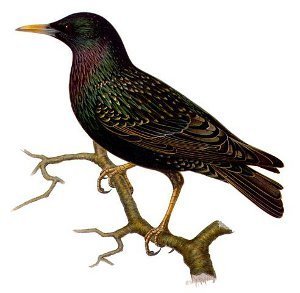
One last striking story about bird mimicry:
I was in the Outer Hebrides and I came across an abandoned derelict croft. It had no roof, but very substantial walls and in the gaps between the stonework was a starlings’ nest. I could hear the birds inside, and eventually one of the starlings came to defend its territory. I heard straight away that it wasn’t just the usual rambling song. It started to mimic a Corncrake, a species that is very rare in mainland Britain. It did this bird’s buzzing repetitive song, but then it immediately went into other sounds that seemed familiar and had a strong rhythm to them. As I was listening I was looking around and could see the remnants of farm machinery, including an ancient tractor that had not moved for 20-30 years. I realised this bird was singing the song of some of this machinery. It was singing the song of a mechanical pump that had obviously been active around this farm, and used by the people who had lived here.
I wasn’t listening to the same starling that heard these original sounds. These copied sounds are usually passed on from parents or neighbouring birds so that a young bird absorbs and then duplicates them. The strange thing was that I was recording the sounds in what had been somebody’s living room, a place that had obviously been full of the conversations of family life over generations and which had passed into history. Yet the birds had returned and taken it back — claimed this space and these rocks — and were singing their own song. And they were singing the songs that were around when the people were here.
– Chris Watson of Tyne and Wear, U.K., quoted in Mark Cocker’s Birds & People, 2013

Pole Position
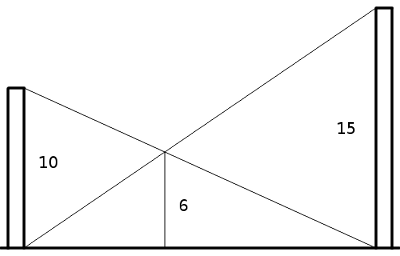
Two poles stand vertically on level ground. One is 10 feet tall, the other 15 feet tall. If a line is drawn from the top of each pole to the bottom of the other, the two lines intersect at a point 6 feet above the ground. What’s the distance between the poles?

January 19, 2014
Unquote
“One will rarely err if extreme actions be ascribed to vanity, ordinary actions to habit, and mean actions to fear.” — Nietzsche

Telling Time
A letter from “J. A. McM.,” West Lynn, Mass., to Mark Twain, April 17, 1907:
Dear Sir:–
Apropos of your very entertaining little book on ‘English as she is Taught’ — the following true story fits in well — A teacher asked her class of boys to tell the difference between herself and a clock. A bright little urchin in the rear row raised his hand and said — ‘You have a face and the clock has a face, and you have got hands and the clock has got hands, and — and (reflecting) the clock has got a pendooleum and you aint.’
On the envelope Twain wrote, “Preserve this. Frame it. It is the second time in 40 years that a stranger has done me a courtesy & charged me nothing for it.”