
 Sorry, you must be a member of the group to do that. Join this group.
David Boyle's Blog, page 42
January 14, 2015
Why I wouldn't have published
I'm not sure I know why I've always found it so difficult to agree with so reasonable a man as Tony Blair. Perhaps his fatal inability to think beyond the most powerful person in any argument - which is a strange Labour party trait; one of the few things he has in common with the rest of his party.
But I do agree with him about religion. Religion may be a force for disorder and war but, in comparison with secularism, it is a pussycat. And unlike secularism, religion carries within it at least a powerful demand for peace.
We are different from France. We don't usually interpret our liberalism in terms of secularism. Disestablishment, maybe. The roots of British Liberalism lie only partly in utilitarianism and radicalism; they also lie in nonconformist religion, and the tolerance which that implies.
We are able to distinguish, as we badly need to do, between good religion and bad religion.
All of which is a way of saying that I find the French aggressive secularism uncomfortable. It seems to me not to be quite human. It smacks just a little of the French Revolution. There is another kind of intolerance about it.
And tolerance, it seems to me, would lead us to understand a little of the sensitivities of those around us, and especially those who are basically on our side. They find pictures of the founder of their religion offensive and upsetting.
I'm not sure therefore whether another cartoon of the Prophet isn't playing into the hands of those who would like this to be a giant battle between Islam and secularism. That isn't a winning hand for our side.
I understand why another cartoon has been published. I understand why it has been republished. But as a British Liberal, I find it uncomfortable. Because if this is a battle against the jihadis - the most important priority is to win it for European values.
I don't have to choose between tolerance and satire, but - if I had to - I would personally go for tolerance.
But I do agree with him about religion. Religion may be a force for disorder and war but, in comparison with secularism, it is a pussycat. And unlike secularism, religion carries within it at least a powerful demand for peace.
We are different from France. We don't usually interpret our liberalism in terms of secularism. Disestablishment, maybe. The roots of British Liberalism lie only partly in utilitarianism and radicalism; they also lie in nonconformist religion, and the tolerance which that implies.
We are able to distinguish, as we badly need to do, between good religion and bad religion.
All of which is a way of saying that I find the French aggressive secularism uncomfortable. It seems to me not to be quite human. It smacks just a little of the French Revolution. There is another kind of intolerance about it.
And tolerance, it seems to me, would lead us to understand a little of the sensitivities of those around us, and especially those who are basically on our side. They find pictures of the founder of their religion offensive and upsetting.
I'm not sure therefore whether another cartoon of the Prophet isn't playing into the hands of those who would like this to be a giant battle between Islam and secularism. That isn't a winning hand for our side.
I understand why another cartoon has been published. I understand why it has been republished. But as a British Liberal, I find it uncomfortable. Because if this is a battle against the jihadis - the most important priority is to win it for European values.
I don't have to choose between tolerance and satire, but - if I had to - I would personally go for tolerance.


January 13, 2015
Tesco, milk and the medieval version of markets
 Only one company exists from the original Dow Jones Index from a century ago (General Electric). It is certainly uneasy at the top. People eventually assert themselves against their overlords and overthrow them.
This is a medieval image of the way competitive markets are supposed to work, but it is the one I gleaned from this morning's rather self-satisfied editorial in the Financial Times. It is a case of The King Is Dead Long Live the King, as Tesco gives away a a slightly bigger oligopoly of identical formats.
It is comforting to know that, in the end, the great tyrants fall. They over-reach themselves. My name is Ozimandius PLC, they might say, before returning to dust. The problem is that it takes time, and they hold us captive in the meantime because the protections against monopoly are far too weak these days.
And if you wanted to see the evidence you need look no further than the milk producers, especially now that the prices paid for milk are now said to be lower than water.
I don't know about the rest of the Big Four supermarkets, but Tesco has insisted on payment terms for its suppliers of 90 days - not an option for its small competitors. That particular abuse - and it is an abuse - has provided it with a rolling interest-free loan equal to two months of total stock.
Again, that is a huge competitive advantage not provided to its competitors.
I was involved in the fascinating debate around the two grocery market inquiries over the past decade or more, which seemed at the time to have been almost pointless given the narrow definition of uncompetitive practices that the Competition Commission were using.
I know they were sticking to the letter of the Enterprise Act, but their basic assumptions were faulty: if a company was one way - as far as the regulators were concerned - then consumers must almost always have chosen for it to be so.
There is a kind of naivety about that which explains why monopoly has become such a curse of modern business and a source of such inefficiency and poor service.
But one reform brought through by the final Competition Commission inquiry, and finally forced through by Lib Dems in government, was the Groceries Code Adjudicator.
By coincidence there was an interview with Christine Tacon, the first in the post, in the Evening Standard last week. She has taken up no case formally yet, but she has tackled a number of abuses more informally - with quiet words in ears. Tesco was demanding payments for better shelf positioning ad the Co-op was asking suppliers for compensation when failing to meet sales targets.
The problem is that, if the market was really working, then this kind of post would not be necessary. Nor would we hear so much today, begging the supermarkets to act in the interests of farmers. The milk producers would be able to go elsewhere to get their milk on the shelves.
As it is, we may soon not have a UK dairy industry at all. If you believe the Financial Times, this would be the result of free and open markets. In fact, it is the absolute opposite.
Subscribe to this blog on email; send me a message with the word blogsubscribe to dcboyle@gmail.com. When you want to stop, you can email me the word unsubscribe.
January 12, 2015
The Liberal Revival at 56: time to take stock
 I'm not sure there is such a thing as 'middle-aged' any more. We burst straight into old age from youth.
 I even have some evidence for this assertion. Some years ago, I was on a Home Office committee giving away money to people for volunteering projects. The first applicant that came before us was promoting a youth volunteering scheme, which they defined as 'under-50'. The second was promoting an older people's volunteering project, which they defined as 'over-55'.
Even by this rule of thumb, I am apparently old. I was born in 1958, which makes me - and here is the relevance of this - the same age as the Liberal Revival (which I date from the Torrington by-election, actually March 27).
Despite the efforts of the Liberal History Group, there has not been nearly enough emphasis on this by academics, so we have little or no consensus about what it meant, but I have grown up with it and it has shaped the way I view the world.
Looking back, this was the political cause which I devoted most of my adult life to over the past 56 years. I think it is therefore time to look back and take stock.
This is how I see it. The Liberal Revival emerged out of Macmillan's Never Had it So Good period as a critique of the Butskellite, Heath-Wilson consensus, that gave us high rise flats, urban demolition, nuclear energy, local government re-organisation, and a highly centralised state. It emerged out of Grimond's critique of bureaucracy.
If you doubt this, have a look at Roger Fulford's The Liberal Case for the 1964 election.
These central questions were blurred by the Alliance and the merger with the SDP, but they were still there, and it led to one absolutely vital achievement: the democratic reform of local government - from an insular, hidebound, patronising mess to something that is now considerably more effective and much more democratic.
Therein also lies its weakness. Far more effective local government but much less power.
The Lib Dem achievements in government are not small - they include of course the Green Investment Bank, the Supermarket Ombudsman, the re-discovery of apprentices, the Pupil Premium, City Deals - but they don't hang together in quite the way the local government achievement has.
It sees to me that we need to start thinking of the past 56 years together, rather than just the last five. Because there is a new question the Liberal Revival must now wrestle with if it is going to revive again. It is: how to rescue internationalism from the distortions and abuses of globalisation.
That will have electoral consequences, but it is also going to involve a great deal of thinking and arguing, before we get there. We are going to have to assemble practical ways forward, and conceptual ones too, just as we did with Grimond's critique of old-fashioned, patronising modernity.
Our ability to carry on for the next 56 years seems to me to be in proportion to our success in this grand new project. The forces of nationalism are growing stronger. No other political creed is really going to challenge them fundamentally. If there remains a Liberal Revival, this is the task set for us by fate. And we have to start by doing a great deal of thinking.
Subscribe to this blog on email; send me a message with the word blogsubscribe to dcboyle@gmail.com. When you want to stop, you can email me the word unsubscribe.
January 8, 2015
Christ the cartoonist and the Liberal power of humour
 Listening to the coverage of the terrible shootings in Paris, I keep finding myself thinking of Umberto Eco's wonderful post-modern extravaganza, The Name of the Rose, where the murderer turns out to be motivated by a fanatical religious hatred of humour. This is what Jorge de Burgos says:
"Laughter is a devilish wind which deforms, uh, the lineaments of the face and makes men look like monkeys."
The detective-monk William of Baskerville replies: "Monkeys do not laugh. Laughter is particular to men."
Which is true. They then discuss whether Christ laughed. It seems to me, as a former theology student, that the sheer starkness of the images in Christ's teachings are based on humour - camels and eyes of needles, and so on: these are caricatures. They are, in their way, cartoons.
Humour is like money in the sense that it is one of the primary forces of Liberalism. Pomposity, privilege, aristocracy, all fall away against the power of humour, just as they do against the power of money. They are great equalisers.
That is not to suggest that they can't be taken too far. We know what happens when we concentrate too much on money - it stops corroding the privileges of the elite and starts to corrode everything worthwhile. It sets up its own elite. The same is true of humour.
It is worth remembering that when we talk about the dangers of self-censorship. Of course, fear is a ferocious censor, but don't let's pretend that cartoonists don't censor themselves every day - as they should do.
Even so, for these reasons, the attack in Paris strikes at the heart of Liberal civilisation. We all feel, I think, that something has shifted yesterday. Tyrants hate humour.
But we have to be clever how we respond. This is a civil war inside Islam. It is not a war, as the nationalists would have it, between Islam and the West. It is no coincidence that these were cartoonists who were killed.
The fanatics want more caricatures, more clever jokes at the expense of Islam. They want a response that can shift more Muslims onto their side. They want this to be a war between East and West: we have to make absolutely sure we don't help them. That may involve a little self-censorship, but it is a strategy to win a struggle that we simply have to win.
And restraint and tolerance of other people's sensitivities are also Liberal values.
Subscribe to this blog on email; send me a message with the word blogsubscribe to dcboyle@gmail.com. When you want to stop, you can email me the word unsubscribe.
January 7, 2015
We need to know why A&Es are in crisis
 “Oh, the sad condition of mankind,” moaned the great Belgian pioneer of statistics, Adolphe Quetelet:
“We can say in advance how many individuals will sully their hands with the blood of their neighbours, how many of them will commit forgeries, and how many will turn poisoners with almost the same precision as we can predict the number of births and deaths. Society contains within it the germ of all the crimes that will be committed.”
It is a frightening thought, just as it was frightening for Quetelet’s contemporaries to hear him say it in the 1830s. But he and his contemporaries had been astonished by how regular the suicide statistics were. Year after year, you seemed to be able to predict how many there would be. There were the occasional bumper years, like 1846, 1929 and other economic crash periods, but generally speaking it was there.
People didn’t seem to be able to help themselves. Amidst a constant number of individuals, the same number would take it into their heads to murder as much as get married. Statistics were powerful and also pretty predictable. More about that in my book The Tyranny of Numbers.
I was thinking about Quetelet this morning listening to the closure of so many hospitals as, one by one, they were overwhelmed by the demand in their casualty departments.
The thing is that underlying demand doesn't change that much. The basic need for emergency healthcare will always remain steady. Yet something is clearly going on - I heard hospital managers talking about pressure of demand going up by 30 or 40 per cent this year.
Yet there is remarkably little agreement about why. Here are some candidates:
1. A growing elderly population. This is true, but it doesn't explain the sudden weight of demand, unless this is a side-effect of a catastrophic breakdown in social care, which it could be.
2. Younger people using A&E instead of making an appointment for a doctor. This must be true too, but again - why so much now?
3. People are particularly ill at the moment - because of all the bugs and the warm winter which failed to kill them. This is possible but why should be have such an impact this year compared with others when there is no obvious epidemic.
4. The difficulty about recruiting NHS staff for A&E. This must be a factor but it doesn't explain the extra demand.
Whatever it is, Norman Lamb is absolutely right to be struggling to get some kind of cross-party consensus on the future of the NHS. But that will depend on some kind of authoritative analysis on why demand has surged over the last year.
For me, only two explanations carry conviction about why this is happening now. Both involve, as they would have to, some kind of tipping point in all these trends, but two in particular.
First, is there a some kind of breakdown in social care which is driving people to A&E, based on the cumulative changes over the past decade - the disastrous over-regulation and target-driven ineffectiveness ions of the New Labour years, and the recent funding reductions? We urgently need to see how the failures in one part of the public service system impacts on other parts.
Second, is there some kind of cumulative effect of the narrowing of outputs to contract, caused by contracting out too many of the big outsourcing giants - whose main expertise is in meeting targets with the minimum of effort, spreading costs elsewhere in the system? These extra costs will tend to come home to roost eventually at A&E because it is the only open-door in the public service system. But are they coming come to roost?
I don't know, any more than anyone else, whether either of these goes anywhere near explaining it. All I do know is that statistics of this kind only vary if something else very important is happening - the basic underlying demand will not change much, at least not year by year.
It is in the coalition parties' interests that we have some firm theory to rely on before the general election. Otherwise people will believe what fits their mood at the time. But something is going on - and we need to know what it is.
January 6, 2015
The great privatisation smokescreen
I spent yesterday sorting out old papers, and what should fall at my feet but a 2008 article by George Monbiot in the Guardian with the headline: 'Labour's perverse polyclinic scheme is the next step in privatising the NHS'.
It so happened that I had found myself swearing at the radio during the staged confrontation between John Humphrys on the Today programme and Labour's Andy Burnham yesterday.
The combination of the two events reminded me that accusations of privatising the NHS is what oppositions fling at governments - and there is always an element of truth about it, but also an element of smokescreen.
What was irritating about the Burnham 'interview' was partly that these confrontations so rarely allow us to get into the issues effectively, and partly because the whole NHS debate appears to be about privatisation and the Health and Social Care Act 2012.
If you have the misfortune to get your news from 38 Degrees, or similar, you might have swallowed the idea that the new legislation, only two years ago, fattened up the NHS for privatisation, allowing Ed Miliband to ride to its defence.
So quickly have we forgotten that the Health and Social Care Act was not passed as originally drafted - when there might have been a case like this to answer - but heavily amended by the Lib Dems.
Turn to the Parliamentary record, if you doubt me, and you will see some of the Lib Dem amendments:
1. To remove “the reviews by the Competition Commission from the Bill to make sure that the NHS is never treated like a private industry.”
2. To "keep the independent regulator of Foundation Trusts, Monitor, to make sure hospitals always serve NHS patients first and foremost.”
3. To "introduce measures to protect the NHS from any threat of takeover from US-style healthcare providers by insulating the NHS from the full force of competition law.” This was also designed to fend off claims under the new TTIP agreement now being negotiated.
4. To "insist that anyone involved with a commissioning group is required to declare their own financial interests, so that the integrity of clinical commissioning groups is maintained.”
5. To "put in place additional safeguards to the private income cap to make sure that Foundation Trusts cannot focus on private profits before patients.”
6. To empower the Secretary of State for Health to give guidance to Monitor in line with his overarching duties, to promote a comprehensive health service and improve health outcomes.
It may be many things, but it was a tightening up of the opportunities for privatising the NHS which had been put into legislation under Blair and Brown. So why the panic about NHS privatisation?
Far from making integration more difficult, the Lib Dem amendments have made integration easier than it was under New Labour - and integration is now the objective of the Department of Health.
Because there is a problem, not with wholesale privatisation, but with the extension of contracting out in the NHS. It is the narrowing of deliverables, which simply sprays costs around the system, which is the real problem here - and the major outsource suppliers whose main skill is to provide the target data with the minimum effort. It is currently leeching money out of the NHS.
Yet, thanks to this smokescreen argument about privatisation, the real issues of contract culture are not discussed.
Subscribe to this blog on email; send me a message with the word blogsubscribe to dcboyle@gmail.com. When you want to stop, you can email me the word unsubscribe.
January 5, 2015
Why the nationalists have us on the run.
New years always take me a little by surprise. I've looked back to see what I was predicting for 2014, and I seem to have been pretty much right. I said that the key intractable issues of the year would be:
1. The rise of the intolerant, nationalist right across Europe.
2. Political stalemate over the status of Scotland.
3. The breakdown of the measurement and transparency system in UK public services.
I'm not sure that I completely hit the nail with No 3. In fact, the measurement and transparency systems which govern public services still stagger on, as boneheadedly as ever - and that will be a theme, if only for me - in the year ahead. We have still not grasped the damage it has been doing.
This is what I wrote under No 2:
"I know all the bets are on the Scots giving a whole-hearted thumbs down to independence, but I am not sure it will be overwhelming at all – and for the same reason for the revolt against the European Commission and the bureaucracy of the single market: voting yes to Scottish independence looks increasingly like a vote for imagination and open-minded courage, and against the miserable technocratic carping about how people’s narrow economic interests will be compromised."
Looking back at the peculiar period of the Scottish referendum, my strong sense is that the issue will not go away until the unionist side can c0me up with a vision for Scotland which is as optimistic and compelling, while still being inside the UK, as the independence side.
The way out in the Scotland debate, and a victory for the non-nationalists, will come in precisely the same way as a victory for the non-nationalists in the Europe debate.
The non-nationalists can win temporarily, by citing narrow economic interests - about being part of the UK or part of the EU - but that is all. By doing so, they simply postpone a solution and leave open the possibility of exit. In this, as in so much else, we await the emergence of a shared radical narrative for a future which is not simply about defending the compromises of the past.
Will it come in 2015? My prediction is that it will be more apparent, but still has some way to go before it reaches the mainstream - maybe as much as a decade. We therefore await the crisis of the early 2020s, which I believe will bring about the major change of direction that I've been predicting.
But still, this is the first blog of the year, so I have to make a few predictions about the 12 months ahead, and in particular the coming general election:
1. The Lib Dems will hang on with 39 seats (yes, you heard it here first).
2. UKIP will get no more than four seats.
3. I have not the foggiest idea who will be prime minister at the end of it - or indeed whether we will have to vote all over again.
I'm only too aware that this isn't much of a prediction. But the implications for the Scotland and Europe debates is that, in the absence of that compelling vision of independence inside the various unions, then the nationalists will still have us on the run this year.
Subscribe to this blog on email; send me a message with the word blogsubscribe to dcboyle@gmail.com. When you want to stop, you can email me the word unsubscribe.
1. The rise of the intolerant, nationalist right across Europe.
2. Political stalemate over the status of Scotland.
3. The breakdown of the measurement and transparency system in UK public services.
I'm not sure that I completely hit the nail with No 3. In fact, the measurement and transparency systems which govern public services still stagger on, as boneheadedly as ever - and that will be a theme, if only for me - in the year ahead. We have still not grasped the damage it has been doing.
This is what I wrote under No 2:
"I know all the bets are on the Scots giving a whole-hearted thumbs down to independence, but I am not sure it will be overwhelming at all – and for the same reason for the revolt against the European Commission and the bureaucracy of the single market: voting yes to Scottish independence looks increasingly like a vote for imagination and open-minded courage, and against the miserable technocratic carping about how people’s narrow economic interests will be compromised."
Looking back at the peculiar period of the Scottish referendum, my strong sense is that the issue will not go away until the unionist side can c0me up with a vision for Scotland which is as optimistic and compelling, while still being inside the UK, as the independence side.
The way out in the Scotland debate, and a victory for the non-nationalists, will come in precisely the same way as a victory for the non-nationalists in the Europe debate.
The non-nationalists can win temporarily, by citing narrow economic interests - about being part of the UK or part of the EU - but that is all. By doing so, they simply postpone a solution and leave open the possibility of exit. In this, as in so much else, we await the emergence of a shared radical narrative for a future which is not simply about defending the compromises of the past.
Will it come in 2015? My prediction is that it will be more apparent, but still has some way to go before it reaches the mainstream - maybe as much as a decade. We therefore await the crisis of the early 2020s, which I believe will bring about the major change of direction that I've been predicting.
But still, this is the first blog of the year, so I have to make a few predictions about the 12 months ahead, and in particular the coming general election:
1. The Lib Dems will hang on with 39 seats (yes, you heard it here first).
2. UKIP will get no more than four seats.
3. I have not the foggiest idea who will be prime minister at the end of it - or indeed whether we will have to vote all over again.
I'm only too aware that this isn't much of a prediction. But the implications for the Scotland and Europe debates is that, in the absence of that compelling vision of independence inside the various unions, then the nationalists will still have us on the run this year.
Subscribe to this blog on email; send me a message with the word blogsubscribe to dcboyle@gmail.com. When you want to stop, you can email me the word unsubscribe.
December 23, 2014
Columbus and the Westminster abuse case
 I wrote a book some years ago about the friendship and rivalry between Columbus, Cabot and Vespucci (
Toward the Setting Sun
). One of the things that became clear to me as I researched it is just how much the excitement of discovery – then and later – was bound up with the prospect of sex with powerless people.
I wrote a book some years ago about the friendship and rivalry between Columbus, Cabot and Vespucci (
Toward the Setting Sun
). One of the things that became clear to me as I researched it is just how much the excitement of discovery – then and later – was bound up with the prospect of sex with powerless people.Later, when I wrote Voyages of Discovery , it came home to me even stronger. But for some reason, the scholars have tended to ignore this. It is as if it wasn’t an important part of the experience of imperialism, yet it was.
That was how Columbus’ first expedition could bring virulent syphilis back to Europe. It was why a later charter for Cabot’s successors by Henry VII of England carried a warning against forced sex.
It was also the nakedness of the natives that first excited major European audiences to Vespucci’s writings, real or fake. Sex and discovery was bound up in everyone’s mind then. See Donne’s poem about going to bed with his mistress if you’re not sure ("O my America, my new found land...").
Finally, it was the real meaning of the description by Columbus’ friend Michele de Cuneo of his encounter with a native woman in his cabin:
“Having taken her into my cabin, she being naked according to their custom, I conceived a desire to take pleasure. I wanted to put my desire into execution but she did not want it and treated me with her finger nails in such a manner that I wished I had never begun.”
The Algonquin people who met Verrazano’s expedition in 1524 made sure than no women went on board his ships. They knew the score by then.
I have been sceptical about the furore over historical child abuse until recently. But the stories about Westminster in the 1980s (still just stories) keep reminding me of Columbus and Michele de Cuneo, and all the others.
Nobody who reads about the period can be in any doubt that sex with powerless people tended towards violence and lazy murder. Anyone who doubts that needs to read the reportage of Bartolomé de las Casas at the time.
There was something of the imperialist frame of mind, the complete impunity of the conqueror, about Westminster in the 1980s. Was there enough of a whiff of imperialism to suspect the worst?
And there is peculiar element to the story: even now, five centuries after the discovery of the New World, few people seem to write about the phenomenon of sex with powerless people in the history of discovery. Violence, yes – sex, no. Nor, it seems, have they known how to categorise it or talk about it in our own time.
I am suspicious of witch-hunts, of the pursuit of abusers into their powerless dotage. I am nervous of the political consequences of discovering that our politicians were harbouring child murderers only a few decades ago. But there was a sickness abroad in the 1980s, which has in turn led to an economic weakness which I’ve written about in my book Broke . If that imperial mindset led to child murder, it would be the scandal of the age.
It would change everything, and should do – and we simply have to know.
December 22, 2014
When did we stop being a seafaring nation?
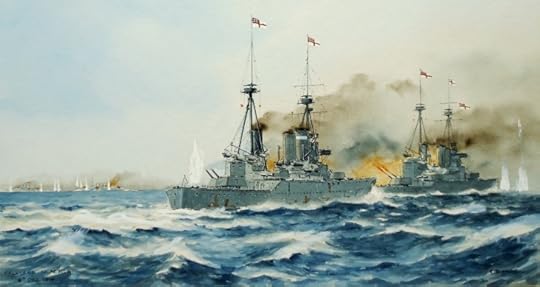
It is rather a strange thing that, as we celebrate the centenary of the Christmas Truce – maybe even read my ebook on the subject – we are forgetting one critical element of the First World War.
Are we not supposed to be remembering the war at sea? Why not?
The last few months have seen the centenary of two of the most decisive sea battles of the First World War, and they have gone by with barely a mention – the overwhelming German victory at Coronel in October, followed by the overwhelming British victory over the same squadron in December at the Battle of the Falkland Isles.
The only institution which seems to have remembered either is the British Film Institute, which released the 1927 film made about the two battles.
It is odd that we have had almost permanent series of memorials on the western front. The Queen must have had to rent rooms in France. But about the war at sea – nothing.
Coronel was one of the biggest British naval disasters in history. The Falkland Isles marked the only time that British battlecruisers were used for the purpose they were designed to: to overwhelm cruisers.
Why? Is it because we worry about marking major defeats? Admiral Si Christopher Craddock had no need to steam into disaster, but somehow felt it was required of him to make the gesture of sacrifice once he was in the situation.
Is it because the mention of the Falklands always makes the official mind nervous?
Is it because we no longer regard ourselves as a seafaring nation? Or that we are embarrassed that the naval tradition which stretches back to the days of King Alfred – with some hiccups along the way – has so much unravelled?
If it is the latter, then that may mark a far-reaching shift that matters politically. It also matters culturally.
When I was growing up, hardly a month would go by without the picture of a warship on the front of the newspapers. These days, the place of the senior service has gone to the army.
When did the shift take place? Because there does seem to have been a parallel shift in political attitudes at the same time – from naval informality, the right to disobey orders and the Nelson Touch to the iron, regimented centralisation of the Thatcher-Blair period.
The question of whether we are a naval nation or a military one has important implications for the way government works. Naval nation’s are permissive and localising; military ones are controlling and authoritarian. I know which I want us to be.
I suggest as a small antidote that we start remembering the battles of Coronel and the Falklands, and the great forgotten commanders, Craddock, Sturdee and Von Spee.
And maybe also remember to commemorate the Battle of Dogger Bank in March.
December 16, 2014
The Hogan-Howe approach would be disastrous
 The long shadow of the BlairBrown approach to public services seems to still reach across the years. The Metropolitan Police commissioner Bernard Hogan-Howe has spelled out what should happen to the police to save money. And, reading through the list, I was wafted back to the infuriating days of 2007 or so - when I was so cross at the state of public services that I set out to write a book.
It eventually emerged as The Human Element , three years later (or was it four?)
Now one of the great omissions of the coalition, in my humble view, is that they failed to draw a line under the public service reforms of the past.
Yes, they promised to reduce targets - and they did a bit. They very sensibly abolished the tyrannical Audit Commission, which was standing in the way of innovation like a serious case of constipation. But that was it. They never articulated what the problem was, and precisely the mistakes Gordon Brown had been making - and often carried on making them as a result.
It is easier to see those fake solutions a little more clearly now for what they are. If the commissioner gets his way, and merges police forces into mega-forces, organises more combined back office services, contracts out key non-uniformed functions and relies more on IT, they will not just find their way disturbingly back to 2008 or so - but costs will rise considerably and effectiveness will go down.
How do I know? Well, the last study I saw of merged police forces showed that smaller police forces catch more criminals than bigger ones.
There was also the famous explanation by economics Nobel prize winner Elinor Ostrom of why crime went up in Chicago when the police went off the beat and began to rely on communications equipment. It was because the public no longer felt they were needed to fight crime - when, actually, they make all the difference and it is quite impossible without them.
I accept, of course, that one of Hogan-Howe's purposes is to avoid cutting community policing, and he's right about that.
But the rest of the Hogan-Howe approach, rather like the Gordon Brown approach, reduces the public to mild irritants who ought to get a grip so that they can be processed more easily. It doesn't work - and for very good reasons, outlined better than I can by the systems thinker John Seddon - it is extremely expensive.
Why have we still not learned these lessons? Well, partly because - despite the original rhetoric - the coalition never learned them. Partly because Whitehall finds this kind of counter-intuitive evidence very hard to hear. And partly because, despite all the sound and fury, our services still exist in a world, not just shaped by Brown, but has ended up as extreme Brown.
We have to articulate a better, more effective way, before we all drown in bills. May I humbly submit The Human Element as my contribution to the debate we are not yet having about the economies and diseconomies of scale.
David Boyle's Blog

- David Boyle's profile
- 53 followers
David Boyle isn't a Goodreads Author
(yet),
but they
do have a blog,
so here are some recent posts imported from
their feed.

