
Brendan Halpin's Blog, page 7
September 10, 2014
Urban Cyclist Manifesto
I use four modes of transportation to get around town, but I commute to work on my bike for about eight months of the year. I see a lot of anti-bike hate on the internet and a little bit on the street, so here is my urban cyclist manifesto. Enjoy!
I have a right to the road. I will ride on any road where it is legal for me to do so.
I have a right to an entire lane, and I will ride in the middle of the lane at will without apology or explanation.
I will not do stupid shit that forces drivers to make sudden, unusual, and dangerous moves to avoid hitting me.
I will treat buses and trucks with extreme deference, giving them more space and time than necessary and remembering in every encounter that being alive is more important than being right.
I will pull over for emergency vehicles and stop for school buses picking up and dropping off passengers.
I will stop for pedestrians in crosswalks.
Recognizing that a significant number of drivers are operating their vehicles in states of distraction, intoxication, emotional instability, or native idiocy that render them unable to share the road well, I will advocate for more bicycle infrastructure, especially cycletracks and bike paths.


September 7, 2014
The Life and Death of Adrian Gonzalez
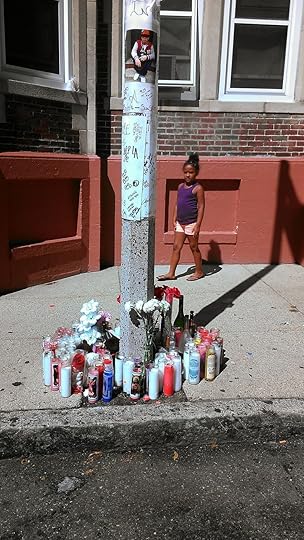
Adrian Gonzalez was murdered on Friday night. (Well, Saturday morning just after midnight.)
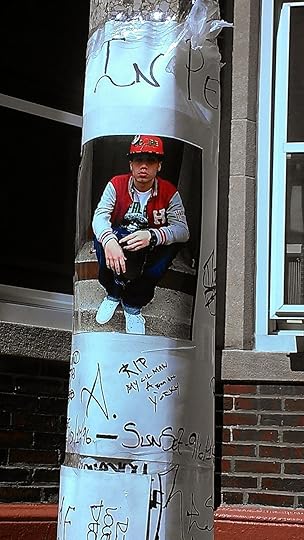
He was shot to death outside his home. He was seventeen years old.
Adrian attended the same elementary school as my children. He was friends with my son from kindergarten through fifth grade. He came over to my house a few times. I met his family. He and my son broke a light playing football in our living room.
And then they were in different classes, and then different schools, and they fell out of touch.
And Friday night, Adrian was shot to death.
I am worried about how my son is going to handle adulthood and whether he'll find the right path for him. Adrian's mother Jaqueline doesn't get to have those worries about him anymore and is probably deep in funeral arrangements today.
I want to assert two things because I feel like our culture continually asserts the opposite.
The first is that Adrian did not deserve to die and is not responsible for his own murder. Adrian was outside of his own house just after midnight on a Friday night, which is a thing everyone should be able to do. You can't blame his family either: his parents are kind, loving, people who supported him and had high expectations for him. Even when he used to come over here in the third grade, Adrian used to talk about where he was going to go to college.
I know people usually like to blame the victims of violent crimes in order to convince themselves that the violence couldn't happen to them, but in murders like this, people do it to hide the truth about this country from themselves. What happened to Adrian and his family will not happen to you or to your son if you are white. It's also very unlikely to happen to you or your family, no matter what your race, if you have money.
Adrian was killed not because of something he did but because of who he was: a Hispanic kid in a low-income neighborhood.
My second assertion is simply that Adrian's life mattered. And that his death mattered. He is being mourned by brothers, sisters, parents, friends, family members, teachers and classmates. Many of these people have also lost other loved ones to violence. Adrian's was the twenty-ninth murder in Boston this year.
Our culture asserts that young men with little money are disposible--we can watch them destroy their bodies for our amusement on the football field, we can send them overseas to die so that we might not have to pay five dollars a gallon for gas, or we can just leave them to the neighborhoods where "those people" live and do nothing to provide the kind of opportunities for them that young men and women who live in more moneyed areas enjoy as their birthright.
The hell with that. Adrian was a person who mattered. His death is a tragedy, and the fact that it happens so often should make us outraged, not inured.
How do you feel about living in a country where stuff like this happens? What are you doing to try to stop it?
What I ask of you is to think of Adrian Gonzalez not as a statistic or as a representative of his ethnicity or his neighborood. Think of him as an individual: a son, a brother, a friend, or as I do, as a cute, energetic, kindhearted third grader who never got the chance to grow up.
September 6, 2014
The Oxford Comma is Bullshit
'Despite the title of this post, I actually don't feel strongly about the serial comma. Though I do suspect if we all agree to call it the serial comma, it will lose some of its appeal to Anglophilic Americans and we'll see less rancor about it.
I actually usually use the serial comma because it's a habit I got into very young.
But what I object to are the stupid examples people give to show why the serial comma is always necessary. These are supposed to show how the serial comma is a magic bullet against ambiguity. Let's look at some of the favorites, shall we?
"I have 100 pounds of steel, 50 pounds of iron and coal." Vampire Weekend refuted this nicely, but also it's a weird and bad sentence. Why the hell would you be so specific about the amounts of steel and iron and then just leave coal hanging out there? It's bad writing that a comma can't fix.
"I'd like to thank my parents, Ayn Rand and God." I've seen this with Bill Clinton and Oprah Winfrey too. In order for this to appear ambiguous, you have to deliberately misunderstand what's being said. I guess you could say a serial comma here prevents annoying people from deliberately misconstruing your words in order to be pedantic about punctuation, but haters gonna hate and pedants gonna ped. Also, you could fix the sentence by putting God first. Or, you could honor your parents in the same way you've honored the celebrities and fictional character by actually calling them by name. Even with a serial comma, it's a weird and dumb sentence.
"Peter Ustinov visits Nelson Mandela, an 800-year-old demigod and a dildo collector." Again, misunderstanding this sentence requires you to be one of the few people in the world who doesn't know who Nelson Mandela was. But okay, let's say you don't know who Mandela was. Then surely you'd know if you wanted to assert that he was an 800 year old demigod and dildo collector, you probably wouldn't use that last "a." It would look like this: "I saw Brendan Halpin, a writer and curmudgeon."
Again, I kind of love the fact that the serial comma is optional, so you can use it or not AND you can use it sometimes and not others. No problem! Your choice! I just can't stand the idea that torturing the language to produce not-actually-ambiguous sentences means you always have to use it.
Here's a genuinely ambiguous sentence for you, inspired by a commercial that aired in my youth: "Billy played soccer while his younger brother held his Orange Crush." There really is no way to tell whose Orange Crush the younger brother is holding. Oh My God! Ambiguity! We must ban pronouns!
Or, maybe, we should just reword the sentence a little so it's clear whose Crush is in the little brother's hands.
So, yeah. Use the serial comma if you like it. Don't if you don't. Mix and match. But stop acting like your preference on this trivial issue is demanded by the language.
August 27, 2014
Who's a Criminal?
I am a criminal. This is the face of crime in America: 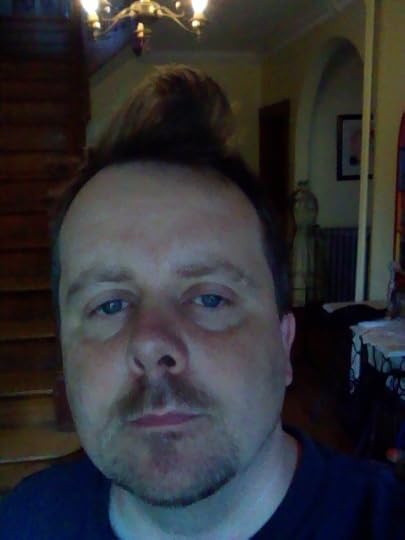
Or, anyway, that's the face of crime when crime just woke up and its hair looks more than usually ridiculous.
But my point is this: if we define a criminal as one who commits crimes, I certainly fit the bill.
Here's a partial list of my crimes:
I bought and consumed alcohol before my 21st birthday on many occasions. I hosted parties in my dorm room at which alcohol was provided to minors.
In 1990, I bought a bag of marijuana and consumed it on several occasions thereafter.
When I was 17, I had a 15-year-old girlfriend. This was before Ohio adopted its "Romeo and Juliet" law. During this year, I also trespassed criminally and put my life at risk by running across I-471 and climbing on the catwalks under the Dan Beard bridge over the Ohio River.
I am, in fact, an international criminal, as I spent six months in 1990 working in Taiwan in violation of that country's work and immigration laws.
I have been pulled over 6 times for traffic offenses. I was guilty in each case, though I only received a ticket twice. Once was for going 40 in a 25 MPH zone (in West Bridgewater, VT, where, I learned, there is always a police officer sitting in the half mile zone where the speed limit drops to 25). The second was for failing to stop for a pedestrian in a crosswalk. In this case, the officer who issued the ticket told me to appeal it. Though I was guilty, I did appeal it, and the charge was dismissed. In the other cases, the police officer checked my license, found that I had a clean driving record, and did not issue me a ticket. I have broken speed limit laws on countless occasions and have regularly "squeezed the lemon"--speeding through a yellow light as it turns red.
I have stolen music by downloading it without paying for it.
I'm sure I have commited more crimes, but I think you have the idea.
I consider myself to be a good person. I try to treat people with kindness, and my work involves helping people to build better lives for themselves. And yet, I am a criminal.
You probably are too. I think we all break the laws we feel are stupid or that shouldn't apply to us, or simply the ones that we can get away with breaking. The culture in which we live plays a big part in this. In the middle-class white culture in which I grew up, speeding was no big deal, and people bragged about their speeding tickets. In high school, knew many people with radar detectors in their cars to help them break speed limit laws more efficiently. There was even a hit song in the 80's called "I Can't Drive 55." And the singer was denounced by talking head pundits as a criminal and a bad role model for impressionable youths. Just kidding! He was white! He joined Van Halen and later became a multimillionare when he sold his tequila business to Seagrams.
This despite the fact that speeding is actually a crime that makes you far more likely to hurt or kill another human being than, say, shoplifting.
This is why I get uncomfortable when we start labeling people as "criminals." I'm talking about Michael Brown, of course, but also about many of the students I work with. Some of them have criminal records, usually for drug offenses.
Drug offenses are ridiculous. I have bought and consumed illegal drugs. I knew who sold illegal drugs at my high school and college. The person who arranged my aforementioned marijuana buy (and who tried to upsell me to ecstasy) now works in law enforcement. The person who sold cocaine in my high school's parking lot is, at least as far as the internet can tell me, a productive member of society who contributes to political campaigns. None of the people I knew who were involved with the drug trade as distributors or consumers are currently incarcerated or, indeed, have criminal records. Only poor people ever get nabbed for drug offenses.
I'm not suggesting that drug use is awesome, but it is a pretty common way in which people of all races and income levels mess up in this country, and most people get to mess up in this way without affecting their job prospects or having anyone suggest that they deserve to be murdered in the street.
I'm also not suggesting that any kind of lawbreaking is awesome; in fact, the more I learn about how traffic works and accident statistics, the more horrified I am at all the speeding I've done. But I am saying that I have broken the law. You too have broken the law. So perhaps let's not be so quick to label people as "criminals."
Calling someone a criminal is suggesting that their lawbreaking activities are the most important part of their identity. I don't feel that my criminal activities define me. Do yours define you? I'd like to suggest, then, that we pause before defining people only by their lawbreaking activities. Some people of course make crime their careers, but most people don't. For most criminals, like me, their lawbreaking activities are part of a much bigger and more complicated story and occur in the context of an entire life that has meaning and value.
So perhaps we can all climb down off that high horse (oh, but it's such a comfy ride and beautiful view from up there!) and show a little bit of empathy and compassion for people who have broken the law but were not lucky enough to get away with it.
August 11, 2014
Interview with Zeus is Dead author Michael G. Munz!
Hi everybody! Today I am donating my incredibly valuable blog real estate to a worthy cause: promoting a book I love! One that I didn't actually write! (I know, right?)
I got a free copy of Zeus is Dead: A Monstrously Inconvenient Adventure from Michael's publicist a few months back. I liked it so much I had my pseudonymus friend Seamus write a blurb for it.
Here's the publisher's synopsis:
The gods are back. Did you myth them?
You probably saw the press conference. Nine months ago, Zeus's murder catapulted the Greek gods back into our world. Now they revel in their new temples, casinos, and media empires—well, all except Apollo. A compulsive overachiever with a bursting portfolio of godly duties, the amount of email alone that he receives from rapacious mortals turns each of his days into a living hell.
Yet there may be hope, if only he can return Zeus to life! With the aid of Thalia, the muse of comedy and science fiction, Apollo will risk his very godhood to help sarcastic TV producer Tracy Wallace and a gamer-geek named Leif—two mortals who hold the key to Zeus's resurrection. (Well, probably. Prophecies are tricky buggers.)
Soon an overflowing inbox will be the least of Apollo’s troubles. Whoever murdered Zeus will certainly kill again to prevent his return, and avoiding them would be far easier if Apollo could possibly figure out who they are.
Even worse, the muse is starting to get cranky.
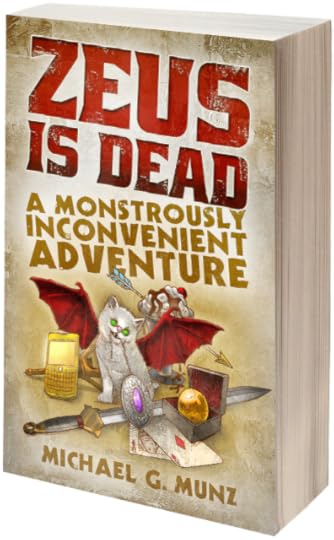
Discover a world where reality TV heroes slay actual monsters and the gods have their own Twitter feeds: Zeus Is Dead: A Monstrously Inconvenient Adventure!
And here's my Goodreads review: I loved this book. The Greek Gods have returned, and a couple of mostly hapless humans are caught up in forces that are mostly beyond their control. It's hilarious throughout: the fourth wall is shattered to dust, and yet the story remains engaging--this is no mean feat, and something I really admired about this book. But all other considerations aside, it's a really fun and funny book that reminded me of the best of Christopher Moore's early work. Highly recommended to fans of fantasy and humor.
Here's Michael's nice headshot:

So, without further ado, here are my questions and Michael's answers!
1. Other than Zeus is Dead, what's your favorite appearance of the Greek Gods in popular culture?
This is a tough one, because I honestly haven't seen many appearances of the Greek gods in pop culture. I've avoided reading/seeing the Percy Jackson series (I became aware of it in 2008/2009 midway through writing Zeus Is Dead, and I didn't want it to influence me), and I'm really picky about how the pantheon is portrayed. I suppose that's part of why I wanted to write my own take on them. I wasn't too pleased with the portrayals in the new Clash of the Titans movies. I have a vague recollection of seeing Disney's Hercules and being disappointed with all of the changes made there, and Troy and the just-released Hercules movie with The Rock have stripped away the gods altogether. So it's a toss-up between the original Clash of the Titans (which, while not perfect, an enjoyable tale), and a book by Dan Simmons called Ilium, which is a sci-fi take on the gods that's as intriguing and intricate as those familiar with Simmons would likely expect. But unlike Zeus Is Dead, it's not a comedy.
Wow, I really sound like a myth snob here, huh?
2.What writers did you read as a kid?
On my childhood bookshelf you'd find books by Roald Dahl (Fantastic Mr. Fox was an early favorite), Lloyd Alexander (I loved the Prydain Chronicles, and gave copies to my niece as soon as she was old enough), Beverly Cleary (do kids still read The Mouse and the Motorcycle?) Bill Watterson (Calvin & Hobbes was a late-childhood favorite that continues on into college until the strip ended) and, of course, a number of mythology books by various authors whose names I don't remember. Oh, and Tolkien, of course, once I was old enough. I don't think I'd even heard of The Hobbit until 4th grade. Oh! And, as a teen, Douglas Adams's The Hitchhiker's Guide to the Galaxy (and others) as a teen.
3.You're publishing with Booktrope--I'm intrigued by their new publishing model. Can you talk a little about the process, how it works,and what your experience has been?
My experience has been great so far. It was a blast to work with people as excited about the book as I am. When I signed on with them (after the usual query & manuscript review process – which took about 6 or 7 months), a creative team was formed consisting of a book manager, an editor, a proofreader, a cover designer, and a project manager (whose job it is to keep all of us on task and on schedule). None of these people are forced to be a part of the team – if they choose to be on it, it's because they believe in the book, and that makes for a great environment to work in. They also have a share in the royalties, so they have a vested interest in making sure the book does as well as it can.
After self-publishing two other books, it's taken me a little time to adjust to working with a team. I'm still vital to the marketing process, but I no longer have to do everything, and I've got the added confidence of the people on my team backing up my own belief in the book.
4. Are the razorwings the result of a special love or hatred for cats?
Neither – at least not in those extremes. I like cats (and in most cases prefer them to dogs), but I don't have any for pets. When I created razorwings I was trying to think of something that would both be cute and terrifying at the same time in order to maximize the comedic potential. (Wow, that just sounds hilarious when spoken of in such terms, doesn't it? "Yes, you see, the coefficient of comedy is inversely proportional to the…") Kittens are insanely cute, but insanely destructive. So hey, why not make them poisonous, give them bladed wings, and make two of them spring live from the corpse of any one you try to kill?
5. Reality TV figures prominently in Zeus is Dead. What are some of your favorite reality shows?
Ah, you mean Monster Slayer (where Jason Powers travels the country slaying the monsters that returned soon after the gods)? Reality TV itself isn't my thing, but if the Greek gods appeared in our world for real, you can bet there'd be some reality TV about it. That said, I do sometimes enjoy shows like Mythbusters, Junkyard Wars, and Dirty Jobs. (I wrote Jason Powers as a cross between Mike Rowe and Hercules.) I can do without anything where people get voted off or people get attention for being complete ***holes to each other.
6. If the Greek gods did return, to which one would you pledge your fealty?
Tough call. My personal favorite of the pantheon is Apollo, but Dionysus is a fun guy, Hermes has got the sense of humor, and there are surely fringe benefits to serving Aphrodite. I'll have to get back to you on this one…
7. Which Greek god is the biggest douche?
Ares. Easily. Sure, the Romans liked him, but the guy's big on chaos, blood, and war for its own sake. He's also a god that doesn't really get too much coverage in the myths beyond being a personified concept, so I enjoyed filling him out more in Zeus Is Dead.
8. Who would win in a fight, Zeus or Odin?
Zeus. He's got the lightning thing going for him. That's a ranged weapon, and he can stroke at Odin before the old guy can even get close. Even if Odin gets his hands on some ranged weapons of his own, the guy's missing an eye. He's got no depth perception! No contest.
Well, there you have it, folks. Apart from the free book, I haven't gotten any compensation for any of this: I'm really doing it because I love the book. Maybe you will too! Check it out!
Goodreads / Amazon / Barnes & Noble
Goodreads: https://www.goodreads.com/book/show/22457276-zeus-is-dead?from_search=true
Barnes & Noble: http://www.barnesandnoble.com/w/zeus-is-dead-michael-g-munz/1119938863?ean=9781620154267
August 5, 2014
The Annotated Ramones: Ramones
Just as a little experiment, I'm going to annotate the first Ramones album in real time while I listen. Perhaps it'll be awesome. Perhaps it'll suck! Let's find out, shall we?
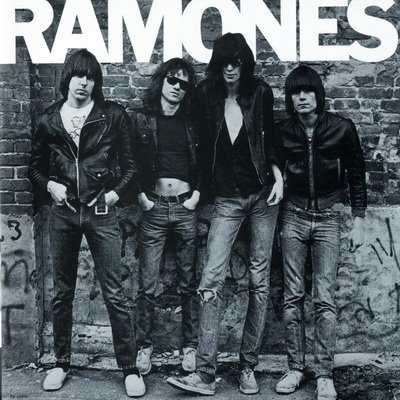
"Blitzkrieg Bop"--Production on this album kinda blows. Bass in my left ear, guitar in my right. Or maybe the other way around. This being 1976, the use of "Blitzkrieg" was still pretty daring. Now it seems pretty tame. Why the hell doesn't Joey aspirate his "h"s on the "Hey, Ho, Let's Go" part?
"Beat on the Brat"-People always talk about the Ramones being this awesome back to basics, no frills band, which they were, but Joey's vocals are double tracked on most songs on this album. Not on the verses here, but still. When I saw them live, Joey wielded a baseball bat during this number. He did not succeed in looking menacing.
"Judy is a Punk"--I saw the Ice Capades when I was a kid. It featured Dorothy Hamill. Not sure if Judy was there or not. You don't think of the Ramones as big heirs of the folk tradition, but that "perhaps they'll die" is right out of "The Old Woman Who Swallowed A Fly."
Not sure where the "second verse, same as the first," originates, but I only know it from Herman's Hermits' "I'm Henry the 8th, I am."
Singing in a joking way about the SLA, the group that kidnapped Patty Hearst, was a pretty badass move in 1976.
"I Wanna Be Your Boyfriend."--Pretty much every Rolling Stone review of a Ramones album when I was growing up had this "OMG! There's a ballad on this album! What a change of pace!" sentence. But this right here is a primo slab of 60's-inspired power pop balladry. And it's the first album.
"Chain Saw" Signals the band's love of horror movies that culminates in "Pet Sematary." I also like the way they say "Massacree," which I can't help but assume is influenced by "Alice's Restaurant."
Taking my baby away from me is a frequent theme for lovelorn Joey for the entire 20 years of the band's existence.
"Now I Wanna Sniff Some Glue"--I'm going to go out on a limb and say this is the dumbest song in the entire Ramones catalog. Not the worst, by a long shot, but definitely the dumbest.
"I Don't Wanna Go Down to the Basement"--Here's what amounts to a complete horror movie in just two minutes and forty-one seconds. I think people can go overboard about the Ramones boiling stuff down to its essence, but, man, that's exactly what this is. There's something down there. What is it? We don't know! We just know Joey doesn't want to go down there! And who can blame him? I think he's probably gonna go, though. Especially with that weird, inconclusive ending.
"Loudmouth"--Not my favorite. Kind of a worse version of "Beat on the Brat." Probably could have been left off the album.
"Havana Affair"--This, on the other hand, is freaking brilliant. It's absurd and funny and steeped in cold war politics without evidencing any ideology. What could possibly be going on at a Cuban talent show that's of interest to the CIA? We don't know! But I suppose spying is better than making a living by pickin' the banana! That "hooray for the USA" doesn't sound incredibly sincere. W0nder if Johnny objected.
"Listen to My Heart"--This, my friends, this is the genius of the Ramones. Dee Dee's absurdist tough guy routine balanced out by Joey's heartbreak. Catch the handclaps between the verses! I think that counts as a guitar solo, too, though of course people will insist that the Ramones didn't have any until whenever they notice one.
"53rd & 3rd"--This one's pretty interesting from a sociological and psychological perspective, but I don't think it's really a Ramones song. Turning tricks for drugs is just a little too gritty,and the whole green beret fantasy/ gay bashing killer thing is just a little more of Dee Dee's psyche than I really ever wanted to see. Also our first taste of Dee Dee's lead vocals, which would improve greatly over the decades.
"Let's Dance"--I'm going to say this now, and I will say it again if I do more of these. The Ramones were simply the best cover band of all time. There is no other band that consistently takes songs by other people and makes them sound like they were written for this band. Better than the original.
"I Don't Wanna Walk Around With You"--In which the Ramones explore the tragedy of unrequited love from the other side.
"Today Your Love, Tomorrow the World"--What the hell are they doing here? 3 Jews and one German American singing about being Nazis. In 1976 singing "I'm a Nazi-schatze you know I fight for the fatherland" was probably way more shocking than they realized. I think it's just Dee Dee being dumb, playing with stuff he knows is offensive to bug the squares. Mel Brooks making nazis the butt of jokes was pretty readily accepted, but shit like this probably kept the Ramones from greater commercial success. What I love about it, though, is what I love about the Ramones--the complete irreverence. They stubbornly refuse to take this shit seriously, and by this shit I mean anything but love, and that's an ideology I can totally get behind.
How to Self Publish, Part 4
People spend a lot of time on the internet fighting over whether traditional publishing or self publishing is better. Having done both, I think that's kind of a dumb question.
Each one has advantages and disadvantages. Let's start with traditional publishing:
The big disadvantage here is the gatekeeper problem. You can have a book that is really good, but for a variety of reasons, nobody wants to publish it. That, in fact, is what happened to me.
There's also this: publishing a book traditionally is necessarily going to involve some compromises. You may be asked to change something you really don't want to change. You may get stuck with a shitty cover. (publishers generally try to make authors happy with the cover, but authors do not get veto power over covers. I dunno, maybe Stephen King does or something, but most people definitely don't.)
But then there are the advantages. The first and most important of which is this: you will make money. Now, I don't necessarily mean quit-your-job-and-make-youtube-videos-all-day money, but you will make money. The publisher assumes the financial risk for the project, paying for designing and editing and publicity, and pays you an advance besides.
And now for self publishing:
The big disadvantage is the gatekeeper problem. Because anybody with a Microsoft Word file can put an ebook on sale in five minutes, self publishing still carries a stigma. Which is too bad, because a lot of self-published books are every bit as good as traditionally-published books. But, then again, there's a lot of shoddily-produced crap. And there isn't really a good way to tell the difference. (To be fair, a lot of traditionally published books are crap too, but there are certain minimum standards of professionalism that they will meet. So they probably won't be riddled with typos, for example.)
Disadvantage number two involves money. Publish a book by yourself and you're risking your own money (or, in my case, the money of your family, friends, and fans). It's true that you have the potential to earn more royalties if you publish yourself (anywhere from 30-70% depending on where you're selling and for how much, vs. 8-12% from the traditional publishers), but since no one knows how many copies you're going to sell, you're definitely taking a risk.
Disadvantage three is that self-publishing requires you to play a number of roles, some of which you might not be that good at. Even if you're hiring people to do your editing, cover, and publicity, you've just become a project manager. Maybe that's a role you're familiar with, so you'll know how to manage the situation when one of your employees doesn't deliver their product on time. Maybe you're comforable telling someone their work isn't up to par. (I should stress that these things didn't happen for me, but when you are working with human beings, these are situations you might reasonably expect to happen.) In any case, you're not just an author--you're wearing a lot of different hats. That can be exciting; it can also kind of suck.
But then there are the big advantages. One is that your book gets out there for people to read regardless of how well your last book sold or what other books a publisher has on its list. Another is that your book will be exactly what you want it to be. You will not have to make any compromises. And, of course, if your book sells, you get paid every month and you make a much higher percentage on each copy than you would from a traditional publisher. And you can make adjustments on the price to try to pump up sales.
And now, to the case study!
Let's look at the pros and cons of my latest books, one of which was self-published, the other of which was traditionally published.
A Really Awesome Mess:
Money invested by me: none (unless you count the time I invested in the writing, but that way lies madness)
Initial advance: $17,500. Split with co-author Trish Cook, which left my share at $8,750. Minus 15% for my agent. This leaves me with $7,437.50. Minus whatever I paid in taxes, which I don't remember, but you get the point. Not life-changing money, not even enough to get a new car, but a pretty decent haul.
Publicity: Reviewed in tons of blogs. 791 Goodreads ratings, 230 Goodreads reviews. 37 Amazon reviews.
Sales: 5881 copies, as of December 2013. It continues to sell and saw a big spike in sales when the paperback came out.
Libraries: according to worldcat, it's in 435 library systems.
Enter the Bluebird:
Money invested by me: $1350, not including Kickstarter-related expenses (printing & postage, mostly)
Initial advance: Whatever was left from the Kickstarter money after expenses. I don't have numbers handy, but my guess is that this was about 300 bucks.
Publicity: 3 blog reviews. 21 Goodreads ratings. 10 Goodreads reviews. 16 Amazon reviews.
Sales: counting the 75 or so Kickstarter copies, my estimate is 250 copies. Most of these were sold at deep discount.
Libraries: According to worldcat, carried in 0 libraries.
Now it's clearly possible for a self-published book to get the kind of sales that A Really Awesome Mess has. And it's clearly possible for a tradional book to sell way less than A Really Awesome Mess has. This is just my experience with these particular books.
So which is better? I guess for me, given the fact that I need the income from my writing (rather desperately), I'll always try for traditional publishing first. Which doesn't mean you should. But that's where I am right now.
NOTE:
I'm trying something new with Enter the Bluebird. It's currently on sale at https://gum.co/bluebird on a pay what you like basis. So if you'd like to check out a fantastic noir superhero novel, go grab it. And maybe even pay me! (Disclosure: gumroad takes 5% plus 25 cents from every sale where money changes hands. So if you pay a buck, I'm getting 70 cents, which is still a 70% royalty. If you pay the same 3 bucks you'd pay to get it anywhere else, I'll get $2.50, which is 40 cents more than I'd get from the Amazon sale.)
August 4, 2014
How To Self Publish, Part 3
In our last installment, we left our intrepid author standing there with a professionally-edited, professionally-designed book in hand, ready to sell!
So I did what everyone does: put the book up on Amazon and watch the cash roll in!
Well, not exactly. But putting the book on Amazon (and Nook and Kobo) was easy. So easy that you should never pay anybody else to do it. Except me.
An aside about ISBNs:
Should you get an ISBN? Up to you. You don't need one to sell on Amazon, Nook, or Kobo, though iBooks does require one. You can get 10 ISBNs for 300 bucks. They can also make it easier to place your book in a bookstore, but, let's face it, you're probably not getting your book into too many bookstores. (Unless you've written something about the local area--I've noticed that bookstores in beach and resort communities tend to stock self-published books about their regions).
I didn't think an ISBN was worth it because I don't think it's going to unlock many more sales. I've read that you can expect to sell about as much on iBooks as you do on Nook, which is about 25% of what you sell on Amazon. So an ISBN feels like a big investment for not too much payback.
If you want an ISBN, you can buy one from Bowker here. I have to recommend against buying any of Bowker's self-publishing packages, though. (Or, really, most people's). They will charge you $139 to convert your Word file to an ebook file and put your book into ebook retailers. This is something you can do by yourself with 10 bucks to Pressbooks and about a half an hour to upload your book to all the leading ebook retailers.
Okay. So I uploaded the book to sell on Kindle, Nook, and Kobo.
Now what? Well, I needed some reviews so that people would believe it was a real book. I looked up bloggers who had reviewed my traditionally-published books. The majority of them don't review self-published books, but I identified 30 who didn't have an explicit prohibition on self-published books. Three of them responded to me.
Okay, so three reviews. (Thanks! And they were all very positive, which was awesome.) Now to secure some reviews from readers. This proved very difficult. I found out that whereas I am a loudmouth who loves posting his opinions everywhere, most people really don't want to post a review anywhere for any reason. To wit: I've sold a little over 200 copies of Enter the Bluebird, which, as of this writing, has 16 reviews on Amazon and 10 reviews on Goodreads. I've started asking people for reviews when they buy the book directly for me. This remains a challenge.
Pricing: I initially put the book at $2.99, which is the minimum price you can set and still get the 70% royalty. I've tinkered with this a little, including some sales (I put it on sale for $1.45 on my 45th birthday, for example). I don't feel like downloading all the data and sorting it and such, but I'm relatively sure that the majority of copies I've sold have been at below $2.99. But would that price have been effective if it weren't a "sale"? I dunno.
Aside about KDP select, or Amazon exclusivity. Should you do this?
Maybe. There are pros and cons. Most of your sales will come from Kindle, and KDP select allows you to milk certain benefits out of Amazon, like getting a 70% royalty on books priced under $2.99 and participation in Kindle Countdown Deals.
On the other hand, if you're helping Amazon build a monopoly, that's going to be bad for you and everybody else in the long run.
I had Enter the Bluebird on KDP select for a while. I think my participation in this program netted me about six bucks I wouldn't have seen otherwise. Six bucks is six bucks, but I think that's a worthwhile price to pay for not creating a bookselling monopoly. You'll have to do KDP select in order to be part of the Kindle Unlimited deal. Enter the Bluebird has been read twice by Kindle Unlimited readers, and I do not have any idea how much money this is going to translate into. They've promised me a share of the general fund. So I'm currently making this book available without having any idea how much I'll be paid per read, which is a pretty shitty business plan.
I've done some other stuff to try to promote the book, but here's the thing that seems to work the best: actually selling hard copies myself. I've brought hard copies to a couple of library events (that I was invited to because of my traditionally-published books) and a couple of writing-centered events and even my local farmers market. Since I buy the hard copies for about 3 bucks, I can sell them for 10 bucks (or less) and actually clear about six bucks a copy. At $2.99, I'd need to sell 3 ebooks to make that much.
Come back tomorrow for conclusions!
August 1, 2014
How To Self Publish, Part 2
Part one here!
So there I am, figuring I have to pay to have my awesome superhero novel formatted and edited and fitted with an awesome cover. What's a brokeass writer to do?
I ran a Kickstarter campaign, which was both wonderfully gratifying and painfully awkward. I've already written about how I did that. Check it out if you're curious.
So now, here I am, money in hand, ready to publish my book. How did I do it?
Formatting:
I used Pressbooks.com. It runs on Wordpress, so you pretty much paste your chapters in like blog entries, and then it automagically spits out a ready-to-publish ebook. They've even got tons of themes for you to choose from. Ten bucks for the ebook files, and a hundred to get a PDF, which I needed in order to make hard copies. More on that in a bit.
Cover:
I networked through the Kickstarter, reaching out to people whose work I liked and asking other people if they knew anyone who would be good for the project. I was very lucky to find Erik Evensen, who illustrated and designed the amazing cover for 500 bucks. I consider it a tremendous bargain. You can get a cover designed for much cheaper. But that often involves someone slapping your name and title over the same stock image that's on a hundred other books. Erik did both the design and the illustration, and the cover pretty much defines eye-catching.
Here's how it worked: Erik and I talked about what my ideas for the cover were and what elements of the book I wanted to highlight. He sent me three sketches, and I thought the one of Julie looking at the Red Talon mask by moonlight really captured the mood and setting of the book perfectly--you know it's a superhero book, but the cover suggests that there's more to it than just kicking bad guys in the teeth. Though that happens too.
Editing:
I've known Deborah Bancroft for longer than either of us would probably like to admit. She's done beta reading for me in the past and has always given me great specific and helpful feedback. I also know her to be a fantasy fan, so I knew she would get what I was trying to do.
She's been freelance editing for a while now, so she was a natural fit for the project. If she hadn't been available, I know she would have referred me to someone else who would have done a good job. So, yeah, networking again. I paid Deb 850 dollars.
Deb's edits were invaluable, in part because she helped me to see where things that were clear to me because the whole thing was in my head weren't necessarily clear to the reader. She never tried to make the book safer; she just made it better.
Printing:
I had initially hoped to print this through the Espresso machine at Harvard Book Store, but the price was just prohibitive. I wound up using createspace, where the setup was free and I can order copies for my use for about 3 bucks a pop. I bought 75 copies to send to Kickstarter backers. This cost about 300 dollars including shipping.
I then spent between $2.50 and $25.00 per book to mail copies to backers throughout the world. I felt kind of bad charging an extra ten bucks for international shipping on the kickstarter; it turns out that wasn't nearly enough. It was like 16 bucks to ship to Canada, which is a freaking five hour drive from here. Same price as Australia, which is ont the other side of the world! Go figure!
The Final Product
I wound up with a book I am incredibly proud of. A book that looks exactly the way I want it to look (except maybe for the interior paper on the hard copy, which is a little too white for my taste) and says exactly what I want it to say. Deb and Erik didn't worry about anything but helping me make exactly the book I wanted. So I got to keep in the drug abuse and child sex trafficking that are key elements of the story without worrying how that would play in the marketplace. And the cover pleased me perfectly though I never did any focus group testing to see if people would like it.
Simply put, Enter the Bluebird is exactly what I wanted it to be.
But now I faced my biggest challenge: letting the world know it existed! Tune in Monday for Part Three!
July 31, 2014
How To Self Publish, Part 1
There's a lot of hype on the ol' internets about self publishing. A significant amount of said hype ("Quit your day job! Sell millions! Get tons of royalties! Unless you're too lazy and stupid to succeed!") comes to you courtesy of people who, coincidentally, offer a book or a webinar or a personal appearance where they will tell you how to succeed just like them. (Funny that they're spending energy hawking these books on how to self publish rather than just publishing. Makes you wonder...)
Well, fuck those guys.
I published a book by myself, and it was and continues to be a great experience. But I think a lot of people have inflated expectations about the process and what it's going to do for them.
And those expectations have often been inflated by people selling information on how to self publish. And people who have shelled out their hard-earned money for a glorified pamphlet padded out to book length.
So the hell with that. I'm going to tell you what I did and how I did it. For free! Here we go!
Why I did it:
Because traditional publishing is dead, and I am the future, man! Just kidding! Actually it was because no one wanted to publish my book! I wrote a really kickass superhero book. Seriously, if you like action and superheroes in a dark, urban vein, this book is totally for you. It's about loss and inequality and the importance of friendship, and kicking terrible people in the teeth.
And nine publishers passed on it, usually with the rationale, "superhero books don't sell" or, possibly, "we've already got a superhero book on our list."
It went to some smaller publishers but didn't make it to any of the tiny presses, in part because I'd been burned by the Night Shade Books debacle, and while I'm sure that most small independent presses actually run professional operations where they do things like have a way to keep track of royalties, the Night Shade thing still haunted me.
This is the great thing about the current publishing world: I didn't have to just leave my work on my hard drive, languishing for want of readers. I could get it out into the world! But I wasn't willing to do it in a halfassed way. So I had to take stock of what I was good at, what I was not good at, and what I was willing to take the time to learn.
Here are the three things you must do in order to publish a book:
1.)Formatting. You can't just publish a Microsoft Word document. You have to do stuff to it to make it work as an ebook. Or a paper book. Do you know how to do this? Me neither! So you have two options: learn how to do it or pay someone to do it. My friend Kirsten decided she wanted to learn how to do it, so for her book No Alligators in Sight, she did her own ebook conversion. This involved her learning about something called "kerning." This was not something I wanted to mess with. So I had to pay someone to get it done.
2.) Cover design. If you know something about design and have command of some design software, this is something you can do yourself if you devote some time to studying and making a bunch of terrible covers before you make a good one. If, like me, you know nothing about design, and applying filters on Instagram is the limit of your image software ability, you should hire someone to do this.
3.) Editing. If you are an English teacher with two decades of experience, as I am, guess what? You still shouldn't do this yourself. You might be able to catch all the comma problems and every misspelling, but you will lose out on the experience of modifying the book for a reader who isn't you. And, after all, that's who you want to buy and read your book, right? I knew I could do a competent job at least with copy editing, but I didn't want my book to be competent--I wanted it to be awesome.
So, great. I had to invest some money to make this happen! If you have a couple of thousand bucks lying around, this shouldn't be an issue. I think Kirsten Feldman's take on this is very smart: lots of people have hobbies that they spend a lot of money on: fly fishing, cycling, xbox, whatever. So if publishing books is your hobby, it's okay to spend money on it. I think this is a much better way to look at it than investing in your career because publishing a single ebook is an incredibly risky investment.
But I didn't have a couple thousand bucks lying around! So what could I do? Tune in tomorrow for Part Two!


