Nicki Chen's Blog, page 27
June 26, 2016
Wild Duck Lake and the Writers
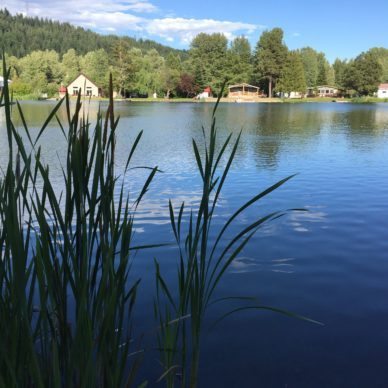
Vacationing with writers comes with its own peculiar kind of fun. I first noticed that peculiarity on the second day of our three-day “writers’ retreat” at Wild Duck Lake.
It was early morning, and we were sprawled on the plush living room chairs and sectional, wearing our varied sleeping costumes and drinking our pre-breakfast coffee. For the next forty-five minutes (with individual breaks to refill our coffee cups), we lost ourselves in a discussion of names, their connotations, and the eras they represented.
Such fun … for a writer, and, of course, for someone who’s expecting a baby.
After breakfast, we cleared the table and sat back down. It was time to get to work critiquing each other’s writing. And although finding out where your writing has taken a wrong turn may not sound like fun, it actually is … especially when the critique comes from trusted friends.
Lunch was another adventure. We drove to Cle Elum, looking for a good place to eat and ended up at a small café that served large bowls of thick chili-like chicken-tortilla soup. When the owner passed by, we told her we liked her soup. We also happened to mention that we were writers. Maybe that’s why she sat down with us for the next half hour and shared her life story.
Stories are like gold for writers, and this woman had some fantastic, heart-breaking stories of tragedies overcome and strong, funny characters. We soaked it all up and considered ourselves lucky.
Even though vacationing with writers has its own special flavor, for the most part, our three days at Wild Duck Lake was like any other getaway. We took walks and drove to nearby points of interest.
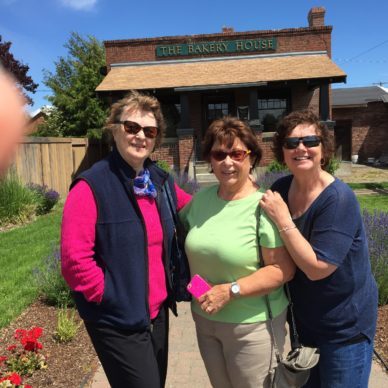
Bakery House, with Paddy, Dianne, and Maureen
We brought lots of good food.

Maureen’s Chicken Nicoise
We enjoyed the scenery.
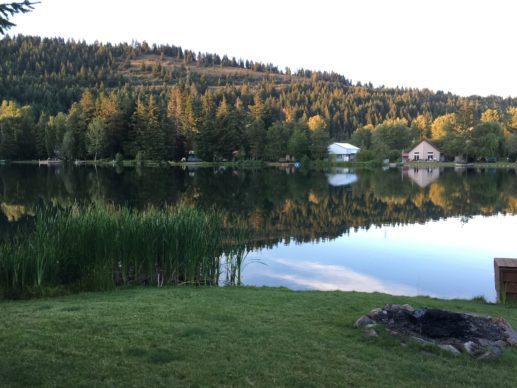
We posed for photos.

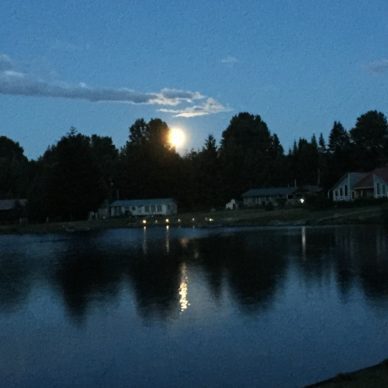
We watched the Strawberry Moon rise over Wild Duck Lake–a special treat since it was the Summer Solstice.
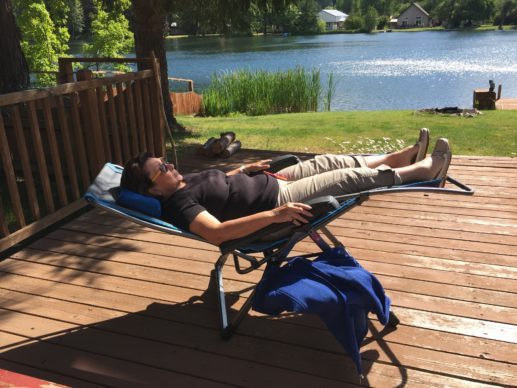
And some of us even found time for a nap.
Oh, and one more thing: There was a painting of a moose hanging on the living room wall, and the owners of the cabin had asked us to suggest a name for him. We took our assignment very seriously, and by the time we left, we had filled a little box with dozens of suggestions. My favorite was “Oscar Wilde.”
Have you ever had some travel partners who gave a special flavor to your trip?



June 18, 2016
The National News Is Not My Life.
June 12, 2016. My clock radio wakes me to news of a terrible tragedy in Orlando, Florida: the worst mass murder in US history, fifty people killed, as many injured. A hate crime committed by a terrorist. Oh, my god!
The story is everywhere—TV, radio, Facebook, and Twitter. The whole country is listening. We’re angry and sad, competing with each other to express how angry and sad we are.
Driving down the quiet streets on my way to church, the story of the massacre is on my car radio. I listen for a while and then switch to Corinne Bailey Rae.
It’s a special day at church, a Baccalaureate Mass for the school’s graduating eighth graders. They sit in the front rows in their blue robes, their hair neatly cut and combed. Father talks about their futures. He asks them to turn to the congregation, and we clap.
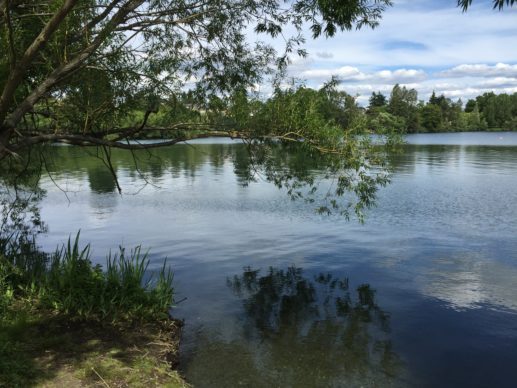
After Mass, I tie on my tennis shoes and drive to my sister’s house. We have lunch together at a Vietnamese restaurant and then drive to Green Lake, an almost-three-mile path around a beautiful little lake. A Seattle favorite.
We join the walkers and runners, the cyclists and skaters. Today it’s mostly walkers. Out on the lake, a sailboat takes advantage of a gentle breeze; a crew practices rowing. The weather is perfect, 69oF.
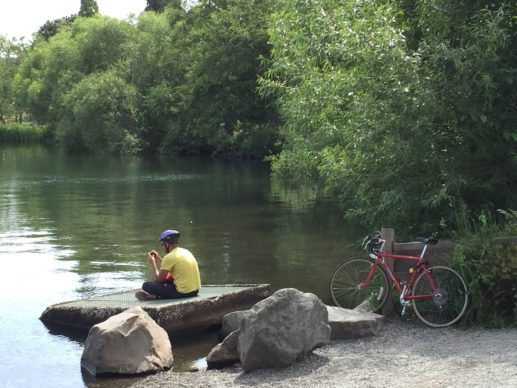
Because it’s an election year, my sister and I find ourselves talking about another election year as we walk: 1968. We remember the Democratic primary that year when the anti-war candidates won 80% of the votes, and yet, Hubert Humphrey, who didn’t run in a single primary, won the nomination. (Talk about a rigged election…) We remember the shock of the My Lai massacre in which 500 Vietnamese villagers, mostly women, children, and old men, were killed by American soldiers. With tears in our hearts we remember the assassinations of Martin Luther King and Robert Kennedy. In 1968, we elected the man who would get caught up in the Watergate scandal, Richard Nixon.
“Wow!” my sister says. “Nineteen sixty eight was a really bad year.”
I stop so quickly, a man with a big dog nearly runs me down. “No,” I say. “It was a great year. It was the year my daughter, C, was born.”
My sister nodded. “Nineteen sixty-eight was the year I studied in Spain,” she says. “It was the best year of my life.”
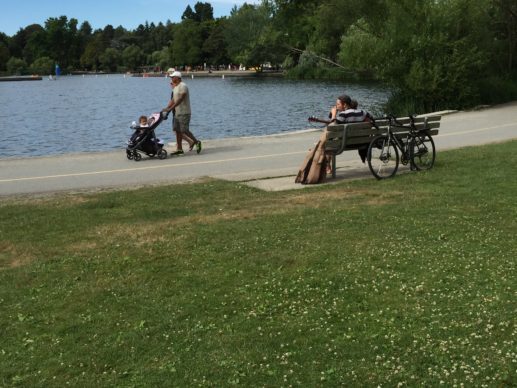
We stop talking about politics and comment on the cute babies in strollers, the man balancing on a tightrope, and the geese at the edge of the lake.
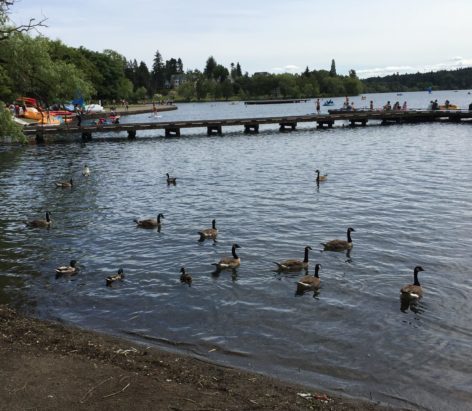
We stop so I can photograph a heron.

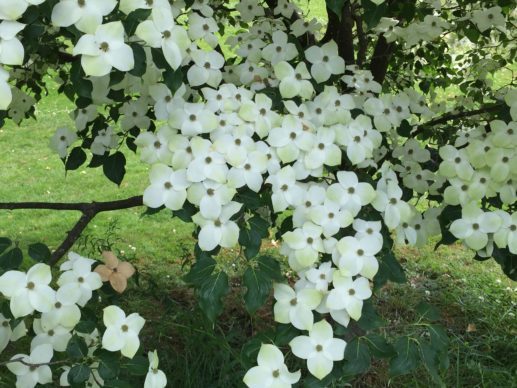
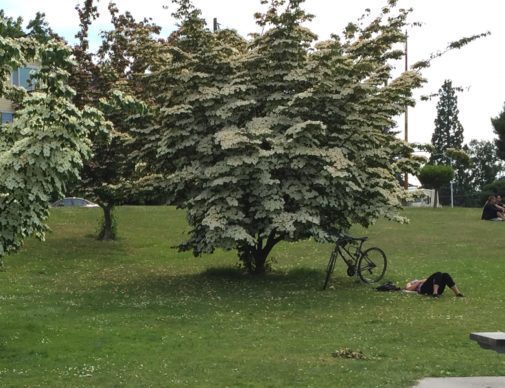
We comment on the dogwoods, which have been especially lush this year.
The massacre in Orlando was indeed horrendous. All week we’ve been gazing at the photos of young men and women whose lives were snuffed out. Ended too soon and without reason. We grieve for them and their families and friends. In years to come, we’ll remember this tragedy along with all the other tragedies of our time.
And yet, each day and each year of our lives is more than the terrible events that happened during that day or year. We would be remiss if we saw only the evil and not the good, if we took time to grieve but neglected to love and enjoy the beauty and goodness of the world.
June 12, 2016
Do “Good Fences Make Good Neighbors”?
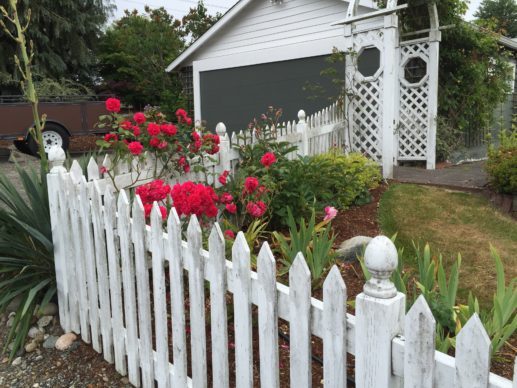
On a recent walk, huffing and puffing my way uphill and down, I found myself noticing fences and walls and the frequent lack thereof.
If you haven’t read Robert Frost’s poem, Mending Wall, since high school or middle school, you may have forgotten that it wasn’t Frost who declared that, “Good fences make good neighbors.” His neighbor was the one who said it.
The wall between Frost’s property and his neighbor’s was built of boulders. In the spring the two men got together and replaced the bounders that fell down during the fall and winter.
But Frost, feeling mischievous, decided to challenge his neighbor’s belief in the need for a wall. His apple trees weren’t about to cross over and eat the pine cones on the neighbor’s pine trees. And neither of them had cows.
“Something there is that doesn’t love a wall,” he says in the poem.
And his neighbor repeated the saying he learned from his father: “Good fences make good neighbors.”

On my walk, the only rock walls I saw were for terracing a hillside.
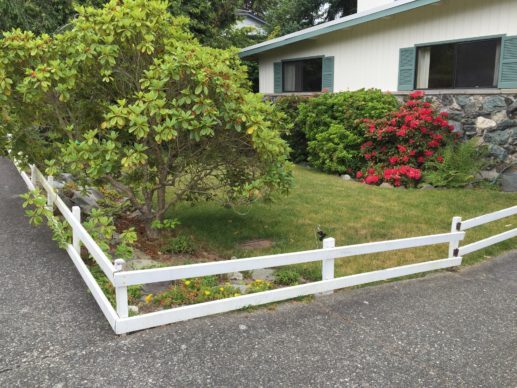
The house above has a small decorative fence.

This fence provides privacy between houses that are built close together.
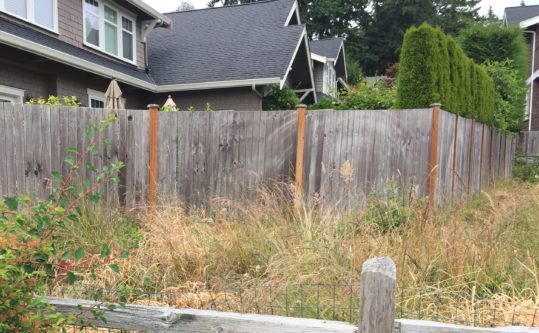
Some homeowners build fences around their back yards.

But probably the majority of the houses I walked past were wide open in the front.
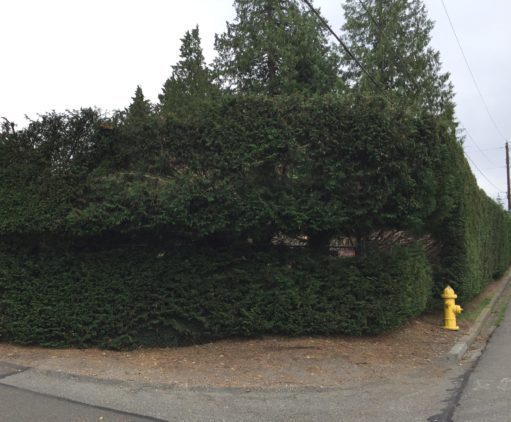
One house was different from all the rest, though. It’s hidden on all sides behind a twenty-foot-high hedge. There must be an entrance or a place to peek in and see the house, but I haven’t found it. Perhaps the homeowner learned from his father that, “Good fences make good neighbors.”
Are you a fan of fences and walls?
June 5, 2016
Narcissus, an Ancient Myth with Modern Significance.
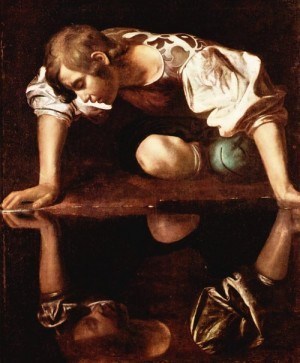 Narcissism is much in the news of late, so I decided to brush up on the myth.
The classic version of the story of Echo and Narcissus is found in Book III of the Metamorphoses, a Latin narrative poem written by Ovid.
Somehow in my schooling, I missed reading the Metamorphoses, maybe because it’s so long. It contains more than 250 myths and tells the history of the world from creation to the deification of Julius Caesar. I don’t know when Ovid started writing it, but he finished in 8 AD. More than 2000 years ago.
This is more or less how the story goes:
Narcissus was the son of the loveliest nymph, Liriope, and Cephisus, the River God. Now you may wonder how a nymph gets involved with a river god. In this case, the river god clasped her in his winding streams and took her by force.
By the time Narcissus was sixteen years old, he was so good looking that he was desired by both youth men and young women. But, “there was such intense pride in that delicate form that none of the youths or young girls affected him.” (from A. S. Kline’s version.)
One day the nymph, Echo, saw him when he was out hunting for deer, and she was inflamed with love. At that time Echo still had a body, but her ability to speak was limited. She could only repeat the last few words someone else said. When Narcissus invited her to come out of the woods, she made the mistake of running up and throwing her arms around him.
Here is where Narcissus’ nature showed itself.
He ran from her shouting, “Away with these encircling hands! May I die before what’s mine is yours.”
Poor Echo. She never stopped loving him. Wandering in the woods, her form eventually wasted away, leaving nothing but the echo we know today.
Narcissus didn’t care. He was too obsessed with himself.
One day, tired from the hunt, he stopped to drink at a clear, untouched pool. Leaning over, he saw the reflection of a gorgeous young man and was filled with desire.
Each time he leaned forward with puckered lips, the one he loved raised his lips to him. When Narcissus smiled, he smiled. When Narcissus cried, he cried. And when Narcissus tried to embrace the loved one’s neck, plunging his arms into the water, the reflection broke apart.
Eventually Narcissus realized that he was burning with love for none other than himself, but still he couldn’t tear himself away. He cried and tore his clothes and struck his naked chest. He knew he was getting weak, and yet he stayed beside the pool with his beloved reflection, waiting for death.
After he died, the residents of the house of shadows left his body as they prepared his funeral pyre. When they returned, it had disappeared, leaving in its place a flower.
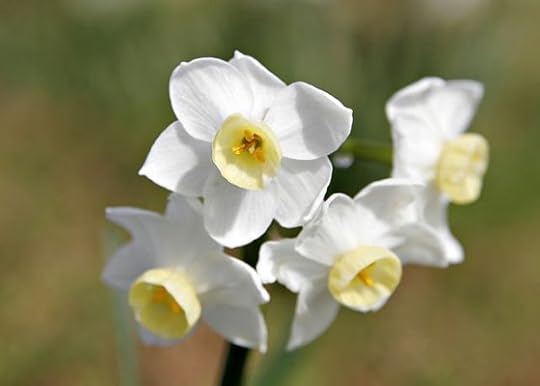
narcissus
Over the years, narcissism has come to mean something even more extreme than the self-love described in the myth of Echo and Narcissus.
Psychology Today defines Narcissistic Personality Disorder as having the following traits:
arrogant behavior, a lack of empathy for other people, and a need for admiration.
Narcissus had the first two traits, but not the last. He died loving and admiring himself, but he didn’t seem to require crowds of admirers.
According to Psychology Today:
Narcissism involves cockiness, manipulativeness, selfishness, power motives, and vanity–a love of mirrors. Related personality traits include: Psychopathy, Machiavellianism.
It seems that a modern narcissist could be far more dangerous than the original young man in the myth.
Do you enjoy reading Greek and Roman myths? What relevance do you think they have for the 21st century?
If you enjoyed this post and you’d like to receive a reminder about future posts, you can leave your email address in the box at the top of the page on the right.
May 29, 2016
Memorial Day: Flowers for Departed Loved Ones
 At the start of the Memorial Day weekend, I bought some flowers and drove the four miles to my husband’s grave. Eugene is buried in a beautiful park-like cemetery with trees and grassy slopes and a view of a small lake. His grave is under the second fir tree on the right.
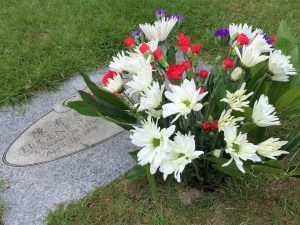 Usually after arranging the flowers, I say a prayer. Then–like characters in movies I’ve seen–I sit on the grass and talk to him. (I’m such a cliché, aren’t I?) I tell him what’s been going on in my life and in the lives of our children and grandchildren. In these one-sided conversation I’m always reminded how much has happened since he died eighteen years ago. How many things he has missed out on.
He told me once that he wanted to be cremated and have his ashes thrown into the wind. He said he didn’t want to tie me down to a particular place. I have no idea how serious he was. But even if he was serious, I’m fine with ignoring his wishes. Since he was concerned about what would be good for me, well then, I guess it was all right for me to decide. And I preferred having a grave to visit.
The following day, my sister and I gathered up some old Mason jars, cheap vases, and a bunch of flowers and headed up to Sedro-Woolley and Bay View where our parents and several relatives are buried. She’d compiled a list of the thirteen relatives whose graves she believed we could find and scanned and printed some family photos to go along with the flowers.
Our first stop was a small cemetery in Bay View. We shouldn’t have much trouble finding the family graves in such a small country cemetery, I thought. And we did have some success.
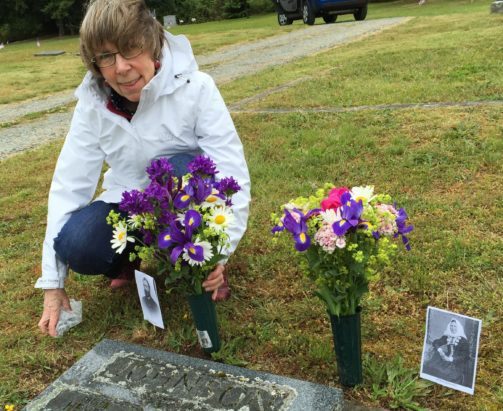
flowers for great-great grandparents
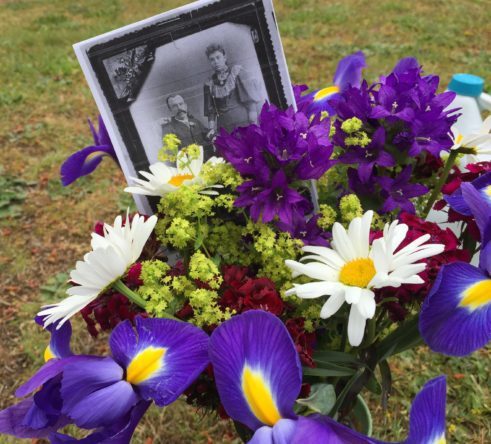
flowers for super serious great-greats
But the grave of our famous great-great grandmother who outlived all three of her husbands was nowhere to be found. We walked back and forth along the hill for almost an hour before finally giving up.
Next stop: Sedro Woolley Union Cemetery where our parents, grandparents, and great grandparents are buried.
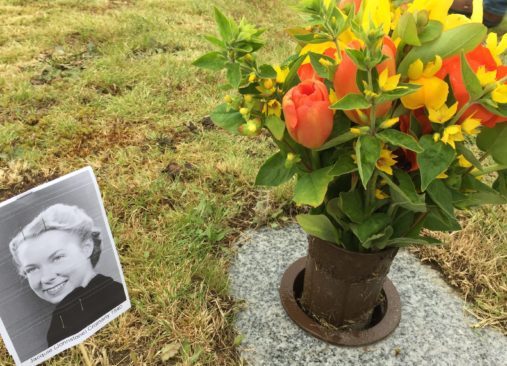
flowers for Mom
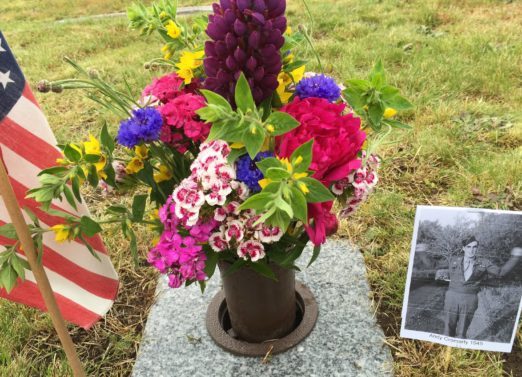
flowers for Dad
Most of the graves were easy to find, all except the grave of Great-Grandpa Fish, the grandpa whose parents were killed by an angry bull while they were picnicking in his field. Even though my sister and I searched for poor Grandpa Fish’s grave for well over an hour, we never found it. Maybe next year.
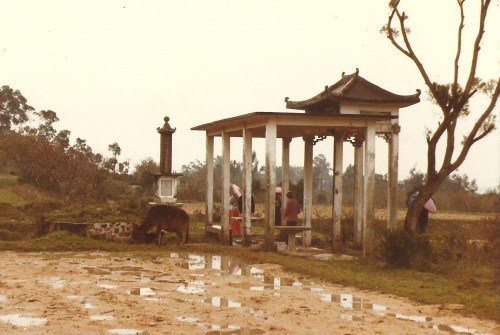
Eugene’s great grandfather’s grave on the outskirts of Xiamen
In my 2014 Memorial Day post, I wrote about my husband’s family and how in 1983 we went hunting for their graves in China. You can find it by clicking on the link.
How do you celebrate Memorial Day and Memorial Day weekend?
May 22, 2016
Reverse Culture Shock & PTSD
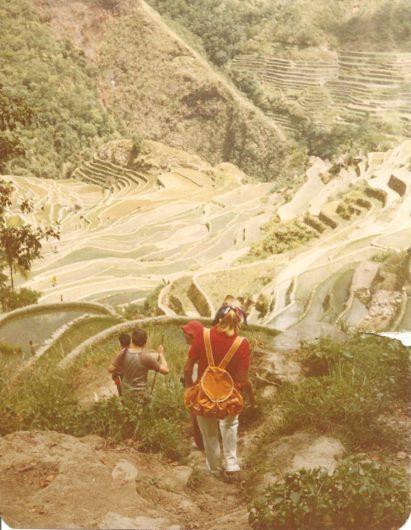 When we lived overseas, we didn’t talk much about culture shock. At first, we were newcomers busy adjusting to the new country. After a year or two we were old hands. When someone did bring up culture shock, almost invariably, another person who’d been through it all before would put on a just-you-wait expression and declare that reverse culture shock was much worse.
What? Going home? I thought. How hard could that be?
After more than twenty years of living abroad (with a few home leaves and extended stays along the way), my husband and I returned home and did our best to reintegrate into American society.
That was quite a few years ago. I don’t think I ever thought about my own reverse culture shock, not until this morning. I was dozing, listening to an NPR program on my clock radio, considering whether to get up. Author Sebastian Junger was being interviewed about his book, Tribe, on Homecoming and Belonging.
He was saying that although only 10% of the US military engaged in combat, 50% have applied for some sort of disability based on PTSD (Post Traumatic Stress Disorder). His theory is that the 40% who haven’t been in combat are having trouble reintegrating into modern society.
I didn’t make the connection to reverse culture shock until he mentioned Peace Corps volunteers. He said they have an extremely high rate of depression after returning from two years in the Peace Corps.
I’ve never thought of myself as having reverse culture shock, but I admit, the transition back to living in the United States did have its difficulties.
You hear returning soldiers talk about the camaraderie they miss. After living in such close quarters with their buddies, trusting and depending on them, they come home, and everyone is busy with their own affairs, and the returning soldier is left to his own devices.
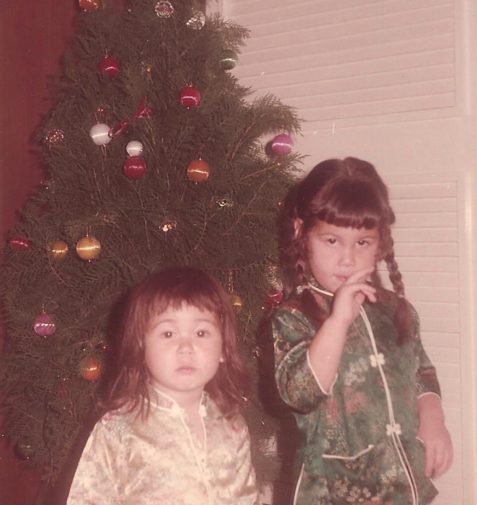
first Christmas in a new country
Expatriate life has a lot in common with the military. Like soldiers, you leave your family, friends, and country behind. When you arrive in the new country, all the other expats are in the same situation. You’re all strangers in a foreign land, and you’re all looking for new friends. When holidays come around, Grandma’s house is too far away, so you get together with your new expat friends.
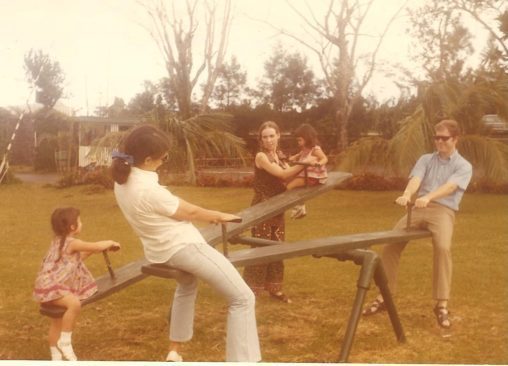
weekend trip with friends
You send your kids to the same international school; you join the same clubs; you take weekend trips together; you run into each other in the airport on your way to home leave. And even though your expat friends come from all over the world, the life you’re living brings you together.
Then one day you return home, and either your expat friends stay abroad or they return to their own countries on other continents. At “home” you don’t have a group of friends. Everyone is busy with their own lives. So you have to start all over at an age when everyone around you has established all the details of their lives a long time ago.
Whether you’re retired military or returned expat, you have trouble talking to people. Everything that has been part of your experience and that’s important to you feels like something you shouldn’t talk about. No one is interested.
Conversation is an exchange, a sort of agreed upon fruit salad. If you throw a fish into the bowl, you spoil the salad. If the other person has no point of contact with what you’re talking about and vice versa, the conversation doesn’t work.
When we came home after twenty-two years of living abroad, I soon learned not to mention those years. To me, they seemed like the center of my life, but no one wanted to hear about them. So I got on with living where I was.
My years as an expat haven’t been erased, but keeping them wrapped up and hidden away has felt like a loss. Maybe that’s what reverse culture shock was for me.
May 15, 2016
After Acupuncture, a Walk Around Town.
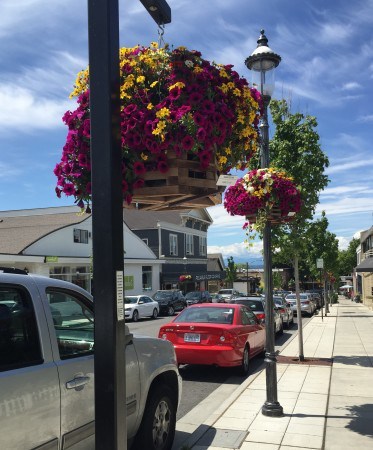
During my forty-five-minute appointment at Quan Yin Acupuncture, I have needles up and down my back, in my arms, hands, legs, the top of my head. After the doctor removes them, I make another appointment and walk to my car.
It’s a “Goldilocks day”—not too hot, not too cold. So instead of heading home, I stash my purse in the trunk of the car and head off down the street.
It’s May, the lovely month of May, and flowers are blooming in street-corner gardens and hanging baskets.
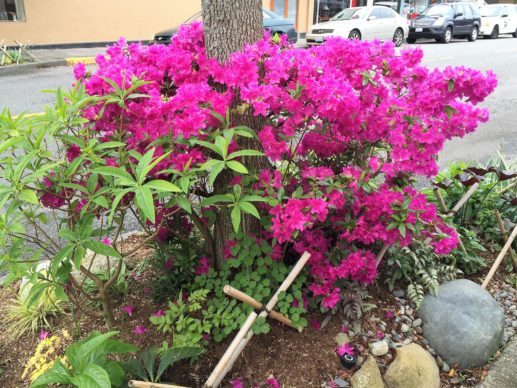 As I walk, I think about the first time I tried acupuncture. We were living in the Philippines then and I was suffering from migraines. It was the 1970s. Back then, acupuncture was rare outside of Chinatown. So when a Vietnamese acupuncturist showed up in Makati, it was an occasion of note. My husband and I went along with some friends to see what he could do for us.
The doctor treated his patients in a large open space with cots, so I was a little scared seeing what he was doing to other people. Needles on the head, face, ears, all over the body. When it was my turn, I found that most of the needles were painless. MOST! The worst were the needles he stuck into that web of flesh between my thumb and forefinger.
And yet, those were the needles that performed the magic. Faster than any pills, those needles totally destroyed my headache. He advised me that the headaches would return. For long-term relief, he said I should meditate every day.
Well, I didn’t meditate every day. Eventually menopause cured my migraines.
Back to my walk:
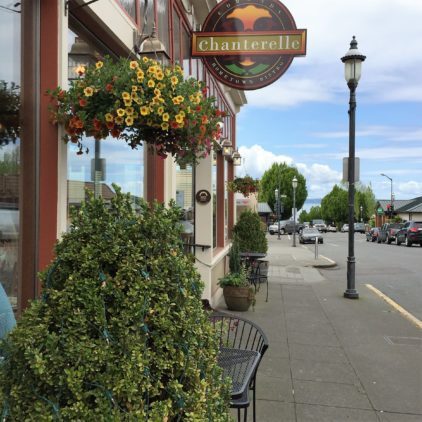 Going downhill on Main Street, I pass a great little restaurant, Chanterelle.
 Turning onto Fourth, I snap a photo of Rick Steves’ travel store, a reminder of a tour some neighbor ladies and I took of Sicily and southern Italy.
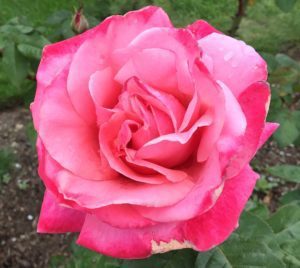
Everywhere I look, flowers are blooming.

I could choose to walk uphill, but the waterfront is calling to me.
 All along Sunset Avenue, the air is thick with the scent of hundreds of wild roses, the humble flower my grandmother loved to paint. (See her china painted plates and cups and saucers here.)
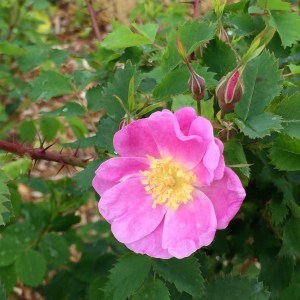 When we lived in Port Angeles, WA, I had another big success with acupuncture. I hesitate to mention it, because it sounds crazy. Anyway, here goes. I was having trouble with arthritis. In fact, my fingers were starting to look gnarly, and I was too vain to accept having gnarly hands.
So I visited an acupuncturist who had a reputation for “curing” arthritis. Sounds crazy, right? But after ten sessions of acupuncture combined with NAET, I was cured. That was almost twenty years ago, and I haven’t had much more than a twinge since.
Continuing the walk, I take a picture of these two colorful houses. In Western Washington state, people favor dull, earthy tones. So it’s nice to see homeowners willing to buck the trend.
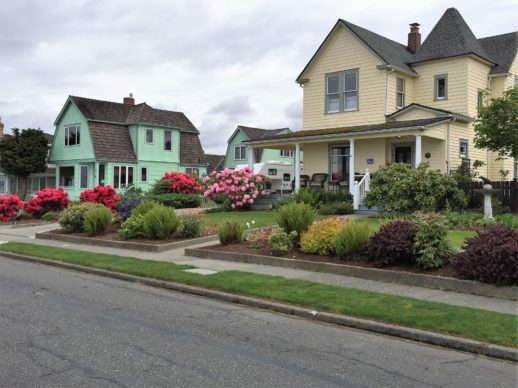 I’m sorry to say that all is not beauty on our waterfront. In the last couple of years, a large number of coal trains and oil trains have started rumbling through town. Can you see the end of this one? I sure can’t.

oil train from North Dakota
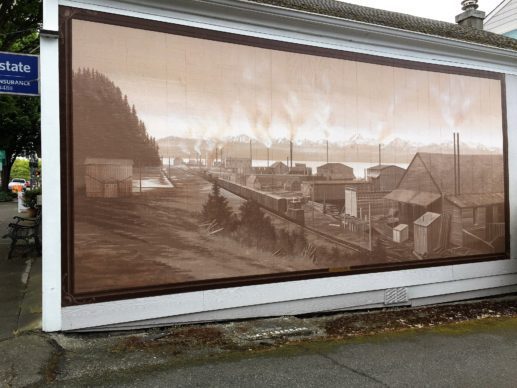 Walking back up the hill, I snap a picture of this mural of Edmonds in its early days when it was a small town built around lumber mills.
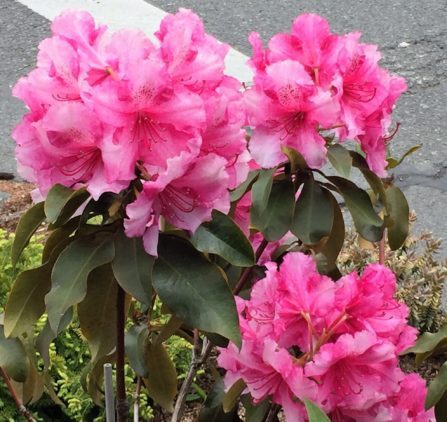
rhododendrons, Washington’s state flower
I’m not expecting any miracles from acupuncture this time. If I achieve some modest improvement in my asthma and general health, I’ll be satisfied.
Have you tried acupuncture. If so, I’d love to hear how it worked for you.
May 8, 2016
Mother’s Day … and Being Good Enough
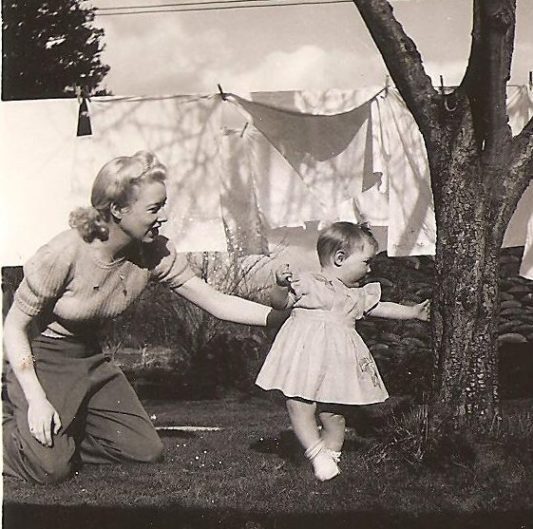
Mom and me
Mother’s Day cards can be a bit over the top. Have you noticed?
Mom is wonderful, they declare in letters embellished with flowers, butterflies, and cute little birds. She’s amazing, the best mother anyone could wish for. Furthermore, she was always there, believed in me, loved me no matter what, understood me, and taught me sooo much.
A tall order. But I was lucky. I had a good mom. Before she died, I never had any trouble choosing a card for her. She was an artist, so my first priority was to find a beautiful card. After that, the words inside usually seemed to fit. Yes, she was a wonderful mom.
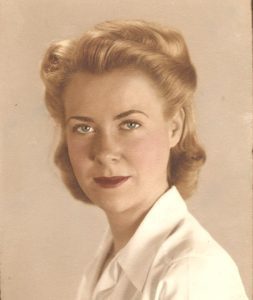
Mom
But when I think about myself, the whole saintly mom image begins to develop cracks. I was a pretty good mom, I think. But amazing? Perfect? Are you kidding?
Let’s just look at one of a mother’s supposed virtues: She’s “always there.”
Always? Wait, does that include being there on time?
Suddenly an image of Daughter Number One flashes through my mind. She’s sitting in Miss Feliciano’s kalachuchi tree, steam coming out of her ears because I’m late picking her up from her piano lesson. (Now, many years later, Daughter Number One still hates to waste time.)
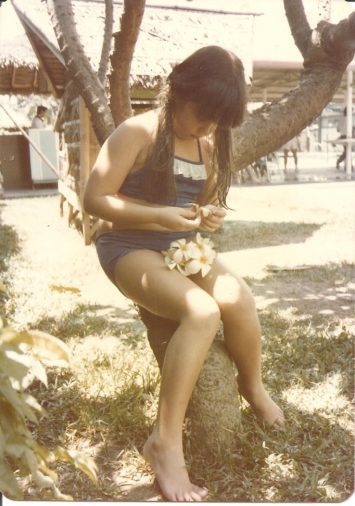
Daughter Number One gathering kalachuchis, aka plumeria or fragipani
I wonder, does “always there” include volleyball games?
At the International School in Manila where my kids studied for eleven years, sports were not a big thing. Parents attended musicals and spelling bees and UN Day parades. But of all the sports, only the swim team had a loyal parental following.
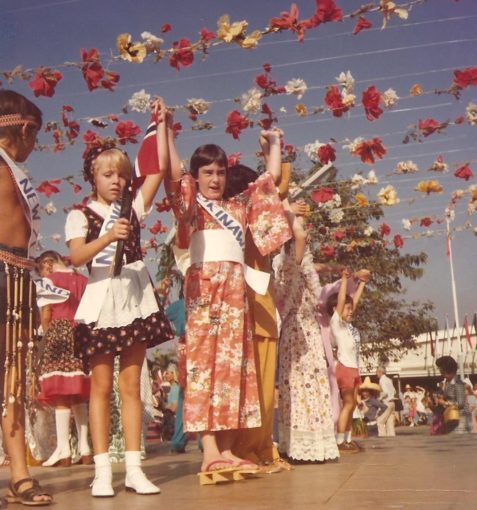
UN Day
Then, when we moved to the United States, Daughter Number Three went all out for volleyball. And she was good. Good for her, I thought. It didn’t occur to me that I was expected to attend all the volleyball games and sit with the other enthusiastic parents. It did, however, occur to my daughter. What a disappointing mother I was!
I’ve saved my most egregious not-always-there moment for last.
Imagine this: I’m driving; my husband, Eugene, is beside me; Daughter Number Two (already an adult) is in the back seat. We’re listening to “This American Life” on NPR when I turn into a gas station.
I pull up behind another car, and Daughter Number Two jumps out to pump the gas. While we’re waiting (and enjoying the very interesting story on NPR), the driver of the other car goes inside the gas station and doesn’t come back out.
So I drive around to another pump. Whoops! Wrong side of the car.
I maneuver to back into the pump, but someone else squeezes in ahead of me.
Now every pump is occupied and I’m frustrated. “What the heck!” I say. “Let’s try the gas station down the street.” And I drive off, still totally engrossed the very interesting, very long story on NPR.
Well … I’m ashamed even to remember how much time passed before either Eugene or I noticed we’d left Daughter Number Two behind. A wonderful mom and dad? I don’t think so.
On that particular day, we weren’t even “good enough.”
According to psychologists, that’s what parents should strive to be: not amazing or perfect, but good enough.
Famed psychoanalyst Donald Winnicott coined the term “good enough mother” in 1953. After studying thousand of mothers and babies, he concluded that imperfect mothers were the best. Dr. Carla Naumburg puts it this way, “Children need their mother (or primary caretaker) to fail them in tolerable ways on a regular basis so they can learn to live in an imperfect world.”
Considering that it’s probably impossible to be a perfect mother, it’s nice to know that a “good enough mother” is the best kind of mother to be.
Happy Mother’s Day to all you good enough mothers.
April 24, 2016
A Chinese Island Retains Its Old World Charm.
 Who would have thought that my contractors, a husband and wife team, would have visited Gulangyu on their Asian cruise! After all, they had five or six countries to visit, and the cruise only allowed three stops in China. Surprisingly, one of the stops was at the small island of Gulangyu and its larger island neighbor, Xiamen.
If you haven’t read my novel, Tiger Tail Soup, you’re probably thinking … So? Well, let me explain. The reason I’m so excited about their visit is because Gulangyu (also known as Kulangsu) was my late husband’s birthplace. It was also the setting for my novel.
In recent years, most Chinese cities have grown to look like Xiamen, Gulangyu’s neighbor across the water. At the top of the photo above you can see it, all shiny and tall and new. In contrast, Gulangyu, at the bottom of the photo, is a quiet little backwater.
To give you an idea how much Xiamen has changed, here’s the picture I took of it from our hotel window in 1983.
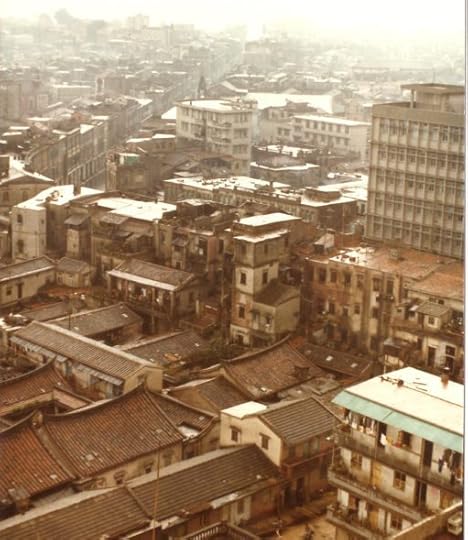
Xiamen, 1983
Gulangsu, on the other hand, hasn’t changed much in the past thirty-three years. I don’t think it was ever meant to be a bustling city. It was the pretty suburb to Xiamen’s gritty metropolis.
Everything on Gulangyu Island, is within walking distance, so there’s never been a need for a real road. Long ago, all but the most necessary wheeled vehicles were banned. The quiet, slower pace of life is one reason that Gulangyu has become a favorite destination for domestic tourists. And now also for foreign tourists.
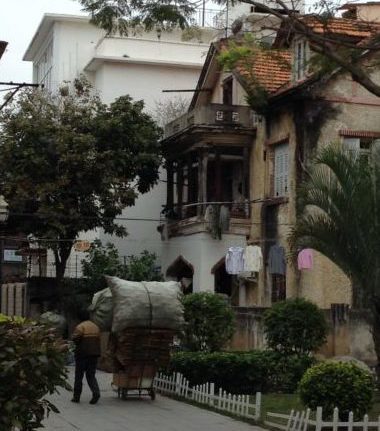
Wheels, but can it be called a vehicle? — photo by AM, my contractor, 2016
The buildings on the island are historic, but they’re far from ancient. Many of the consulates, churches, hospitals, schools, police stations, and houses were built by the foreign communities that settled there after the Treaty of Nanking, which was signed in 1942. Like Shanghai, Gulangyu and Xiamen (then known as Amoy) were treaty ports until December 1941 when the Japanese invaded Pearl Harbor and all the Chinese treaty ports.
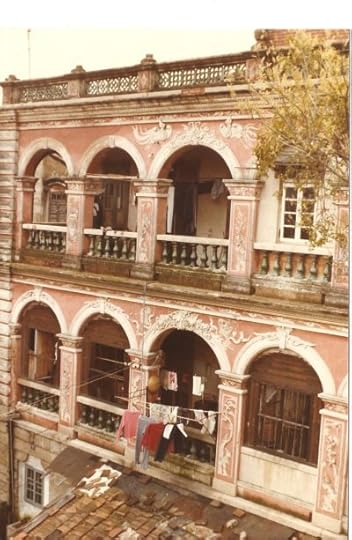
European-inspired Gulangyu mansion, 1983

Gulangyu mansion, 2016 — photo by AM
The view of Sunlight Rock, the highest point on Gulangyu Island, hasn’t changed much, although these are from different angles.
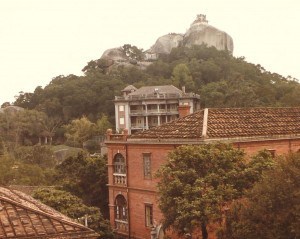
Sunlight Rock, 1983

Sunlight Rock, 2016
The little fishing boats look about the same.
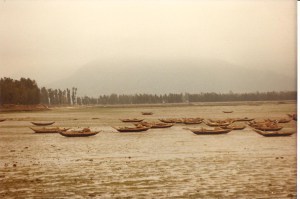
Jimei, nr. Gulangyu, gathering oysters and seaweed, 1983
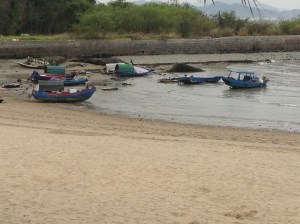
2016
The ferry has improved. In 1983, they didn’t bother with seats. Everyone stood. (It is a short ride.)
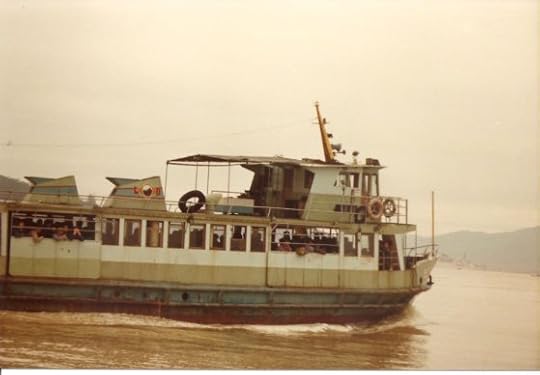
Gulangyu to Xiamen ferry, 1983

Gulangyu-Xiamen ferry, 2016
It still amazes to me that Gulangyu and Xiamen have become a regular stop for tourists. When we visited in 1983, Xiamen was putting the finishing touches on its first hotel for Overseas Chinese. They hadn’t even started thinking about having non-Chinese visitors–in Beijing and Shanghai maybe, but not in Xiamen.
Ever since 1949, China had been cut off from the rest of the world. Like the Russians, who lived behind an Iron Curtain, the Chinese remained isolated inside their own Bamboo Curtain. (See: “The Fall of the Bamboo Curtain.”) Nineteen eighty-three was early days for Xiamen. The city didn’t know what to do with me and my daughters. (Read about our lodging adventure in “No Room at the Inn.”)
Now my contractors are back. They have stories to tell about Cambodia, Vietnam, Thailand, China, and Korea. A week after their return, though, they were already back to work, ripping up my carpets and moving my furniture. They did an excellent job. Check out last week’s post to see the new hardwood floor.
Before I finish, I’d like to give you a link to Becky Ances’ blog. She’s a cute young American teacher, writer, traveler, and tea drinker living in Xiamen. I think you’ll really enjoy reading what she has to say.
Has your city or town changed a lot since 1983?
April 17, 2016
You Could Always Remodel.
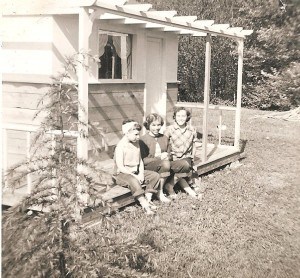 My younger sister was the one who liked to play house. She spent hours inside the playhouse our dad built for us, decorating and redecorating and having tea parties with her dolls.
I preferred reading, drawing, painting, and bike riding.
That doesn’t mean I’ve never been interested in playing house, especially when it’s for real. I grew up in a series of new houses built by Dad and decorated by my artistic mother. It’s hard for me not to expect a degree of perfection in my living space.
When I moved into my current house thirteen years ago, my attitude was: Yeah. Good enough. I’ll just cleaned it up and move in. I really didn’t intend to do a big remodel.
Little by little, though, I saw things that needed to be changed or improved. A new washer and dryer. Then it was a new furnace. The walls needed repainting. One year it was a new roof. Another year it was a deck. Then two bathrooms. Finally two years ago I had the kitchen remodeled. That was a big job!
This year I had the carpet replaced with hardwood floors. A smaller job. And yet …
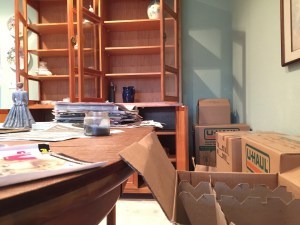 Everything had to be packed away before they could even start. (I spent about a month on that.) The real work began on March 24th and was finished on April 9th. Not bad, especially considering the found a problem under the floor. (See “What Was Hiding under My Carpet.“)
Now I’m unpacking and trying to remember where to put everything.
If you feel like you’re in a rut, you could always remodel.
This remodel of mine went smoothly, thanks to my wonderful contractor and hard-working, skillful installer. But there’s no getting around it, every remodel turns your life upside down for a while.
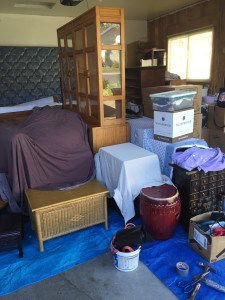 My garage became a storage space, making it necessary to park down the street under a tree that was shedding pollen and little sticky things.
 My driveway became the perfect place to cut and finish the baseboard and base shoe.
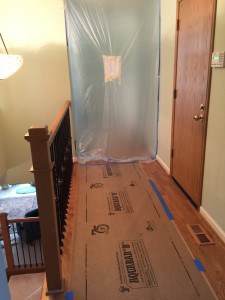 The bedroom, dining room, and living room were made off limits to me, so I slept in the guest room downstairs.
Theoretically, I was able to eat and work in the kitchen. But most days the sawing and pounding drove me away.
 One day I had breakfast at Chanterelle’s (stir fried veggies and two thick slices of bacon). Another day I had lunch at El Puerto (sopa de albondigas).

Baicha Tea Room sells over 100 varieties of tea
I did my reading and writing at the Baicha Tea Room and Cafe Louvre.
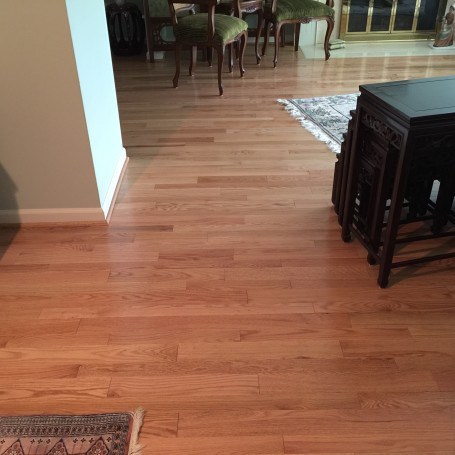 Now the work is finished (except for the unpacking). And the new floors look great! In fact, I’m already beginning to forget how my house looked with wall-to-wall carpeting.
By the way, my dad who built lots of houses, preferred not to do remodels. When you’re working on an old house, too much can go wrong, and … homeowners can be hard to satisfy.
Do you have some good (or bad) remodeling stories? Did you like to play house when you were a kid?