Nicki Chen's Blog, page 25
January 8, 2017
Meet John Kang, my Online Chinese-American Friend.

After publishing Tiger Tail Soup, my novel about WWII China, I’ve made quite a few online connections with writers with a focus on China. John Kang is one of them.
Born in the US, John had to grow into his identity as an Asian American. In this guest post, he briefly describes his fascinating “journey toward self-discovery.” Along the way, John also became a writer of fantasy novels. Read on to learn what Dungeon and Dragons and three weekends of major snowstorms had to do with it. Here’s John …
While 2016 will go down as one of the most tumultuous years of my life, it marked the beginning of my online acquaintance with Nicki Chen. I was about to release my first Asian Fantasy, and came across her blog article about Weina Dai Randel’s spectacular debut, Moon in the Palace.
What struck me was that despite coming from different generations, Nicki and I shared similar experiences and histories. Her husband hailed from Xiamen, while my father had spent his early high school years there. Her father-in-law was a Nationalist official, while many of my mother’s family also held posts in the government. I suspect he and my maternal grandfather might have been involved in the same operation to secure boats and ships for the last of the Nationalist’s troops to reach Taiwan.
None of this shared history would have made a difference to me as a youth. Born and raised in the then-urban blight of the Confederacy’s capital (now America’s up-and-coming foodie capital!), I grew up in denial of my Asian roots. There were no other Asians in my elementary school; and the very few I knew in middle and high school were all recent immigrants from China or Vietnam. To my insecure teenage eyes, they fit comfortably into the negative stereotypes prevalent in the 1980s. I was an unabashed Twinkie (yellow on the outside, white on the inside, and so fake, it’s hazardous to your health).
My journey toward self-discovery would be incredibly long-winded and even more incredibly irrelevant to this particular blog– but basically spans four years of college living among fellow American-born Asians, four years of acculturating to life in Japan and Taiwan, and four years basking in the generational and ethnic diversity of the San Francisco Bay Area. It is a path where I first shed the baggage of identity denial, then came to appreciate my cultural heritage, and finally replaced my contempt toward the Asian immigrant with a deep sense of respect and admiration. Along the way, I may or may not have been a little militant with Asian Pride.
I have since found a comfortable middle ground in my cultural identity. Living in my Southern hometown, I am still concerned with the portrayal of Asians in American media, and how that might impact my soon-to-be teenage girls. I have long felt we need to tell our own stories, but it wasn’t until a few years ago that I thought I would do the telling.
Comfortable in my life as an acupuncturist and kung-fu instructor, I might have never started writing fantasy stories, save for two fluke coincidences: During the Christmas of 2010, while cleaning out childhood junk from my mom’s house, I came across my old Dungeons and Dragons world. Before relegating the binder of maps and notes to the trash where it belonged, I decided to peek back and see what my 13-year-old self had created.
I couldn’t help but laugh at my teenage brain. Rivers flowed uphill. Empires produced money faster than the Fed. However, a few of the premises had potential. For the next six days, I redesigned my world, taking into account things I had learned over the last 25 years. Advanced stuff like gravity, evolution, and supply and demand.
On the seventh day, I rested. Looking at my glorious creation, I was hit by the realization that I would never play D&D again.
A month later, the second event occurred: three weekends of major snowstorms. Stuck indoors for days at a time, I used my skills as a technical writer and pumped out a 120k word novel set in this multicultural world, fusing elements of Chinese Wuxia with the elves, dwarves, and orcs of classic western fantasy, and the scheming and backstabbing of Game of Thrones.
When I submitted my masterpiece to an online critique group, I learned a hard truth: fiction writing and technical writing were two different beasts. My magnum opus read like Ikea furniture instructions, with no pictures.
Not one to give up, and with the help of some awesome crit partners, I ended up writing and revising the prequel to the original story, followed by a sequel, and then a prequel to a prequel. The stories follow an imperial princess as she grows from awkward and naïve to graceful and cunning, while learning how to channel magic through music. The first book, Songs of Insurrection is now available on Amazon.


I hope you enjoyed this guest post by John Kang.



December 21, 2016
Mall Shopping on a Saturday before Christmas
 “You’re not going shopping tomorrow, are you?” My hairdresser swung the scissors away from my head and gave an open-mouthed look of incomprehension to our reflections in the mirror.
“Not the best plan,” I admitted.
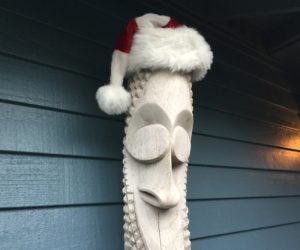 Sure enough, when I left home the following morning, nothing seemed to be going my way. It was raining, the freeway was crowded, and the first two floors of my favorite parking garage were full.
There was still a third floor, a.k.a., the roof. So that’s where I parked. Leaving my coat in the car, I dashed through the cold rain, down the stairs, across the sky bridge, and into the mall. Time to begin.
Lately, mall shopping seems to have lost its glow. People tell me they never go to the mall anymore or they hate shopping or they always shop on line. It’s just so much easier, they say.
 I, however, still like mall shopping. I do a fair amount of shopping on line, but I also like a bit of the real thing. It’s a tactile experience; it’s friendly; and it even involves a measure of exercise.
My first stop on that Saturday before Christmas was REI where I bought socks for a gift. I also found a wonderful, warm hat for myself. With all the part-time employees REI hired for the holidays, the clerk had plenty of time to tell me a little history about my hat. A Seattle family, he said, sponsored a visit here for a Sherpa. So when the Sherpa returned to Nepal, he set up a business for hand-knitted warm hats. I thought that was a fun fact for me to know about my new hat.
As I continued my shopping, I ran into other friendly, informative people. There was the young man who helped me choose the grassiest green tea at DAVID’s TEA, and the woman at Macy’s who showed me perfume and then sent me off with five sample spray bottles of Chloe to keep in my purse.
The main “boulevards” of the mall were thick with shoppers walking alone and in groups of all sizes, many of them moving more slowly than my preferred speed. Crowded sidewalks and malls always remind me of Hong Kong and how much fun I had there dodging and weaving, seeing how fast I could go without bumping anyone. That was a while ago, but I can still dodge pretty fast.
 When my shopping was done, there was still more fun to be had. A cilantro lime shrimp salad at Nordstrom, and after that, a 30-minute massage by the Chinese guys who work in the mall hallway.
December 7, 2016
December 7, 1941: “A Date Which Will Live in Infamy.”

Pearl Harbor, photo courtesy of lefatima
Seventy-five years ago today, The Japanese Navy attacked Pearl Harbor, Hawaii. President Franklin D. Roosevelt called it, “A date which will live in infamy.” The following day, the United States declared war on Japan. Three days later, it declared war on Nazi Germany and Fascist Italy.
In an earlier post, I wrote about Pearl Harbor from the point of view of two families. Today, on the seventy-fifth anniversary of that attack, I’d like to run that post one more time.
Pearl Harbor Wasn’t the Only Target
If you’re a history buff, you probably know how expansive the Imperial Japanese Navy war plans were for December 7, 1941. Besides attacking Pearl Harbor in Hawaii, they planned and carried out simultaneous strikes and movements against several other targets, attacking the Philippines, Wake Island, Guam, Midway, Malaya, Thailand, Hong Kong, Java, Sumatra and Shanghai.
There was at least one other place they invaded on that day. But let me keep you guessing for a while.
Two Families Half a World Apart

Less than two months after the attack on Pearl Harbor, my parents were married in Mount Vernon, WA. In keeping with wartime frugality, it was a simple civil ceremony. Soon thereafter my dad, who was still actually a Canadian citizen then, was drafted into the United States Army and sent to Fort McClellan in Alabama for basic training. When he completed training, he was shipped out to fight in North Africa and then in Italy, France, and Germany.
They made him an engineer, which meant he was sent out beyond the front lines to build bridges and such.

Andy Cromarty and his best friend, Chet, before the siege of Monte Cassino
During the siege of Monte Cassino, Chet, was killed. Losing his best friend was so painful for my father that he avoided having a best friend again as long as the war continued.
In Nov 1944 during the Battle for Bruyeres in Alsace, France, my dad and another Army engineer were sent out to locate mines by stabbing the ground with a knife. The other man made contact with a mine and was blown to bits. My dad spent the next six weeks in a French hospital before returning to the front.
When my dad was at war, my mom was pregnant with me. After my birth, she sent him pictures of the baby surrounded by hearts and lacy doilies. My dad, who was generally quiet and low-key, wrote mushy letters back to her. (She saved them all.) My favorite quote from him: “I love my wife, baby, rifle & foxhole.” When he returned from the war, I was already three years old.
On the other side of the world my future husband’s family was affected more directly by the attack on Pearl Harbor. They lived on the small Chinese island of Kulangsu (now known as Gulangyu). The area surrounding them had been occupied by the Japanese since 1938. But Kulangsu, which was an International Settlement or Treaty Port, had been spared. Then at 4 a.m. on December 8th 1941 (December 7 on the other side of the International Date Line), the Japanese Marines crossed over from Amoy, and for the next three and a half years, the 70 American, British and Dutch citizens and the nearly 80,000 Chinese on the island lived under Japanese occupation.
While my mother-in-law and her children struggled to survive the occupation, my father-in-law fought the Japanese. He was an engineer too, but unlike my dad who was self-taught, my father-in-law had a degree in engineering. He was a Kuomintang (Nationalist) officer who fought the Japanese for seven long years. In 1949, when the Nationalists retreated to Taiwan, he helped arrange for some of the last boats to ferry Nationalist soldiers and their families to Taiwan. By the end of the evacuation, they were lashing small boats together like rafts to cross the Taiwan Strait.
A Few Statistics
After Pearl Harbor the United States declared war on two fronts. By 1945, 418,500 Americans were dead. More than three hundred thousand of them died in Europe; 106,000 in the Pacific Theater.
China, which had been fighting on its own soil since 1937, lost three to four million soldiers and around sixteen million civilians.
Thankfully, my future father-in-law and my own dad were among those soldiers who survived. But as the numbers above show, it was particularly dangerous to be a Chinese civilian during the war. Without adequate food, fuel, clean water and medicine, many people starved or fell ill, my husband’s baby brother among them.
My novel, Tiger Tail Soup, is set in southeastern China immediately before and after the events of December 7, 1941.
If you’re like many people in the world, you have some connection to Pearl Harbor. Do you have a story to share?

The digital version of Tiger Tail Soup is currently on sale for $1.99. The paperback at $16.95 might suit someone on your Christmas gift list.
December 4, 2016
Transitioning from News to Music
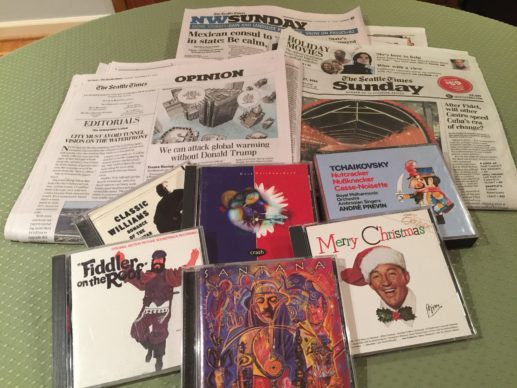
I’ve been listening to too much news lately, especially during the presidential campaign and its aftermath. It’s like a soap opera with real life consequences—hard to turn off. Like a box of See’s candy or a sack of bite-sized Snickers—bad for your health but oh, so tempting to overindulge in it.
My solution: listen to more music. I don’t mean to say that I’m opting out of the news. I still feel the need to know what’s going on in my country and the world. To be a knowledgeable citizen. To do my part.
But for a while I was going overboard. And so, in order to gain more balance in my life, I’ve decided to turn to music. Or at least I’m trying to make at least a partial transition from news to music. Old habits die hard.
One old habit of mine is listening to NPR while I drive. Sometimes I listen to music CDs when I’m in the car, or even to “the sound of silence.” Lately, though, NPR has had the lion’s share of my driving time. The mix CDs my daughter made for me deserve more attention. And really, there’s nothing wrong with a little silence now and then.
Another habit: watching or listening to the news while I’m cooking, eating or washing dishes. I haven’t always been such a news junkie. I suppose I fell into the habit after my husband died. The house had begun to seem too quiet, and the radio and TV helped fill up that sound space. This year, the outrageous presidential campaign and election overflowed into every nook and cranny.
My transition to music started a few weeks ago with the songs I have on iTunes. Those songs were getting a little stale, though, so I signed up with Pandora.
Here are some of the “stations” I’ve set up so far on Pandora:
Bruno Mars, Sam Smith, Smooth Jazz, Sara Bareilles, Santana, Fun., and Christmas Traditional, which I play when I’m wrapping gifts and addressing Christmas cards.
I still find it hard to tear myself away from the news–all those meaty, complex, outrageous things going on every day in my country and the world. When I listen to music, though, I smile more. I even find myself swinging my hips and twirling my way around the kitchen.
I feel happier. And that’s gotta be a good thing.
So … What do you fill your sound space with–news, music, talk, nothing at all? What type of music do you like?
November 20, 2016
Privacy Is a Moving Target.
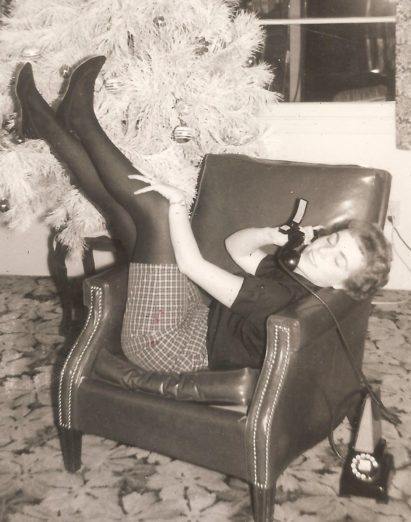
From public phone books to hummingbird drones.
For most of my life, my phone number and address could be found in the fat public phone book everyone received once a year. When I was a kid, we even had a “party line”—two short rings for our phone, one for the neighbors’. We didn’t listen in, but if we’d wanted to, nothing would have stopped us.
Before we had the internet, most of us didn’t worry about our privacy. Our lives were just naturally private enough. If we wanted to keep something to ourselves, we just kept our mouths shut.
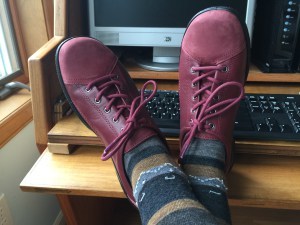 Even now, most of the intrusions are not too bad. I bought a pair of shoes online a couple months ago, and now I get emails from the company every few days. I could unsubscribe, but … you know … I like their shoes. Maybe I’ll buy a pair of boots for winter. Or some slippers. Mine are looking worn. I really don’t mind those ads from the shoemaker. In fact, I’m glad they keep track of me and alert me to their sales.
I might have a different opinion, though, if someone sent a drone disguised as a hummingbird over my patio. Sounds like science fiction, right? Nope. AeroVironment has already produced one. (For more fun facts about other frontiers in surveillance, take a look at Matthew Hutson’s article in The Atlantic, “Even Bugs Will Be Bugged.”)
Elena Ferrante’s Loss of Privacy
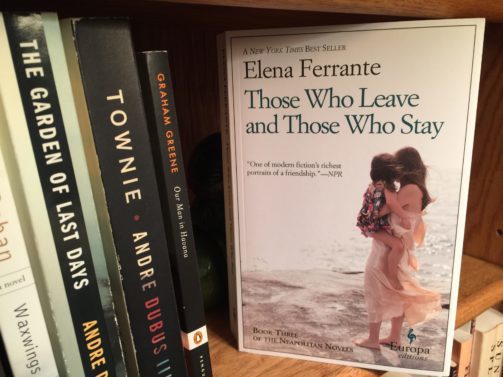
Last month the New York Review of Books published an article about an Italian author whose real name was made public against her will. Ever since, I’ve been thinking about the tightrope authors walk and the contradiction they live.
In my blog of October 16th, I wrote about one small aspect of the outing of the author known as Elena Ferrante. I was interested then in the problem of authors writing about people different from themselves. Most people, on the other hand, were concerned about the author’s loss of privacy. Why, they asked, shouldn’t she be allowed to hide behind her pseudonym if that was her desire?
Indeed. Why shouldn’t we all be able to choose what to keep private and what to make public?
We writers are a strange bunch. Many of us are introverts, at least to some extent. You may not notice it because we also like to spend time with friends and family. We may even enjoy crowds on occasion. But you can’t be a writer unless you have the ability to spend lots of time alone, thinking and writing, just you and your laptop or pen and paper.
It can be frightening for a writer to show words to the world that were written in private. And yet, if the writer doesn’t publish, all that work will have been in vain. It’s like cooking dinner only to find out that everyone has already eaten and all your work was a big waste of time.
I understand why Anita Raja, who now is assumed to be the real Elena Ferrante, would want to use a pseudonym. Many writers would like to do the same, if only we could.
Or could we?
* * *
Here are some quotes from Elena Ferrante from an article in The Guardian. They compiled the quotes from various sources before the events of last month.
“I don’t protect my private life. I protect my writing.”
“I’m still very interested in testifying against the self-promotion obsessively imposed by the media. This demand for self-promotion diminishes the actual work of art …”
“The fact that Jane Austen, in the course of her short life, published her books anonymously made a great impression on me as a girl of 15.”
“…what counts most for me is to preserve a creative space that seems full of possibilities, including technical ones. The structural absence of the author affects the writing in a way that I’d like to continue to explore.”
Do you have privacy concerns?

You may be interested in these related posts:
Elena Ferrante Isn’t Who I Thought She Was.
P.S.- Maybe I should be more concerned about my privacy. Even though my phone calls and emails are pretty innocuous, I suppose a way could be found to twist my words. If I learned anything from the campaign of the past few months, it is to choose my words carefully and beware of hackers.
November 13, 2016
“Loving,” the Movie, and the Crime of Interracial Love.
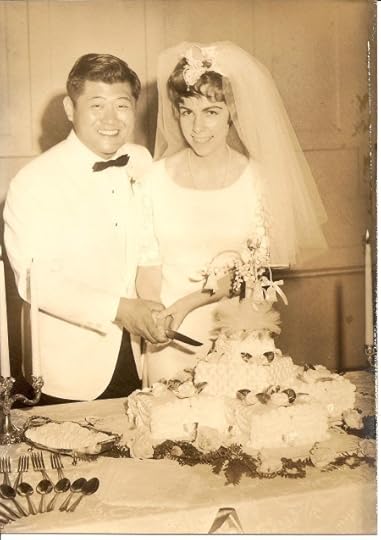
I had no idea.
In June of 1967, Eugene and I were putting the finishing touches on our wedding plans.
At the same time, the United States Supreme Court was preparing to release its decision in the case of Loving v Virginia, a case that would decide whether our marriage would be legal in Virginia and throughout the country.
What?
I understood that our marriage would be unusual, but it never crossed my mind that it might be illegal. And not just in the South. Six days before our wedding, interracial marriage was illegal in sixteen states. If, after getting married, we’d decided to move to Tennessee or Texas or any one of fourteen other states, we would have been criminals.
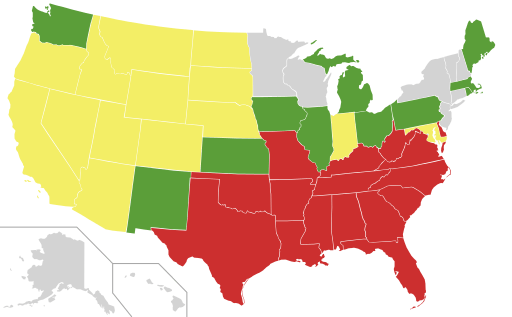 US states by date of repeal of anti-miscegenation laws:
gray: no anti-miscegenation laws passed
green: 1780 to 1887
yellow: 1948-1967
red: after 1967
Then, five days before our wedding, the Supreme Court made interracial marriage legal and anti-miscegenation laws unconstitutional. Their reason: The laws forbidding interracial marriage had been enacted for the purpose of perpetuating white supremacy. (The legal reasoning is more complex.)
 Eugene and I didn’t know it at the time, but by the date of our wedding on Jun 17, we were back on the right side of the law.
The Supreme Court decision wasn’t the end of it, though. Laws against interracial marriage remained on the books in sixteen states. In Alabama, local judges continued to enforce them until 1970, and they didn’t get around to striking them from their books until 2000 when a citizen’s initiative forced them to do it.
The story of Richard Loving’s and Mildred Jeter’s fight for interracial justice.
 It was just a coincidence (a happy coincidence) that one of the plaintiffs in the case of Loving v Virginia was named Loving, Richard Loving.
He and his wife, Mildred Jeter, went to separate segregated schools. But they’d been friends since he was 17 and she was 11. By the time Mildred was 18, they were ready to get married and raise a family. But Richard was a white man and she, a black woman. They couldn’t get married in Virginia.
So they left their home and drove to Washington, DC to be legally wed.
The trouble began five weeks later after they’d returned to Virginia. One night while they were sleeping, the county sheriff and two deputies broke into their bedroom, beamed flashlights into their eyes, and arrested and jailed them for unlawful co-habitation.
The judge sentenced them to a year in jail, but in a plea bargain he agreed to a suspended sentence if they would agree to leave the state and never return together for the next 25 years.
So they made a home for themselves in Washington, DC and raised three children there, taking separate trips back to Virginia to visit friends and family. They never could get used to city living, though.
In 1963, after five years in Washington, DC, Mildred wanted to move back home, and she contacted Attorney General, Robert F. Kennedy, who referred her to the ACLU. The case worked its way through the lower courts all the way up to the US Supreme Court. And on June 12, 1967, the case was decided in their favor by a unanimous verdict. Chief Justice Earl Warren wrote the opinion.
“Loving,” the movie.
The movie about their lives came out on November 4, but only in selected cities. I’m waiting for it to be more widely available. “Loving” is not the first movie to tell the story of the Lovings, but it promises to be the best. It received a standing ovation at Canne, and it’s already named as an Oscar contender.
Joel Edgerton plays Richard and Ruth Negga plays Mildred.
While you’re waiting for “Loving” to come to a theater near you, please enjoy this trailer:
https://www.youtube.com/watch?v=zRXuCY7tRgk
November 6, 2016
Whoops! I Missed UN Day.

my daughter, R, in her brocade Chinese suit being hugged by her nursery school teacher
United Nations Day was October 24. I’d forgotten all about it until I turn the page on my calendar. And there it was: UN Day. For many years–thirteen to be exact–it had been the biggest school celebration for my three daughters.
The first school they attended was the Makati International Nursery School.
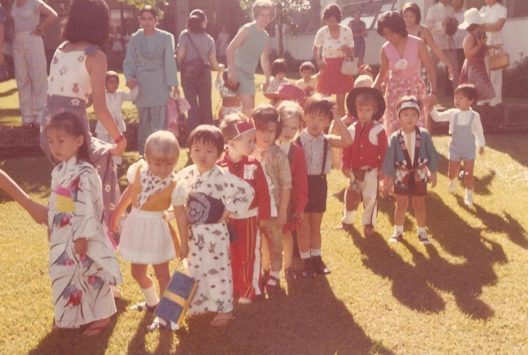
Then they moved on to the Manila International School. Most of their elementary and secondary school years were spent there.
The students at the International School came from every continent except Antarctica. No single national group made up more than about fifteen percent of the whole, so it was hard to find a holiday the school could celebrate.
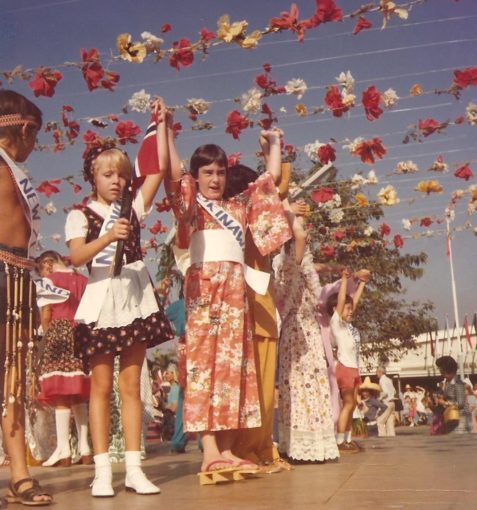
children representing New Zealand, Norway, and Okinawa
National holidays were out. For American children, that meant no Fourth of July, Memorial Day, Martin Luther King Day, Columbus Day, end-of-summer Labor Day, or even American Thanksgiving.
In a student body of varied religions, celebrating religious holidays didn’t make much sense either.
Since the school was located in the Philippines, a Christian (mainly Catholic) country, it didn’t need to celebrate Christmas and Easter. Reminders of them were everywhere … outside of the school.
Halloween can’t really be described as a national holiday or a true religious holiday. But however you want to describe it, it isn’t universally observed around the world. During our years in the Philippines, if a child had knocked on a door and shouted “trick-or-treat,” the homeowner would have greeted him not with candy but with a look of puzzlement.
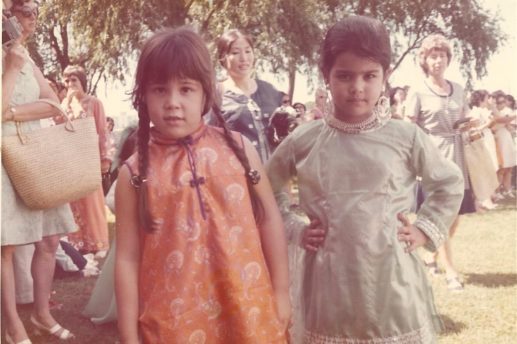
my daughter, C, in a Chinese-style dress with her Pakistani friend, N.
The only holiday remaining suitable for an international school to celebrate was United Nations Day.
At my daughters’ schools, the UN Day celebrations often lasted for a week. The older children participated in mock-UN sessions and learned national dances. The younger children brought their mothers in to share games, crafts, and traditional dishes from their respective countries.
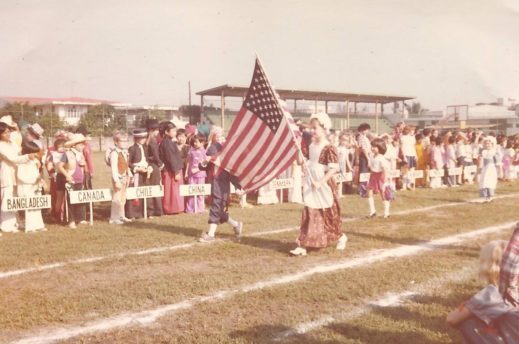
The culmination of the week-long festivities was the Parade of Nations.
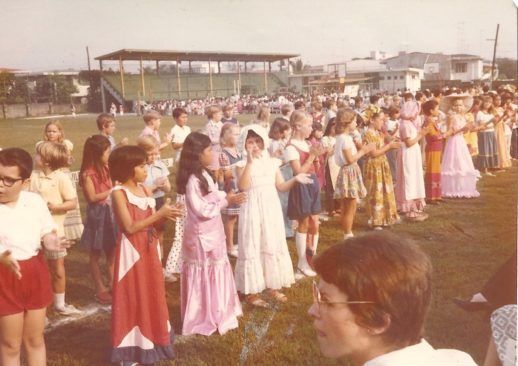
my daughter, C, in her pioneer bonnet.
October 30, 2016
The True Story of a Foreign Ghost in a Chinese Cemetery.
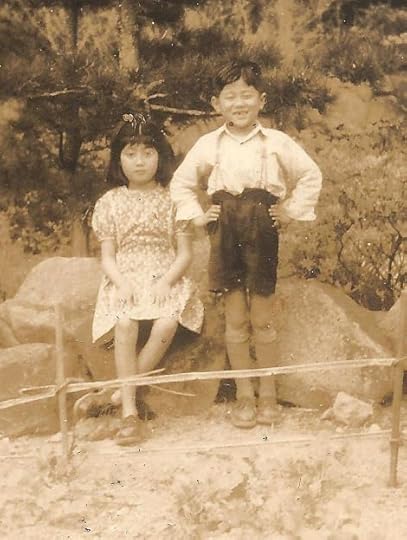
We’re fast approaching that time of year when souls and saints appear. A time for recalling and repeating tales of the unexplained. So come along, I invite you to revisit this true tale of a little boy who encounters a foreign ghost in a Chinese cemetery.
My late husband Eugene was a “ghost whisperer.” Or so some believe.
He saw his first ghost when he was still a child. It was wartime and he lived in a war zone—a place with more than its share of people who’d died before their time, more than its share of discontented, angry spirits.
Enemy troops occupied his island in those days. Still, little Eugene wandered the lanes, watching the flow of life, playing and talking to the shopkeepers. One afternoon, he found himself far from home as the sun was sinking into the sea, and he realized he’d never make it back before curfew unless he cut through the cemetery.
 As he sprinted down the lane, shopkeepers on either side were pulling their metal shades down for the night. The cemetery was all long shadows and pools of darkness. He heaved open the iron gate and darted inside. Then, skipping and dodging around the tombstones and newly dug graves, he raced into the spreading darkness.
That’s when he saw the ghost. She was floating over the graves, a tall, shining woman in a flowing white dress with the long nose and round eyes of a foreigner.
He froze for an instant. Then he ran as fast as he could, stumbling over grave markers, rocks, and uncut grass. He didn’t stop until he reached the gate on the other side of the cemetery. Looking over his shoulder, he saw her. She was close behind, floating between the trees, watching him.
“Stop following me,” he shouted.
She reached her hand toward him.
And he took off again.
When he told his mother and grandmother what he’d seen, his mother scolded him for staying out late. His grandmother put her arm around him and asked if he’d ever done anything to harm a foreign woman.
“No, Grandmother,” he said. “Never.”
“Then you needn’t worry. Next time you see a ghost, remind her you did her no harm during her lifetime, and she will leave you alone.”
It was useful advice since the white woman in the cemetery was not the last ghost Eugene was to encounter.
Happy Halloween.
Do you have a favorite ghost story or a tale of the unexplained?
October 23, 2016
Manila American Cemetery — Traveler on Foot
I’m re-blogging this post by Glenn Martinez because it reminds me of a day long ago. My mom was visiting us in the Philippines, and the American Cemetery was close to where we lived. I’d never been there before, but you know how it is, when visitors come to town, you take them to see the sights you would never see otherwise.
As Glenn reminds us in this post: The Manila American Cemetery is the largest resting place for American service men and women outside the United States. My mom and I were surprised at how big it was. It’s a beautiful cemetery, well cared for and dignified.
Another personal memory from that day was how well my youngest daughter, who had recently learned to walk, ran up and down the hills.
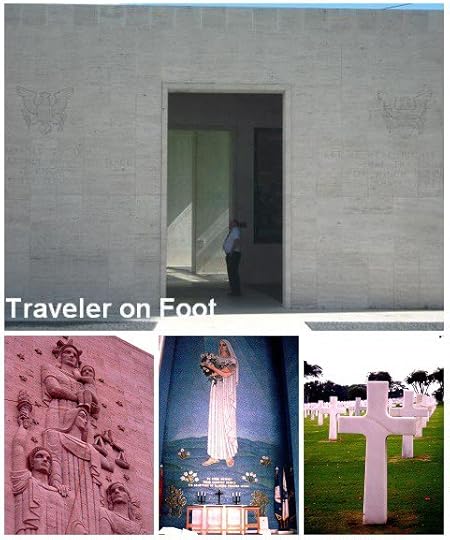
MCKINLEY ROAD. Serious, simple, and sprawling, this is the Manila American Cemetery and Memorial in Fort Bonifacio, Taguig City. Established a decade after World War II in what is known then as Fort McKinley, it is the largest resting place for American service men outside the United States. The best way to reach the cemetery […]
October 16, 2016
Elena Ferrante Isn’t Who I Thought She Was.
And I’m glad she’s not.
Elena Ferrante is the pseudonym for Italy’s most famous author. For twenty years her true identity has remained a carefully guarded secret.
Then, on October 2nd, the New York Review of Books published an article on its website by Claudio Gatti. Mr. Gatti claimed that he had discovered the woman behind the pen name. In the kind of investigation usually reserved for criminals or crooked politicians, he had combed through financial records and found all the evidence he needed.
Anita Raja, a Rome based translator was the real Elena Ferrante. Ms. Raja denies it, but his proof is pretty convincing.
So why, you may wonder, am I glad—not that she was outed—but that she probably isn’t who I thought she was?
Over the past year or so I’ve read the four books that compose her Neapolitan Quartet. The books follow the lives and friendship of two women from a poor neighborhood of Naples. The narrator, Elena Greco, takes us through more than fifty years of their lives.
If Mr. Gatti is right, the author of the Neapolitan Quartet was not a girl from a poor neighborhood in Naples. She was born in Naples, but she moved to Rome when she was three years old. And her father was not poor. He was a magistrate.
The four books are a testament to the power of the imagination. The author of the Neapolitan Quartet was able to imagine herself inside the skins of people who were different than she was. In my mind, that’s a good thing.
Not everyone agrees with me. These critics believe authors have no right to tell other people’s stories, especially if the people whose stories the author wants to tell are from a different socio-economic class or a different race.
The White Englishman, Chris Cleave, was criticized for presuming to write from the viewpoint of a Nigerian girl in his best-selling book, Little Bee. Another book, The Help, was made into a movie, but it was roundly criticized for the way the white author, Kathryn Stockett, portrayed its characters of color.
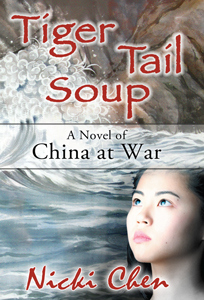
When I started my novel, Tiger Tail Soup, I knew how dangerous it was to write from the point of view of a Chinese woman. I didn’t start out with the intention of doing a high-wire act on my first novel. But I had a story to tell, and that was the only way I knew to tell it.
I know. Anita Raja (if she actually is Elena Ferrante) was the same race and nationality as the characters in the Neapolitan Quartet. But she did step out of her comfortable middle-class world to write about women who lived in poverty. And that leap, which fooled everyone, gives me confidence to continue to imagine the lives of people whose experience is different from my own.
The Neapolitan Quartet:
#2
#3 Those Who Leave and Those Who Stay
#4 The Story of the Lost Child